Blogs

Nearly 2,000 Fossils Discovered in Central Turkey

Saturday, August 3, 2019

Fossils excavated in Kirsehir province belong to elephants, primates, giraffes, horses, rhinos, cats, monkeys.

Nearly 2,000 animal fossils were discovered in Turkey's central Anatolian province of Kirsehir. 

Archaeological excavations began in 2011 in Kurutlu village of Kirsehir's Kaman district, with the goal of researching the natural history of 7 million years ago.

The fossils belonging to elephants, primates, giraffes, horses, rhinos, cats and monkeys, were found during digs on the side of the Hirfanli Dam Lake.

The excavations are supported by Turkey's Culture and Tourism Ministry, Ahi Evran University (AEU), Turkish Historical Society and are being continued as council of ministers excavation under Ahmet Cem Erkman, an academic from AEU.

"We are planning to exhibit the fossils at a museum in Kirsehir,” Erkman said. “We keep working. This is a long-lasting excavation," he said and added that the importance of the findings will shed light on the natural history of Anatolia.

New findings can make contributions to books in the archaeological field, as part of Paleontology, he said.

Source: www.aa.com.tr

LEGO Jurassic World Coming to Nintendo Switch

Friday, August 2, 2019

Nintendo Switch is finally getting the video game LEGO Jurassic World.

Back in 2015, LEGO Jurassic World was released to tie in with the return of the dinosaur franchise. The game will soon be available for the very first time on Nintendo Switch, which will support handheld mode and be playable on the new Nintendo Switch Lite.

The release date for the new edition of the game is September 20.

LEGO Jurassic World allows fans to play through the classic film Jurassic Park as well as The Lost Work: Jurassic Park, Jurassic Park III and Jurassic World. Playable characters include Owen Grady, Clare Dearing, Ian Malcolm, Alan Grant and Ellie Satler – but it is the many, many playable dinosaurs that make the title a unique entry in the LEGO video game series.

“We’re delighted to bring the exhilarating adventures in LEGO Jurassic World to a new generation of players on Nintendo Switch,” said Jonathan Smith, Head of Production and Strategic Director, TT Games. “The young and young-at-heart will love re-experiencing the magic of the movies told through a LEGO lens at home and on-the-go.”

In addition the main game, three DLC packs will be included with the Nintendo Switch edition:

Jurassic World DLC Pack: Gives players access to six new characters, two new vehicles, the JURASSIC Response Unit, the JURASSIC WORLD Shuttle, and more.

Jurassic Park Trilogy Pack #1: Grants access to three characters and one vehicle including, Dino Handler, Eric Kirby and Paul Kirby, and the Animal Control Vehicle.

Jurassic Park Trilogy Pack #2: Provides access to three characters and one vehicle including Jurassic Park Helicopter Pilot, Lex and Tim Murphy, and Dr. Ian Malcolm’s convertible.

LEGO Jurassic World is available on a variety of formats now. The Nintendo Switch version will be released on September 20.

Source: www.brickfanatics.com

What if Jurassic Park Never Had Another Movie?

Thursday, August 1, 2019

Believe it or not some people actually thought that this was what might happen, not the picture above, but that Jurassic Park might be a one and done kind of movie, no matter how great it was.

The technology that was introduced at the time was impressive and the story line, despite having a few holes here and there and not being in complete agreement with the book, was pretty good. Mike Singer of ScreenCrush makes a very good point as to why none of the sequels and certainly not the follow up, Jurassic World, are that good. In a big way they’re just designed to put butts in the seats and take advantage of the dinosaur craze that hit over two decades ago and cash in on the fact that people will buy just about anything. When you think about it, marketing execs were probably laughing all the way to the bank despite the fact that the two Jurassic Park sequels didn’t do nearly as good as their predecessor since people were STILL buying merchandise, movie tickets, and anything they could get their hands on. The craze that came from Jurassic Park was something that can’t be denied since it interested people in the pseudo-science that was taking place and got them wondering if such a thing could ever be real.

Well, no, not really. If you were paying attention at all in the movie then you noticed that, impressive as it was to find ‘dino DNA’ the movie admittedly had gaps in the sequence that had to be replaced. That’s almost like saying that the bunch of human cells that will become a baby have a few things missing in their genetic code that need to be implanted by a mad scientist hiding behind a charming face (sorry B.D. Wong). The dinosaurs created for Jurassic Park have been making researchers and scientists laugh hysterically for years now, but despite what they’ve said and the records they’ve tried to set straight it’s pretty obvious that people have preferred the imaginary, reconstructed dinosaurs over the real thing. Now to be honest a lot of what goes on when it comes to reconstructing what a dinosaur looked like does come from some artistic license taken on the part of the paleontologists as Brian Soash of Science Friday has said. But the idea of splicing in genes from different animals and finding a way to keep them from being rejected by the obviously limited and very specialized strands of DNA seems more like science than fiction. But the point of it all is that people bought it. They wanted to believe that a T-Rex looked like a lumbering death lizard the size of a building that could smash through anything without much effort, even at a dead run. They wanted to believe that velociraptors looked like sleek, scaled death machines with claws that could probably gut a rhino, and they had no trouble believing that these creatures would be content to be caged and held as exhibits for people to see.

Yeah, nature doesn’t quite work that way. If there was any truth to how aggressive some of these dinosaurs were back in their day the chance that they would do anything but try to attack or consume just about anything or anyone they came across for reasons of their own would be extremely great. Even the most docile of the dinosaurs has been written to have had an attack mode and more than one defense against predators, as evidenced by pictures and findings of many a scientist and paleontologist. Unfortunately the more sensationalist aspects of Jurassic Park were all that made it into the movie since the director knew that this is really all that people have the patience for when watching a movie. That’s smart from a marketing standpoint, but when dealing with the story content it would seem that things fell off the rails pretty quickly. One thing though among everything stands out as to why the sequels just didn’t measure up, and it’s because once you know an island filled with deadly creatures who are now on the loose exists, you might want to consider just staying away from it, or nuking it entirely. Of course by the second movie we came to learn that, surprise surprise, Hammond had a second island that he’d been doing research on. Seriously, the guy had enough money to buy two islands and conduct top-level biological research on both of them, you’d think there would be better ways to spend that kind of money. But once the first movie came out, the writers seemed to get lazy and went back to the same template again and again, finding new reasons why humans, insipid as we can be, might hang around a couple of islands where deadly creatures just happen to roam. And lo and behold, they thought Jurassic World, with new attractions and effects, wouldn’t be caught out for using the same basic template but with a new look.

To be honest, it kind of killed the mojo of the first one, even if it became successful. Again, it just proves that people will spend money on anything that’s new, shiny, and exciting.

Source: www.tvovermind.com

10 Scariest Moments From The Jurassic Park Franchise

Monday, August 5, 2019

The original Jurassic Park was adapted from a novel that has a surprising amount of horror in it. Author Michael Crichton studied extensively to practice medicine, and it showed. The source material is full of disturbingly graphic detail. And its 1993 adaptation, though friendly towards younger audiences, was unafraid to display genuine frights. Even though Jurassic Park: The Lost World transformed the DNA of the series, those traces of horror sometimes remained.

RELATED: Jurassic Park: 10 Ian Malcolm Quotes That Show How Woke He Is

Every time the franchise reached into its inherent nature, it was most effective. So, let’s have a look back at the scariest scenes from the series. And, naturally, spoiler warning!


10 SPINOSAURUS ATTACKS THE BOAT

There’s not much to say about Jurassic Park III that hasn’t already been complained about. It was a nightmarish production from inception, and the results show. A skeleton that looks like a Halloween toy falls on Tea Leoni. Billy survives the Pteranodon attack, for literally no reason whatsoever. And even the selected scene, in which Spinosaurus attacks a vulnerable boat, is sabotaged.

RELATED: Jurassic Park: 10 Differences Between The Book & The Movie

The filmmakers decided to cut between a legitimately suspenseful scene (possibly the only one in the movie) and Barney & Friends. The scene is dark and rainy, like the first two films. It also found a way to put the characters in a claustrophobic setting. The annoying signature ringtone helps the suspense, this time. It’s pretty frightening, and could actually be really effective if not for the low-hanging pun.

GASOLINE FOR THE INDOMINUS

This is the only scene in Jurassic World that doesn’t feel like a playful, splashy summer blockbuster. The majority of the film plays its cards face-up from the beginning. For all of its fan service, the film doesn’t want much to do with the tone of the original movie. However, after the “Indominus Rex” breaks out, there’s a striking scene that’s pretty tense. It’s the only suspenseful scene that doesn’t feel flashy, or end with some sort of joke. Owen and a fleeing park employee take cover from the Indominus.

RELATED: Everything We Know About The Original Jurassic Park 4 Script

It promptly chomps down the latter, and Owen cleverly douses himself with gasoline to remain hidden. The Indominus is hidden from plain view, with only its bloody teeth in sight, until it saunters off. The employee’s death is uniquely ruthless, and blunt.

WHEATLEY’S DEATH

Jurassic Park: Fallen Kingdom went in the opposite direction of the 2015 sequel. Instead of being a thoroughly lighthearted romp, it reduced big set pieces and jokes to a minimum. Neither film struck the balance between those tones, which strongly made the original entry so iconic. However, Fallen Kingdom didn’t feel compelled to end every scene with a punchline. So, its horror has more impact, and the director has a knack for tension.

Many of the scariest scenes in any horror movie are drawn out, allowing you to become more immersed. Wheatley’s warranted death is pretty startling. The “Indoraptor” literally tears his arm off, and swallows. Although there’s no blood, it’s a pretty shocking visual for a PG-13 movie. It’s a slow, painful death. And it’s actually followed by an effective elevator scene, wrapped in darkness and full of strobing lights. However, this scene ranks lower on the list because the villains "deserved" their deaths. This made it more satisfying than frightening.

SHOOT HER!

Jurassic Park is one of the most structurally sound stories ever put to film. Steven Spielberg smartly decided to satiate audiences’ craving for dinosaurs right at the onset. In fact, the opening of the film is also a swift embodiment of everything the film has to say. A caged raptor nearly breaks free, despite all precautions, and kills someone. Much like Bruce from Jaws, the predators in this film are deliberately kept in the shadows for a while.

RELATED: Jurassic Park: 10 Facts Fans Didn’t Know About Isla Nublar

The imprisoned raptor belts out intimidating screeches, which have since become iconic. The flashes of electrifying prods contrast with the dead of night. And the park employee that ends up in the raptor’s clutches has a drawn out death, with screams of agony. Some extreme close-ups emphasize the eyes of everyone involved—including the animal’s. It’s entertaining, to be sure, but it’s also certainly pretty scary. Especially when the victim’s body is dragged up and down against the cage, until his fingers slip free of Muldoon.

THE LONG GRASS

It isn’t surprising that Spielberg delivered the scariest sequences of the entire series, even in such a flamboyant sequel. The man directed Jaws, after all. In Jurassic Park: The Lost World, Spielberg wanted to make his own King Kongmovie. There’s far more adventure, dinosaurs per minute, and so forth. However, Spielberg’s eye for kinetic imagery remains. Sidhu’s iconic warning to avoid the long grass is hopeless, falling on desperate ears. Velociraptors bend the grass as they pursue the oblivious fleeing men.

This is a truly innovative tool of suspense. And when the raptors attack, the men appear to drown into the grass. The attacking predators pounce, one after another, in the darkness. The night is full of screams from both parties, a truly nightmarish scenario.

EDDIE’S TORN APART

This is probably the darkest the franchise was ever willing to go. After an extended action set piece, Eddie’s death is surprisingly gruesome. First one Tyrannosaurus Rex, then another, descend upon him as he attempts to rescue the core protagonists. Eddie’s trapped in his vehicle, as both of the giant predators proceed to tear it apart. Eventually, they lift Eddie into the air, and literally rip his body in half.

The scene pulls no punches and it shows everything, although there’s no blood. In fact, one of the animals tosses their half in the air for a better bite, momentarily. It’s a truly graphic scene, for such a courageous and likable character. The tragedy makes it all the more frightening. So, everyone who complained about Zara clearly forgot how viciously this series killed off a legitimate hero.

CLEVER GIRL

This was our first brush with a Velociraptor in full view. The opening of Jurassic Park hints at their enormous strength, nearly breaking free. It remains mostly a silhouette. Later on, this is reinforced by the shredded feeding metal. And the exposition about their intelligence makes them uniquely intimidating. It’s also what gets Muldoon killed. He believes he’s gotten the better of a Velociraptor, when in fact, it was only bait. He utters the famous line, “clever girl,” impressed. And then, we are subjected to an up-close and personal death scene, complete with some form of shaky cam.

RELATED: 10 Things Jurassic Park Gets Completely Wrong About Dinosaurs

The attack itself feels absolutely ferocious, and we know that Ellie’s life depended on Muldoon’s abilities. Moreover, Spielberg was careful enough to draw out the suspense beforehand. Muldoon spends a long time carefully preparing his weapon, before he’s eaten.

RAPTORS CHASE ELLIE

This is a supremely effective piece of horror. Right at the beginning, there’s a superb jump scare, the likes of which few actual horror films can muster. As soon as the lights come back on, Ellie Sattler is relieved—until Arnold’s death is revealed. The bloody stump of his arm falls all over her, which is the most graphic Jurassic Park ever gets. Even Gennaro’s death doesn’t feel graphic, because he abandoned the kids and is sitting on a toilet.

After a raptor bangs into the metal behind Ellie, the chase scene that ensues is artfully crafted. A thin chain fence rescues Ellie just in time, before she limps off, dragging metal. The established speed and intelligence of these creatures, combined with Muldoon’s death, ramp up the tension. The mechanical setting, dim lights, and injured protagonist keep up the horror throughout.

REXY PURSUES THE KIDS

This is arguably one of the most iconic scenes in film history. The Tyrannosaurus breakout is a surprisingly lengthy scene. There are a number of shifting elements that transform the scene enough to keep the suspense at maximum from beginning to end. It’s genius cinema, wielding Hitchcockian suspense. First, Spielberg allows the audience certain clues to establish that something large has arrived. Ripples in the glass of water; then, the bloody goat limb. Gennaro abandons the kids, who eventually come face to face with the Tyrannosaurus because of their naivité.

The animal roars constantly, and does its absolute best to tear the kids’ vehicle apart. Dark, and rainy, the only thing between the two kids and the giant predator is a pane of glass. Rexy embodies the force of nature itself. Ian Malcolm is trampled, Gennaro is eaten, Grant and Lex hang off a cliff—it’s chaos. And it’s some of the most frightening images you can give younger audiences. The only way it’s easily digestible is if they’re already a fan of the dinosaurs themselves.

RAPTORS IN THE KITCHEN

The only thing more terrifying than sheer massive force, is lethal cunning. The better an animal can outwit us, the more disconcerting it is. The two children, Lex and Tim, are temporarily left alone with some tasty desserts. Then, the raptors subsequently hope to have them for dinner. The kids are herded into the kitchen, fleeing the keen dinosaurs. They proceed to have a battle of wits. The children prove remarkably resourceful as they outmaneuver the hungry raptors. The camera settles in on their horrifying claws now and then. Every sound is crucial, every movement spells death.

And eventually, the kids actually confront the animals. They manage to lock one in a freezer, and wildly flee. It’s incredible how much effective silence there is throughout the scene, and the near-misses are perfectly gut-wrenching.

Source: https://screenrant.com

U of A Study Links Dinosaur Sex Appeal to Evolution of Flying Creatures

Thursday, August 1, 2019

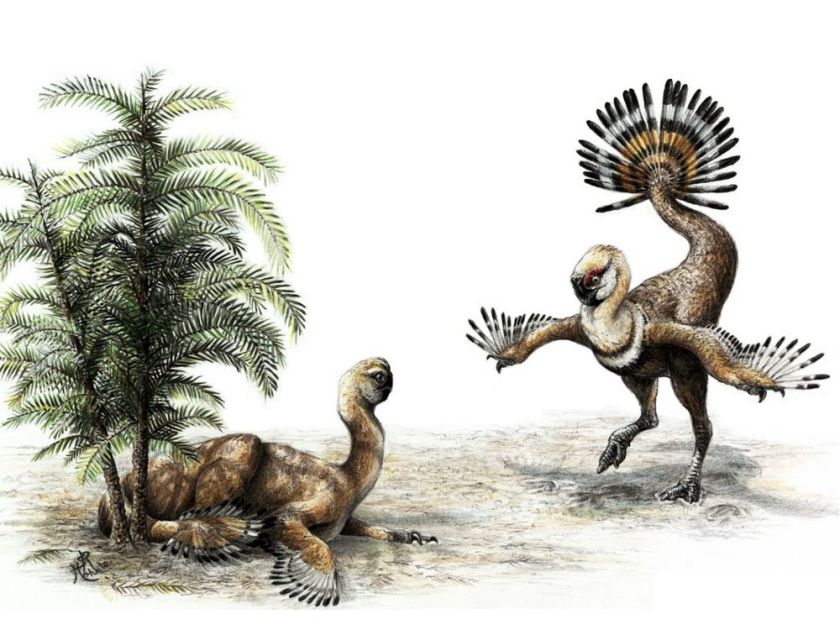
The feathered but flightless dinosaur Khaan. A male struts his stuff and fans his plumage for a watching female. Sydney Mohr/Supplied EDMONTON

A new study by a former University of Alberta postdoctoral researcher sheds light on how dinosaurs’ feathers evolved from simple insulators into a flight-enabling feature.

The evolution took a complex path, with the formation of feathers that existed mainly for sex appeal acting as a vital stepping stone towards the dinosaurs that were no longer bound to the ground, according to the study.

“There are three identifiable feather functions that we see spread out through the evolution of feather dinosaurs,” said Scott Persons, now the curator of the Mace Brown Museum in South Carolina’s College of Charleston, as well as a professor at the school. Before taking on that role, Persons completed his masters, PhD and postdoc studies at the U of A.

The first feathers had the role of insulating dinosaurs by containing their body heat, while the final type of feathers is the most fully developed, and the closest to those found on birds today. These let dinos glide or parachute through the air, the precursor to the evolution of flying birds.

The variety that bridged these two types feathers served the same purpose as the flashy feathers of peacocks or the antlers of deer — attracting mates.

“They were used as sexual display structures. They would be flaunted and waggled about in courtship rituals,” Persons said. “Our study is looking at how this role of sexual selection was a very important intermediate function in order to ultimately bring dinosaurs the feathers that were complex enough and broad enough in range and fan that they could be used for gliding and then ultimately for flying.”

Throughout the study, Persons analyzed troves of fossils, many of which required travelling to China. It was a study that encompassed much of his time as a postdoctoral student at the U of A.

Persons stressed that evolutionary processes like this don’t happen linearly.

“Evolution tends to work in a bushy, branching fashions. There were many splits of the feathered dinosaur family tree that led to animals experimenting with feather forms that were ultimately dead-ends,” he said.

While feathers often aren’t a prominent feature of dinosaurs in pop-culture portrayals, like the raptors of Jurassic Park, many dinosaurs had a full coat of feathers.

“Those velociraptors ought to be covered in feathers,” Persons said of the film, adding that many larger, warmer-climate dinosaurs did look more like their traditional scaly portrayal.

Source: https://edmontonjournal.com

Bone Wars: The Marsh-Cope Feud and Its Dinosaur Discoveries

Wednesday, July 31, 2019

The Bone Wars

The feud between the two men produced some of the most spectacular dinosaur discoveries of all time.

As rivalries go, there's Coke versus Pepsi, Ford versus GM, Thomas Edison versus Nikola Tesla, Bill Gates versus Steve Jobs, and Nike versus Reebok, but for sheer animosity, nothing approaches the feud between the two principals of "Bone Wars" — Othniel Charles Marsh and Edward Drinker Cope.

Bone Wars was a period of intense fossil hunting and discovery during the years 1877 and 1982. Marsh and Cope started out at opposite ends of the spectrum. Cope was born in 1840 to a wealthy and influential Quaker family in Philadelphia and went on to become a professor of zoology at Haverford College in Pennsylvania.

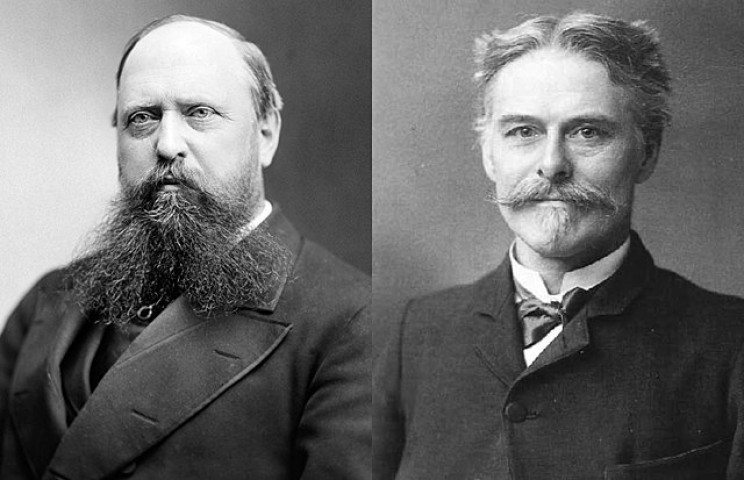
Othniel Marsh and Edward Cope. Source: Matthew Brady/Frederick Gutekunst/Wikimedia Commons

Marsh was born in 1831 in Lockport, New York and grew up poor, but he had the proverbial rich uncle — philanthropist George Peabody.

After receiving degrees from Yale University, Marsh persuaded Peabody to build the Peabody Museum of Natural History at Yale, and Peabody appointed Marsh as its first head. When Peabody died in 1869, Marsh was suddenly a rich man.

A Bitter Rivalry Begins

The two men initially cooperated on a fossil-hunting expedition in New Jersey where Hadrosaurus foulkii, one of the first American dinosaurs had been found. In what would set the tone for the rest of their relations, Marsh secretly bribed the pit operators to divert future fossil finds to him rather than Cope.

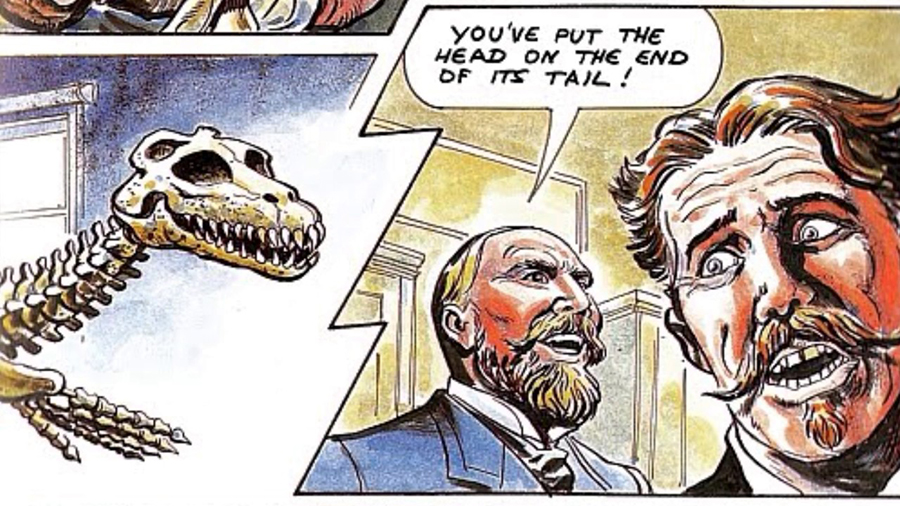
When Cope reconstructed a plesiosaur Elasmosaurus, putting the head where the tail should have been, Marsh pounced in the press. Cope retaliated by moving his attention to Marsh's fossil hunting grounds in the western U.S., in the states of Kansas and Wyoming.

Marsh's 1872 expedition. Source: John Ostrom/Peabody Museum/Wikimedia Commons

In June 1872, Cope set off on a trip to the West as part of the U.S. Geological Survey. Heading to Fort Bridger, Wyoming, Cope discovered dozens of new species. After 1872, Marsh preferred to remain back East and send students and others to do his prospecting.

Three Letters

In 1877, Marsh received a letter and a shipment of bones from a school teacher in Golden, Colorado who reported finding massive bones near the town of Morrison, Colorado. When Marsh was slow to respond, the teacher also sent bones to Cope.

Then, Cope received a letter and a shipment of bones from a naturalist in Cañon City, Colorado. They turned out to be the bones of huge herbivores (plant-eating dinosaurs). Hearing of the discovery, Marsh quickly dispatched surrogates to Cañon City.

Then, a third letter arrived at Yale from two railroad workers. The men, William Harlow Reed, and William Edwards Carlin were working on the First Transcontinental Railroad through a remote area of Wyoming.

They had found large numbers of bones in the area of Como Bluff, Wyoming. Marsh sent his men, but men from Cope were also scoping out the area. Marsh advised Reed and Carlin to keep Cope out of the area.

The fossils Reed and Carlin sent in 1877 were named by Marsh and became some of the most famous dinosaurs ever found — StegosaurusAllosaurusand Apatosaurus.

News of the finds appeared in the Laramie Daily Sentinel in April 1878, and by the winter of 1878, Carlin had become disenchanted with Marsh and began working for Cope.

Stegosaurus. Source: Othniel Charles Marsh/Wikimedia Commons

Between 1877 and 1892, tons of fossils were being sent back East, but the rivalry between Marsh and Cope remained, with Reed and Carlin now on opposing sides. The discoveries of Marsh and Cope were accompanied by sensational accusations of spying, stealing each other's workers and fossils, and bribery.

A Rivalry Even in Death

In the early 1890s, Cope was elected President of the American Association for the Advancement of Science, and that same year, Marsh stepped down as head of the National Academy of Sciences. By 1897 when Cope died, their rivalry had financially ruined both him and Marsh, but it continued even in death.

Before he died, Cope issued a challenge to Marsh: Cope donated his skull to science so that his brain could be measured, hoping that it would be larger than that of Marsh. At that time, brain size was considered a measure of intelligence. While Marsh never accepted the challenge, Cope's skull is still preserved at the University of Pennsylvania.

ScottRobertAnselmo/Wikimedia Commons

Who Won Bone Wars?

So, who won Bone Wars? Cope discovered 56 new dinosaur species, while Marsh discovered 80 new species. Together, they discovered TriceratopsAllosaurusDiplodocusStegosaurusCamarasaurus, and Coelophysis.

Marsh is one of the first scientists to suggest that birds are descended from dinosaurs, and Bone Wars led to a rise in the popularity of dinosaurs with the public. Paleontologist Robert Bakker has said, "The dinosaurs that came from [Como Bluff] not only filled museums, they filled magazine articles, textbooks, they filled people's minds."

Source: https://interestingengineering.com

Colossal Dinosaur Bone Find in France Thrills Scientists

Tuesday, July 30, 2019

Scientists say the femur might have belonged to a gigantic sauropod

Scientists have unearthed a huge two-metre (6.5-foot) dinosaur bone in a winegrowing village in southwestern France dubbed a "national treasure" for its prehistoric gems.

The 140-million-year-old thigh bone, which weighs 400 kilogrammes (880 pounds), is the latest discovery at the vast Angeac-Charente palaeontological site near Bordeaux, where experts and volunteers have dug up thousands of bones over the past decade.

But thanks to its remarkably good condition, the femur—which scientists say probably belonged to a gigantic sauropod—could help piece together an incomplete set of bones which the latest find resembles.

"We were wondering how big it was. We kept saying, 'Oh, there's more!'" said Maxime Lasseron, the doctoral student who made the gigantic discovery.

The largest land animals ever to roam the Earth, sauropods were massive plant-eating dinosaurs with a long neck and tail, towering up to 18 metres (59 feet) tall.

"It cost me a bit of money, because I had promised to bring champagne if it was complete," said Jean-Francois Tournepiche, the operations coordinator at what he calls "one of Europe's biggest dinosaur sites".

Tests will now compare the femur to another thigh bone discovered in 2010 to find out if they belonged to the same type of sauropod or even the same creature.

"We kept saying, 'Oh, there's more'!" said Maxime Lasseron, a doctoral student who made the discovery

The bone's "preservation and perfect fossilisation makes it really unique", said Ronan Allain, a paleontologist at the French Museum of Natural History in Paris.

Prehistoric ecosystem

Now known for its cognac vineyards, Angeac-Charente was home to a vast ecosystem of dinosaurs, invertebrates and vegetation thanks to its humid, subtropical climate millions of years ago.

"There was a river and large coniferous trees," Allain said.

Angeac-Charente was once home to a vast ecosystem of dinosaurs, invertebrates and vegetation

"Amphibians, crocodiles and fish lived in the swamp, and on dry land, small and large dinosaurs. It was full of life".

The discovery coincides with the 10th annual dig at the site, which stretches over 750 square metres (nearly 8,100 square feet).

But with more discoveries expected on the horizon, the site's owners have given diggers the go-ahead to excavate in another 4,000 square metres of land.

"Another surprise for our 10-year anniversary," Tournepiche said. "At this rate, we'll be busy for the next 30 years!"

Tests will compare the femur to another thigh bone discovered in 2010

Source: https://phys.org

Cambroraster falcatus: This Newfound Predator May Have Terrorized the Cambrian Seafloor

Wednesday, July 31, 2019

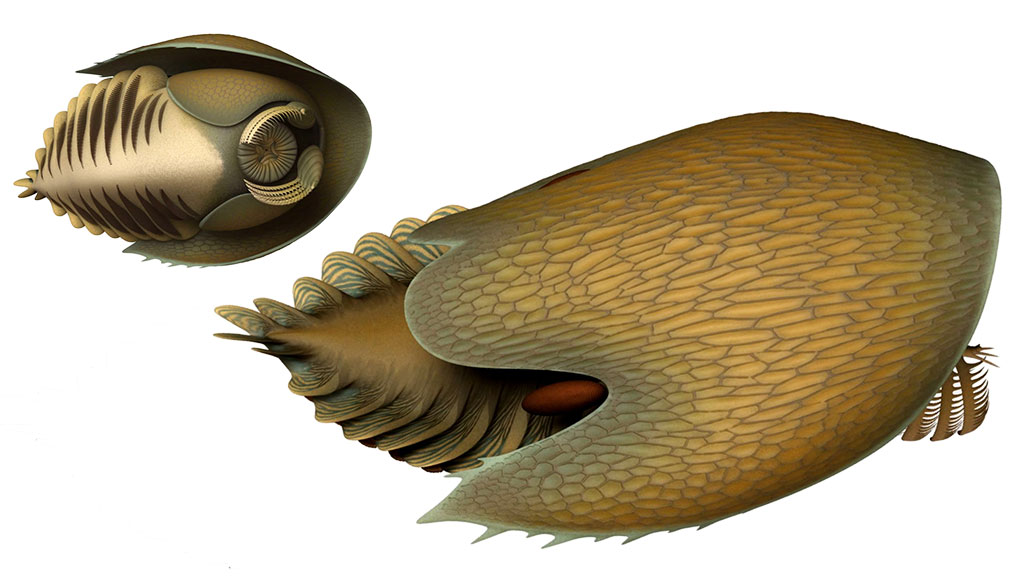
BOTTOM FEEDER  With a spaceship-shaped carapace, rakelike claws and a round tooth-filled mouth, Cambroraster falcatus (shown in an artist’s rendition) hunted for food along the seafloor.

With rakelike claws and a toothy mouth, it could snag prey even under the sand.

A fierce predator, with spiny claws and a round, rasping mouth, terrorized the Cambrian seafloor 508 million years ago as it raked through the sand in search of food.

Dubbed Cambroraster falcatus, the predator was about 30 centimeters long — which, to the tiny prey of the time, likely seemed monstrous enough. But C. falcatus also had a pair of jointed limbs that ended in rakelike claws, a round mouth lined with sharp, serrated plates and a broad, shield-shaped carapace that covered its head and most of its back, giving it a distinct resemblance to a horseshoe crab, or perhaps a spaceship.

Researchers, who describe C. falcatus for the first time July 31 in the Proceedings of the Royal Society B, have now found hundreds of fossils of the ancient arthropod — including one showing the critter’s entire body, both front and back — in Canada’s Burgess Shale (SN: 4/27/19, p. 32).

The creature’s round, tooth-filled mouth “is a type of mouth that doesn’t exist anymore,” and is characteristic of an extinct group of arthropods called radiodonts, says Jean-Bernard Caron, a paleontologist at the Royal Ontario Museum in Toronto. Radiodonts, in general, are rare in the fossil record, Caron says.

Fierce fossil

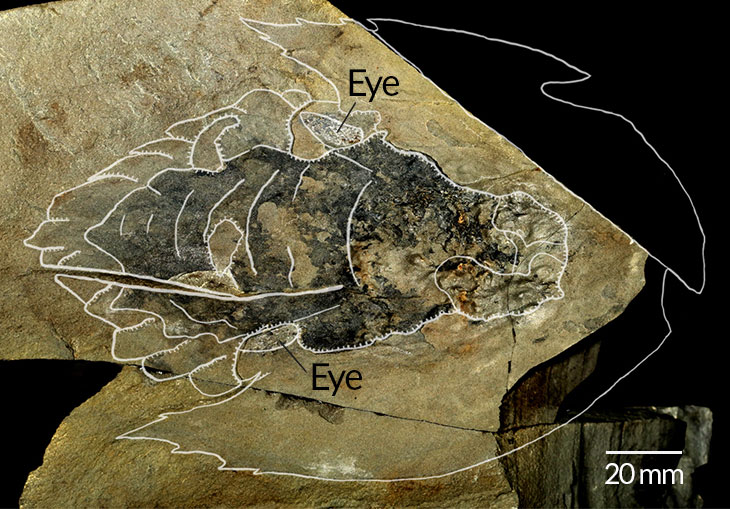
This slab shows the stomach side of the most complete C. falcatus fossil, including its two eyes. The outline of the backside of the creature, which is preserved on a counterpart slab, is traced here in white. 

JEAN-BERNARD CARON © ROYAL ONTARIO MUSEUM

So it was all the more remarkable to find so many specimens of C. falcatus in one location, where the animals may have gathered thanks to abundant food. A mass molting event may also have occurred at the site, the researchers speculate, which would help explain the clusters of appendages and carapaces.

The team spotted what turned out to be the first specimen of C. falcatus in 2012. “But we didn’t know what we were looking at” because the specimens were mostly just bits and pieces, Caron says. Then, in 2016, Caron and paleontologist Joseph Moysiuk of the University of Toronto found the key to the puzzle: a nearly complete fossil of the creature.

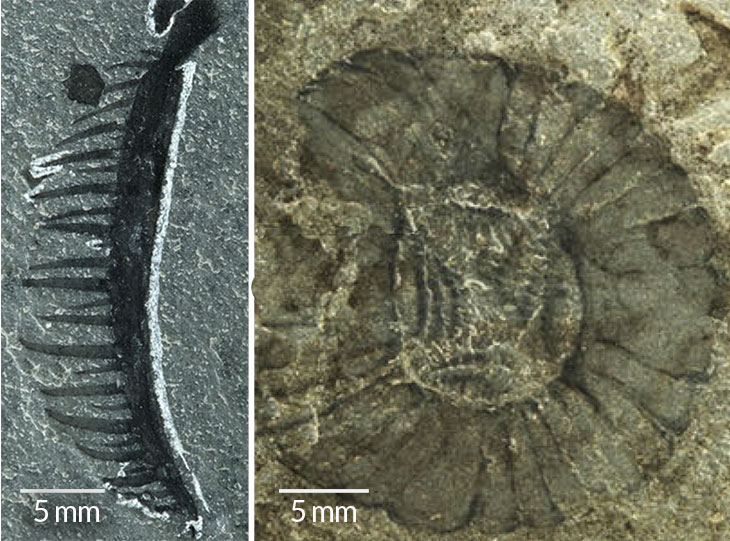
CLAWS AND JAWS C. falcatus had closely packed spines along the back of its appendages (left), which it may have used to dig through seafloor sediment to trap prey. Its round mouth was lined with serrated plates (right).

Cambroraster refers both to the Cambrian Period when this critter reigned and to the rakelike shape of its front claws, and falcatus to the sickle shape of the carapace. C. falcatus may have used its long, spiky claws to rake through the sand and form a kind of basket in which it trapped animals such as worms, small arthropods and even small fish. It may also have plowed through sediment with its spaceship-shaped head.

“What’s striking about this animal is that it opens a new window into predation during the Cambrian,” Caron says. Previous fossil finds sketched a relatively simple ecosystem structure, he says: Shrimplike predator Anomalocaris was at the top, and some smaller specialized arthropods like trilobites scuttled along the seafloor.

But C. falcatus was something else, he says: a remarkable and fierce predator that occupied its own niche, with adaptations “that really allowed it to feed on anything living in the mud."

Citations

J. Moysiuk and J.-B. Caron. A new hurdiid radiodont from the Burgess Shale evinces the exploitation of Cambrian infaunal food sourcesProceedings of the Royal Society B. Published online July 31, 2019. doi: 10.1098/rspb.2019.1079.

Further Reading

C. Gramling. See beautiful fossils from top Cambrian sites around the worldScience News. Vol. 195, April 27, 2019, p. 32.

C. Gramling. Newfound fossils in China highlight a dizzying diversity of Cambrian life. Science News Online, March 21, 2019.

C. Martin. Ancient oddball invertebrate finds its place on the tree of life. Science News Online, January 11, 2017.

A. Yeager. Fossil worm adds head to its spiny appearanceScience News. Vol. 188, August 8, 2015, p. 5. 

T.S. Feldhausen. Ancient brain fossils hint at body evolution of creepy-crawlies. Science News Online, May 12, 2015. 

A. Witze. Fossil fangs not so fierceScience News. Vol. 178, November 20, 2010, p. 13.

R. Monastersky. The first monstersScience News. Vol. 146, August 27, 1994, p. 138.

Source: www.sciencenews.org

Jurassic Park Logo Origin & History Explained

Tuesday, July 30, 2019

The red and yellow Jurassic Park emblem is one of the most iconic logos in movie history. The logo was based on the design featured on Michael Crichton's 1990 novel that inspired the movie. Here's the origin story behind that Jurassic Park logo.

The movie adaptation of Jurassic Park from director Steven Spielberg was released in 1993 and went on to become the highest-grossing film of all-time (until Titanic released four years later). The film's popularity was responsible for spawning two sequels and a revitalized Jurassic World trilogy, making it one of the most successful franchises in history. But before all that, there was the striking poster.

RELATED: Why Jurassic Park's Dinosaurs Don't Have Feathers

Per TIFF, before Crichton's Jurassic Park novel hit bookshelves, publisher Alfred A. Knopf had the difficult task of developing a proper book jacket. Crichton and Knopf agreed that they didn't want a flesh-and-blood dinosaur on the cover. After many failed designs, Knopf hired designer Chip Kidd to create the book jacket. Kidd turned his sights to a dinosaur skeleton, something the rest of the team was skeptical about. He got his inspiration from a Tyrannosaurus Rex illustration in the American Museum of Natural History gift shop. From there, the image for the Jurassic Park cover was born.

The film rights for Jurassic Park were being discussed before the novel was even published. Crichton chose Universal Pictures and Amblin Entertainment to adapt his book. During the early stages of development, Spielberg had a clear vision of the film's marketing. He didn't want any real dinosaurs used on logos or promotional material. Additionally, Jurassic Park would be featuring a lot of on-screen branding so he needed a logo that could be used throughout the movie and on real-world merchandise.

Universal Pictures Marketing Executive Tom Martin put together a team to come up with the official park logo. Over 100 designs were created but not one of the options felt like the right fit. The art team then created an image inspired by Kidd's skeleton image. A small jungle scene was added to the bottom to showcase the size of the T. Rex. While they needed to acquire the rights from Kidd, that proved a non-issue as the illustrator was appreciative that they wanted to use his work.

Martin and designer John Alvin were working on the Jurassic Park movie poster when the logo was still being designed. Alvin came up with a number of designs including dinosaur footprints, fossils, and a close up of a dinosaur's eye. Spielberg then decided that the Kidd-inspired logo design would be featured on the poster as the sole image. The only element that was added was the tagline: "An Adventure 65 Million Years In The Making.”

Jurrasic Park's initial book cover design remained the inspiration behind the logos used for the sequels in the franchise. Each movie would make changes to the emblem (such as replacing the T. Rex with a Spinosaurus for the third movie) but it retained a similar aesthetic. Jurassic World brought back the T. Rex design but used a different color scheme with a silver design on a blue background. Jurassic World 3 is expected to follow in line with an iteration of the iconic logo.

Source: https://screenrant.com

Rhinoceros Fossil Preserved in Pillow Basalt

Monday, July 29, 2019

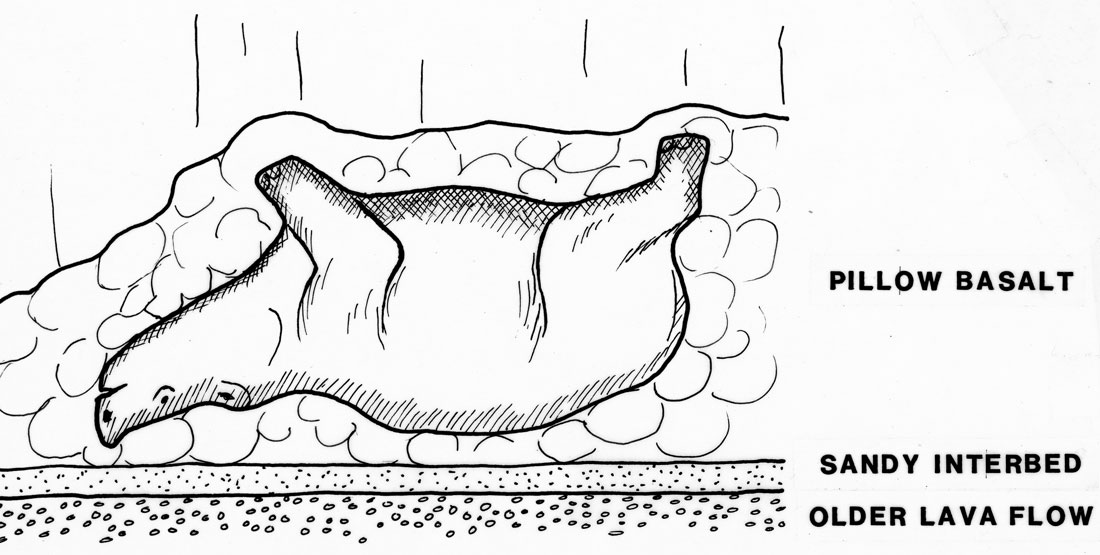
A sketch of the rino buried upside down within the pillow bassalt

The Miocene pillow basalts from the Lake Roosevelt National Recreation Area of central Washington hold an unlikely fossil mold of a small rhinoceros, preserved by sheer chance as it's bloated carcass sunk to the bottom of a shallow pool or lake just prior to a volcanic explosion. We've known about this gem for a long while now. The fossil was discovered by hikers back in 1935 and later cast by University of California paleontologists in 1948. These were the Dirty Thirties and those living in Washington state were experiencing the Great Depression along with the rest of the country and the world. Franklin D. Roosevelt was President of the United States, navigating the States away from laissez-faire economics. Charmingly, Roosevelt would have his good name honored by this same park in April of 1946, a few years before researchers at Berkeley would rekindle interest in the site. 

Both hiking and fossil collecting were a fine answer to these hard economic times and came with all the delights of discovery with no cost for the natural entertainment. And so it was that two fossil enthusiast couples were out looking for petrified wood just south of Dry Falls on Blue Lake in Washington state. While searching the pillow basalt, the Frieles and Peabodys came across a large hole high up in a cave that had the distinctive shape of an upside down rhino.   

This fossil is interesting in all sorts of ways. First, we so rarely see fossils in igneous rocks. As you might suspect, both magma and lava are very hot. Magma, or molten rock, glows a bright red/orange as it simmers at a toasty 700 °C to 1300 °C (or 1300 °F to 2400 °F) in hot chambers beneath the Earth's surface. As the magma pushes up to the surface becoming lava, it cools to a nice deep black. In the case of our rhino friend, this is how this unlikely fellow became a fossil. Instead of vaporizing his remains, the lava cooled relatively quickly preserving his outline as a trace fossil and remarkably, a few of his teeth, jaw and bones. The lava was eventually buried then waters from the Spokane Floods eroded enough of the overburden to reveal the remains once more.

Diceratherium (Marsh, 1875) is known from over a hundred paleontological occurences from eighty-seven collections. While there are likely many more, we've found fossil remains of Diceratherium, an extinct genus of rhinoceros, in the Miocene of Canada in Saskatchewan, China, France, Portugal, Switzerland, and multiple sites in the United States. He's also been found in the Oligocene of Canada in Saskatchewan, and twenty-five localities in the US, specifically in Arizona, Colorado, Florida, Nebraska, North Dakota, Oregon, South Dakota, Washington and Wyoming.

We know a bit about him. He roamed a much warmer, wetter Washington state some 15 million years ago. By then, the Cascades had arrived and we'd yet to see the volcanic eruptions that would entomb whole forests up near Vantage in the Takama Canyon of Washington state. He had two horns on his nose and was a distant relative of our modern rhinoceros. He was also a chunky fellow, weighing in at about one tonne (or 2,200 lbs). You can visit the site, but it is one of the most difficult to reach and comes with significant risk. Head to the north end of Blue Lake in Washington. Take a boat and search for openings in the cliff face. 

You'll know you're in the right place if you see a white "R" a couple hundred feed up inside the cliff. Inside the cave, look for a cache left by those who've explored here before you. Once you find the cache, look straight up. That hole above you is the outline of the rhino. If you do not relish the thought of basalt caving, you can visit a cast of the rhino at the Burke Museum in Seattle, Washington. They have a great museum and are pretty sporting as they've built the cast hardy enough to let folk climb inside. The Burke Museum is having a bit of a facelift at the moment and is closed while they move their collections to the New Burke, a 113,000 sq.ft. building opening in the Fall of 2019.

Source: www.science20.com

Pages