Blogs

Microraptors Ate Lizards for Lunch

Saturday, July 13, 2019

Microraptor swallowing Indrasaurus wangi. Image credit: Doyle Trankina.

Paleontologists in China have uncovered a nearly complete, fully articulated skeleton of Microraptor zhaoianus, a pigeon-sized, four-winged dinosaur that lived about 120 million years ago, and found an additional surprise preserved in its stomach: a previously unknown species of prehistoric lizard.

The unique Microraptor specimen was collected in deposits of the Jiufotang Formation near Jianchang in Liaoning Province, northeastern China, and was acquired by paleontologists in 2005.

Both the dinosaur and the lizard were part of the so-called Jehol Biota, an early Cretaceous terrestrial and freshwater ecosystem preserved in a multi-layered rock formation cropping out in the Chinese provinces of Liaoning, Hebei and Inner Mongolia and famous for exceptionally preserved remnants of early birds, feathered dinosaurs, primitive mammals and ancient plants.

“This is the fourth documented occurrence of a Microraptor preserving stomach contents,” said Professor Jingmai O’Connor from the Institute of Vertebrate Paleontology and Paleoanthropology at the Chinese Academy of Sciences and colleagues.

“This dinosaur is now known to have fed on mammals, birds, fish, and lizards, supporting the interpretation that it was an opportunistic predator.”

Microraptor preserving the lizard Indrasaurus wangi in the abdominal cavity. Image credit: O’Connor et al, doi: 10.1016/j.cub.2019.06.020.

Named Indrasaurus wangi, the lizard had teeth unlike any other previously known from the Jehol Biota.

The creature’s skeleton is nearly complete and articulated, showing that it was swallowed whole and head first, meaning that Microraptor fed in a manner similar to living carnivorous birds and lizards.

“Recently, one specimen of the Jurassic four-winged bird-like dinosaur Anchiornis was described with bones belonging to more than one unidentified lizard preserved in the esophagus, interpreted as a gastric pellet prior to egestion,” the paleontologists said.

“Our data indicate that both Anchiornis and Microraptor had similar, unspecialized diets consistent with their overall similar skull architecture and skeletal proportions: both species are documented feeding on lizards and fish and are considered opportunistic predators.”

The discovery is described in a paper in the journal Current Biology.

_____

Jingmai O’Connor et alMicroraptor with Ingested Lizard Suggests Non-specialized Digestive Function. Current Biology, published online July 11, 2019; doi: 10.1016/j.cub.2019.06.020

Source: www.sci-news.com

Clucking Dinosaurs

Thursday, July 11, 2019

When a Tyrannosaurus rex or other carnivorous dinosaur is depicted on screen, it roars like a carnivorous mammal. But birds developed from dinosaurs, so could they have screeched or called like the modern cassowary, or made no noise at all?

Tony Holkham, Blaenffos, Pembrokeshire, UK

The same question occurred to me when I first saw Jurassic Park. Why would a stealth predator roar?

T. rex was a carnivore, and carnivores are usually only vocal when establishing territory or seeking a mate. Advertising their presence when hunting wouldn't be smart. The same goes for birds, which evolved from dinosaurs.

Mike Follows, Sutton Coldfield, West Midlands, UK

There is no way to be sure what T. rex sounded like because the soft tissues of its voice box haven't been fossilised.

The roar of the T. rex in Jurassic Park was created by combining sounds made by a baby elephant, alligator and tiger. But dinosaurs would have used sound not to frighten prey but to communicate.

Birds and crocodilians are the dinosaurs' nearest living relatives. Julia Clarke at the University of Texas has combined the booming cry of the Eurasian bittern (Botaurus stellaris) with sounds made by Chinese alligators (Alligator sinensis) to make a fearsome low-frequency rumble ideal for long-distance calling. The fossilised ear cavities of T. rex suggest they were sensitive to low-frequency sound.

Or maybe dinosaurs didn't have vocal organs and made vibrations in resonating chambers. This would have allowed them to make noises with their mouths closed, as birds and reptiles do.

Peter Jones, Wolfenbüttel, Germany

Those interested should check out the “Jurassic Squawk” episode of BBC Radio 4 series The Curious Cases of Rutherford & Fry, from May 2019. T. rex may not have had a larynx or had a mouth cavity suitable for vocalisation. Its branch of dinosaurs evolved into birds, which use a different organ, the syrinx, to make sounds, but this developed later. Our best guess, based on closed-mouth vocalisation similar to modern crocodiles, is that they made an underwhelming low-pitched hum. If you turn the volume up, it does sound a bit more threatening.

Richard Lucas, Camberley, Surrey, UK

The only dinosaur sound we have any confidence in is that of the Parasaurolophus. Its bony, crested skull held tubes connected to its nasal passages that would have been used to make a sound like a trombone. Birds use a thoracic organ called a syrinx to form their calls. A late-age dinosaur fossil complete with syrinx has recently been found in Antarctica.

Hazera Forth, Bedford, UK

This is why my 10-year-old and I cluck when a T. rex appears in any scene of the Jurassic Park franchise. It is hilarious.

Source: www.newscientist.com

4 Dynamite Facts About Dinosaurs

Thursday, July 11, 2019

Dinosaurs were reptiles that lived between 230 million and 65 million years ago. If humans weren’t around then, how do we know they really existed?

Let's check out the answer to this and many more facts about these awesome, gigantic (and sometimes small) creatures that once ruled the Earth!

How are dinosaurs studied?

Student scientists looking for bones in New Zealand. (Wikimedia/Larusnz/CC BY-SA)

palaeontologist is a scientist who studies the plants and animals that lived millions of years ago.

They dig up preserved bones, called fossils, to get information about the dinosaurs from long ago. Once they collect a skeleton, they can start to imagine what that dinosaur looked like.

The bones are often made into moulds and cast in fibreglass. They can then be put together and shown in museums.

The largest dinosaur skeleton to be shown in a museum is a type of Titanosaur. You can find it in the American Museum of Natural History in New York city. It’s one of the largest museums in the world and the whole skeleton still couldn’t fit inside one room. Its head and part of its neck poke through a door into the next room!

When did the dinosaurs live?

About 250 million years ago, there used to be just one giant piece of land called Pangaea (say “pan-GEE-ah”). At the time, there were no polar ice caps and the inland regions were very dry and hot.

It was at this time that scientists believe that dinosaurs evolved and came to be.

There were big earthquakes and volcanic eruptions over millions of years. This caused Pangaea to break into different continents separated by oceans.

This caused different species of dinosaurs to evolve on different lands.

How many dinosaurs were there?

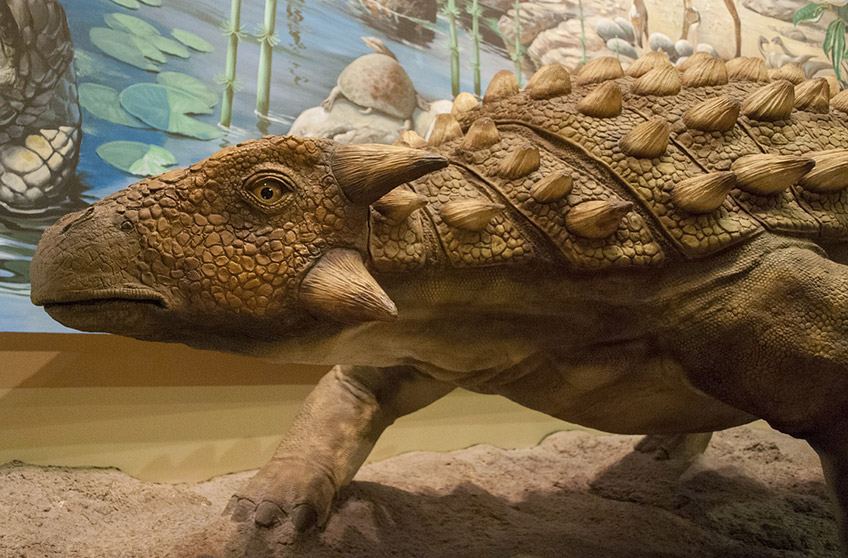
An ankylosaurus. (Pixabay)

There are long dinosaurs like the Seismosaurus (about as long as five school buses). There are small dinosaurs like the Compsognathus (about the size of a chicken).

There are tall dinosaurs like the Sauroposeidon (about as tall as a building with six floors). And there are heavy dinos like the Brachiosaurus (about as heavy as 17 African elephants).

These are just a few of the 700 named species of dinosaur, and more are named every year.

Palaeontologists believe that there are hundreds more types of dinosaurs still to be discovered!

When did the dinosaurs disappear?

Dinosaurs went extinct about 65 million years ago.

Some scientists believe that a large volcanic eruption got rid of dinos. The volcanic clouds did not let the sun shine through causing the Earth’s temperature to drop.

It then became much too cold for dinosaurs to survive on Earth. Some scientists believe a large meteorite, asteroid or comet hit the Earth. The crash caused massive volcanic eruptions.

It is believed that birds are the only living dinosaurs today.

Source: www.cbc.ca

20 Best Dinosaur Birthday Party Ideas

Thursday, July 11, 2019

GETTY IMAGES

Is your little one ready to party prehistorically?

Kids of all ages love dinosaurs—it's practically a scientific fact. Whether the dinos are cute, scary, or somewhere in the middle, little ones can't get enough of them. They also really love birthday parties. So if you've got a celebration to plan, why not combine the two for an amazing dinosaur birthday party? It's a no-fail theme that'll work for both boys and girls alike and can be executed at your home or an event space any time of year. It also naturally lends itself to a lot of fun activities (like digging for dinosaur bones!) and cute decor, so that's another win.

Find tons of creative inspiration here for your child’s dinosaur-themed birthday party with ideas for everything you'll need, from DIY projects to decorations you can have delivered to your doorstep. There's an awesome dinosaur birthday cake you can make and decorate yourself, plus "fossil" sugar cookies that'll have everyone (especially your little T-Rex!) smiling. You'll also find the cutest Etsy invitation you can customize and print at home (because who wants to run an errand if they don't have to?), plus party favors and games that won't break the bank. Oh, and make sure to check out the centerpiece ideas too. Happy planning!

1 - Dinosaur Birthday Invitation


Prepare guests for a roaring good time with these cute custom dinosaur birthday party invitations! The best part? You can download and print them from the comfort of your own home. 

2 - Roar Balloon

SHOP NOW

Show off your dino-mite party decorating skills with this playful balloon banner. Each foil balloon measures 16 inches tall.

3 - Dinosaur Dig Triple Chocolate Sheet Cake

Busy parents, rejoice! This chocolate sheet cake is pretty much the easiest cake you'll ever decorate. The "dirt" topping is made from crushed Oreo cookies and the dinosaur bones are made using white almond bark and a food-safe mold.

Get the recipe at Sprinkle Bakes.

SHOP DINOSAUR BONES CAKE MOLDS

4 - Dinosaur Paper Party Plates

SHOP NOW

These green foil dinosaur plates will bring a smile to guests' faces! (We especially love the spiked edges.) They come in a package of eight. 

5 - Dinosaur Party Favor Labels

SHOP NOW

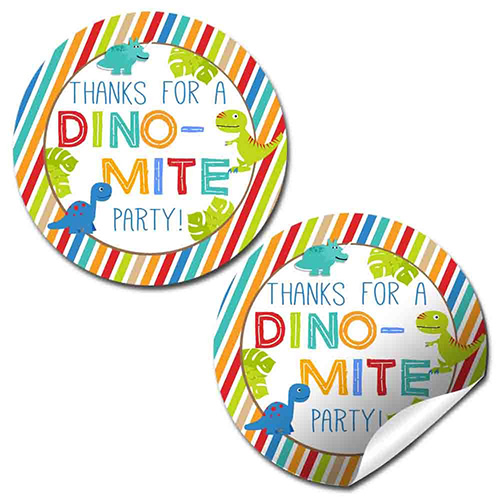
No bones about it—these personalized stickers make party favors a total breeze.

6 - Dinosaur Ice Cream Bar

What kid doesn't love ice cream? This dino-themed DIY ice cream bar includes alllll the toppings. (Dinosaur "eggs," sprinkles, and gummies, oh my!)

Get the tutorial at Cutefetti.

SHOP CADBURY CHOCOLATE EGGS

7 - Dinosaur Party Favors

Party favors don't have to be complicated. Here, a simple "adopt a dinosaur" sign transforms a basket of toys into the cutest parting gift.

SHOP SMALL TOY DINOSAURS

8 - Party Dino Decoration

Need a centerpiece idea? Grab a plastic dino, some paint, and a few silk flowers and whip this one up.

Get the tutorial at The Party Parade.

SHOP LARGE TOY DINOSAURS

9 - Dinosaur Dig Party

Excavate a party as cute as this one by Anders Ruff Design Co. A green-and-orange color palette and "Landon's Dinosaur Dig" sign set the perfect tone.

SHOP HATCHING DINOSAUR EGG FAVORS

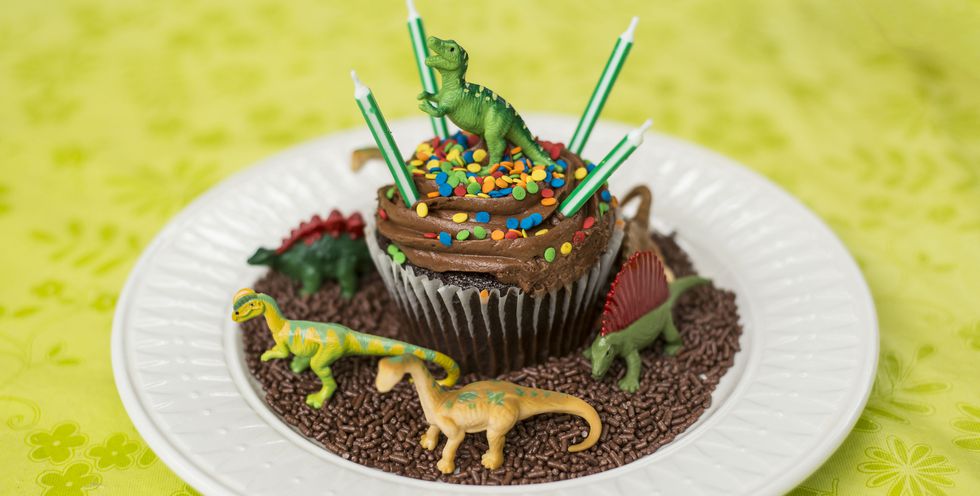
10 - Dinosaur Cake Topper

Need to dress up a simple cake? Put a dino on it!

SHOP DINOSAUR CAKE TOPPERS

11 - Dinosaur Straws

SHOP NOW

These paper dinosaur straws will have party guests sipping in style. Each order comes in a pack of 12.

12 - Dino Table Decorations

A bouquet of greenery and a sprinkling of dinosaur toys makes for a lovely table decoration. Sometimes, keeping it simple is the way to go.

SHOP SILK PALM LEAVES

13 - Bean Bag Toss Game

Why settle for a regular old bean bag toss when you can feed the T-rex? This game was made using a piece of scrap plywood and some paint.

Get the tutorial at Family Chatter.

SHOP BEAN BAGS

14 - Dinosaur Dessert Bars

Made with a simple cake mix base and topped with dinosaur-shaped sprinkles, these easy-to-make blondies will be a hit with partygoers of all ages. (The kiddos will especially appreciate the color!)

Get the recipe at Cutefetti.

SHOP DINOSAUR SPRINKLES

15 - Dinosaur Party Favor Bags

SHOP NOW

16 - Fossil Cookies

These "fossils" are made using a simple sugar cookie recipe. Just stamp a foot into each ball of cookie dough using a toy dinosaur before baking.

Get the recipe at Delish.

SHOP TOY DINOSAURS

17 - Dinosaur Pinata

SHOP NOW

Is a party really a party without a piñata? This awesome find is almost too cute to whack.  

18 - Dinosaur Toenails

This is a slightly gross but very clever way to turn Bugles corn chips into a party-worthy snack—and trust us, the kids will love it. This idea comes from Place Of My Taste.

SHOP BUGLES CORN CHIPS

19 - Dino Inflatable Sprinkler

SHOP NOW

20 - Dinosaur Dig Activity

Need an activity for your dinosaur-themed birthday party? Make salt dough "fossils" and bury them in your yard or sandbox. Then, hand the kids a paintbrush to dig 'em up!

Get the tutorial at Family Chatter.

SHOP PAINT BRUSHES

Source: www.countryliving.com

The 10 Best Dinosaur Museums in the World, Ranked

Thursday, July 11, 2019

Museum of the Rockies, Bozeman, MT - Siebel Dinosaur Complex

Dinosaurs are some of the most fascinating and mysterious creatures ever to walk the  Earth, simply because no-one ever has ever witnessed one with their own eyes. The closest we can come in this day and age is finding a well-preserved fossil buried deep beneath the ground or a dinosaur skeleton in a museum.

However, there are so many museums in the world that it might be tough to narrow down which ones are worth your time and money. If you're curious to discover dinosaurs and learn more about their ecosystems, then consider checking out the ten museums below that will cater to the paleontologist in you!

10 - NATIONAL DINOSAUR MUSEUM: CANBERRA, AUSTRALIA

Established in 1993, the National Dinosaur Museum is located in Gold Creek Village near Canberra, and serves around 100,000 visitors each year. The museum hosts guided tours of their many exhibits, and holds a large amount of rare fossils, animatronic dinosaurs, skulls, skeletons, and murals.

The museum also has an outdoor Dinosaur Garden featuring Stan, a 65 foot tall dino who guards the entrance!

9 - SMITHSONIAN MUSEUM OF NATURAL HISTORY: WASHINGTON, D.C., USA

The Smithsonian family of museums is famous for its wide and vast collection of materials, and that includes its range of fossils and dinosaur-related exhibits! The new Fossil Hall at the Smithsonian opened June 9 of this year, and includes a 31,000 foot exhibit dedicated to exploring life on earth from 4.6 billion years ago to the future.

The exhibit, entitled Deep Time, boasts around 700 fossil specimens, including that of a Tyrannosaurus Rex, a Diplodocus, and a mammoth. The workers at the Smithsonian, in renovating the exhibit, wanted to better incorporate how science has evolved in the past century, and hope that many will enjoy the new spin on the Hall of Fossils!

8 - BADLANDS DINOSAUR MUSEUM: DICKENSON, NORTH DAKOTA, USA

Formerly known as Dakota Dinosaur Museum, the Badlands Dinosaur Museum opened in 1993 and is currently overhauling its exhibits and dinosaur-related offerings. Badlands focuses primarily on exhibits of fossils, fieldwork and research programs, and public laboratory preparations for new specimen additions to its collection.

Though they are adding more exhibits in the future, you can currently view a variety of Tyrannosaurus, Triceratops, Edmontosaurus, and more ice-age mammals. They also accept volunteers for their fieldwork crew in the Summer, so you can be involved if you're interested in digging for dinosaurs!

7 - FUKUI DINOSAUR MUSEUM: KATSUYAMA, JAPAN

One of the leading Asian dinosaur museums, Fukui was finished in the summer of 2000. Its location was chosen due to the large amount of dinosaurs that had been discovered in the region, and the museum sits only 3.41 miles from the dinosaur excavation site.

The museum is divided into five zones, which each house their own unique exhibitions of materials. There are over 40 skeletons of dinosaurs available for viewing, alongside moving robotic dinosaurs.

6 - THE FIELD MUSEUM: CHICAGO, ILLINOIS, USA

Located near Lake Michigan, the Field Museum opened its doors in 1894 with exhibits that had debuted at the World's Columbian Exposition one year earlier. Over 65,000 artifacts found a home at the newly established museum, named for Marshall Field, the man who donated the $1 million needed to start the project.

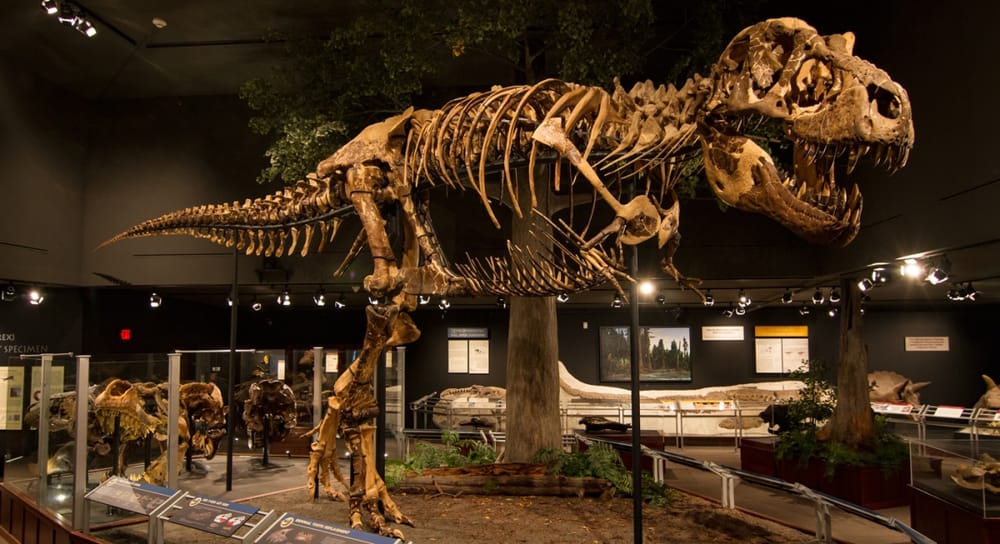
The museum opened its current building in 1921, and has been educating and entertaining visitors ever since. The Field Museum is an important place because it houses Sue the Tyrannosaurus Rex, the most complete skeleton of the creature to date. The museum attempts to display the "real" fossils whenever possible, but also includes casts of some of the creatures using accurate molds of fossils.

5 - NATURAL HISTORY MUSEUM: LONDON, ENGLAND

The Natural History Museum is home to many exhibitions, but it includes some of the oldest dinosaur specimens known to science. The museum boasts a portion of the first Tyrannosaurus Rex and Iguanodon skeletons ever found, and also has some other important dinosaur fossils within its collection.

Some of the paleontologists from the museum have joined a dinosaur dig taking place in Wyoming, and have already unearthed some specimens!

4 - ROYAL TYRRELL MUSEUM OF PALEONTOLOGY: ALBERTA, CANADA

The premier museum for dinosaurs in Canada, Royal Tyrrell is open seven days a week in order for visitors to experience their amazing collection of specimens. Standouts of their collection include the skeleton of a new armored dinosaur, Borealopelta markmitchelli, which was discovered in 2011 and was the oldest dinosaur found in Alberta to date.

Their rotating exhibit Fossils in Focus also features an astonishing exploded skull of  Daspletosaurus, which were gathered and reproduced (if  delicate) over 10 years until the specimen was complete .

3 - ROYAL BELGIAN INSTITUTE OF NATURAL SCIENCE: BRUSSELS, BELGIUM

Founded in 1846, the Royal Belgian Institute of Natural Science has the largest Dinosaur Gallery in Europe, devoted to displaying dinosaur fossils and information about them. In 1878, there were 38 nearly complete Iguanodon skeletons found in a coal mine in Belgium, of which the museum acquired 30, which continue to be the centerpiece of the establishment to this day.

Other highlights include Ben the Plateosaurus and a replica Tyrannosaurus named Stan. They also have preserved fossils of feathered dinosaurs available for viewing as well.

2 - NATURAL HISTORY MUSEUM: PARIS, FRANCE

The Natural History Museum has 14 sites around France, with 4 situated in Paris. The museum is the third-largest collection of specimens in the world, with about 62 million in reserve.

There are many dinosaurs and prehistoric mammals to be found at the Natural History Museum, and the vast array of animals represented will be sure to satisfy the most curious paleontologist-in-training!

1 - ZIGONG DINOSAUR MUSEUM: ZIGONG, CHINA

Opened in 1987, Zigong Dinosaur Museum is unique from many of the other destinations on this list, as it is situated upon a site where dinosaur fossils were found. The temperate climate in Zigong has made it a gold mine for dinosaur-related discoveries!

Spread out over three floors, the museum spans around 710,000 square feet and contains a number of exhibits devoted to the Jurassic period, which occurred around 205 million to 135 million years ago. There were 100-plus specimens discovered at the Zigong site alone, and thirty of them were complete (or nearly complete) skeletons!

Source: www.thetravel.com

Hesperornithoides miessleri: Small Wyoming Dinosaur Helps Rewrite the Evolutionary Story of Birds, Flight

Thursday, July 11, 2019

An artistic rendering of what Lori, scientifically known as Hesperornithoides miessleri, may have looked like when she was alive roughly 150 million years ago. IMAGE BY GABRIEL UGUETO

Scientists have long known that birds and dinosaurs are related, but as with many families, it’s complicated.

There are dinosaurs with feathers, but no wings, and dinosaurs with feathery wings that couldn’t fly. Years of study and an abundance of new fossils in recent decades have left researchers making their best predictions as to whom is related to whom, and just where birds first emerged has remained elusive.

Now, a small, chicken-sized dinosaur discovered by accident while excavating a much larger dinosaur in the Morrison Formation of Wyoming is helping researchers sort out these challenging family dynamics.

Researchers in Wyoming were excavating a giant dinosaur known as supersaurus when they accidentally discovered a small, winged dinosaur now nicknamed Lori. Lori is helping rewrite the evolutionary relationship dinosaurs and modern birds. PHOTO BY WYOMING DINOSAUR CENTER

That dinosaur, Lori, is the oldest winged dinosaur ever found in North America and the smallest dinosaur found in Wyoming. She is the subject of a study published in the journal PeerJ. And due to the diligence of the team that discovered her and work led by University of Wisconsin–Madison graduate student Scott Hartman, she is helping researchers better understand the evolutionary relationship between modern birds and dinosaurs.

Lori is also providing new insight into the origins of flight in birds.

“She is the perfect specimen to work with to put all of this together,” says UW–Madison Geology Museum Scientist, Dave Lovelace, lead scientist on the new study. “It’s a big story on how phylogeny is done and how we as scientists can do it better.”

Phylogeny is a way of sorting out the evolutionary relationships between similar species of plants or animals by figuring out, like a puzzle, how each piece fits together. Only, scientists often don’t have all of the pieces. So, they build the clearest picture they can with the pieces they have.

The trouble with this is that as new species are discovered, researchers often are left trying to fit them into what already exists, rather than re-envisioning the bigger picture altogether.

Hesperornithoides skeletal by Scott Hartman

For instance, since 2001, scientists have been adding new species and new traits onto an existing framework called the Theropod Working Group (TWiG), but many species’ relationships remained to be tested, Hartman explains. He and coauthors sought to overhaul the database to incorporate all of the reliable and relevant species information to date, inspired by Lori’s discovery, which also occurred in 2001.

Theropods are carnivorous, hollow-boned dinosaurs that had three toes and walked on two feet. They include velociraptors, Tyrannosaurus rex, and the ancestors of modern birds. Lori is a theropod, closely related to velociraptors.

“We built a phylogenetic matrix that includes 500 species,” Hartman says. “People usually include 200-to-300, so it’s a doubling of the species sample.”

According to independent co-author Mickey Mortimer, based in Washington: “We took the best existing analysis and made it far more precise, more than doubled the number of dinosaurs tested, and ended up with the most detailed test of bird origins yet published.”

Ma of the discovery by David Lovelace

The analysis found that none of the earliest winged dinosaurs in the theropod family could fly. Flying dinosaurs show up in branches with flightless ones multiple times over evolutionary time, suggesting that dinosaurs developed pre-adaptations to flight, including feathers and wings, millions of years before birds took to the skies.

It also shows that avian flight may not have evolved until relatively late – in the Late Jurassic or Early Cretaceous, between 160 million and 100 million years ago.

“Archaeopteryx is usually assumed to be on the bird line, but our analysis does not find this,” says Hartman. “Archaeopteryx may not be part of a true bird lineage at all; it’s buried (in the phylogenetic tree) with non-flying dinosaurs.”

Lori represents something of an intermediate on the phylogenetic tree. She has features that are similar to birds, such as a well-developed wishbone, but also those that differ, such as large, bladed teeth.

She was found in the thick rock and debris covering an excavation intended to unearth the giant dinosaur Supersaurus vivianae, whose shoulder blade alone is roughly the size of a grown man.

“We were removing a ledge of overburden rock and found — unfortunately with a shovel — some tiny, delicate bones poking out,” says Bill Wahl, preparation laboratory manager at the Wyoming Dinosaur Center and the paleontologist who helped find her. “We immediately stopped, collected as much of the bones as possible and spent the next few days frantically searching for more.”

Unfortunately, her fossilized skull and other small parts were damaged before she was discovered, but a partial skull and much of the rest of her remain. Geologic evidence at the site suggests she would have lived in a wetland-like environment. Says Hartman: “She was maybe more heron than desert-dweller.”

However, he adds: “Lori probably would have had wing feathers, but they would have been too small for her to fly.”

Researchers at the University of Wisconsin–Madison Geology Museum’s Preparatory Lab, who helped describe Lori, discovered by paleontologists in 2001 in Wyoming. PHOTO COURTESY OF STUDY AUTHORS

Scientists have several theories to explain why dinosaurs may have evolved feathers and wings before they evolved flight. They may, for instance, have helped them run, Lovelace says.

“All of a sudden you have these fuzzy things and your arms are outstretched and you’re running and it reduces drag,” he says.

They may also have helped insulate the animals and their developing eggs, been useful for attracting mates, and, as researchers at the University of Montana have found, feathers and wings may have helped them escape predators by allowing them to propel themselves up trees and other sloped terrain.

Lori, officially named Hesperornithoides miessleri  — in honor of the Miessler family on whose private land she was found — will be on display for the first time beginning Friday, July 12, 2019, at the Wyoming Dinosaur Center. The Center, says co-author Jessica Lippencott, is committed to preserving her and other Wyoming specimens for research and for public display.

The study represents the first time Lori has been described and it was funded, in part, by crowdsourced donations. Says co-author and visiting scientist at the University of Manchester, Dean Lomax: “We are grateful to everybody who kindly donated and helped make this project happen.”

In addition to donations made through Experiment.com, the work was also funded by the Jurassic Foundation and the Western Interior Paleontological Society.

Source: https://news.wisc.edu

Pleistocene Salmon Knock The Glaciers Back 6,000 Years

Wednesday, July 10, 2019

Salmon have permeated First Nations mythology and have been prized as an important food source for thousands of years. 

For the Salish people of the Interior of British Columbia, Canada, salmon was the most important of the local fishing stock and salmon fishing season was a significant social event which warranted the nomination of a “Salmon Chief” who directed the construction of the hooks, weirs and traps and the distribution of the catch.

Interior of the province, archaeological evidence dates the use of salmon as a food source back 3,500 years. Sheri Burton and Catherine Carlson were able to isolate and amplify mitochondrial DNA from salmon remains from archaeological sites near Kamloops, and identified the species as Oncorhynchus nerka, or Sockeye salmon. No older salmon remains had been found in the Kamloops area until the 1970’s, when fossil salmon concretions were collected on the south shore of Kamloops Lake.

These concretions were originally dated as Miocene (24 – 5.5 million years old) by the Geological Survey of Canada, based on analysis of pollen grains found in the concretions. However, many local experts, including UBC geology professor W.R. Danner and the late geologists W.H. Mathews and Richard Hughes, suspected the remains were from the much more recent, Late Pleistocene epoch.

It was not until the early 1990s that Catherine Carlson and Ken Klein found definitive proof of this. By good luck, the fish remains in the Kamloops Lake concretions had not been completely replaced by minerals – enough of the original organic bone collagen remained for radiocarbon dating. The corrected date is approximately 18,000 years. It is likely that erosion during the time of deposition had carried pollen down from Miocene layers in surrounding hills, to be deposited around the dead fish, causing the initial over-estimation of the age of the concretions.

This lovely specimen is Oncorhynchus nerka, a Late Pleistocene Fossil Sockeye Salmon, from the fine-grained, silty clays on the south shore of Kamloops Lake, British Columbia, Canada. The site was originally collected in the 1970's by the late geologist and paleontologist Richard Hughes. I was introduced to the site much later after it's redescovery by Catherine Carlson and Kenneth Klein in the fall of 1991 with the help of local and gracious host, Bill Huxley.

They later wrote up and published a chapter in Rolf Ludvigsen's "Life in Stone: A Natural History of British Columbia's Fossils." It was Huxley who shared it's location with John Leahy, a local Kamloops resident and avid fossil hunter, and him with me. 

This specimen was collected by John in the 1990's, his tenth partial salmon from this site and the sole one in my collection.

An age of 18,000 plus years sets the fossils firmly as the only salmonids of the Late Pleistocene in North America, a very significant find. The date also changed our ideas about the early climate of the Interior; the Thompson Valley could not have been covered by glacial ice for as long as originally thought. Indeed, it makes the Interior ice-free only 2,000 years after the Last Glacial Maximum and some 4,000 years before our western continental coastline and the Rocky Mountain Foothills.  

It has long been accepted that the most recent series of ice ages began approximately 1.6 million years ago, beginning as ice accumulations at higher altitudes with the gradual cooling of the climate. Four times the ice advanced and receded, most recently melting away somewhere around 10,000 years ago. Ice retreated from southwestern British Columbia and the Puget Sound area around 15,000 years ago. 

In the southern Interior, ice built up first in the northern Selkirk Mountains, then slowly flowed down into the valleys. Once the valleys were filled, the depth of the ice increased until it began to climb to the highlands and finally covered most of the Interior of British Columbia. Between ice advances, there were times when the Kamloops area was ice free and the climate warm and hospitable. 

Glacial ice was believed to have initiated its most recent retreat from the South Thompson area around 11,000 to 12,000 years ago, but salmon remains from 18,000 years ago suggest that it may have actually began its northwest decline much earlier and indicating a much warmer climate in the Interior than archaeologists or geologists had originally estimated.

Eighteen thousand year-old salmon also challenge the archaeological notion that aboriginal people of the Interior have had access to salmon as a significant protein source for only a few thousand years. In the popular view, people living in the Okanagan and Thompson Valleys were felt to have moved to settlements that were semi-permanent about 4500 years ago. 

By that time they would have had a seasonally regulated diet composed primarily of salmon and supplemented by local game - deer, elk, small mammals – and available shellfish, birds and plant foods. If salmon were present much earlier, it is possible that this pattern of food utilization may have arisen earlier than thought.

Richard Hughes had originally identified the fossilized Kamloops salmon as Oncorhynchus nerka or Sockeye salmon, the same species found in the 3,500 year old archaeological sites. But, using the carbon-13 isotope ratio, Klein and Carlson were able to determine that these salmon did not feed on protein from a marine source and relied solely on a freshwater diet. 

In other words, they could not have spent part of their life in the ocean, as modern Sockeye salmon do. Based on the specimens’ smaller heads and stunted bodies, the longest measuring in at a pint-sized 11.5 cm, Klein and Carlson feel that the fossils are likely Kokanee, a modern landlocked variety of Sockeye.

Source: www.science20.com

Paleontologists Identify Oldest Known Ancestor of Mackerel Sharks

Wednesday, July 10, 2019

Carcharocles megalodon pursuing two prehistoric whales. Image credit: Karen Carr / CC BY 3.0.

Mackerel (lamniform) sharks include some of the most iconic shark species, like the great white shark (Carcharodon carcharias) and the extinct Carcharocles megalodon, the biggest predatory shark that has ever roamed the world’s oceans. A team of paleontologists has examined the tooth mineralization processes in mackerel sharks and discovered a unique feature in their teeth, which allowed the researchers to trace back the origin of the group to Palaeocarcharias stromeri, a small benthic shark from the Middle Jurassic period, some 165 million years ago.

“Similar to humans, shark teeth are composed of two mineralized structures: a hard shell of hypermineralized tissue (in humans enamel, in sharks enameloid) and a dentin core,” said Dr. Patrick Jambura from the University of Vienna and colleagues.

“Depending on the structure of the dentin we distinguish between two different types: orthodentin and osteodentin.”

“Orthodentin has a very compact appearance and is similar to the dentin we can find in human teeth.”

“In shark teeth, orthodentin is confined to the tooth crown. In contrast, the other dentin type is spongious in appearance and resembles real bone and therefore is called osteodentin.”

“It can be found in the root, anchoring the tooth to the jaw and in some species also in the tooth crown where it supports the orthodentin.”

Using high resolution micro-CT images, the scientists examined the tooth composition of the great white shark and its relatives.

They found a peculiar condition of the teeth of members of this group: the osteodentin of the roots intrudes into the crown and replaces the orthodentin there completely, making it the only type of dentin being present. This condition is not known from any other shark, which all possess orthodentin to some degree and thus it is confined to members of this group.

A whole skeleton of Palaeocarcharias stromeri from the Jura Museum Eichstätt. Image credit: Jürgen Kriwet.

The researchers also examined a fossil shark called Palaeocarcharias stromeri.

The oldest known specimen of this species is from the Middle Jurassic and it didn’t have much in common with living mackerel sharks.

Palaeocarcharias stromeri is a small sluggish benthic shark, not exceeding lengths of more than 3.3 feet (1 m) and seemingly hunted small fish in shallow waters.

To this day, its affiliation has been a riddle to paleontologists, since its body shape resembles a carpet shark, while its fang like teeth are similar to mackerel sharks.

The examination of the tooth microstructure yielded the presence of the same unique tooth composition that is found only in great white sharks and their relatives.

The shared tooth histology is a strong indicator that this small inconspicuous shark gave rise to one of the most iconic shark lineages that includes giants like Carcharocles megalodon or the living great white shark.

“Orthodentin is known for almost all vertebrates — from fish to mammals, including all modern sharks, except for the mackerel sharks,” Dr. Jambura said.

“The discovery of this unique tooth structure in Palaeocarcharias stromeri strongly indicates that we found the oldest known ancestor of the great white shark and shows that even this charismatic giant shark started on a shoestring.”

The findings were published in the journal Scientific Reports.

_____

Patrick L. Jambura et al. 2019. Micro-computed tomography imaging reveals the development of a unique tooth mineralization pattern in mackerel sharks (Chondrichthyes; Lamniformes) in deep time. Scientific Reports 9, article number: 9652; doi: 10.1038/s41598-019-46081-3

Source: www.sci-news.com

Mysterious Deep-Sea Shark That's Older Than the Dinosaurs Captured on Film

Tuesday, July 9, 2019

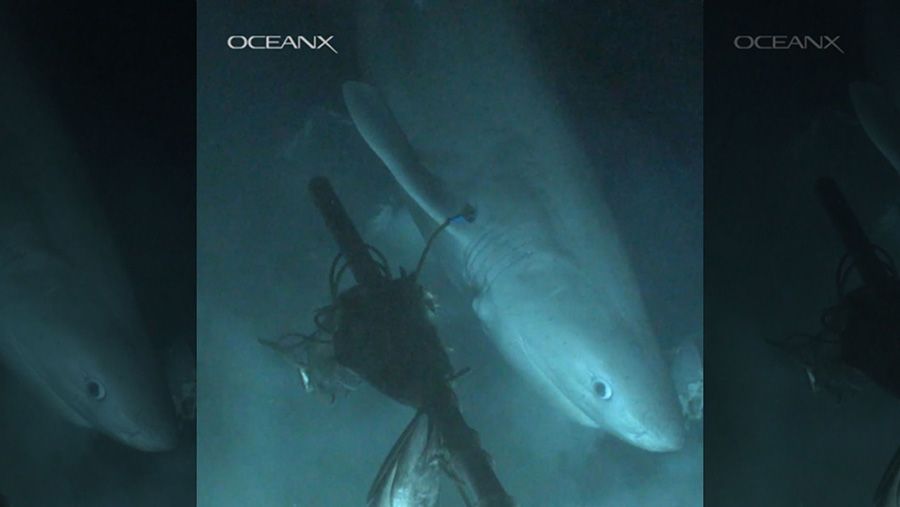
Blutnose sixgill shark eyeing the bait the team laid out. (Credit: OceanX, Florida State University)
 

Researchers have captured the mysterious bluntnose sixgill shark on film, a creature that has been on Earth since before the dinosaurs.

Described as "perfectly efficient" by the team from OceanX and Florida State University, the bluntnose sixgill shark is largely still an unknown to researchers, despite having been on the planet for nearly 200 million years.

Occasionally, they come to the shallow waters, rising from depths as far as 8,200 feet, according to Science Alert, where they arrive under the blanket of the night sky to feed.

In capturing the mysterious bluntnose sixgill on film in the Bahamas, the researchers also managed to achieve history. They were able to tag the creature from a submersible vessel, the first time that feat has been achieved.

"Because bluntnose sixgills are a deep sea species, it’s hard on them physiologically to be tagged in this way," the researchers wrote in a blog post, describing the achievement. "In their typical life cycle, they won’t experience daylight, and very rarely will they feel the low pressure, warmer temperatures of surface waters. Typically, the data obtained after surface tagging of a six gill is believed to be skewed, as the shark does not return to its natural behaviors for some time after the tagging."

Blutnose sixgill shark eats the bait the team laid out. (Credit: OceanX, Florida State University)

Bluntnose sixgill sharks are thought to have lifespans approaching 80 years and could grow to 16 feet in length. According to National Geographic, they are not considered dangerous to humans unless provoked. They largely consist on a diet of fallen carcasses, using their serrated teeth to act like knives and tear the flesh away from the dead bodies.

Footage of the shark was also posted to Facebook and it has been viewed nearly 25,000 times.

Based on fossil records of the perplexing predator, sixgill sharks have evolved little since the early Jurassic period.

MEGALODON: TERRIFYING FACTS ABOUT THIS PREHISTORIC MONSTER

The footage of the sixgill shark is a rare treat for researchers, as the creature has rarely been spotted on film before. In 2016, a team working with OceanGate, an organization that provides subsea research and exploration, filmed a sixgill shark alongside dogfish near British Columbia’s Desolation Sound.

A new species of the shark, the Atlantic sixgill shark, was discovered by scientists in 2018.

Source: www.foxnews.com

Research Sheds Light on Strange Seaway That Once Covered the Sahara

Tuesday, July 9, 2019

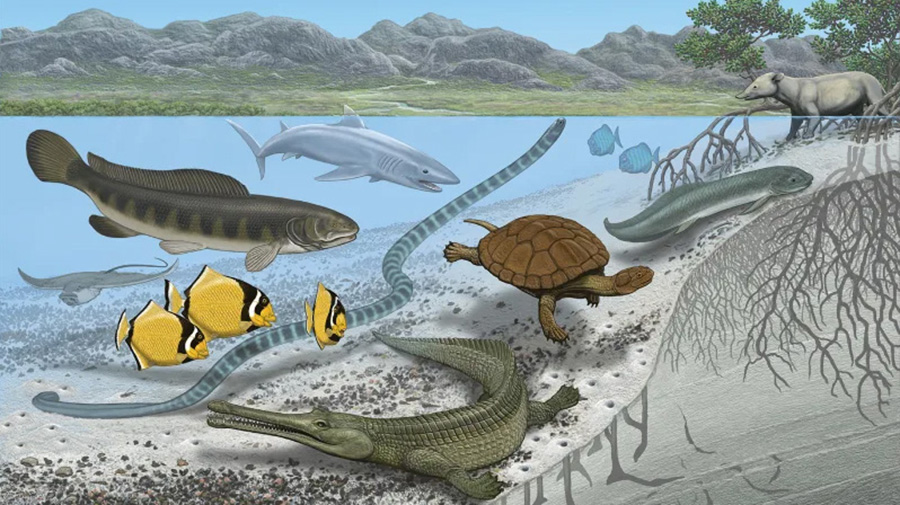
Artist’s concept of the Trans-Saharan Seaway. Illustration: Carl Buell (AMNH)

The Sahara might seem like one of Earth’s most lifeless regions today, but its fossils show it was once a vast seaway filled with giant fish and some of the largest sea snakes the planet has ever seen.

From 100 million to 50 million years ago, a large seaway up to 160 feet deep covered much of West Africa, leaving behind lots of marine fossils, including vertebrates, invertebrates, plants, and microbes. Many of them were surprisingly large. It’s difficult to study this region due to harsh geopolitical and physical climates, so a group of scientists decided to compile and synthesize lots of existing research on the area. They paint a surprising picture of the ancient world during a time period that straddled the event 66 million years ago that put an end to large dinosaurs.

“The K/Pg extinction is one of the largest mass extinction events,” study author Maureen O’Leary from Stony Brook University explained to Gizmodo. “We don’t have a section in the rock record to tie in the fossils at the species level and see these intricate changes on every continent.” Data from the Trans-Saharan Seaway could fill in some blanks about how the extinction played out in an understudied part of the world.

That the western Sahara was once a waterway has long been known to those who live there; the Tuareg people have found remnants of sea life in the desert, O’Leary told Gizmodo, and the idea has been part of the paleontological discourse for over a century. During warm periods between 50 million and 100 million years ago, rising sea levels caused a waterway to develop, probably connecting the Gulf of Guinea to the Mediterranean Sea. Scientists from the United States, Mali, and Australia have analyzed fossils and sediment from three expeditions to the Sahara in Mali, and have published a bulletin detailing everything they learned so far about the region, hoping to illustrate what the ecosystem looked like.

The shallow bodies of water that covered the Sahara were likely similar to other large seas sitting on top of continents today, like the Caspian Sea, or to the shallow warm waters around some Caribbean islands. The seaway’s shores likely featured forests of mangroves, trees found today around the world on tropical and subtropical shores. The fossils they found were weird and often very large, including a 5-foot-long catfish, 40-foot-long sea snakes, and other large fish, as well as relatives of today’s crocodiles, sharks, and elephants, according to the synthesis of their findings in the Bulletin of the American Museum of Natural History

But why were the fish so big? There’s a theory called island gigantism in which species can grow extra large on islands because they’re protected from predators and have less competition for resources. Perhaps there’s a similar version in aquatic environments—as the seaway dried up, it might have left “islands” of water where similar evolutionary forces could have generated large snakes and fish.

The region’s fossil history offers another place to study the K/Pg extinction event. The effects of the event weren’t quite as dramatic as O’Leary expected, she explained, with some of the species persisting both before and after the time of the extinction. But this paper’s purpose was more to lay the groundwork for future researchers to build upon when trying to see how the mass extinction unfolded around the world.

Much of the previous research on this area was published in French, so many paleontologists may not be familiar with this region and its sediments, O’Leary explained. But Mali is the site of ongoing conflicts, making it unsafe for scientists to perform field work.

The research demonstrates just how complex an enterprise paleontology can be. It includes discoveries on the smallest scale—one of the researchers found a fossil invertebrate that had burrowed into previously fossilized poop, for example—as well as bigger-picture thinking about the history of the planet, beyond just dirt and bones.

Source: https://gizmodo.com

Pages