Blogs

Jurassic Park: 10 Sequel Moments That Lived Up To The Original

Saturday, August 10, 2019

Jurassic Park is a classic Spielberg movie that probably defined a lot of our childhoods. It has groundbreaking effects that still hold up, gripping pseudoscience, and interesting conversations about ethics. It’s also structurally perfect, and strikes just the right balance between humor and suspense. Subsequently, Spielberg immediately transformed the nature of the franchise with The Lost World. The series welcomed more elements of monster movies, and the third entry is often maligned for that reason. By Jurassic World, the new franchise installments had come to focus more on nostalgia. However, the sequels aren’t without their own merits, particularly Spielberg’s underrated 1997 film. So, let’s examine ten great moments that actually lived up to the original, spoilers included!

10 YOU ASKED FOR MORE TEETH

Jurassic World was essentially fan service from beginning to end, even if the tone was radically different. This resulted in a movie that, possibly inadvertently, included important traces of the series’ original film. One of the most important and captivating things about Jurassic Park was its interest in science and nature. It was surface level, sure. But it included 3D gene visualization, robot arms, and Frog factoids to explore its own mythology. This added a certain degree of internal logic—“realism” if you will.

Well, Dr. Wu is the connective tissue that allowed this to reappear in Jurassic World. He has an intriguing conversation with Masrani after the Indominus breaks out. Wu finally explains why the franchise’s dinosaurs don’t look like reality. He also briefly touches on ethics once more. He describes how Masrani’s interest in making a “cool” product led to an animal with needlessly dangerous traits. For all the dinosaurs, this is one of the best throwbacks to the original movie, if somewhat overacted.

LONE GYROSPHERE

The gyrosphere is a fun idea from Jurassic World, and the kids drive it into a restricted area, where the Indominus Rex promptly attacks them. However, it’s a splashy scene wherein the creature fights an ankylosaurus. It feels more like a kid mashing two action figures together. And yet, after the Indominus flips the gyrosphere over, the scene develops an interesting tone. Most of the film is pure action, rather than suspense. But in this scene, the vibrating phone achieves some effective tension.

Visually, this one-on-one with the Indominus has a number of callbacks to the original Jurassic Park. But the Indominus update is actually rather satisfying. The way it slowly wraps its mouth around the gyrosphere is pretty intimidating. Then, it starts slamming the kids into the ground, and they run for their lives. The kids outsmart the animal by waiting underwater, and the scene doesn’t end with a punchline. Overall, it’s a surprisingly effective scene that feels like the original film by standing on its shoulders.

INDOMINUS REX BREAKOUT

This Jurassic World scene is all about hubris, which really ties into the roots of this franchise. It doesn’t come close to the breakout of the original Tyrannosaurus, but it’s still nifty. The Indominus sets up a trap for its guards, by misleading them with a skill no one was aware of. It’s revealed that this kind of intelligence is possible because the creature was infused with raptor DNA. But the only reason it escaped is because of the humans. They simply assumed their cameras would notice it. Then, before confirming the animal was actually gone, Owen and staff enter the enclosure anyway.

It’s foolish arrogance, and the foot chase that ensues is pretty gripping. The Indominus quickly eats someone. And just outside the breached gate, Owen hides under a car and creatively covers himself with gasoline. That moment alone, where the Indominus gets to bare its bloody teeth, is reminiscent enough of the first film. It’s a fun combination of suspense and action, and the deaths are genuinely striking.

REXY’S BLOOD TRANSFUSION

Any scene that goes lengths to create suspense is going to be tonally closer to the original than the sequels tend to be. After all, the source material of the entire franchise was steeped in gory horror, while the sequels tend to be more lighthearted. Crichton crafted intense details, drawing from medical studies. This selection, from Fallen Kingdom, is a neat blend of both. In order to save Blue’s life, Owen and Claire need to get blood from Rexy herself. It’s a lengthy scene that's smartly paced and effectively utilizes the reputation of that particular animal. It’s a daring feat already, and the film smartly locks the protagonists inside the cage with Rexy. The claustrophobic setting, signature animal, and suspenseful escape make this a proper addition to the franchise.

INDOMINUS RECOVERY MISSION

The visuals in the opening scene of Fallen Kingdom are a blatant, welcome homage to the original movie. It’s the dead of night, and pouring rain, which are crucial elements to the franchise’s iconography. Then, you’ve got someone in a classic yellow parka. But the context has changed, and it works. It’s rather overused throughout the film, but at this point, the flashing lights are pretty neat. It’s classic horror imagery, gradually revealing the Mosasaurus and Tyrannosaurus as they approach. The sequence concludes with action that consequently feels decidedly out of place, but the atmosphere and direction are still terrific.

MALCOLM’S LOGIC

Ian Malcolm is often a voice of reason, and he’s the franchise’s biggest critic. In fact, he’s the one with all the meta jokes in Jurassic Park: The Lost World. But although most remember him for his Goldblum-isms, providing great comic relief, he has a more important task - questioning the characters' ethics. Questionable ethics are at the heart of this story, and there is plenty to scrutinize. So, when Fallen Kingdom allows Malcolm to attend a senate hearing, nothing could be more significant. He’s once again allowed to voice his concerns at the beginning and end of the film. Goldblum carries the same gravitas as ever, and Malcom’s point of view is very interesting. As the perpetual critic, he is the true moral voice of Jurassic Park.

DIETER’S DEATH

It shouldn’t be surprising that Spielberg was the one who best lived up to the original film. The remaining entries all belong to the master craftsman. Dieter’s death by Compys is a superb scene in The Lost World, even if the impetus is ridiculous. And, it’s certainly on the nose that he’s somehow getting comeuppance for electrifying a Compy earlier in the film. However, the initial fall is appropriately hard-hitting.

Basically, the scene is a recreation of Nedry’s death from Jurassic Park. He fell down a hill, contended with a seemingly cute dinosaur, and we see blood trail away from the attack. Dieter’s final scene has an equivalent level of pacing, direction, and special effects. The Compy swarm is very convincing, and the one that rips into Dieter’s mouth is an alarming visual. Spielberg really knows how to make the entire scene immersive and suspenseful, even when the victim is a villain.

T-REX ATTACKS THE CAMP

Again, it’s preposterous the way Julianne Moore’s character, Sarah, carried around a bloody shirt in The Lost World. Sarah has supposedly worked with predators before, but she still assumed that the Rex wouldn’t be able to smell that far. Either way, it leads to a terrific scene. A giant, practical T-Rex head invades Sarah’s tent, as she hides candy bars. Then, Kelly wakes up, and Sarah desperately tries to keep her quiet. This is a movie that allows implausible catalysts to achieve superb suspense. When someone outside notices the intruding Rex, his screams wake everyone and start a terrific foot chase. After Spielberg ramps up the action, he gets some camp survivors trapped behind a waterfall. Making everything claustrophobic all over again is a perfect conclusion to the sequence.

RAPTORS IN THE GRASS

The darker these movies get, the closer they feel to the original film. This Lost World scene is full of kinetic camerawork, and certainly meets the level of chaotic suspense as the original. First, Sidhu warns everyone about the long grass. Predators are known to use it for cover. When the Velociraptors arrive, they break paths into the grass indicating their presence. It’s right out of Jaws, where floating barrels signaled the threat better than actually seeing the shark. And when the wild raptors strike, it’s an absolute slaughter.

The raptors first drag unsuspecting men to the ground, eaten en masse. Those that remain panic, and we see raptors leap through the air to pounce. It’s a ballet of violence, achieving the kind of pure adrenaline that Spielberg uniquely delivers. He absolutely knows how to handle the raptors, as crafty and ferocious animals. They live up to the reputation established by the first film. No other sequel handles or visualizes them nearly this well.

THE CLIFFHANGER

“Mommy’s very angry.” This is easily the best scene from The Lost World, or any sequel in the franchise. The entire finale of the story is simply a blatantly deliberate homage to King Kong. Many of the other scenes throughout the film echo that intent. However, when Sarah helps treat the injured Baby Rex, its parents show up and disapprove. The sequence is just as lengthy and memorable as the initial Tyrannosaurus breakout in Jurassic Park.

In fact, they follow a similar formula. Protagonists are stuck in a vehicle, under direct conflict with the mascot animal. The Rexes proceed to flip the vehicle over, and our main characters end up dangling over a cliff. Just like Grant and Lex. The entire scene is slow and methodical, with incredible practical effects and careful direction. Then, Eddie appears and heroically tries to save the protagonists from plummeting to death. Unfortunately, the activity attracts the Rexes again, and they end up tearing him in half. It’s a suspenseful, tragic, exciting scene that is every bit as effective as anything from Jurassic Park. It combines all the elements of claustrophobic horror, action, and effects wizardry that made the original so iconic.

Source: https://screenrant.com

New Nests With Dinosaur Eggs Discovered in Romania

Saturday, August 10, 2019

New nests with dinosaur eggs were discovered in Livezi and Boița, two localities in the Tara Hategului area in Romania. Research began three years ago and teams of students from the University of Bucharest, led by professor Zoltan Csiki-Sava and lecturer Ștefan Vasile, with the support and involvement of Romania’s dinosaur park Dino Parc Rasnov, are currently restoring the nests.

According to researches, the eggs found in these nests come most likely from the “duck-billed dinosaur” Telmatosaurus transsylvanicus, a species of herbivorous dinosaur that lived in the area of Transylvania about 66-70 million years ago.

To mark these new discoveries, Dino Parc Rasnov will host starting August 15 an exhibition of real dinosaur egg nests and replicas of dinosaur nests with hatchlings. The exhibits that will go on display at the opening event were discovered and curated between 2015 and 2018, in the localities of Livezi and Boița.

Restoration of Telmatosaurus by Debivort

Dino Parc Rasnov, the only dinosaur-themed park in Romania and the largest in Southeast Europe, is an open-air leisure area located close to the Rasnov Citadel, near Brasov. It features 100 exhibits, all life-size replicas of dinosaurs and prehistoric creatures, but also playgrounds for children, treehouses, 9D and 360° cinemas, an adventure trail, and several other interactive areas.

Source: www.romania-insider.com

A Land of Dinosaurs … Discover Morocco’s Most Bizarre-Looking Reptiles

Thursday, August 8, 2019


Spinosaurus A by  RAPHTOR

During the prehistoric times, many dinosaurs roamed, swam and flew over Morocco. The giant reptiles were different, unique-looking and fascinating. Discover four of Morocco’s most bizarre-looking dinosaurs.

Millions of years ago, dinosaurs lived on our planet and scientists and paleontologists have managed to provide the world with glimpses of their lives and features. While exploring the age of the dinosaurs, they discovered that many of these weirdly-shaped creatures lived, preyed and roamed Morocco.

Dinosaur fossils found in Morocco helped researchers answer questions about the prehistoric era. According to several studies, the Kingdom has even been a rich fauna of dinosaurs during several periods.

To those who are curious enough to discover more about these gigantic and prehistoric animals we have a list for you. Four bizarre-looking reptiles inhabited the country. Thanks to science, we now know that some of them could swim, while others could fly or lived shortly after the mass extinction.

Spinosaurus, Kem Kem’s swimming dinosaur

The only known dinosaur adapted to life in water, Spinosaurus aegyptiacus swam the rivers of North Africa about 95 million years ago. Image credit: © Davide Bonadonna / National Geographic magazine.

It is a theropod, a very big one also, but most precisely one that could swim. North Africa was the primary home of this dinosaur, discovered for the first time in Egypt in 1912. Spinosaurus, which, according to scientists, lived during the Cretaceous period, was also found in Morocco.

The first discovery was linked to the Kem Kem beds, a geological formation located near the border between Morocco and Algeria. The area was described by Luke Mahler, from the department of Anatomy and the Organizational Biology at the University of Chicago, as an area that «have produced a disproportionally large number of carnivores (…) including Spinosaurus».

The fossils of this theropod, who is also called Spinosaurus maroccanus, revealed that he is one of the largest carnivorous dinosaurs, who preyed mostly in the water and had round or crescent-like dorsal sails.

In 2014, more details were given about this gigantic carnivore. The findings of a study, carried by German-Moroccan paleontologist Nizar Ibrahim, brought evidence suggesting that this dinosaur could swim.

In a study published on Science, the paleontologist concluded that Spinosaurus is «the world’s first known swimming dinosaur». Ibrahim described it as a 15-meter-long «behemoth» that has a crocodile-like face and is perfectly equipped to swim.

«It’s the first dinosaur that shows these really incredible adaptations», Nizar Ibrahim told science journal Nature. «There’s no doubt in my mind that Spinosaurus would have done most of its hunting in the water».

Relying on already-found fossils and remains found in Erfoud, Ibrahim managed to get a more detailed picture of Morocco’s Spinosaurus. According to Nature, the semi-aquatic creature has «nostrils that are located relatively high on its skull, perhaps so that it could breathe while partly submerged». Its teeth, on the other hand, «are interlocked like a fish trap, and its powerful forelimbs could have paddled through the water».

Although this giant dinosaur could swim, further research found out that he was an «awkward swimmer». Quoting a 2018 study published on PeerJ, National Geographic reported about the Moroccan monster that «despite its taste for fish, he may not have been a great swimmer after all». The study compared the animal to nowadays' crocodiles, who spend a lot of time in the water but are awkward swimmers.

Morocco’s long-necked herbivore

Neck vertebrae and restored skull of the Rutland C.oxoniensis

It is a long-necked and small-headed dinosaur who lived in both Africa and Europe. Its fossils were discovered decades ago, suggesting that unlike other dinosaurs that inhabited Morocco, it was a plant-eating sauropod.

The first described Cetiosaurus was found in England in 1841. It was first labeled as a «whale reptile» that was «about the same size as the North Atlantic great whales», according to a platform called HowStuffWorks.

But there is more to this dinosaur than just that. Three skeletons of the reptile were found in 1960 in El Mers, a small town in the Fes-Meknes region by French paleontologist Albert-Félix de Lapparent. The scientists called the dinosaur Cetiosaurus mogrebiensis, referring to Morocco.

The big monster who lived during the Middle Jurassic Period roamed only terrestrial habitat and reproduced by laying eggs.

Morocco's flying reptile and dinosaurs' cousin

An artists impression of Alanqa saharica, the newly identified pterosaur which lived 95 million years ago in the Kem Kem region of the Sahara on the border of present day Morocco and Algeria - Artist’s impression by Davide Bonadonna

Technically speaking, it is just a reptile that could fly, but it is mostly referred to by media as the «flying dinosaur». Pterosaur is literally a winged lizard, who flew over Morocco 66 million years ago. It is known by its powerful wings, long tail and fully-toothed jaws.

According to a 2010 survey, Pterosaur fossils were mainly discovered in the Kem Kem beds. «The Hamada Kem Kem and Maider region» are described as the «principal pterosaur localities» in the Kingdom, researchers revealed.

However, researchers debated over when and how these animals went extinct. According to a 2018 study, Pterosaurs, who are known as the cousins of dinosaurs, were stronger and more diverse by the end of the Cretaceous period than what scientists previously thought.

Researchers from the Bath and Portsmouth universities in England found that the bones discovered in Morocco belong to different and distinct types of the flying reptiles.

Based on previous findings, scientists believed in the past that these species were going extinct way before the end of the dinosaurs era, which occurred 66 million years ago. However, the new study conducted by the two universities and made public by journal PLOS Biology suggested that the fossils found in the Kingdom belonged to the Cretaceous period.

«To be able to grow so large and still be able to fly, pterosaurs evolved incredibly lightweight skeletons, with the bones reduced to thin-walled, hollow tubes like the frame a carbon-fiber racing bike», the study revealed. The latter concluded that these Moroccan reptiles belong to the latest species of their kind that lived on Earth during the last phase of the Cretaceous period.

Chenanisaurus, Morocco and Africa’s last dinosaur

Two Chenanisaurus sprinting along a coastline

It is an Ouled Abdoun Basin-native and Africa’s last dinosaur. Chenanisaurus, who lived in Morocco, is a smaller version of America’s T-rex. This dinosaur is known for its tiny arms, big head and separate teeth.

In 2017, researchers found that the predatory abelisaurid theropod is one of the latest dinosaurs that lived in Morocco, 66 million years ago. The discovery was described as similar to winning the lottery by Doctor Nick Longrich who studied a partial jaw belonging to the predator.

Found in a phosphate mine, the dinosaur is a two-legged Abelisaur measuring 7-8 meters (23-26 ft). While examining the discovery, Longrich indicated that its teeth were strong enough to crack a bone.

«It’s one of the last dinosaurs in Africa before the mass extinction that wiped out the dinosaurs. It’s an exciting find because it shows just how different the fauna was in the southern hemisphere at this time», the researcher said at the time.

Now that you have an idea about four of Morocco’s most bizarre-looking dinosaurs, which one is your favorite?

Source: https://en.yabiladi.com

What's Wrong With Buying a Dinosaur?

Friday, August 9, 2019

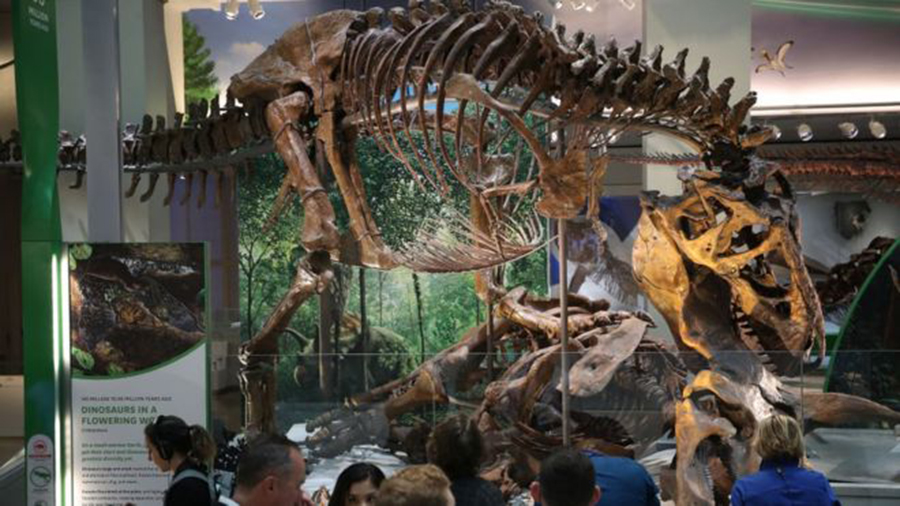
Tyrannosaurus rex is the rock star of the dinosaur world; specimens fetch more than older fossils. EMPICS

Fossils are in fashion, with private buyers snapping up prehistoric remains online and at auction but the trend is raising concerns within the scientific community.

In the saleroom at Christie's auction house in London, buyers are crowding round to view - not works of fine art, antique furniture or jewellery - but fossils from an era so far in the past it is hard to fathom.

There are Triceratops horns, the teeth of a Tyrannosaurus rex, and the tail of a duck-billed dinosaur from 66 million years ago.

Bidders from as far apart as California and Hungary join the auction online and the murmurs of excitement rise as the room is shown slides of such palaeontological treasures as oil-black teeth from a Megalodon - a giant prehistoric shark - or Sauropod eggs and fossilised dragonflies.

Private buyers have been showing a growing interest in ancient remains over the past few years. Bidders from more than 50 countries regularly participate in sales like these, says James Hyslop, head of science and natural history at Christie's.

Mosasaur skulls are popular with private buyers. GETTY IMAGES

Celebrity interest - Leonardo DiCaprio, Russell Crowe and Nicolas Cage are all known to have bought prehistoric treasures - has helped make them fashionable.

Such fossils may not yet compete with fine art in terms of the most expensive sale tags, but the boom in interest means that prices are rising.

Elephant bird eggs sold for £20,000-30,000 a decade ago, for example - now they're selling for £100,000.

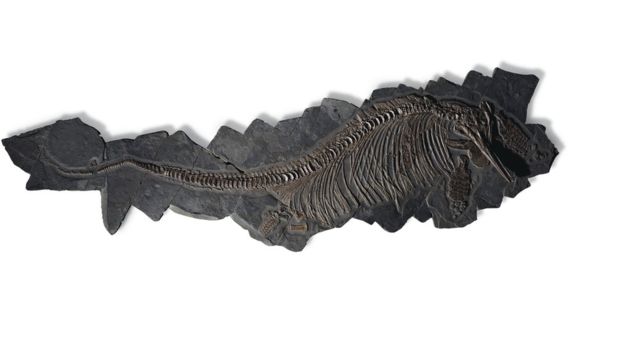
Mr Hyslop points out one of the sale's rarest specimens: a female ichthyosaur fossil. At 3.5m (11ft) this is the largest ever sold at auction. This prehistoric fish-lizard swam the oceans of the early Jurassic, 184 million years ago.

Christie's recently sold this rare pregnant ichthyosaur fossil. CHRISTIE'S AUCTION HOUSE

On close inspection there are also the rare remains of two embryos in its rib cage: it was pregnant. It finally sells for £240,000 to an anonymous buyer.

Mr Hyslop puts the growing interest in prehistoric remains down to a generation that grew up on the first batch of Jurassic Park films (1993-2001).

"We love this subject," he says. "People just love what it stands for". What it stands for is a combination of popular science and popular history, but also the excitement of breaking new ground. According to National Geographic, 50 new species of dinosaur are being discovered every year.

On the online trading site eBay, Mosasaur fossils are popular. The remains of these striking marine reptiles are now changing hands at a rate of around 100 every month in the UK - a 42% increase on the year before.

Searching eBay turns up hundreds of specimens for sale. BETH TIMMINS/ EBAY

But you can also find Triceratops skulls and baby Allosaurus skeletons, ranging in price from a few thousand pounds to hundreds of thousands - eBay reported a 22% increase in fossil sales last year.

However this rising popularity is concerning scientists: for one thing it is fuelling the illicit trade in fossils.

While some countries like the US, will allow private fossil hunters to sell-on their finds on a "finders keepers" basis, many others including China, Mongolia and Brazil ban the export of all specimens. They're also working to reclaim illegally excavated specimens.

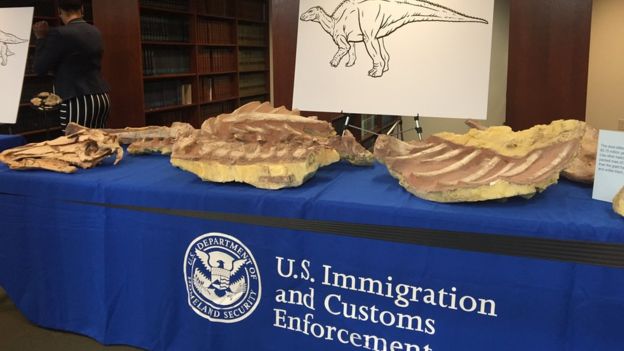
US Immigration and Customs Enforcement has seized $44m worth of dinosaur fossils over the last five years. BOLORTSETSEG MINJIN

The 70 million-year-old skull of a Tyrannosaurus bataar, an Asian relative to Tyrannosaurus rex, that actor Nicolas Cage bought at auction in the US in 2012, was later reclaimed by the Mongolian government, for example.

Yet the palaeontologist who won that legal battle, Bolortsetseg Minjin, says despite the Mongolian government's determination to stem the flow there are still plenty of new cases of poaching, which she says risk causing irrevocable damage to the specimens.

"Poachers don't have skills and only go for the parts that'll make them money, like destroying whole skeletons just for teeth," she says. "It's treating them like a commodity but these fossils are priceless."

Private buyers might not realise it, she says, but unless they are sure of a fossil's provenance, buying it could indirectly be causing harm by fuelling that black market trade.

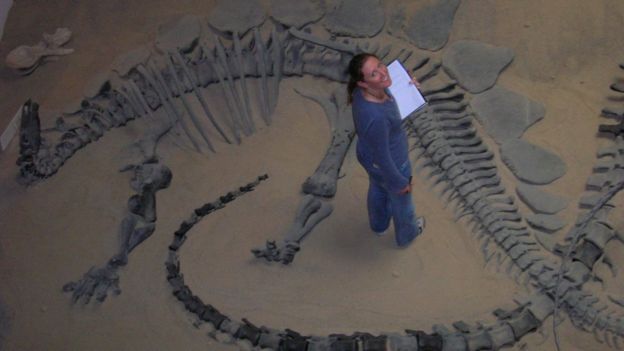
Bolortsetseg Minjin has fought to repatriate more than 30 fossils originally excavated in Mongolia. BOLORTSETSEG MINJIN

The booming private market can have a knock-on negative effect even when legal, says Dr Susannah Maidment from the Earth Sciences department of London's Natural History Museum.

"The problem is these specimens go on sale for huge amounts of money, far more than museums can afford.

"Our acquisition budget for specimens across the entire museum, not just palaeontology, amounts to tens of thousands of pounds annually. But many of these big dinosaur specimens will sell for well over a million dollars," she explains.

When specimens are privately owned that can act as a barrier to scientific research, she argues.

Dr Maidment studying a Stegosaurus specimen at the Prehistoric Museum in Price, Utah. DR SUSANNAH MAIDMENT

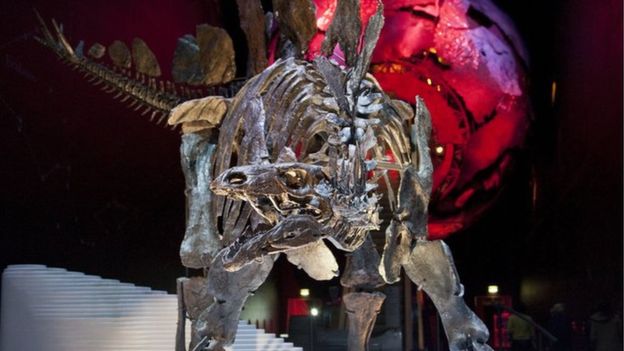
One of the London Natural History Museum's prize exhibits is Sophie, a 151 million-year-old complete Stegosaurus skeleton. Before the museum acquired it, no-one actually knew how many bones there were in the backbone of a Stegosaurus or how many plates it had along its spine, says Dr Maidment.

The museum, like many other scientific institutions, won't research or publish work on privately-owned specimens as a matter of principle, because scientific rigour relies on replicating research. A private owner may allow one researcher to examine their fossil but then might refuse access to others.

On the other hand, the process of exploration and excavation is labour intensive and expensive.

"It's a conflict because we don't have the resources to collect these ourselves, and we wouldn't know about them if commercial dealers weren't digging them up," Dr Maidment says.

Yet when the purpose of the excavation is private profit there's the risk that gathering essential contextual data will be neglected, she adds.

Sophie the Stegosaurus is one of the London Natural History Museum's prize exhibits. GETTY IMAGES

Mr Hyslop argues we shouldn't demonise private buyers as if they were "a Bond villain who's sitting on his dinosaur bones and never letting anyone else look at them". Many private buyers are happy for their items to be displayed and studied, he points out.

But often the problem is on a much simpler level, says Dr Matthew Carrano, curator of Dinosauria at The Smithsonian in Washington - that new discoveries may just be missed altogether.

With the rate of dinosaur discoveries showing no sign of slowing, he says a private find may slip under the radar as "there's no catalogue or account of them aside from the occasional high-profile example that might make the news.

"The rest are sold and bought without any publicity and just disappear into private hands, often without science knowing they exist."

Source: www.bbc.com

Dinosaur Egg Bonanza Gives Vital Clues About Prehistoric Parenting

Monday, August 12, 2019

Therizinosaurus by PaleoGuy on DeviantArt

Perhaps the most amazing thing about fossils is that they don’t just show us what extinct animals looked like, they can also reveal how those animals lived. Even a fossilised dinosaur egg can provide a wealth of clues about its parents’ behaviour.

Dinosaur hunters in the Javkhlant region of the Gobi Desert in Mongolia recently discovered 15 exceptionally well preserved clutches of eggs that came from a species of theropod dinosaur. Through some fantastic detective work, the researchers argue that this fossil site provides the strongest evidence yet that such dinosaurs nested in colonies and protected their eggs.

I’m a behavioural ecologist. I study how animals live their lives and how species fit together in ecosystems. We can uncover the behavioural ecology of past species and ecosystems by using fossils and our knowledge of animals and habitats today. In this case, I suggest that these dinosaurs may have protected their eggs as a community rather than caring solely for their own nests. It is also possible that these dinosaurs didn’t need to care for their young once they had hatched.

The spherically-shaped eggs were found in clutches of between three and 30 eggs in what was a seasonally arid flood plain. They were laid towards the end of the Cretaceous period around 66m years ago, not long before the dinosaurs disappeared.

The eggs are between 10cm and 15cm in diameter, similar in size to those of the largest living bird species, the ostrich. By comparing the eggs with fossilised embryonic remains in other eggs, the scientists identify that these specimens likely came from the Therizinosauroidea family.

The shells of the eggs have a high porosity, meaning they contain lots of tiny holes. The researchers looked at how this compares to the eggs of living species. We know these dinosaurs lived in a dry, arid environment, and animals in these habitats (such as ostriches) typically lay eggs with few pores in order to minimise water loss.

Instead, the high porosity of the Javkhlant eggshells is similar to those of Australasian megapode birds such as the mallee fowl, and crocodilians. These species cover or bury their eggs in organic-rich material, which generates heat as it rots, in order to incubate the eggs. The high porosity of the Javkhlant eggs suggests these dinosaurs did the same because the pores would have made it easier for the developing embryo to breathe in the damp, oxygen-poor environment of rotting vegetation.

The fossils also indicated that all the eggs were laid and hatched in the same nesting season, providing evidence that the dinosaurs nested in colonies. About 60% of them hatched successfully, a relatively high hatching rate similar to that of modern birds and crocodilians that protect their eggs. This supports the argument that these dinosaurs also looked after their nests.

‘Big Mama’ Oviraptor brooding egg clutch – parental care in action?  Ghedoghedo/Wikimedia Commons

Evidence for dinosaur parental care most famously comes from a fossil of what was thought to be a mother Oviraptor found sitting on a nest of eggs. New understanding of dinosaur skeletons suggests this “Big Mama” should actually be renamed “Big Papa”. Male (paternal) care may have been the ancestral form of parental care, with birds evolving from theropod dinosaurs (birds are avian dinosaurs). In the most primitive group of living birds (including the ostrich) it is usually the male birds that sit on eggs.

However, in the case of our Therizinoid dinosaurs, we think the eggs were buried, which would mean the parents wouldn’t need to sit on them for incubation. But that doesn’t mean they abandoned the eggs completely.

Modern megapode bird and crocodilian species that abandon or rarely attend their eggs after laying and burying them have relatively low hatching success rates (under 50%) because of predators attacking the nests. But, as we’ve seen, the Javkhlant eggs had a higher hatching rate of 60%.

Communal breeding

If the adult dinosaurs didn’t physically incubate their eggs but did protect the nests at a communal site, this could indicate communal defence of the eggs or communal breeding, whereby individuals provide “alloparental” care for the offspring of others.

However, megapode chicks are superprecocial. This means when they hatch they can survive completely independently and so don’t receive any (post-hatching) parental care. So, while the high hatching success indicates these dinosaurs looked after their eggs, it may be that they didn’t need to protect their young once they did hatch.

Unfortunately, the constraints of the fossil record mean it would be very difficult to find direct evidence of communal breeding and cooperative care in dinosaurs. We would need evidence of more than two adults caring for a single brood, or of one adult caring for more eggs than could be laid in a single clutch.

Whatever future fossil finds serve up, there is no question that they will open more windows of understanding into the behavioural ecology of long-extinct dinosaurs. Our understanding will also be informed, not only by the fossils themselves, but by interpretation of the behaviour of modern species. The behavioural dynamics of dinosaur ecosystems were not so different from those of today.

Source: https://theconversation.com

Meet Ngwevu intloko, New Jurassic Dinosaur from South Africa

Wednesday, August 7, 2019

The skull of Ngwevu intloko. Image credit: Kimberley Chapelle.

A new genus and species of sauropodomorph dinosaur has been described — after its fossilized remains spent more than three decades sitting in a museum.

The newly-identified dinosaur species, named Ngwevu intloko, lived between 191 and 201 million years ago (Early Jurassic period) in what is now South Africa.

The ancient creature was bipedal with a fairly chunky body, a long slender neck and a small, boxy head.

It would have measured 10 feet (3 m) from the tip of its snout to the end of its tail and was likely an omnivore, feeding on both plants and small animals.

Ngwevu intloko’s fossilized remains were collected in 1978 by paleontologist Professor James W. Kitching.

Professor Paul Barrett and colleagues reassessed the specimens, which are held at the University of Witwatersrand, Johannesburg.

They used the dinosaur’s distinctive skull and partial skeleton to identify it as a new genus and species of sauropodomorph.

“Lots of other scientists have already looked at it. But they all thought that it was simply an odd example of Massospondylus, one of the first dinosaurs to reign at the start of the Jurassic period,” Professor Barrett said.

Ngwevu intloko would have looked similar to Massospondylus carinatus seen here. Image credit: Nobu Tamura, spinops.blogspot.com / CC BY 3.0.

The findings will help paleontologists better understand the transition between the Triassic and Jurassic periods, around 200 million years ago.

Known as a time of mass extinction it now seems that more complex ecosystems were flourishing in the earliest Jurassic than previously thought.

“This new species is interesting, because we thought previously that there was really only one type of sauropodomorph living in South Africa at this time,” Professor Barrett said.

“We now know there were actually six or seven of these dinosaurs in this area, as well as variety of other dinosaurs from less common groups. It means that their ecology was much more complex than we used to think.”

“Some of these other sauropodomorphs were like Massospondylus, but a few were close to the origins of true sauropods, if not true sauropods themselves.”

The team’s work appears online in the journal PeerJ.

_____

K.E.J. Chapelle et al. 2019. Ngwevu intloko: a new early sauropodomorph dinosaur from the Lower Jurassic Elliot Formation of South Africa and comments on cranial ontogeny in Massospondylus carinatusPeerJ 7:e7240 https://doi.org/10.7717/peerj.7240

Source: www.sci-news.com

Heracles inexpectatus: World’s Largest Parrot Lived 19 Million Years Ago in New Zealand

Thursday, August 8, 2019

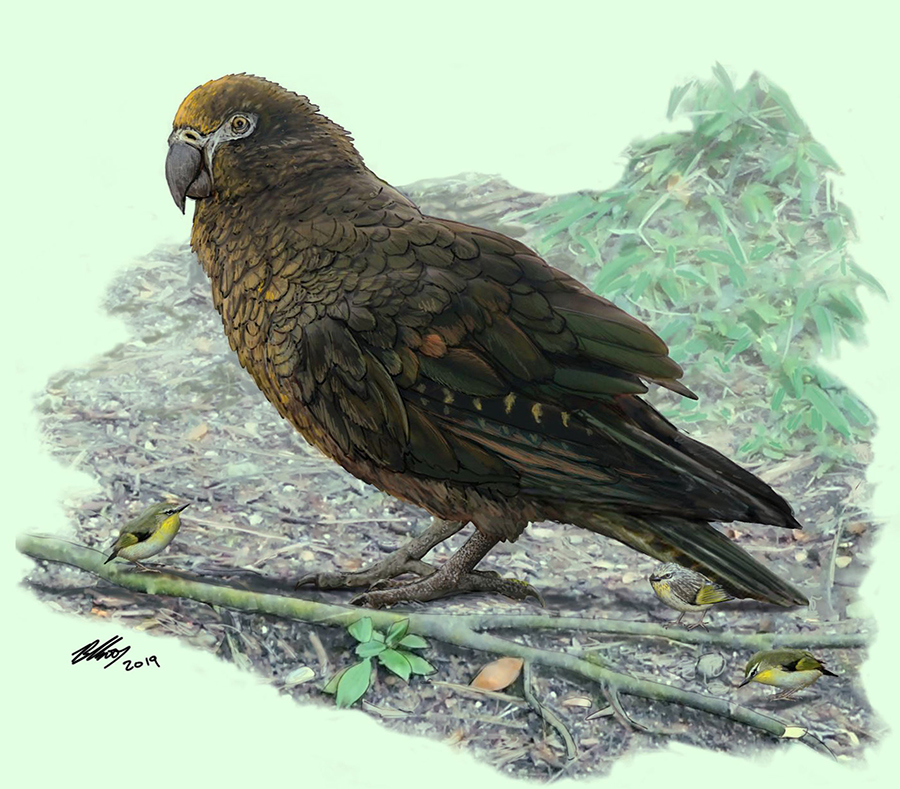
Reconstruction of Heracles inexpectatus, dwarfing a bevy of 3.1-inch (8 cm) high Kuiornis — small New Zealand wrens scuttling about on the forest floor. Image credit: Brian Choo, Flinders University.

An international group of paleontologists has found two incomplete bones from an ancient parrot with a mass of 7 kg, double that of the heaviest known parrot, the kakapo (Strigops habroptila).

Named Heracles inexpectatus, the giant parrot lived in New Zealand about 19 million years ago (Miocene epoch).

The bird was about 3.3 feet (1 m) tall and had an estimated mass of about 7 kg.

Like the kakapo, it was a member of an ancient New Zealand group of parrots that appear to be more primitive than parrots that thrive today on Australia and other continents.

“New Zealand is well known for its giant birds,” said Dr. Trevor Worthy, a paleontologist Flinders University.

“Not only moa dominated avifaunas, but giant geese and adzebills shared the forest floor, while a giant eagle ruled the skies. But until now, no-one has ever found an extinct giant parrot — anywhere.”

Heracles inexpectatus tibiotarsi: holotype (a, b, f) and paratype (g), compared to (d, e) left tibiotarsus of Strigops habroptila, in craniolateral (a) and cranial (b-g) views; (c) silhouettes of a human and Heracles inexpectatus for scale. Scale bars – 2 cm. Abbreviations: ccl – crista cnemialis lateralis, cl – condylus lateralis, cm – condylus medialis, dtl – distal insertion scar for transverse ligament, fc – fibular crest, lfr – lateral scar for fibular retinaculum, lic – linea intermuscularis cranialis, mfr – mediocranial scar for fibular retinaculum, pons – pons supratendineus, ptl – proximal insertion scar for transverse ligament, se – sulcus extensorius, sf – sulcus m. fibularis, trf – tuberculum retinaculi m. fibularis. Image credit: PhyloPic / T.M. Keesey / Worthy et al, doi: 10.1098/rsbl.2019.0467.

The fossilized bones of Heracles inexpectatus were found near St Bathans in Central Otago, New Zealand, in an area well known for a rich assemblage of Miocene birds.

Heracles inexpectatus, as the largest parrot ever, no doubt with a massive parrot beak that could crack wide open anything it fancied, may well have dined on more than conventional parrot foods, perhaps even other parrots,” said University of New South Wales’ Professor Mike Archer.

“Its rarity in the deposit is something we might expect if it was feeding higher up in the food chain. Parrots in general are very resourceful birds in terms of culinary interests.”

“New Zealand keas, for example, have even developed a taste for sheep since these were introduced by European settlers in 1773.”

Heracles inexpectatus lived in a diverse subtropical forest where many species of laurels and palms grew with podocarp trees.

“Undoubtedly, these provided a rich harvest of fruit important in the diet of Heracles inexpectatus and the parrots and pigeons it lived with. But on the forest floor the giant bird competed with adzebills and the forerunners of moa,” said Professor Suzanne Hand, also from the University of New South Wales.

“The St Bathans fauna provides the only insight into the terrestrial birds and other animals that lived in New Zealand since dinosaurs roamed the land more than 66 million years ago,” added Dr. Paul Scofield, senior curator at Canterbury Museum, Christchurch.

The research is published in the journal Biology Letters.

_____

Trevor H. Worthy et al. 2019. Evidence for a giant parrot from the Early Miocene of New Zealand. Biol. Lett 15 (8); doi: 10.1098/rsbl.2019.0467

Source: www.sci-news.com

Plant Fossils Reveal Temperatures in North America During the Cretaceous Period

Tuesday, August 6, 2019

A team of paleontologists led by McGill University uncovered fossil plants in eastern Canada that have produced the first quantifiable evidence of the region’s climate during the Cretaceous period.

Combined with specimens collected in previous expeditions, the newly discovered fossilized remains are giving experts unprecedented insight into a time when dinosaurs still dominated the planet.

The McGill team discovered the ancient plant samples last August in a remote area of Labrador. Some of the remains represent species that have never been found in this region before.

In the late 1950s, paleontologists theorized that the Cretaceous climate of Quebec and Labrador was far warmer than it is today based on fossilized leaves and insects. The current study has now confirmed this theory based on the Climate Leaf Analysis Multivariate Program (CLAMP), which is used to predict a variety of climate statistics for a given fossil flora. CLAMP measures variables such as temperature and precipitation based on the shape and size of tree leaves.

Under the supervision of Professor Hans Larsson, graduate student and study first author Alexandre Demers-Potvin analyzed the plant fossils and determined that eastern Canada had a warm, temperate, and humid climate during the middle of the Cretaceous period.

The experts found that the average annual temperature in this part of Canada was 59 degrees Fahrenheit, with an average summer temperature of over 68 degrees Fahrenheit.

According to Demers-Potvin, the new work provides insight into how the climate of eastern Canada evolved over time, which will be useful information for studying climate change today.

“The fossils from the Redmond mine show that an area that is now covered by boreal forest and tundra used to be covered in warm temperate forests in the middle of the Cretaceous, one of our planet’s ‘hothouse’ episodes,” said Demers-Potvin. “These are new pieces of evidence that can help improve projections of the global average temperature against global CO2 levels throughout the Earth’s history.”

The study is published in the journal Palaeontology.

Source: https://www.earth.com

Study: Dinosaur Feathers Evolved for Sexual Display

Tuesday, August 6, 2019

Persons & Currie explored how feathers went from dinosaur insulation to enabling flight. Image credit: Zhao Chuang / Martin Kundrát.

New research, published recently in the journal Evolution, shows that some dinosaurs may have taken flight thanks to sex appeal.

Modern bird feathers are complicated: the feathers on a bird’s wing each have a central hollow shafted called a rachis, branching filaments called barbs, and even smaller filaments called barbules.

Fossil feathers show us that many dinosaurs were covered only in simple hair-like feathers. Those simple hairy feathers served as insulation and had absolutely nothing to do with flight.

But it has been unclear how simple feathers later developed into complicated feathers on wings.

“The first complex wing feathers show up in tiny raptor dinosaurs that could parachute and glide flying-squirrel-style through the prehistoric tree tops,” said study lead author Dr. Scott Persons, a researcher at the Mace Brown Museum of Natural History.

“We explored how dinosaurs went from staying warm with simple hairy feathers to gliding on complicated wing feathers.”

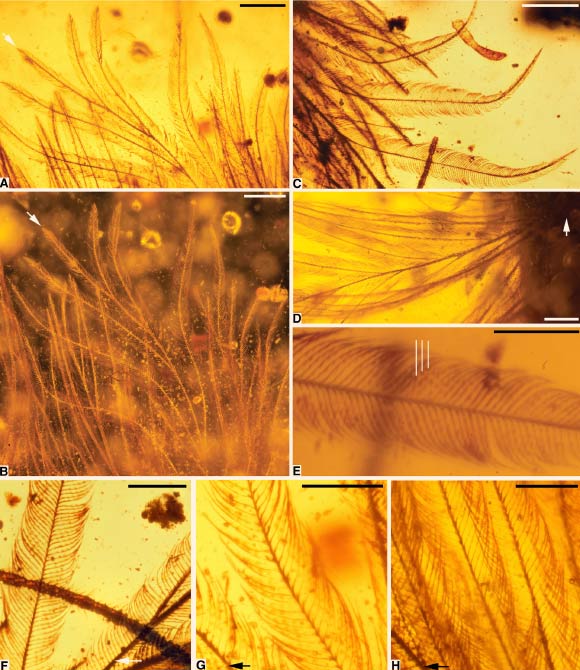
A feathered tail of a coelurosaur preserved in mid-Cretaceous amber from Kachin State, Myanmar. Image credit: Lida Xing et al, doi: 10.1016/j.cub.2016.10.008.

Dr. Persons and University of Alberta’s Professor Philip Currie found that larger, stiffer, flatter feathers gradually evolved as showy fans on the arms and tails of dinosaurs to be waved and waggled in courtship displays, leading eventually to the evolution of birds.

“The evolution of avian flight is one of the most important transitions in vertebrate evolution,” Dr. Persons said.

“There are now over 10,000 species of birds, and birds were the only group of dinosaurs to survive the mass extinction.”

“The extraordinary success of birds is tied to their ability to fly. But, to evolve into complex flight feathers, traditional natural selection needed a boost from sexual selection. Effectively, sexual selection led to an increased complexity, which bridged the gap from one function to another.”

“Recognizing that critical contribution teaches us something fundamental and important about the evolutionary process. The implications go way beyond the single example of dinosaurs and feather evolution.”

Photomicrographs of coelurosaur feathers: (A) pale ventral feather in transmitted light (arrow indicates rachis apex); (B) dark-field image of (A), highlighting structure and visible color; (C) dark dorsal feather in transmitted light, apex toward bottom of image; (D) base of ventral feather (arrow) with weakly developed rachis; (E) pigment distribution and microstructure of barbules in (C), with white lines pointing to pigmented regions of barbules; (F–H) barbule structure variation and pigmentation, among barbs, and ‘rachis’ with rachidial barbules (near arrows); images from apical, mid-feather, and basal positions respectively. Scale bars – 1 mm in (A), 0.5 mm in (B)–(E), and 0.25 mm in (F)-(H). Image credit: Lida Xing et al, doi: 10.1016/j.cub.2016.10.008.

While the study sheds new light on the evolutionary steps leading from dinosaurs to birds, there are still rich paleontological mysteries to explore concerning fossil feathers.

“We are still missing clear examples of sexually dimorphic feathers in dinosaurs. Today, it’s easy to tell the sexes of many birds apart based on their feathers,” Dr. Persons explained.

“Male birds tend to have larger, gaudier, and brighter feathers because they are the ones doing the displaying,” he said.

“This was very likely true of feathered dinosaurs, but we haven’t found a definitive example… yet.”

_____

W. Scott Persons & Philip J. Currie. Feather evolution exemplifies sexually selected bridges across the adaptive landscape. Evolution, published online July 30, 2019; doi: 10.1111/evo.13795

Source: http://www.sci-news.com

About a Dozen Triceratops Skulls Found in ND

Monday, August 5, 2019

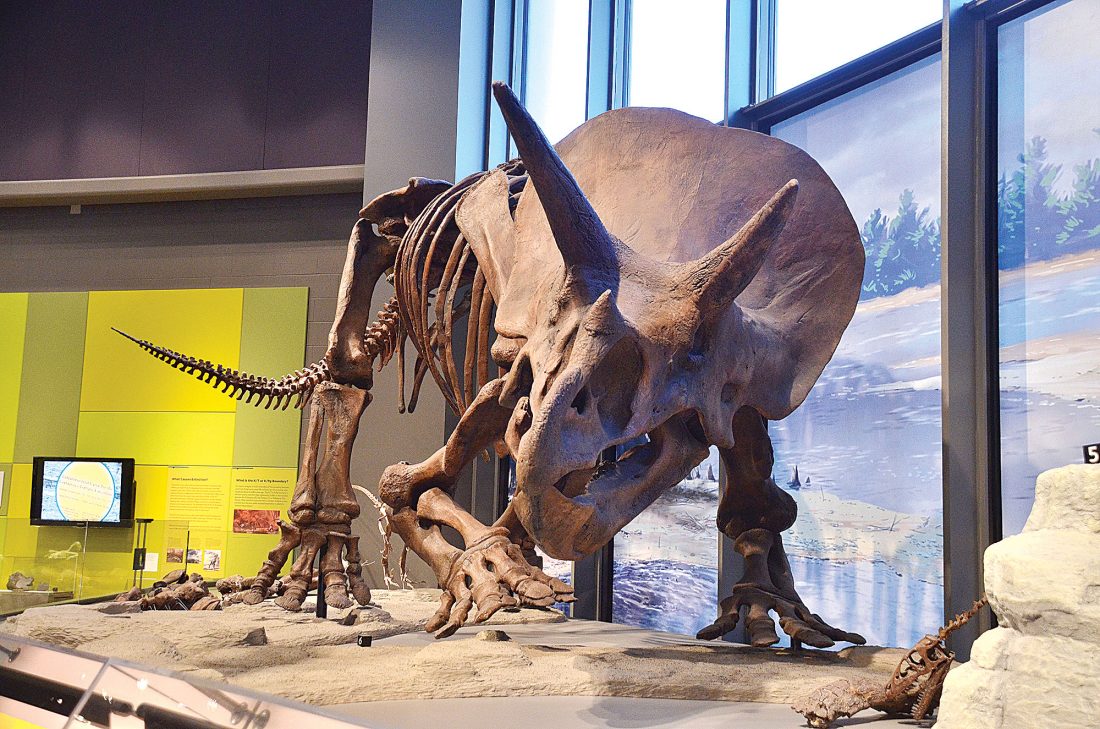
Eloise Ogden/MDN This cast of a Triceratops horridus skeleton is displayed in the North Dakota Heritage Center & State Museum in Bismarck. The exhibit is in the Adaptation Gallery: Geologic Time.

A California college student who found a 65-million-year-old Triceratops skull in the North Dakota Badlands made state and national news recently.

“Finding good skulls is difficult,” said Clint Boyd, senior paleontologist with the North Dakota Geological Survey.

He said Triceratops are rather common in the Hell Creek Formation and finding bones of the Triceratops in various places is not unusual.

The formation stretches over portions of North Dakota, Montana, South Dakota, and Wyoming.

Boyd said about a dozen Triceratops skulls have been found in the state. These are the result of work by the N.D. Geological Survey, U.S. Forest Service and others.

Eloise Ogden/MDN This Triceratops brow horn found in the Hell Creek Formation is in the North Dakota Heritage Center & State Museum display in Bismarck. “Triceratops had three horns that were used for protection from predators and probably for fighting rivals to establish dominance and attract mates,” the exhibit information says.

The North Dakota Heritage Center & State Museum in Bismarck has an exhibit on the Triceratops in its Adaptation Gallery: Geologic Time. Other places with Triceratops skulls displayed include the University of North Dakota, Grand Forks. The Badlands Dinosaur Museum in Dickinson has a Triceratops skull recovered across the state line at Baker, Mont.

The Barnes County Historical Society Museum in Valley City has on display Gundy, an 18-foot replica of a fossilized Triceratops found in the Hell Creek Formation in South Dakota. Gundy replaces Bob, a 26-foot-long Triceratops, displayed at the museum for a time. Bob was found in the Hell Creek Formation in southwest North Dakota and considered the largest or one of the largest and most complete Triceratops ever found.

Sixty-five million years ago western North Dakota was a large delta with Triceratops and other dinosaurs plus other exotic animals living in subtropical environment.

The Triceratops was one of the largest and heaviest of the plant-eating horned dinosaur. It would be larger than the biggest African elephant today, growing to 30 feet long and weighing as much as 5 tons, according to North Dakota Geological Survey information. The Triceratops’ most distinguishing feature was its huge skull with imposing horns and large bone frill.

Harrison Duran, a biology student at the University of California-Merced, made the discovery of the Triceratops skull when he was working with Michael Kjelland, a professor at Mayville State University, at a dig site on private land in the N.D. Badlands in June. The skull has been given the name “Alice,”according to news reports.

The N.D. Geological Survey, with headquarters in Bismarck, conducts fossil digs usually from late June through mid-August. For more information visit the N.D. Geological Survey website at https://www.dmr.nd.gov/ndfossil/digs/

Source: www.minotdailynews.com

Pages