Blogs

New Insight Into the Evolution of Sight From 54 Million Year-Old Fossil
Friday, August 16, 2019

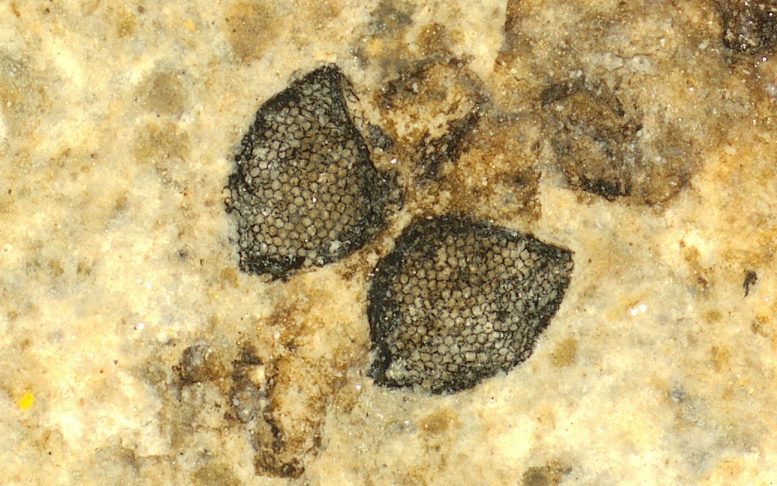
Eyes surprise: fossil eyes from a 54 million-year-old cranefly. Credit: Lindgren et al./Nature

Fossilized flies that lived 54 million years ago have revealed a surprising twist to the tale of how insects’ eyes evolved. These craneflies, unveiled in Nature today, show that insect eyes trap light the same way as human eyes, using the pigment melanin – yet another example of evolution finding similar solutions to similar problems.

Evolutionary biologists have always been fascinated by eyes. Charles Darwin, anticipating the skeptics, devoted a long explanation of how random mutation followed by natural selection could readily fashion such “organs of extreme perfection”. It is not surprising that these useful adaptations have evolved repeatedly across the animal kingdom – octopuses and squids, for instance, have independently acquired eyes uncannily similar to ours.

Vision is so vital that most animals today have photoreceptors of some kind. Notable exceptions include creatures that live in total darkness, such as in caves or the deep ocean.

Yet the fossil record of eyes is very poor. The rock record generally preserves hard parts such as bones and shells. Eyes and other soft tissues, such as nerves, veins, and intestines, are preserved only under exceptional circumstances.
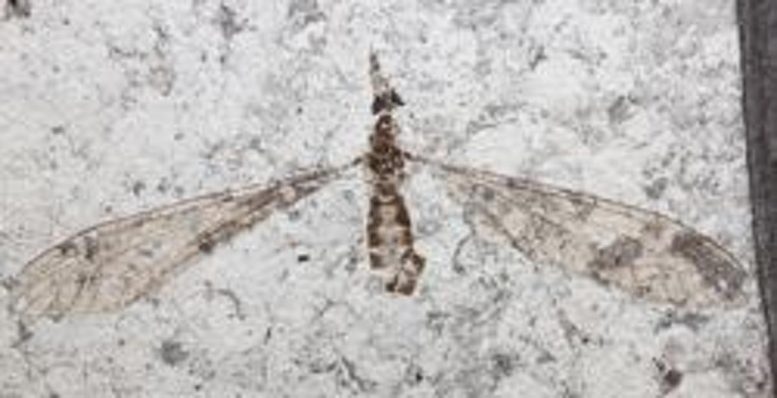
54-Million-Year-Old-Cranefly

Exceptionally preserved insect fossils

Because eyes are icons of evolution yet rarely fossilized, the discovery of perfectly preserved eyes from 54 million-year-old insects is noteworthy. In their new study, researchers led by Johan Lindgren of Lund University in Sweden collected and analyzed eyes from 23 craneflies – long-legged relatives of pesky houseflies.

The fossils were exquisitely preserved in sediments containing high levels of fine-grained volcanic ash. They were unearthed in what is now chilly Denmark, but back then was a tropical paradise with abundant insect life.

The fossilized eyes were surprisingly similar to our own eyes in one important way. The back of our eyeball, called the choroid, is dark and opaque; this protects against ultraviolet radiation and also stops stray light bouncing around and interfering with vision. In human eyes, this anti-reflective layer contains high levels of the pigment melanin, the same molecule involved in skin pigmentation (hence terms such as “melanoma”).

Insects, too, have dark anti-reflective layers in their eyes, but this was long thought to consist entirely of a different molecule, ommochrome. Given that insect eyes arose independently from our own and have an entirely different structure, it seems reasonable that their molecular machinery would also be different.

Eyes like our own?

However, detailed chemical analysis of the fossil cranefly eyes revealed that they contained human-like melanin. When the researchers had another look at the eyes of living craneflies, they were surprised to confirm the presence of melanin (as well as lots of ommochrome). It took fossils to alert us that the eyes of humans and insects both use the same shielding pigments (melanin) – yet another example of convergent evolution.

Intriguingly, the outer layers of the fossilized eyes were full of calcite, the mineral that makes up most of limestone. Not only that, but crystals in the calcite were aligned to transmit light efficiently into the eye. Yet this apparent fine engineering (a mineralized outer eye layer optimized to transmit light) was almost certainly caused by the fossilization process, as the eyes of living craneflies are not mineralized.

While the fossil record can reveal, it can also mislead, if not interpreted carefully. Trilobites, the hard-shelled crab-like creatures that are among the most abundant and diverse animal fossils, are frequently found with mineralized, light-transmitting outer eye layers. These have usually been assumed to faithfully reflect their life condition: predation in ancient oceans was so intense that trilobites even armored their eyeballs.
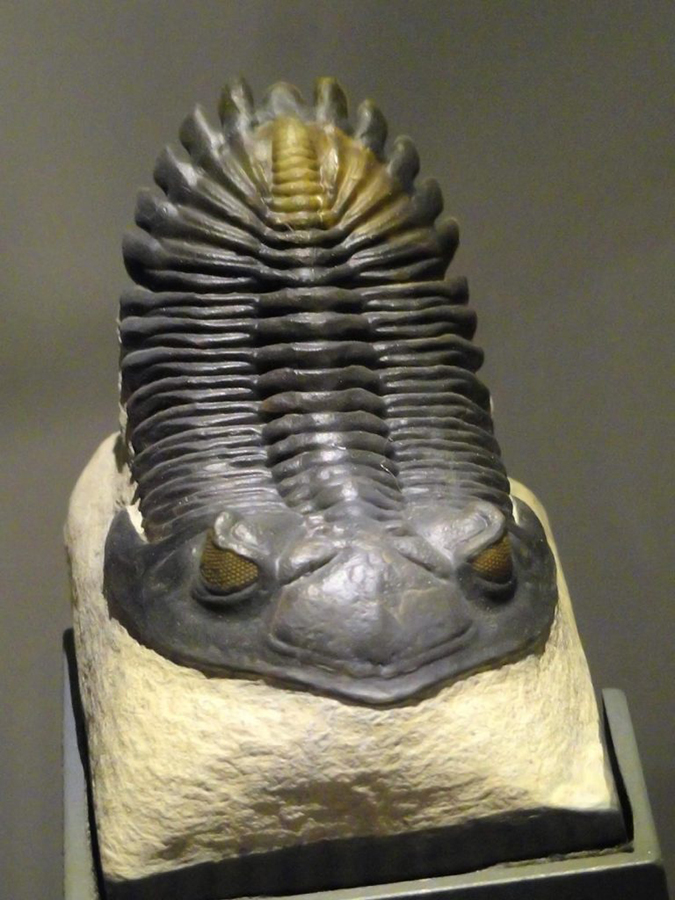
The 400-million-year old trilobite Hollardops mesocristata is widely thought to have had mineralized eyes. Credit: Daderot / Wikimedia Commons

Lindgren and colleagues warn against this interpretation: perhaps the trilobite’s “protective goggles” only appeared after fossilization, just as in the craneflies. However, this interpretation will likely be debated. Trilobite eyes seem to have been unusually rigid and resilient in real life, as they are preserved in three dimensions much more often than eyes of other animals. They also have certain optical properties that make more sense when the rigid outer layer is accepted as real.

A disagreement between a few paleontologists might seem a bit arcane, but these debates can have real-world relevance. Most famously, the concept of nuclear winter was directly inspired by discussion of how the dinosaurs went extinct, when a meteorite impact enveloped the world in a cloud of dust, deep-freezing the entire biosphere.

Granted, the debate over how insect and trilobite eyes functioned is unlikely to influence world peace, but it might still have useful applications. For example, the way trilobite lenses (apparently) provide constant acuity while being totally rigid has inspired bioengineers to fashion high-performance optical devices with uses spanning microscopy to laser physics.

Source: https://scitechdaily.com
STOP Believing These Eight Myths about Dinosaurs

Friday, August 16, 2019

Check out these myths about dinosaurs you probably still believe!

There is so much to learn about the extraordinary creatures who once upon a time were the kings of the world. Even after 200 years since the first dinosaur was found and dug up, we don’t know nearly enough about those scary and enigmatic creatures. Therefore, there are so many misinformation on dinosaurs.

Here are some of the myths about dinosaurs that we shouldn’t believe in.

Myth Number 1 – Dinosaurs are Extinct

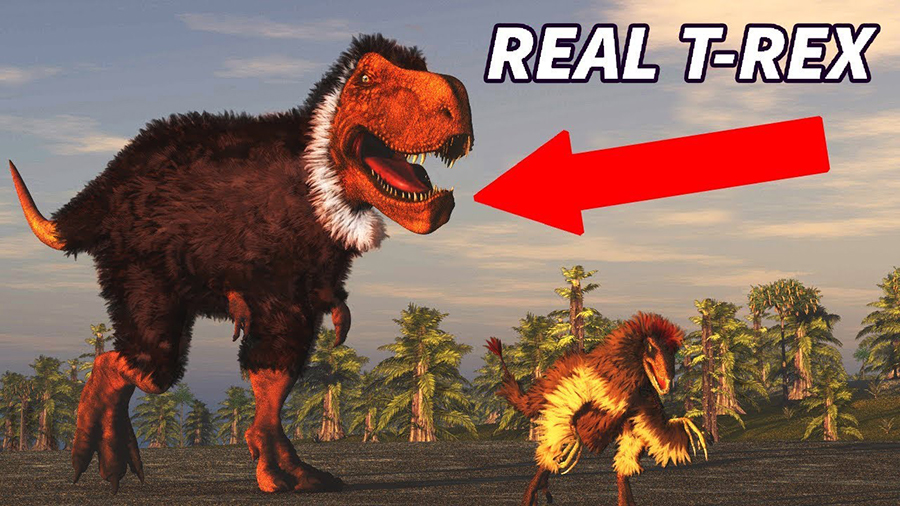
Alright, you won’t find a dinosaur like in the photo above walking down Broadway Avenue, but dinosaurs are not completely extinct. Despite the devastating meteorite that hit the Yucatan peninsula 65 million years ago, dinosaurs are not entirely wiped from the face of the planet Earth. Believe it or not, every bird is a dinosaur. Crazy, right?

Myth Number 2 – Cold-Blooded Dinosaurs

The usual depiction of dinosaurs is that they are large, cold-blooded monsters. However, the truth is more complicated than that. From bone examinations, we found out that their metabolisms were so fast, and a dinosaur could not rely on the sun for body heat. The question is how they produced heat? It’s a mystery since there are a lot of different ways to keep body heat.

Myth Number 3 – Dinosaurs Were Scaly

Some dinosaurs were scaly but some were not. Based on the impression of their skin, we can say that not all dinosaurs were scaly. Some even had feathers. Those were times when the distinction between birds and dinosaurs was not clear. So, in conclusion, Jurassic Park is not telling us the whole truth about the amazing world of dinosaurs.

Myth Number 4 – Dinosaurs Were Brown or Green

Believe it or not, we know the colors of some dinosaurs and they were not all green or brown as depicted in Hollywood movies. Some dinosaurs were red, white, black and other colors. Also, they didn’t necessarily have one color. Some dinosaurs even had raccoon-like tales.

Myth Number 5 – Not All Dinosaurs Were Around at the Same Time

Think about the two most famous dinosaurs: Tyrannosaurus rex and Stegosaurus. One was a giant meat-eater and the other one was a plant-eater with a lot of dangerous defensive spikes. However, they never crossed each other’s paths.

Myth Number 6 – Dinosaurs Were a Failure of Evolution

When someone is not up to speed with today’s modern world, what do we call them? A dinosaur. Even worse, if someone is slow or bad at what they do, we might call them a dinosaur. This is not fair. Dinosaurs ruled the world for approximately 186 million years. We, humans, are “ruling” the world for only the past 300,000 years. We have 185.7 million years ahead of us before we can make fun of dinosaurs or before we consider them to be an evolutionary failure.

Myth Number 7 – All Dinosaurs Were Giants

The skeletons and fossils of giant dinosaurs were the first ones that caught our attention. Now, that we know what we are looking for, we are finding dinosaurs of all sizes and shapes. Some dinosaurs were as huge as a passenger airplane, but some were as small as a pigeon.

Myth Number 8 – Mammals Evolved After Dinosaurs Died Out

It’s our understanding that mammals evolved from a reptile which we call the cynodont and it looked like a scaly rat and lived 200 million years ago, which is way before dinosaurs. Mammals diversified into two lines of evolution: marsupial and placental line, which happened approximately 165 million years ago. Mammals lived in the world of dinosaurs but once the non-bird dinosaurs were wiped out from the Earth, mammals started to diversify, grow to a bigger size and spread around the world. It’s hard to say if we would be here if dinosaurs had stayed around.

Source: www.gildshire.com

Dinosaur Virus Proof as 98 Million Year-Old Infection Found in Cockroaches

Saturday, August 17, 2019

A group of experts – including a Brit – unearthed the virus from creatures preserved in amber.

Scientists may have uncovered proof of viruses in dinosaurs after a 98 million year-old infection was found in cockroaches preserved in amber.

The team of palaeontologists, led by Dr Peter Vrsansky of the Slovak Academy of Sciences and made up of experts from Slovakia, China, Germany and Singapore, found evidence of the virus in now-extinct predatory cockroaches preserved in Cretaceous Myanmar amber.

The British scientist who was part of the team is Edmund Jarzembowski.

The team discovered perfectly-preserved now-extinct predatory cockroaches preserved in Cretaceous Myanmar amber.

One cockroach from the newly-found species, named Stavba babkaeva, displays an undeveloped hindwing and symmetrically deformed curled forewings. 

These are symptoms of Deformed Wing Virus infection caused by pathogenic DWV-Iflavirus.

The virus still exists today and is known to affect honey bees. 

Although the specimens found dated back 98 million years, the virus may be much older. 

The oldest ever recorded viral infection was discovered on a Mesozoic dinosaur bone. 

Vrsansky told Central European News: "That one piece of evidence is not convincing on its own. Definitely, this is a prove of viruses in times of dinosaurs, their time was a time with parasites and viruses."

Based on his discovery, Vrsansky told CEN that viruses may actually be beneficial to us, "otherwise they will be extinct a long time ago".

He said: "It seems they represent another key player in the evolution causing robustness of its bearers in geological time. 

"All organisms bear them, so it seems they help the system of modern organism genomes to be more stable against mistakes and errors." 

He added: "Most of the researchers expected that viruses are old, but here comes the prove with a specific virus ((+)ssRNA Iflavirus) known to cause these symptoms. Thus dino times forests were not only diverse, but also structured in a modern way, although without true flowering trees." 

Vrsansky adds that it is impossible to ascertain when exactly viruses originated, as we only have amber containing arthropods dating back to the Triassic Period. 

The team's findings were published in May this year in the journal Palaeontographica. 

Source: www.dailystar.co.uk

Study Details Dinosaur Brain Development From Baby to Adult

Friday, August 16, 2019

Scientists use 3D models of dinosaur skulls to better understand the relationship between braincase development and posture change. Photo by Claire Bullar/University of Bristol

By surveying dozens of skulls of a common Early Cretaceous dinosaur, scientists have gained new insights into dinosaur brain development.

Psittacosaurus was a genus of extinct dinosaur living in Asia between 126 and 101 million years ago. Over the decades, hundreds of specimens have been recovered. The genus was part of the group of dinosaurs known as Ceratopsia, the group to which the genus Triceratops belonged.

Psittacosaurus was a beaked plant-eater, and the dinsoaur birthed tiny, hamster-sized babies. As adults, Psittacosaurus dinosaurs reached lengths of 6.5 feet.

To better understand the effect of this maturation process on the dinosaur's brain, scientists used 3D models to animate the changing shape of the it's braincase.

The new survey revealed that, as the baby dinosaurs developed, their brains changed shape and location, shifting from the back of the small, rounded head, to the front. As the dinosaurs grew, their heads and brains stretched out and became more elongated, extending under the skull roof in the adults.

Analysis of the changing brain position also revealed a change in the developing dinosaur's locomotion. The evidence suggests Psittacosaurus babies spent their earliest years on all fours, but by the age of two or three, they assumed a bipedal posture.

"I was excited to see that the orientation of the semi-circular canals changes to show this posture switch," Claire Bullar, researcher at the University of Bristol, said in a news release. "The semi-circular canals are the structures inside our ears that help us keep balance, and the so-called horizontal semi-circular canal should be just that -- horizontal -- when the animal is standing in its normal posture."

The braincases of adolescent Psittacosaurus dinosaurs showed the maturing dinos were pointing their heads forward, not downward. In other words, by the time they were a few years old, they were standing up.

"This posture shift during growth from quadruped to biped is unusual for dinosaurs, or indeed any animal," said Michael Ryan, a scientist at Carleton University in Canada. "Among dinosaurs, it's more usual to go the other way, to start out as a bipedal baby, and then go down on all fours as you get really huge."

The findings -- published in the journal PeerJ -- suggest Psittacosaurus babies were fairly vulnerable. Being on all fours allowed the dinosaurs to keep out of site under brush. As the dinosaurs got older and bigger, bipedalism allowed them to run faster and escape large predators.

Source: www.upi.com

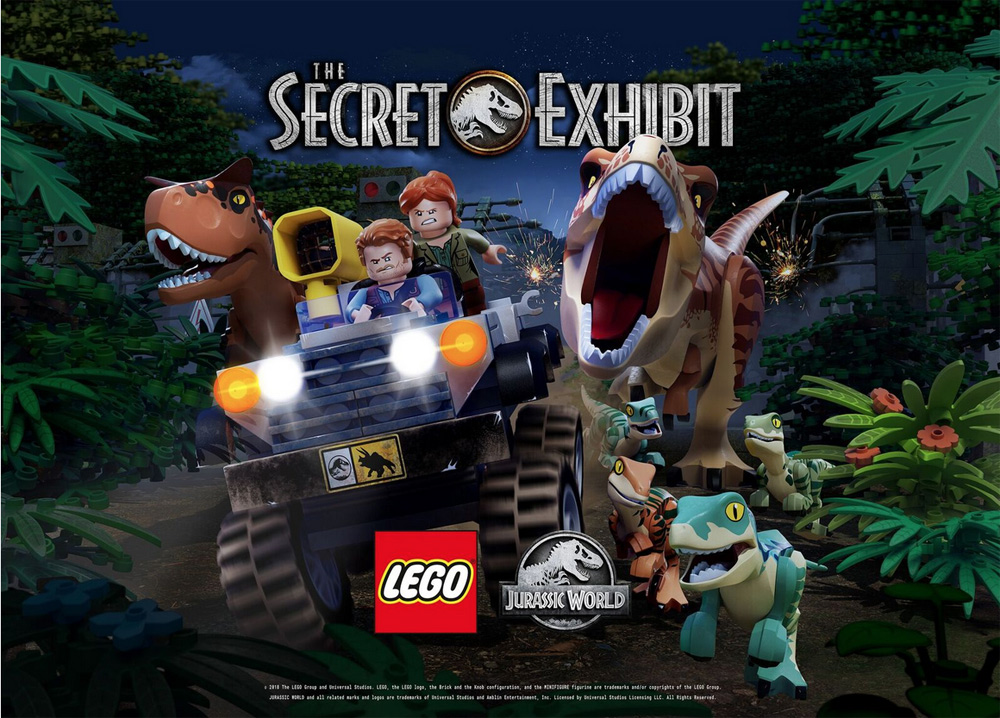
Something Big Is Coming in ‘LEGO Jurassic World: The Secret Exhibit’!

Thursday, August 15, 2019

LEGO: Jurassic World: The Secret Exhibit

Prepare to return to a lost world of dinos, danger and tons of laughs in LEGO: Jurassic World: The Secret Exhibit, a new two-part animated special coming to Nickelodeon this month! Our pals at Nick gave us a sneak peek at the exciting new brickworld adventure, which launches with Part 1 on Saturday, August 17 at 11:30 a.m. (ET/PT) and wraps with Part 2 on Saturday, August 24 at 11:30 a.m. (ET/PT).

LEGO: Jurassic World: The Secret Exhibit

In The Secret Exhibit, Simon Masrani has an idea for a new attraction that is guaranteed to keep Jurassic World at the forefront of theme park entertainment, but in order for it to succeed, he needs his right-hand can-do problem solver, Claire Dearing, and newcomer Owen Grady, to get a trio of dinosaurs across the park to the new, super-secret exhibit. Unfortunately, delivering the dinosaurs to the new attraction is not as easy as they thought!

Source: www.animationmagazine.net

Crossvallia waiparensis: Ancient Monster Penguin Unearthed in New Zealand

Friday, August 16, 2019

This illustration provided by the Canterbury Museum, shows the approximate height of a giant penguin, a "crossvallia waiparensis" next to a human being.

The fossilized bones of a large-sized penguin species that lived during the Paleocene Epoch (between 66 and 56 million years ago) have been discovered in New Zealand.

Named Crossvallia waiparensis, the ancient penguin was about 5.2 feet (1.6 m) tall — taller than today’s 4-foot (1.2 m) Emperor penguin — and had a mass of between 70 and 80 kg.

Its leg bones and two ends of the humerus were unearthed by amateur paleontologist Leigh Love at the Waipara Greensand fossil site in 2018.

Dr. Gerald Mayr from the Senckenberg Natural History Museum and colleagues analyzed the bones and concluded they belonged to a previously unknown penguin species.

They concluded that the bird’s closest known relative is a fellow Paleocene species Crossvallia unienwillia, which was identified from a fossilized partial skeleton found in the Cross Valley in Antarctica in 2000.

“Finding closely related birds in New Zealand and Antarctica shows our close connection to the icy continent,” said Dr. Dr Paul Scofield, a paleontologist at Canterbury Museum.

“When the Crossvallia species were alive, New Zealand and Antarctica were very different from today — Antarctica was covered in forest and both had much warmer climates.”

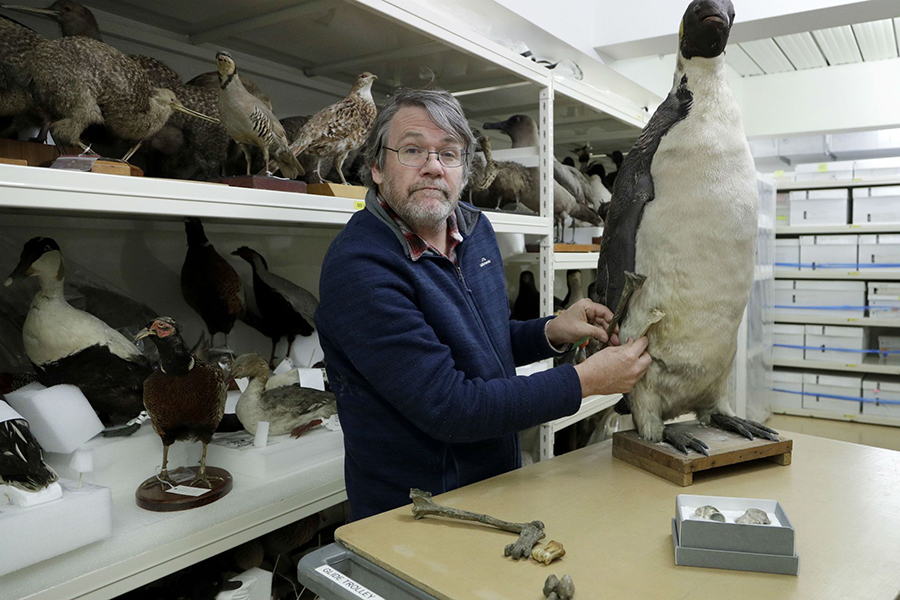
Dr. Paul Scofield, senior curator natural history at Canterbury Museum, holds the fossil, a tibiotarsus, top, next to a similar bone of an Emperor Penguin in Christchurch, New Zealand.AP

The leg bones of both Crossvallia penguins suggest their feet played a greater role in swimming than those of modern penguins, or that they hadn’t yet adapted to standing upright like modern penguins.

Crossvallia waiparensis is the fifth ancient penguin species described from fossils uncovered at the Waipara Greensand site.

“The Waipara Greensand is arguably the world’s most significant site for penguin fossils from the Paleocene epoch,” Dr. Mayr said.

“The fossils discovered there have made our understanding of penguin evolution a whole lot clearer.”

“There’s more to come, too — more fossils which we think represent new species are still awaiting description.”

“The discovery of a second giant penguin from the Paleocene epoch is further evidence that early penguins were huge,” said Dr. Vanesa De Pietri, also from Canterbury Museum.

“It further reinforces our theory that penguins attained a giant size very early in their evolution.”

The team’s paper was published in the Alcheringa: an Australasian Journal of Palaeontology.

_____

Gerald Mayr et al. Leg bones of a new penguin species from the Waipara Greensand add to the diversity of very large-sized Sphenisciformes in the Paleocene of New Zealand. Alcheringa: an Australasian Journal of Palaeontology, published online August 12, 2019; doi: 10.1080/03115518.2019.1641619

Source: www.sci-news.com

Clevosaurus hadropondon: Tiny Tusked Dinosaur Discovered in Brazil

Thursday, August 15, 2019

Randall L. Nydam, Ph.D., Midwestern University

Researchers have recently discovered a gecko sized reptile species from the Triassic period, named clevosaurus hadropondon.

The Clevosaurus hadropondon is a newly discovered reptile species from the Triassic Period that was found in the Brazilian state of Rio Grande do Sul.

Researchers have found the remains of a jaw and other skull belonging to the new species. The remains were found in Triassic rock dating back to around 237M years ago.

The clevosaurus hadropondon is the oldest discovered fossil to of it’s kind from Gondwana, the continent which now makes up Africa, Antarctica, Australia, India and South America.

This gecko sized Triassic reptile possessed small blade like teeth with “a large, blunt, tusk-like tooth in the first tooth position of the both premaxilla (upper jaw) and of dentary (lower jaw). This feature is typically observed only in later sphenodontian lineages” according to Annie Schmaltz Hsiou,  Associate Professor at the University of São Paulo. Annie Schmaltz Hsiou is also the head of the study which analysed the remains. By sphenodontian she means a lizards like reptile also known as a Rhynchocephalia.

Co-author of the study Randall Nydam is Professor at Midwestern University (US). Nydam is a vertebrate paleontologist studying the evolutionary history of lizards and snakes. “Clevosaurus hadroprodon is an important discovery because it combines a relatively primitive sphenodontian-type tooth row with the presence of massive tusk-like teeth that were possibly not for feeding, but rather used for mate competition or defense. If correct, this means that non-feeding dental specialisations predated changes in the sphenodontian dentition related to feeding strategies. This is a very exciting discovery.”

Nydam is currently working on the early evolution and distribution of snakes based on specimens from both the north and southern hemispheres including the oldest known snake fossils.

The new discovery will help with the understanding of small reptilian evolution.

Source: www.scitecheuropa.eu

One Ironic Reason 'Godzilla: King of the Monsters' Stumbled at the Box Office

Wednesday, August 14, 2019

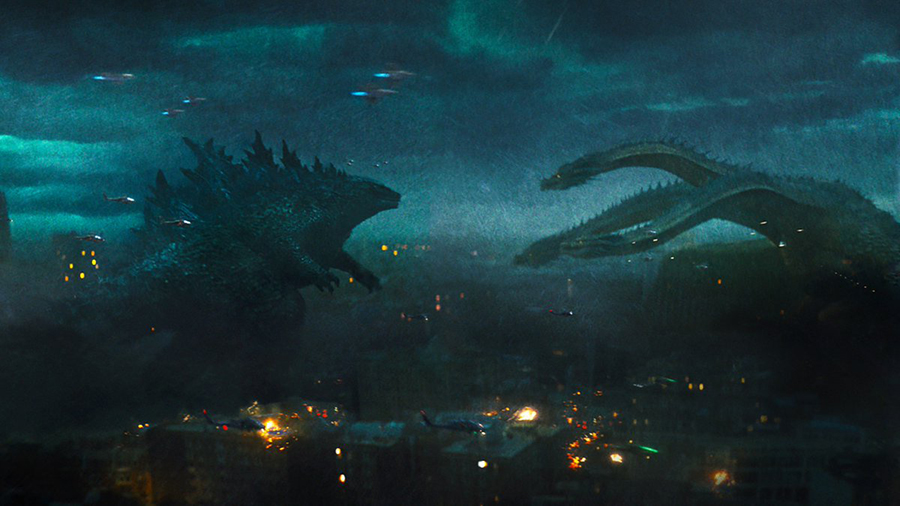
'Godzilla: King of the Monsters'WARNER BROS. AND LEGENDARY

The two biggest movies, in terms of size and scale, of the year, are both available in post-theatrical this morning. Avengers: Endgame is now available on DVD, Blu-ray, 4K HD and priced-to-rent VOD for those so inclined. And Warner Bros. Godzilla: King of the Monsters is now available in digital HD (or "priced-to-buy" VOD) as of this morning in advance of its DVD/Blu/4K launch. The film was one of the more high-profile disappointments in a summer where several seemingly big movies played comparatively small. While Godzilla earned strong reviews and $200 million domestic/$529 million worldwide on a $160 million budget, King of the Monsters earned mixed reviews and $110 million/$374 million on a $170 million budget.

There are any number of reasons as to why the film stumbled, among them competition from Avengers: Endgame and Aladdin, the above-noted mixed reviews, the five-year-gap between installments (which did nothing for Pacific Rim: Uprising or The LEGO Movie 2), and the underestimation in audiences' interest in a "Godzilla versus monsters only your super-geek friends have heard of" sequel. But, just as Marvel (and DC Films) have allowed superhero movies to dominate by virtue of approximating rival genres, so too might Godzilla: King of the Monsters have ironically been stymied by five years' worth of buzzy successes within the specific realm of monster movies. King of the Monsters wasn't remotely the only game in town.

In the five years between Gareth Edwards' Godzilla and Michael Dougherty's Godzilla: King of the Monsters, we've had two huge Jurassic World movies ($1.671 billion in 2015 and $1.31 billion in 2018) and one ill-received Pacific Rim sequel ($275 million in 2018, all from Universal and Legendary. But Warner Bros., both with and without Legendary, has also offered a handful of popular, well-liked and comparatively more crowd-pleasing monster movies within the last five years. Kong: Skull Island ($568 million in 2017), intended as a prequel to Godzilla and King of the Monsters, blended big movie stars (Tom Hiddleston, Sam Jackson and Brie Larson) with broad-daylight action and more conventional monster mash action.

Warner Bros. and New Line Cinema's Rampage ($428 million in 2018) offered Dwayne Johnson and a host of colorful character actors facing off against three giant, city-destroying beasts (a giant gorilla, a giant crocodile and a giant wolf) amid a big-scale part-campy/part-scary (but in a kid-friendly fashion) action romp. And Warner Bros.' The Meg, arguably the first Hollywood/China co-production to score huge on both shores ($144 million domestic, $153 million in China and $530 million worldwide in 2018), offered Jason Statham and Li Bingbing doing battle with a giant shark in a kid-friendly action romp. To the extent King of the Monsters was merely "okay," it was outclassed by recent kajiu-type movies from its own studio.

Prestigious cast (including Kyle Chandler as the ultimate Gary Stu, along with Ken Watanabe, Millie Bobby Brown, Vera Farmiga and Zhang Zyi) aside, it lacked the butts-in-the-seats/added-value element stars of The MegRampage and Skull Island, while also lacking the IP value of a Jurassic Park movie. Nor did it have the colorful human characters (John C. Reilly's World War II vet in Skull Island, Jeffrey Dean Morgan's cowboy government agent in Rampage, Bryce Dallas Howard's "doing it backwards and in heels" heroine in Jurassic World, etc.) that provided entertainment value even when the monsters weren't mashing. More so than its peers, King of the Monsters bet everything on "Do you want to see another Godzilla movie?"

We'll see if Adam Wingard’s Kong VS. Godzilla can restore Legendary and WB's "monster verse" to its “$525 million-plus on an over/under $175 million budget” glory next March, presuming it doesn’t get delayed. Godzilla versus King Kong is bigger/better among general audiences as opposed to Godzilla versus King Ghidorah. The film's biggest challenge won't be that folks weren't all that taken with King of the Monsters, but rather that moviegoers have already feasted on a deluge of crowd-pleasing monster movies of late, many of them straight from Warner Bros. and/or Legendary. In a skewed way, a big franchise play was spoiled by the prior successes of comparatively standalone fare from the same studio(s).

Source: www.forbes.com

Jurassic World of Volcanoes Found in Central Australia

Wednesday, August 14, 2019

JWFK volcano erruption

An international team of subsurface explorers from the University of Adelaide in Australia and the University of Aberdeen in Scotland have uncovered a previously undescribed 'Jurassic World' of around 100 ancient volcanoes buried deep within the Cooper-Eromanga Basins of central Australia.

The Cooper-Eromanga Basins in the north-eastern corner of South Australia and south-western corner of Queensland is Australia's largest onshore oil and gas producing region of Australia. But, despite about 60 years of petroleum exploration and production, this ancient Jurassic volcanic underground landscape has gone largely unnoticed.

Published in the journal Gondwana Research, the researchers used advanced subsurface imaging techniques, analogous to medical CT scanning, to identify the plethora of volcanic craters and lava flows, and the deeper magma chambers that fed them. They've called the volcanic region the Warnie Volcanic Province, with a nod to Australian cricket legend Shane Warne.

The volcanoes developed in the Jurassic Period, between 180 and 160 million years ago, and have been subsequently buried beneath hundreds of meters of sedimentary -- or layered -- rocks.

The Cooper-Eromanga Basins are now a dry and barren landscape but in Jurassic times, the researchers say, would have been a landscape of craters and fissures, spewing hot ash and lava into the air, and surrounded by networks of river channels, evolving into large lakes and coal-swamps.

"While the majority of Earth's volcanic activity occurs at the boundaries of tectonic plates, or under the Earth's oceans, this ancient Jurassic world developed deep within the interior of the Australian continent," says co-author Associate Professor Simon Holford, from the University of Adelaide's Australian School of Petroleum.

"Its discovery raises the prospect that more undiscovered volcanic worlds reside beneath the poorly explored surface of Australia."

The research was carried out by Jonathon Hardman, then a PhD student at the University of Aberdeen, as part of the Natural Environment Research Council Centre for Doctoral Training in Oil and Gas.

The researchers say that Jurassic-aged sedimentary rocks bearing oil, gas and water have been economically important for Australia, but this latest discovery suggests a lot more volcanic activity in the Jurassic period than previously supposed.

"The Cooper-Eromanga Basins have been substantially explored since the first gas discovery in 1963," says co-author Associate Professor Nick Schofield, from the University of Aberdeen's Department of Geology and Petroleum Geology.

"This has led to a massive amount of available data from underneath the ground but, despite this, the volcanics have never been properly understood in this region until now. It changes how we understand processes that have operated in Earth's past."

The researchers have named their discovery the Warnie Volcanic Province after one of the drill holes that penetrated Jurassic volcanic rocks (Warnie East-1), itself named after a nearby waterhole), but also in recognition of the explosive talent of former Australian cricketer Shane Warne.

"We wrote much of the paper during a visit to Adelaide by the Aberdeen researchers, when a fair chunk was discussed and written at Adelaide Oval during an England vs Cricket Australia XI match in November 2017. Inspired by the cricket, we thought Warnie a good name for this once fiery region," says Associate Professor Holford.


Story Source:

Materials provided by University of AdelaideNote: Content may be edited for style and length.


Journal Reference:

  1. Jonathon P.A. Hardman, Simon P. Holford, Nick Schofield, Mark Bunch, Daniel Gibbins. The Warnie volcanic province: Jurassic intraplate volcanism in Central AustraliaGondwana Research, 2019; 76: 322 DOI: 10.1016/j.gr.2019.06.012

Source: www.sciencedaily.com

Devonian Fossil Forest Unearthed in China

Tuesday, August 13, 2019

Reconstruction of the Xinhang forest landscape. Image credit: Wang et al, doi: 10.1016/j.cub.2019.06.053.

Paleontologists have discovered a 360-million-year-old (Devonian Period) fossilized forest of lycopsid trees near Xinhang in China’s Anhui province — the oldest known fossil forest in Asia.

The Xinhang forest covered an area of at least 62 acres (250,000 m2) and grew in a coastal environment prone to flooding.

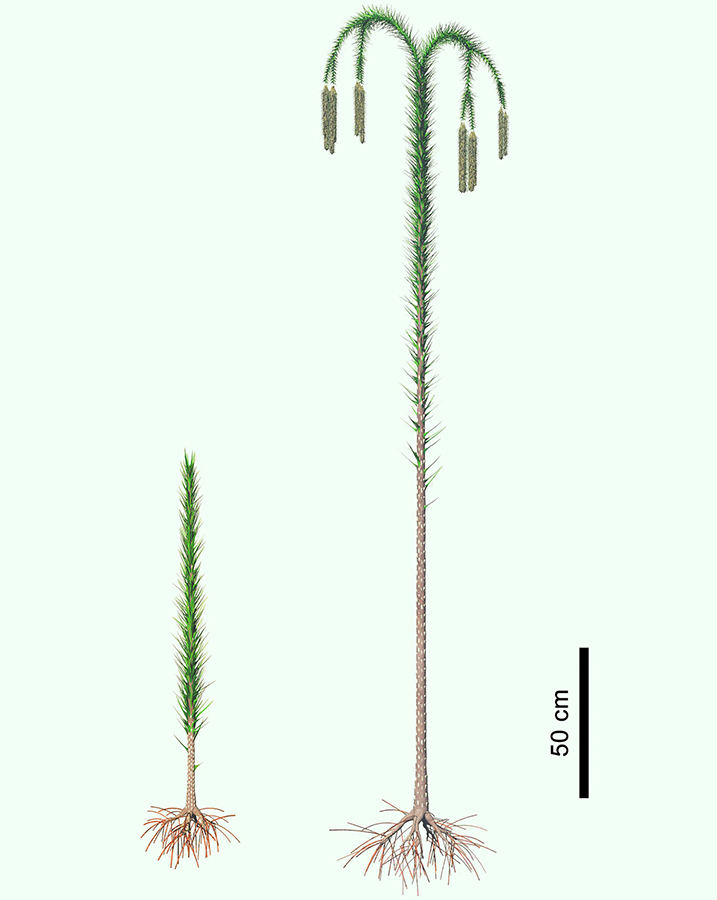
Lycopsid trees found in the forest resembled palm trees, with branchless trunks and leafy crowns.

Named Guangdedendron, they had no flowers and no seeds, but shed megaspores.

These trees were normally less than 10.5 feet (3.2 m) tall, but the tallest was estimated at 25.3 feet (7.7 m), taller than the average giraffe.

Reconstruction of Guangdedendron. Image credit: Wang et al, doi: 10.1016/j.cub.2019.06.053.

“The large density as well as the small size of the trees could make the Xinhang forest very similar to a sugarcane field, although the plants in the forest are distributed in patches,” said Professor Deming Wang, a researcher in the School of Earth and Space Sciences at Peking University.

“It might also be that the Xinhang lycopsid forest was much like the mangroves along the coast, since they occur in a similar environment and play comparable ecologic roles.”

Several other Devonian fossil forests have been found: in the United States and in Norway.

Rooting systems and erect stems of Guangdedendron. Scale bars – 1 cm (I and J), 2 cm (D, F-H, K-N, and coin diameter), and 5 cm (C and T). Image credit: Wang et al, doi: 10.1016/j.cub.2019.06.053.

“The fossilized Guangdedendron trees are visible in the walls of the Jianchuan and Yongchuan clay quarries, below and above a 13-foot (4 m) thick sandstone bed,” the paleontologists said.

“Some fossils included pinecone-like structures with megaspores, and the diameters of fossilized trunks were used to estimate the trees’ heights.”

“It was difficult to mark and count all the trees without missing anything.”

The team’s paper was published in the journal Current Biology.

_____

Deming Wang et al. The Most Extensive Devonian Fossil Forest with Small Lycopsid Trees Bearing the Earliest Stigmarian Roots. Current Biology, published online August 8, 2019; doi: 10.1016/j.cub.2019.06.053

Source: www.sci-news.com

Pages