Blogs

Giganotosaurus Was One of the Largest Carnivorous Dinosaurs That Ever Lived

Thursday, June 11, 2020

The skeleton of Giganotosaurus carolinii on display at the Fernbank Museum of Natural History, in Atlanta, Georgia. JAMES EMERY/FLICKR (CC BY 2.0)

They lived about 30 million years apart and never set foot on the same continent. Yet Giganotosaurus carolinii is always getting compared to the world's most popular dinosaur, the beloved and well-known Tyrannosaurus rex.

Tyrannosaurus rex has been a media darling since (arguably) 1906, when The New York Times called it "the prize fighter of antiquity." Named just one year prior, this big beast was already making a splash over at the American Museum of Natural History in Manhattan.

Today we know an adult T. rex could stand 12 feet (or 3.6 meters) tall at the hip and measure 40 feet (12 meters) long. As such, Tyrannosaurus was one of the largest predators to ever walk the earth.

But hold your horses. A handful of other meat-eating dinos rivaled, or possibly exceeded, the creature in size. Giganotosaurus belongs to this elite group — and it's part of a dinosaurian mystery that's never been solved.

Beasts of the Southern Wild

T. rex and Giganotosaurus were both representatives of the theropoda clade T. rex and Giganotosaurus were both representatives of the theropoda clade. (A "clade" is a group of organisms which includes a common ancestor species and all of its presumed descendents.) Hollow-boned and bipedal, the theropods were (and are) a highly successful bunch. On the list of documented theropods, you'll find every carnivorous dinosaur yet discovered, quite a few plant-gobbling species and all birds, living and extinct.

The last nonavian dinos were wiped out at the close of the Cretaceous period, an expanse of geologic time that lasted from 145 to 66 million years ago. Its conclusion marked the end of the Mesozoic Era, sometimes called "The Age of Dinosaurs."

Tyrannosaurus rex lived in North America during the twilight of the Cretaceous, making its evolutionary debut around 68 million years before the present. Our buddy Giganotosaurus was the product of another time — and a different landmass.

A reconstructed Giganotosaurus carolinii skeleton on display at The Australian Museum in Sydney, Australia. LISA MAREE WILLIAMS/GETTY IMAGES

Native to western Argentina, it came along much earlier in the Cretaceous, roughly 98 to 97 million years ago. South America was a realm of giants back then. Huge sauropods, or "long-necked dinosaurs," roamed the countryside, with some species — like Andesaurus and Limayasaurus — stretching around 50 feet (15 meters) long. Rounding out the local bestiary were crocodylians, early snakes and beaked herbivores.

No doubt Giganotosaurus kept its neighbors on guard. The theropod's discovery was first announced in 1995 by paleontologists Rodolfo A. Coria and Leonardo Salgado. In all the years since, we have yet to find a complete skeleton. However, the backbones and tail vertebrae at our disposal suggest Giganotosaurus was at least 41 feet (12.5 meters) in length.

So Giganotosaurus might've been slightly longer than Tyrannosaurus. Cool beans.

On the other hand, a 2014 paper published in the journal Plos Biology, argued T. rex had a much heavier build. Using the circumference of its upper leg bone, Roger Benson and his colleagues calculated that a mature Giganotosaurus weighed about 13,448 pounds (6,100 kilograms). The same technique put T. rex at a whopping 16,975 pounds (7,700 kilograms).

Shark-like Teeth Sliced Ribbons of Flesh off Prey

Weight gaps are all well and good, but the jaws tell better stories. Anatomical evidence suggests these two carnivores used very different methods to bring down their prey.

Thick and banana-shaped, the teeth of Tyrannosaurus would've excelled at crushing bone. In contrast, Giganotosaurus had tall, skinny teeth which looked an awful lot like recurved kitchen knives. Serrated on both sides, the pearly whites were housed inside a narrow snout. (By the way, Giganotosaurus had a monstrous skull; scientists estimate the noggin was around 6 feet — or 2 meters — long.)

A 7.5-inch resin cast from a Giganotosaurus dinosaur tooth. INDEPENDENT PICTURE SERVICE/UNIVERSAL IMAGES GROUP VIA GETTY

Combine these features and you're looking at a theropod that probably killed by slicing ribbons of meat off its unfortunate prey — as opposed to shattering bones. Once bitten, a victim may have bled out while the carnivore lurked nearby.

Giganotosaurus hails from one of the fossil record's most intimidating families: the carcharodontosaurids.

If you're into sharks, that name should ring a bell; scientists call the great white Carcharodon carcharias. Likewise, the word "carcharodontosaurid" roughly means "shark-toothed lizard" in Greek.

Steve Brusatte is a paleontologist at the University of Edinburgh who's studied these remarkable theropods — and happens to be a scientific adviser for the next "Jurassic World" movie.

"The roster of carcharodontosaurid fossils has expanded tremendously over the last decade as people have found new fossils all over the world, particularly in South America and Africa, but also in Asia and Europe," says Brusatte in an email. "Most carcharodontosaurids [like Giganotosaurus] were giant meat-eating dinosaurs with deep jaws and sharp, thin, almost shark-like teeth. They were the largest and most formidable predators in many ecosystems during the early to middle part of the Cretaceous, before the rise of tyrannosaurs."

Indeed, T. rex had some puny forebears. The first members of its lineage were human-sized predators that showed up around 170 million years ago. Giant tyrannosaurs wouldn't start evolving until the late Cretaceous Period, after the mighty carcharodontosaurids died out.

"This changeover remains a mystery," explains Brusatte. "We don't really know why it happened, and it is one of the biggest remaining mysteries of dinosaur evolution, in my opinion."

Source: https://animals.howstuffworks.com/

What a Buried Crater in Mexico Says About the Asteroid That Doomed the Dinosaurs

Tuesday, June 9, 2020

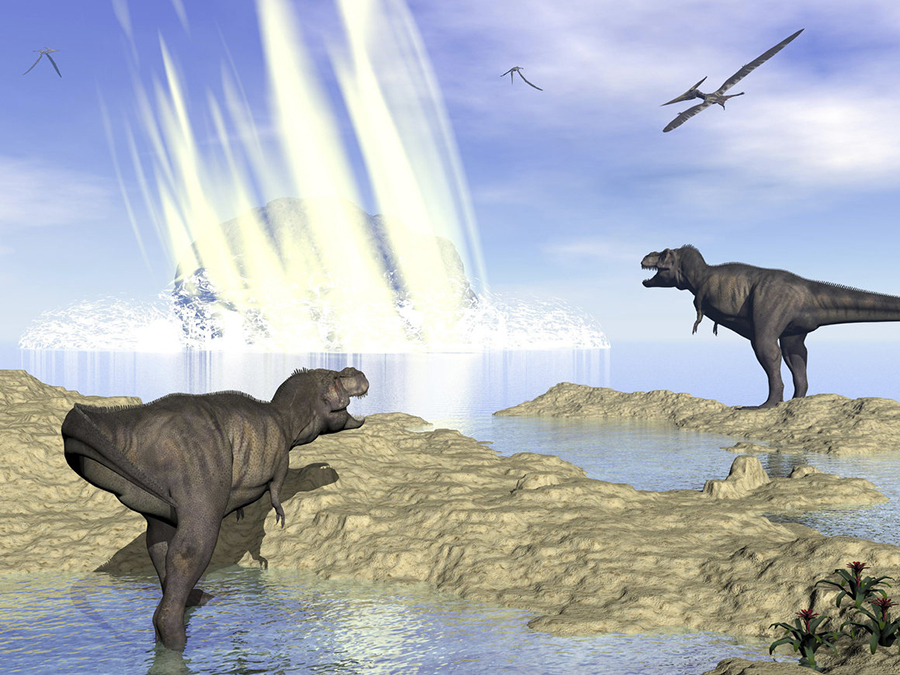
The asteroid that led to a mass extinction 66 million years ago likely struck the Earth at a very high speed—around 12.5 miles per second—and at the deadliest possible angle. MARK GARLICK / SCIENCE PHOTO LIBRARY / GETTY IMAGES

And why the scars left by meteoritic impacts tell us about life, the universe, and everything.

IMAGINE STANDING ON THE EDGE of a giant crater, knowing nothing about how this massive hole in the ground came to be. Or figuring out that a cataclysmic event like an asteroid hitting the Earth killed the dinosaurs, but having no visible evidence on the planet of a collision of that magnitude.

Scientists and explorers have faced such puzzling moments in our history. They may have had inklings that giant collisions happened in the universe, but where and how and whether they still happened are things that modern scientists are only now able to answer with some degree of certainty. Until they started to, around the mid-20th century, craters like Arizona’s Meteor Crater and those on the moon were largely thought to be volcanic in origin.

Like detectives piecing together clues across time and space, scientists who study impact craters are revealing the stories of these fascinating planetary and lunar scars. Most recently, a new study on the Chicxulub crater in Mexico concludes that the asteroid that led to the dinosaur-ending mass extinction 66 million years ago likely struck at a steep angle and high speed that maximized the lethal effects that followed.

Computer simulations in the study, published in the journal Nature Communications, show the impact blowing open a hole some 19 miles deep and 50 miles wide in the Earth’s crust, which quickly rebounded upward into a mountain of rock higher than Mount Everest before collapsing into the crater formation that remains today—all within about 15 minutes.

The impact triggered a tsunami and unleashed toxic debris high into the atmosphere, which cooled the planet, choked off sunlight, and wiped out much of life on Earth. ELENA DUVERNAY / STOCKTREK IMAGES / GETTY IMAGES

The speed with which the crater formed is “one of the most awe-inspiring aspects of all this,” says Gareth Collins, the study’s lead author and a professor of planetary science at Imperial College London. “The asteroid was moving astonishingly quickly—probably around 20 kilometers [nearly 12.5 miles] a second—when it struck. That’s about 100 times the speed of a jumbo jet.” (It’s also, perhaps unnervingly, a common speed for asteroids that have pummeled our planet.)

Incredibly, the crater (or what’s left of it) can’t be seen on the Earth’s surface: It’s now buried about two-thirds of a mile beneath the Yucatán Peninsula. The team of researchers, from more than a dozen countries, compared 3-D simulations of different hypothetical impact angles and speeds with geophysical observations of Chicxulub that enable them to interpret features of the crater beneath the Earth’s surface.

The results suggest an asteroid trajectory that was particularly deadly. The catastrophic visitor, thought to be about 7.5 miles across, struck at an angle of around 60 degrees to the horizon in what was seawater at the time, says Collins, triggering a tsunami and unleashing a massive amount of debris and climate-changing gases into the upper atmosphere. The prolonged period of cooling and choked-off sunlight that followed wiped out much of life on the planet.

The impact created the Chicxulub crater, now buried beneath the Yucatán Peninsula. MARK GARLICK / SCIENCE PHOTO LIBRARY / GETTY IMAGES

As Chicxulub demonstrates, impact craters offer extraordinary evidence of dramatic events that define the landscapes—and even the state of life—we observe today. In a sense, crater investigators like Collins have to work backwards to figure out the narratives behind these mighty geologic imprints.

The tale of Arizona’s Meteor Crater is particularly instrumental in how we’ve come to understand the very existence of impact craters. A popular tourist destination that was once a mining site and training ground for astronauts, the Barringer Meteorite Crater, as it’s known to scientists, is thought to be 50,000 years old and stretches three-quarters of a mile across.

“Planetary scientists make pilgrimages to Meteor Crater because it’s so exquisitely preserved,“ says David Kring, a geologist whose extensive work has spanned the Barringer, Chicxulub, and lunar craters. “It is considered to be the first proven impact site by the scientific community.”

Trying to prove that an object from outer space created it, however, cost the crater’s namesake, Daniel Moreau Barringer, his mining fortune and caused a scientific stir at the turn of the 20th century.

In 1896, G.K. Gilbert, then head of the U.S. Geological Survey, concluded that the depression was the result of a volcanic steam explosion. Meanwhile, Barringer—a Princeton-educated mining engineer and self-taught geologist—pushed his theory about a meteoritic impact in papers he published in 1905 and 1910. He cited, among other things, meteoritic iron found both beneath the crater floor and scattered in a concentric ring around the crater, plus inverted layers of rock—an indication that material in the hole had been thrown out and then landed upside down following the impact.

“Planetary scientists make pilgrimages to Meteor Crater [in Arizona] because it’s so exquisitely preserved,“ says geologist David Kring. “It is considered to be the first proven impact site by the scientific community.” GSO IMAGES / GETTY IMAGES

Granted, Barringer bought the site in hopes of making money selling pieces of meteorite metal. But he ended up unable to find the enormous extraterrestrial object that he thought still lay beneath the crater. “Barringer was understandably fooled,” says Kring. “He got the impact origin completely right, but he didn’t appreciate how much of the impact object was destroyed.” (Scientists now know that asteroids are largely melted and vaporized during a crash.)

Kring notes that Barringer’s theory wasn’t widely accepted until around 1960, when work by Gene Shoemaker, co-discoverer of the Shoemaker-Levy 9 comet, helped validate his ideas. During Barringer’s time, the notion that catastrophic events still happened was a paradigm shift from what was then the prevailing school of thought, known as uniformitarianism. A fundamental principle of modern geology, it says that Earth’s geologic processes have been consistent and slow-moving throughout the past and present.

The philosophical resistance that Barringer encountered continued well into the 20th century, says Kring. The theory that lunar craters were created by asteroid impacts, he notes, remained a minority belief until the Apollo missions to the moon returned with lunar rocks exhibiting radical alterations that only shock pressures and extreme heat from impact events—not volcanic ones—can cause.

“With Apollo, people grudgingly accepted the idea there were impact processes—but only in the past,” says Kring. “It wasn’t until the Shoemaker-Levy comet hit Jupiter, in 1994, that people realized that oh, this can still happen.”

Kring—who in 1991 identified Chicxulub as the site of the dinosaur-extinction event first theorized a decade earlier—says that one need only look to the moon to see what the asteroid impact looked like before it became buried and degraded, like many of the approximately 200 impact craters known on Earth.

Nearly 200 miles wide, the moon’s Schrödinger basin is a bigger but otherwise nearly identical version of the Chicxulub crater. NASA (IMAGE BY LUNAR RECONNAISSANCE ORBITER) / PUBLIC DOMAIN

The moon’s nearly 200-mile-wide Schrödinger basin is a virtual twin of the Chicxulub crater, only bigger, notes Kring. They are so similar, in fact, that Kring and Collins, in a 2016 study with other researchers, used Schrödinger’s exposed features to better understand what transpired at Chicxulub.

Looking at impact craters on Earth and other bodies in the solar system, it turns out, go hand in hand. “On other planets, we get a better picture of what a pristine crater looks like, but we only see the surface,” says Collins. “On Earth, we rarely see the surface because there’s so much activity and erosion. But through geophysical and geological mapping and drilling we can learn about what’s beneath the surface. By putting those two observations together, we get a more complete picture of what a crater is and how it forms.”

The knowledge unlocked by studying impact craters goes even further—potentially to the origin of life on Earth itself. According to Kring, the Schrödinger basin is a high priority for exploration in future moon missions—a way to shed light on questions that include whether an intense period of bombardment in the early solar system may have seeded life on our planet.

“Those are really big questions,” he says. “Not just about lunar geology, but questions that reverberate across the entire solar system.”

Source: www.atlasobscura.com/

Toy Dinosaurs, Olive Branches and Penis Doodles: Bizarre Objects that Astronauts Took To Space

Tuesday, June 9, 2020

Astronauts took and left behind several strange objects on the moon between 19699 and 1972 | Image credit: Reuters (representational)/ Wikipedia

While many of us love to carry mementos, keepsakes and comfort items on our travels, the items that astronauts carry to space may leave you surprised.

Earlier in June, two NASA astronauts Bob Behnken and Doug Hurley hurtled into space aboard a SpaceX mission to the International Space Station. With them, they carried a toy dinosaur which their sons, both of whom are interested in dinosaurs, chose as their totem. Videos of the sequined toy floating in zero gravity went viral on social media as the "Dragon Crew" made its way to the ISS.

But the toy dino is not even the strangest thing that an astronaut has taken to space. As travel author David Bramwell writes in The Guardian, Buzz Aldrin who reached the moon on Apollo 11 in 1969, carried with him a "miniature chalice, wine and bread".

A devout Christian, Aldrin allegedly poured the wine on the surface of the moon as he read from the Bible, making alcohol the first liquid that humans poured on the surface of the moon.

The report further cites how astronaut Alan Shepard took a gold club and balls to the moon and even knocked a few balls in space. three of those balls remain in space.

The Apollo 11 which included Neil Armstrong who was was the first man to land on the moon also carried with it a golden olive branch which they left on the moon as a symbol of peace, perhaps for alien civilizations yet to find us.

In an inventory created by archaeologist and anthropologist at New Mexico State University, Dr Beth O'Leary, who focuses on space, has created a database of the items that astronauts left behind on the moon between the years 1969 to 1972.

These include a bunch of gadgets and equipment, flags of the United States, family photographs such as the one left behind by Charles Duke from the 1972 Apollo 16 mission, and of course, a bag of human poop.

But perhaps the most interesting thing that was ever sent to space is not one that was taken there by astronauts but sneaked into one of the spacecraft as an act of mischievous rebellion.

An artwork called "Moon Museum", created by artist Forest Myers and containing the works of six leading artists from the 1960s including Andy Warhol, was sneaked onto the moon aboard the legs of an Apollo 12 module which currently remains on the moon. The artwork consisted mainly of a ceramic wafer that contained images from the six artists. What did Warhol draw and send to space? The doodle of a penis.

Source: www.news18.com/

Fossil of 2 Million Year-Old Rare Frog Species Found in Argentina

Wednesday, June 10, 2020

Despite the fossil’s size, it was possible to identify the frog because Anuras, the tailless amphibians group to which frogs and toads belong, have a unique structure at the distal end of the humerus that forms the elbow joint.(AFP / Representative Photo )

The fossil was discovered 44 meters (144 foot) underground during the digging of a well in San Pedro, around 180 kilometers to the north of the capital Buenos Aires.

Argentine paleontologists have uncovered fossilized remains of a rare species of frog that lived two million years ago, the science and technology agency at the La Matanza national university said Monday.

“We know very little about prehistoric frogs and toads,” said Federico Agnolin, a researcher at the Natural Science Museum.

“Frogs and toads are very sensitive to climate and environmental changes, which makes them an important source to understand past climates.”

The fossil was discovered 44 meters (144 foot) underground during the digging of a well in San Pedro, around 180 kilometers to the north of the capital Buenos Aires.

It consisted of a “very small humerus (arm bone) of a tiny amphibian, distinct from horned and tree frogs,” said Angolin.

Despite the fossil’s size, it was possible to identify the frog because Anuras, the tailless amphibians group to which frogs and toads belong, have a unique structure at the distal end of the humerus that forms the elbow joint, Angolin said.

That peculiarity gave the frogs great agility.

“Discovering a new species of amphibian from the end of the Pliocene-beginning of the Pleistocene is a huge boon for Argentine paleontology,” he added.

The Pleistocene geological epoch began around 2.6 million years ago.

Source: www.hindustantimes.com/

Jurassic World 3 Will Have A Key Difference To Past Jurassic Park Movies

Sunday, June 7, 2020

Unlike past Jurassic Park movies within the franchise, Jurassic World: Dominion will have one key difference: it won't take place on an island.

Jurassic World: Dominion will have one key difference from all the previous movies: it won’t be set on an island. Jurassic World 3’s director Colin Trevorrow confirmed that Chris Pratt and Bryce Dallas Howard will be returning as Owen Grady and Claire Dearing respectively, alongside original Jurassic Park cast members Sam Neill, Laura Dern, and Jeff Goldblum. However, not much else is currently known about the plot of Jurassic World 3 except that it will be picking up where Jurassic World: Fallen Kingdom left off, with the dinosaurs venturing from the confines of Isla Nublar out into the world.  

All five films within the Jurassic Park franchise were set on two separate islands: Isla Nublar and Isla Sorna. The original Jurassic Park, as well as the reboot films Jurassic World and Fallen Kingdom, all took place on Isla Nublar, the main island located off of Central America’s Pacific Coast where John Hammond (Richard Attenborough) first created his theme park filled with genetically-engineered dinosaurs. Isla Sorna, a neighboring island also known as “Site B” that contains the InGen research station where the dinosaur clones were first created, is the setting of the sequels The Lost World: Jurassic Park and Jurassic Park III. In Fallen Kingdom, however, the surviving dinosaurs that were transported to Benjamin Lockwood’s (James Cromwell) estate are set free from their cages by Maisie Lockwood (Isabella Sermon), and head out onto the mainland - starting a new Jurassic Age.

Unlike past Jurassic Park films, Dominion will be the first film in the franchise to break away from Jurassic Park’s original formula by having the dinosaurs explore beyond their controlled environment. With the exception of The Lost World: Jurassic Park, which featured a Tyrannosaurus rex briefly wreaking havoc within the city of San Diego before being returned to Isla Sorna, much of the damage caused by dinosaurs in previous films is usually restricted to a single island and has no lasting effect on the outside world. Instead of following the traditional formula with humans trespassing on the dinosaurs’ isolated world, Trevorrow’s vision for Dominion reverses the concept by having these predators invade our own habit, mainly in the wilderness where dinosaurs “might run out in front of your car on a foggy backroad, or invade your campground looking for food.”

While the genetically engineered dinosaurs have always posed a threat to Earth’s ecosystem and to the human population at large within the Jurassic Park universe, Dominion will be the first film to truly play out that concept. We'll get to see how the dinosaurs alter the face of our world once it's impossible for them to be returned to their island. Since the last frame of Fallen Kingdom features Blue discovering a suburban community out in the desert, Dominion may answer a theory posed by Alan Grant within Jurassic Park III: if velociraptors hadn’t gone extinct, would they have evolved into the dominant species instead of humans? Not only will there be drastic changes to the food change within Dominion, but bringing back the original cast from Jurassic Park will bring the story full circle, emphasizing the moral ramifications for those who took part in the origins of this new Jurassic Age. 

By changing the setting from the traditional island to the mainland, Jurassic World: Dominion also sets up an interesting conflict that can’t be resolved as easily as it was in past films. At the beginning of The Lost World, and the end of Jurassic Park and Jurassic World, the dinosaur clones always destroy whatever facility they are housed in and gain dominion over the island, leading the main characters to resolve that the best solution is to abandon the site entirely and leave it to the dinosaurs. Similarly, within Jurassic Park III, Alan Grant and the remaining survivors are saved after the Navy arrives at Isla Sorna and transports them off of the island. Unlike past Jurassic Park films, Grady and Dearing won’t be able to solve the dinosaur invasion simply by evacuating the area if the dinosaurs occupy all of Earth, which will force the main characters to face the consequences of bringing dinosaurs back to modern day head-on.

Source: https://screenrant.com/

Navajoceratops sullivani and Terminocavus sealeyi: Two New Species from New Mexico Help Fill Gap in Evolution of Horned Dinosaurs

Saturday, June 6, 2020

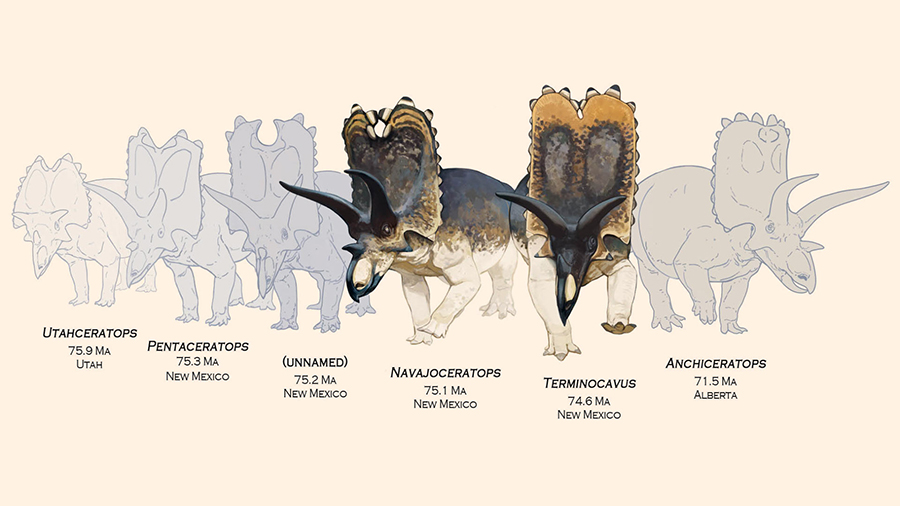
Navajoceratops sullivani and Terminocavus sealeyi. Image credit: Ville Sinkkonen & Denver Fowler.

Two new transitional species of plant-eating horned dinosaurs have been unearthed in New Mexico, the United States.

The newly-discovered dinosaurs roamed the Earth approximately 75 million years ago (Cretaceous period).

Named Navajoceratops sullivani and Terminocavus sealeyi, both species belong to Ceratopsidae, the same family as famous horned dinosaurs TriceratopsCentrosaurus, and Styracosaurus.

Their fragmentary skulls were uncovered from the Hunter Wash Member of the Kirtland Formation in New Mexico.

The specimens are intermediate in age between two previously known ceratopsid dinosaurs Pentaceratops and Anchiceratops.

Pentaceratops lived 75.3 million years ago in New Mexico and had a distinctive deep notch on the back border of the frill, and a pair of spikes at the center of the frill that turn outwards like the wings of a butterfly.

Anchiceratops had no notch in its frill and lived 3.8 million years later in what is now Canada.

In the 1990s, Texas Tech University paleontologist Thomas Lehman proposed that Pentaceratops might have been the ancestor of Anchiceratops.

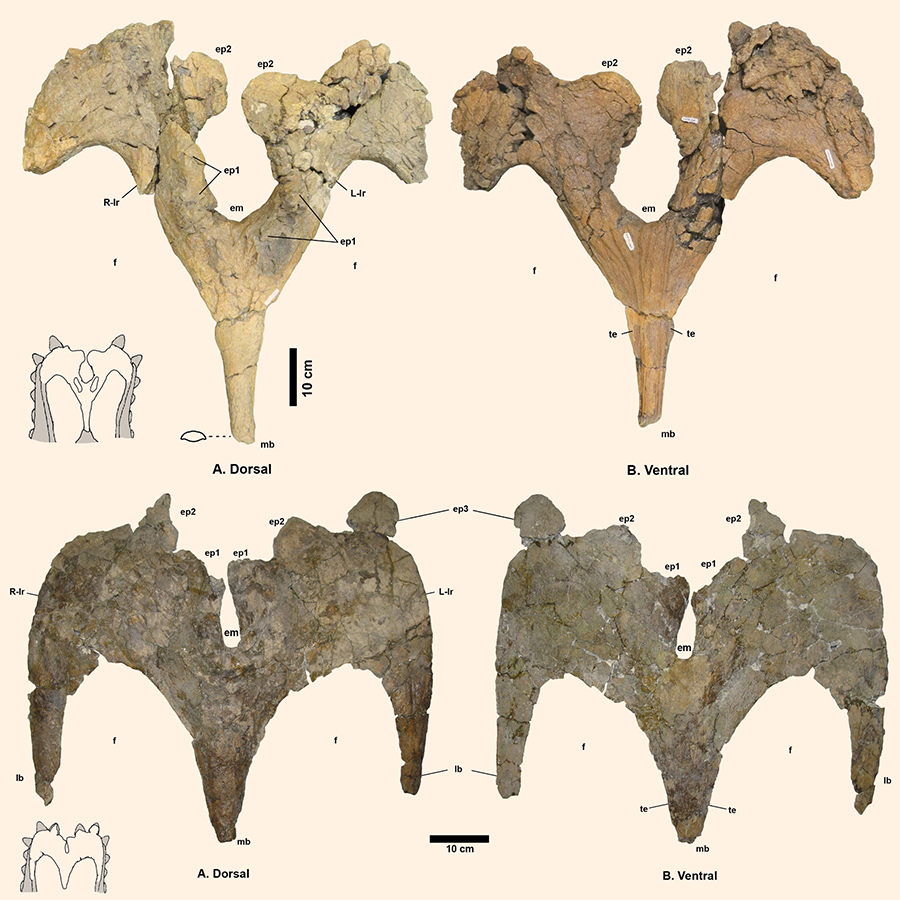
Navajoceratops sullivani and Terminocavus sealeyi are intermediate in shape between these two dinosaurs and show how the notch in the frill became even deeper through time and eventually closed in on itself, explaining the lack of a notch in Anchiceratops.

“The two intermediate skulls form important links in a 5 million year lineage stretching from Utahceratops through Pentaceratops, to Anchiceratops,” said study authors Dr. Denver Fowler and Dr. Elizabeth Freedman Fowler from Badlands Dinosaur Museum and Museum of the Rockies.

The parietal frills of Navajoceratops sullivani (top) and Terminocavus sealeyi (bottom). Image credit: Fowler & Freedman Fowler, doi: 10.7717/peerj.9251.

The new specimens revealed a splitting event deep in the evolutionary history of long-frilled ceratopsids (chasmosaurines), after which a Pentaceratops lineage evolved a progressively deepening notch in the frill, contrasting against its sister group, the Chasmosaurus lineage, which evolved a progressively shallower notch.

“The origin of this evolutionary split occurred during the Late Cretaceous period, when a vast interior seaway flooded the lowlands of North America dividing it into eastern and western subcontinents,” the paleontologists said.

“A short period of especially high sea level 85-83 million years ago brought the edge of the sea very close to the young Rocky Mountains.”

“For hundreds of miles across what is now central Utah to southern Alberta, the coastal plain would have been as little as 5-10 km wide, providing very little habitat for dinosaurs.”

“This would have effectively cut off northern and southern populations, which then probably evolved in isolation into two distinct lineages. However, after 83 million years ago, the sea receded from the mountain front, allowing northern and southern populations to mix again.”

The team’s paper appears in the journal PeerJ.

_____

D.W. Fowler & E.A. Freedman Fowler. 2020. Transitional evolutionary forms in chasmosaurine ceratopsid dinosaurs: evidence from the Campanian of New Mexico. PeerJ 8: e9251; doi: 10.7717/peerj.9251

This article is based on text provided by Dickinson Museum Center.

Source: www.sci-news.com/

Paleontologists Predict What Future Animals Might Look Like

Saturday, June 6, 2020

It’s a bit unorthodox, reaching out to those who spend their lives studying past and asking them to predict the future. But these paleontologists were happy to take on our assignment: Could you apply what you know about how life has changed over time to guess what species might be like millions of years from now?

The goal was not to predict the future with 100 per cent accuracy. Instead, we wanted to understand what processes shaped life on Earth before today and how those same factors could change life down the road.

One of the scientists we interviewed explicitly mentions the interconnectedness of all species on this planet. If we pull that string a little more, we know that nothing exists today by accident. Everything we know now is the result of everything that came before us. It’s a staggering mental exercise: trying to grasp the eons of time, change, and evolution that have brought Earth to this point.

The question is: What comes next?

Stephanie Drumheller, paleontologist in Earth and Planetary Sciences at the University of Tennessee:

Alligators and crocodiles have a reputation for being “living fossils” who “haven’t changed since the time of the dinosaurs.” This particular turn of phrase is a great way to make croc paleontologists rage, because it doesn’t actually take much digging to find a lot of fun weirdness in the croc family tree. There have been fully marine crocs with flippers and fully terrestrial crocs with long, running legs. There have been omnivorous and herbivorous crocs, with funky, specialist teeth and weak little jaws. There were heavily armoured crocs, crocs with broad, flat heads and little peg-like teeth, tiny crocs, giant crocs, just all kinds of wacky stuff. If you go far enough back in the family tree, you even get distant croc-relatives that walked around on two legs and looked kind of like dinosaur-mimics.

What’s driving the idea that crocs are unchanging is that we’re looking at a low stand in their diversity right now, and the living crocs all have variations on the semi-aquatic ambush predator body plan, where they pretend to be a log and pop out to surprise prey. Fossil croc-relatives also filled those roles in their ecosystems going all the way back to the age of dinosaurs, but it definitely wasn’t the only niche they filled.

We can look at how croc diversity changed through geologic time and map that against climate, to understand why we see more diverse crocs in some periods and less diverse crocs in others. In the broadest sense, when the climate gets warmer, crocs seem to spread out and diversify. We find croc fossils at really high latitudes when the paleoclimate was warm. When it gets cooler, lineages die off and the survivors become concentrated in warmer regions. Geologically speaking, we only recently came out of a glacial period, so we’re looking at a modern diversity that just went through a rough patch.

It’s hard to predict what might happen in the future, but it can be fun to speculate. One of the interesting things about crocs is that all of that odd diversity I mentioned isn’t super restricted in the family tree. By that I mean, there isn’t just one branch of the family tree with all of the marine crocs, or one branch with the omnivorous ones, or one branch of the surfboard heads. They pop up all over the place. So crocs are pretty adaptable, and they sometimes move into ecological roles you wouldn’t expect, especially if your basis for comparison is only the modern survivors.

In the distant future, I could see crocs filling some of their funkier paleontological roles again: marine, terrestrial, filter feeding, herbivorous, etc. They’re very good at filling unexpected niches, and they’ve proven themselves to be survivors in the past.

I think we’re going to see crocs on the move in the near future. As one example, American alligators are a real success story for conservation; people sometimes forget that they used to be classified as endangered. We’re already seeing them expand their range. You can actually find wild alligators in places like Oklahoma, which blows people’s minds.

Ashley Leger, field director at Cogstone Resource Management:

There has always been a cycle to paleontology, and, in my opinion, it can be linked to one constant: climate change!

Our planet’s current rate of climate change is unprecedented and is strongly due to anthropogenic factors. Because of the human aspect — I’m not sure if this is going to happen in 1,000 years, 100,000 years, or millions of years — I think we will start to see some distinct changes in the flora AND faunas of the Earth. (If I had to guess, I think it’ll happen sooner, rather than later.)

As the Earth gets hotter, plants are going to start to slowly change. Coniferous trees are going to struggle. Palm trees and cacti are going to flourish. Grasslands are going to start slowly shrinking, and things will become more and more arid. There will be abundant life near sources of water, and that is where most of the rich, green vegetation is going to thrive.

Mammals: I believe the megafauna animals (and I’m including everything from deer to elephants) face one of two options. They will either go extinct, or they will shrink. There will not be enough vegetation for them to maintain their large body sizes, and they will get smaller and smaller.

In the Oligocene, there were deer that were only about 12 inches tall. I think if the large mammalian population is to survive, they will get considerably smaller over time. The determining factor between shrinking and extinction, though, will be directly tied to the rate at which we change the climate. If it continues at the current rate, extinction is most likely. If we can slow the rate of climate change, megafauna *might* have time to adapt and shrink. I also think mammals with adaptations already for warmer climates will do much better in this evolving world. Body size will shrink, fur will get thinner and shorter, eyes will get smaller (to reduce water loss, because in a hotter environment, moisture can be lost through eyes), ears will get bigger (for cooling and listening for where food is), and tails will get longer because there will be more bugs to swat away.

For specific examples, African elephants use their giant ears to keep them cool. Their ears are full of tiny blood vessels and they flap their ears when it’s hot to cool the blood. They’re already better adapted to heat. Thus, African elephants will be more likely to survive and adapt (aka become smaller) than Asian elephants. Polar bears are doomed, but the sun bear, which is more well adapted to heat, will likely adapt. Animals with shorter coats (like antelope) will do better than animals with longer coats (Rocky Mountain goats). I think any mammals primarily adapted to cold environments will go extinct. Those in the temperate climates have a chance at adaptation.

Birds: I think birds are going to become larger. Since they are so mobile and can fly to new areas, they will have a better chance of finding food. Plus, if mammals start getting smaller, this means there will be more small animals for birds to eat. Thus, I think the birds get larger, with bulkier breast muscles to be able to fly farther and farther. I also think eggshells will become much thicker to protect against the heat.

Fish: This is tricky! Water takes a longer time to assimilate a new temperature regime. I think the faunas of the ocean will remain relatively constant for a long time. Some of the larger creatures will struggle, though, because of their food sources. The blue whale will have a hard time maintaining its large body size, and animals like orcas and sharks that eat a lot of seals will also struggle. I think the seal population will diminish, and so orcas and sharks will have to shrink. The very deep-sea creatures are likely facing extinction. Once the ice caps have melted, there will be no influx of sinking cold water. I think the deep-sea creatures will not have time to adapt and will go extinct. Bye coelacanths…. for real this time!

Reptiles: I think the lizard population is going to explode. These cold-blooded animals are so well-suited to warm temps that I think they are going to thrive. I think there will first be a massive increase in the population of small lizards, and I think they will start adapting and have larger body sizes. As the rest of the populations struggle, there will be more and more insects for the lizards to eat. Plus, if the birds get larger, lizards will get larger, too, so they are not as easy to eat. I think speed will also start to be an adaptation that will be desirable. If the lizards are abundant, they will start naturally selecting for speed. The strong, fast lizards will be the ones that escape the birds.

Insects: This creeps me out to think about. A lot of insects really love hot and humid weather. If the planet keeps heating up, more ice caps will melt and there will be more and more water to try and absorb the heat. As that happens, more and more water will evaporate, and Earth will become very humid. Thus, the insect population will explode. This will also fuel the reptile population that will be feasting upon all these bugs. And that’s all I have to say about bugs, because now I’m itchy.

I think humans have done a major disservice to our planet. I think Mother Nature is a tough ol’ lady, and she’s going to fight back. I really believe that we could be facing another megafauna extinction right now. And honestly, the other animal species of the Earth will do better if humans go extinct. We destroy so much natural habitat, and we hunt everything. If mammals (think deer, elk, moose, bear) that are hunted keep getting smaller, humans will be hunting more and more.

If I had to put my money on one species to pull through, I’d be betting on horseshoe crabs. If you look at horseshoe crabs through time, they have changed very, very little. They are, in my opinion, the “perfect” species. They don’t get terribly large, so they can maintain their diets; most of their exposed body is shell for protection; and they live in the water, which will change more slowly, giving them more time to adapt. Plus, their blood is so unique and seems to carry healing properties that cannot be duplicated in labs. I think something about these amazing animals has them slated to do very well, no matter what our planet undergoes.

Jingmai O’Connor, paleontologist; senior professor, Institute of Vertebrate Paleontology and Paleoanthropology of the Chinese Academy of Sciences:

When we talk about a mass extinction, it usually lasts 5 million years. We can actually see this within the geologic record. We see rock all over the world that records a 5-million-year period devoid of any life. In other words, you see all of these fossils, this rich diversity, and then suddenly, you hit this extinction zone and everything is gone. Then after 5 million years, everything is back, although, of course, with a slightly different fauna. We talk about these theoretical places that we refer to as “refugia,” where we know that certain lineages must have survived. When conditions were right again, they returned back to normal population levels. Refugia are not in the fossil record, but we know things survived.

After the end-Cretaceous extinction, which occurred about 66 million years ago, large dinosaurs were wiped out. But one lineage of birds survived. I don’t mean just one species of bird; there were a bunch of species within one lineage. And that lineage, which is called Neornithes — crown birds, essentially — exploded in diversity after the extinction into the huge diversity of birds alive today. Birds are the most diverse group of vertebrates on land. After these large carnivores, the dinosaurs, went extinct, then birds evolved to occupy that niche. A great example in the Paleocene is these large birds that are called “terror birds” (Phorusrhacids). They were flightless, and they had skulls up to 1 metre long! They occupied this ecological niche of the terrestrial predator that was formerly occupied by non-avian dinosaurs.

I envision that something like this would probably happen again. Wipe out all the large mammalian predators and birds will surely survive. In the absence of other predators, birds might start walking around on the ground more; they wouldn’t have to fly to get away. And if birds don’t need to fly, they could increase in size. Flight restricts your body size. You have to be really light to be able to fly because flying is very energetically demanding. So then we’ll probably have something like the terror bird back, which is a neat thing to think about.

It’s been demonstrated that we’re in this sixth major mass extinction and that this is the first mass extinction caused by one species actively destroying its environment. One question posed was, will higher intelligence evolve again? Everything is about survival, and if our intelligence leads to a mass extinction, then my argument is it’s not necessarily good for survival. We are probably going to wipe ourselves out. It’s unlikely that such intelligence is going to rise again, especially as we’re wiping out all of these other lineages that also have enlarged brains. We actually behave like a virus. A virus multiplies in its host until it kills its host. That’s what we’re doing. Of course, I love humanity. I think it’s amazing, a lot of the things that we can do. But one thing that I’ve always said is that humans are just extremely myopic. We’re not looking at the bigger picture: what we’re doing and how we’re going to deal with the problems we’re creating. So, we do have this intelligence, but we’re not utilising it in a way that is actually intelligent.

I’m a fatalist. I don’t believe humans have any hope. We’re definitely doomed. And unfortunately, we’re taking a lot of things with us. That’s the most unfortunate and tragic part: We’re devastating this beautiful Earth. But, as paleontologists say, in 5 million years it’s all going to be normal again!

Jessica Ware, assistant curator at the Sackler Institute for Comparative Genomics at the American Museum of Natural History; assistant professor at the Richard Gilder Graduate School; president of the World Dragonfly Association; and vice president of the Entomological Society of America:

All of the species on the planet are interconnected.

You could imagine a future where there would be the drop out of some taxa, opening up niche states, and then the rise of, maybe, lice. Right now, they’re inconsequential — maybe not inconsequential, they’re a nuisance — but in terms of a species number, very, very small!

We have a couple different types of lice that can be on our body. As long as there’s that food source, there will probably always be room for them to diversify. But if, in the future, humans aren’t still here, then circumstances would change for that specific type of lice.

You can basically track human migration by tracking where these lice have gone. But if humans aren’t moving things around, then that species of lice becomes isolated, and when isolated, they accumulate mutations. Background mutation occurs constantly in life, but if you imagine two populations separated by a river of lava, say, then the accumulated mutations will eventually differ between the populations; this is a kind of speciation.

If birds and other mammals survive into the future, continuing to provide a food source for lice, who knows? Maybe it will be the rise of lice!

I think that so much of human existence has been focused on documenting things that are like us. We love things that are tetrapods. We love things that have four legs. Insects, even though they’re the most abundant organism on Earth, they’re just so poorly appreciated. There are hundreds of thousands of species of flies! They have very fast mutation rates; there are constantly new species being described. By comparison, there are only 6,000 species of dragonflies, and only 2,900 species of termites.

While everything is constantly undergoing evolutionary processes, such as the radiation, or the diversification, of species, perhaps we are just seeing the tip of the iceberg of the major radiation of flies. Maybe they’re in the process of this big species explosion. Especially in the absence of humans, since we are always trying to eradicate them, maybe flies are going to be the next big one. There are so many strategies that they have: some drink blood, some are scavengers, some are fruit-feeders, some are pollinators, some are predatory. They fill a lot of different niches, which evolution has proved increases survival.

Phillip Barden, paleoentomologist; assistant professor at the New Jersey Institute of Technology

I specialise in social insects in the fossil record, mostly ants and termites. When we’re talking in terms of biological success, we usually talk about three metrics: diversity, biomass (the amount of total abundance), and longevity (how long a lineage persists without going extinct).

In the case of social insects, the reason why their biomass is so high is because of the eusocial behaviour. Only one or a few individuals do all of the reproduction. This not only means that they’re efficient, it also means that they are able to sustain a lot of casualties. It’s not a big deal for an ant colony that has 10 million individuals to lose 10,000 individuals every day. It’s like you shedding off your dead skin cells.

Lineages that only appear for a brief time we might consider to be less successful than those that appear in the rock record for tens or even hundreds of millions of years. In the case of termites, they are the original societies and evolved social behaviour in the Jurassic, as far back as 150 million years ago. The oldest ant fossils are about 100 million years old. Put another way, the amount of time between the first termite colonies forming and Tyrannosaurus rex is greater than the amount of time between T. rex and today.

We know from a recent global estimate that the biomass of termites is probably about on par with the biomass of all humans alive today. So they have these really remarkable impacts on environments, and they, themselves, tend to cause ecosystem changes. Think, for example, of all of the organisms that eat ants and termites.

I think insects are going to do really well in the very long term, once it gets warm broadly around the planet. Insects tend to like it hot. The highest diversity we find in insects is in the tropics. The highest biomass is in the tropics. And, should the planet become largely tropical, then I think insects are going to have a good time millions of years in the future. Things like ants and termites will probably continue to diversify, and they might persist all around the planet. If that’s the case, they might shape other organisms by indirectly making more species of ant- and termite-feeders, or future species may join the 10,000 estimated species of invertebrates today that make a living by mimicking ants or exploiting resources within an ant colony.

The maximum body size of insects is restricted because they don’t have lungs; they respire passively. The surface area of all the internal tunnels that infiltrate their body is a hard constraint on how big they get, unless you increase the amount of oxygen that’s present. Some of the insects that we had in very Deep Time were able to get large because of an increased amount of atmospheric oxygen. An example is Meganisoptera, or griffinflies. They’re relatives of modern dragonflies that had 0.61 m-wide wingspans. Their massive size is tied to increases in oxygen approximately 300 million years ago.

More recently, Earth experienced the Paleocene-Eocene Thermal Maximum (PETM), which was the hottest that Earth had ever been in the last 55 million years. In the fossil record, around the PETM, we find these enormous ants about the size of hummingbirds. They’re only present around this period. And the really cool thing about them is that they are found in fossil deposits that are in high latitudes today (for example, Germany). That suggests, along with some other paleoclimatic evidence, that the reason these massive ants were able to live so far north was because it was really warm.

Today, the only places you find the largest ant species — the ones that are about the size of your thumb — are in the tropics. And it’s probably not a coincidence that the places we find fossil ants that are even larger than the largest ants we have today are in areas we estimate were also very hot millions of years ago. Therefore, if, in the future, the entire global temperature increases, it seems likely that we’ll see not only larger insects, but larger insects in more places than we see them today.

We already know from the fossil record that local extinction — that is, extinctions that are restricted to certain geographic areas — drives a lot of the patterns we see in biogeography. The classic vertebrate example are camels. You only find camels in Africa, the Middle East, and Eurasia today (although llamas in South America are also camel relatives), but we know from the fossil record that they actually originated in North America. They went extinct in North America. If we have these great changes in climate in the future that shift the ecosystems that we know about today, there may only be these small pockets of refugia left on the planet that certain insects can live. It would be fun, but also depressing, to think about ladybugs only living in Greenland or Patagonia or other extremes where it’s likely to be less warm.

Another interesting idea to think about is that some of the stereotypical things we think of insects doing today might be done in the future by a different group of insects that takes over that niche if the current occupants go extinct. If it turns out that bees are particularly prone to extinction in the future, there might be other types of pollinators that fill in those specific niches. The fossil example is Kalligrammatidae. They were, essentially, butterflies in the Jurassic. They are actually not related closely to butterflies; they are more closely related to what are called lacewings, those little green things that stick to your screen door in the evening. They convergently evolved a lot of the same traits that we see in butterflies: they have a proboscis, they even have spots on their wings. Those were actually the original “butterflies,” but they went extinct, and modern butterflies filled in that niche.

Alexis Mychajliw, paleoecologist; postdoctoral research associate at the Laboratories of Molecular Anthropology & Microbiome Research at the University of Oklahoma; and research associate at the La Brea Tar Pits & Museum:

How we think about the future really goes back to what we understand about the past — not just specific baselines of biodiversity, but when you zoom out enough, you see the same experiments played out across Earth’s history: temperature change, sea level rise and fall, carbon dioxide variations, and in turn, responses from biological communities as species either move, adapt, or die.

We don’t need to extrapolate much to show that as our planet warms due to human activities, sea levels will rise around the world, because water that was locked up in glacial ice is now melting. This, of course, has catastrophic consequences for island nations and low-lying coastal developments, many of which are already unfolding before our eyes.

Sea levels fluctuated in the past as well, particularly during the Pleistocene (approximately 2.8 million years ago to 11,700 years ago), which was an epoch shaped by recurring glacial cycles: as temperature and ice cover changed, so did sea level. This resulted in many islands growing larger or smaller over time, sometimes being connected to continents through “land bridges” or even being connected to each other, if they shared the same underlying bank. The logic of the species-area relationship indicates that we would expect bigger land areas to support a greater diversity of species at any one given time. This recent history of sea level change is one of the reasons why islands today are incredible places to study evolution for their unique histories of isolation and colonisation, and also places of global conservation importance for harbouring so many endemic species.

We can also appreciate that islands were evolutionary cradles and places where, quite frankly, things got weird. So, in a thought experiment fast-forwarding thousands of years, let’s imagine that sea level has risen because of anthropogenic climate change. Let’s imagine that it’s taken places that were once contiguous pieces of land and broken them up into islands of varying shapes and sizes. What would happen to the evolutionary trajectories of the mammals cut off from their larger populations?

From studying extinct island mammals, scientists have developed a hypothesis, known as the “island rule,” but what I prefer to consider as the “Alice in Wonderland” effect: drinking the potion, normally large mammals get small (island dwarfism), and eating the cake, normally small mammals get big (island gigantism).

Proboscideans (elephants and their relatives) have given us great examples of island dwarfism because they are excellent swimmers and reached many islands in the past. The California pygmy mammoth, for example, evolved as a result of Columbian mammoths swimming over to the Channel Islands during sea level lows and grew to just 4 to 8 feet at the shoulder! The Mediterranean islands (e.g., Crete, Malta, Cyprus, and others) are well known for their diversity of extinct dwarf proboscideans, and it has been intriguingly posited that one of their skulls inspired the Greek legend “cyclops.”

In the Caribbean, relatives of giant ground sloths reached places like Cuba and Hispaniola and evolved over millions of years to become the size of monkeys or small dogs. Imagine having one of those on your shoulders! In the future, could we have more pint-sized proboscideans? What new myths and stories would they inspire?

Now time for my favourites. On the flip side, just as you have big things growing small, perhaps because of resource constraints, you also have small things getting big. Maybe it’s because they are suddenly freed from the pressures or predation and competition or have new resources to use. Whatever the cause, the results have been awesome. Let’s go over a few.

If you found yourself in Gargano (Italy) during the Late Miocene, you would actually be on an island, rather than a peninsula. And you’d have to watch out for the fearsome Deinogalerix koenigswaldi, a GIANT MOONRAT! Moonrats, also known as gymnures, are non-prickly hedgehogs that are normally about the size of a large rat. But Deinogalerix was about the size of a dog and was likely a carnivore, rather than insectivore. Nearby Sardinia also had an extra-large pika.

In the Caribbean, during the Pleistocene, you could have found Amblyrhiza inundata, a giant rodent and distant cousin of the guinea pig, that would have weighed anywhere from 100 to 400 pounds! It lived during a time when many of the small islands of the Lesser Antilles, such as Anguilla, were much larger or even connected to each other. As sea levels rose, these islands disconnected and shrunk and were likely just too small to support a megafaunal rodent.

There are many more instances of species drinking the potion or eating the cake on islands, especially those whose effects were more subtle, such as the still-extant Hispaniolan solenodon, which is about the size of a house cat and one of the few venomous mammals in the world. At 1 kilogram, though not seemingly “giant,” it is more than 10 times larger than your average shrew.

Unfortunately, in many of these cases, these fantastic island species went extinct not due to environmental change but human arrival. So, any future we foresee of spectacular evolutionary potential caused by isolation and divergence on the myriad hypothetical islands created by sea level rise must also mean that we humans give species the space to embark on their evolutionary journeys.

Source: www.gizmodo.com.au/

Jurassic World Dominion: 10 Original Trilogy Characters We Hope Will Return

Friday, June 5, 2020

With Grant, Sattler, and Malcolm joining the new cast, could other original cast members appear too?

We're one year away from Jurassic World: Dominion and it's safe to say that this is going to be the biggest chapter in the series yet. This won't be the conclusion of the franchise, but rather, "the start of a new era". It seems that the events of Jurassic World: Fallen Kingdom will have such catastrophic consequences that can't be resolved in a single movie.

While it'll be interesting to see how Owen Grady and Claire Dearing survive the fallout (and address the whole human cloning issue), fans are most excited to see the return of the original cast.

Sam Neil and Laura Dern are making a return to the franchise, joining Jeff Goldblum and BD Wong once again. Hopefully, all four of their characters will receive more than a quick cameo. However, with so much of the story still uncovered, we have to wonder if any other characters from the original trilogy will pop up in the global madness.

Even though most characters of significance were turned into dino dung, a handful of notable faces survived their walk in the park.

7. Roland Tembo

Sadly, our first entry is more of an honorable mention than a prediction.

In The Lost World, few members of InGen's team were worth rooting for. Roland Tembo was the exception. A big-game hunter, Tembo took point on the expedition to help InGen capture as many dinosaurs as possible. His reward? The opportunity to hunt the ultimate game, the Tyrannosaurus rex.

Somehow, the master hunter turned the all-mighty predator into his prey, taking the beast down with a rifle and two stones the size of grapefruits. After achieving his goal, he's remorseful that one of his companions didn't survive the trip to the island.

We can assume that Tembo would have walked quietly and contently into the sunset, but his regret would have certainly been compounded once he realized that the very T-rex he took down went on a San Diego rampage.

As the only man in the world to successfully hunt a T-Rex and live, it would be great to see Tembo hunt these beasts again on an urban game trail.

Unfortunately, actor Pete Postlethwaite passed away in 2011, and although he could be recast, such a great actor deserves to have his great character laid to rest as well.

6. Kelly Curtis & Sarah Harding

Ian Malcolm, as a character alone, was bad ass enough to take the lead in Michael Crichton's unplanned Jurassic Park sequel. Only raising the character's profile, Jeff Goldblum made Malcolm arguably the most beloved character of the entire franchise, only perhaps rivaling Dr. Grant.

Although Ian Malcolm returned for a brief moment in Jurassic World: Fallen Kingdom, he'll hopefully get more screen time during his row in Dominion. If he gets to do more than spout off a quick monologue, we need to learn what happened to his daughter Kelly and girlfriend Sarah Harding.

Malcolm's character arc suggests that he became a better father and partner following The Lost World. What would he do to protect his family a second time around? Would Harding agree with Claire Dearing that these animals deserve to protected rights and how would that ideology conflict with Malcolm's?

With the ethical and moral philosophies acting as key themes in the franchise, allowing these strong characters to debate their viewpoints would give Dominion story significant depth.

5. Dodgson

"Dodgson, Dodgson, we've got Dodgson here! See nobody cares."

On the contrary, quite a few fans would care to know what the mysterious Dodgson has been up to since the first film.

Of all of the characters to kick off the Jurassic World series, few would have pegged Dr. Henry Wu as the first to appear. The moment he was revealed to be alive, well, and still playing god, fans wondered who else from the original trilogy could still be lurking behind the scenes.

As long as dinosaurs exist, shady characters will always try to get their hands on them. Although most of these goons were eaten alive, Dodgson is one of the only ones who never came close to harm. Are he and his handlers still trying to get their hands on dino DNA?

Seeing Dodgson appear, even in a cameo revealing that he was helping to secure buyers in Jurassic World: Fallen Kingdom, would be a nice nod to the original film.

4. Lex & Tim

It wouldn't be a Jurassic Park film without a few kids getting emotionally traumatized for the rest of their lives.

It's been quite some time since we've seen John Hammond's grandchildren, Lex and Tim. After surviving the events of Jurassic Park, they appeared briefly in The Lost World not looking too worse for wear. Now that they're adults, it's time to check in on them.

With Lockwood's estate causing the release of dinosaurs into the United States, the surviving members of the Hammond clan would definitely voice their detest and condem the privatization/militarization of dinosaurs. Spotlighting their first-hand experiences, we shouldn't be surprised to see the siblings vocally and financially supporting the cause to eradicate these genetic monsters.

The new cast and the old cast will surely cross paths in Dominion and placing Lex and Tim at odds with Owen and Claire would be an excellent way to put both groups at odds with each another.

3. The Kirby Family

The thought of the Kirby family reentering the franchise is not ideal. No, we really don't need another Kirby family drama, but it would be awesome to see how Eric handles dinosaurs in the wild.

Eric is far from the first child to find themselves running from dinosaurs, but he is the only one that had to survive on his own. With the exception of the few compounds he was able to raid for food and use for shelter, the kid essentially had no resources to survive for the long-term.

Somehow, his intelligence and drive to survive keep him alive long enough to be rescued, but let's not pretend that he's now an Average Joe in society. If he could survive so well in the jungle as a child, he would be the ultimate dino-doomsday-prepper today.

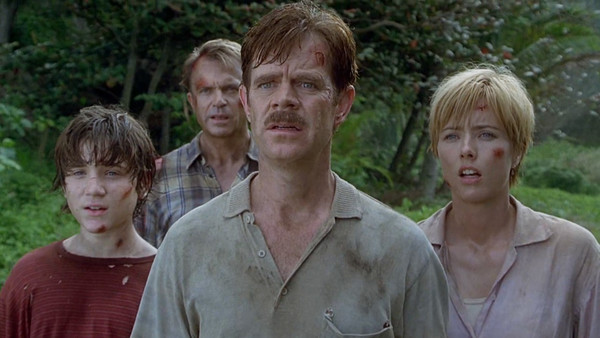
As an added bonus, performances from William H. Macy and Tea Leoni would be welcomed as well, provided that their shenanigans are kept to a bare minimum.

2. Billy Brennan

Speaking of the unbearable Kirby family, there was only one person on the island that was able to keep Dr. Alan Grant sane: Billy Brennan. A colleague of Dr. Grant's, it was evident that the two had a close friendship that showed shades of a familial bond. In many ways, Grant was mentoring Brennan as if he were an older brother or even a fatherly figure.

Young, goodhearted, and a little naive, Brennan was a little too much the younger Alan Grant, which ultimately created a fracture in their relationship. Apart from learning that Billy was alive and Grant was relieved, we have no indication on where their relationship stands post-Jurassic Park III.

Billy was a bright spot in Jurassic Park III and his relationship with Grant, personally and ideologically, deserves further exploration with Dominion's coming events. Will the two have mended fences or has Jurassic World created a deeper rift in their relationship?

1. Nick Van Owen

Love or hate The Lost World, Nick Van Owen was a cool character.

A bit of a playboy and wildcard, Nick was a redeemable character despite any of his flaws. He walked the line in even the most extreme situations and is the sole reason many of our favorite characters made it out of the film alive.

Nick is also a character who audiences love enough to be heartbroken by his death but not completely destroyed. If the stakes are set high in Dominion, major characters need to take the fall. Owen, unfortunately, is just the type of character who writers would send to slaughter in a sequel.

Bringing Vince Vaughn back into the series would be an excellent addition to the story and the cast. Keep in mind, The Lost World was relatively early in his career and he still commanded the screen. He'd complement the new cast well in both comedy and drama. Giving him another go with the character will be anything but disappointing.

Source: https://whatculture.com/

Meet the Sinosaurus: Chinese Rockclimbers Discover 'Chicken Paw Prints'

Friday, June 5, 2020

Reconstructed skeleton at Museo delle Scienze di Trento

In March 2019, a group of rock climbers discovered a string of large 'chicken paw prints' at the Sharen Bomb Shelter in Chongqing, China. Chongqing Municipal Planning and Natural Resources organized a group of paleontologists who identified the footprints of a theropod dinosaur, the sinosaurus.

study recently published by the combined efforts of Xing Lida, Associate Professor of the China University of Geosciences in Beijing, Dai Hui, Senior Engineer at the Geological Heritage Protection Research Institute, Chongqing Bureau of Geology and Minerals Exploration, and Wei Guangbiao, Research Fellow of Chongqing Institute of Geology and Mineral Resources dated the footprints to be from 190 million years ago. 

The newly reported Kayentapus footprints are from the Lower Jurassic Geleshan site is one of the best-preserved examples of this ichnogenus in the region where other theropod species had dominated during the Early Jurassic period. All Kayentapus generally have large footprints, often called a 'bigfoot' species. 

Other Kayentapus species with tridactyl tracks ('chicken paw prints') including the T-rex. Based on the length of the stride and footprint sizes, the scientists predicted that the creatures were large and medium-sized theropods, specifically the Kayentapus hopii.

Dai Hui said that 'Although the footprints of Kayentapus are widely distributed globally, they had not been found in Asia,' until this recent discovery. He also shared that 'China provides some of the best-preserved examples of this ichnogenus in Asia and shows that it can be consistently distinguished from robust Eubrontes. The assemblage is further evidence that the dinosaur track sites of the Lower Jurassic were theropod-dominated in Asia and globally with a consistent diversity of track morphotypes.'

There were 46 total footprints ranging from six to fourteen inches in length. Previously, Kayentapus fossils were found in Yunnan, Sichuan, and Shaanxi provinces. 

The Sinosaurus

The dinosaur is believed to be a sinosaurus, meaning lizard in Chinese, and was named by Chung Chien Young who is known as the 'Father of Chinese Vertebrate Paleontology' in 1948. As one of the fiercest and largest carnivores of its time, the dinosaur remained at the top of the food chain, weighing about half a ton and growing to 18 feet long. 

It also had two crests at the top of its head but were not used for combat. It is believed that the crests would hold open the abdominal cavity of its prey while feeding. 

Dong, studying the dinosaur's feet, concluded that it resembled vultures. As carnivores, they probably adapted to feed on large prey such as prosauropods or long-necks.

More Research

Another observation was evidence of dental damage. Remodeling the creature's jaw 'contributes to mounting evidence suggesting theropods were highly resilient to a broad spectrum of traumas and diseases,' concluded paleontologists. This is also the first-ever documented dental pathology found on a dinosaur. 

Paleontologist Lida Xing is also hoping that the national park would consider closing the area from rock climbers so that the fossil trackway may be preserved. The team shared that 'We very rarely find tracks like this in China, so it will aid in research and public education.'

Source: www.sciencetimes.com/

Paleontologists Created the Most Detailed 3D-Model of Ankylosaur Brain

Saturday, June 6, 2020

Paleontologists at St Petersburg University created the most detailed virtual 3D-model of the endocranial cast and blood vessels of the head of an ankylosaurian.

Paleontologists from St Petersburg University have been the first to study in detail the structure of the brain and blood vessels in the skull of the ankylosaur Bissektipelta archibaldi. It was a herbivorous dinosaur somewhat similar in appearance to a modern armadillo. The first three-dimensional computer reconstruction of a dinosaur endocast made in Russia — a digital cast of its braincase — was of help to the scientists. It made it possible to find out that ankylosaurs, and Bissektipelta in particular, were capable of cooling their brains, had an extremely developed sense of smell, and heard low-frequency sounds. However, their brain was one and a half times smaller than that of modern animals of the same size.

Ankylosaurs appeared on Earth in the middle of the Jurassic — about 160 million years ago — and existed until the end of the dinosaur era, which ended 65 million years ago. These herbivorous animals were somewhat reminiscent of modern turtles or armadillos, were covered with thick armor, and sometimes even had a bony club on the tail. The researchers became interested in the uniquely-preserved remains of ankylosaurs from Uzbekistan. Although these fossils have been known for 20 years, only now have the scientists had a unique opportunity to study the specimens from the inside using cutting-edge methods.

What the ankylosaur Bissektipelta archibaldi might look like. Credit: Image provided by the authors of the paper.

During the study, the paleontologists examined three fragments of fossil skulls of the ankylosaur Bissektipelta archibaldi. They were found during a series of international expeditions URBAC (Uzbek / Russian / British / American / Canadian Joint Paleontological Expeditions) in the late 1990s and early 2000s at the Dzharakuduk locality in the Central Kyzylkum Desert, Uzbekistan. The scientists emphasize that it is unique in that numerous remains of various representatives of the ancient fauna (about 90-million-year-old) can be found there. These include dinosaurs, pterosaurs, crocodiles, birds, mammals, and other vertebrates.

‘This is really one of the richest locations in the world. The fauna of Dzharakuduk has now more than 100 species of ancient vertebrates,’ said Pavel Skutschas, Associate Professor at St Petersburg University and an expert in Mesozoic vertebrates. ‘Of course, such a diversity of life would not have been found without large-scale field studies. A series of nine URBAC expeditions, undertaken from 1997 to 2006, pooled together the efforts of paleontologists from many countries in the search for the bones of ancient animals.’

The material that was collected at that time comprises dozens of fragments of skulls and skeletons, and hundreds of thousands of isolated bones. Scientists still use them in their research and say that it is enough for many years to come. At present, the three fragments of fossil ankylosaur braincases from Uzbekistan are stored at the Zoological Institute of the Russian Academy of Sciences. However, they have been temporarily transferred for research to the Department of Vertebrate Zoology at St Petersburg University.

Ankylosaurs lived on our planet for 100 million years

‘Thanks to the development of computed tomography (CT) over the past 15-20 years, paleontologists are able to learn more and more about the dinosaur brain and its structure,’ said Ivan Kuzmin, the lead author of the article and a doctoral student at St Petersburg University. ‘We decided to re-describe Bissektipelta archibaldi, and we managed to clarify its place on the phylogenetic tree of ankylosaurs. A 3D reconstruction of the endocast of its brain cavity was made using CT. It is important to understand that the digital ‘cast’ of the braincase is not the brain itself. It is necessary to study it carefully to understand how big the actual brain was, where its parts were, how the vessels and nerves were housed.’

Skull reconstruction of the ankylosaur Bissektipelta archibaldi and the approximate position of the studied holotype specimen ZIN PH 1/16. Credit: Image provided by the authors of the paper.

After meticulous work that lasted for three years, the scientists managed to find out that a considerable part of the brain of Bissektipelta archibaldi was occupied by olfactory bulbs — about 60% of the size of the cerebral hemispheres. Bissektipelta could boast of an extremely developed sense of smell, which probably helped it to look for food, relatives of the opposite sex, and to feel the approach of predators in time. It was of vital importance to know about any danger in advance because ankylosaurs had such heavy armor and a clumsy figure. The olfaction of ankylosaurs can even be compared with the olfaction of the famous predator Tyrannosaurus rex. Its olfactory bulbs were even larger, as they occupied about 65-70% of the size of the large hemispheres.

‘Another interesting skill of the ankylosaur that we learned about is the ability to cool its brains in the literal sense,’ said Ivan Kuzmin. ‘The network of veins and arteries in its braincase turned out to be very complicated: they did not go in a single direction, but constantly communicated with each other, like a system of railway tracks. The blood could have flown in different directions and been redistributed, while maintaining the optimal brain temperature of the animal. For example, if the top of an ankylosaur’s head became warm, the vessels diverted quickly the warm blood and created a screening effect — as if a dinosaur put a sun hat on. Moreover, the endocranial vasculature of ankylosaurs turned out to be somewhat more like the vessels of present-day lizards than that of the closer extant relatives of dinosaurs — crocodiles or birds.’

Another important conclusion concerns the hearing of Bissektipelta archibaldi. The paleontologists managed to examine the inner ear of the ancient animal. Its anatomy suggests the frequency of sounds that the ankylosaur could hear. The range turned out to have been from about 300 to 3,000 hertz — present-day crocodiles hear in the same range. These are quite low frequencies that correspond to the relatively large size of ankylosaurs. The larger the present-day animals are, the more low-frequency sounds they make and hear. The paleontologists suggested that, during evolution, ankylosaurs increased in size, so later forms perceived sounds of even lower frequencies.

‘Present-day animal species are characterized by a certain brain-body size relationship,’ explained Ivan Kuzmin. ‘If you look at dinosaurs, then ankylosaurs and their closest relatives (stegosaurs) were almost outsiders. The mass of their brain turned out to be at least half less than what we would expect, based on a comparison with present-day animals. It was about 26.5 grams for a three-meter Bissektipelta. Its brain size can be compared with two walnuts. Nevertheless, ankylosaurs existed on the planet for 100 million years. They were quite successful in terms of evolution. However, judging by the size of their olfactory bulbs, they sniffed a little faster than they thought.’

At the next stage of their research, the scientists would like to study the fossil braincases of other species of ankylosaurs in order to test the hypotheses expressed in the paper. Additionally, the paleontologists continue to use computed tomography and are currently working with digital endocranial casts of hadrosaurs — duck-billed dinosaurs whose remains were found at the same locality in Uzbekistan.

Reference: “The braincase of Bissektipelta archibaldi — new insights into endocranial osteology, vasculature, and paleoneurobiology of ankylosaurian dinosaurs” by Ivan Kuzmin, Ivan Petrov, Alexander Averianov, Elizaveta Boitsova, Pavel Skutschas and Hans-Dieter Sues, 5 June 2020, Biological Communications.
DOI: 10.21638/spbu03.2020.201

In addition to Ivan Kuzmin and Pavel Skutschas, the study engaged: Ivan Petrov, a high school student and a trainee of the Krestovsky Ostrov Ecological and Biological Centre of the St Petersburg City Palace of Youth Creativity; Alexander Averianov, Head of the Laboratory of Theriology of the Zoological Institute of the Russian Academy of Sciences and Professor at St Petersburg University; Elizaveta Boitsova, a graduate of St Petersburg University, who was in charge of the visual part of the work; and Hans-Dieter Sues, a well-known paleontologist from the National Museum of Natural History of the Smithsonian Institution. Also, Pavel Krasnov, a 3D printing specialist from St Petersburg, helped the researchers print a real-size three-dimensional model of the ankylosaur endocast. The academic paper features the current issue of Biological Communications. It is a renewed Vestnik of St Petersburg University. Series 3, Biology updated three years ago that has been published in Russian since 1946. Today it has been transformed into a journal in English on biology with a particular focus on communicating Russian scientific discoveries to the global academic community. After its renewal, the Editor-in-Chief was Yegor Malashichev, Associate Professor of the Department of Vertebrate Zoology at St Petersburg University, who passed away at the end of 2018. The paleontologists from St Petersburg University have published this paper in Biological Communications in memory of their friend and talented scientist.

Source: https://scitechdaily.com/

Pages