Blogs

360-Million-Year-Old Fossil Reveals Extinct Species of Fern-Like Plant

Thursday, June 18, 2020

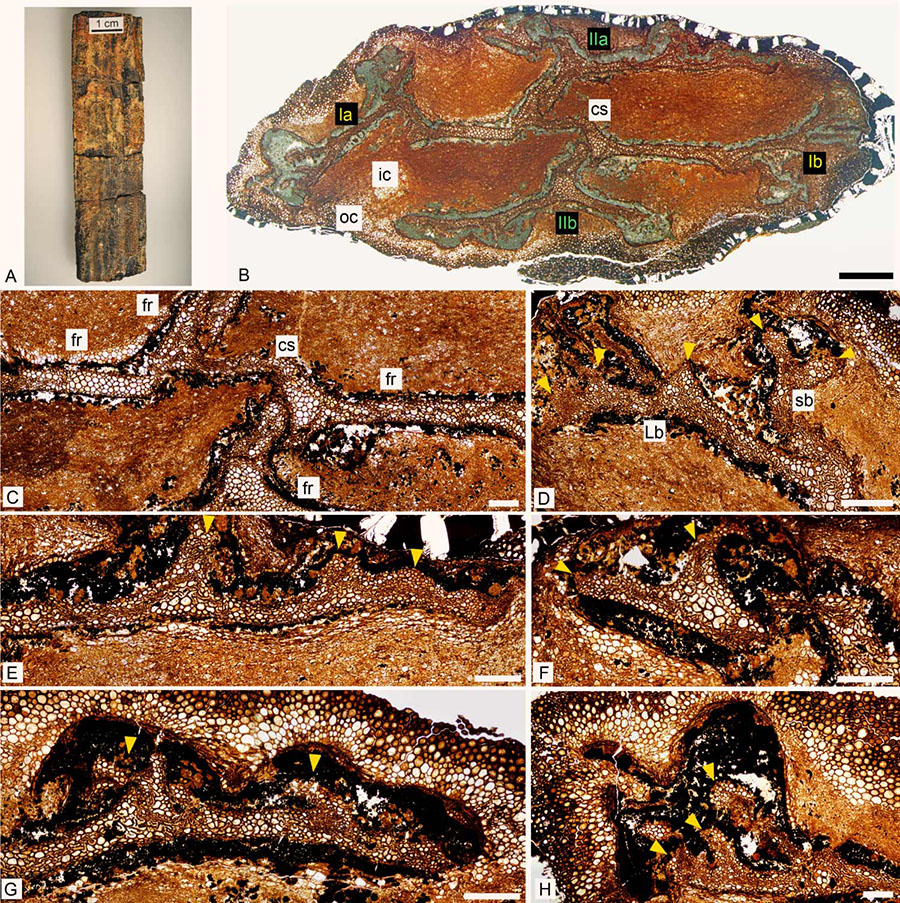
Keraphyton mawsoniae: (A) specimen before preparation; (B) general view of stem showing the 4 rib systems (Ia, Ib, IIa and IIb); (C) central segment and four fundamental ribs; (D) rib system Ib showing a short branch dividing into two equal ultimate ribs at right and a long branch producing at least three long ultimate ribs at left; (E) long branch of rib system IIa producing short ultimate ribs; (F) short branch of rib system IIa dividing into two ultimate ribs; (G) long branch of rib system IIb producing short ultimate ribs; (H) long branch of rib system Ia producing long, but broken, ultimate ribs. Abbreviations: cs – central segment, fr – fundamental rib, ic – inner cortex, oc – outer cortex, Lb – long branch, sb – short branch. Yellow arrowheads indicate ultimate ribs. (DH) are all oriented with the cortex of the axis towards the top of the photo. Scale bars – 500 μm, (B) – 2 mm. Image credit: Champreux et al, doi: 10.7717/peerj.9321.

Paleontologists have identified a new genus and species of fern-like plant from a single fossilized specimen collected in the New England region of New South Wales, Australia.

The newly-discovered plant species lived approximately 360 million years ago (Devonian period) — a time when Australia was part of the supercontinent Gondwana.

“It is an extraordinary discovery, since such exquisitely-preserved fossils from this period are extremely rare,” said lead author Antoine Champreux, a PhD student at Flinders University.

“Plants and animals had just started to colonize continents, and the first trees appeared.”

“Yet while diverse fish species were in the oceans, continents had no flowering plants, no mammals, no dinosaurs, and the first plants had just acquired proper leaves and the earliest types of seeds.”

“Well-preserved fossils from this era are rare — elevating the significance of the new plant fossil.”

Named Keraphyton mawsoniae, the ancient plant shares some similarities with modern ferns and horsetails.

“We named the genus Keraphyton (like the horn plant in Greek), and the species Keraphyton mawsoniae, in honor of our partner Professor Ruth Mawson,” the researchers said.

The fossil was found in the 1960s by amateur geologist John Irving on the bank of the Manilla River in Barraba, New South Wales.

The specimen is a straight, 90-cm-long and 2 x 1-cm-wide portion of anatomically preserved stem.

It is characterized by a star-shaped vascular system with strands located at rib tips, and by a lack of secondary tissues.

There is no information on the lateral organs, their nature, size and arrangement in Keraphyton mawsoniae.

Nevertheless, it provides sufficient features to demonstrate its uniqueness and its affiliation to a new genus and species.

“It’s nothing much to look at — just a fossilized stick — but it’s far more interesting once we cut it and had a look inside,” Champreux said.

“The anatomy is preserved, meaning that we can still observe the walls of million-year-old cells.”

“We compared the plant with other plants from the same period based on its anatomy only, which provide a lot of information.”

The discovery is reported in the journal PeerJ.

_____

A. Champreux et al. 2020. Keraphyton gen. nov., a new Late Devonian fern-like plant from Australia. PeerJ 8: e9321; doi: 10.7717/peerj.9321

Source: www.sci-news.com/

The Wild True Story Behind Samuel L. Jackson's Famous Jurassic Park Line

Wednesday, June 17, 2020

Sam Jackson is one of the most notorious scene stealers in Hollywood. You simply do not cast Samuel L. in a supporting role unless you intend him to upstage your leads literally every time they share a frame in front of the camera. This is one maxim of the entertainment industry that's as true today as it was, say, back in 1993, when Mr. Jackson delivered one of the most memorable lines in the smash hit blockbuster Jurassic Park.

The iconic dinosaur thriller, based on a best-selling book of the same name by Michael Crichton, has grossed over $1 billion since its original debut, making it by far the highest-grossing film of 1993 and a respectable 28th on the all-time list of box office champions (via Box Office Mojo). The franchise-launching film starred Sam Neill (Event Horizon) and Laura Dern (Big Little Lies) as lead scientists Grant and Ellie with fellow A-listers Jeff Goldblum (Independence Day), Richard Attenborough (Rosebud) and BD Wong (Law and Order: SVU) appearing in supporting roles. Jackson appears several slots further down on the casting list, in the bit part of Ray Arnold, the largely desk-bound computer scientist working under the nefarious corporate spy, Dennis Nedry (Wayne Knight).

Despite his limited screen time, Jackson's character delivered one of Jurassic Park's most quotable lines when he exclaimed, "Hold onto your butts!" Viewers who have also read the book will note that this particular turn of phrase does not appear in the source material. "Hold onto your butts!" was the sole creation of screenwriter David Koepp, who recently opened up to Cinema Blend about the infinitely quotable declaration's origin story.

Jurassic Park screenwriter David Koepp borrowed Jackson's line from Robert Zemeckis

Koepp recently sat down with the Reel Blend podcast to share some behind-the-scenes anecdotes from the production of the iconic dino-disaster flick. According to the screenwriter himself, that famous Jackson line came straight from Back to the Future creator-writer-director Robert Zemeckis.

Koepp fessed up on air, telling Reel Blend, "I was finishing Death Becomes Her when I was writing Jurassic Park, and we had an ending that was really disastrous at first from one of these horrible test screenings where they almost kill you. So we'd very quickly gone out to shoot a new ending for the movie, but there was little time before the movie came out, so we were in the dailies of the reshoots, and there was gonna be no opportunity to redo the reshoots. So this was it, this really had to work. And we sat down in the dailies, and as the lights were going down, Bob Zemeckis said, 'Hold onto your butts.' I happened to be working on the script at that time, and I was like, 'Oh, I love that.' I went back and I typed it into the script immediately, and then Sam Jackson said it. I don't think I ever told Zemeckis that, but that's his line."

There are definitely some creative benefits to spending your time with other writers. Zemeckis was never credited for his contribution, but at least the truth has finally come out.

Source: www.looper.com/

We Thought We Knew The Biggest Dinosaur Ever, But Something Else Might Have Stolen Its Thunder

Monday, June 15, 2020

Credit: © Gregory Paul 2020

It seems T. rex has probably been sensationalized too much. While the iconic carnivore has been the poster dino for the entire Jurassic Park franchise (except maybe that one Brachiosaurus), there were creatures that made it look like a pet lizard.

Titanosaurs trampled the earth from the Jurassic through the mid-late Cretaceous, leaving behind only fragments of their skeletons for scientists to try and piece together. These herbivorous species were so huge that even voracious predators like T. rex would have to freeze literal tons of leftovers if freezers actually existed. Until recently, Patagotitan was thought to be the heavyweight, but researcher Greg Paul suggests there were more gargantuan things out there.

Paul, who published a study in Annals of Carnegie Museum, found that measurements of Argentinosaurus bones have an edge over those of Patagotitan, and there was possibly something that out-monstered both of them.

“A main conclusion of my analysis is that Patagotitan is definitely not the largest known titanosaur, that being the previously known, less complete titanosaur Argentinosaurus, the individual bones of which are distinctly larger in critical dimensions,” Paul, whose rendering of Argentinosaurus can be seen above and below, told SYFY WIRE.

While Patagotitan was previously thought to be the largest sauropod to have ever existed, Paul’s measurements resulted in an estimate of around 50-55 tons, while Argentinosaurus could have been an astonishing 65-75 tons. His mass estimates relied on volumetric models. These were based on restorations of the entire skeletal profile of the behemoth, which were then used to reconstruct it in three dimensions. Volumetric models are far more accurate than some other methods based on dimensions of individual limb bones. As a basis for comparison, models of extant animals that use the limb bone method are off by at least a factor of two—meaning, probably even more inaccurate in anything extinct.

Credit: © Gregory Paul 2020

But wait. Was there a size limit? Extreme life-forms have extreme energy needs, and these herbivores needed to munch quite a few trees to stay alive. They also have extreme limitations. The blue whale, which is now is the largest animal in existence at up to 82 feet long and 330,000 pounds, evolved during the ice age only a few million years ago, possibly because it feeds on almost unlimited plankton and that water alleviates at least some of the burden of its immense size. Scientists believe that physiological stress from diving and surfacing may have limited the blue whale’s body size.

“We know that sauropods approaching and perhaps exceeding 100 tons lived on land, in part because we have their trackways formed out of the water,” Paul explained. “The calculations show their bones were strong enough, and their muscles powerful enough, to have been able to walk normally.”

Super-titanosaurs are thought to have trudged along like elephants on land. The highest speed they could reach was probably no faster than 15 miles an hour, and it is unlikely something of that size could ever actually run. Not that they had too many predators to worry about. Growing to incredible sizes might have actually been how some titanosaurs adapted to living in places where their ancestors had always been stalked by theropods similar to T. rex or Allosaurus. because trying to take down such a beast was useless for a carnivore, dagger teeth and all, whose average height was around 20 feet. Could anything have held these titans back from growing any larger?

“It is possible that limitations in finding food are what limited the size of sauropods. Or problems pumping blood all the way up to their heads. Or structural issues regarding moving on land,” Paul said, but stressed that “It is not known what the maximum size limit of animals is on land or in the water, or why.”

Even Argentinosaurus, which was proven to have been an overall larger species than Patagotitan, may have still not been the most massive sauropod and land animal to have ever roamed the Earth. Something may or may not have beat that. Maraapunisaurus, if it actually existed, is thought to have been at least 80-120 tons. This hypothetical dinosaur might have gotten to such a size because it had a shorter neck than Argentinosaurus, which relieved it of blood pressure issues often brought on by extreme height, and vertebrae that were built for a strength boost. The problem is that only one vertebra thought to belong to this mythic creature was ever found—and then lost.

Whether Maraapunisaurus was real remains a mystery. Unfortunately, even known species like Argentinosaurus and Patagotitan have only let us know of their existence through incomplete skeletons. That still doesn’t mean larger sauropods never made the ground tremble with their thunderous footsteps. Dinosaurs of such a tremendous size, as Paul noted, could not have been easily fossilized because decomposition processes probably didn’t allow for them to be buried fast enough for sufficient preservation.

“There are partial remains of other sauropods that may suggest animals larger than Argentinosaurus,” he said. “In any case, the possibility that we have happened to have already found the largest land animals of all time is essentially zero, bigger ones must have existed.”

Just don’t tell that to any hardcore Jurassic Park fans.

Source: www.syfy.com/

Why Jurassic World Couldn’t Use Dennis Nedry’s Stolen Embryos

Sunday, June 14, 2020

Jurassic World didn't follow up on Jurassic Park's lingering plot point - the stolen shaving cream can containing dinosaur embryos - for good reasons.

There are a few reasons why Jurassic World didn't use one of Jurassic Park's lingering plot points: the Barbasol shaving cream can containing dinosaur embryos that Dennis Nedry (Wayne Knight) lost when he died. Colin Trevorrow's 2015 sequel soft reboots Steven Spielberg's 1993 blockbuster; 22 years after the disaster on Isla Nublar, InGen has been purchased by Masrani Global Corporation and successfully operated the dinosaur theme park for a decade - until a similar disaster struck Jurassic World. Trevorrow's trilogy continued in 2018's Jurassic World: Fallen Kingdom and will conclude in 2021's Jurassic World: Dominion.

Fans have wondered about the missing Barbasol can ever since Jurassic Park. In the original film, Nedry, one of the Park's programmers, accepted a bribe from the rival BioSyn corporation. Dennis was provided with a gimmicked shaving cream can that could store 15 dinosaur embryos for 36 hours. As Nedry tried to escape the park during the stormy night that led to the dinosaur breakout, he crashed his jeep and was subsequently attacked and killed by a Dilophosaurus. The Barbasol can containing the embryos was lost in the mud, but this plot point was abandoned by Spielberg's 1997 sequel The Lost World: Jurassic Park and 2001's Jurassic Park III. The Barbasol can was also not mentioned at all in Jurassic World, but that makes sense considering how much time has passed in between Spielberg's original film and Trevorrow's soft reboot.

The likeliest explanation as to why Jurassic World moved past the Barbasol can plot point is that 22 years had passed since Jurassic Park. After all, the embryos in the can were only meant to last for 36 hours. Even if the can had been recovered, the embryos inside were useless. Further, Masrani wouldn't need those stolen embryos anyway; they purchased InGen so they owned all of Dr. Henry Wu's (B.D. Wong) research and they kept Wu on the payroll t0 make more dinosaurs as well as create new hybrids like the Indominus Rex and the Indoraptor. The embryos in the shaving cream can would only have been valuable to competing biotech companies trying to breed their own dinosaurs. Further, Isla Nublar was largely terraformed by Masrani to build Jurassic World, so though the Barbasol can may have been recovered at some point, the embryos within would have been useless. Barbasol's real-world product tie-in to Jurassic World is its closest acknowledgment of Nedry's lost embryos.

What ultimately did happen to the missing Barbasol can was the subject of 2011's Jurassic Park: The Game, created by Telltale Games (The Walking Dead). Jurassic Park: The Game was set during the events of the original film, involving a pair of BioSyn mercenaries entering Isla Nublar to find Nedry and the embryos. They locate Nedry's body and retrieve the Barbasol can, but they are attacked by the rampaging dinosaurs. The game offers two different endings for the Barbasol can: in the first, a mercenary named Nima is eaten by the T-rex and the can is left behind on the island. In the second ending, the T-rex steps on the can. Jurassic Park: The Game was intended to be canonical, but whether or not its story does occur in Jurassic World's pre-history, Nedry's stolen Barbasol can never made it off Isla Nublar.

In 2002, Spielberg was excited about the script for the never-made Jurassic Park IV written by John Sayles (The Alienist), which made Nedry's Barbasol can a focal point of its story. In Jurassic Park IV, a rival company bought InGen, the embryos somehow didn't expire after 36 hours, and after they were retrieved, the film's villain, Baron Werner V0n Drax, used them to make weaponized, hybrid, cybernetic dinosaurs. Colin Trevorrow later told Screen Crush that he did read Sayles' Jurassic Park IV script before he made Jurassic World and some elements influenced Trevorrow's characters and story.

However, Trevorrow's Jurassic World screenplay reworked a different Jurassic sequel script written by Rick Jaffa and Amanda Silver, and Trevorrow had to follow three directives from Spielberg: "The park is open, there is a raptor trainer (who became Chris Pratt's Owen Grady), and the dinosaur that breaks free threatens the park." Dennis Nedry's stolen embryos simply didn't factor into Jurassic World's equation, and since Isla Nublar was destroyed by a volcanic eruption in Jurassic World: Fallen Kingdom, the Barbasol can is now permanently lost to history.

Source: https://screenrant.com/

Forget Marvel And Star Wars—Jurassic Park Is Easily The Box Office’s Biggest Franchise

Saturday, June 13, 2020

Chris Pratt attending a photocall for Jurassic World: Fallen Kingdom, held at the Strada, London. ... [+] PA IMAGES VIA GETTY IMAGES

As theaters slowly start to come back to life, moviegoers from around the world await the next step for several of Hollywood’s biggest franchises. Daniel Craig’s final stint as 007 will come with No Time to Die; the Harry Potter universe will continue to grow with Fantastic Beasts and Where to Find Them 3; the DCEU will add a Wonder Woman sequel to its growing lineup; and, of course, the biggest franchise on the planet, Marvel, will add two more films to its growing cinematic universe.

But as undeniably lucrative as all those franchises are, it’s doubtful that any of those new movies will be as profitable as Jurassic World: Dominion.

In fact, Jurassic Park is the most profitable franchise on the planet—and it’s not even close.

It’s truly miraculous how seamlessly the franchise transitioned from its monster original film Jurassic Park in 1993 to the multi-billion-dollar franchise that dominates the box office today. The Jurassic Park films have continually extracted the most value from their budgets, resulting in a rate-of-return that’s far and above every other franchise on the market.

Don’t believe me? Here’s a breakdown of the top ten live action franchises on the market. The franchises are ranked by their rate-of-return—which is every franchise film’s combined worldwide box office divided by the combined budget.

Note: I’ve decided to exclude animated franchises—although only one (the Despicable Me films) actually tops the Jurassic Park series.

  1. Jurassic Park - 8.13x rate-of-return

  2. Twilight - 7.92x rate-of-return

  3. Star Wars - 6.16x rate-of-return

  4. Harry Potter - 5.99s rate-of-return

  5. Hunger Games - 5.98s rate-of-return

  6. Lord of the Rings - 5.88x rate-of-return

  7. Marvel Cinematic Universe - 4.99x rate-of-return

  8. Fast & Furious - 4.88x rate-of-return

  9. Transformers - 4.47x rate-of-return

  10. Mission Impossible - 4.35x rate-of-return

The gargantuan difference between Hollywood’s most profitable franchise, Jurassic Park, and its tenth-most-profitable franchise, Mission Impossible, is pretty telling. Jurassic Park nearly doubles the Tom Cruise series’ rate-of-return.

And if we don’t include the Twilight films on this list—which maybe we shouldn’t, considering there are only five movies and the franchise likely won’t grow moving forward—then Star Wars is the only other franchise that comes even close to match Jurassic Park’s profitability. And even then, Jurassic Park eclipses Star Wars’ profitability by a striking 32%.

Perhaps the most significant gap, however, is the difference between Jurassic Park’s and the MCU’s profitability. While the Marvel films have generated an insane $22.577 billion since Iron Man hit theaters in 2008, they’ve also required a combined budget of $4.529 billion. Meanwhile, the five Jurassic Park films’ combined budget rests at a mere $616 million.

To break that down, the average Marvel movie requires a budget of $196.9 million and produces an average of $981.6 million in worldwide revenue. But the average Jurassic Park movie only requires a budget of $123.2 million and produces an average of $1.002 billion in box office receipts.

Now, there’s an obvious reason for that gap in budgets: three of the Jurassic Park movies came out during the 1990s and early 2000s. Those three movies’ combined budget was just $231 million, which would blow up exponentially in today’s dollars. For instance, the original Jurassic Park’s budget of $63 million would be a little over $102 million today.

But if we were to inflate the budget, then we’d have to inflate each movie’s box office total as well. That means that Jurassic Park’s domestic total of $402.5 million would inflate to a staggering $853.3 million in 2020—which is just $5 million away from what Avengers: Endgame made last year when it become the second-highest-grossing film in U.S. box office history.

Honestly, though, that comparison isn’t fair to the original Jurassic Park, considering the film’s owns a nearly unmatchable 16.6x rate-of-return, which far outpaces Endgame’s 6.99x rate-of-return—as well as Star Wars: The Force Awaken’s 6.76x rate-of-return.

It’s also telling that the Jurassic Park’s only true “flop,” Jurassic Park III, saw a 3.93x rate-of-return—a figure that tops the overall average for several franchises, including James Bond, the DCEU, Pirates of the Caribbean, X-Men and Star Trek.

The Jurassic Park franchise has carried that momentum into today. While the series may seemingly not be as viral as either Marvel or Star Wars, the latest two Jurassic World films have produced a combined $2.979 billion at the global box office on a combined budget of $385 million—that represents a 7.74x rate-of-return. Once again, better than the most profitable films in both the Marvel and Star Wars franchises.

Simply put: no other modern franchise can match those kinds of numbers.

Source: www.forbes.com/

Cretaceous-Period Crocodiles from Korea Walked on Two Legs

Saturday, June 13, 2020

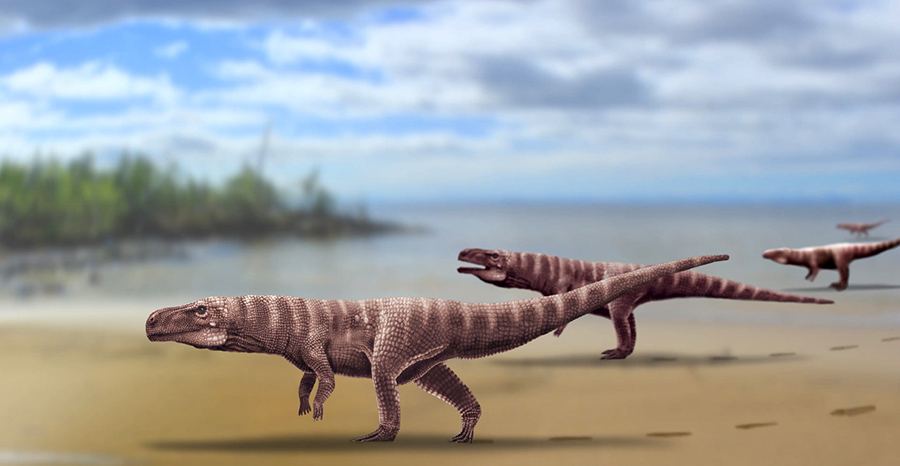
Bipedal crocodylomorph trackmakers. Image credit: Anthony Romilio.

Multiple, well-preserved trackways made by large crocodylomorphs, extinct ancestors of modern-day crocodiles, between 110 and 120 million years ago (Cretaceous period) have been found near Sacheon City in South Korea. Surprisingly, the trackways never include handprints and indicate exclusively bipedal walking, a gait not known from fossil crocodylomorph trackways.

Professor Kyung Soo Kim from Chinju National University of Education and colleagues discovered the well-preserved crocodylomorph trackways with clearly defined foot impressions and localized skin traces at the Sacheon Jahye-ri site of the Jinju Formation.

The tracks are between 18 and 24 cm long, indicating trackmaker body lengths over 3 m.

“It shocked us to learn that the trackways represent bipedal animals 3-4 m long,” Professor Kim said.

“The footprints were initially thought to be made by a giant bipedal pterosaur walking on the mudflat, we now understand that these were bipedal crocodile prints,” said University of Queensland’s Dr. Anthony Romilio.

“The footprints measure around 21 cm, suggesting the track-makers had legs about the same height as human adult legs. These were long animals that we estimate were over 3 m in length.”

“And while footprints were everywhere on the site, there were no handprints.”

The paleontologists initially questioned the absence of hand impressions from the trackways, given that modern-day crocodiles are quadrupedal (four-legged).

“Fossil crocodile tracks are quite rare in Asia, so finding an abundance of nearly one hundred footprints was extraordinary,” Dr. Romilio said.

“As an animal walks, the hind feet have the potential of stepping into the impression made by the hand and over-printing it, but we find no evidence of this at these Korean sites.”

“It isn’t due to poor preservation either, because these fossils are spectacular, they even have the fine details of the toe-pads and scales on their soles preserved.”

Batrachopus grandis trackways made by bipedal crocodylomorphs. Image credit: Seul Mi Bae.

The researchers named the new tracks Batrachopus grandis emphasizing the large size in comparison with much older and smaller 2-3-cm-long tracks of the Batrachopus type, commonly found in the Jurassic of North America.

“Nobody expected such large bipedal crocs. The Jinju Formation is so rich in tracks; you can read the entire ecology,” said University of Colorado’s Professor Martin Lockley.

Among the remains of some of the oldest terrestrially adapted crocodiles are large species that lived more than 200 million years ago (Triassic period), and some paleontologists think they may have been bipedal.

“The Korean trackways prove this hypothesis, at least for the Cretaceous period,” Dr. Romilio said.

“It also proves this adaptation was effective for millions of years, even with big fierce dinosaurs running around.”

The study was published in the journal Scientific Reports.

_____

K.S. Kim et al. 2020. Trackway evidence for large bipedal crocodylomorphs from the Cretaceous of Korea. Sci Rep 10, 8680; doi: 10.1038/s41598-020-66008-7

Source: www.sci-news.com/

Why Lost World Wasn’t As Good As Jurassic Park: What Went Wrong

Saturday, June 13, 2020

Four years after Jurassic Park's blockbuster success, The Lost World arrived. But why wasn't this big budget sequel as good as its predecessor?

The Lost World: Jurassic Park arrived four years after the groundbreaking release of Steven Spielberg’s Jurassic Park, to much anticipation, but was ultimately a disappointment. Given the degree of expectation heaped upon the sequel by critics and fans, Spielberg had an especially challenging task ahead of him. Though the film was a global financial success, it failed to reach either the monetary or critical heights of its predecessor. Many fans of Jurassic Park were let down by the sequel, and unfortunately, The Lost World marked a swift decline of the franchise’s quality until Jurassic World arrived in 2015.

The sequel involves Doctor Ian Malcolm (Jeff Goldblum) travelling to Isla Sorna – the island on which wealthy entrepreneur Richard Hammond first began experimenting on the possibilities of cloning dinosaurs - in order to rescue his girlfriend, Sarah Harding (Julianne Moore). Moore is part of a small group organised by Hammond, whose purpose was to document the natural and unfettered life of dinosaurs. The creatures had been abandoned on the island after a storm, and with Hammond’s company InGen now headed by his nephew, Hammond wishes to ensure that the creatures are given the attention and respect he believes they deserve. Accompanying Malcolm is photographer Nick Van Owen (Vince Vaughn) and field equipment expert Eddie Carr (Richard Schiff). Trouble begins from the moment Malcolm and the rest of the crew set foot on Isla Sorna, as Malcolm’s daughter Vanessa (Kelly Curtis) reveals she’s stowed away on the dangerous mission, and InGen’s unpleasant crew of mercenaries arrive to capture dinosaurs for a theme park in San Diego.

Because Jurassic Park opened up new possibilities for visual effects and changed the way in which films were made, a sequel seemed like a guaranteed hit. But those who were wanting a return to the same energy, tension and excitement that Jurassic Park had provided were left feeling short changed by The Lost World. It’s slightly unusual for a sequel to bring back a director as renowned as Steven Spielberg, as well as the same writer and some of the same cast, and yet still fail to engage with audiences. Since this was the case with The Lost World, why exactly wasn't it as good as Jurassic Park?

Jurassic Park's Sense Of Wonder Is Gone

A major part of what made Jurassic Park the hit it was can be attributed to the film’s groundbreaking use of animatronics and CGI. Audiences were blown away the first time they saw the likes of a T-Rex or brachiosaurus on screen, and that immediate intrigue enriched everything about Jurassic ParkThe Lost World doubled down on this aspect, bringing in more CGI dinosaurs, but by this point, a realistic looking dinosaur on the big screen was old news. At the same time, however, it wasn’t simply the film’s visual effects or life-sized animatronic models that captivated its viewers. The concept of visiting a remote island where actual dinosaurs had been brought back to life was so fresh and harkened back to such a widely shared feeling of childhood wonder, that audiences couldn’t help but become swept away by Jurassic Park. Which dinosaurs would appear next and how they would behave was thrilling, as was the struggle for survival that the film’s protagonists faced when Jurassic Park went from being a place of real-life wonder to one of real-life terror.

All of this changed with The Lost World. A return to a remote island no longer held the same degree of curiosity, simply because audiences had already been there. Sure, the events of The Lost World were set on Isla Sorna rather than Jurassic Park’s Isla Nublar, but the geographical differences between the two islands was minimal. What’s more, the film’s central thrust was instigated by Ian Malcolm’s desire to rescue his girlfriend from what he knew was the extreme danger of Hammond’s dinosaurs. Right from the start, the film was about the fear and treachery of dealing with real life dinosaurs. Audiences did not have the luxury of watching as something that was as fascinating as seeing living, breathing dinosaurs in the 20th century gradually transform into something horrifying, as they did with Jurassic Park. This made The Lost World feel more like a standard monster movie than a well rounded adventure, and by doing so, Spielberg touched on tropes that were already far too familiar to audiences, even back in 1997.

The Last World Has Too Many Rehashed Moments Rather Than Original Ones

One of the biggest problems with sequels is that often, they needn’t be made at all. Some films favor a return to the concepts and characters explored in a previous instalment and enrich them in an entirely different way, but this only works if what the sequel offers is original. In the case of The Lost World, several of its key moments are simply rehashed versions of what came before in Jurassic Park. An example of this is the rather lengthy sequence in which Malcolm, Harding and Van Owen fight for their lives while suspended from a cliff in a research trailer. The unit has been pushed into this position by a T-Rex, in much the same way as one of Jurassic Park’s SUV’s is pushed off the road by a T-Rex and left hanging from a tree in the first film.

Another example of this sort of repetition comes when arrogant InGen employee Dieter Stark (Peter Stormare), loses his way and falls down a hill in the jungle. Initially, Stark was pestered by a small dinosaur called a Compsognathus, which he bullied, believing that it posed no threat to him. But after falling down the hill, Stark’s disregard for the creature turns to terror as a large pack of them overwhelm and kill him. This scene strikes a very familiar similarity to the manner in which Dennis Nedry (Wayne Knight) meets his demise in Jurassic Park. As the greedy programmer attempts to escape the island with dinosaur embryos, his jeep slides off the road. He then encounters a Dilaphasorous and is initially frightened, but acts derisively toward the creature once he’s lead to believe that it isn’t dangerous, costing him his life.

The Lost World’s mimicry of the original film continues with the second act’s central focus on the stranded characters’ need to find their way to the island’s operations building. Again, the trek through a deadly jungle landscape is entirely reminiscent of Jurassic Park’s plotting – from the journey of Doctor Alan Grant (Sam Neill) and the children back to the visitor’s centre after being waylaid by a T-Rex, to Doctor Ellie Sattler’s tense quest to reach the maintenance shed under the stalking eye of Velociraptors. Though these plotting repetitions might not have been immediately recognizable to audiences upon The Lost World’s release, their existence was arguably familiar enough to mitigate a great deal of the intrigue that people wanted from the film.

Less Is More, Bigger Isn’t Always Better

After the massive success of Jurassic Park, Spielberg clearly wanted to repeat the spectacle in an even bigger and better way. As previously mentioned, this resulted in more dinosaurs, more CGI, more characters and bigger (though not necessarily more original) set pieces. There’s certainly nothing wrong with going all out – especially if you happen to be Steven Spielberg – but the film was so laden with these things as to leave it feeling bogged down and overstuffed. This is especially evident during the film’s final 20 minutes, where Spielberg made the decision to bring the T-Rex to civilization.

The inclusion of dinosaur meets city assumed that audiences would be excited by the prospect of old meets new. Perhaps if a major metropolis had been the setting for the entire film this would have worked out well. Instead, the plot point comes across as tacked on, teasing something that never really had the chance to be expanded on or explored in any significant way. After all, dinosaurs suddenly arriving in the middle of modern day civilization is not something that can or should be simply touched upon in a film’s closing minutes. What this portion does succeed in doing, however, is match the film’s overall lack of significant exploration. Preoccupied with trying to be visually engaging, The Lost World suffers from a general lack of depth with regard to its characters and the direction that its plot takes.

The Lost World Has Flat Characters

Jurassic Park offered an opportunity for its characters to make valid transformations while asking philosophical questions about mankind and science. The often cruel and unfair cycle of life was emphasized, as was the beauty of existence. The film’s focus on Dr. Grant’s change from a man who seemed to take more joy in frightening or outright ignoring children than actually caring for them fit in perfectly with Jurassic Park’s general themes. As audiences discovered, the concept of parenthood and the responsibilities it necessitates was not so different from the responsibility involved in bringing back an ancient and extinct species. Watching Grant go from curmudgeon to father figure offered a gentle touch of humanity to the film, making the story all the better for it.

With The Lost World, however, little of significance was learned about the characters and ultimately, the film suffered as a result. Any attempts at fleshing out Malcolm’s relationship with either his daughter or his girlfriend were superficial at best. The film was more concerned with the spectacle of dinosaurs than actually balancing it with real human emotion and feeling. Because of this, audiences were unable to connect with the film in the same way as they did with Jurassic Park. While that film’s components blended together seamlessly for a thrilling and emotional journey, The Lost World’s approach was clunky without the latter’s heart.

The financial success of The Lost World has undoubtedly led many people to conclude that it was a complete success and that it really was a good film. And while The Lost World isn't a terrible movie by any means, one can’t help but feel that it would have been better served by a little more time in its developmental stages. Four years may seem like a lengthy enough period of time between films, but it’s worth acknowledging that Jurassic Park was originally written in 1983 as a screenplay by Michael Crichton before it was eventually published in 1990 as a novel. That’s a considerable amount of time to work through themes, characters, and the story’s overall arc. This isn’t to suggest that Spielberg should have waited 10 years to make a sequel, but it does emphasize just how valuable attention to detail is and how it could have gone a long way in making The Lost World memorable.

Source: https://screenrant.com/

8 Wild Examples of Evolution Copying Itself

Saturday, June 13, 2020

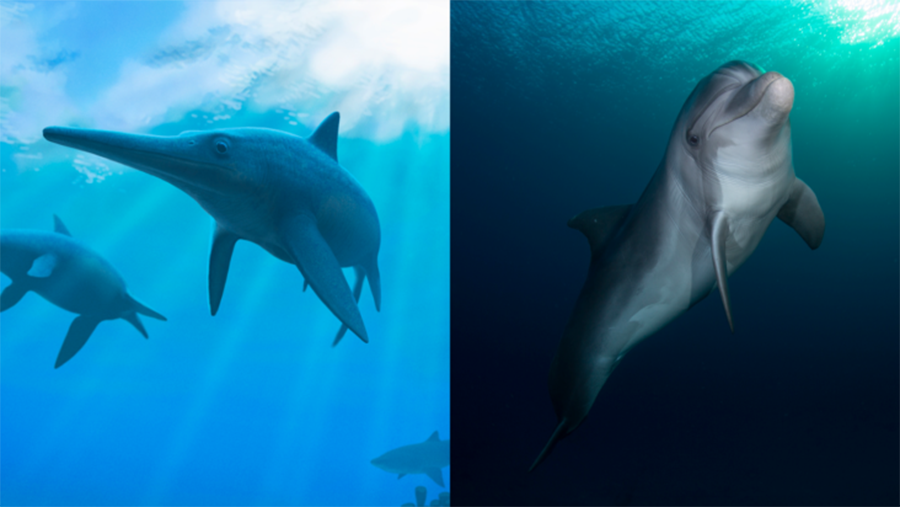
Left: Artist's impression of extinct ichthyosaurs. Right: A modern dolphin. (Image: Andrey Atuchin/ טל שמע (Wikimedia Commons)

Every once in a while, Darwinian natural selection stumbles upon the same solution more than once, in a process known as convergent evolution. Here are our favourite examples of evolution making the same creature, or same physical trait, twice.

In evolution, mutation is random, but selection is most certainly not. Every adaptive new trait acquired by a species was likely accompanied by countless failed experiments. The judge, as it were, in deciding which mutations are beneficial or not is brutally simple: ongoing survival.

For organisms caught in a Darwinian mode of existence — which is all of them — the space of all possible beneficial mutations is sufficiently small, a space ruled by physics, biological constraints, and environmental pressures. It sometimes happens that two unrelated species, separated by time and space, will find themselves living in the same ecological niche or facing similar evolutionary problems. When this happens, evolution will dip into its limited grab-bag of solutions, and essentially create the same species twice.

Dolphins and Ichthyosaurs
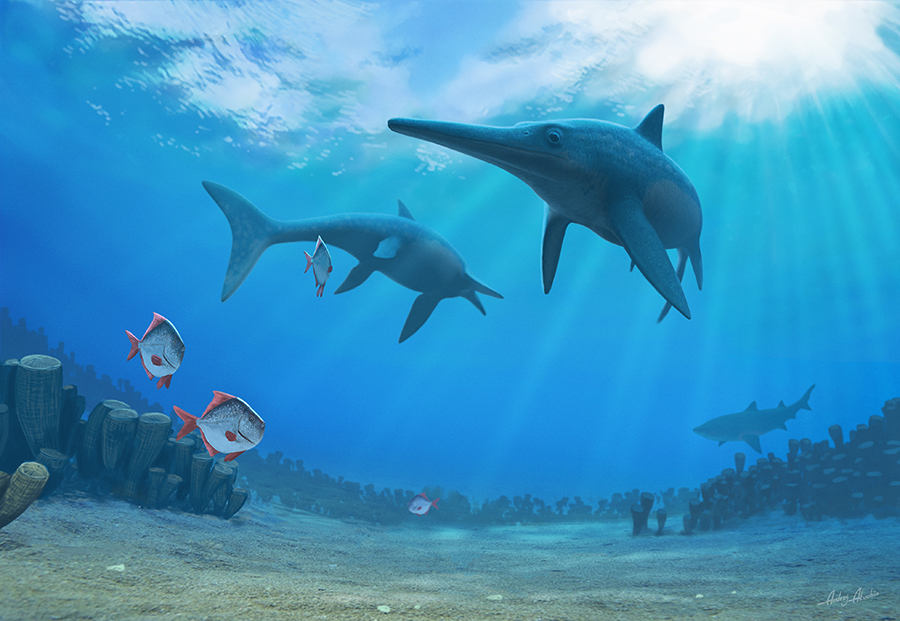
Artist's impression of ichthyosaurs. (Image: Andrey Atuchin)

The Germans have a great word to describe an ensemble of physical features common to different species: Bauplan. This translates to “body plan” in English, and it nicely encapsulates a key aspect of convergent evolution, namely morphological similarities in unrelated species. In other words, two different animals that look a hell of a lot alike.

Two dolphins swim in the Egyptian Red Sea marine reserve. (Photo: EMILY IRVING-SWIFT/AFP, Getty Images)

Two species that share a common or at least a very similar Bauplan are modern dolphins and ancient ichthyosaurs. It’s a striking example of evolution stumbling upon the same solution for two very different types animals, in this case mammals and reptiles. These two creatures share other similarities as well, including live births, warm blood, and even similar camouflage.

Modern sharks and dolphins share certain aspects of convergent evolution, such as their streamlined shape and triangular dorsal fin, but they also have many differences.

Cassowaries and Corythoraptors
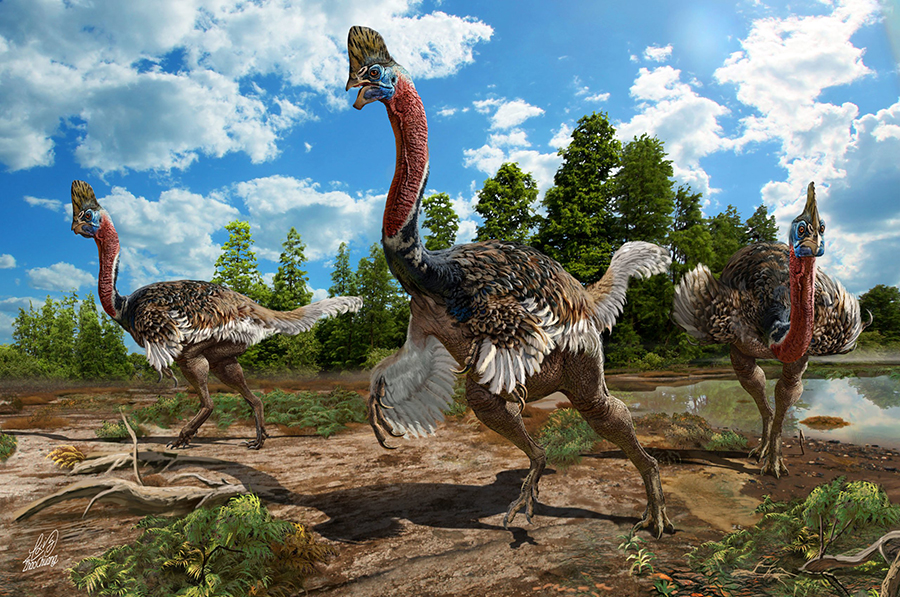
Artistic reconstruction of Corythoraptor jacobsi. (Image: Zhao Chuang)

In 2017, paleontologists discovered an unusual dinosaur in southern China called Corythoraptor jacobsi. Dating back to the Late Cretaceous, the bipedal oviratporid was remarkably similar to modern cassowaries, a flightless bird native to Queensland, Australia.

A free ranging Southern Cassowary at Etty Bay, north Queensland, Australia. (Image: Summerdrought/Wikimedia)

In addition to sharing a similar body shape, both animals feature elaborate crests, called a casque, on the top of their heads, which likely serve as advertisement for prospective mates.

Canids and Tasmanian Tigers
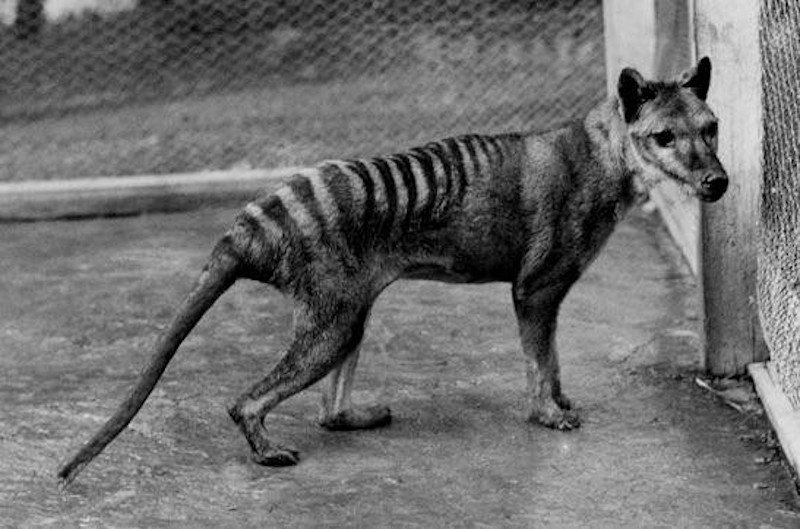
A Tasmanian tiger. (Image: TMAG Tasmanian Museum and Art Gallery)

The extinct Tasmanian tiger, also known as the thylacine, looked eerily similar to modern canids, a group of predatory carnivores that includes wolves, foxes, and domesticated dogs. But thylacines were large marsupial predators, and they carried their young in a pouch similar to kangaroos and koalas.

Incredibly, the last common ancestor of placental canids and thylacines lived 160 million years ago, during the Jurassic period. Despite this gigantic gap in evolutionary history, both Tasmanian tigers and canids share a strikingly common skull shape and body plan. As a Nature paper from 2017 pointed out, their physical “resemblance is considered the most striking example of convergent evolution in mammals.”

Piranhas and Piranhamesodons

The nearly complete fossil of Piranhamesodon pinnatomus. (Photo: M. Ebert and T. Nohl)

During the late Jurassic, some 150 million years ago, a very piranha-like fish terrorised the seas in what is now southern Germany. Called Piranhamesodon pinnatomus, it’s the oldest known flesh-eating ray-finned bony fish, a family that now includes trout, grouper, and cod, but not modern piranhas.

Artist's impression of Piranhamesodon pinnatomus. (Image: The Jura-Museum, Eischstatt, Germany)

Piranhamesodon featured distinctly piranha-like teeth, which it used to bite chunks of flesh from other fish — especially from their fins. Paleontologist David Bellwood from James Cook University said it’s “an amazing parallel with modern piranhas, which feed predominantly not on flesh but the fins of other fishes,” to which he added: “It’s a remarkably smart move as fins regrow, a neat renewable resource. Feed on a fish and it is dead; nibble its fins and you have food for the future.”

Undersized Archaic Humans

Artist's reconstruction of Homo floresiensis. (Image: Kinez Riza)

Paleontological evidence suggests humans aren’t immune to the effects of convergent evolution. Homo sapiens is the last human species left standing, but plenty of other humans have walked the Earth, including Neanderthals, Denisovans, H. erectusH. naledi, among others.

In 2004, scientists working on the island of Flores discovered evidence of a diminutive human species, called Homo floresiensis, popularly known as the Hobbit. Now extinct, this archaic human stood no taller than 0.91 m and 7 inches (109 centimeters). Incredibly, evidence of a second diminutive species, named Homo luzonensis, was uncovered in the Philippines last year.

These species lived at roughly the same time — roughly 50,000 years ago — but nowhere close to each other. Their striking physical similarities has been attributed to an evolutionary process known as insular dwarfism, in which a species shrinks over time owing to limited resources. Perhaps not coincidentally, both human species lived on islands, which are known to produce diminutive species of various sorts.

Six-Fingered Aye-Ayes and Giant Pandas

An aye-aye. (Image: David Haring/Duke Lemur Centre)

Research from last year showed that aye-ayes have a sixth finger, or as scientists call it, an “accessory digit.” Giant pandas also feature an extra finger on top of the usual five per hand. Same for moles and some extinct reptiles, which they use for digging. Like the giant panda, however, aye-ayes use their sixth finger to enhance their grasping abilities, making this a good example of convergent evolution.

Fascinatingly, the accessory digit in aye-ayes and giant pandas is an example of convergent evolution as a consequence of contingent evolution. Both animals evolved highly specialised hands not suited for climbing, resulting in an evolutionary pressure to produce a sixth finger.

Bats and Ambopteryx
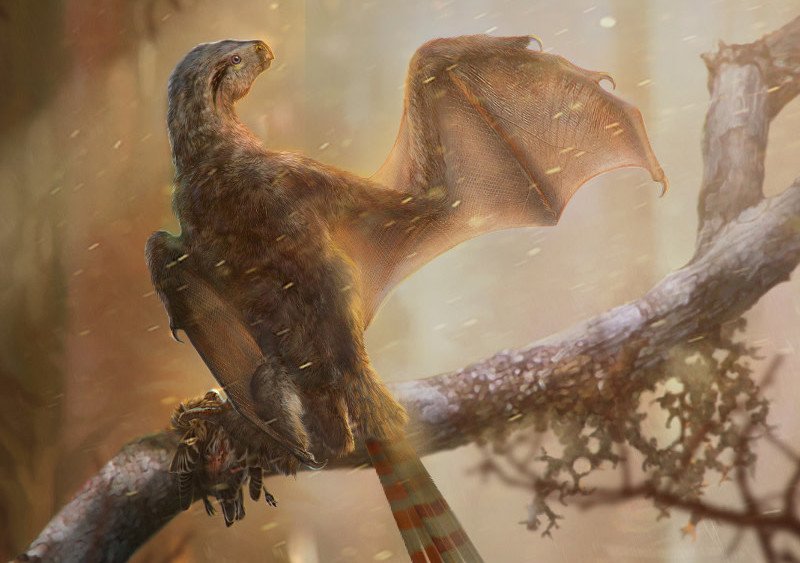
Artist's impression of Ambopteryx longibrachium. (Illustration: Chung-Tat Cheung)

Bats, flying squirrels, and extinct pterosaurs have membranous wings held in place by a special bone called the styliform. That’s convergent evolution in action, but dinosaurs also co-opted this strategy, in which wings are formed from webbing around super-elongated fingers. This revelation was only made last year, following the discovery of Ambopteryx longibrachium, a tiny Jurassic dinosaur with membranous wings.
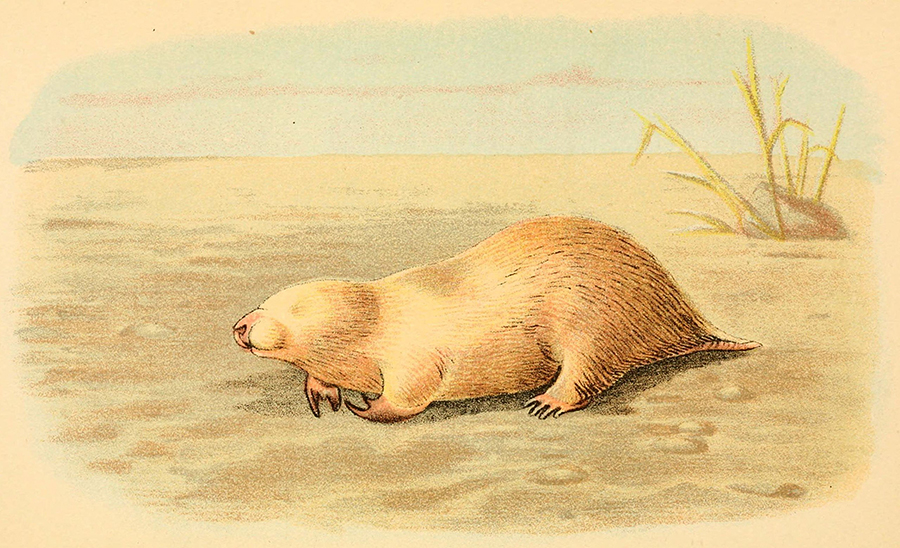
Illustration of a marsupial mole from Australia, which bears a striking resemblance to placental moles. (Illustration: Richard Lydekker)

Evolution is incredibly diverse, but at the same time super limited. All species must honour basic physics and unassailable biological limits (we’ll never see, for example, an animal with wheels… or at least we don’t think we ever will). At the same time, evolution often drives animals toward common “fitness peaks,” in a phrase used by evolutionary biologists. And sometimes, those fitness peaks just happen to be located at the very same spot.

The ‘Platypus’ Dinosaur
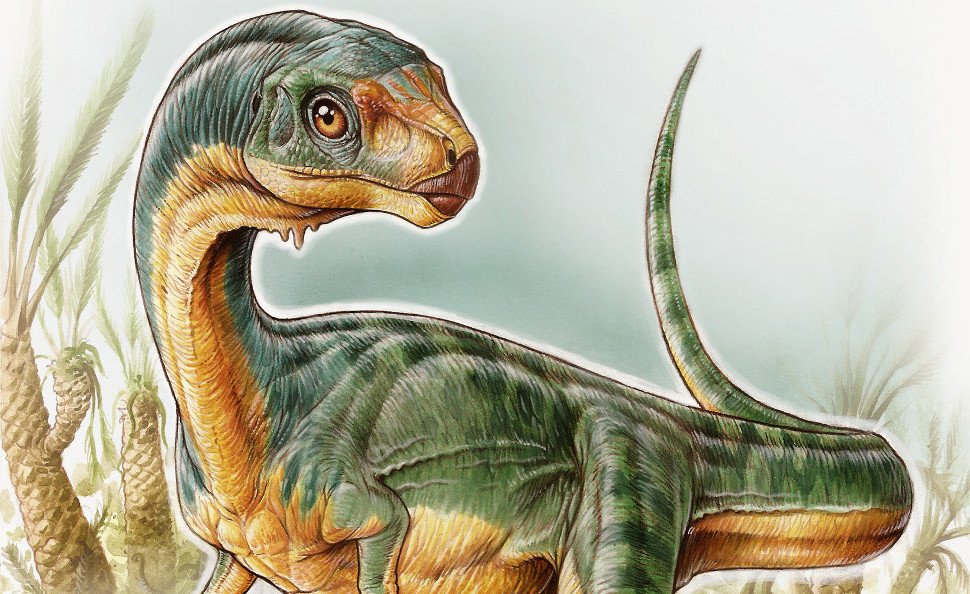
Artist's impression of Chilesaurus diegosuarezi. (Illustration: Gabriel Lio/University of Birmingham)

When this remarkable theropod, called Chilesaurus diegosuarezi, was revealed to the world in 2015, its discoverers called it the “platypus” of dinosaurs owing to its patchwork of anatomical features.

This creature is a stunning example of mosaic convergent evolution, in which characteristics seen in several unrelated species are lumped together to create… well…. a kind of platypus-like creature. In this case, Chilesaurus had strong forearms like Allosaurus, and a pelvis similar to ornithischian dinosaurs, such as Stegosaurus and Ceratopsians. It also featured teeth, skull, a facial features seen in other dinosaurs.

Source: www.gizmodo.com.au/

Saber-Toothed Anchovy Relatives Were Once Fearsome Hunters

Friday, June 12, 2020

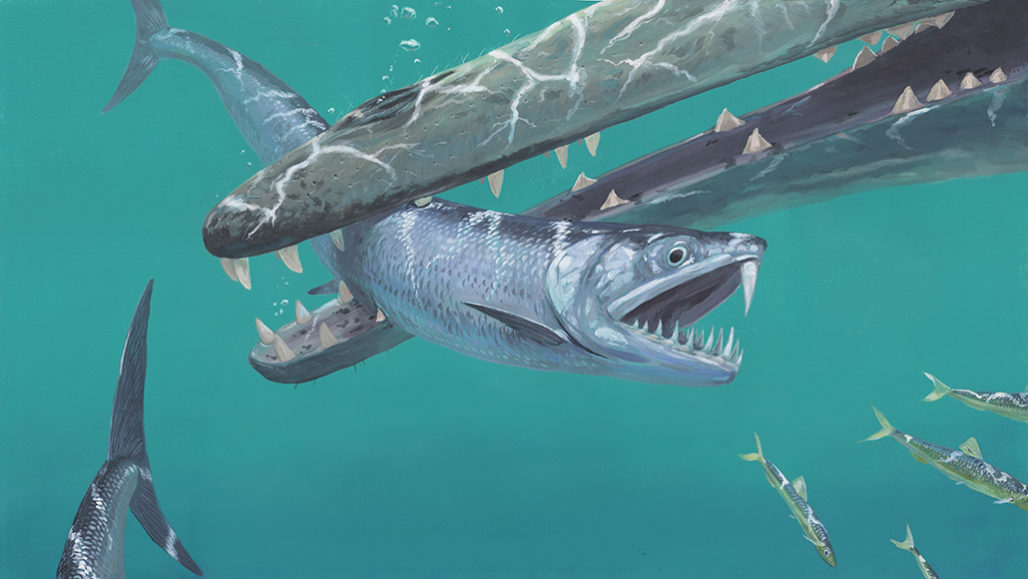
Roughly 50 million years ago, some ancient anchovy relatives sported unusual teeth. They had spikes on their lower jaw and a lone upper sabertooth. One such fish called Monosmilus chureloides is caught in the jaws of an early whale as it chases smaller fish in this illustration.  JOSCHUA KNÜPPE

Their kin now eat mostly plankton. But those long ago had spiky teeth that could spear other fish.

Ancient relatives of today’s anchovies once had quite the bite. They would have been less like a pizza topping and more of a fearsome predator.

Fossils show that these fish were armed with a mouthful of awesome teeth. Each of two newly analyzed specimens sports a toothy lower jaw and one giant spear jutting down from its top jaw. Stranger still, their single sabertooth sat off-center. Such chompers suggest that the animals hunted other fish.

Hundreds of species of anchovies exist today. Some people find them tasty. But their ancient relatives were very different than the fish people munch on today.

Today’s anchovies feast mostly on tiny organisms called plankton. The modern types “have super tiny teeth. They look nothing like these things,” says Alessio Capobianco. He’s a paleontologist at the University of Michigan in Ann Arbor.

The fossils revealed physical traits that connect these fish with their modern relatives. Today’s anchovies open wide to gulp food. The fossil fish also had a gaping mouth, Capobianco says. “Probably that mouth opening helps to catch fish … because those teeth are so large.”

Even their bodies were large compared to their modern kin. Anchovies today top out at around 37 centimeters (15 inches). Fossils show one of the ancient fish may have stretched nearly a meter (39 inches) long, Capobianco and his team estimate. They shared their findings May 13 in Royal Society Open Science.

The fossils date from roughly 50 million years ago. It was a time known as the Eocene Epoch. It came after the mass extinction that finished off the dinosaurs. The event, roughly 66 million years ago, also wiped out many marine species. Some of the animals that went extinct were large predatory fish. The strange newfound anchovy kin may have evolved to fill those voids. Swimming with them were fish that would look familiar today, notes Capobianco. There were types of tuna, barracudas and mackerels. Also, at that time, “There were sort of failed experiments going on,” Capobianco says. They included “these saber-toothed anchovies that didn’t survive to the modern day.”

As crazy as a T. rex

The authors may be right that the fish were experiments, says Kerin Claeson. She’s a paleoichthyologist (PAY-lee-oh-ik-thee-OLL-uh-gizt). That means she studies ancient fishes. Claeson works at the Philadelphia College of Osteopathic Medicine in Pennsylvania. However, she adds, those authors “can’t rule out … that [the strange anchovy kin] may have lived for a long time, but they just didn’t fossilize very well.”

The scientists used CT scans to peer inside the fossils. That technology uses X-rays to map a sample’s inner structure without tearing it apart. One specimen had been pulled from the ground decades ago, but scientists only now gave it a closer look. The new scans exposed features that weren’t visible from the outside — including the giant teeth.

Having one big fang near the middle of the mouth is pretty unusual, Claeson notes. These animals are an example of the exciting ancient life beyond dinosaurs. These fish “were as crazy as something like a Tyrannosaurus rex … It certainly was a terror just like T. rex was, just swimming around.”

Power Words

CT scan: (Also known as a CAT scan). The term is short for computerized axial tomography. It is a special type of X-ray scanning technology that produces cross-sectional views of the inside of a bone or body.

dinosaur: A term that means terrible lizard. These ancient reptiles lived from about 250 million years ago to roughly 65 million years ago. All descended from egg-laying reptiles known as archosaurs. Their descendants eventually split into two lines. For many decades, they have been distinguished by their hips. The lizard-hipped line are believed to have led to such two-footed theropods as T. rex and to the lumbering four-footed Apatosaurus (once known as brontosaurus). A second line of so-called bird-hipped dinosaurs appears to have led to a widely differing group of animals that included the stegosaurs and duckbilled dinosaurs. However, it should be noted, a 2017 analysis challenged that characterization of relatedness based on hip shape.

Eocene: The term for a span of geologic time that lasted from 55.8 million to 33.9 million years ago.

epoch: (in geology) A span of time in the geologic past that was shorter than a period (which is itself, part of some era ) and marked when some dramatic changes occurred.

extinction: (adj. extinct) The permanent loss of a species, family or larger group of organisms.

fossil: Any preserved remains or traces of ancient life. There are many different types of fossils: The bones and other body parts of dinosaurs are called “body fossils.” Things like footprints are called “trace fossils.” Even specimens of dinosaur poop are fossils. The process of forming fossils is called fossilization.

ichthyologist: A biologist who specializes in studying fish.

kin: Family or relatives (sometimes even distant ones).

mackerel: An oily oceanic fish harvested as a human food. It has wavy patterns on its back. Or a term for such wavy markings as they appear on other animals, such as cats.

marine: Having to do with the ocean world or environment.

paleo: A prefix that relates something to ancient — especially geologically early — times.

paleontologist: A scientist who specializes in studying fossils, the remains of ancient organisms.

peer: (verb) To look into something, searching for details.

plankton: A small organism that drifts or floats in the sea. Depending on the species, plankton range from microscopic sizes to organisms about the size of a flea. Some are tiny animals. Others are plantlike organisms. Although individual plankton are very small, they form massive colonies, numbering in the billions. The largest animal in the world, the blue whale, lives on plankton.

predator: (adjective: predatory) A creature that preys on other animals for most or all of its food.

species: A group of similar organisms capable of producing offspring that can survive and reproduce.

Tyrannosaurus rex: A top-predator dinosaur that roamed Earth during the late Cretaceous period. Adults could be 12 meters (40 feet) long.

void: An empty space or cavity.

X-ray: A type of radiation analogous to gamma rays, but having somewhat lower energy.

New Bird-Like Dinosaur Discovered: Overoraptor chimentoi

Thursday, June 11, 2020

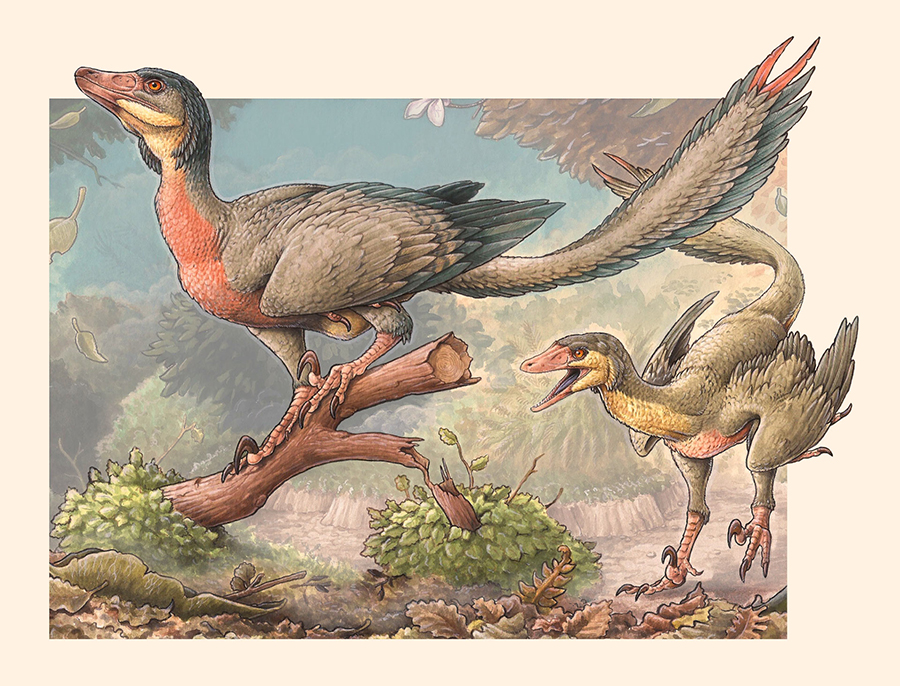
Life reconstruction of an adult and a juvenile Overoraptor chimentoi. Image credit: Gabriel Lio.

A new genus and species of paravian theropod dinosaur has been identified from fossils found in Patagonia, Argentina.

The newly-discovered dinosaur roamed the Earth some 90 million years ago during the Cretaceous period.

Scientifically named Overoraptor chimentoi, the ancient creature was a gracile theropod, approximately 1.3 m (4.3 feet) in length.

It had very long and graceful arms, legs well adapted for running, and Velociraptor-like sickle claw on the second toe.

“This feature is not present in birds, whose legs — more advanced in evolutionary terms — allow them to hold onto tree branches,” said lead author Matias Motta from the CONICET and the Argentine Museum of Natural Sciences ‘Bernardino Rivadavia’ and his colleagues.

Life reconstruction of Overoraptor chimentoi. Image credit: Gabriel Lio.

The fossilized remains of Overoraptor chimentoi were recovered from the beds of the Huincul Formation in the Patagonian province of Rio Negro. The specimens were found in association with crocodilian and turtle bones.

“There are characteristics that distinguish Overoraptor chimentoi from the unenlagiid theropods of Argentina as well as from non-South American raptors such as Velociraptor,” said Dr. Fernando Novas, also from the CONICET and the Argentine Museum of Natural Sciences ‘Bernardino Rivadavia.’

“When analyzing its arms, we found avian features related to the flight. This leads us to consider that in a phylogenetic tree, Overoraptor chimentoi is closer to birds than most of the raptors known so far.”

“Our hypothesis is that in the case of Overoraptor chimentoi, its ability to automatically fold the wings must have had a different function than it does in flying birds, given it is a running animal,” Motta added.

“It is possible that the dinosaur’s arms had the role of guaranteeing balance during the race — by providing greater balance and precision — thanks to the possibility of moving them in a consistent manner, as happens in running birds such as the rhea or ostriches.”

“Certain characteristics of the bones of Overoraptor chimentoi’s arms, particularly the ulna, make them more similar to the wings of birds, such as those of the rheas and condors, than to other raptor dinosaurs, including unenlagiids.”

Silhouette of Overoraptor chimentoi showing selected skeletal elements. Scale bars – 50 cm in the silhouette, 4 cm in (a, b, d, h, and j), and 2 cm in (c, e, f, g, and i). Image credit: Motta et al, doi: 10.1007/s00114-020-01682-1.

The paleontologists also found that Overoraptor chimentoi is closely related to Rahonavis, a paravian theropod dinosaur that lived 70 million years ago (Cretaceous period) in what is now northwestern Madagascar.

“Both species had raptor-type legs and arms similar to the wings of birds, which means an evolutionary advance absent in both unenlagiids and velociraptors,” Dr. Novas said.

“We think that due to its anatomical characteristics, Rahonavis must also have had the ability to perform the automatic folding of the wing, typical of birds,” Motta said.

“These similarities would indicate that Overoraptor chimentoi and Rahonavis could form a new group of paravian runners, which would be closer to the birds than known raptor families.”

The discovery is reported in a paper in the journal Science of Nature.

_____

M.J. Motta et al. 2020. New theropod dinosaur from the Upper Cretaceous of Patagonia sheds light on the paravian radiation in Gondwana. Sci Nat 107, 24; doi: 10.1007/s00114-020-01682-1

Source: www.sci-news.com/

Pages