
Blogs

How To Get Google 3D Animals To See Dinosaurs On Android & iPhone?
Tuesday, July 7, 2020

How-To-Get-Google-3D-Animal

Feeling a little stressed out due to the Coronavirus pandemic and subsequent self-quarantine? Here is a cool iPhone Google trick that will put a smile on your face.

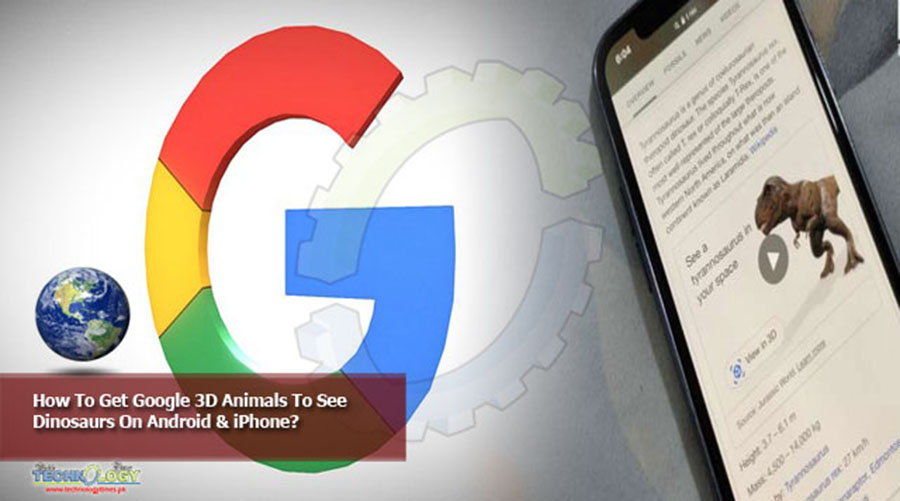
Back at Google I/O 2019, the company announced that it will be adding Augmented Reality (AR) objects to the Google search. Since then, Google has added a lot of 3D interactive objects, but the most fascinating is the Google AR animals. Literally, any Google user can view live animals through their smartphone. If you have a kid, or friends who don’t keep up with the tech, this is your chance to put them at a loss of words.

According to Google, the “easiest way to wrap your head around new information is to see it,” and that is where Google’s “View in 3D” animals come in. Here, you can scale 3D figures, move them around in your surroundings, or juxtapose them in weird places.

How do Google 3D Animals work?

The best part about Google’s new feature is that you don’t need a Pixel phone to make it work. It will work on any smartphone, provided it’s an Android or an iPhone device.

Open Google Search on your Android/iOS

It can be the Google app, the Chrome browser, or even Safari on an iPhone; Google 3D Animals will work as long as it’s a smartphone.

In the Google search bar, type the name of the animal and hit enter.

For instance, you can search for a “Dinosaur” or a “Tiger.”

Scroll down and tap on the “View in 3D” button

If you searched for a “Dinosaur”, you will see a Knowledge Panel. There you will find the button just below the Wikipedia description.

Move your phone

For Google 3D Animals to work, keep moving your device for a few seconds.

A 3D Dinosaur is coming right up!

You will now see the Google AR animal. You can pinch in/out on the figure to increase or decrease its size. Moreover, you can touch and drag the 3D shape anywhere in the room.

Frequently Asked Questions (FAQ)

Which phones support Google 3D Animals?

Google’s “View in 3D” works on all Android devices running Android 7.0 and above. It also works on all iPhones running iOS 11.0 and above. Here is the official list of Google 3D Animal supported devices.

Do 3D Animals run on iPads?

3D Animals also works on all iPads running iOS 11 and above (now iPadOS).

Which 3D Animals are on Google?

Here is a list of all the 3D animals that are available on Google Search —

Land Animals: Tiger, lion, giant panda, leopard, easter bunny, goat, cheetah, pony, brown bear, timber wolf, Shetland pony, python, Arabian horse, raccoon, hedgehog, and deer.

Underwater and Wetland Animals: Mallard duck, alligator, great white shark, octopus, angler fish, and sea turtle.

Birds: Macaw, emperor penguin, and eagle.

Housepets:  Pomeranian, golden retriever, labrador, rottweiler, French bulldog, pug, and cat.

Dinosaurs: Tyrannosaurus rex, Velociraptor, Triceratops, Spinosaurus, Stegosaurus, Brachiosaurus, Ankylosaurus, Dilophosaurus, Pteranodon and Parasaurolophus.

Google 3D Animals not working?

Here are a few things you can try if 3D Animals on Google is not working on your device

  • Reboot the device

  • Update “Google Play Services for AR” from the Google Play Store.

If it’s still not working, then either the particular 3D Animal or the entire service is not available on your smartphone.

This news was originally published at fossbytes.com

Source: www.technologytimes.pk/

‘Jurassic World: Dominion’ Star Chris Pratt Reveals Fan Who Will Be Eaten By A Dinosaur

Monday, July 6, 2020

Chris Pratt stars as Owen in “Jurassic World.” Chuck Zlotnick, Universal

Chris Pratt stayed true to his word and announced the new dinosaur meal.

“Jurassic World: Dominion” star Chris Pratt has revealed the lucky (er, unlucky?) fan who will have a chance to be eaten by a dinosaur in the upcoming monster flick.

What happened:

Pratt told a fan named Terry that he will join the cast of “Jurassic World: Dominion” in London to begin setting up a scene where he will be eaten by a dinosaur.

Pratt had a conversation with the fan where he revealed Terry will be eaten alive by a computer dinosaur.

Pratt said: “It’s been an honor to be part of the #AllInChallenge which has raised over $59 MILLION to help feed the hungry during this global crisis! Congrats Terry!! The world can’t wait to see you get eaten by a dinosaur!”

It's been an honor to be part of the #AllInChallenge which has raised over $59 MILLION to help feed the hungry during this global crisis! Congrats Terry!! The world can't wait to see you get eaten by a dinosaur! pic.twitter.com/VlATFcpcC7

— chris pratt (@prattprattpratt) June 30, 2020

Back in April, Pratt announced the contest as a part of the “All In Challenge” — a celebrity event where donations from fans could lead to cool prizes, as the Deseret News reported.

‘Jurassic World’ returns to production

  • In mid-June, “Jurassic World” announced it would return to production amid the coronavirus pandemic, which I wrote about for the Deseret News. “Dominion” would be the first Hollywood film to return to production amid the pandemic.
  • The film’s other star, Bryce Dallas Howard, said the cast would only return when things were safe.
  • Universal studios production executive said the studio has worked hard to promote safety at the workplace, according to ComicBook.com.
  • The executive said: “Anyone with symptoms will be isolated immediately before being sent home. We want to make sure that we are going above and beyond the national protocols to create a safe environment. Cost isn’t our main concern now: it’s safety. We will take direction from our medical team, but we’re confident that with the staggered scheduling and zones of talent and crew, along with a system of contact tracing, we can move forward with limited delay in production.”

Source: www.deseret.com/

Jurassic Park’s Hammond Gets Revenge With T-Rex Robot In Movie Art

Tuesday, July 7, 2020

A strange new piece of Jurassic Park fan art imagines the Park's creator, John Hammond, getting revenge by controlling a robotic T-Rex.

John Hammond uses a giant T-Rex robot to get revenge in a new piece of Jurassic Park fan art. As the mastermind behind the fictional dinosaur park first introduced on-screen in 1993, John Hammond was a man filled with ambitious dreams for the future. Insistent on the fact that no expense was spared in the construction of Jurassic Park, things, unfortunately, didn’t work out at all how Hammond had expected them to.

Aside from the ultimate achievement of actually bringing dinosaurs back from extinction, Hammond’s efforts lead to spectacular failures in both Jurassic Park and its 1997 follow up, The Lost World. The world, it seemed, was simply not ready for the responsibility of having real dinosaurs roam the earth once again. And while some looked at the dinosaurs as money-making opportunities, Hammond’s approach was more heartfelt – that of a man who truly wanted to make people happy and educate them about the amazing creatures that dinosaurs were. It wasn’t meant to be, and although watching the on-screen chaos unfold was exciting for audiences, it was hard for many not to feel sorry for Hammond as he watched his dreams die.

Any lingering sympathies that Jurassic Park fans may have for Hammond can now be put to rest with a quick look at some excellent fan art from Paul Jackson. The drawing, called "Hammond's Revenge," offers a completely different perspective on the gentle, dinosaur-loving Hammond, as he literally becomes a T-Rex. Armed with the controls that make this version of the famed king of dinosaurs live, Hammond doesn’t appear to be putting up with any more setbacks. Instead, it’s clear that Hammond’s Revenge is exactly what’s taking place.


There’s a nice sort of dark humor at work in this piece, and it also prompts the question as to exactly who Hammond would target if this plot twist had been a reality. One thing that’s undeniable about it is that Jurassic Park would have been a completely different film had Hammond been able to literally roam around in a dinosaur. It’s hard to imagine the octogenarian taking on other dinosaurs in his park, even when those dinosaurs began to wreak havoc. The character was simply too kind-hearted for that sort of carnage. Still, many fans would agree it could have been spectacular and downright bizarre to watch Hammond man the controls of a T-Rex and engage in battle with a Raptor.

There have been many tributes over the years to Richard Attenborough, who played Hammond. Attenborough passed away in 2014 at the age of 90 and had accrued a sizeable following over his extensive, multi-Oscar winning career. None the less, of all the projects he took part in, it’s safe to say that he likely had never considered that one day, one of his greatest roles would be reimagined in the way that Jackson’s artwork suggests. Jurassic Park fans will never know what Hammond controlling a robot T-Rex could have looked like on-screen, but thanks to Jackson’s artwork, the prospect can live on in fans’ imaginations.

Source: Paul Jackson (via Instagram) originally on https://screenrant.com/

Should Jurassic World 3 Free the Dinosaurs, or End Them?

Friday, July 3, 2020

Dinosaurs will roam the planet in the upcoming Jurassic World: Dominion. Can they co-exist with humans, or will the movie make them extinct (again)?

Dinosaurs will roam the planet in the upcoming Jurassic World: Dominion, which begs the question: can they co-exist with humans, or will they have to go extinct (again) by the end of the film? The Jurassic franchise has been moving towards getting its cloned dinosaurs out into the world for a long time. 1997's The Lost World: Jurassic Park laid the groundwork by setting a Tyrannosaurus Rex loose on the city of San Diego, once again proving that humans and free-roaming dinosaurs aren't a great mix. Jurassic Park III further hinted at dinosaurs making their way beyond Isla Nublar and Isla Sorna with its final shot (showing Pteranodons flying to somewhere unknown), but didn't take things further than that.

After that, the first Jurassic World more or less recycled the premise of the original Jurassic Park, only with dinosaurs breaking loose at an up and running theme park on Isla Nublar (as opposed to one that had yet to launch). Its sequel, Fallen Kingdom, then attempted to move beyond nostalgia by destroying Isla Nublar in a volcanic eruption before trading in the island settings of the previous films for a shadowy manor in its second half. And as much as general audiences have taken issue with the way the Jurassic World trilogy has played out so far, the ending to Fallen Kingdom nevertheless succeeded in doing what the previous four movies had only teased at: releasing the dinosaurs out into the world.

As its title impliesDominion will be all about answering the question of whether humanity can find a way to live side by side with dinosaurs or have to wipe them out, for good this time. Last year's short film, Battle at Big Rock, offered a sneak peek of what life is like post-Fallen Kingdom, and as you would imagine, co-existing alongside dinosaurs is easier said than done. But at this stage in the game, the idea of humans eliminating all dinosaurs in Dominion seems to clash with everything the series has been about so far.

Fallen Kingdom has already called attention to the problem of humanity allowing natural forces (namely, a volcano) to "correct" their actions and wipe out the dinosaurs. As the movie points out, the dinosaurs were brought back into a world where they don't belong against their will, making it unnecessarily cruel to abandon them at a time when they need protection. It's possible Dominion will build on this by focusing on a virus that threatens to kill the remaining dinosaurs, bringing back an idea that was introduced at the end of The Lost World book (but never explored in the films) and forcing humankind to decide what the ethical response would be. Alternatively, the governments of the world could decide dinosaurs are too dangerous and try to destroy them (be it with a man-made disease or pure firepower), spurring the franchise's heroes to find a compromise that allows them to continue existing, but without putting human lives in unnecessary danger.

Thematically, it might make the most sense to have Dominion end with the dinosaurs being truly set free. The Jurassic franchise has always functioned as a parable about capitalism and its exploitation of the planet's natural resources, arguing that humanity can only do so much to undo their previous mistakes when it comes to mistreating the environment, and is better off trying to learn from them and dealing with the new status quo they've created. Having the series' leads find a way for the dinosaurs to survive (while also protecting them from being further exploited) would not only be a satisfying payoff to the Jurassic World trilogy, it would also end the franchise on an optimistic, if bittersweet, note in keeping with the final moments from Steven Spielberg's original Jurassic Park (where John Hammond lets go of his dream of a dinosaur park).

There's also something timely about the idea of humans learning to live in a brave new world at the end of Dominion, rather than being able to go back to the way things were before then. As the COVID-19 pandemic rages on across the globe, it's clear life in the future is going to be different than it was prior to 2020, and not in the typical ways you expect with the passing of time. Many people are struggling to come to terms with that (including, those in the film and television industry) and just want to get back to the way things were, rather than adjusting to the new normal. Point being, if humans can learn to live peacefully with dinosaurs by the final scene of Jurassic World: Dominion, then it would be all the more relevant a message for those in the real world to absorb.

Source: https://screenrant.com/

The Very Weird Reason Batman Has A Dinosaur In His Cave

Friday, July 3, 2020

The Tyrannosaurus rex in Batman's cave has become a staple of his trophy room, but where did he actually get the robotic dinosaur?

The Batcave has no shortage of tokens and trophies from Batman's long history of crime-fighting. But why is one of his souvenirs a life-sized, animatronic replica of a tyrannosaurus rex? To borrow a phrase from Jack Nicholson's Joker, "Where does he get those wonderful toys?" To find the answer, fans will have to go way back to 1946 to revisit the absurdity found in the pages of Batman #35. 

A P.T. Barnum-esque showman named Murray Wilson Hart is struggling to come up with the next spectacle to top his latest "aqua carnival" and "ice frolics," whatever those are. Inspired by a headline declaring a prehistoric mammoth had just been unearthed in a Siberian glacier, he goes full John Hammond and decides he'll create Dinosaur Island, a destination guests can visit to see robotic recreations of prehistoric creatures. He concludes a press conference by announcing that he's hosting a dinner party for big game hunters that will be serving...  steaks cut out of the Siberian mammoth. “Meat millions of years old! Should be tender,” he tells the reporters.

And if that wasn't already weird enough, the very next panel sees Batman and Robin sitting at that dinner party. Wilson Hart explains to his guests that they're presence is on account of their being manhunters, a proclamation some of the guests take offense to. A Mr. Breach says the duo don't deserve a spot at the table because of their reliance on (then) modern technology in their adventures. He bets $5,000 that they couldn't survive 36 hours on Dinosaur Island without the help of their tools, offering the money to a charity of Batman's choosing. Breach will control the animatronics as the pair struggle to avoid danger. Despite the fact that Bruce Wayne could probably find $5,000 in his couch cushions, he accepts the offer. All the while, another dinner attendee, Stephen Chase, rubs his chin and plots.

After the Dynamic Duo ceremoniously strip themselves of their utility belts for a photo op, the pair head into the wilds of Dinosaur Island. Little do they know, however, Chase has ambushed Breach and seized the controls with plans to take them out for good. Charged by a styracosaurus, Batman and Robin barely escape by diving into the ocean, at which point Batman is almost bitten in half by yet another robo-dinosaur. They escape, but are soon again besieged, this time by robot cavemen. A fairly self-aware panel's narration calls it, "the most bizarre battle ever fought!"

They survive that brawl, but things really come to a head in the final battle, which sees Chase charging at Batman riding the now famous T-Rex. And is if that wasn't outlandish enough, he's only stopped when Robin - who had fashioned himself wings out of a robotic pterodactyl and catapulted himself into the sky - pours water on the robots' control panels from overhead. Somehow, this plan works and the story ends with Chase in a cage as Batman gives a press conference. The villain explains that he wanted Batman out of the way to create a crime syndicate in Gotham, which apparently there was somehow a shortage of.

So that's the insane story behind the Batcave's iconic T-Rex. Batman just kept it after surviving some weird sort of West World/Jurassic Park amalgamation nearly a century ago and it's now become a fixture in Batman lore. So that answers that question, but probably the more important one is... did Batman and Robin actually eat those steaks?

Source: https://screenrant.com/

Looping Footstep Pattern in Modern Guineafowl Sheds Light on Dinosaur Tracks

Thursday, July 2, 2020

Sub-surface foot kinematics through a volume of substrate. Synchronized standard (a) and X-ray (b) video frames of a guineafowl walking through a dry granular substrate. Toes and markers are clearly revealed sub-surface (inset). (c) Oblique view of digit claw marker motion trails for one step through dry grains. (d) Lateral view of a sample of digit III motion trails on several deformable substrates (coloured lines; thin = entry, bold = exit) and one solid substrate (black line). Digit III offset (e) measured at 5 mm depth horizons (horizontal lines in (d)) and are plotted for 81 steps from all three individuals. (f) Anterior view of claw motion trails showing the toes widely spread when sinking (thin), and smoothly collapsing upon withdrawal (bold). (g) Digit II–IV width are plotted from 49 steps of two individuals (equal scales in d–g). (h) Selected horizons for the green step (d–g) showing changing locations of claw entry (filled circles) and exit (open circles). The looping entry (thin) and exit (bold) path of digit III is indicated by a dashed line. Grey bars indicate zones for this track volume. Vertical and horizontal scales in (d–g) shown by axes in (e) and (g). Tick marks in (h) equal 1 cm. Credit: Biology Letters (2020). DOI: 10.1098/rsbl.2020.0309

A trio of researchers, two with Brown University, the other with Liverpool John Moores University, has found that a looping pattern in modern guineafowl footsteps is similar to those of certain dinosaurs. In their paper published in The Royal Society Biology Letters, Morgan Turner, Peter Falkingham and Stephen M. Gatesy describe their study of tracks made by modern guineafowl and how they compared to dinosaur tracks left in modern Connecticut.

Prior research has shown that many dinosaurs walked upright, including some that left three-toed tracks in a part of modern Connecticut. To learn more about how such dinosaurs might have walked, the researchers looked to modern guineafowl—birds that are endemic to Africa and are believed to represent one of the oldest gallinaceous birds. One species of guineafowl, the helmeted guineafowl, has been widely dispersed and domesticated around the world. It was this species that the researchers chose to study because it not only has a three-toed foot similar to the dinosaur tracks found in Connecticut, but is also flightless.

The work involved filming several guineafowl with high-speed cameras as they walked across a variety of surfaces, from hard to granular to firm and semi-liquid so that the action could be seen in slow motion. The researchers also X-rayed the tracks left behind by the birds.

In studying the film and X-ray images, the researchers were able to follow the path of all parts of the birds' feet as they touched the ground and then dug in when the surface was not hard, and then as the foot was extracted from the ground The team then made animations of the footsteps showing that the tips of the birds' toes executed a looping motion as they moved first into the ground and then as they were retracted. The team then compared their guineafowl findings with the footprints left by dinosaurs in Connecticut, and found them to be very similar—enough so to conclude that the dinosaurs likely walked with looping footsteps, as well.

Using sophisticated X-ray-based technology, a team of Brown University researchers tracked the movements of guineafowl to investigate how their feet move below ground through various substrates and what those findings could mean for understanding fossil records left behind by dinosaurs. Credit: Brown University

The researchers suggest the looping pattern they observed likely made walking in mucky water less difficult. They further suggest that its expression in modern birds demonstrates how successful the foot shape observed in dinosaurs has been.

More information: Morgan L. Turner et al. It's in the loop: shared sub-surface foot kinematics in birds and other dinosaurs shed light on a new dimension of fossil track diversity, Biology Letters (2020). DOI: 10.1098/rsbl.2020.0309

Press release

Journal information: Biology Letters

Source: https://phys.org/

These Insects Preserved In Amber Are Still Glowing 99 Million Years Later

Friday, July 3, 2020

Insects from the mid-Cretaceous period preserved in amber were found in present-day northern Myanmar.NIGPAS

The fossilized insects are a rare find for paleontologists.

Fossils can tell scientists a lot about prehistoric life, but they can’t say everything. When it comes to understanding our animal and plant forebears, there’s a lot we’ll probably never learn from fossils, like what colors ancient animals were. However, in rare cases, researchers get lucky. In a new paper published in the journal, Proceedings of the Royal Society B, by a team of researchers at the Nanjing Institute of Geology and Paleontology, the group identified the true colors of three ancient insects that were preserved in amber—an incredibly rare find for paleontologists.

The insects can be dated back to the Cretaceous period, which occurred 99 million years ago. The animals were all preserved in pieces of amber from a mine in northern Myanmar. The insects—a beetle, a fly, and a wasp—are so well-preserved in the amber that their true color could be identified.

“The way that the color is preserved in these things is really remarkable,” says James Lamsdell, a University of West Virginia paleobiologist who was not involved in the research. “There have been reports of color in the fossil record before, but often what we’re looking at is not the true color, because it’s been changed by the fossilization process.”

In instances where the color is questionable, Lamsdell says, scientists gather clues from the cellular structure of the exoskeleton and extrapolate what the color probably was. But in this case, the iridescent “structural color” of these insects remained visible after the researchers prepared the specimens, a process that involves carefully polishing the amber until the insect bodies are nearly exposed, and in some cases setting it against a light. Blue, green, and purple iridescent colors are all clearly visible in the specimens.

Scientists can speculate as to what evolutionary pressures drove all these different insects to iridescence, but there’s no way to know for sure.NIGPAS

The researchers say these images were edited in Photoshop “to adjust brightness and contrast” but that the colors themselves were not changed or edited. The iridescent structural hues of these very distantly related species is notable, Lamsdell says, since they seem to have each evolved iridescent traits independently at some point before these specific insects were born. Although scientists can speculate as to what evolutionary pressures drove all these different insects to iridescence, there’s no way to know for sure.

Frustratingly, this is where the story ends for these shimmering insects. The oldest amber in the fossil record appears about 320 million years ago—not too long ago on the geologic timescale. And the amber in Myanmar is all from the same specific time in the Cretaceous period. That means there’s no way to trace the evolution of these iridescent traits back further in time.

Remarkable as they are, the results are tainted for Lamsdell by knowledge of what it likely took to get the amber in the first place. So-called “Burmese amber” is mined in Myanmar’s Kachin state, which in prehistoric times was thickly forested with coniferous trees that produced sap which turned into amber, perfectly preserving numerous examples of the insects of that place and time. Today, that amber can be mined. “It’s ended up being a resource for fueling conflict,” says Lamsdell, “because it’s very lucrative.”

Mining amber is a big, ethically questionable business in Myanmar, as Josh Sokol documented for Science in 2019. And awareness of the ethical issues has grown in recent years. This April, representatives of the Society of Vertebrate Paleontology signed their names to a letter asking the editors of scientific journals to stop accepting and publishing papers whose findings were based on Burmese amber.

Source: www.popsci.com/

Giant Penguin-Like Seabirds Lived in Northern Hemisphere About 30 Million Years Ago

Thursday, July 2, 2020

A group of Copepteryx, plotopterid birds that lived in Japan between 28.4 and 23 million years ago. Image credit: Mark Witton.

Paleontologists have discovered striking similarities between the fossilized bones of giant penguins that lived 62 million years ago in what is now New Zealand and those of the plotopterids, a group of flightless seabirds that lived in North America and Japan between 37 and 25 million years ago.

Plotopterids (family Plotopteridae) are extinct, flightless and wing-propelled diving birds that combine a striking mosaic of features characteristic for true penguins and pelecaniform birds like gannets, boobies, cormorants, and anhingas.

The wing of plotopterids is remarkably similar to the flipper of penguins, to which it shows numerous parallels.

Plotopterids developed in the northern hemisphere much later than penguins, with the first species appearing between 37 and 34 million years ago. Their fossils have been found at a number of sites in the United States (California, Oregon, and Washington), Canada (British Columbia) and Japan.

Unlike penguins, which have survived into the modern era, the last plotopterid species became extinct around 25 million years ago.

In a new study, Dr. Gerald Mayr from the Senckenberg Research Institute and Natural History Museum and his colleagues from the United States and New Zealand compared the fossilized remains of plotopterids with fossil specimens from three species of giant penguins — WaimanuMuriwaimanu, and Sequiwaimanu — and identified previously unrecognized similarities and differences.

The researchers found plotopterids and the ancient penguins had similar long beaks with slit-like nostrils, similar chest and shoulder bones, and similar wings.

These similarities suggest both groups of birds were strong swimmers that used their wings to propel them deep underwater in search of food.

Some species of both groups could grow to huge sizes. The largest known plotopterids were over 2 m long, while some of the giant penguins were up to 1.6 m tall.

“What’s remarkable about all this is that plotopterids and ancient penguins evolved these shared features independently,” said Dr. Vanesa De Pietri, Curator of Natural History at the Canterbury Museum.

“This is an example of what we call convergent evolution, when distantly related organisms develop similar morphological traits under similar environmental conditions.”

“Some large plotopterid species would have looked very similar to the ancient penguins,” said Dr. Paul Scofield, Curator of Natural History at the Canterbury Museum.

“These birds evolved in different hemispheres, millions of years apart, but from a distance you would be hard pressed to tell them apart.”

“Plotopterids looked like penguins, they swam like penguins, they probably ate like penguins — but they weren’t penguins.”

The parallels in the evolution of these bird groups hint at an explanation for why birds developed the ability to swim with their wings.

“Wing-propelled diving is quite rare among birds; most swimming birds use their feet,” Dr. Mayr said.

“We think both penguins and plotodopterids had flying ancestors that would plunge from the air into the water in search of food.”

“Over time these ancestor species got better at swimming and worse at flying.”

paper on the findings is published in the Journal of Zoological Systematics and Evolutionary Research.

_____

Gerald Mayr et al. Comparative osteology of the penguin-like mid-Cenozoic Plotopteridae and the earliest true fossil penguins, with comments on the origins of wing-propelled diving. Journal of Zoological Systematics and Evolutionary Research, published online June 29, 2020; doi: 10.1111/jzs.12400

Source: www.sci-news.com/

Sam Neill Excited To Resume Filming Jurassic World: Dominion

Tuesday, June 30, 2020

Sam Neill is "very excited" to head to the U.K. and resume filming Jurassic World: Dominion.

The 72-year-old actor is reprising his role as Dr. Alan Grant, alongside fellow original Jurassic Park stars Laura Dern and Jeff Goldblum, for the upcoming dinosaur blockbuster.

Back in March, production on the third film in the Jurassic World franchise, directed by Colin Trevorrow, was shut down only four weeks into the shoot after the coronavirus pandemic struck. It was announced earlier this month that it would be the first major studio blockbuster to resume production in the U.K., with filming set to begin at Pinewood Studios on 6 July in accordance with new social distancing guidelines.

Neill has confirmed he will be heading to England soon and is looking forward to reuniting with Dern and Goldblum.
"We are about to begin again and I should be in the United Kingdom all things being equal in a couple of weeks. And we're gonna be at Pinewood working under very strict protocols," he explained during a recent interview on ITV talk show This Morning. "We'll be breaking new ground, in fact. I think we're the first big film to get back into production and it's going to be very interesting to see the process."

"I'm very excited about it. It's going to be a terrific film. I'm so much looking forward to meeting my old friends again," the New Zealand native added.

Jurassic World: Dominion, also starring Chris Pratt and Bryce Dallas Howard, is slated for release on 11 June, 2021.

Source: www.film-news.co.uk/

Jurassic World: What Happened To Site B, Isla Sorna

Tuesday, June 30, 2020

The Jurassic World movies have forgotten about Isla Sorna, the second island of dinosaurs in the original trilogy. Here's what became of Site B.

Here's what happened to Jurassic Park's island of Isla Sorna, also known as Site B. After Jurassic World soft rebooted the Jurassic franchise in 2015, there has been no mention of the second island of dinosaurs that was the setting of 1997's The Lost World: Jurassic Park and 2001's Jurassic Park III. Isla Sorna was originally the factory floor of InGen, the biotech company owned by billionaire John Hammond (Richard Attenborough), where the dinosaurs were cloned and bred before being transported to Jurassic Park on Isla Nublar, 87 miles east of Isla Sorna.

In The Lost World, Hammond sent Dr. Ian Malcolm (Jeff Goldblum) to lead a team to Isla Sorna in order to document the dinosaurs and gain public support for Site B to be isolated as a natural preserve. Meanwhile, InGen's new CEO and Hammond's nephew Peter Ludlow (Arliss Howard) sent a mercenary team to Isla Sorna to capture the dinosaurs for display in Jurassic Park: San Diego. The incident led to both teams getting decimated by the Tyrannosaurs Rexes and Velociraptors on the island. Although a T-rex was captured and brought to the mainland, it escaped and rampaged through downtown San Diego. After the T-rex was brought back to Isla Sorna, the island was declared a restricted zone and the 1997 Gene Guard Act protected the dinosaurs' rights and prevented more cloning. However, InGen continued to illegally clone dinosaurs, including dangerous new species like the Spinosaurus, which Dr. Alan Grant (Sam Neill) faced in Jurassic Park III when he went to Isla Sorna to rescue the child of a wealthy couple who was trapped in Site B.

Jurassic World, set 14 years after Jurassic Park III and 22 years after Steven Spielberg's original blockbuster, revealed that the Masrani Global Corporation bought InGen, resumed its dinosaur cloning and successfully opened John Hammond's theme park. Masrani even brought back Dr. Henry Wu (B.D. Wong), Jurassic Park's geneticist, to oversee the creation of new dinosaurs. But Isla Sorna's fate hasn't been mentioned in Jurassic World or in the 2018 sequel, Jurassic World: Fallen Kingdom. Instead, the clues to what happened to Site B can be found in a movie tie-in website created for Jurassic World: Fallen Kingdom's Dinosaur Protection Group headed by Claire Dearing (Bryce Dallas Howard). Essentially, Isla Sorna is no more.

When InGen abandoned Site B after the incident seen in Jurassic Park, the dinosaurs were let loose upon the island. Instead of succumbing to the lysine deficiency that they were bred with, the animals thrived instead and developed a natural order. However, in 1998, InGen returned to Site B and conducted illegal cloning in defiance of the Gene Guard Act and they introduced the Spinosaurus into the ecosystem. The Spinosaurus replaced the T-rex as the island's apex predator and unbalanced the natural order. When Masrani bought InGen and opened Jurassic World, they took the remaining living dinosaurs from Site B and transported them to populate their new park on Isla Nublar. Isla Sorna was then abandoned and became a dead zone.

Ironically, the eruption of Mt. Sibo in Jurassic World: Fallen Kingdom destroyed Isla Nublar, killing the dinosaurs that weren't captured and transported to the United States to be sold in an illegal dinosaur auction. The dinosaurs were set free by Owen Grady (Chris Pratt), Claire Dearing, and Maisie Lockhart (Isabella Sermon) and are now loose upon the world. But, since the abandoned island of Isla Sorna still exists, maybe the answer to the global crisis in the upcoming Jurassic World: Dominion will be to capture the dinosaurs and bring them back to Site B where they can live in peace once again.

Source: https://screenrant.com/

Pages