Blogs

New Dinosaur 50p Coins Launched - With an Added Special Feature
Tuesday, June 2, 2020

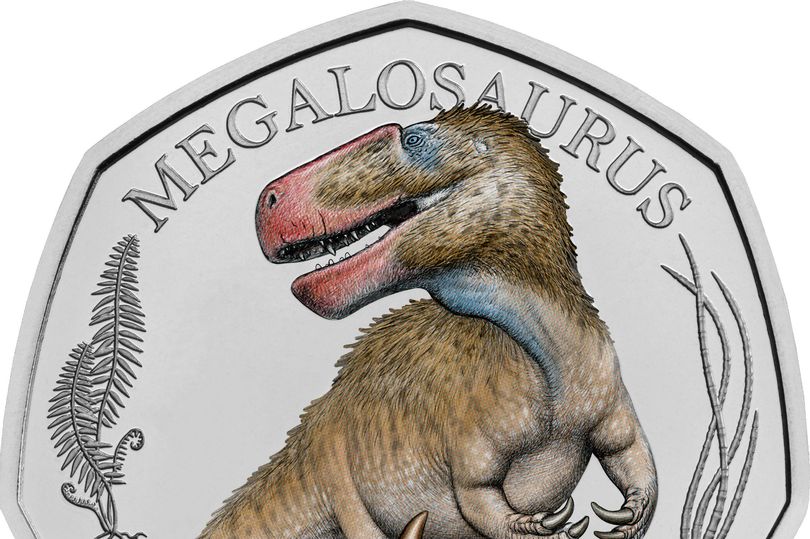
Not just a pretty face - with added extras included in the design (Image: PA)

For the first time your 50ps will come with a hidden extra feature - as well as fantastic pics of dinosaurs - in this highly collectible new coin collection from the Royal Mint.

The Royal Mint has launched a new set of 50p coins - celebrating Britain's contribution to the discovery of dinosaurs.

But on top of pictures of the terrible lizards, they feature augmented reality technology.

After receiving the coin, collectors can scan the packaging into the Royal Mint's Activate app to unearth facts, clips and images.

It's the first time the technology has been deployed by the Royal Mint - although the Bank of England managed it for the new Turner £20 note earlier this year.

The Dinosauria Collection's Brilliant Uncirculated edition also use the latest colour printing techniques to vividly show the megalosaurus, iguanodon and hylaeosaurus.
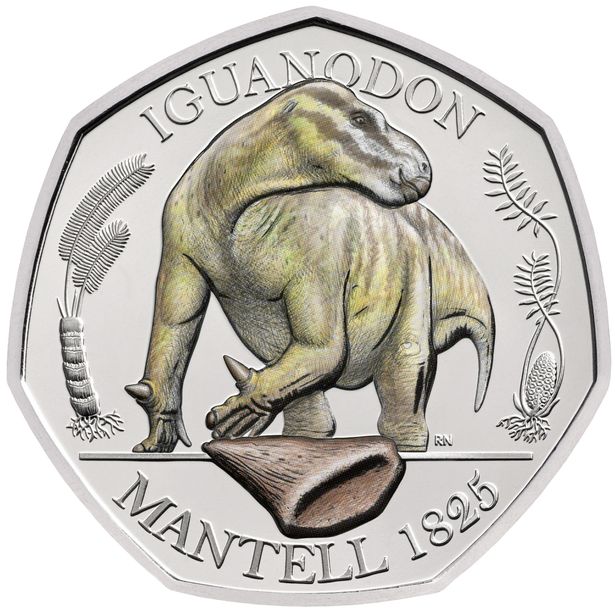
(Image: PA)

Experts at the Natural History Museum worked in conjunction with the Royal Mint to bring the prehistoric creatures to life.

Clare Maclennan, divisional director of commemorative coin at the Royal Mint said: "As one of the nation's most loved tourist attractions remains closed, we are pleased to partner with the Natural History Museum to bring dinosaurs to life from the comfort of your home.

"It is the first time that The Royal Mint has combined augmented reality with a coin series as we continue to innovate and enrich the experience of coin collecting.

"Simply by scanning the packaging our customers will be able to access exclusive content which celebrates Britain's role in the discovery of dinosaurs, brings the animals to life through animation and explores the intricate details of each coin."

The hylaeosaurus coin is the third and final in the Dinosauria Collection, which features three different dinosaurs.

Fossils from the three led British anatomist Sir Richard Owen, the founder of the Natural History Museum, to coin the term dinosauria in a paper in 1842.
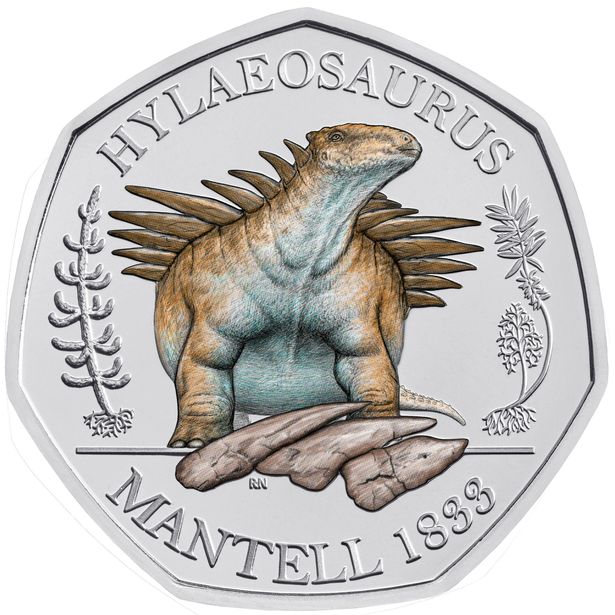
(Image: PA)

When the first dinosaur 50ps launched earlier this year, Rachel Hooper of Changechecker said: "We expect these coins to be very popular with collectors, especially considering this is the first time ever dinosaurs have featured on a UK coin.

"Looking back at the popularity of previous 50p series such as the 2012 Olympic 50ps and the Beatrix Potter coins from 2016, 2017 and 2018, we would expect demand for these new coins to be high as collectors look to add all three to their collection."

If the coins rise in value similar to the Beatrix Potter designs, they could be worth several hundred of pounds down the line.

Source: www.mirror.co.uk/

Mass Extinction 215 Million Years Ago Was NOT Due to Asteroid or Climate Change

Monday, June 1, 2020

According to a new study, the mass extinction that occurred 215 million years ago was not caused by an asteroid hitting Earth or by climate change.

A team of University of Rhode Island scientists and statisticians conducted a sophisticated quantitative analysis of a mass extinction that occurred 215 million years ago and found that the cause of the extinction was not an asteroid or climate change, as had previously been believed. Instead, the scientists concluded that the extinction did not occur suddenly or simultaneously, suggesting that the disappearance of a wide variety of species was not linked to any single catastrophic event.

Their research, based on paleontological field work carried out in sediments 227 to 205 million years old in Petrified Forest National Park, Arizona, was published in April in the journal Geology.

According to David Fastovsky, the URI professor of geosciences whose graduate student, Reilly Hayes, led the study, the global extinction of ancient Late Triassic vertebrates – the disappearance of which scientists call the Adamanian/Revueltian turnover – had never previously been reconstructed satisfactorily. Some researchers believed the extinction was triggered by the Manicouagan Impact, an asteroid impact that occurred in Quebec 215.5 million years ago, leaving a distinctive 750-square-mile lake. Others speculated that the extinction was linked to a hotter and drier climate that occurred at about the same time.

“Previous hypotheses seemed very nebulous, because nobody had ever approached this problem – or any ancient mass extinction problem – in the quantitative way that we did,” Fastovsky said. “In the end, we concluded that neither the asteroid impact nor the climate change had anything to do with the extinction, and that the extinction was certainly not as it had been described – abrupt and synchronous.  In fact, it was diachronous and drawn-out.”

The Adamanian/Revueltian turnover was the perfect candidate for applying the quantitative methods employed by the research team, Fastovsky said. Because the fossil-rich layers at Petrified Forest National Park preserve a diversity of vertebrates from the period, including crocodile-like phytosaurs, armored aetosaurs, early dinosaurs, large crocodile-like amphibians, and other land-dwelling vertebrates, Hayes relocated the sites where known fossils were discovered and precisely determined their age by their position in the rock sequence. He was assisted by URI geosciences majors Amanda Bednarick and Catherine Tiley.

URI graduate student Reilly Hayes (left) and undergraduate Amanda Bednarick examine an outcrop for fossils at Petrified Forest National Park as part of their research. Credit: Photo courtesy of Amanda Bednarick)

Hayes and URI Statistics Professor Gavino Puggioni then applied several Bayesian statistical algorithms to create “a probabilistic estimate” of when the animals most likely went extinct. This method allowed for an unusually precise assessment of the likelihood that the Adamanian vertebrates in the ancient ecosystem went extinct dramatically and synchronously, as would be expected with an asteroid impact.

Previous research concluded that the asteroid impact occurred 215.5 million years ago and the climate change some 3 to 5 million years later. The URI researchers demonstrated that the extinctions happened over an extended period between 222 million years ago and 212 million years ago. Some species of armored archosaurs Typothorax and Paratypothorax, for instance, went extinct about 6 million years before the impact and 10 million years before the climate change, while those of AcaenasuchusTrilophosaurus and Calyptosuchus went extinct 2 to 3 million years before the impact. Desmatosuchus and Smilosuchus species, on the other hand, went extinct 2 to 3 million years after the impact and during the very early stages of the climate change.

“It was a long-lasting suite of extinctions that didn’t really occur at the same time as the impact or the climate change or anything else,” Fastovsky said. “No known instantaneous event occurred at the same time as the extinctions and thus might have caused them.”

The URI professor believes it will be difficult to apply these quantitative methods to calculate other mass extinctions because equally rich fossil data and precise radiometric dates for them aren’t available at other sites and for other time periods.

“This was like a test case, a perfect system for applying these techniques because you had to have enough fossils and sufficiently numerous and precise dates for them,” he said. “Other extinctions could potentially be studied in a similar way, but logistically it’s a tall mountain to climb. It’s possible there could be other ways to get at it, but it’s very time consuming and difficult.”

Reference: “Modeling the dynamics of a Late Triassic vertebrate extinction: The Adamanian/Revueltian faunal turnover, Petrified Forest National Park, Arizona, USA” by Reilly F. Hayes, Gavino Puggioni, William G. Parker, Catherine S. Tiley, Amanda L. Bednarick and David E. Fastovsky, 3 January 2020, Geology.
DOI: 10.1130/G47037.1

Source: https://scitechdaily.com/

SpaceX 'Stowaway' Revealed by Crew as Sons' Dinosaur Toy 'Tremor'

Monday, June 1, 2020

A stowaway aboard SpaceX's first mission to launch astronauts to the International Space Station may have set a new record — the most sequins to enter Earth orbit.

Formally revealed a few hours after Saturday's (May 30) launch, but spotted mere seconds after NASA crew members Bob Behnken and Doug Hurley began to circle the planet on SpaceX's Crew Dragon spacecraft, the sparkly third passenger sent "tremors" across social media.

"We did end up with one stowaway on board our vehicle when we launched today. It was not just Doug and I who accomplished the launch here," said Behnken, addressing the reported sighting of a blue and pink creature on the ship. "We do have an Apatosaurus aboard."

A blue and pink sequined dinosaur floats for the first time on board SpaceX's Crew Dragon capsule after entering Earth orbit. The doll, chosen by the crew's sons, served as the zero-g indicator. (NASA)

A long-necked, four-legged dinosaur that walked the Earth during the late Jurassic period 150 million years ago, the Apatosaurus had now achieved spaceflight.

Or at least a sequin-covered doll of the sauropod had, as one was now floating on board the commercial space capsule.

"We both have two boys who are super interested in dinosaurs," said Behnken. "We collected up all the dinosaurs between our two houses and 'Tremor,' the Apatosaurus, got the vote from the boys to make the trip into space today with us."

The SpaceX Demo-2 astronauts' Apatosaurus "Tremor" was made by Ty, the same company that made Beanie Babies, as part of its Flippables line of sequin-covered, dual-color stuffed animals. (Ty)

Made by Ty, the same company that made Beanie Babies, Tremor was one of the first dolls introduced in 2018 as part of the Flippables line. Tremor is covered in hundreds of small, dual-color sequins. Flip the sequins to one side and the dino turns a sparkly light blue. Flip them the other way and the Apatosaurus takes on a shiny shade of pink.

Although Ty probably did not have spaceflight in mind when creating the toy doll, Tremor made for a very visual "zero-g indicator." At the point that the Demo-2 mission's Crew Dragon (named "Endeavour") reached orbit, the dinosaur began to float. A video camera aboard the capsule caught the scene as Behnken gave Tremor a nudge and sent it tumbling across the cabin (the doll was tethered to the empty seat next to Behnken's to keep it from going too far).

Zero-g indicators are a tradition that date back to the first person to fly into space, Soviet-era cosmonaut Yuri Gagarin, who launched with a small doll on board his Vostok spacecraft in 1961. In the decades since, Russians and international crew members launching on Soyuz spacecraft from the Baikonur Cosmodrome in Kazakhstan have often flown small toys to serve as a visual cue for microgravity, a good luck talisman and a treat for their children.

NASA astronaut Bob Behnken with "Tremor" the Apatosaurus on board SpaceX's Crew Dragon spacecraft in Earth orbit. (NASA TV)

Behnken and Hurley are each married to fellow astronauts. Behnken and Megan McArthur have a 6-year-old son, Theodore (Theo), and Hurley and Karen Nyberg have a 10-year-old son, Jack.

When Nyberg last flew in space in 2013, she made for Jack a stuffed dinosaur out of scraps of fabric that she found around the space station. Now it was Jack's and Theo's turn to send their Apatosaurus into space.

"That was super cool thing for us to get a chance to do for both of our sons, who I hope were super excited to see their toy floating around on board," said Behnken. "I am sure they would rather be here, given the opportunity, but hopefully they are proud of this as well."

Source: www.collectspace.com/

World's Largest Dinosaur in Drumheller is Getting a $300,000 Makeover

Saturday, May 30, 2020

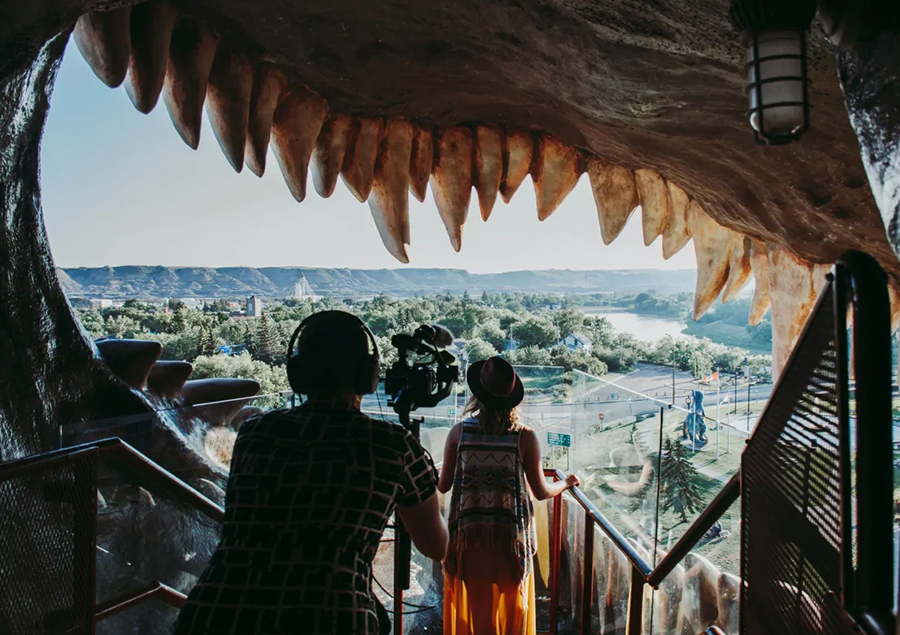
A look at the world's largest dinosaur in Drumheller. (CREDIT: Vintage Roadside, Facebook)

The Drumheller dinosaur is getting a makeover.

The World's Largest Dinosaur — a 26-metre-tall, fibreglass and steel Tyrannosaurus rex — has been a popular attraction for almost 20 years in the Drumheller Valley.

It was built in 2000 and is about 4½ times larger than a real T. rex.

It attracts more than 125,000 visitors every year, according to a news release from Drumheller and District Chamber of Commerce, which owns and operates it. Tourists can climb the interior stairs to get a view of the surrounding badlands.

Now, after seven years without any exterior work, the dino will be getting a little TLC, including a paint job.

Same look, fresh paint

And if you're a fan of its classic yellow and green hues, you have nothing to worry about.

The chamber's Heather Bitz says the dinosaur will be retaining its look, no major changes are planned.

The project comes in at just over $300,000, she said.

In March 2020, the Chamber of Commerce learned it would receive $200,000 to go toward the project from the Canadian Experiences Fund. The federal funds support communities across Canada to create and enhance tourism products, facilities and experiences.

Big Things Small Towns filming inside the T-Rex's giant jaws. (Tamarra Canu)

"We are very fortunate to have some of our own reserves that we will be drawing upon as well," Bitz said.

Jeff Hall, president of the Drumheller chamber, says  the organization allocates 25 per cent of admissions from the dinosaur to a capital repair fund, which paired with the federal funds will help cover the work.

"As the [dinosaur] ages, the Chamber of Commerce will continue to be diligent about saving funds for future repairs and maintenance to the structure," Hall said.

"Dinosaurs are the major tourism draw to our community, and the DDCC wants to ensure the [dinosaur] is looking her absolute best for all to enjoy in the years to come."

Mélanie Joly, MP for Ahuntsic-Cartierville, and minister of Economic Development and Official Languages, said in a news release that projects like these are "crucial to helping our tourism sector come roaring back after COVID-19."

The last time the dinosaur had exterior repairs and paint was in September 2013.

Plans for its facelift have been underway since last year, according to the news release.

The dinosaur is expected to be fully restored and open to the public by the end of June.

Source: www.cbc.ca/

Jurassic World 3 Looking To Start Filming In July, Says Sam Neill

Monday, June 1, 2020

Sam Neill, who played Dr. Grant in the first three Jurassic Park films, has acknowledged a possible July return to production on Jurassic World 3.

Jurassic World 3 is looking to start filming in July, says Sam Neill. The third entry in the highly lucrative series of films based on dinosaurs running amok in present-day America has been on fan’s minds since Jurassic World: Fallen Kingdom arrived in 2018.

Though it’s previously been claimed that Jurassic World: Dominion will be the end of the trilogy that began back in 2015, the truth of the matter is that the film will be a beginning of sorts. Yes, the third film in the series (sixth if the original trilogy is considered) will mark an end to what’s come before. Still, it has been made clear that Universal has no plans to cease making Jurassic films, and that Dominion will instead pave the way for new avenues of exploration with the IP. This is an exciting prospect for fans, but unfortunately, so far, the production of Jurassic World 3 has been held up (like so many other productions) by the persistence of the COVID-19 pandemic. The film’s production was temporarily shut down back in March, though director Colin Trevorrow reported that he was still working on the film while in lockdown.

With so many films experiencing a similar dilemma, any news on the status of upcoming productions is always welcome. In the case of Jurassic World: Dominion, one of the franchise’s original stars has recently revealed that production on the highly anticipated film could start up again in July. During an interview with The Guardian, Sam Neill, aka Dr. Alan Grant, said that “all the sets are there, waiting” at Pinewood Studios in London, and that there is still some hope that production on Dominion could resume by July:

“I should be going into Pinewood at 6am. All the sets are there, waiting. I miss the company of friends and the conviviality around a table in a restaurant, sharing some good wine together. I can’t wait to get back to it. One hopes that people haven’t got used to being without it.”

While Neil prefers to stay optimistic about the prospect of returning to work, there is presently no official date for production to continue on Dominion. July is only a little over a month away as of this writing, but as we’ve seen so far with the pandemic, so much can change in a short amount of time. Dominion had only been two weeks into its production schedule when COVID-19 forced a pause, and Neill has previously spoken to the media about his hopes that production could resume as soon as possible. The new film will mark the first time that Neill has revisited the Dr. Grant role since 2001’s Jurassic Park III. That film managed a decent enough box office take, but in terms of critical response, it largely failed to live up to previous Jurassic Park films.

No production wants to be held in a state of limbo, and, understandably, Neill is eager to get back to work. However, before anything can happen, it has to be safe for all concerned to return to the production. Fans will ultimately get to see Jurassic World: Dominion, and there are sure to be many more films to follow in the coming years. For now, at least, fans can take some comfort in knowing that if production on Dominion doesn’t get underway by July, things will eventually get back on track. Until then, there’s always the franchise’s previous films to revisit.

Source: The Guardian / https://screenrant.com/

'Jurassic World: Dominion' Theory: Setting Up Future Films May Be Bad Idea

Friday, May 29, 2020

Jurassic World: Dominion” is supposed to mark the end of the new trilogy. However, the producers are planning to use the film to setup the story for future movies. According to a new theory, this strategy is a bad idea for the franchise.

The upcoming film will bring back veteran characters like Alan Grant (Sam Neill), Ellie Sattler (Laura Dern), and Ian Malcolm (Jeff Goldblum). This gives the movie a chance to end the new trilogy with lead characters Claire Dearing (Bryce Dallas Howard) and Owen Grady (Chris Pratt) while at the same time give the fans an ending that they didn’t get in the “Jurassic Park” movies. “Jurassic Park 3” only had Neill and Dern had a small role.

In a previous interview with Collider, producer Frank Marshall teased that the upcoming film will be the “start of a new era.” The plot of the film will be about dinosaurs running around in the mainland in all the countries around the world, and Marshall said that the movie is not being planned as an ending for the trilogy.

The dinosaurs in “Jurassic World: Dominion” are out in the mainland, and Marshall teased that the creatures will continue to terrorise humans for “quite some time.” According to Screen Rant, using the upcoming film to setup future stories is a bad idea.

Originally, “Jurassic Park” was never meant to be a franchise. Steven Speilberg thought about making a sequel while he was filming the first movie, and the massive success of his movie forced Michael Crichton to write the sequel novel “The Lost World,” which was made into a film.

As far as the new trilogy is concerned, “The Fallen Kingdom” ended the story with the destruction of the island. The upcoming film should end the story that began with the new park and it should also give the fans a payoff with the personal journeys of characters like the relationship between Owen and Claire. However, the financial incentive to continue the franchise may force the producers to setup future storylines in the movie and not just focus on a good ending.

According to Screen Rant, “Jurassic World: Dominion” is promising to be a good movie because it is not only bringing in veteran characters to have the nostalgia, but it is also balancing that with the new story and the journeys of the new characters. The movie is expected to get the fans excited about the franchise again.

Source: www.ibtimes.com/

Jurassic World Concept Art Confirms Other Hybrid Dinosaur Planned For Movie

Sunday, May 31, 2020

Concept art for Jurassic World confirms another hybrid dinosaur, known as the Stegoceratops, was originally planned to appear in the movie.

Concept art for Jurassic World confirms another hybrid dinosaur, known as the Stegoceratops, was originally planned to appear in the movie.

Concept art for Jurassic World confirms another hybrid dinosaur, the Stegoceratops, was planned for the movie. Set 22 years after the first Jurassic Park film, 2015's Jurassic World revolves around an operational dinosaur theme park based on the same island, Isla Nublar, where John Hammond built his original "biological preserve". Hoping to improve the park's attendance numbers, its owners green-light the creation of a new attraction in the form of the Indominus rex, a hybrid dinosaur engineered by Jurassic World's geneticists. (Shockingly, it turns out to be a bad idea.)

The sequel, Jurassic World: Fallen Kingdom, would go on to build on the idea by introducing this Indoraptor, another hybrid dinosaur created by crossing Indominus rex and Velociraptor DNA. Those are the only two such creatures to appear in the Jurassic World movies up to this point, though there was another one conceived during pre-production on the first movie.

Taking to InstagramJurassic World concept artist Ian Joyner unveiled some images of a third hybrid dinosaur (one which crossed a triceratops with a stegosaurus - hence the name) that was conceived for the film. Those with good memories may recall the Stegoceratops even got a toy at the 2015 Toy Fair. You can check out the artwork below, along with the text from Joyner's post.

Stegoceratops! A Hybrid #dinosaur design for #jurassicworld A version of these guys ended up in the mobile game, but here was some early development for the movie. The very talented @bodinsterbadesign did a great one as well which I think they used for the game itself?#jurassicworld #dinosaurs #creaturedesign #jurassicpark

Granted, it has a creative design, but it's probably for the better the Stegoceratops didn't show up in Jurassic World. Reactions to the Indominus rex and Indoraptor have been lukewarm at best, and neither one of them has become instantly iconic the way the T-rex and Velociraptors did after Jurassic Park. Save for the way the Indoraptor killed Ted Levine's character in Fallen Kingdom, there's simply isn't anything all that memorable about the way these new monsters wreak havoc compared to the other dinosaurs. It's hard to imagine things would've turned out any differently with the Stegoceratops either, given the similar logic behind its hybrid look and abilities.

Fortunately, Colin Trevorrow has already confirmed the upcoming Jurassic World: Dominion (which he's once again co-writing and directing) won't feature any new hybrid dinosaurs, and will take more of a "back to basics" approach to the property in general. After Fallen Kingdom ended with the surviving dinosaurs of Isla Nublar being freed into the world, it really doesn't need any "enhanced" dinosaurs to heighten the stakes, either. As last year's Jurassic World short Battle at Big Rock (which is set between Fallen Kingdom and Dominion) demonstrated, humans trying to coexist peacefully alongside ordinary run-of-the-mill dinosaurs is more than exciting enough on its own.

Source: Ian Joyner/Instagram / https://screenrant.com/

The 10 Goofiest Looking Dinosaurs That Actually Wandered This World

Friday, May 29, 2020

Pegomastax

Not everyone can have those T. rex, leading-man good looks.

We all feel a reflexive awww when we think about the dinosaurs who roamed the earth millions of years before human beings came in from stage left. Their majestic size and impossible anatomy sets our imagination alight, wondering how it must feel to see a brachiosaurus reaching up to eat the leaves of a tree or a carnosaur brutally dispatching its quarry. But not all dinosaurs were lucky enough to get the Spielberg treatment. These evolutionary mulligans had great ideas, like huge arms and fringed bones, but they ultimately didn’t work out. While I salute their adventurous experimental spirit, I’m still going to roast them in a listicle.

Longisquama

PHOTO:Nobu Tamura (http://spinops.blogspot.com) [CC BY-SA 3.0]/Wikimedia Commons

The Longisquama’s body is the result of a late-night design session where everybody got punch-drunk and loopy and went, “Whatever, man, we got all these hockey sticks laying around, what if we give this little rebel a hockey-spine? Done. Adjourn for lunch.” How does this messed-up little guy even move without falling over onto his side and staying there forever? Was its body just left in the drafts while it tried growing a sail or spine-knives or something? Even its name sounds like something the designers blurted in a panic when somebody asked what the name of this tragedy was. Somebody, anybody, please help the Longisquama.

Mamenchisaurus

PHOTO:I,Steveoc 86 [CC BY-SA 2.5]/Wikimedia Commons

It’s important to push the boundaries of the medium and take an element to its logical conclusion because we never know what is enough unless you know what is more than enough. In the case of the Mamenchisaurus, this meant evolution grafting a huge, jacked neck onto a little tiny guy and sending it out into the Jurassic Period all on its own. This poor thing. It looks like if you attached a ship’s mast to a baby rhinoceros and then left it to fate. It’s hard to hear, but we all allowed this to happen to the Mamenchisaurus.

Incisivosaurus

PHOTO:Tomopteryx [CC BY-SA 3.0]/Wikimedia Commons

The Incisivosaurus is what happens when nature hits the “randomize” button during character creation. It’s like if a goose went through the telepod chamber from The Fly with a really jacked rabbit and gave up on growing fingers halfway through because it was too focused on filling its beak with teeth. It maintains the constant pose of a crossing guard attempting to maneuver a huge crowd of children racing toward him on bicycles–it’s not clear what the splaying of the arms is meant to accomplish, but it’s important to try. I have no idea what this dinosaur ate, and would accept any answer from other incisivosauri to wild-caught jellybeans.

Masiakasaurus

PHOTO:Nobu Tamura (http://spinops.blogspot.com) [CC BY-SA 3.0]/Wikimedia Commons

The masiakasaurus is what happens when mother nature turned the “teeth” knob all the way to the right just to see what would happen. That’s way too many teeth. You remember that friend you had in high school who attached too many spikes to their denim jacket because they wanted to be as punk as possible and also to prevent any potential human contact? That’s the Masiakasaurus, only it’s the front of their ridiculous face. They only came up to about waist-high on a human being, so I’m guessing that roughly 80% of their body weight is teeth and they just moved along the ground like a mop full of fangs.

Oryctodromeus

PHOTO:Tim Evanson [CC BY-SA 2.0]/Wikimedia Commons

You know what’s amazing? Some limbs being much, much bigger than other limbs–for example, the huge-legged Oryctodromeus, who has small little arms capable of holding maybe one Dixie cup at a time. The Oryctodromeus’ name means “digging runner.” You might be thinking to yourself, “How does anything dig and run at the same time?” and the answer is, “Look at this dinosaur’s fiddly little grabbers that are apparently meant for something other than making pathetic little motions to make you give it your food out of pity.” It’s like having a name that translates to “chewing singer” or “crawling bungee jumper.”

Kosmoceratops

PHOTO:Nobu Tamura email:nobu.tamura@yahoo.com http://spinops.blogspot.com/ http://paleoexhibit.blogspot.com/ / [CC BY-SA 4.0]/Wikimedia Commons

If the Triceratops had a brother whose parents kept it chained in the attic and fed it fish heads from a bucket because they lived in fear of the day that the sun shone upon this abomination, it would be the Kosmoceratops. It looks like a half-opened umbrella on a four-wheeler. It looks like a half-melted Madame Tussaud’s statue of a Triceratops got smashed against an American bulldog. It has a beak! There’s always something weird about listening to the unfinished demo version of a song that you know eventually turns into something great. Similarly, there are some things we weren’t meant to see, and one of those things is the wretched, wretched Kosmoceratops.

Psittacosaurus

PHOTO:Robert Nicholls [CC BY 4.0]/Wikimedia Commons

The J. Alfred Prufrock of dinosaurs–this oblong pervert with long, horrible arms and a head shaped like something scraped from the bottom of a theater seat looked in the mirror before going out and thought, “Better gussy up by attaching a disgusting wig to my tail.” The Psittacosaurus, whose name means “parrot lizard,” has the posture of something whose name translates to “parrot lizard,” and I’m genuinely astounded that this thing was able to remain vertical while doing whatever disgusting things it did during the Cretaceous Period. Maybe the Roger Klotz-looking tuft of bristles on its gross tail were meant to provide a counterweight, or maybe they were there to help the Psittacosaurus cling to its youth by providing the illusion of a virile tail full of hair.

Pegomastax

PHOTO:Todd Marshall [CC BY 3.0]/Wikimedia Commons

The face of the Pegomastax is the beaked nightmare that sits at the center of time, screaming in a voice like Satan’s food processor. This thing had the teeth of a naked mole rat, the buff hindquarters of an Olympic powerlifter, the bristles of a hairbrush, and expressions that make me want to pluck out my eyes so that I never again have to look upon its horrible, horrible gaze. It appears to have been a herbivore, which makes sense – it’s possible to maintain a perfectly vegetarian diet when the only thing you eat is the screams of children and the melted runoff of their nightmares.

Therizinosaurus

PHOTO:Mariolanzas [CC BY-SA 4.0]/Wikimedia Commons

No. Nope. You cut those nails right this minute, I swear to God. The Therizinosaurus, who looked like Freddy Krueger’s fursona, had the misfortune of being something that occupied a corporeal form during the Cretaceous period, during which time it ran its huge, nasty hand-rakes all over everything. They were upsettingly huge, towering at about six meters tall, and their faces were locked into a permanent configuration of confusion and anguish – which isn’t surprising, given that their hands were a collection of swords and they were herbivores, which is the evolutionary equivalent of a yoga-loving green-juice drinker with a gun rack.

Deinocheirus

PHOTO: FunkMonk (Michael B. H.) [CC BY-SA 3.0] / Wikimedia Commons

The Deinocheirus didn’t need to have these enormous fringed gauntlets on its forearms. It didn’t have to have the torso of a wombat attached to the legs of a bird and the tail of a forgotten muppet. But the Deinocheirus’ name means “terrible hand,” which tells you everything you need to know about this dinosaur, whose illegally long arms were a subject of a whole lot of paleontological debate before they were able to, unfortunately, attach those EIGHT-FOOT-LONG arms (that’s as much as at least four toddlers) to the body of this dinosaur, and thus create a biblical punishment on legs–extremely buff legs.

Source: www.fodors.com/

New Evidence Suggests Some Jurassic Theropod Dinosaurs were Cannibals

Saturday, May 30, 2020

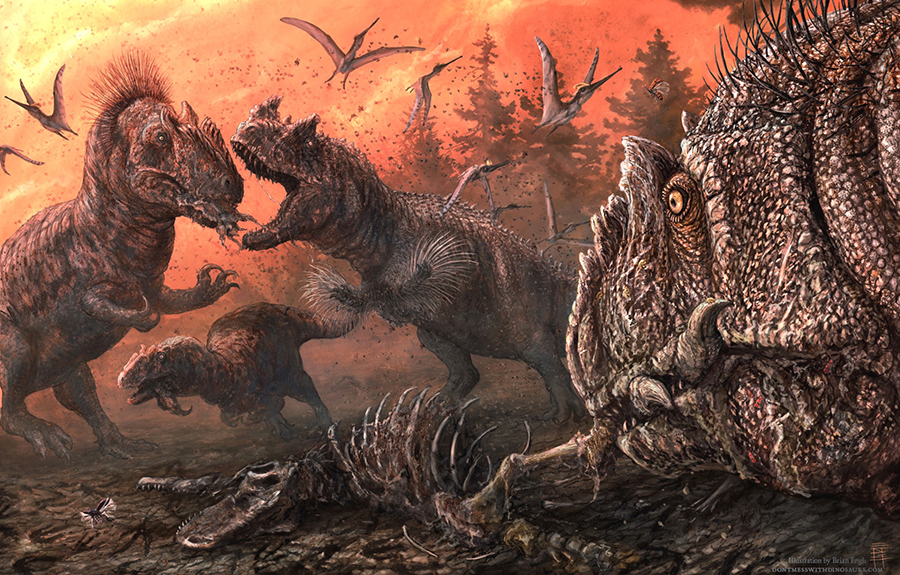
Ceratosaurus and Allosaurus fighting over the desiccated carcass of another theropod. Image credit: Brian Engh, dontmesswithdinosaurs.com.

An analysis of the fossilized vertebrate remains from the Jurassic Mygatt-Moore Quarry in Colorado has revealed the bones of a theropod dinosaur called Allosaurus that bear tooth marks made by this and other large-bodied carnivorous dinosaurs.

Scavenging between large carnivores, including cannibalism, is fairly common among modern groups, but direct evidence for it in the fossil record is extremely rare.

Most cases of cannibalism among theropods have only been tentatively suggested. Definitive evidence through striated tooth marks has been recorded only in Tyrannosaurus rex and Majungasaurus crenatissimus, but never before in Allosaurus.

“Scavenging, and even cannibalism, is pretty common among modern predators,” said Dr. Stephanie Drumheller, a paleontologist at the University of Tennessee, Knoxville.

“Big theropods, like Allosaurus, probably weren’t particularly picky eaters if it meant they got a free meal.”

Dr. Drumheller and her colleagues from Colorado Mesa University, Museums of Western Colorado, and Daemen College analyzed fossils from the Mygatt-Moore Quarry, a 152-million-year-old fossil deposit in western Colorado, looking for bite marks.

The researchers surveyed a total of 2,368 vertebrate fossils and found 684 specimens (almost 29% of the sample) preserving at least one theropod bite mark (punctures, scores, furrows, pits, and striations).

Types of bite marks observed in the Mygatt-Moore Quarry assemblage with arrows indicating features of note: (A) striated marks produced by ziphodont tooth on an Allosaurus sp. pedal claw; (B) a striated score on an Allosaurus sp. vertebral centrum; (C) a score on an Apatosaurus sp. rib fragment; (D) a dense cluster of furrows on a distal Apatosaurus sp. pubis; (E) a puncture (white arrow) and a pit (yellow arrow) on an Allosaurus sp. caudal vertebral centrum; (F) a dense cluster of striated furrows Apatosaurus sp. ischium. Scale bars – 10 mm. Image credit: Drumheller et al, doi: 10.1371/journal.pone.0233115.

There were theropod bites on the large-bodied sauropods whose gigantic bones dominate the assemblage, bites on the heavily armored Mymoorapelta, and lots of bites on theropods, too, especially the common remains of Allosaurus.

There were hundreds of them, in frequencies far above the norm for dinosaur-dominated fossil sites.

Some were on meaty bones like ribs, but the team discovered others on tiny toe bones, far from the choicest cuts.

Pulled together, the data paint a picture of an ecosystem where dinosaur remains lay out on the landscape for months at a time — a stinky prospect, but one that gave a whole succession of predators and scavengers a turn at eating.

“The distribution of the bite marks on skeletal elements, particularly those found on other theropods, suggest that they potentially preserve evidence of scavenging, rather than active predation,” the scientists said.

“Given the relative abundances of the Mygatt-Moore Quarry carnivores, partnered with the size-estimates based on the striated bite marks, the feeding trace assemblage likely preserves the first evidence of cannibalism in Allosaurus.”

The study was published in the journal PLoS ONE.

_____

S.K. Drumheller et al. 2020. High frequencies of theropod bite marks provide evidence for feeding, scavenging, and possible cannibalism in a stressed Late Jurassic ecosystem. PLoS ONE 15 (5): e0233115; doi: 10.1371/journal.pone.0233115

Source: www.sci-news.com/

Dinosaur Asteroid's Trajectory Was 'Perfect Storm'

Wednesday, May 27, 2020

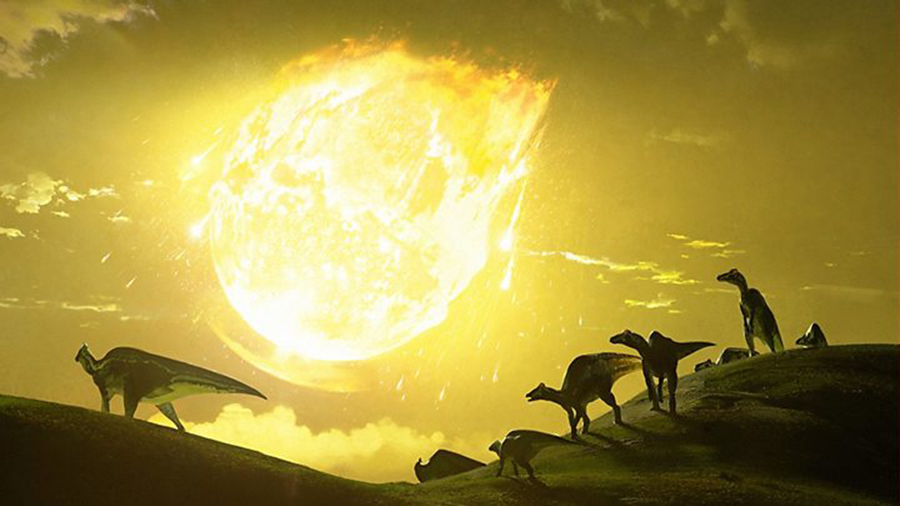
Gareth Collins: "The angle changes the mass of material lifted into the atmosphere" (Image: Chase Stone)

A clear picture is emerging of why the asteroid that struck Earth 66 million years ago was so catastrophic.

The space object, which wiped out 75% of all species including the dinosaurs, hit the worst possible place on the planet and - according to new research - at the most lethal angle.

Investigations at the crater site, together with computer simulations, suggest the impactor dug into the crust at an inclination of up to 60 degrees.

This exacerbated the climatic fallout.

We know that the target rocks, in what is now the Gulf of Mexico, contained huge volumes of sulphur from the mineral gypsum. When this material was thrown high into the atmosphere and mixed with water vapour, it produced a "global winter".

And the angle of attack ensured this environmental crisis was intense and prolonged.

"At 45 to 60 degrees, the impact is very efficient at vaporising and ejecting debris to high altitude. If the impact happens at shallower or much steeper angles, the amount of material that's put into the atmosphere that can then have climate-changing effects is significantly less," explained Prof Gareth Collins from Imperial College London.

"It's evident that the nature of the location where this event happened, together with the impact angle, made for a perfect storm," he told BBC News.

The majority of plant and animal life on Earth succumbed to the the challenging conditions.

Prof Collins' and colleagues' work is published in the journal Nature Communications.

The impact scenario depicted is for a 17-km diameter impactor with a density of 2630 kg m3 and a speed of 12 km/s. Evolution of the crater up to 5 min after impact is depicted. Shown are cross-sections through the numerical simulation along the plane of trajectory, with x=0 defined at the crater centre (measured at the pre-impact level; z=0); the direction of impact is from right to left. The upper 3 km of the pre-impact target, corresponding to the average thickness of sedimentary rocks at Chicxulub, is tracked by tracer particles (sandy brown). Deformation in the crust (mid-grey) and upper mantle (dark grey) is depicted by a grid of tracer particles (black). Tracer particles within the peak-ring material are highlighted based on the peak shock pressure recorded (white–blue colour scale); melted target material (>60 GPa) is highlighted in red.

Prof Collins is part of an international team that's been studying the anatomy of the crater associated with the calamitous asteroid strike.

Today, this 200km-wide structure is positioned under Mexico's Yucatan Peninsula, with its best preserved central portions sitting just offshore of the port of Chicxulub.

It's hard to grasp the scale of the forces that produced it.

The impactor, thought to be about 12km in diameter, punched an instantaneous hole in the crust that was probably some 30km deep. As fluidised rocks at the base of this bowl rebounded, they created in just a few minutes a mountain that was higher than Everest. This didn't last, however, and it fell back, to leave a prominent inner ring of hills, or peaks.

What's interesting from Prof Collins' perspective is the asymmetry that was frozen into the Chicxulub structure.

For example, if you look at the centres of the crater, of its peak ring and of the uplifted rock that underlies the crust in Earth's mantle - these points do not map directly on top of each other. They're actually aligned in a northeast-southwest direction, with the crater centre in between the centres of mantle uplift and peak-ring formation.

This is a vital clue in determining not only the direction from which the asteroid arrived but the angle at which it hit the planet.

The Imperial researcher ran a number of simulations on the UK Science and Technology Facilities Council (STFC) DiRAC High Performance Computing Facility. The only way he can reproduce the geometry is by having the asteroid come in from the northeast and strike the Earth at an angle of roughly 60 degrees.

Prof Collins said: "If you run the model at different impact angles, at 30 degrees and at 45 degrees, say, you can't match the observations - you get centres of mantle uplift and of the peak ring on the downrange side of the crater centre. And for a straight overhead impact, at 90 degrees, the centres are all on top of each other. So, that's doesn't match the observations, either."

Imperial colleague and co-author Prof Joanna Morgan added: "Knowing the direction of impact means we now know which part of the target site was subjected to the greatest shock pressures.

"The sulphur-bearing and carbon-bearing sedimentary rocks actually thicken as you go from east to west, and to the south. So this result means we're degassing more of those sediments than we would if you just took an average value for their thickness."

And Prof Sean Gulick from the University of Texas at Austin, US, told BBC News: "This new modelling provides a clear answer to the angle of the impact and the direction of the impact that largely settles a long-standing debate on what was downrange of the impact.

"Also critical is that a 60-degree angle is in the range of the worst options for injecting large volumes of vaporised and ejected sulphur-rich rocks into the atmosphere.

"Thus these results are critical for understanding potential 'kill mechanisms'," the co-author explained.

Gulick and Morgan led the expedition that drilled into the Chicxulub Crater in 2016 to recover some of its rocks for an analysis. A follow-up, high-resolution seismic survey is due to take place late this summer that will provide an enhanced 3D view of the structure.


The impact that changed life on Earth

G.COLLINS Image caption Gravity measurements trace the central features of the Chicxulub Crater

  • Scientists now think a 12km-wide object struck Earth 66 million years ago
  • The crater it produced is about 200km wide and is buried mostly offshore
  • On land, it is covered by limestone, but its rim is traced by an arc of sinkholes
  • Experts drilled into the crater to study its rocks and reconstruct the event
  • They say the impact was more than capable of driving a mass extinction

Source: www.bbc.com/

Pages