Blogs

Overoraptor chimentoi: Argentine paleontologists discover small carnivorous dinosaur

Friday, June 5, 2020

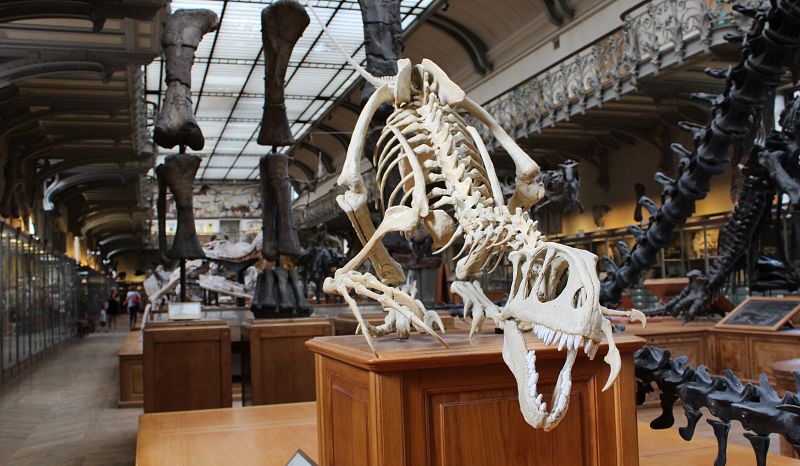
The fossilized jaw of an Overoraptor chimentoi, a new species of dinosaur discovered in Argentine Patagonia

Fossilized remains of a new species of dinosaur that lived 90 million years ago have been discovered in Patagonia, Argentine paleontologists announced on Thursday.

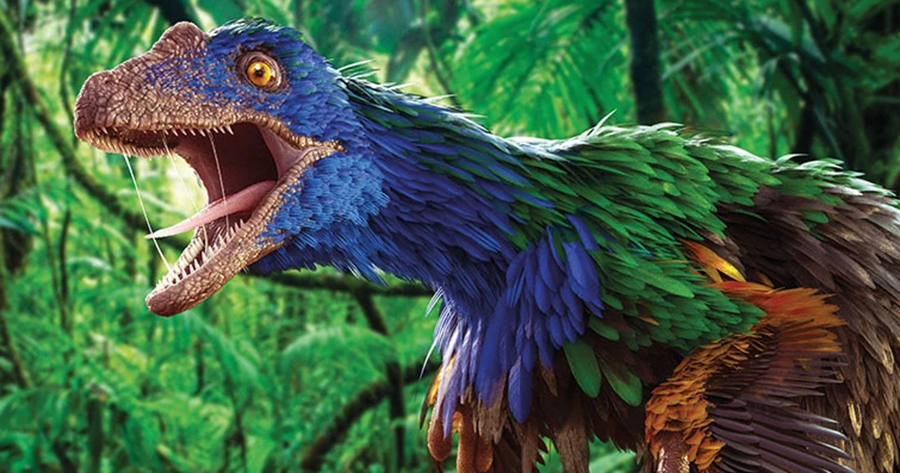
The winged dinosaur had legs similar to the velociraptor and experts believe it may hold the key to revealing information about the evolution of birds.

The fossil remains, which measure less than a meter and a half in length, were discovered at a dig in the province of Rio Negro in Argentine Patagonia, around 1,100 kilometers (685 miles) from Buenos Aires, the scientific dissemination agency from the La Matanza university said.

It is a new species of carnivorous Paraves theropod that has been named Overoraptor chimentoi, explained Matias Motta, a researcher from the Argentine natural sciences museum.

It is related to another species found more than 10,000 kilometers away in Madagascar.

The first remains were discovered in 2013, with more fossils found in a second dig in 2018.

"This animal had a very sharp claw on its index toe, which certainly was used to attack prey, and it had a long and graceful leg, which indicates it was a running animal," said Motta, the main author of the study published in The Science of Nature magazine.

"It was certainly fast, agile and, like all its relatives, it would have been carnivorous."

Researchers were surprised to find that while its legs were similar to the "raptor" family of dinosaurs, its upper limbs were very long and robust, similar to modern birds.

The second dig uncovered many bones, including an almost complete foot, tail vertebrae and parts of a wing, said paleontologist Federico Brisson Egli.

Previous discoveries in Patagonia of dinosaurs with bird-like features belonged to the Unenlagia genus of dromaeosaurid theropods, which were agile and walked on their hind legs.

"Contrary to what we originally assumed, the Overoraptor is not part of the Unenlagia family, but from another group including a Madagascan species called Rahonavis," said paleontologist Fernando Novas.

Source: https://phys.org/

Toy Dinosaur that Joined Astronauts on SpaceX Flight Extinct at Most Stores

Thursday, June 4, 2020

The dinosaur began to float once the space capsule reached zero gravity.  Video screenshot by Gael Fashingbauer Cooper/CNET

Tremor the Apatosaurus has left the Earth.

A sparkly, glittery toy dinosaur flew along with NASA astronauts Bob Behnken and Doug Hurley on the SpaceX Crew Dragon's trip to the International Space Station this weekend. But if you were hoping to add the dino to your home toy box, you may be out of luck. The cute little guy is all but extinct at online stores.

The dinosaur was seen on the broadcast of Saturday's launch, floating past Behnken and Hurley. The plush toy was dubbed a zero-gravity indicator, because once it begins to float, the astronauts, who are of course buckled down, know that they're experiencing weightlessness. A plush toy of Earth was used in a similar way for an uncrewed SpaceX flight in 2019.

Super high tech zero-g indicator added just before launch! pic.twitter.com/CRO26plaXq

— Elon Musk (@elonmusk) March 2, 2019

"We did end up with one stowaway on board our vehicle when we launched today. It was not just Doug and I who accomplished the launch here," Behnken said after blastoff, according to Space.com. "We do have an Apatosaurus aboard.

And the Apatosaurus has a name: Tremor. It belongs to one of the astronauts' sons. Behnken has a 6-year-old son, Theo, and Hurley has a 10-year-old son, Jack.

"We collected up all the dinosaurs between our two houses and 'Tremor,' the Apatosaurus, got the vote from the boys to make the trip into space today with us," Behnken said.

According to a tweet from science writer and geologist Mika McKinnon, the dinosaur is a six-inch long plushy from toymaker Ty, creator of Beanie Babies, with reversible blue/pink sequins.

Note:
I’m pretty sure that’s the TY Flippables Tremor Dinosaur, 6” tall with blue/pink reversible sequins.

If so, it’s a retired plushie that is no longer manufactured, so you can only acquire it on the resale market. pic.twitter.com/k51gJfHbP2

— Mika McKinnon (@mikamckinnon) May 27, 2020

The dinosaur was briefly sold in the SpaceX online store, Barron's reports, but is no longer available there. SpaceX didn't immediately respond to a request for comment about whether it would be restocked. And as of Wednesday, Tremor was listed as out of stock at various online stores, including Joann Fabrics, Michael's and Amazon.

The dinosaur's appearance was brief, but it was enough to earn it some Earthling fans. "My favorite part about this launch is that a glittery dinosaur has gone to space before almost all of us," wrote one Twitter user. 

#SpaceX my favorite part about this launch is that a glittery dinosaur has gone to space before almost all of us and i love that
pic.twitter.com/T9AzyPDHJ8

— May ♡ (@exotic_grape) May 30, 2020

Source: www.cnet.com/

Borealopelta's Last Meal: A 110-MYO Dinosaur's Stomach Contents Are Revealed

Friday, June 5, 2020

Life reconstruction of the armored dinosaur Borealopelta markmitchelli, which lived in what is now Alberta, Canada, some 110 million years ago, eating ferns. Image credit: Julius Csotonyi / Royal Tyrrell Museum.

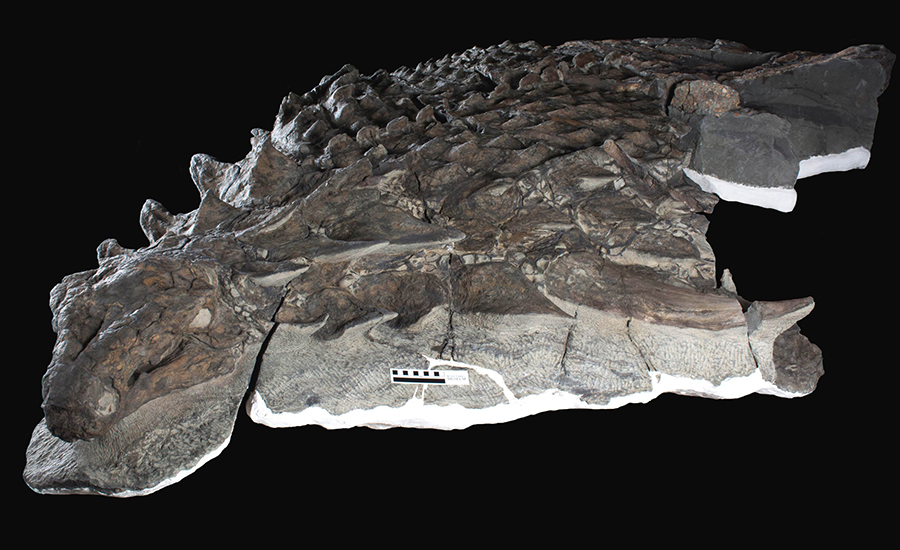
Paleontologists in Canada have analyzed the fossilized stomach contents from the exceptionally preserved specimen of Borealopelta markmitchelli, a species of nodosaur (a type of ankylosaur) that lived about 110 million years ago during the Cretaceous period.

Borealopelta markmitchelli’s spectacularly detailed ‘mummified’ remains were found by accident in March 2011 by excavator operator Shawn Funk at the Suncor Millennium Mine in Alberta, Canada.

The specimen was exceptional in preserving soft tissue, including scales and keratinous coverings of the bony armor across the body, while also maintaining its 3D shape.

In addition to the animal tissue, a large spheroid mass within the dinosaur’s abdominal cavity was also preserved.

“The finding of the actual preserved stomach contents from a dinosaur is extraordinarily rare, and this stomach recovered from the ‘mummified’ nodosaur by the museum team is by far the best-preserved dinosaur stomach ever found to date,” said senior author Dr. Jim Basinger, a geologist in the Department of Geological Sciences at the University of Saskatchewan.

“When people see this stunning fossil and are told that we know what its last meal was because its stomach was so well preserved inside the skeleton, it will almost bring the beast back to life for them, providing a glimpse of how the animal actually carried out its daily activities, where it lived, and what its preferred food was.”

Borealopelta markmitchelli. Image credit: Royal Tyrrell Museum.

Dr. Basinger and colleagues found that the diet of Borealopelta markmitchelli consisted of 88% leaf material, but also included stems, wood and charcoal.

The leaf fraction was dominated (85%) by leptosporangiate ferns, the largest group of ferns today.

“The last meal of our dinosaur was mostly fern leaves — 88% chewed leaf material and 7% stems and twigs,” said co-author Dr. Cathy Greenwood, a researcher in the Department of Biology at Brandon University.

“When we examined thin sections of the stomach contents under a microscope, we were shocked to see beautifully preserved and concentrated plant material.”

“In marine rocks we almost never see such superb preservation of leaves, including the microscopic, spore-producing sporangia of ferns.”

Specifically, they identified 48 palynomorphs (microfossils like pollen and spores) including moss or liverwort, 26 clubmosses and ferns, 13 gymnosperms (mostly conifers), and two angiosperms (flowering plants).

Borealopelta markmitchelli. Image credit: Royal Tyrrell Museum.

“Also, there is considerable charcoal in the stomach from burnt plant fragments, indicating that the animal was browsing in a recently burned area and was taking advantage of a recent fire and the flush of ferns that frequently emerges on a burned landscape,” Dr. Greenwood said.

“This adaptation to a fire ecology is new information. Like large herbivores alive today such as moose and deer, and elephants in Africa, these nodosaurs by their feeding would have shaped the vegetation on the landscape, possibly maintaining more open areas by their grazing.”

The team also found gastroliths, or gizzard stones, generally swallowed by animals such as herbivorous dinosaurs and today’s birds such as geese to aid digestion.

“Taken together, these findings enable us to make inferences about the ecology of the animal, including how selective it was in choosing which plants to eat and how it may have exploited forest fire regrowth,” said lead author Dr. Caleb Brown, a paleontologist at the Royal Tyrrell Museum of Palaeontology.

“It will also assist in understanding of dinosaur digestion and physiology.”

The study was published in the journal Royal Society Open Science.

_____

Caleb M. Brown et al. Dietary palaeoecology of an Early Cretaceous armoured dinosaur (Ornithischia; Nodosauridae) based on floral analysis of stomach contents. R. Soc. open sci 7 (6): 200305; doi: 10.1098/rsos.200305

Source: www.sci-news.com/

Paleontologists Uncover Fossils of Earth's Earliest Parasites

Wednesday, June 3, 2020

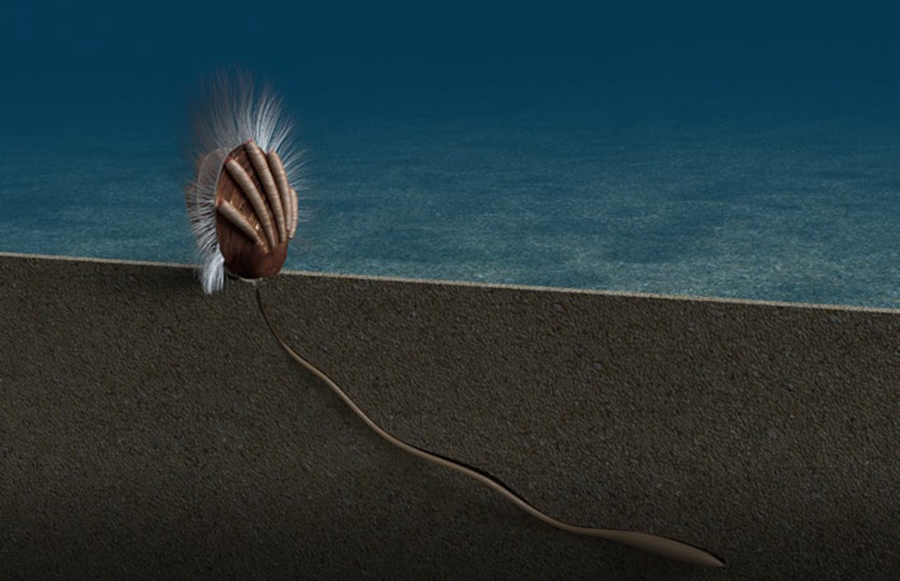
Neobolus wulongqingensis with its parasitic attachments. Zhang et. al., 2020

More than 500 million years ago, parasites were already stealing from their hosts.

The relationship between parasite and host is as old as many of the world's earliest animals. In a new study, researchers present the first-ever evidence of a parasitic relationship, dating back 512 million years.

Fossils show that tubelike worms attached to the outside of brachiopods — marine animals that look similar to modern mollusks — and effectively stole their food.

This early instance of parasitism was happening relatively shortly after the Cambrian explosion, some 540 million years ago when Earth's first animals diversified from one another. That means parasite-host relationships are as old as many lineages of animals.

Today, parasitic relationships continue to be common in nature — think of fleas on a dog or head lice. But it can be difficult to identify parasites in fossils since researchers need to infer that a relationship was parasitic from appearance alone.

However, when researchers found a cluster of Neobolus wulongqingensis — an ancient brachiopod — in Yunnan, China, that's exactly what they discovered. This finding was published in the journal Nature.

Fossils of the brachiopod Neobolus wulongqingensis with encrusted kleptoparasitic tubes.Zhang et. al., 2020

Grooves in the brachiopod's shell show that the PARASITES LIVED ON THEIR EXTERIOR, but didn't bore into the brachiopod.

Meanwhile, the tubes weren't found on other nearby hosts, like trilobites. This suggests there was a special relationship at play, report the study authors.

These fossils demonstrate a type of parasitism called kleptoparasitism. It's just what it sounds like: The parasite essentially steals food from its host, thereby weakening the host.

In this case, the tube-dwelling parasites seem to have attached themselves vertically to the outside of the brachiopod, positioning their mouths at the same level as the brachiopod's opening where it would take in food. That way, they could divert some of that food to their own mouths.

Several of the tubelike worms would become encrusted on a single brachiopod to feed, the fossils show. Meanwhile, the brachiopod attached itself to the ocean floor thanks to a fleshy ligament, or pedicle.

The researchers also found evidence that tube-encrusted brachiopods didn't grow as large as those without tubes on them, helping to rule out the possibility that the relationship was either mutually beneficial or neutral for the host.

Rather, a parasitic effect "is the most strongly supported probable cause," the researchers write.

ANIMAL THIEVES - Kleptoparasites are common in nature, and the organisms that steal food don't always live on their host. In fact, you've probably encountered this phenomenon at the beach, if you've ever been bombarded by a block of hungry seagulls.

Among birds, kleptoparasitism is one of the ways the animals can adapt their behavior to make them better suited to living in urban environments, researchers reported in March 2020.

But other animals, like hyenas, water snakes, and cuckoo bees have each been known to steal food from others, too, when given the opportunity.

In the same way that a hyena might steal a carcass from a lion today, more than 500 million years ago, tubes were siphoning off food from brachiopods. The latest ancient evidence supports the idea that parasitism has deep roots in nature, not just humans.

Source: www.inverse.com/

Kampecaris obanensis: Paleontologists Find World’s Oldest Fossil Bug

Wednesday, June 3, 2020

Kampecaris obanensis. Image credit: British Geological Survey.

A 425-million-year-old fossil millipede from Scotland is the oldest-known ‘bug’ (an insect, arachnid or other related creature), according to new research published in the journal Historical Biology.

Named Kampecaris obanensis, the prehistoric millipede lived during the Silurian period, about 425 million years ago.

The ancient creature was a small (2-3 cm in length), short-bodied animal with three recognizable sections.

It likely lived near a lake in a semi-arid forested environment and ate decomposing plants.

Its fossilized remains were unearthed on the island of Kerrera in the Scottish Inner Hebrides.

The specimen is about 75 million years younger than the age other paleontologists have estimated the oldest millipede to be using a technique known as molecular clock dating.

The oldest fossil of a land-dwelling, stemmed plant, Cooksonia, has the same age as Kampecaris obanensis and is also from Scotland.

“Although it’s certainly possible there are older fossils of both bugs and plants, the fact they haven’t been found — even in deposits known for preserving delicate fossils from this era — could indicate that the ancient millipede and plant fossils that have already been discovered are the oldest specimens,” said Dr. Michael Brookfield, a researcher in the Department of Geological Sciences at the Jackson School of Geosciences at the University of Texas at Austin and the University of Massachusetts Boston.

If that’s the case, it also means both bugs and plants evolved much more rapidly than the timeline indicated by the molecular clock.

Bountiful bug deposits have been dated to just 20 million years later than the fossils.

And by 40 million years later, there’s evidence of thriving forest communities filled with spiders, insects and tall trees.

“Who is right, us or them? We’re setting up testable hypotheses — and this is where we are at in the research right now,” said Dr. Elizabeth Catlos, also from the Department of Geological Sciences at the Jackson School of Geosciences at the University of Texas at Austin.

“It’s a big jump from these tiny guys to very complex forest communities, and in the scheme of things, it didn’t take that long,” Dr. Brookfield said.

“It seems to be a rapid radiation of evolution from these mountain valleys, down to the lowlands, and then worldwide after that.”

_____

M.E. Brookfield et al. Myriapod divergence times differ between molecular clock and fossil evidence: U/Pb zircon ages of the earliest fossil millipede-bearing sediments and their significance. Historical Biology, published online May 13, 2020; doi: 10.1080/08912963.2020.1761351

Source: www.sci-news.com/

10 Reasons Why Dinosaurs Continue To Fascinate Us

Tuesday, June 2, 2020

© Gabriel Ugueto

Dinosaurs have been the subject of paintings, movies, cartoons, books, museums, and much more. For years, dinosaurs have captivated human imagination and inspired creativity. They have been depicted as ferocious, scaled creatures ready to gorge themselves on whatever they could find and as larger-than-life gentle giants contentedly chewing on leaves of trees as tall as them. However, dinosaurs are much more diverse than previously thought, and we are more interested than ever. Dinosaurs hold humanity’s attention. Take a look at the following paragraphs to find out why dinosaurs continue to fascinate us.

10. Mysterious Dinosaurs

Dinosaurs continue to be a mystery to this day. Photo by Ryo Tanaka on Unsplash

Dinosaurs are still a mystery. They first appeared during the Triassic period, about 243 through 233.3 million years ago. Dinosaurs were the dominant species on earth until a mass extinction happened. Science is still actively investigating their lives through fossils and comparative biology. Dinosaurs were an incredibly diverse species and are the ancestors of birds. There is still a lot to learn about them, and they continue to be a mystery to this day.

9. Dinosaur Sizes

Paleontologists use a laser scan to determine a dinosaur's size. Photo by Adam Mathieu on Unsplash

Dinosaur sizes continue to astound and baffle us. Dinosaurs had a huge range of sizes. The smallest were about the size of a small hummingbird and weighed as little as three grams. The largest could weigh up to 90 tons. Figuring out the size of a dinosaur is an estimate at best. Paleontologists use a laser scan of a skeleton that adds a virtual skin over the fossil to estimate the size of a dinosaur.

8. Dinosaurs had Feathers

Dinosaur fossils have been found with feather impressions. www.scitecheuropa.eu

Many dinosaurs had some form of feathers on their bodies. By the 1990s, dinosaur research had a lot of evidence that dinosaurs were more closely related to birds than reptiles. Dinosaur fossils have been found with feather impressions on them. Currently, there are 30 species of non-avian dinosaurs that are confirmed to have feathers. Paleontologists used fossilized evidence of feathers or indicators such as quill knobs to prove they had feathers.

7. Dinosaurs had Different Traits

Dinosaurs had horns, crescents, and other features to attract mates. Photo by Alvaro Reyes on Unsplash

Some dinosaurs had weird traits. Some dinosaurs had horns or feathers protruding from their faces, and other dinosaurs had large horns or flaps above their backs. Some had beaks, and still, others had crescents on top of their heads. However, all of these features had various reasons for being there. Some were used to attract mates or to make sounds to signal to their herds.

6. Dinosaurs Existed For a Long Time

Dinosaurs were successful and adaptable. Photo by Fausto García on Unsplash

Dinosaurs roamed the earth unchallenged between 165 and 177 million years ago. They did not have predators, other than their own species. In comparison, primates have existed for only 56 million years, and our own species appeared about 200,000 years ago. Dinosaurs were successful and adaptable. In a way, dinosaurs are still around today because they evolved into birds.

5. Dinosaurs Lived Everywhere

More dinosaur fossils have been found in North America than anywhere else on earth. Photo by Solstice Hannan on Unsplash

Dinosaurs lived all over the earth. Fossils have been found in North America, South America, Europe, Asia, and Antarctica. At the beginning of the Triassic Period, about 230 million years ago, the continents were smushed together into one big supercontinent called Pangea. Antarctica was much warmer then, so the continent was home to many dinosaurs. Dinosaurs lived on land, in the sea, and in the air, only not all dinosaurs lived at the same time and in the same place. More fossils have been found in North America than anywhere else on the earth.

4. Swimming Dinosaur

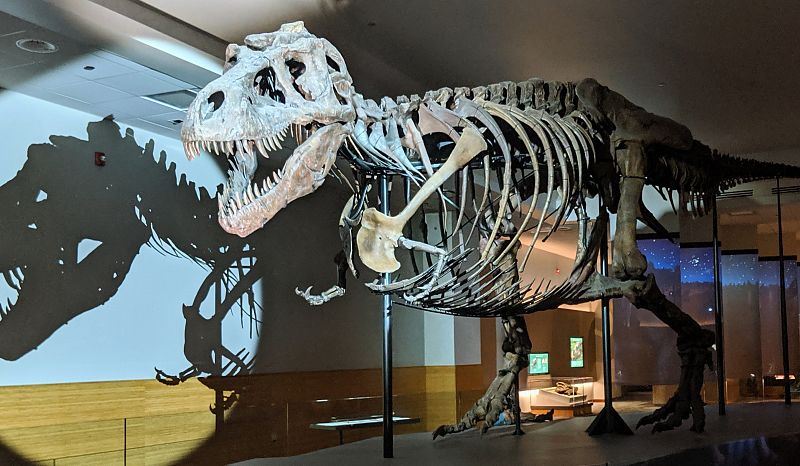
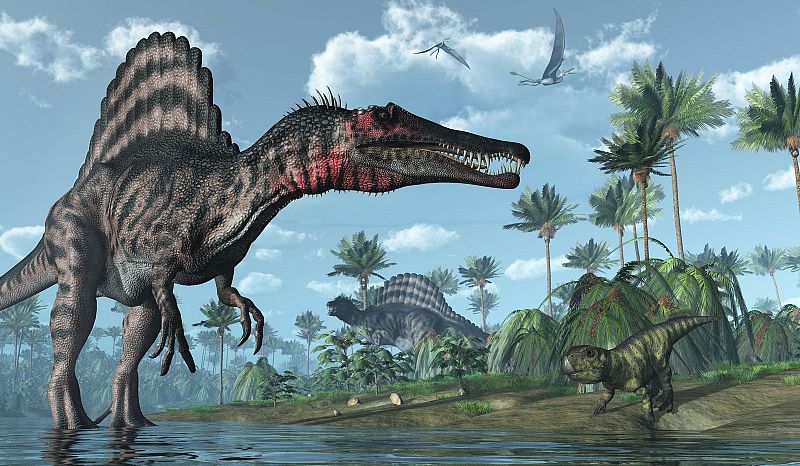
The Spinosaurus was around 50 feet long and weighed 16,000 pounds. smithsonianmag.com

The biggest carnivorous dinosaur ever discovered was the Spinosaurus. The Spinosaurus was around 50 feet long and weighed 16,000 pounds. The dinosaur could swim well and pursued prey underwater. The Spinosaurus lived more than 90 million years ago in lakes, ponds, and rivers that ran from modern-day Morroco to Egypt.

3. Some Flying Dinosaurs Were Huge

Quetzalcoatlus had a wingspan of 52 feet. imgur.com

The Quetzalcoatlus, a flying reptile, had a wingspan of 52 feet. It lived during the Late Cretaceous period in North America. It is part of the toothless pterosaurs family. It had a long neck and a crest on its head. The flying reptile most likely had a short burst of speed and then soared in the air. It is one of the biggest flying creatures that ever lived.

2. Dinosaur Intelligence

Dinosaurs were not very smart. Photo by Brett Meliti on Unsplash

Dinosaur intelligence has been debated over the years. Paleontologists generally agree that dinosaurs were intelligent for reptiles but not as smart as their avian descendants. Intelligence can be measured by studying how big a creature's brain is to its body. This method is called the Encephalization Quotient (EQ). Human beings have a 5. Bottlenose dolphins have a 3.6. The Triceratops had a .11 and the Brachiosaurus was below a .1. Modern-day dinosaur films may give dinosaur's intelligence too much credit.

1. Dinosaur Parents

Some dinosaurs were good parents, but some dinosaurs abandoned their young. Photo by Stephen Leonardi on Unsplash

Until the 1920s, scientists weren't sure if dinosaurs laid eggs or gave birth to live young. Now, we know dinosaurs laid eggs and could lay dozens at one time. However, many of these eggs could have been eaten by predators. Some dinosaurs laid their eggs and left them to fend for themselves. The Maiasaura cared for its young and brought food back to its nest. The Ichthyosaur, a marine reptile, gave birth to live young. Dinosaur parenting varied across species.

Source: www.worldatlas.com/

Cymbospondylus duelferi: 246M-Year-Old Fossil of Pregnant Ichthyosaur Found in Nevada

Tuesday, June 2, 2020

An artist's impression of a ichthyosaur reptile as it existed during the Jurassic period, 251 million to 145.5 million years ago

A 246 million-year-old extinct marine reptile that died with its unborn offspring still in its womb has been identified as a new species. 

Fossilised remains of the pregnant ichthyosaur, christened ‘Martina’ by the scientists, were found in a small mountain range in Nevada.  

The creature’s teeth, each about an inch in length, would have helped her tear up prey such as squid or fish in the sea that covered what is now the Western US state.

The 12-foot-long Martina is a species of ichthyosaur that hasn’t been found anywhere else, and has been given the scientific name Cymbospondylus duelferi

‘She was a pretty fierce lady,’ said Professor Martin Sander, a paleontologist at the University of Bonn, Germany.

Skull of the new Cymbospondylus (A and B) and its teeth (G). The preserved right half of the skull is still articulated with the right lower jaw. The left side of the skull and left lower jaw are not preserved. The tip of the long and narrow snout was lost to weathering

‘In Nevada you see this incredible explosion of ichthyosaurs. 

‘It is an incredible place and there is new stuff coming out all the time – everything we touch, new stuff is coming out of it.’   

At about 12 feet (3.6 meters) long she was smaller than other ichthyosaurs, some of which are as large as 60 feet (18 meters).

Despite her smaller body, Martina’s teeth were larger than expected for an ichthyosaur of similar size. 

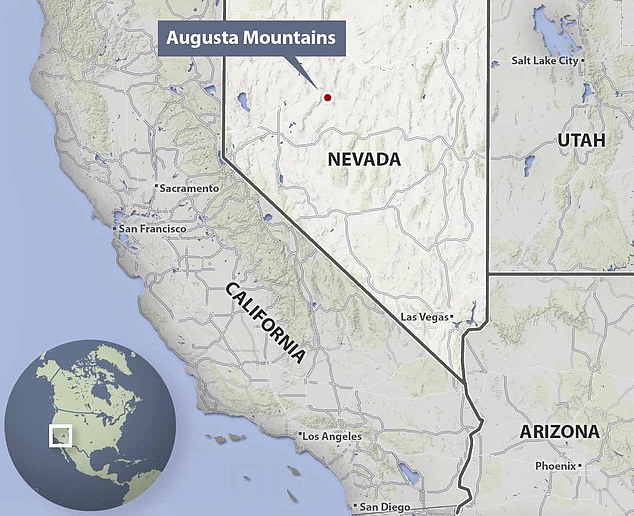
Sander found the remains of Martina at an excavation site in the Augusta Mountains, 150 miles (241 kilometers) east of Reno, back in October 2011.

The German palaeontologist had been working summers in Nevada for 20 years by that point and he and his team were nearing the end of a two-week expedition in an ichthyosaur hotspot.   

Generally, when an excavation team packs up and leaves for the season, they know it might be months – or even years – before they return.

So Sander made the decision to take another last-minute trip around the site before they packed up and left, which is when he came across Martina.

‘The trick is you have to know what you are looking for,’ said Sander, who described that final stroll as ‘wandering around in the field’.

At an outcropping around 6,000 feet (1,828 meters) in elevation he spotted what appeared to be fossilised remains of an ichthyosaur spine. 

Further, there was evidence the large, prehistoric, swimming reptile had been pregnant when it died, likely with three offspring. 

‘I found it and realised pretty quickly what I was looking at,’ Sander said.

Sander found the remains of Martina at an excavation site in the Augusta Mountains, 150 miles (241 kilometers) east of Reno

The next day, with cold and snow closing in, the team packed up the exposed fossils for further research. 

They returned in 2014 and excavated the rest of the area and only now, six years later, they have published their findings in the Journal of Systematic Palaeontology.

The fetuses are, on average 68 per cent smaller than a single vertebrae in the medium-sized mother’s back, the team estimate. 

Cymbospondylus duelferi, from the early Triassic period, shows how quickly life evolved following the Permian-Triassic extinction event 252 million years ago, which is thought to have wiped out as many as 96 per cent of the world’s species. 

That ichthyosaurs of immense size and diversity are found dating back to a few million years later suggests the animals evolved relatively quickly.

‘The cool thing about it is they just diversified crazily fast,’ Sander said. 

Some of the earliest Ichthyosaur ancestors are thought to have ventured out onto land to lay eggs, but they later adapted to give birth to live offspring, meaning they could remain in the sea at all times. 

It’s much like the advantage a whale or dolphin has over a sea turtle – while the former give a live birth, the sea turtle is exposed, along with offspring, to danger by having to leave the water to lay eggs on shore.

‘Most of the reptiles that returned to the sea, they all evolved this ability from egg laying to giving birth to live young,’ Sander said. 

Martina is the second-oldest specimen of a pregnant ichthyosaur, after a 249-million-year-old specimen found in China.

She’s also one of two major ichthyosaur findings at the location in the Augusta Mountains.

Cymbospondylus has been interpreted as a pregnant female with a minimum number of three fetuses preserved

The other finding hasn’t yet been published in an academic journal, but it involves an ichthyosaur fossil Sander refers to as ‘the giant skull’, which may even prove the more significant of the two discoveries.    

While both Martina and the giant skull are exciting to researchers like Sander, they’ve also captured the imagination of people like craft brewer Tom Young, a former geologist and founder of Great Basin Brewing in Reno. 

It was his beer truck that researchers used to haul the giant skull from the Augusta Mountains to the Los Angeles Museum of Natural History.

Great Basin Brewing brews the Ichthyosaur, or ‘Icky’, IPA, described as a highly-evolved brew’.

Young said the company’s mission is to popularise paleontology in Nevada with help from beer. 

‘It is so important we preserve this and study these things to show where we are today and how we got here,’ he said. 

‘You marvel as a human and realise the importance of our being here now, but at the same time you are looking at us as part of this much larger, huge universe.’

Young has contributed thousands of dollars, and plenty of beer, to the research efforts and has hosted brewery fundraisers for members of the public who want to hear from the scientists.

The team said they’d like to see the state develop a repository for keeping ichthyosaur fossils recovered from public land.

Nevada’s Berlin-Ichthyosaur State Park retains fossils that are on display as they were found. 

But many significant finds are trucked to Berkeley or Los Angeles where there are repositories that meet federal standards.

‘It should give Nevada some great pride we have some the coolest and biggest and meanest things to evolve on Earth here in our backyard,’ Young said. 

Published in Science / Source: https://en.brinkwire.com/

Wightia declivirostris: New Pterosaur Species Identified from Fossil Found in England

Tuesday, June 2, 2020

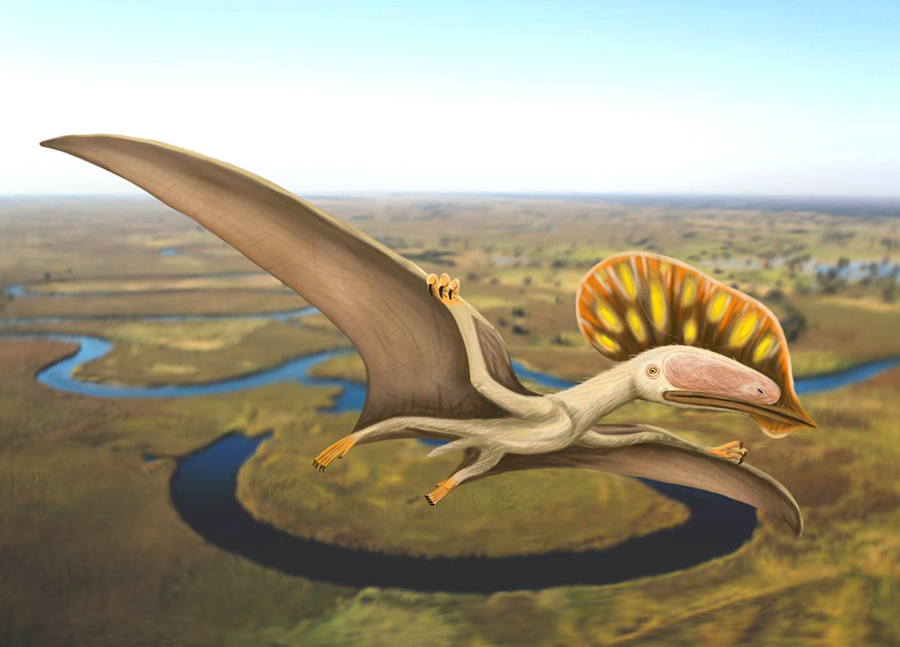
Wightia declivirostris flying over an oxbow lake in the valley of the ancient Wessex River that flowed from Devon to the Isle of Wight. Image credit: Megan Jacobs.

A new genus and species of pterosaur has been identified from a partial fossilized jaw collected on Isle of Wight, southern England.

The newly-discovered flying reptile lived during the Cretaceous period some 127 million years ago.

Named Wightia declivirostris, it belongs to Tapejaridae, a bizarre group of small- to medium-sized pterosaurs with wingspans of up to 4 m.

Most tapejarids had large, highly elaborate soft tissue crests sweeping up from the front of the skull. The crests were probably used in sexual display and may have been brightly colored.

These pterosaurs are well known from the Araripe Basin of northeast Brazil and the Jiufotang Formation of China. Elsewhere, however, their remains are exceedingly rare, with only fragmentary specimens reported from North Africa and Europe.

Wightia declivirostris is the first record of Tapejaridae in the United Kingdom.

“Despite the number of near complete skeletons of tapejarids from China and 3D-preserved examples from Brazil, elsewhere in the world, many tapejarids are highly fragmentary, and there remains much to learn about the group, especially from the tantalizing remains representing species from Spain, Morocco and now the Isle of Wight,” said University of Portsmouth’s Professor David Martill and colleagues.

The partial premaxilla of Wightia declivirostris. Scale bars – 10 mm. Image credit: Martill et al, doi: 10.1016/j.cretres.2020.104487.

The partial upper jaw bone (premaxilla) of Wightia declivirostris was found by fossil hunter John Winch in a plant debris bed of Wessex Formation at Yaverland, near Sandown on the Isle of Wight.

The specimen is the first record of Tapejaridae in this formation and is amongst the oldest record of tapejarids outside of China.

“Although only a fragment of jaw, it has all the characteristic of a tapejarid jaw, including numerous tiny little holes that held minute sensory organs for detecting their food, and a downturned, finely pointed beak,” said co-author Megan Jacobs, a student at the University of Portsmouth.

The paleontologists found that the fossil seemed more closely related to the tapejarid genus Sinopterus from China rather than Brazilian tapejarids such as TapejaraTupandactylus and Caiuajara.

“This new species adds to the diversity of dinosaurs and other prehistoric reptiles found on the Isle of Wight, which is now one of the most important places for Cretaceous dinosaurs in the world,” Professor Martill said.

The discovery is reported in a paper in the journal Cretaceous Research.

_____

David M. Martill et al. 2020. First tapejarid pterosaur from the Wessex Formation (Wealden Group: Lower Cretaceous, Barremian) of the United Kingdom. Cretaceous Research 113: 104487; doi: 10.1016/j.cretres.2020.104487

Source: www.sci-news.com/

What Operating System Did They Use in Jurassic Park?

Tuesday, June 2, 2020

In the background, the CM5 supercomputer with its iconic red lights. Source: Universal Pictures

Jurassic Park (1993) needs no introductions. It is a film that was successful at the time and continues to like. Best of all, it’s hardly aged. In addition, curiosities about her continue to appear after more than 20 years. And there is so much to talk about in this film… For example, computers that appear in various scenes and that, in fiction, make it possible for everything to work, more or less. In one of the final scenes, one of the characters claims that the operating system he is viewing is UNIX. To what extent is this true? What operating system did they use in Jurassic Park?

When in a movie or television series it appears an electronic device or a computer, I usually look at what make and model it is and what operating system or applications it uses. It is something that strikes me, especially if I am seeing a title from a few years ago.

In some cases, they are created dummy interfaces for the moment. There are some very successful, as in the Star Trek saga or Minority Report, but others are limited to simple screenshots. You also have to try to be true to reality. In Matrix Reloaded, for example, we could see a real hacking scene on a command line. And in series like Seinfeld, throughout the seasons you can see that its protagonist changes his Mac for a PC and returns to the Mac again, showing software boxes of different versions already obsolete.

All this comes to mind because there are films in which the technological component is more relevant, especially when it stars in several scenes. In Jurassic Park (1993), one of the movies that better has aged and that is still a must-see, there are many scenes in which computers are the protagonists. In addition, the design effort of the park control interfaces.

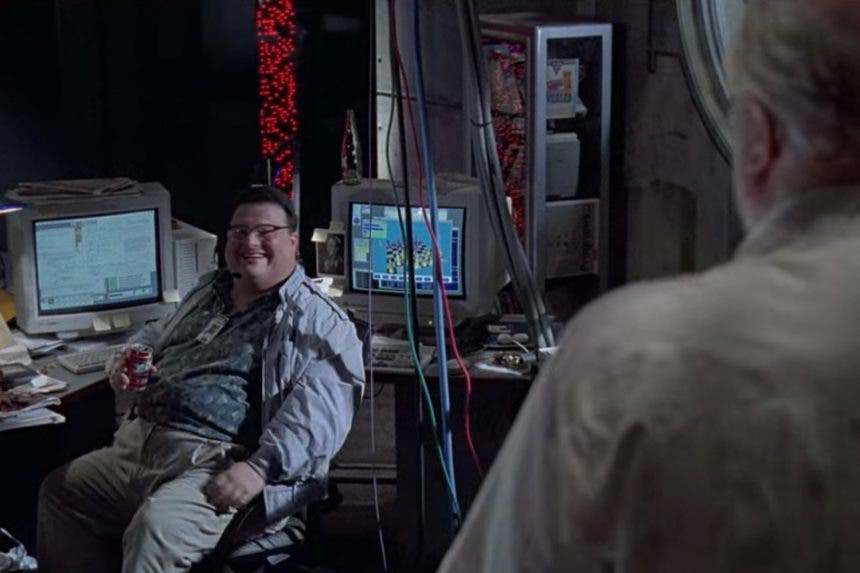
What’s more, some of the scenes have gone down in the history of cinema, such as the one known as “You didn’t say the magic word” in which the character of Arnold, played by a very young Samuel L. Jackson, try to access the computer of Dennis Nedry, played by the comedian Wayne Knight. However, the latter has locked all systems to the point of showing an animation showing its own face.

Another mythical scene is known as “It’s a Unix system” in which the character of Lex, played by the actress Ariana richards, sits in front of the computer Dennis Nedry and recognizes the interface you see on the screen as a UNIX system. In the scene we see how scrolls through folders and files in the form of 3D cubes, something very innovative for 1993. The scene in question attracted attention at the time with some controversy, nothing to do with what would have happened today in the middle of the social media era. UNIX and a 3D interface? How crazy is this?

So, let’s go back to the 90s to take a look at the ins and outs of filming Jurassic Park. Specifically, we are going to stop at the computers we saw in the movie and determine what operating system did they use in fiction. Were they real? Is everything we saw fiction? Did they really use UNIX in Jurassic Park?

Asking the experts

First stop, internet. When someone says that everything is on the internet, they are not wrong. And it is that we can find practically anything if we search well. For example, Starring The Computer, a fantastic page that collects the computers that appear in movies and television series. It is very useful for unraveling mysteries from old movies or vintage reenactments where it is easy to fall into temporary errors. Also, it is frequently updated with new content.

As well. If we consult its file on Jurassic Park we will find from the computers used by the park’s workers and programmers, which in this case are computers Apple Macintosh Quadra 700, up to the supercomputers that are in charge of controlling the entire park, in this case Thinking Machines CM-5. In the control center we also find a SGI Crimson and a SGI R4000 Indigo Elan, workstations or workstations on the way between the home computer and the supercomputer.
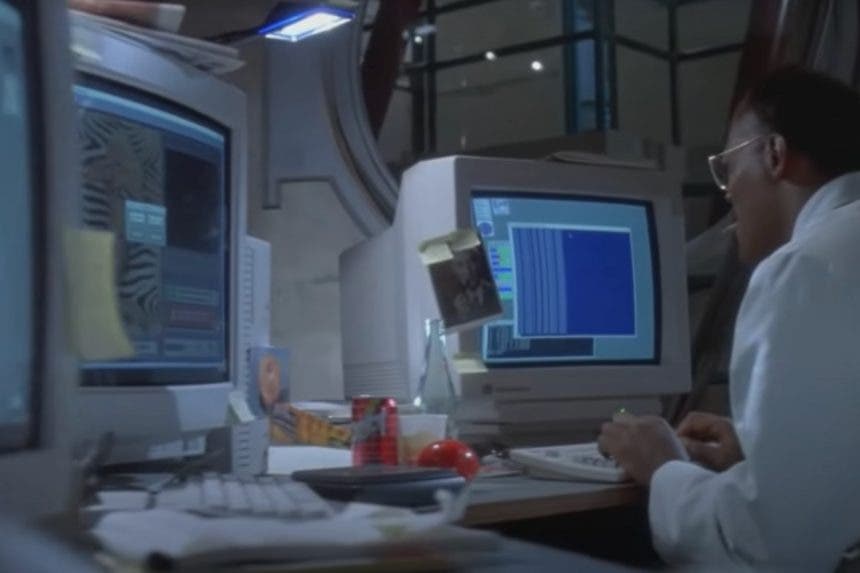
Source: Universal Pictures

So, the computers that we see in several scenes in which a park control interface, with maps and other visual elements, are Apple’s Macintosh Quadra 700, computers that were for sale between 1991 and 1993 and that used Motorola 68040 processors. As for the operating system, as we see on its screens, it is the System 7, with its characteristic icons and the edges of the windows. And if you want to spin finer, the version is between the 7.0.1 that these factory computers came with and the 7.1 that was published in August 1992. Regarding the park’s controls interface, the person responsible was Michael Backes.

We have already unraveled the mystery behind most of the computers we see in Jurassic Park. Now we have to take a look at the workstations, protagonists of the mythical scene “It’s a Unix system”.

We have spared no expense

The phrase you just read is repeated over and over again by the character from John Hammond, the billionaire responsible for the park and who plays the always great Richard Attenborough, unfortunately already deceased.

This motto of “we have not spared expenses” refers to how much they have invested in the Jurassic Park: research, facilities, technology … Ironically, that phrase loses validity in the figure of Dennis Nedry, character who disagrees in that sense. But I will not say more for not gutting the film.

The case is that it can also be applied to the computers that we see on the screen. In 1993 the CM-5 supercomputer that we see in the film was considered the fastest in the world on the prestigious list TOP500. Moreover, for several years, that model was in the top ten on the same list. It is interesting to see how reality merges with fiction in something as secondary to a movie as it is a technological element that we hardly see in a couple of scenes, in the background.

Regarding computers Macintosh Quadra 700 The ones we talked about before were priced at the time of $ 5,700.

And now let’s go to the workstations, the SGI Crimson and the SGI R4000 Indigo Elan. Both were created by SGI, an acronym for Silicon Graphics, Inc. His specialty, workstations specialized in graphic tasks. Precisely, several of the models seen in the film were used in tasks related to some of the visual effects that we see on screen. And, by the way, they were integrated into the scenography as part of the Jurassic Park facility.

This is UNIX system

The model that interests us to finish this article is the SGI Crimson, who stars in the aforementioned scene. In that scene, Lex’s character claims to see UNIX on a computer screen that turns out to be that of Dennis Nedry and that we have seen in various scenes of Jurassic Park.

In the previous scenes we have basically seen a console where the character of Nedry and Arnold entered orders by text commands. But in the scene in question, we see a three-dimensional interface. Through it, Lex moves through the park controls.

As well. That 3D interface corresponds to fsn, pronounced fusion and which is the acronym for File System Navigator, an experimental application for viewing folders and files in 3D. A file explorer, go. The tool was designed by SGI, the manufacturer of the workstation itself SGI Crimson. The experimental thing is literal, because it did not have a lot of travel despite inspiring other similar applications.
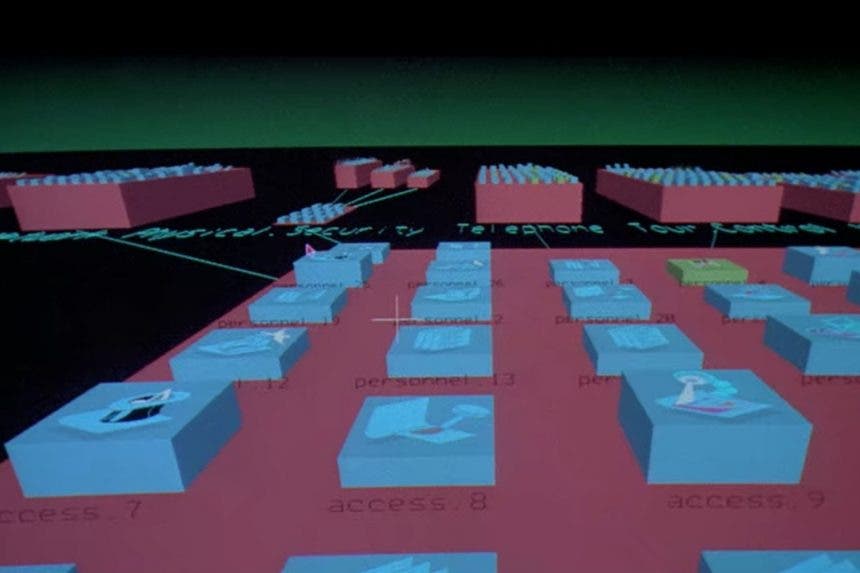
The experimental 3D interface for IRIX. Source: Universal Pictures

As for the operating system that SGI Crimson machine runs, it is IRIX. This operating system was also developed by itself SGI (Silicon Graphics). First released in 1988, IRIX was specifically designed for computers with RISC processor, which were the ones that ran on SGI workstations.

RISC was based on UNIX System V. And among other improvements, it included BSD extensions, its own XFS file system and the graphic system OpenGL. As for the version of RISC that we see in Jurassic Park, it may be IRIX 4.0, released in 1991. The later version, 5.0, did not see the light of day until 1993, when the film had already been shot and was released in theaters. As for the IRIX interface that we see in the film, it is very familiar because it is X Window System (X11R4), introduced in 1991.

As a curiosity, that interface has been honored in Jurassic Systems, a page that recreates the screen of Dennis Nedry’s workstation. At a graphic level it is practically identical, but it is not very interactive and we can hardly do anything.

Source: www.explica.co/

Yeppoon Man Steve Ross Finishes Scrap-Metal Dinosaur Sculptures

Tuesday, June 2, 2020

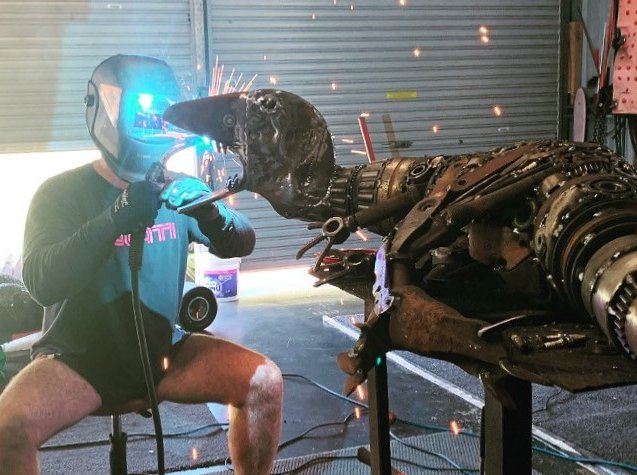
Steve Ross says he spent more than 500 hours building the family of dinosaurs from scrap metal.(Supplied: Kylie Hoffmann)

House builder and building inspector Steve Ross took up metal sculpture as a hobby in 2018 and immediately started to think big.

Now, almost two years on he has put the finishing touches to his Jurassic family outside the Yeppoon landfill — with the addition of three juvenile Australovenator dinosaurs.

Livingstone Shire Council commissioned the sculptures as part of the town's placemaking program, designed to add character to the region.

Using a crane, Mr Ross unveiled the 600-kilogram mother dinosaur in August 2019.

A growing family

Now he has added three new 150-kilogram dinosaurs using parts from the landfill and pieces from friends and family.

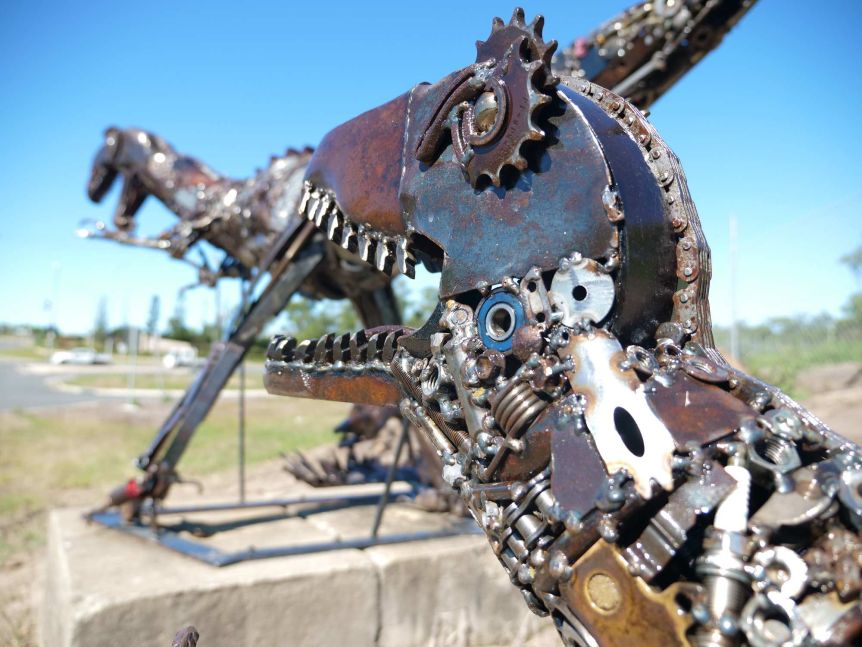
"It's mostly automotive parts, there's the odd gym weight in there, tractor parts, earth moving parts, machinery parts - it's everything I can get my hands on," he said.

"They're a one-off thing that's what I like about it.

"You're making something out of nothing, but it will last a lifetime."

Steve Ross says he spent more than 400 hours working on three new dinosaurs to display outside the Yeppoon landfill.(Instagram: Rossys.Welding.Art)

Working around his day job, Mr Ross spent more than 400 hours and about six months building the juveniles.

He said the hard work, stress and mess was made worthwhile by the community's positive reaction.

"I feel great, I really do, words can't describe it, I just love it," he said.

"I went out there to do some final touches and a couple of older ladies parked up and said, 'awesome work'.

"Parents love taking the kids out to have a look at them on their way and the response has been good."

Why dinosaurs?

The council gave Mr Ross free range to build anything, and seagulls were the first suggestion.

"It just works out that the kids love dinosaurs, they don't like looking at seagulls for too long," he said.

The dinosaurs are made of automotive parts, tractor parts, earth moving parts, machinery parts and even the odd gym weight.(ABC Capricornia: Erin Semmler)

Mr Ross is giving the welding machine a couple of weeks to cool off before moving onto his next project.

"I had a nice looking shed at one stage, everything was spick and span, now it's just full of steel offcuts and parts ... it's getting a bit out of control," he said.

"But it's just your typical man cave with a welder in there."

As for the prospect of more prehistoric animals, Mr Ross said he was keen to try something new.

"I've already started building a big grouper fish here at home," he said.

"I've exhausted myself with doing dinosaurs, so I just wanted to do something different for myself."

Source: www.abc.net.au/

Pages