nandi's blog

Jurassic World: Camp Cretaceous Season 1: Release Date, Trailer, Plot, and Details

Monday, February 3, 2020

Netflix is the latest franchise that is going to take a dip into the world of Jurassic Park themed show. In this post, I will be talking about all the details related to this new promising animated series from Netflix. Also, you will find some Jurassic World: Camp Cretaceous Season 1 spoilers in this post as well, if you do not like to read spoilers then I may suggest this is not the post for you.

However, if spoilers do not bother you, then you should indeed read this post now that the warmings and spoiler alerts are out of our way to let us dive into the world of Netflix’s Jurassic Park.

Jurassic World: Camp Cretaceous Plot

First things first, let us discuss the plot of the upcoming show. As the title suggests, this story is bound to have dinosaurs in it. The story will mainly focus on six kids who will be given an amazing opportunity to visit Jurassic Park. All the kids will be enthusiastic about watching live dinosaurs; little do they know that this could be their last trip ever to anywhere.

Jurassic World: Camp Cretaceous

All the kids get trapped in this world of dinosaurs, and thus they have to struggle in order to save themselves from these treacherous creatures. Soon the six kids will be tied by a bond more strong than even blood. The show is bound to be super awesome. The animations will be the key to this show; better the animations, more people will like to watch the show. So, let us see how the show actually turns out to be.

When Is Jurassic World: Camp Cretaceous Season 1 Release Date?

Jurassic World: Camp Cretaceous will be released in 2020. The exact date or even month of the release of this show is yet to be disclosed, but it has been made official that the show will be released in the 2020 year only. As soon as the details of the release date are out, we will share it with you all. The team of executive producers is that of Scott Kreamer and Lane Lueras. While as the producers of the show are Steven Spielberg, Frank Marshall, and Colin Trevorrow.

The genre of Jurassic World: Camp Cretaceous is action and adventure. DreamWorks Animation and Amblin Entertainment are the backbones of the show. While Netflix is the platform through which they are going to release the show. I certainly hope that this new Jurassic Park themed show will be able to live up to the expectations of the fans. When more details of the show are out, we will share them with you here at Otakukart.

Source: https://otakukart.com/

Jurassic World 3: Trevorrow Teases Next Film With Adorable Baby Dino

Sunday, February 2, 2020

Jurassic World 3 director Colin Trevorrow offered a behind-the-scenes glimpse at one of the film's prehistoric stars.

“Next steps,” wrote Trevorrow on Twitter alongside a video of an animatronic dinosaur wiggling around in a cage. Trevorrow has been vocal in the past about not wanting to use so much CGI, and Jurassic World: Fallen Kingdom, the second film in the franchise, used more puppets and animatronics than the first.

Jurassic World 3 is slated to start filming in the summer. Although J.A. Bayona directed Fallen Kingdom, Trevorrow, who directed the 2015 original, will return for the third film in the trilogy. His original Jurassic World is one of the highest-grossing films ever, having earned over $1.6 billion at the worldwide box office. As of writing, that movie holds a 72% among critics on review aggregator Rotten Tomatoes. Jurassic World will see the new series' stars return alongside several actors from the original Jurassic Park series.

Directed by Colin Trevorrow, Jurassic World 3, starring Bryce Dallas Howard, Chris Pratt, Sam Neill, Laura Dern and Jeff Goldblum. The film is set to be released on June 11, 2021.

Source: www.cbr.com/

Bone of Rare Long-Necked Dinosaur Found in Southern Utah Desert

Sunday, February 2, 2020

A rendering of what a Brachiosaurus could have looked like. | Art by Brian Engh, courtesy of Utah State Parks, St. George News
 

A bone belonging to a rare, yet well-known dinosaur was discovered in Southern Utah and has paleontologists excited by its discovery.

Utah State Parks reported that a 6-foot, 7-inch humerus bone belonging to a rare 30-ton Brachiosaurus was unearthed at a site in the Southern Utah desert last May by paleoartist Brian Engh. The team that removed the bone included paleontologists from the Utah Field House of the Natural History State Park Museum in Vernal, Utah, and the Western University of Health Sciences, in Pomona, California.

To protect it, the exact site is not being disclosed.

The plaster-jacketed Brachiosaurus leg bone prior to it being removed from the big site, Southern Utah, October 2019 | Photo by Brian Engh, courtesy of Utah State Parks, St. George News

The recovered bone, the humerus, is the upper arm/leg bone for this towering creature. This is only the third Brachiosaurus humerus ever found – and the first in Utah, according to Utah State Parks.

It’s an exciting find, John Foster, the curator of collections at the Utah Field House, told St. George News Wednesday.

“This is the first (Brachiosaurus) humerus found in over 60 years that’s also in pretty good condition,” Foster said.

The first Brachiosaurus humerus was found in 1900 in Grand Junction, Colorado, with the second being found in 1955. The 2019 find is the most complete of the three.

The giraffe-like Brachiosaurus is distinguished by its long front legs, deep chest and long neck. It is a cousin of other sauropods (large, long-necked dinosaurs) like the Brontosaurus and Diplodocus.

The paleontology team poses with the plaster-jacketed Brachiosaurus bone, Southern Utah, October 2019 | Photo by Brian Engh, courtesy of Utah State Parks, St. George News

According to LiveScience.com, its unclear just how large the dinosaur was, but some estimates put it at over 80 feet long and 40-to-50 feet tall. The Brachiosaurus was also once declared to be the largest dinosaur ever found, but other sauropods are now believed to have been larger and heavier.

Foster said the Brachiosaurus was particularly rare for the time period it inhabited, and is estimated have been outnumbered by other dinosaurs, like the far more common Camarasaurus, by to 20-to-1. Over 200 examples of the Camarasaurus have been found in what is called the Morrison Formation, while only 10 known specimens of the Brachiosaurus have been found up to this point.

According to the National Park Service, the Morrison Formation is a rock unit that covers the Late Jurassic period – 155 million to 148 million years ago. It extends throughout the Western United States and contains a large amount of fossils. In addition to the Brachiosaurus and Camarasaurus, fossil remains of Stegosaurus, Allosaurus, Diplodocus and other dinosaurs have also been found in the formation.

Paleontologists putting adding plaster to the protective jacket placed around the Brachiosaurus bone found in Southern Utah, October, 2019 | Photo by Brian Engh, courtesy of Utah State Parks, St. George News

Another reason the find excited has paleontologists is that is it a rare chance to find a Brachiosaurus fossil in the wild, Foster said. The only places one can see the other recovered fossils is in a museum.

“It’s hard not to get excited about this,” Foster said.

After proper permitting was acquired by October, paleontologists were able to remove the Brachiosaurus bone from where it have been discovered.

The fossilized bone was covered in plaster and burlap to immobilize it within the encasing sand, soil and mudstone. It was dragged to a utility wagon and then hauled out of the remote site across rugged terrain by the Clydesdale horse team of Darla and Molly, led by Wes and Resha Bartlett of Naples, Utah, according to Utah State Parks.

Clydesdale horses were used to help transport the recovered Brachiosaurus bone from the rugged area where it was discovered by paleoartist Brian Engh, Southern Utah, October 2019 | Photo by Brian Engh, courtesy of Utah State Parks, St. George News

In addition to the Brachiosaurus humerus, which is believed to have been located in the dinosaurs right front leg, the more fragmentary left humerus was found eroding down a nearby gulch, and several rib fragments and other bones were collected from the same area.

There are additional finds at the Brachiosaurus site paleontologists plan to return to and investigate in the near-future, Foster said.

For now, the Brachiosaurus bone is being prepared at the Utah Field House of National History, 496 E. Main St. in Vernal, where it was made available for public viewing Thursday.

The location of the Brachiosaurus find is being left vague to protect the integrity of the site for future excavation by paleontologists.

Source: www.stgeorgeutah.com/

Fossil Tracks Suggest Dinosaurs Lived in a "Land of Fire"

Saturday, February 1, 2020

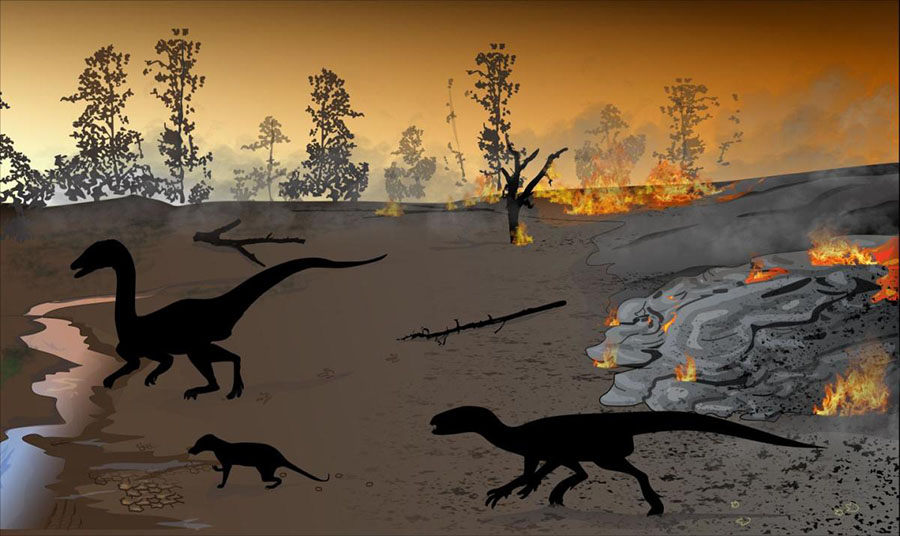
Reconstruction of the environment set alight by a volcanic flowBordy et al, 2020

A new study has found dinosaur footprints in sandstone embedded between fossilized lava dating back 183 million years in southern Africa. During this time in the early Jurassic period, a mass extinction was taking place and parts of the world were being transformed into a world of fire by rampant volcanism.

Extinction events permeate our planet’s history. One of the most famous of these events is the devastating asteroid strike that occurred 66 million years ago, and brought about the extinction of non-avian dinosaur species.

Whilst this impact ended the reign of the dinosaurs, it was by no means the first mass extinction that was inflicted upon them. A new study has identified dinosaur prints dating back to 183 million years to the early Jurassic period, when volcanic eruptions were dramatically changing the face of the world, along with its climate.

The fossils studied by the researchers were discovered in the Karoo Basin in southern Africa, which is known for harboring massive deposits of igneous rock. These deposits are what remains of lava flows which, over time, fundamentally altered vast swathes of the ancient African terrain.

Five sets of fossilized tracks made up from a total of 25 footprints were discovered in sandstone deposited between lava flows. This suggests that the creatures that made the prints survived the first bout of volcanic eruptions that, the paper describes, would eventually turn their homes into a "land of fire."

Based on the length of the footprints – between 2 to 14 cm (0.8 to 5.5 in) – and the patterns in the trackways, the researchers believe that the marks were made by three types of animals: small mammals or their precursors, small four-legged herbivores, and a group of large bipedal carnivores. The patterns suggested that some of the dinosaurs had been running when they made the prints.

According to the authors of the study, these creatures were likely some of the last to inhabit the Karoo Basin before it was consumed by lava flows.

"The fossil footprints were discovered within a thick pile of ancient basaltic lava flows that are 183 million years old," comments one of the study’s authors, Emese M. Brody of the University of Cape Town. "The fossil tracks tell a story from our deep past on how continental ecosystems could co-exist with truly giant volcanic events that can only be studied from the geological record, because they do not have modern equivalents, although they can occur in the future of the Earth."

The study has been published in the journal PLOS ONE.

Source: PLOS via EurekAlert

Our Image of Dinosaurs Was Shaped by Victorian Popularity Contests

Saturday, February 1, 2020

Our understanding of dinosaurs is undergoing a revolution. Thanks to new research, animals that were until recently depicted with a sleek coat of scales now sport feathers, quills, spines and fluff.

But not everyone has an interest in this particular vision of dinosaurs. The upcoming Jurassic World 3, for instance, will likely continue to air the recognisable scaly Velociraptors of the 90s. Meanwhile, mainstream bookshops such as Waterstones are selling Too Big to Walk, an anti-establishment take on dinosaurs by independent researcher Brian J Ford. Ford, now on his second edition, shows little interest in feathers and instead argues that dinosaurs were chiefly aquatic animals.

Dinosaurs, then, are malleable beasts. Unexpected fossil discoveries have altered specialist consensuses again and again. In fact, dinosaurs are so malleable that the constant reshaping of these popular animals has also been driven by cultural and political trends.

We haven’t even known about dinosaurs for long. One of Britain’s first palaeontologists, Richard Owen, coined the term “Dinosauria” in 1842. The Victorians were relatively familiar with reptile fossils thanks to the earlier findings of Mary Anning. But Owen’s coinage brought a group of the most mysterious discoveries under one umbrella.

The fossil evidence at the time was relatively slim, leading to his conception of dinosaurs as a series of vast quadrupedal lizards with straight, mammal-like limbs. Owen was famed for basing his grand deductive claims on little more than a single bone, giving him a reputation for almost supernatural academic abilities.

Richard Owen’s reconstruction of the Megalosaurus, 1854. Wikimedia Commons

When attempting to rise to the top of British science, it helped to have the media on your side. Owen’s friendship with both Charles Dickens and William Makepeace Thackeray led to fond name-dropping by both novelists. Dickens’s Bleak House famously begins by imagining a Megalosaurus, one of Owen’s original dinosaurs. Both novelists even compared their own writing process to Owen’s palaeontological techniques.

Scientific competition

In the scientific community, Owen’s dinosaur research was first besieged by his bitter rival, Gideon Mantell, a surgeon and the describer of the Iguanodon. After Mantell’s death, just as Owen’s reputation and power was at its height, the young scientific reformer Thomas Henry Huxley took up the gauntlet.

Huxley threatened not only to undermine the illustrious Owen’s dinosaurs but also his ambitious plan to create what became London’s Natural History Museum (which Huxley opposed at every opportunity). Both Mantell and Huxley doubted Owen’s conception of dinosaurs as exclusively elephantine lizards, suspecting that many dinosaurs possessed bipedal or even avian characteristics.

Some of these suspicions were verified after dinosaurs of all shapes and sizes were unearthed in the United States. During the 1870s and 1880s, a new pair of palaeontological rivals, OC Marsh and ED Cope, raced to acquire and describe as many of these skeletons as possible. In the process, they fought to become the United States’ premier palaeontologist.

Naming dinosaurs was a powerful way of claiming ownership over fossil material, especially when both men were investigating the very same animals. Had Cope gained the upper hand, we might now all recognise Hypsirhophus and Agathaumas instead of Marsh’s Stegosaurus and Triceratops. Like Owen, Cope and Marsh knew the power of the press and their specialist disputes spilled out into a series of mutual accusations of incompetence in the New York Herald.

Richard Owen presides over a dinner table attended by dinosaurs. © Wellcome Images, CC BY-SA

It was no easy task translating for a wider public the knowledge that dinosaurs had been so many shapes and sizes. Back in Britain, the American dinosaur discoveries were first popularised by a science journalist named Henry Hutchinson in a series of well-illustrated books, starting with Extinct Monsters in 1892, the year of Owen’s death.

Hutchinson’s books aroused the ire of an unexpected opponent. Several years prior, the British palaeontologist Harry Seeley had published a theory that the dinosaurs could be divided neatly into two classes: Ornithischia (bird-hipped) and Saurischia (lizard-hipped). He argued that these two groups were only distantly related, drawing doubt on the unity of Owen’s Dinosauria. Marsh, in contrast, saw the dinosaurs as a natural grouping, and classified them based on the shape of their feet.

In the journal Nature, Seeley took Hutchinson to task for ignoring his research and ventriloquising Marsh’s views. Given that competing technical interpetations of dinosaurs were available, Seeley worried that Hutchinson’s attractive books would warp public perceptions of dinosaurs in favour of Marsh. General audiences, he reasoned, would not be able to judge the evidence for themselves.

A print from Henry Hutchinson’s Extinct Monsters. Biodiversity Heritage Library/Flickr, CC BY

Dinosaurs and dollars

Ultimately, the defining modern image of the dinosaur was to be shaped by a much more powerful force. At the dawn of the 20th century, the biggest fossil-hunting expeditions and museum exhibits were bankrolled by American industrialists and financiers. Finally, audiences could flock to see the reassembled skeletons of Jurassic titans. Ultra-rich men like Andrew Carnegie funded these cutting-edge dinosaur displays, carefully projecting an image of American capitalism’s cultured benevolence.

Of course, this was not universal benevolence. At the American Museum of Natural History, masterful displays depicting the brutal age of the dinosaurs segued neatly into adjacent human fossil galleries reflecting views today we would recognise as pseudoscientific and white supremacist. When read together, these exhibitions painted a narrative of evolutionary progress that saw less vigorous species and races fall constantly by the wayside. This narrative flattered white patrons, such as the museum’s wealthy donors, by placing them at the apex of modernity.

Meanwhile, in bestselling scientific romances by authors like JJ Astor and Edgar Rice Burroughs, fiercely masculine “Anglo-Saxon” protagonists slaughtered countless dinosaurs in a symbolic assertion of prominence.

Dinosaurs are still tools in the culture wars. In 2019, a stunning new exhibition opened at the Smithsonian National Museum of Natural History. The new exhibit re-purposes the museum’s dinosaurs for a modern narrative: a comprehensive warning about climate change. At the same time, the exhibition’s very name announces its creation through funding from a powerful climate sceptic, the late David Koch.

The Smithsonian have cleverly employed Koch’s money against his own climate agenda, but the “David H. Koch Hall of Fossils” is still the kind of grandiose spectacle he invested in. Richard Owen would not have been surprised to learn that the reconstruction of dinosaur bones is still an act that is entangled in politics.

Source: https://theconversation.com/

Jurassic World Fan CORRECTLY Guesses the Title of Next Film

Saturday, February 1, 2020

Next chapter: A fan of the Jurassic Park franchise has correctly guessed what the next film - Jurassic World 3 - will be called, during a casual discussion on Twitter

A fan of the Jurassic Park franchise has correctly guessed what the next film - Jurassic World 3 - will be called, during a casual discussion on Twitter.

Responding to a thread which saw movie buffs speculating what the film - set for a summer 2021 release - will be officially called, one fan's guess proved to be right, according to screenwriter/director Colin Trevorrow.

The filmmaker was tagged in the debate and replied: 'Wow, somebody in this thread actually got it. Respect.'

Fans then begged him to reveal the movie's subtitle - the last sequel in 2018 being called Jurassic World: Fallen Kingdom.

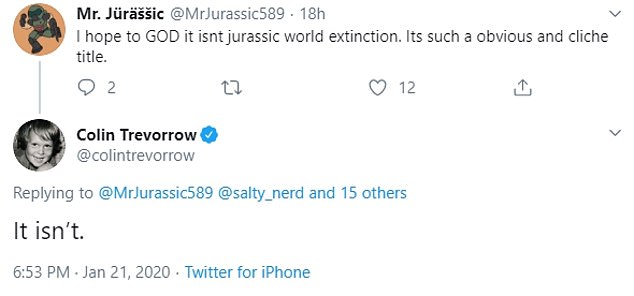
The only information the director teased was when he clarified that the film will not be called Jurassic World: Extinction - the title many have believed it to be previously.

This left 25 other possible guesses, ranging from the more fathomable 'Survival' and 'Chaos Effect' to the less-realistic 'Rex In The City' and 'You Asked for It Humans'.

Via the process of elimination, fans seemed to think they'd whittled the options down to two front-runners: 'A New Era' or 'Edge Of Chaos'.


What to expect? Fans were excitably speculating what Jurassic World 3 - which will see Laura Dern and Sam Neill [pictured] return to the franchise for the first time since 2001's Jurassic Park 3 - will be subtitled

'A New Era' refers to the fact that the movie will pick up after the events of Fallen Kingdom, where dinosaurs finally made it onto the mainland to run freely in the wild. 'Edge Of Chaos' is a nod to the famous Chaos Theory that runs through the franchise.

Jurassic World 3 is the sixth film overall in the series and details are sparse regarding the plot.

Director Trevorrow - the man responsible for rebooting the franchise in 2015 with fourth instalment Jurassic World - first waded into the fan speculation on the new film's name when he confirmed on Twitter that he has settled on a title.

He took to the micro-blogging site to comment that he was enjoying seeing all the guesses people were making.
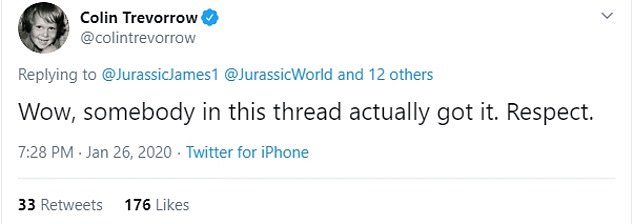
Correct! Responding to a thread which saw movie buffs speculating what the film - set for a summer 2021 release - will be officially called, one fan's guess proved to be right, according to screenwriter/director Colin Trevorrow

The 26 Possible Titles for Jurassic World 3

The Jurassic World

Jurassic World: The Jurassic Park of Jurassic World

Jurassic World: Survival

Jurassic World: Clash of Worlds

Jurassic World: Illusion of Control

Jurassic World: New Era / A New Era

Jurassic World: Dawn of a New Era

Jurassic World: Rise of New Era

Jurassic World: Rise of the New Kingdom

Jurassic World: Edge of Chaos

Jurassic World: Chaos Effect

Jurassic World: When Dinosaurs Ruled the Earth

Jurassic World: Reverie

Jurassic World: War for the Planet

Jurassic World: Ancient Futures

Jurassic World 3: Long Live the Dinosaurs

Jurassic World 3: Rex in the City

Jurassic World 3: Illusion of Control

Jurassic World: Extinction

Jurassic World: New King

Jurassic World: The Return of the King

Jurassic Park: Dinotopia

Jurassic World 3: You Asked for It Humans

Jurassic World 3: When Worlds Collide

Jurassic World: Coexistence

Jurassic World: This Series Needs to Throw in the Towel 

One fan asked him directly: 'By any chance, do you already have a potential title in mind -- or is that something that evolves over time?'

To which he answered: 'I’ve got it.'

The first film - Steven Spielberg's Jurassic Park - was released in 1993, based on the novel of the same name by author Michael Crichton.

Other details have leaked in recent days, as production is set to kick off this year. 

It's said that the west coast of Canada's British Columbia will serve as a location, as will Malta, including the capital Valletta.

Teasers: While Trevorrow has not elaborated, he previously confirmed on Twitter that he has a name in mind

Production is also set to continue at Pinewood Studios, in Buckinghamshire, as well as O'ahu, Hawaii.

The latter suggests an island-setting will be involved, despite the destruction of Isla Nublar in Fallen Kingdom.

The plot is expected to focus on the dinosaurs escaping on mainland USA. Could they be rounded up and returned back to the tropics in the film?

Casting for Jurassic World 3 has set fans of the franchise buzzing, after it was confirmed original stars Laura Dern, Sam Neill and Jeff Goldblum will star alongside Bryce Dallas Howard and Chris Pratt.

Goldblum will be back as Dr. Ian Malcolm for the fourth time and said in a recent interview on Virgin Radio that he 'can't wait' to get started on the movie with original Jurassic Park stars Neill and Dern.

Next year: The movie serves as the second sequel to Jurassic World, and is the sixth film overall in the series. It will be released in June 2021 and follow on from the events of 2018's Jurassic World: Fallen Kingdom

He said: 'We're gonna do another one of those [Jurassic Park films] around these parts come this summer. Colin Trevorrow as the great director is going to be writing and directing it. And I can't wait.'

Trevorrow, 43, admitted recently that he always wanted to include the original cast in the new trilogy, but there needed to be a logical reason to get them back. 

Speaking in Empire Magazine's 2020 preview issue, he said: 'We'd have had to come up with a reason why Ellie, Malcolm and Grant all went to the theme park on the exact same day it broke down - again.

Back again: Jeff Goldblum is set to return to the dinosaur franchise as Dr. Ian Malcolm for the fourth time and he 'can't wait' to get started [pictured in Jurassic Park]

'The next film allows the legacy characters to be part of the story in an organic way. I call it Jurassic Park VI because it is.' 

Colin went on to admit that the filmmakers have also been considering how the characters have changed since their last appearance in 2001's Jurassic Park III. 

He said: 'You start asking the most basic questions: who are those people now? What do they make of the new world they're living in, and how do they feel about being part of its history?'

Jurassic World 3 is set for a 2021 release.

Source: https://www.dailymail.co.uk/

Scientists Have Found a 330-Million-Year-Old Shark's Head Fossilized in a Kentucky Cave

Saturday, February 1, 2020

Kentucky's Mammoth Cave National Park is a long way from the ocean, but newly discovered fossils suggest the area was once teeming with sharks.

Scientists have identified the remains of 15 to 20 different species of sharks deep in the cave, including part of the head of a great white-sized monster that's partially protruding from a wall, paleontologist John-Paul Hodnett told CNN.

The sharks lived about 330 million years ago in what is known as the Late Mississippian geologic time period, when much of North America was covered by oceans. When they died, their remains were encased in sediment that eventually became the limestone where the cave formed.

"There's hardly ever any any record at all of sharks teeth coming from these rocks. So that was exciting, Hodnett sad. "So this is a brand new record of sharks from a particular layer of time."

Mammoth Cave scientists Rick Olson and Rick Toomey were mapping a remote part of the cave when they started seeing shark fossils, according to Vincent Santucci, senior paleontologist with the National Park Service.

They sent photos of their find to Hodnett, because he's an expert on Paleozoic sharks. He works at Maryland's Dinosaur Park, a fossil site near Washington, DC, and does support research for the National Park Service.

There were quite a few shark teeth in the photos, Hodnett said, but he also saw cartilage that he thought might be a shark's skeleton. That's pretty rare because cartilage is softer than bone, so it's not often preserved.

When the scientist visited the cave in November, he realized he was looking at something much bigger.

"It turns out is actually not a skeleton, it is actually just parts of the head. And the head itself is pretty big," Hodnett said.

You can see the part of the shark's jaw where it would have attached to the skull and the end that would have been its chin, Hodnett said. Some of the middle of the jaw isn't visible, but he estimated that it would have been about 2 1/2 feet long.

By studying its teeth, Hodnett was able to determine that the fossil was part of a species called Saivodus striatus that was about the size of a modern great white shark -- about 16 to 20 feet long.

He said they don't know how much of the shark is still entombed in the rock.

"It's super exciting, but not exactly the most easy thing to study," Hodnett said. "Caves are a very special environment, so it's not ideal to be removing big chunks of rock out of it and damage the the internal environment by doing this."

Getting to this part of the cave is a challenge of its own. Hodnett said they had to crawl on hands and knees for about a quarter mile to reach their prize.

"It's gonna be very hard to bring the appropriate equipment in there to to properly excavate the specimen out of the cave," he said.

Hodnett said he is still studying the fossil specimens he has collected from the cave, but he's already learned a lot. He estimates that he's found the fossils of about 150 different sharks from 15 to 20 different species.

Most of the fossil record from the Late Mississippian period was found in Europe, so this could answer a lot of questions about what was going on then in North America.

"We literally just scratched the surface, and the sharks are just coming out from that scratch," Hodnett said. "So, hopefully, with more field work, we'll get another good batch of specimens to kind of help get at least some more rich diversity."

The researchers plan to present their preliminary findings in October at a meeting of the Society of Vertebrate Paleontology.

Santucci said the fossils were found in a remote part of the park that people can't visit without special permission, but they don't want to reveal the exact location.

Eventually, he said, they'll display the fossils in the park and online. But, he says, the project is just getting started.

"It's amazing how quickly we've already found some interesting stuff," Santucci said.

Source: https://edition.cnn.com/

The Smallest Dinosaur on the Planet Discovered

Friday, January 31, 2020

At the word “dinosaur” we most often imagine a huge formidable predator with a full mouth of razor-sharp teeth. Be that as it may, according to an article published on livescience.com, we can be very mistaken about the appearance of some representatives of the ancient fauna. So, one of such examples of the amazing effect of evolution perfectly adapted to modern climatic conditions, acquired a bright color and plumage, while acquiring five centimeter dimensions. In other words, the smallest dinosaur in the world is a hummingbird!

Smallest dinosaur

Birds – one of the lines of dinosaurs, which accidentally survived to the present. It is believed that the smallest bird on the planet is a bee hummingbird (Mellisuga helenae), which lives in Cuba. According to the National Audubon Society, these tiny birds are just over 5 centimeters long and weighing less than two grams and are often mistaken for bees.

A possible ancestor of modern hummingbirds may be the 70-centimeter dinosaur Mahakala omnogovae, whose skeleton was found in 2007 in the Mongolian Gobi desert. It is known that the dinosaur lived in the Cretaceous period about 80 million years ago, and its size could only compete with the herbivorous Micropachycephalosaurus, which also had a similar length.

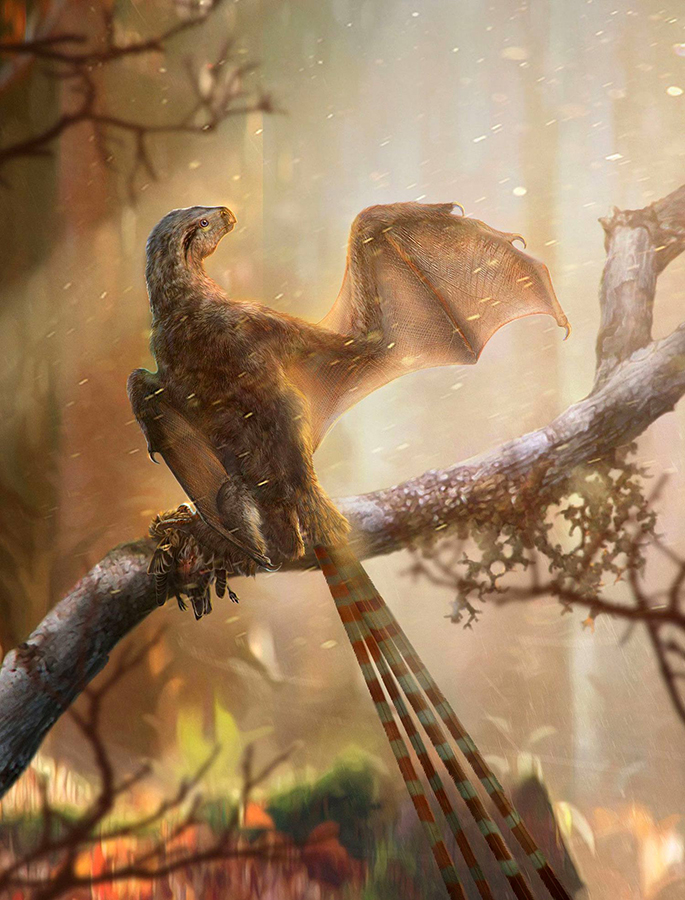
One of the smallest dinosaurs that ever inhabited the planet is the so-called Yi Qi, a feathered dinosaur from China with webbed wings that look like bat wings. The miniature creature weighed only about 380 grams and was the closest relative of the even smaller dinosaur Ambopteryx longibrachium. By the way, this species also lived in China and had about 32 centimeters in length and weight about 306 grams.

Ambopteryx longibrachium. Image credit: Chung-Tat Cheung & Min Wang / Institute of Vertebrate Paleontology and Paleoanthropology, Chinese Academy of Sciences.

Sometimes the small size of the fossils can lead scientists astray. So, when paleontologist discovered the bones of a tiny dinosaur in the 1970s, the find prompted researchers to call the fossil animal “muszavr” or “mouse lizard”. However, scientists were much surprised when, after a while, giant versions of this dinosaur were found! Thus, paleontologist were much surprised when they first discovered the fossils of a Muszavr cub, whose adult weight could reach 113 kilograms.

Another type of tiny dinosaur showed its existence more in the footsteps than in the fossils. In 2018, an international team of researchers discovered tiny dinosaur footprints in the South Korean province of Jingju dating back 110 million years; each track was only 1 centimeter long, which hinted at the extremely small sizes of the dinosaurs that left them – no more than a modern sparrow. However, it still remains unknown whether the mini-dinosaurs found were mature individuals or were the cubs of some still undiscovered species of ancient predators.

Source: https://freenews.live/

Move Over T-Rex: Newly-Identified First King of the Dinosaurs Announced

Friday, January 31, 2020

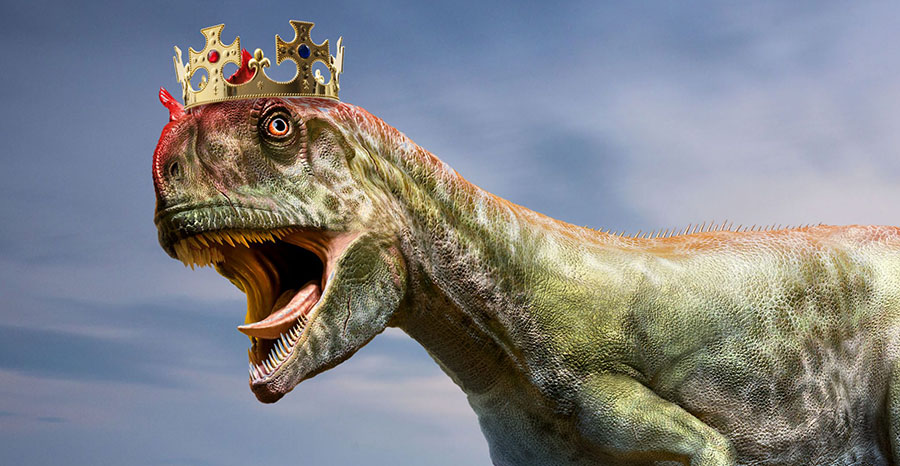
King Allosaurus by PaleoGuy on DevianArt

Thanks to films about the king of the dinosaurs like “Jurassic Park and its endless sequels, the Tyrannosaurus rex just might be the most famous, and feared, dinosaur that ever roamed the earth.  Now, however, there just may be a new contender to T. rex’s title of undisputed king of the dinosaurs, or at least the first king until T. rex came along.

Scientists in Utah recently reassembled bones from museums around the globe, and have discovered a brand new species, one that is related to T. rex but lived earlier, roaming all over North America. A team that has been studying these bones have named the new species, Allosaurus Jimmadseni, for the late, Utah state paleontologist Jim Madsen, Jr. Their findings were published in Peer J, an online scholarly journal.

This creature, the team reports, weighed in at about 4,000 pounds, and grew to almost 30 feet in length, from the tip of its head to the tip of its tail. It stood on two, three-toed feet, had 80 serrated teeth with which to capture and shred its prey, and also had long, curved claws to help it hunt.

Scientists have debated for years what specimens should go into the category of Allosaurus, which refers to dinosaurs that stood on two legs, had large bodies and were carnivores. Now the A. Jimmadseni has been declared the oldest in the genus, dating back 145 million years to 200 million years, long before the T. rex appeared. To make sure that they’d actually found a new species, the team analyzed more than 20,000 Allosaurus bones, gathered from all around the world.

This included a particularly famous one nicknamed “Big Al”, which is housed at the Museum of the Rockies in Montana. Originally identified as A. fragilis, Big Al, as well as a second Allosaurus called “Big Al Two,” have now been re-designated as A. jimmadseni.

A. Fragilis dinosaur. Photo by Fred Wierum CC by 4.0

Everybody knows Allosaurus, or thinks they know Allosaurus,” says Steve Brusatte, a paleontologist at the University of Edinburgh. “But here we are, nearly 150 years after the first Allosaurus bones were found, and after dozens and dozens of skeletons have been collected, and it turns out there is another species…. There are many more dinosaurs out there to find.”

Some scientists argue that more than 10 species belong in the Allosaurus category, but for the new study, only two were recognized: Jimmadseni and one that came about five million years later, called A. Fragilis, also a predator of extreme skill. The co-authors of the study are Mark Loewen, a paleontologist with the Natural History Museum of Utah, and Daniel Chure, a paleontologist with the Dinosaur National Monument, also in Utah. Their work is the culmination of about 30 years of work on the Allosaurus genus.

The team put together the bones into two, almost complete specimens, now on display at the Natural History Museum in Utah. Loewen explained in a statement to the media that A. Jimmadseni was lost, in evolutionary terms, likely because it had a skull with weaknesses that left it vulnerable. When A. Fragilis came on the scene, it was better able to out-hunt its chief rival, and left Jimmadseni to go extinct.

A size comparison of various specimens of the theropod dinosaur genus Allosaurus. Photo credit: Steveoc 86

“It shows that the Allosaurus changed over time,” Loewen explained in the statement. “It (Fragilis) out-competed Jimmadseni. It was a better hunter.” During their respective periods, however, both dinosaurs were excellent predators that were at the top of the food chain in their ecosystems.

Now that the Allosaurus genus has a new, formally-named member, one has to wonder why Hollywood didn’t use the right time period for its monster movie.  Is it because “Cretaceous Park” just doesn’t have the same ring to it that “Jurassic Park” has?

Who knows what goes on in the minds of movie makers, but one thing’s for sure: there’s no excuse anymore for leaving out Jimmadseni, should the franchise pick up and decide to make a new dinosaur film for a whole, new audience. Jimmadseni just might give T. rex a run for its money as the new cinematic king of the dinosaurs.

Source: www.thevintagenews.com/

New Predatory Dinosaur Added to Australia's Prehistory

Friday, January 31, 2020

The Lightning Ridge noasaurid bone in approximate life position, with a human for scale. Credit: Tom Brougham

Evidence of agile, carnivorous two-legged dinosaurs known as noasaurids have been found across the now dispersed land masses that once formed the ancient southern supercontinent of Gondwana, but never in Australia—until now.

Researchers identified a single neck bone found in an opal mine near the outback town of Lightning Ridge, New South Wales, as belonging to a noasaurid, and then realised that another fossil discovered in 2012 along the south coast of Victoria was from the same group.

Noasaurid are a rare group of theropod dinosaurs—two legged carnivores—that lived in the middle to late Cretaceous Period, between about 120 and 66 million years ago. Noasaurids were small-bodied dinosaurs, many with peculiar facial features, typically less than two metres long and weighing about 20 kilograms.

The recognition of this new group of dinosaurs in Australia by palaeontologists from the Palaeoscience Research Centre at the University of New England and the Australian Opal Centre in Lightning Ridge adds a missing piece to a puzzle.

"It was assumed that noasaurids must have lived in Australia because their fossils have been found on other southern continents that, like Australia, were once part of the Gondwanan supercontinent," said lead scientist, Dr. Tom Brougham of the Palaeoscience Research Centre. "These recent fossil finds demonstrate for the first time that noasaurids once roamed across Australia. Discoveries of theropods are rare in Australia, so every little find we make reveals important details about our unique dinosaur fauna."

The researchers compared the 100 million-year-old Lightning Ridge neck bone with those from other carnivorous dinosaurs and quickly realised it was different from anything that had been found in Australia to date. "When we looked at what features this bone has compared to those of other theropods, we found that it matched closely with this strange group of dinosaurs called noasaurids," Dr. Brougham said.

"This prompted us to re-examine an ankle bone of a dinosaur that was discovered in Victoria in 2012, about 20 million years older than the Lightning Ridge bone, and using the same methods we concluded that this also belonged to a noasaurid. In addition, this ankle bone is approximately the same age, or perhaps even older, than the oldest known noasaurids, which come from South America."

Noasaurids were similar in size to, and lived at the same time as, a more well-known group of carnivorous dinosaurs called dromaeosaurids or 'raptors'—infamously represented by Velociraptor in Jurassic Park—and were probably also active predators. However, while Velociraptor and kin have representatives from all over the world, noasaurids were known only from several of the southern continents (South America, Africa, Madagascar and India), which formed the supercontinent of Gondwana before it started breaking apart in the Cretaceous.

The study was published in the journal Scientific Reports.

More information: Scientific Reports (2020). nature.com/articles/s41598-020-57667-7

Provided by University of New England

Source: https://phys.org/

Pages