nandi's blog

Does This Fossil Reveal a Jurassic Tropical Freeze?

Thursday, February 20, 2020

On view for over a century, a fossil slab may display evidence of tropical freezing during the Jurassic, but scientists never noticed it—until one finally did. Some colleagues are not convinced.

“Hiding in plain sight for over 123 years is physical evidence that the tropics froze for brief periods of time 200 million years ago, at the beginning of the age of dinosaurs,” according to Paul Olsen, a paleontologist at Columbia University’s Lamont-Doherty Earth Observatory in Palisades, N.Y.

Addressing reporters at AGU’s Fall Meeting last December, Olsen described his utter surprise when he looked at a fossil that he had seen at least 40 times since the 1970s and realized it revealed more than he had ever previously noticed. In fact, the fossil in question has been on public display since 1896 and has been viewed by hundreds of thousands of visitors, including hundreds of scientists, first at Wesleyan University and more recently at Dinosaur State Park, both in Connecticut.

This slab from the early Jurassic period is famous for the five clear footprints it preserves of Otozoum moodii, an ancestor of Brontosaurus. Although on display for more than a century, only recently have scientists concluded that the groove (left) may reveal a period of freezing in the tropics. Credit: Drew Hyatt

The fossil is a sandstone slab about 3.4 meters in length, dates to the early Jurassic period, and was recovered at a quarry in Portland, Conn., in the 19th century. It is famous for clearly displaying five footprints of Otozoum moodii, an early ancestor of Brontosaurus.

Equally conspicuous in the slab, but somehow unremarked before Olsen’s epiphany in 2017, is a groove that he and his coauthors interpret as the track left by a “sailing rock” and, with it, evidence of Jurassic freezing.

Sailing rocks are stones that occasionally move across flat landscapes, gouging indented trails like the one seen in the fossil slab. Present-day sailing rocks are famously visible at Racetrack Playa, a dry lake bed in Death Valley National Park, Calif.

The cause of the rocks’ movement was the subject of much speculation prior to experiments conducted in 2014 by researchers at the Scripps Institution of Oceanography (SIO). With the aid of GPS trackers placed on stones they left on the playa floor, researchers determined that the rocks moved following rainy periods when the lake bed was covered by a few centimeters of water that froze overnight. When the Sun warmed the ice, thin sheets broke away and were pushed by the wind, taking the stones with them. When the water evaporated, trails left by the moving stones became visible.

That is what Olsen thinks occurred 200 million years ago in what is now Connecticut. However, at that time, Connecticut was part of the Pangea supercontinent and was located at around 20°N latitude—in the tropics.

Two Hypotheses for the Track

Why was there ice in the tropics 200 million years ago? Olsen suggests a period of global cooling occurred, created by a series of powerful volcanic eruptions in the Central Atlantic Magmatic Province that spewed sulfurous emissions into the atmosphere. Those emissions blocked sunlight from reaching the surface, allowing groundwater to freeze and resulting in a mass reptilian extinction. He thinks that dinosaurs’ protofeathers insulated them from the cold, whereas stem mammals’ fur protected them, as did their underground burrows.

There is, however, another known cause of sailing rocks on flat landscapes, aside from ice slabs: thick and slippery microbial mats that allow the wind to push rocks across their surface, like what occurs now on a dry lake near Toledo, Spain. Olsen does not think that is the explanation for the Connecticut track because the dinosaur’s footprints would not have been so well defined in a soft microbial mat, but he does not completely rule it out.

Some scientists are not convinced. Konrad Hughen of the Woods Hole Oceanographic Institution in Massachusetts thinks the microbial mat explanation is more plausible because of the unlikelihood, in his view, of a brief freeze during a massive volcanic winter in the middle of a carbon dioxide–fueled warm period. Hughen added that for him to be more sure of this hypothesis, there would have to be microfossil or geochemical evidence of a microbial mat, which is so far lacking.

Richard Norris of SIO noted that Chilean researchers reported “something similar” to Olsen’s discovery in Jurassic rocks east of Santiago. Regarding the Connecticut fossil, he says, “I don’t know what the track maker was, but it was probably not a moving rock.”

Norris noted that the track is “a negative impression, and the presumed levees on the trail are actually grooves along the edge of the trail. Hence, the feature cannot be made by a rock that was pushing sediment out of the way when the rock was in motion.”

Seeing and Believing

Whatever hypothesis eventually prevails, why did Olsen see and comprehend in 2017 what had eluded him and other scientists dozens of times before?

Olsen said that all of us tend not to recognize things that don’t fit into our existing ideas. In 2017, he was in China, studying evidence of freezing in the Jurassic and Triassic periods. He was actually looking for traces of sailing rocks, which would be evidence of ice. At the time, he didn’t remember that he had seen exactly that in Connecticut, he said, but the next time he visited the exhibit at Dinosaur State Park, he slapped his forehead and exclaimed, “Oh—that looks like a sailing rock trace!”

Meanwhile, Patrick Getty of Collin College in Spring Creek, Texas, attributes a set of small tracks on the fossil, equally unnoticed for more than a century, to a tiny stem mammal, bounding along near the dinosaur track.

“Both of those things [traces of a sailing rock and a stem mammal] are examples of things which nobody observed because they weren’t, in a way, prepared to see them,” Olsen said. “I wouldn’t have seen it, if I hadn’t believed it,” he concluded.

Citation: Leifert, H. (2020), Does this fossil reveal a jurassic tropical freeze?, Eos, 101, https://doi.org/10.1029/2020EO140315. Published on 19 February 2020.

Source: https://eos.org/

Some Awesome Dinosaurs

Thursday, February 20, 2020

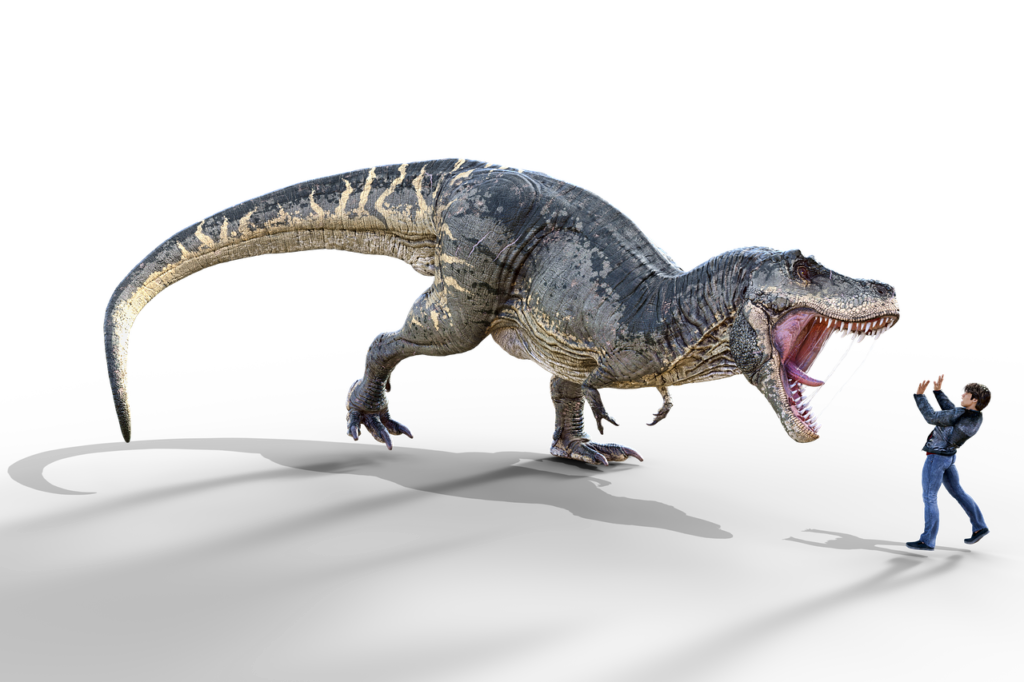
Quite an unfortunate situation to be in. Luckily, T-Rex lived some 66 million years before jeans ever became a thing. Image credits: Schwoaze.

So, you love dinosaurs. You’re probably familiar with the T. rexthe Triceratops, and the Stegosaurus but you want more. Well, don’t worry, cause we’ll give you more.

It would far too long to go through all the dinosaur species we know existed, so we’ll have a look at some of the most representative dinosaurs, discuss what their name means, what they looked like, and add in a little bit of trivia. But first, let’s look at how dinosaurs as a group got their name.

How dinosaurs got their name?

The term was coined in 1842 by English biologist Sir Richard Owen. The name dinosaur literally means “terrible lizards”, which we can safely say is a pretty fair description (at least in most cases). It comes from two Greek words: deinos, a name that means “terrible”, and saurus, which means lizard.

As for the individual species, they were named in different ways. Often, dinosaurs are named for a distinctive characteristic. Baryonyx means heavy claw. Corythosaurus means helmet lizard. Tyrannosaurus means tyrant lizard — you get the point. Other times, they’re named after the place where the first fossil was found, like Albertasaurus (from Alberta, Canada).

Before we start looking into individual species and their names, there are a few other Greek roots that can help you better understand dinosaur names.

  • Draco: from Rakon – means Dragon;

  • Hippos: from Hippos – means Horse;

  • Hydro: from Hydro – means Water;

  • Ortho: from Orthos – means Straight, Right, or Upright;

  • Macro: from Makros – means Large;

  • Micro: from Mikros – means Small;

  • Mega: from Megas – means Huge;

  • Morph: from Morph – means Shape;

  • Poly: from Polys – means Many.

Now that we’ve got the boring stuff out of the way, let’s finally look at some dinosaurs.

Tyrannosaurus rex

Scotty The T-Rex. By BangBooDoragon

Let’s start with the king: Tyrannosaurus rex means the “Tyrant Lizard King”, and you could hardly imagine a better name. It was named in 1905 by Henry Fairfield Osborn, who was then the president of the American Museum of Natural History.

T. rex, as it is often called, lived in the late Cretaceous, the very last period when dinosaurs ruled the Earth. Although it seems that T. rex “only” lived for 2 million years (a relatively short period, compared to other dinosaurs), it made quite an impact.

It’s one of the largest known land predators and is estimated to have had the strongest bite among all terrestrial animals. However, while T. rex was likely an apex predator, it might have also been a scavenger. To this day, the debate about whether he was purely a hunter of also scavenged is one of the most heated in the world of paleontology.

From here on, we will focus on a genus of dinosaurs instead of individual species, but we thought we’d give T. rex a category of its own.

Stegosaurus

The Stegosaur was an imposing creature, although its back spines were probably not as menacing as you might think. Image credits: Parker West.

Stegosaurus is a much older dinosaur than the Tyrannosaurus rex. So you can get an idea, the T. rex lived closer to the current day, than to the days of the Stegosaur — so those drawings of T. rex fighting a stegosaur are rubbish and have no geological truth to them. But if through some miracle you happened to see a stegosaur from some 150 million years ago, it would be a sight to behold.

Stegosaurs were large and heavily built herbivores. They had rounded backs and spiky tails which they likely held high in the air. The tails were most likely used for defense against predators, but contrary to popular belief, their recognizable back plates probably served a different purpose: thermoregulation. It was traditionally believed that these plates also served a defense purpose, but more recent research suggests that they were heavily vascularized, which means they were good for regulating the dinosaur’s temperature (they might have also been used for mating displays).

Triceratops

Triceratops horridus, a ceratopsian from the Late Cretaceous of North America, pencil drawing by Nobu Tomura.

Unlike the Stegosaur, the Triceratops was actually contemporary with the T. rex, so the two might have encountered each other. Alas, one can only imagine what impression the first Triceratops skull made on its discoverers. A massive, tank-like dinosaur boasting three devil-like horns on its armored head must have been quite the sight. However, while the Triceratops was probably not the most gentle of dinosaurs (fossil findings suggest that it regularly engaged in fights with predators and other members of its species), it was still an herbivore.

The Triceratops is one of the last known true dinosaurs, becoming extict 66 million years ago. Its name literally means “three-horned-face”. Its sturdy, robust body meant not only that the Triceratops was not an easy prey — but also that many examples have been preserved as fossils, allowing paleontologists to study the species in relative detail. Its fossils are among the most common dinosaur fossils in the late Cretaceous.

Velociraptor
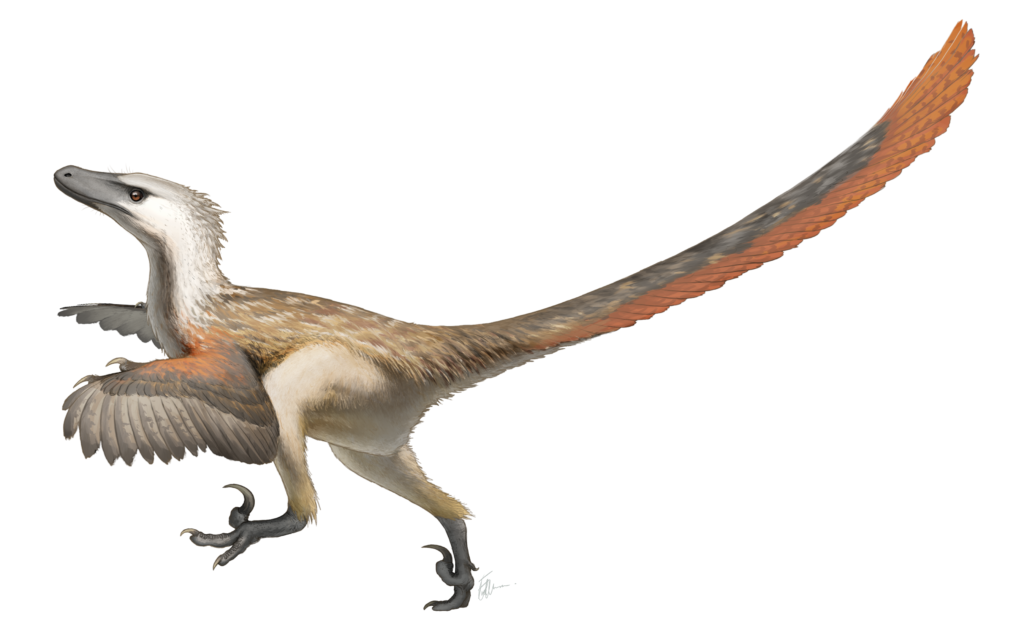
 Artistic restoration of Velociraptor mongoliensis. Not what you’d expect, eh? Image credits: Fred Wierum.

Velociraptor was not nearly as impressive as the other dinosaurs we’ve seen so far, and it was also not contemporary with T. rex — it lived just a few million years before T. rex emerged. Velociraptors were dog-sized dinosaurs, part of a family called dromaeosaurid. The largest velociraptors measured 2.07 m (6.8 ft) long, 0.5 m (1.6 ft) tall. Unlike what Jurassic Park shows you, Velociraptors were covered in feathers (or, at the very least, furry feathery coats). They were probably warm-blooded, at least to some degree.

In one of the most remarkable fossils ever discovered, a Velociraptor is found fighting a Protoceratops andrewsi, in a distinct example of predatory behavior. Also contrary to popular belief, there is no evidence that the Velociraptor hunted cooperatively (though recent findings have shown that they moved around as a group — at least sometimes). The pack-hunting hypothesis is still uncertain.

When did dinosaurs live?

Dinosaurs lived in a period called the Mesozoic. The Mesozoic is split into three large periods: the Triassic, the Jurassic, and the Cretaceous. Here is an image showing when some of them used to live.

Spinosaurus
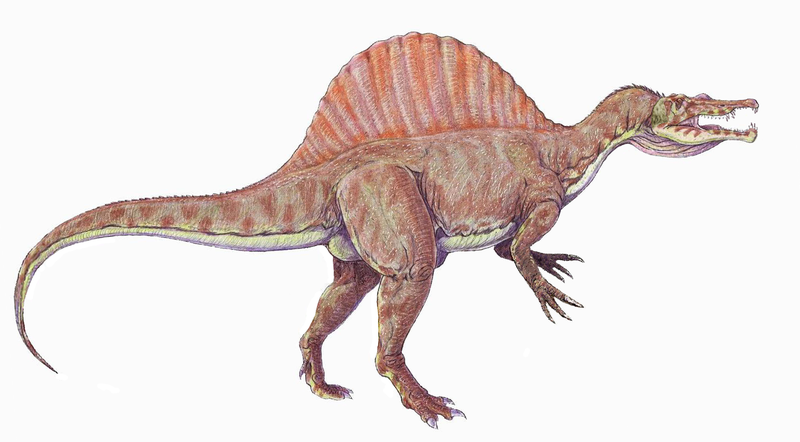
Spinosaurus aegipticus, boasting the spinal structure from which its name derives. Image credits: Bogdanov, modified by Matt Martyniuk.

Spinosaurus was among the largest of all known carnivorous dinosaurs, nearly as large as or even larger than Tyrannosaurus. It lived around 100 million years ago, in the early to mid-Cretaceous. Among its many notable features, Spinosaurus also featured massive neural spines on its back — from which its name also derives. The exact purpose of these spines is still a matter of debate, though as with the Stegosaur, they were more likely used for thermoregulation and display than for defense.

For a long time, it was thought that Spinosaurus feasted on fish almost exclusively, as its elongated jaws, raised nostrils, and conical teeth suggest. However, more recent findings (including a fossil which contained bones of another dinosaur in its belly) suggest that Spinosaurus was likely to have been a generalized and opportunistic predator, feeding on anything its size allowed it to hunt.

Allosaurus
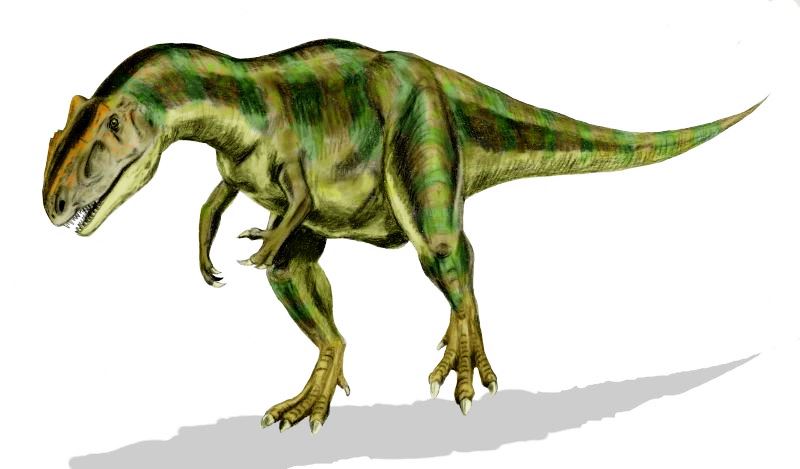
Allosaurus fragilis, an allosaur from the Late Jurassic of North America, pencil drawing by Nobu Tomura

Allosaurus means “different lizard” — a name that alludes to its concave vertebrae, which at the time of its discovery was unique. Allosaurus was a large predator, somewhat like the Tyrannosaur. It measured over 9.5 metres (31 ft) in length, though some partial findings suggest that it might have grown way beyond that. However, unlike the Tyrannosaur, the Allosaurus might have hunted in packs (still under debate), making it one of the fiercest predators of its time.

Like many other predator dinosaurs (as well as both ancient and modern crocodiles), Allosaurus constantly grew, shed and replaced its teeth. Even if it hunted in packs, Allosaurus was more than capable of hunting prey on its own, several findings suggest.

Archaeopteryx

Archaeopteryx is regarded as one of the most important fossils ever discovered. Here, a representation of what it may have looked like. Image credits: Pedro José Salas Fontelles.

Archaeopteryx is a genus of bird-like dinosaurs considered to be a transitional species between non-avian featured dinosaurs and modern birds. The name comes from the Greek archaios, which means “ancient”, and pteryx, which means “feather”. It is one of the most significant fossils ever discovered. It shared clear similarities with birds (such as small size, broad wings, and a presumed ability to fly or glide), but had strong dinosaur features: jaws with sharp teeth (instead of a beak), three fingers with claws, as well as a long, bony tail.

Archaeopteryx was not a large creature. It was similar in size to a magpie, and the largest individuals might have reached the size of a crow.

Megalosaurus
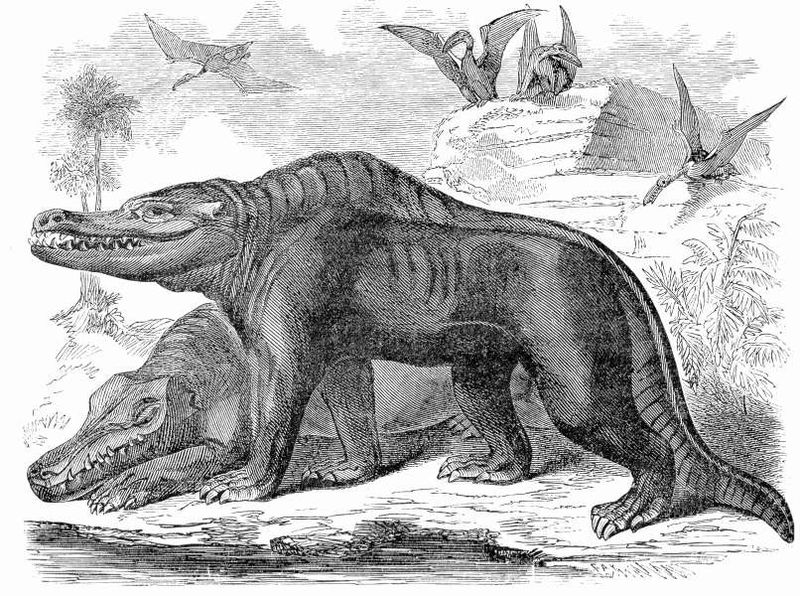
Samuel Griswold Goodrich: Illustrated Natural History of the Animal Kingdom, 1859. Today, paleontologists believe Megalosaurus was more likely bipedal.

Megalosaurus is truly worth the title of “giant lizard”, as its name implies. It was a large, meat-eating dinosaur from the middle Jurassic and is quite possibly the first dinosaur ever described properly in the scientific literature. Early naturalists considered it to be a gigantic 20-meter (65-foot) lizard, although more recent studies have found it to be probably in the 6-meter range (20 feet).

Megalosaurus may have hunted stegosaurs, iguanodons, or even sauropods. It was probably bipedal, although the earliest reconstructions depict it as 4-legged. However, although this dinosaur has been known for a long time, it is still not properly understood. Its skull shape, in particular, is not known.

Diplodocus
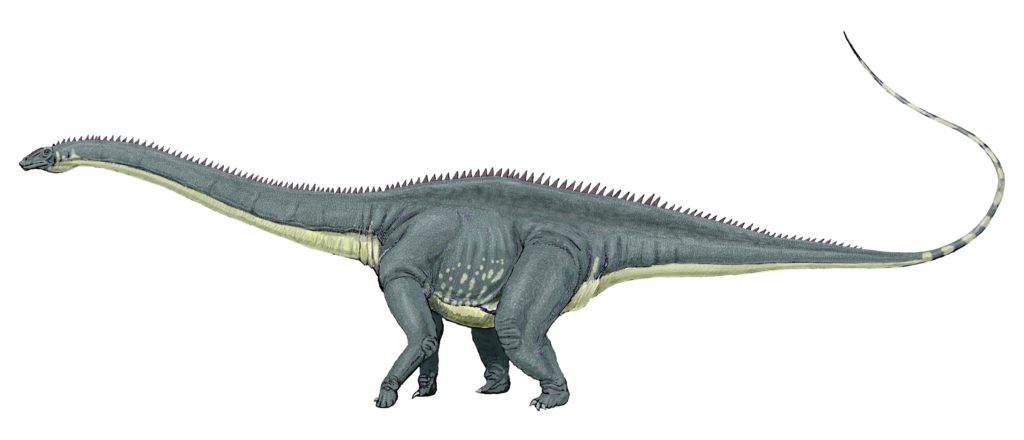
Diplodocus longus. Image credits: Dmitry Bogdanov.

Diplodocus is one of the largest dinosaurs thus far discovered. Diplodocus carnegii, a Diplodocus species, is one of the longest dinosaurs conserved from a complete skeleton, but other individuals likely grew to even larger sizes. Diplodocus lived some 152 million years ago and like most sauropods, it featured a long neck and tail, and four sturdy legs. Its size and shape is so unusual that paleontologists aren’t even sure how sauropods were able to breathe.

They likely had an avian respiratory system (which is far more efficient than a reptilian or mammalian one). Diplodocus would have spent its days browsing on trees, ferns, and bushes, from low levels to around 4 meters high. However, reconstructions suggest that it could also use its tail as a prop, giving it a stable tripodal posture (on its hind legs and tail), allowing it to reach up to 11 meters high. Like giraffes, it is believed that Diplodocus developed such a long neck as a feeding advantage.

Ankylosaurus

Possible appearance of an Ankylosaurus. Image credits: Mariana Ruiz Villarreal (LadyofHats).

Ankylosaurus is an armored dinosaur estimated to have been between 6 and 8 metres (20 and 26 ft) long. It walked on four legs, boasting a horned head that ended with a menacing beak, as well as a large club on the end of its tail.

Although Ankylosaurus has several striking features, its tail is probably the most interesting. Researchers believed it was actively used as a defensive weapon and was likely possible of crushing the bones of its would-be attackers — which, at the end of the Cretaceous, could have measured the likes of the T-Rex. Ankylosaurus’ mouth suggests that it was an indiscriminate herbivore, feeding on whatever plants it could find lying around.

Brachiosaurus

Brachiosaurus altithorax, a sauropod from the Late Jurassic of North America and Africa, pencil drawing by Nobu Tomura.

Brachiosaurus is another sauropod, like the Diplodocus. In 1903, paleontologist Elmer S. Riggs named the dinosaur Brachiosaurus altithorax — with the name Brachiosaurus being Greek for “arm lizard”, and altithorax being Greek for “deep chest”.

The Brachiosaurus also had a bird-like breathing system, with air sacs pumping air. But Brachiosaurus was also atypical in some regards — for instance, it had long forelimbs (longer than its hind limbs), resulting in a steeply inclined trunk.

Iguanodon
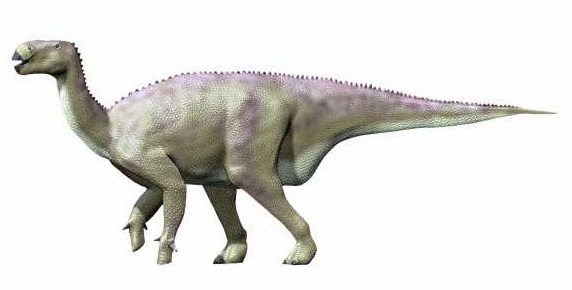
Image credits: Nobu Tomura.

Iguanodon is another emblematic dinosaur. Iguanodon were large, bulky herbivores, but they featured prehensile fingers with which they foraged for food, as well as large thumb spikes, which were probably used to defend against predators. The spike would have been used as a close-quarter stiletto-like weapon against predators, although a more benign explanation would be that it was used to break into seeds and fruits.

Given its well-developed jaws, it’s not clear what Iguanodon ate, although, given its size, it was probably a dominant herbivore. Remarkably, Iguanodon may have been bipedal in its early age, but became more quadrupedal as it got older and heavier.

Parasaurolophus

Sketch of the hadrosaurid Parasaurolophus in tetrapod or quadrupedal pose, anatomically correct. Image credits: Tim Bekaert.

Parasaurolophus (whose name means “near crested lizard”) might not have the most famous name — but its look is definitely recognizable. Parasaurolophus was also a hadrosaurid, but its crest provides a notable difference to other species.

It’s not clear what role the crest served. It may have been purely sexual display, or may have served for thermoregulation, or even acoustic resonance. Most likely, it served quite a combination of purposes, making it a unique feature, even in the diverse world of dinosaurs.

Hadrosaurus

This hadrosaurus does not approve of your behavior. Image credits: Audrey M / Wikipedia.

Hadrosaurus has a pretty self-explanatory name: hadros means “bulky” or “large” and sauros means “lizard”. As you may have guessed, Hadrosaurus is a large, bulky lizard — a very common trait in the dinosaur herbivores. Hadrosaurus foulkii, the only species in this genus, is known from a single specimen consisting of much of the skeleton and parts of the skull.

Hadrosaurus has traditionally served as the basis for a rather large subfamily called Hadrosaurinae, which was seen as a group of largely crestless group of hadrosaurs. However, recent studies have shown Hadrosaurs to be more primitive than their relatives, and the name Hadrosaurinae was restricted. That’s probably why it looks so judgy in the reconstruction above.

These are just a few of the countless dinosaurs that ruled the Mesozoic (not only the Jurassic!), from 233 million years ago down to the very present.

Wait. Does that mean dinosaurs are still alive? Absolutely! Birds are modern feathered dinosaurs, and it’s a remarkable example of how much a group of animals can change in geologic time.

Source: www.zmescience.com/

New Study Results Consistent With Dog Domestication During Ice Age

Thursday, February 20, 2020

Peter Ungar with the jaw of a dog-like canid at the Moravian Museum in the Czech Republic.  CREDIT Peter Ungar

A research team performed dental microwear analysis on canid fossils from a Paleolithic site in the Czech Republic

Analysis of Paleolithic-era teeth from a 28,500-year-old fossil site in the Czech Republic provides supporting evidence for two groups of canids - one dog-like and the other wolf-like - with differing diets, which is consistent with the early domestication of dogs.

The study, published in the Journal of Archaeological Science, was co-directed by Peter Ungar, Distinguished Professor of anthropology at the University of Arkansas.

The researchers performed dental microwear texture analysis on a sample of fossils from the Předmostí site, which contains both wolf-like and dog-like canids. Canids are simply mammals of the dog family. The researchers identified distinctive microwear patterns for each canid morphotype. Compared to the wolf-like canids, the teeth of the early dog canids - called "protodogs" by the researchers - had larger wear scars, indicating a diet that included hard, brittle foods. The teeth of the wolf-like canids had smaller scars, suggesting they consumed more flesh, likely from mammoth, as shown by previous research.

This greater durophagy - animal eating behavior suggesting the consumption of hard objects - among the dog-like canids means they likely consumed bones and other less desirable food scraps within human settlement areas, Ungar said. It provides supporting evidence that there were two types of canids at the site, each with a distinct diet, which is consistent with other evidence of early-stage domestication.

"Our primary goal was to test whether these two morphotypes expressed notable differences in behavior, based on wear patterns," said Ungar. "Dental microwear is a behavioral signal that can appear generations before morphological changes are established in a population, and it shows great promise in using the archaeological record to distinguish protodogs from wolves."

Dog domestication is the earliest example of animal husbandry and the only type of domestication that occurred well before the earliest definitive evidence of agriculture. However, there is robust scientific debate about the timing and circumstances of the initial domestication of dogs, with estimates varying between 15,000 and 40,000 years ago, well into the Ice Age, when people had a hunter-gatherer way of life. There is also debate about why wolves were first domesticated to become dogs. From an anthropological perspective, the timing of the domestication process is important for understanding early cognition, behavior and the ecology of early Homo sapiens.

###

The study's lead author is Kari Prassack, curator of paleontology at Hagerman Fossil Beds National Monument, which is part of the National Park Service. Co-authors were Martina Lázničková-Galetová of the Moravian Museum in Czech Republic; Mietje Germonpré of the Royal Belgian Institute of Natural Sciences; and Josephine DuBois, Ungar's former Honors College student and now student at the University of Missouri-Kansas City School of Dentistry.

This research was supported by the Czech Science Foundation, the Ministry of Culture of the Czech Republic and the University of Arkansas Honors College. Fossil material for this study came from collections of the Moravian Museum in Czech Republic.

Source: www.eurekalert.org/

How Jurassic World: Evolution Became a Compelling Dinosaur Game

Wednesday, February 19, 2020

Director Rich Newbold talks about the gameplay loops that make Jurassic World: Evolution so compelling.

Over the Christmas break, I became absolutely obsessed with Jurassic World: Evolution. The theme-park building game from the Cambridge-based developers at Frontier has a compelling gameplay loop that sucks you in and doesn’t let you go, as you figure out how to run Jurassic World without all hell breaking loose. It wasn’t long before I was recommending the game to my friends, and they ended up sinking significant chunks of their festive free time into it too.

But how does a company craft a game that is quite this engaging? Keen to talk about my obsessive dinosaur-wrangling, I reached out to Jurassic World: Evolution’s game director Rich Newbold to pick his brain about just that. The overarching gameplay loop - which sees the player completing a number of challenges on an island in order to unlock another island, and then completing challenges on that island to unlock another island, and so on - was one of the first things we talked about.

“We tend to design gameplay loops in two stages,” Newbold explained. “Firstly, we look at the mechanics and loops that work in the macro time such as a few minutes. These are then expanded over a longer period of time and combined with other gameplay to create the overarching structure of the game.”

Lots of thought and effort go into the smaller tasks in the game, even when they only take up tiny chunks of your time. For instance, if you want to make a new dinosaur, there are quite a few jobs that you need to do first: you need to send dig teams to find enough fossils, then you use your fossil center to extract viable genomes from the fossils, then you need to incubate the dinosaur in your lab, and then (if all is going well) you’ll be able to release your brand new creature - this comes with a nice bit of fanfare and triggers a sizeable endorphin rush.

These little tasks - digging, extracting, incubating, releasing - don’t take long to do on their own. And this, from a player’s perspective, makes it easy to justify continual play. You end up egging yourself on - just one more dig and then it’s time for bed, you might think to yourself, but then your dig comes back and you really want to extract the genomes... Then the genomes add up and suddenly you’re able to incubate a new dinosaur... and before you know it you’ve played for another hour.

Once these macro elements were put in place, Newbold and his team began thinking about other things to throw at players. As he puts it, “The player can have all three [digs, fossils, and incubations] in progress at any one time, yet while these are active there’s also the process of managing the progression and expansion of their park as well as the management of their dinosaur welfare – and on top of that there’s always the possibility of something going wrong, such as a dinosaur escaping!”

As well as catching and securing dinosaurs that escape, and managing your loop of macro-tasks, you’ll also have to hit your outlined targets in the main storyline ("Release two herbivores into an enclosure" or "Get a park rating of three stars") as well as manage one-off contracts that can come in at any time ("Sell a dinosaur with a rating of 120" or "Take a marketing photo worth $10,000"). You’re trying to hit a lot of goals at once, as well as contain any crises that break out.

“Creating a world that continues to be exciting and compelling for players is always front of mind when we’re developing our games,” says Newbold, and part of that job involves making sure that players have all the skills that they need to succeed without getting too stressed out. “We work to make sure that the addition of new mechanics or items are timed so that we don’t overwhelm the player at any stage. While we found that sometimes it’s enjoyable to let the player ‘learn by doing’ with only light help and support, we’ve tried to ensure that if it’s a new skill, item, or dinosaur, the player has already had the time to learn how to manage the basics of it.”

Despite the fact that I'd never sunk this many hours into a park-building game before, I found myself picking up the skills to progress through the five main islands of the game’s campaign (and the two islands in its recent Return to Jurassic Park prequel DLC) during my playthrough. Even when things went wrong, there was always a way to fix it, which stops you from giving up. The game seems to encourage and support you, which is another element that keeps you playing beyond your pre-planned bedtime. 

When it comes to encouraging players, while still challenging them, Newbold says, “It’s a balance. That feeling of euphoria you feel when you complete a challenge or achievement without help is something we try to ensure players have the opportunity to feel. We balance it by giving the player opportunities to rectify their mistakes before encountering big failures. In Challenge Mode, for example, you can have a few near misses where you get emergency cash grants for a failing park before we say you’ve run out of money. And if a dinosaur does escape and starts chomping on guests, that’s not the end. You take a financial hit but it’s still acceptable overall, even though it’s something that would likely shut down an entire theme park if it happened in real life!”


You’re able to learn from the mistakes you make along the way, taking the lessons of each area and applying them to new missions. As Newbold puts it, “Each new island comes with a new challenge, whether that’s playable area size or more frequent calamities. That said, with new challenges come new opportunities to not only access new dinosaurs or research but also to learn from the successes (and failures!) of the islands that came before it and put those learnings into building a more optimal park on the new island.”

To complete an island and unlock the next one, you normally have to achieve a three-star rating on your current island. This rating is based on the variety and wellbeing of your dinosaurs and the breadth of facilities that you offer to guests, among other things. Even if your first attempt at managing an island is a disaster, you can delete your mistakes and try again until you get that three-star rating and earn the right to move on. Die-hard fans of building games will probably hit that target quickly, but for newcomers, each three-star rating will feel like a huge accomplishment.

How do you make sure the game appeals to both newbies and hardened experts alike? Newbold admits, “It's really tough. You don’t want to talk down to those players who instantly grasp all the mechanics and game loops, especially those with lots of management game experience. Yet you also want to make sure that those players who aren’t into deep management games are catered for. Jurassic is a franchise with such a broad appeal so we wanted to make sure that fans of as many ages and experiences could see that T-rex come out of the Hatchery for the first time and hear its iconic roar.”

It took me a while to work out how to stop that T-Rex from breaking out of its area and eating the guests. Let’s be honest, though - that’s exactly what the Jurassic Park franchise has always been about! Newbold and his team did a fine job in bringing this world, and the logistics behind it, to life. They also made an experience that’s compelling, engaging, and totally consumed my Christmas.

Jurassic World: Evolution is out now for PC, PlayStation 4, and Xbox One.

Source: www.denofgeek.com/

Utahraptor State Park Would Protect Discovery Site of Utah’s Namesake Dinosaur

Wednesday, February 19, 2020

Mike Mower, Gov. Gary Herbert’s deputy chief of staff, makes a face while holding a statue of a Utahraptor during a press conference at the Capitol in Salt Lake City on Friday, Feb. 14, 2020, to discuss HB322, which would create Utahraptor State Park in the Dalton Wells area near Moab. Kristin Murphy, Deseret News

The man who named the ferocious prehistoric predator that was more accurately featured in “Jurassic Park” — the Utahraptor, not the Velociraptor — held up a claw he dug from the Dalton Wells Quarry in Grand County back in 1991.

The sickle-shaped claw, reconstructed to resemble its true shape on the toe of a living, breathing Utahraptor, was even longer than the claw in the Spielberg classic that fictional paleontologist Alan Grant used to terrify a snarky teen.

Jim Kirkland, Utah’s state paleontologist, showed how it dwarfed a tiny claw of the actual velociraptor, holding it between the tip of two fingers.

“The star of Jurassic Park?” Kirkland said, laughing. “I think not.”

Rep. Steve Eliason, R-Sandy, discusses HB322, which would create Utahraptor State Park in the Dalton Wells area near Moab, during a press conference at the Capitol in Salt Lake City on Friday, Feb. 14, 2020.  Kristin Murphy, Deseret News

The Utahraptor used its over 9-inch claws to attack and rip apart its prey. While velociraptors were much smaller, Utahraptor adults grew to around 20 feet long and about 5 feet tall at the hip, according to paleontologists.

Oh, and “Jurassic Park” also left off the feathers.

The Utahraptor fossils were brought to Utah’s Capitol Hill Friday to kick off an effort to get $10 million in state funds to create Utah’s 45th state park: Utahraptor State Park. It would honor of one of the most famous, yet often wrongly identified, dinosaurs discovered in Utah’s red rock country.

The state park would protect, preserve and celebrate Dalton Wells Quarry in Grand County where the Utahraptor’s first fossils were discovered. Located about 15 miles northwest of Moab and west of Arches National Park, Dalton Wells is among the quarries that rim the Cedar Mountain Formation, which contains one of the richest early Cretaceous dinosaur bone deposits in the world, dated over 125 million years ago. The quarry is right on the Dinosaur Diamond National Scenic Byway.

“It’s a very, very rich place for dinosaurs,” Kirkland said.

State paleontologist James Kirkland discusses HB322, which would create Utahraptor State Park in the Dalton Wells area near Moab, during a press conference at the Capitol in Salt Lake City on Friday, Feb. 14, 2020.  Kristin Murphy, Deseret News

Rep. Steve Eliason, R-Sandy, is leading the charge with HB322 that would establish the state park and fund new amenities like state-of-the-art campgrounds, RV parking, restrooms, park areas, trails, roads and more. The bill is also seeking $375,000 in ongoing funds for park operations.

Though it’s not currently contemplated in the plans, Eliason said the state park could someday feature a museum, where maybe a full Utahraptor fossil skeleton could someday be displayed, along with other fossils dug straight out of the quarry.

“How cool would it be to take your family camping with critters like this?” joked Mike Mower, Gov. Gary Herbert’s deputy chief of staff, as he held up a mini replica of the Utahraptor at a news conference Friday.

After all, the Utahraptor State Park is 145 million years “in the making,” Mower said.

“How cool is it that Utah, of all 50 states, has the coolest dinosaur out there that’s named after our state?” Mower said. “The fact that we’re making this a state park really puts this up there as something incredible, not only now, but for years to come.”

As proposed, the Utahraptor State Park would include about 6,500 acres in Grand County, all made up state land, managed by either the state Division of Forestry, Fire and State Lands or the Utah School and Institutional Trust Lands Administration. Since it’s all state-owned, with no federal jurisdiction, it has better chances of becoming a state park, Eliason said.

A Utahraptor skull reconstruction is displayed during a press conference at the Capitol in Salt Lake City on Friday, Feb. 14, 2020, to discuss HB322, which would create Utahraptor State Park in the Dalton Wells area near Moab.  Kristin Murphy, Deseret News

Dalton Wells is already a popular camping location, teeming with mountain biking and dirt bike trails. But it lacks amenities — no restrooms, no trash cans — and has become unfortunately littered with “Charmin’s lily,” or white tufts of toilet paper, Eliason said.

Dalton Wells’ history isn’t just for dinosaurs, either. It was also the site of a Civilian Conservation Corps camp, or the Moab Isolation Center, which was used as a Japanese American internment camp during World War II.

The Dalton Wells Quarry also features what Kirkland called the “most spectacular views” of not only dinosaur bone excavation sites, but also of the Arches area — all areas worth protecting.

While paleontologists still have multiple “lifetimes of work” already excavated out of the Dalton Wells Quarry still waiting to be studied, Kirkland said the area has become a popular place for vandals or curious diggers who “scratch the surface” for bones.

Eliason said the Utahraptor State Park would protect the geological wonders, the dinosaur gold mines for generations to come while also bringing amenities to increase access for future generations of Utahns.

“It’s one of the most exciting state park opportunities in our history,” Eliason told the Deseret News. “This has everything. It has recreation, it has historical significance, a huge chunk of our fossil record and many existing fossils still yet to be excavated, and it’s in the epicenter of tourism in the state.”

Eliason noted it has a significant fiscal note, amid a year when legislative leaders have said it may be a tricky budget year, but he’s hopeful to find some revenue sources from restricted funds that could be eligible for the one-time $10 million request.

If not, Eliason said he’ll keep trying next year — and the year after that, if need be — to make Utahraptor State Park a reality.

Source: www.deseret.com/

Dinosaurs Were Warm-Blooded, Study of Fossil Eggshells Suggests

Wednesday, February 19, 2020

A nesting cassowary-like dinosaur named Beibeilong sinensis in the act of incubating eggs. Image credit: Zhao Chuang.

Using a novel technique called clumped isotope paleothermometry, an international team of paleontologists analyzed eggshell fossils representing three major dinosaur groups and found that these creatures were characterized by warm body temperatures.

“Dinosaurs sit at an evolutionary point between birds, which are warm-blooded, and reptiles, which are cold-blooded,” said Dr. Robin Dawson, a researcher in the Department of Geology and Geophysics at Yale University.

“Our results suggest that all major groups of dinosaurs had warmer body temperatures than their environment.”

Dr. Dawson and colleagues applied their novel method to the eggshells of three major groups of dinosaurs: Ornithischia, Sauropodomorpha, and Theropoda.

“Clumped isotope paleothermometry is based on the fact that the ordering of oxygen and carbon atoms in a fossil eggshell are determined by temperature,” they explained.

“Once you know the ordering of those atoms, you can calculate the mother dinosaur’s internal body temperature.”

“For example, eggshells of a Troodon, a small, meat-eating theropod, tested at 38 degrees, 27 degrees, and 28 degrees Celsius (or 100.4, 80.6, and 82.4 degrees Fahrenheit).”

“Eggshells from the large, duck-billed dinosaur Maiasaura yielded a temperature of 44 degrees Celsius (111.2 degrees Fahrenheit).”

“Both the Troodon and Maiasaura eggshells were from Alberta, Canada. Meanwhile, fossilized dinosaur eggs from the oospecies — a species classification limited to dinosaur eggs — Megaloolithus, from Romania, tested at 36 degrees Celsius (96.8 degrees Fahrenheit).”

Petrographic microscope images of dinosaur eggshell: (A-C) well-preserved Troodon eggshells from Alberta, Canada; arrows and horizontal lines point to the approximate boundary between the mammillary and prismatic layers; presence of two calcitic layers is diagnostic of non-avian theropods; (D) Maiasaura hadrosaur eggshell from Alberta, Canada, with intermediate preservation; the diagnostic radiating tabular units are indicated by the white arrow; (E) Romanian eggshell (oospecies Megaloolithus cf. M. siruguei) from Tuştea locality, Romania, with intermediate preservation; diagnostic radiating acicular crystals indicated by white arrow; (F) poorly preserved lambeosaurine hadrosaur eggshell fragment from Alberta, Canada. Scale bars – 500 μm. Image credit: Dawson et al, doi: 10.1126/sciadv.aax9361.

The scientists conducted the same analysis on cold-blooded invertebrate shells in the same locations as the dinosaur eggshells.

This helped the team determine the temperature of the local environment — and whether dinosaur body temperatures were higher or lower.

“The Troodon samples were as much as 10 degrees Celsius (18 degrees Fahrenheit) warmer than their environment, the Maiasaura samples were 15 degrees Celsius warmer (27 degrees Fahrenheit), and the Megaloolithus samples were 3-6 degrees Celsius (5.4-10.8 degrees Fahrenheit) warmer,” Dr. Dawson said.

“What we found indicates that the ability to metabolically raise their temperatures above the environment was an early, evolved trait for dinosaurs.”

The results are published in the journal Science Advances.

_____

Robin R. Dawson et al. 2020. Eggshell geochemistry reveals ancestral metabolic thermoregulation in Dinosauria. Science Advances 6 (7): eaax9361; doi: 10.1126/sciadv.aax9361

Source: www.sci-news.com/

How Accurately Does “Jurassic Park” Describe Costa Rica?

Tuesday, February 18, 2020

Whoops, San José is another 78 km east.

Jurassic Park” gets a bad rap from many Costa Ricans.

The story of John Hammond and his dinosaur island is set in Costa Rica. But the 1993 film adaptation barely mentions Costa Rica, and when it does, it’s notably wrong.

One memorable scene purportedly depicts San José … as a small, dusty beach town with chickens crowing in the background. Even if you give the movie the benefit of the doubt, all of San José province is landlocked, too. 

More recently, Dean Cundey, director of photography for “Jurassic Park,” said he had considered filming the movie in Costa Rica because the story “takes place on an island.” As always, Costa Rica continues to not be an island.

But before it became an iconic film (and eventually, two trilogies), “Jurassic Park” was a 1990 novel by Michael Crichton.

And, as they say, the book is in many ways better than the movie. Let’s see if Crichton’s “Jurassic Park” did a better job depicting Costa Rica.

* * * *

Jurassic Park: “She liked the isolation of Bahía Anasco, and the friendliness of its people. Costa Rica had one of the twenty best medical systems in the world, and even in this remote coastal village, the clinic was well maintained, amply supplied.”

Verdict: Accurate.

First things first: Bahía Anasco, far as we can tell, is a fictitious village. That artistic liberty is fine by us. Besides, Crichton got the rest right: Costa Ricans are indeed known for their friendliness. Costa Rica’s health system is consistently ranked very highly. At the turn of the century, the World Health Organization ranked it 36th worldwide. More recently, the Global Competitiveness Index placed Costa Rica 25th worldwide in health.

* * * *

Jurassic Park: “The Costa Ricans were not especially superstitious, but she had heard the hupia mentioned in the village before. They were said to be night ghosts, faceless vampires who kidnapped small children. According to the belief, the hupia had once lived in the mountains of Costa Rica, but now inhabited the islands offshore.”

Verdict: Inaccurate.

The hupia isn’t a Costa Rican superstition. And Crichton had so many others to choose from! La Segua, El Cadejo, and La Llorona are all examples of supernatural creatures that are well-known in Costa Rican folklore. Admittedly, the legend of the hupia in “Jurassic Park” is used to provide specific context when dinosaurs begin attacking children in mainland Costa Rica.

* * * *

Jurassic Park: “Mike Bowman whistled cheerfully as he drove the Land Rover through the Cabo Blanco Biological Reserve, on the west coast of Costa Rica. It was a beautiful morning in July, and the road before him was spectacular: hugging the edge of a cliff, overlooking the jungle and the blue Pacific. According to the guidebooks, Cabo Blanco was unspoiled wilderness, almost a paradise.”

Verdict: Accurate.

Crichton does well in describing Costa Rica’s protected areas. (He also name-drops Carara more than once.) It makes sense he’d choose Cabo Blanco since it’s on the Pacific Coast — closest to the dinosaur-filled, fictitious Isla Nublar — and was Costa Rica’s first major nature reserve.

Yes, Cabo Blanco is spectacularly beautiful. But you wouldn’t be able to drive a Land Rover “through” the reserve. There are no public roads, and even if there were, July is rainy season — so the road would probably be far from enjoyable.

* * * *

Jurassic Park: “When they arrived, it turned out Ellen had an appointment to see a plastic surgeon in San José. That was the first Mike Bowman had heard about the excellent and inexpensive plastic surgery available in Costa Rica, and all the luxurious private clinics in San José.”

Verdict: Accurate.

Tens of thousands of people visit Costa Rica each year for cheaper, high-quality private healthcare. In 2011 alone, 48,000 tourists entered the country to undergo a medical or wellness procedure. It’s too bad Ellen and Mike’s vacation ended with their young daughter being mauled by a dinosaur.

* * * *

Jurassic Park:  “Only seventy-five miles wide at its narrowest point, the country was smaller than the state of Maine. Yet, within its limited space, Costa Rica had a remarkable diversity of biological habitats: seacoasts on both the Atlantic and the Pacific; four separate mountain ranges, including twelve-thousand-foot peaks and active volcanoes; rain forests, cloud forests, temperate zones, swampy marshes, and arid deserts.”

Verdict: Accurate.

Costa Rica is well-known for its biodiversity, and Crichton describes it well. One caveat: While some parts of Costa Rica can get particularly dry, none are classified as deserts. But we’ll give Crichton extra credit for mentioning Costa Rica’s deforestation problem, which was particularly rampant in the 1990s.

* * * *

Jurassic Park: “I was thinking,” Muldoon said, “that, when the Costa Ricans come, they will probably imagine this island to be a military problem. Something to destroy as soon as possible. … They’ll bomb it from the air. Perhaps napalm, perhaps nerve gas as well. But from the air.”

Verdict: Inaccurate.

Costa Rica is going to bomb the island? With what army?

* * * *

Jurassic Park: “Each day it seemed to Grant he was taken to another government office, where he was questioned by another courteous, intelligent government officer.”

Verdict: Inconclusive.

Grant went to different Costa Rican government offices every day and left with the impression that the officials were all courteous and intelligent? Not likely.

Grant had to visit a different office every day, because he’d waited hours in line before each meeting? Now that’s the Costa Rica we all know and love.

Source: https://ticotimes.net/

Solved: The Mystery Surrounding Dinosaur Footprints on a Cave Ceiling

Tuesday, February 18, 2020

A life-reconstruction of the 200-million-year-old dinosaur track-maker from Mount Morgan. Credit: Anthony Romilio

The mystery surrounding dinosaur footprints on a cave ceiling in Central Queensland has been solved after more than a half a century.

University of Queensland paleontologist Dr. Anthony Romilio discovered pieces to a decades-old puzzle in an unusual place—a cupboard under the stairs of a suburban Sydney home.

"The town of Mount Morgan near Rockhampton has hundreds of fossil footprints and has the highest dinosaur track diversity for the entire eastern half of Australia," Dr. Romilio said.

"Earlier examinations of the ceiling footprints suggested some very curious dinosaur behavior; that a carnivorous theropod walked on all four legs.

"You don't assume T. rex used its arms to walk, and we didn't expect one of its earlier predatory relatives of 200 million years ago did either."

Researchers wanted to determine if this dinosaur did move using its feet and arms, but found accessing research material was difficult.

"For a decade the Mount Morgan track site has been closed, and the published 1950s photographs don't show all the five tracks," Dr. Romilio said.

However Dr. Romilio had a chance meeting with local dentist Dr. Roslyn Dick, whose father found many dinosaur fossils over the years.

Credit: University of Queensland

"I'm sure Anthony didn't believe me until I mentioned my father's name—Ross Staines," Ms Dick said.

"Our father was a geologist and reported on the Mount Morgan caves containing the dinosaur tracks in 1954.

"Besides his published account, he had high-resolution photographs and detailed notebooks, and my sisters and I had kept it all.

"We even have his dinosaur footprint plaster cast stored under my sister's Harry Potter cupboard in Sydney."

Dr. Romilio said the wealth and condition of 'dinosaur information' archived by Ms Dick and her sisters Heather Skinner and Janice Millar was amazing.

"I've digitized the analogue photos and made a virtual 3-D model of the dinosaur footprint, and left the material back to the family's care," he said.

"In combination with our current understanding of dinosaurs, it told a pretty clear-cut story."

Credit: University of Queensland

The team firstly concluded that all five tracks were foot impressions—that none were dinosaur handprints.

Also the splayed toes and moderately long middle digit of the footprints resembled two-legged herbivorous dinosaur tracks, differing from prints made by theropods.

"Rather than one dinosaur walking on four legs, it seems as though we got two dinosaurs for the price of one—both plant-eaters that walked bipedally along the shore of an ancient lake," Dr. Romilio said.

"The tracks lining the cave-ceiling were not made by dinosaurs hanging up-side-down, instead the dinosaurs walked on the lake sediment and these imprints were covered in sand.

"In the Mount Morgan caves, the softer lake sediment eroded away and left the harder sandstone in-fills."

The research has been published in Historical Biology.

The 3-D virtual model of the Staines' family track is available for download.

More information: Anthony Romilio et al. Archival data provides insights into the ambiguous track-maker gait from the Lower Jurassic (Sinemurian) Razorback beds, Queensland, Australia: evidence of theropod quadrupedalism?, Historical Biology (2020). DOI: 10.1080/08912963.2020.1720014

Provided by University of Queensland Source: https://phys.org/

Stupendemys geographicus: Paleontologists Find New Fossils of Gigantic Freshwater Turtle

Tuesday, February 18, 2020

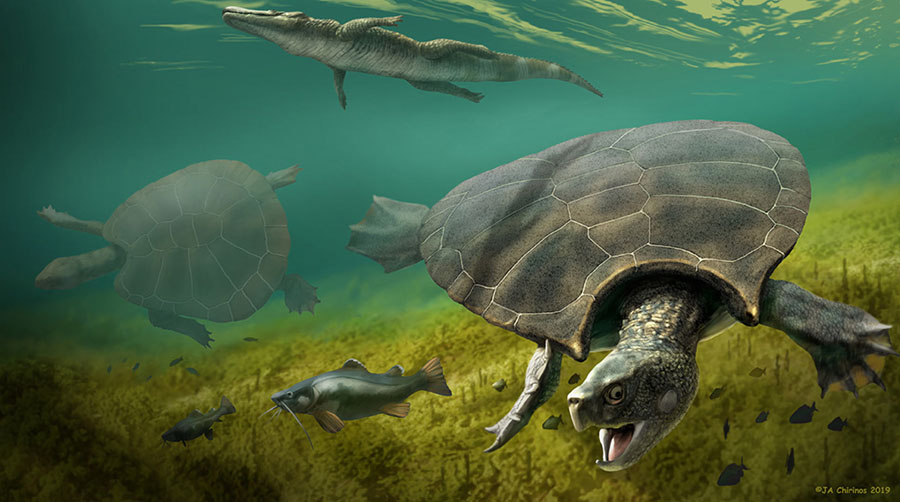
Reconstruction of Stupendemys geographicus male (front) and female (middle-left), together with the giant caimanine Purussaurus mirandai and the large catfish Phractocephalus nassi. Image credit: Jaime Chirinos.

An international team of paleontologists has unearthed several well-preserved shells and the first known jaw specimen of Stupendemys geographicus, a species of freshwater side-necked turtle that lived 5-10 million years ago (Miocene Epoch) in South America. Together, the fossils shed new light on the biology, past distribution, and phylogenetic position of the gigantic turtle.

“Since the extinction of dinosaurs, the northern Neotropics have harbored now-extinct vertebrates that have been at the extreme of large size within their respective clades,” said team leader Dr. Marcelo Sánchez, director of the Paleontological Institute and Museum at the University of Zurich, and colleagues.

“Among them are the largest snake, caimanine crocodile, gharial, and some of the largest rodents.”

“One of the most iconic of these species is the gigantic turtle Stupendemys geographicus, as it is the largest non-marine turtle ever known from a complete shell.”

Stupendemys geographicus was first described in 1976 from the Urumaco Formation in northwestern Venezuela, but our knowledge of this animal has been based on partial specimens that have resulted in a problematic taxonomy, especially due to a lack of specimens with associated skull and shell elements.”

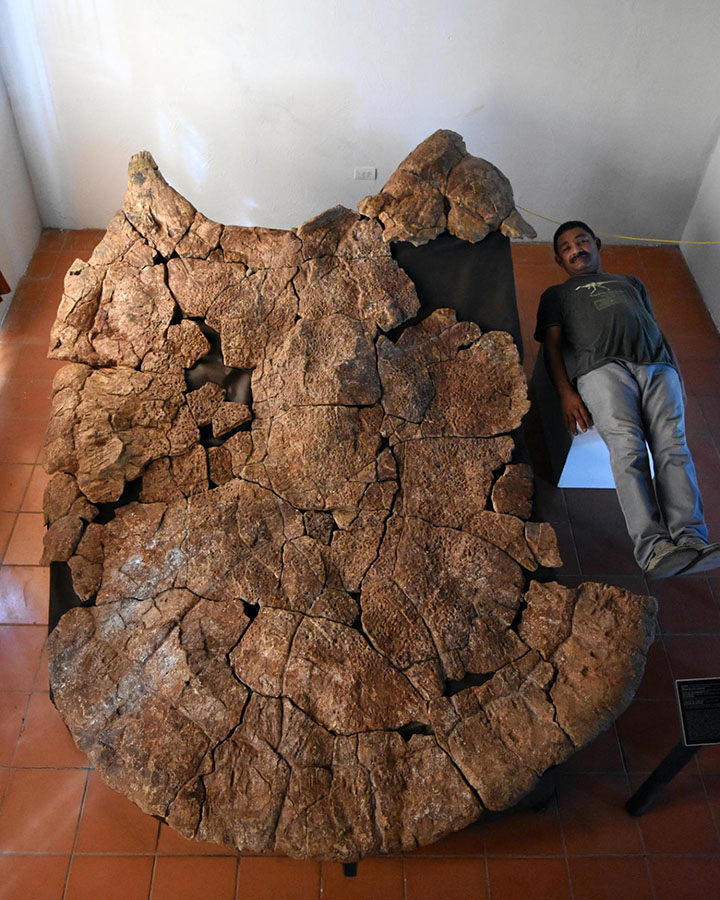
Paleontologist Rodolfo Sánchez and an 8-million-year-old carapace of male Stupendemys geographicus from Urumaco, Venezuela. Image credit: Edwin Cadena.

Dr. Sánchez and co-authors unearthed and examined new specimens of Stupendemys geographicus in the Urumaco region in Venezuela and La Tatacoa Desert in Colombia.

The finds included the largest shell reported for any extant or extinct turtle, with a carapace length of 2.4 m (8 feet) and estimated mass of 1.145 kg, almost 100 times the size of its closest living relative.

“The carapace of some Stupendemys geographicus individuals reached almost 3 m (10 feet), making it one of the largest, if not the largest turtle that ever existed,” Dr. Sánchez said.

In some specimens, the researchers observed a peculiar and unexpected feature: horns.

“The two shell types indicate that two sexes of Stupendemys geographicus existed: males with horned shells and females with hornless shells,” Dr. Sánchez said.

“This is the first time that sexual dimorphism in the form of horned shells has been reported for any of the side-necked turtles, one of the two major groups of turtles world-wide.”

The scientists were also able to revise the evolutionary relationships of this species within the turtle tree of life.

“Based on studies of the turtle anatomy, we now know that some living turtles from the Amazon region are the closest living relatives,” Dr. Sánchez said.

“Furthermore, the new discoveries and the investigation of existing fossils from Brazil, Colombia and Venezuela indicate a much wider geographic distribution of Stupendemys geographicus than previously assumed. The animal lived across the whole of the northern part of South America.”

“Despite its tremendous size, the turtle had natural enemies,” the authors added.

“In many areas, the occurrence of Stupendemys geographicus coincides with Purussaurus, the largest caimans.”

“This was most likely a predator of the giant turtle, given not only its size and dietary preferences, but also as inferred by bite marks and punctured bones in fossil carapaces of Stupendemys geographicus.”

The research is described in a paper in the journal Science Advances.

_____

E.-A. Cadena et al. 2020. The anatomy, paleobiology, and evolutionary relationships of the largest extinct side-necked turtle. Science Advances 6 (7): eaay4593; doi: 10.1126/sciadv.aay4593

Source: www.sci-news.com/

How Have Dinosaur Blood Vessels Survived for Centuries?

Tuesday, February 18, 2020

Credit: Boatman et al. and Smithsonian Institute

A team of scientists led by Elizabeth Boatman at the University of Wisconsin Stout used infrared and X-ray imaging and spectromicroscopy performed at Berkeley Lab’s Advanced Light Source (ALS) to demonstrate how soft tissue structures may be preserved in dinosaur bones – countering the long-standing scientific dogma that protein-based body parts cannot survive more than 1 million years.

In their paper, the team analyzed a sample from a 66-million-year-old Tyrannosaurus rex tibia to provide evidence that vertebrate blood vessels – collagen and elastin structures that don’t fossilize like mineral-based bone – may persist across geologic time through two natural, protein-fusing “cross-linking” processes called Fenton chemistry and glycation.

First, the scientists used imaging, diffraction, spectroscopy, and immunohistochemistry to establish that structures present in the sample are indeed the animal’s original collagen-based tissue. Then, Berkeley Lab co-authors Hoi-Ying Holman and Sirine Fakra respectively performed synchrotron radiation-based Fourier-transform infrared spectromicroscopy (SR-FTIR) to examine how the cross-linked collagen molecules were arranged, and X-ray fluorescence (XRF) mapping to analyze the distribution and types of metal present in T. rex vessels.

“SR-FTIR takes images and spectra of the same sample, and so you can reveal the distribution of protein-folding patterns, which helps to identify the possible cross-linking mechanisms,” said Holman, director of the Berkeley Synchrotron Infrared Structural Biology (BSISB) Imaging Program. Fenton chemistry and glycation are both non-enzymatic reactions – meaning they can occur in deceased organisms – that are driven by the iron present in the body.

“The XRF microprobe revealed the presence of finely crystalline goethite, a very stable iron oxyhydroxide mineral, on the vessels that likely contributed to the preservation of organic molecules,” said Fakra, an ALS research scientist.

The authors believe that the cross-linking reactions they found evidence of, combined with the protection offered from being surrounded by dense mineralized bone, can explain how original soft tissues persist.

Reference

Boatman et al. (2020) Mechanisms of soft tissue and protein preservation in Tyrannosaurus rexScientific Reports. DOI: https://doi.org/10.1038/s41598-019-51680-1

Source: www.technologynetworks.com/

Pages