nandi's blog

Why Did the Dinosaurs Go Extinct? New Study Hopes to Put Debate to Rest

Saturday, January 18, 2020

Ever since a huge crater was discovered off Mexico's Yucatan Peninsula in the early 1990s, scientists have been confident that an asteroid slammed into Earth 66 million years ago and killed off the dinosaurs and most life on the planet.

But the cause has never been definitively settled, and some scientists have questioned the widely held "sudden-death by asteroid" theory. That camp believes that massive volcanic eruptions, which may have released climate-changing gases in the Spain-sized region known as the Deccan Traps, played a significant role.

Now, a group of researchers at Yale University are putting the blame back solely on the asteroid.

They say that any environmental impact from the eruptions and lava flows that occurred in the Deccan Traps (located in what is now India) happened well before the extinction event that wiped out the dinosaurs, which scientists call K-Pg.

"A lot of people have speculated that volcanoes mattered to K-Pg, and we're saying, 'no, they didn't," said Pincelli Hull, an assistant professor of geology and geophysics at Yale and lead author of the study, which published Thursday in Science.

"What our study does is take 40 years of research and adds a bunch of new research. It combines this in the most quantitative tests you can do and it really doesn't look like it (was the volcanoes)."

Some researchers believe that emissions from the volcanoes, which released gases like sulfur dioxide and carbon dioxide, weakened the ecosystem so that dinosaurs went extinct more easily when the asteroid hit.

The Deccan Traps are in present-day India.

The Yale-led study investigated the timing of this outgassing by modeling the effects of carbon dioxide and sulfur emissions on global temperatures and comparing them with paleotemperature records spanning the extinction.

They found that at least 50% or more of the major outgassing from the Deccan Traps occurred well before the asteroid impact, and only the impact coincided with the mass extinction event.

The volcanoes did "cause a warming event," but its effect had gone by the time extinction happened, said Michael Henehan, a former researcher at Yale who is now based at the GFZ German Research Centre for Geosciences.

Researchers look at cores of rock drawn from the sea bed.

"Volcanic activity in the late Cretaceous [period] caused a gradual global warming event of about two degrees, but not mass extinction," said Henehan, who compiled the paleotemperature records spanning the extinction event.

To ascertain changes in temperature back then, Henehan used proxy records based on several sources, including chemical traces in fossils and other biomarkers.

The researchers also examined cores of rock drawn from the sea floor, which showed when the asteroid hit.

"You can see impact — melted fragments of rock. It's really, really clear on these cores of rock," said Henehan.

So does this put the debate over what wiped out the dinosaurs to rest?

It should, says Hull.

"If someone came up with compelling evidence tomorrow, I'd be prepared to say we are wrong. But it really doesn't look like it based on what we know today," she said.

Source: https://edition.cnn.com/

Wulong bohaiensis: New Dinosaur Discovered in China Shows Dinosaurs Grew up Differently From Birds

Thursday, January 16, 2020

Wulong bohaiensis. The skeleton described in the new paper is remarkably complete. The name means "Dancing Dragon" in Chinese and was named in part to reference its active pose.  CREDIT: Ashley Poust

San Diego Natural History Museum paleontologist describes a dinosaur that is new to science, offers view into dinosaur-bird evolution.

A new species of feathered dinosaur has been discovered in China, and described by American and Chinese authors and published in the journal, The Anatomical Record.

The one-of-a-kind specimen offers a window into what the earth was like 120 million years ago. The fossil preserves feathers and bones that provide new information about how dinosaurs grew and how they differed from birds.

"The new dinosaur fits in with an incredible radiation of feathered, winged animals that are closely related to the origin of birds," said Dr. Ashley Poust, who analyzed the specimens while he was a student at Montana State University and during his time as a Ph.D. student at University of California, Berkeley. Poust is now postdoctoral researcher at the San Diego Natural History Museum.

"Studying specimens like this not only shows us the sometimes-surprising paths that ancient life has taken, but also allows us to test ideas about how important bird characteristics, including flight, arose in the distant past."

Scientists named the dinosaur Wulong bohaiensis. Wulong is Chinese for "the dancing dragon" and references the position of the beautifully articulated specimen.

About the Discovery

The specimen was found more than a decade ago by a farmer in China, in the fossil-rich Jehol Province, and since then has been housed in the collection of The Dalian Natural History Museum in Liaoning, a northeastern Chinese province bordering North Korea and the Yellow Sea. The skeletal bones were analyzed by Poust alongside his advisor Dr. David Varricchio from Montana State University while Poust was a student there.

Larger than a common crow and smaller than a raven, but with a long, bony tail which would have doubled its length, Wulong bohaiensis had a narrow face filled with sharp teeth. Its bones were thin and small, and the animal was covered with feathers, including a wing-like array on both its arms and legs and two long plumes at the end of its tail.

This animal is one of the earliest relatives of Velociraptor, the famous dromaeosaurid theropod dinosaur that lived approximately 75 million years ago. Wulong's closest well-known relative would have been Microraptor, a genus of small, four-winged paravian dinosaurs.

The discovery is significant not only because it describes a dinosaur that is new to science, but also because it shows connection between birds and dinosaurs.

"The specimen has feathers on its limbs and tail that we associate with adult birds, but it had other features that made us think it was a juvenile," said Poust. To understand this contradiction, the scientists cut up several bones of the new dinosaur to examine under a microscope. This technique, called bone histology, is becoming a regular part of the paleontology toolbox, but it's still sometimes difficult to convince museums to let a researcher remove part of a nice skeleton. "Thankfully, our coauthors at the Dalian Natural History Museum were really forward thinking and allowed us to apply these techniques, not only to Wulong, but also to another dinosaur, a close relative that looked more adult called Sinornithosaurus."

The bones showed that the new dinosaur was a juvenile. This means that at least some dinosaurs were getting very mature looking feathers well before they were done growing. Birds grow up very fast and often don't get their adult plumage until well after they are full sized. Showy feathers, especially those used for mating, are particularly delayed. And yet here was an immature dinosaur with two long feathers extending beyond the tip of the tail.

"Either the young dinosaurs needed these tail feathers for some function we don't know about, or they were growing their feathers really differently from most living birds," explained Poust.

An additional surprise came from the second dinosaur the scientists sampled; Sinornithosaurus wasn't done growing either. The bone tissue was that of an actively growing animal and it lacked an External Fundamental System: a structure on the outside of the bone that vertebrates form when they're full size. "Here was an animal that was large and had adult looking bones: we thought it was going to be mature, but histology proved that idea wrong. It was older than Wulong, but seems to have been still growing. Researchers need to be really careful about determining whether a specimen is adult or not. Until we learn a lot more, histology is really the most dependable way."

In spite of these cautions, Poust says there is a lot more to learn about dinosaurs.

"We're talking about animals that lived twice as long ago as T. rex, so it's pretty amazing how well preserved they are. It's really very exciting to see inside these animals for the first time."

About the Jehol Biota

The area in which the specimen was found is one of the richest fossil deposits in the world. The Jehol biota is known for the incredible variety of animals that were alive at the time. It is also one of the earliest bird-rich environments, where birds, bird-like dinosaurs, and pterosaurs all shared the same habitat.

"There was a lot of flying, gliding, and flapping around these ancient lakes," says Poust. "As we continue to discover more about the diversity of these small animals it becomes interesting how they all might have fit into the ecosystem." Other important changes were happening at the same time in the Early Cretaceous, including the spread of flowering plants. "It was an alien world, but with some of the earliest feathers and earliest flowers, it would have been a pretty one."

###

Five authors contributed to the manuscript that is scheduled to be published in The Anatomical Record on January 15: Dr. Ashley Poust; Dr. Chunling Gao; Dr. David J. Varricchio; Dr. Jianlin Wu; Fengjiao Zhang.

About the San Diego Natural History Museum

The San Diego Natural History Museum (The Nat) is the second oldest scientific institution in California and the third oldest west of the Mississippi. Founded in 1874 by a small group of citizen scientists, the Museum's mission is to interpret the natural world through research, education, and exhibits; to promote understanding of the evolution and diversity of southern California and the peninsula of Baja California, Mexico; and to inspire in all people respect for the environment. The Museum is located at 1788 El Prado, San Diego, CA 92101 in Balboa Park. For more information, call 877.946.7797 or visit sdnat.org. Follow The Nat on Twitter and Instagram and join the discussion on Facebook.

Source: https://eurekalert.org/

550-Million-Year-Old Fossilized Guts Found

Wednesday, January 15, 2020

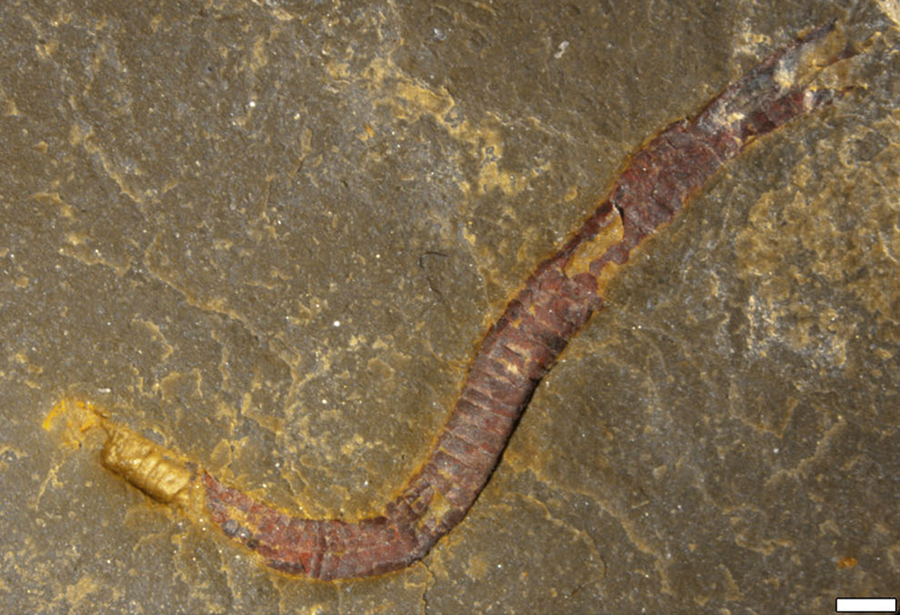
The fossilized cloudinomorph Costatubus bibendi from the Wood Canyon Formation, Nye County, Nevada, the United States. Image credit: Scale bar – 1 mm. Image credit: Selly et al, doi: 10.1080/14772019.2019.1623333 / Schiffbauer et al, doi: 10.1038/s41467-019-13882-z.

Paleontologists from the University of Missouri have discovered the well-preserved digestive tracts in the fossils of microscopic animals called cloudinomorphs. The worm-like animals lived during the Ediacaran period, some 550 million years ago.

“Not only are these structures the oldest guts yet discovered, but they also help to resolve the long-debated evolutionary positioning of this important fossil group,” said Dr. Jim Schiffbauer, a researcher in the Department of Geological Sciences and the X-ray Microanalysis Core at the University of Missouri.

“These fossils fit within a very recognizable group of organisms — the cloudinids — that scientists use to identify the last 10 to 15 million years of the Ediacaran period.”

“We can now say that their anatomical structure appears much more worm-like than coral-like.”

The cloudinomorph fossils studied by Dr. Schiffbauer and colleagues were recovered from the Wood Canyon Formation, Nye County, Nevada, the United States.

The scientists used micro-CT imaging to produce digital 3D images of the specimens.

“With CT imaging, we can quickly assess key internal features and then analyze the entire fossil without potentially damaging it,” said Dr. Tara Selly, also from the Department of Geological Sciences and the X-ray Microanalysis Core at the University of Missouri.

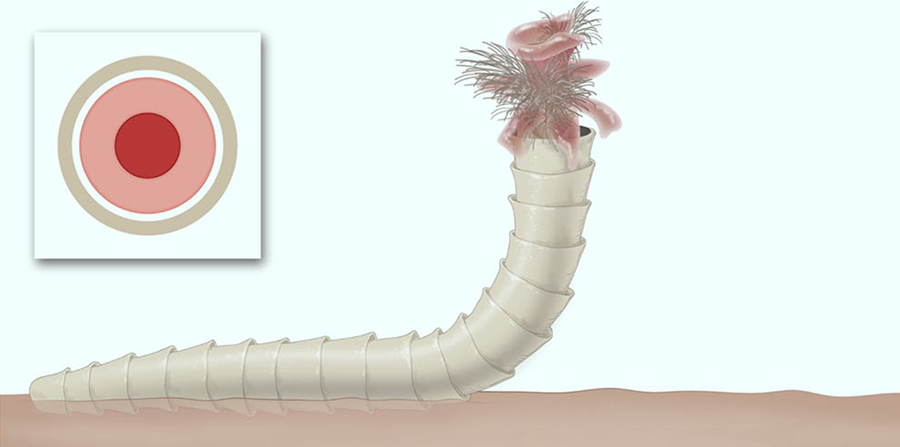
A cloudinomorph in hypothesized life position; external soft tissue hypothesized, modeled after siboglinid polychaete. Image credit: Stacy Turpin Cheavens / Schiffbauer et al, doi: 10.1038/s41467-019-13882-z.

The team was able to identify the fossilized soft tissues within the external tubes of the cloudinomorphs.

“Although alternative interpretations are plausible, these internal cylindrical structures may be most appropriately interpreted as digestive tracts, which would be, to date, the earliest-known occurrence of such features in the fossil record,” the paleontologists said.

“If this interpretation is correct, their nature as one-way through-guts not only provides evidence for establishing these fossils as definitive bilaterians but also has implications for the long-debated phylogenetic position of the broader cloudinomorphs.”

The results were published in the journal Nature Communications.

_____

J.D. Schiffbauer et al. 2020. Discovery of bilaterian-type through-guts in cloudinomorphs from the terminal Ediacaran period. Nat Commun 11, 205; doi: 10.1038/s41467-019-13882-z

Source: www.sci-news.com/

Stemonitis: World’s Oldest Slime Mold Found in Amber

Tuesday, January 14, 2020

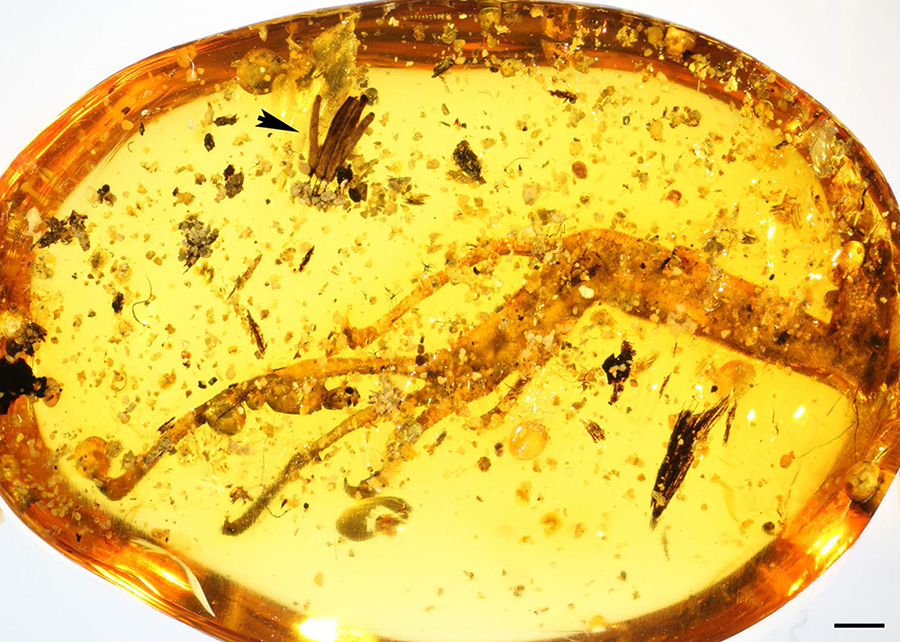
Overview of the Kachin amber specimen showing the close proximity of the myxomycete sporocarps (arrowhead) and the hind leg of an agamid lizard. Scale bar – 1 mm. Image credit: Rikkinen et al, doi: 10.1038/s41598-019-55622-9.

The fossilized fruiting bodies of a myxomycete from the extant genus Stemonitis preserved in Kachin amber date back some 100 million years (mid-Cretaceous period) and represent the oldest record of myxomycetes known to date.

Myxomycetes or ‘slime molds’ are a monophyletic lineage of eukaryotes that produce intriguing, morphologically complex fruiting bodies,” said University of Helsinki’s Professor Jouko Rikkinen and colleagues.

“They are phylogenetically an ancient lineage within the Amoebozoa, but like most amoeboid microorganisms, direct evidence of their evolutionary history is extremely scarce.”

The piece of amber containing the fossil myxomycete came from the outcrop near Tanai, a village in Kachin State, northern Myanmar.

The specimen consists of a group of six stalked fruiting bodies (sporocarps) entrapped in resin while young, with almost entire spore mass.

“The fragile fruiting bodies were most likely torn from the tree bark by a lizard, which was also caught in the sticky tree resin, and finally embedded in it together with the reptile,” Professor Rikkinen said.

“The lizard detached the fruiting bodies at a relatively early stage when the spores had not yet been released, which now reveals valuable information about the evolutionary history of these fascinating organisms.”

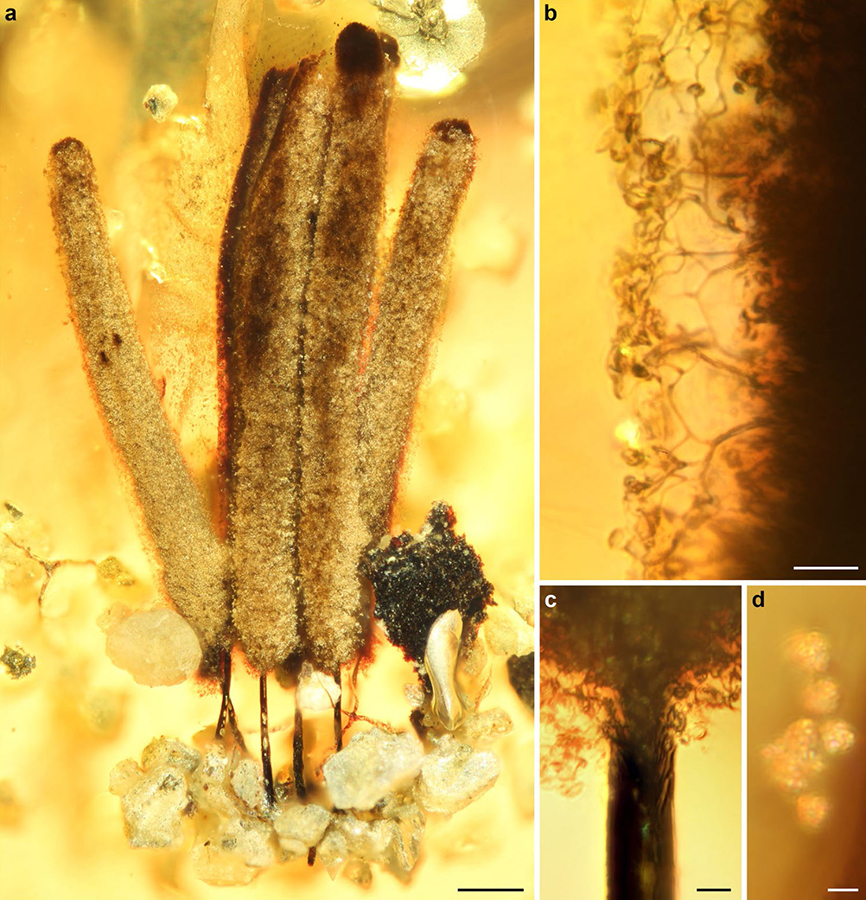
Fossil Stemonitis in Kachin amber: (a) general habitus of sporocarps; (b) surface of sporotheca, showing details of capillitium; (c) base of sporotheca, showing stalk continuing as a columella into the sporotheca; (d) detached spores. Scale bars – 200 µm in (a), 20 µm in (b), 10 µm in (c), and 5 µm in (d). Image credit: Rikkinen et al, doi: 10.1038/s41598-019-55622-9.

According to the team, the sporocarps of the ancient myxomycete are indistinguishable from Stemonitis, one of the two main lineages of the myxomycetes.

“The fossil provides unique insights into the longevity of the ecological adaptations of myxomycetes,” said University of Göttingen’s Professor Alexander Schmidt.

“We interpret this as evidence of strong environmental selection. It seems that slime molds that spread very small spores using the wind had an advantage,” Professor Rikkinen added.

“The ability of slime molds to develop long-lasting resting stages in their life cycle, which can last for years, probably contributes to the remarkable similarity of the fossil to its closest present-day relatives.”

The team’s paper was published in the journal Scientific Reports.

_____

J. Rikkinen et al. 2019. Morphological stasis in the first myxomycete from the Mesozoic, and the likely role of cryptobiosis. Sci Rep 9, 19730; doi: 10.1038/s41598-019-55622-9

Source: www.sci-news.com/

Dinosaurs Also Suffered From Cancer, Belgian Scientists Discover

Tuesday, January 14, 2020

"Diseases look the same independent of what critter is affected." Credit: Wikipedia.

Sauropods – the largest dinosaurs that have ever lived on Earth – were also prone to develop bone diseases such as cancer, according to new research conducted by two Belgian universities.

Researcher scientists from VUB and the University of Liège revealed the findings in an article published in the scientific journal Philosophical Transactions B.

By studying these bone samples, the team, led by Benjamin Jentgen-Ceschino, PhD student at ULiège, concluded that cancer and other tumoral and infectious conditions are not recent pathologies.

Studying a bone sample from cf. Isanosaurus of the Lower Jurassic (about 200 million years ago), researchers discovered no growth was beyond the development of fine spicules on the external surface of the bone, meaning that the animal died soon after.

These spicules are typically associated with malignant bone tumours and therefore correspond to the hypothesis of the development of malignant bone cancer in this individual. 

A second sample – this time from a Spinophorosaurus – which showed similar growths seemed to show that some may have survived the disease.

This could be a reaction to a benign tumour or a viral infection, explained Jentgen-Ceschino, “but the rest of the skeleton of this specific individual also has several other pathologies, indicating that the Spinophorosaurus specimen studied here suffered several times different types of trauma during his life,” he added.

RELATED: Lufengosaurus huenei: Jurassic Dinosaur Diagnosed With Bone Disease

“This study also shows that many fossil pathologies have probably gone unnoticed until now,” concluded Valentin Fischer (ULiège).

The bones had previously been harvested by Koen Stein, a palaeontologist at the VUB and co-author of the study, Belga reports.

“When I harvested these dinosaur bones in 2008 for my doctoral research on bone growth in sauropods, I noticed that they had aberrant bone tissue, I never had time to describe and analyze them in detail,” said Stein.

 “It is thanks to the meticulous work of Benjamin, who analysed dozens of medical and veterinary cases, that the team succeeded in narrowing the list of potential causes of these diseases,” he added. 

Previous work by radiologist Bruce Rothschild of the Northeastern Ohio Universities College of Medicine in Rootstown also showed certain dinosaurs could get the disease.

“Diseases look the same independent of what critter is affected,” explained Rothschild.

Source: www.brusselstimes.com/

The Many Lives of Triceratops Skull No. 21

Tuesday, January 14, 2020

A 3D model of the restoration of Triceratops skull No. 21, which the Peabody traded to the Delft University Geological Museum in the 1950s. The restoration is underway in the Netherlands. (Photo credit: Javid Jooshesh, Naturalis)

In November 1956, a Yale-owned Triceratops skull made a perilous transatlantic journey from the Peabody Museum of Natural History to the Delft University Geological Museum in the Netherlands.

The ship carrying the tri-horned herbivore’s head, which the Peabody had agreed to trade for a collection of marine invertebrate fossils, encountered rough seas, and the 1,000-pound skull, though carefully packed, jostled violently in the cargo hold. More fatefully, its crate was apparently dropped upon arrival in Delft: The skull, which had been painstakingly reconstructed from fossil fragments at Yale, smashed into hundreds of pieces.

Curators in the Netherlands again reconstructed the shattered treasure, using plaster and wire frames to fill in gaps caused by the damage and shortcomings in the original specimen. Then they put it on display, and there the matter rested until January 2015.

That was when Daniel Brinkman, a museum assistant in the Peabody’s Division of Vertebrate Paleontology, fielded an inquiry from a researcher at the Naturalis Biodiversity Center, the Netherlands’ national natural history museum. The Dutch were planning a third, more scientifically accurate, reconstruction of the skull, and the Dutch researcher, Dylan Bastiaans, sought information about “Triceratops skull 21.”

“It came in out of the blue,” said Brinkman, who had been unaware that a Triceratops skull had left the Peabody for Delft in 1956. “Dylan was hoping we had some of the missing pieces that for one reason or another weren’t included in the original reconstruction.”

The Dutch team works on the skull reconstruction. They are using data from skulls that were on view at the Peabody to design and create missing pieces with a 3D printer. (Photo credit: Hanneke Jacobs, Naturalis)

Bastiaans provided a photograph showing that the skull bore the Peabody’s standard late-19th-century field-number designations, a promising start. At first, Brinkman couldn’t find any records of the fossil exchange. But the field number strongly suggested Bastiaans was referring to Triceratops specimen YPM VP 001832 — a skull collected during an 1891 Yale expedition in the Lance Formation in Wyoming led by John Bell Hatcher 1884 B.Phil., a protégé of famed Yale paleontologist O.C. Marsh.

Digging into the division’s library, Brinkman made the big find he needed — a 1986 paper co-authored by the renowned Yale vertebrate paleontologist John Ostrom. It confirmed that “skull 21” was, in fact, the specimen Hatcher excavated in 1891. Brinkman forged ahead, scouring the vertebrate paleontology collections in the Peabody’s basement, and ultimately came up with four drawers of fossilized bones belonging to the triceratops, including pieces of cranium.

But he still had no record of the swap.

Then Bastiaans found one: A Dutch publication had cited the deal, placing it in time. This prompted Brinkman to ask Yale colleague Jessica Utrup, a museum assistant in the Division of Invertebrate Paleontology, to search the archives of Yale invertebrate paleontologist Carl Owen Dunbar, who had directed the Peabody Museum from 1942 to 1959.

Utrup discovered a sheaf of related correspondence.

In a letter to a Dr. Kruizinga dated Oct. 19, 1953, Dunbar expressed admiration for the “fine collection of Triassic and Permian of fossils from Timor” that had arrived that summer. He promised to send a “good skull of a Triceratops.”

It was Dunbar who selected “skull 21” for the exchange. He promised that Yale would reconstruct the skull, then in pieces and still partially embedded in rock, before shipping it to Delft. The work took years due to preparators’ workload, according to the correspondence. Eventually, in the fall of 1956, the skull made its fateful journey across the Atlantic.

“Dirk,” a Triceratops skeleton on view at Naturalis, the Netherlands' national natural history museum. Data from Peabody specimens contributed to the reconstruction of Dirk’s skull. (Photo credit: Mike Bink Fotografie)

While the Dutch geologists’ original reconstruction, finished in 1961, was precise in places, it left the specimen with scientifically inaccurate features, including the orientation of its horns and frill — the bony shield at the back of the skull — Brinkman and the Dutch researchers said. The Dutch had decided a complete overhaul was necessary to make the specimen truly suitable for study and exhibition.

In the summer of 2018, Bastiaans and colleague Valentin Vanhecke came to New Haven to make 3D scans of the Peabody’s three best Triceratops skulls, then exhibited in the Great Hall. (One is now displayed outside the new O.C. Marsh Auditorium in the new Yale Science Building. Marsh used this skull specimen in 1889 to first describe and name the Triceratops species.)

Additionally, the Peabody shipped to the Netherlands about 80 pounds worth of skull fragments Brinkman had rediscovered.

Today, the Dutch conservators are using information from the scans made in New Haven to prepare the completer and more accurate specimen. They’ll use 3D printers to make pieces for filling the final gaps in the skull.

“It’s like putting together a jigsaw puzzle that’s missing some pieces,” said Brinkman.

The accuracy of the 3D scans and printing eliminates much of the guesswork and artistic license that can accompany fossil reconstructions using plaster and clay, said Anne Schulp, a Dutch paleontologist and researcher at Naturalis.

“It’s real data from complementary specimens, which makes it much easier to accurately connect the dots,” he said.

The Dutch conservators also used information from the Peabody skulls to help reconstruct the frill on a separate, nearly complete Triceratops skeleton, nicknamed “Dirk,” that went on view in September at Naturalis’ new museum in Leiden.

“We had scans from a variety of skulls, but the data from the Yale collection was by far the best match,” Schulp said. “It was extremely helpful.”

Schulp and his colleagues had excavated Dirk in the Lance Formation — near the place where John Bell Hatcher collected the Peabody’s specimens more than a century ago.

Once completed, the now thrice-reconstructed Triceratops Skull No. 21 will be exhibited at Delft University of Technology.

“It’s a famous local personality there,” Schulp said.

Source: https://news.yale.edu/

Scientists Argue a 'Corpse Signal' Will Be Left in The Fossil Record of Our Time

Sunday, January 12, 2020

(MR.SUTIN YUUKRUNG/Getty Images)

Today, the vast majority of scientists agree that humans are causing unprecedented changes to our planet. Yet whether that warrants delineating an entirely new epoch is something geologists continue to disagree on.

Some think the impact of humans is now so great, it exceeds the natural processes of the Holocene, while others argue there's no clear marker in the geological record of the age of humans - the so-called Anthropocene.

Palaeontologists Roy Plotnick and Karen Koy fall in the former category, and they think our fossil record is a dead give-away. In a new paper, the pair argue that in the far future - say, a hundred thousand years from now - fossils of our age will point unmistakably towards humans.

Rather morbidly, they call it the "corpse signal", and it's entirely our fault. Since humans have been on this Earth, the total biomass of wild mammals has fallen by as much as 65 percent; at the same time, the overall biomass of mammals has quadrupled.

The main reason for this tip of the scales is a huge and continuous growth in livestock and humans. This suggests that today, cows, pigs and chickens are far more likely to become "potential fossils".

Throw in domestic pets, like the worldwide dog population of 900 million and the 100 million feral cats, and wild mammals stand even less of a shot.

"The chance of a wild animal becoming part of the fossil record has become very small," says earth and environmental scientist Plotnick from the University of Illinois at Chicago.

"Instead, the future mammal record will be mostly cows, pigs, sheep, goats, dogs, cats, etc., and people themselves."

It's not the first time, this idea has been suggested. In 2018, scientists argued that domestic chickens may act as a marker for the Anthropocene, given their worldwide distribution and their massive population size.

But Plotnick and Koy think this goes far beyond the chicken. After all, there are several other animals like cows, pigs and even humans, that together have almost entirely supplanted wild animals.

What's more, corpses in gravesites and landfills leave behind reasonably complete skeletons that can stay well preserved. Even when livestock are thrown in the dump after being used, solitary bones and cut pieces usually remain.

"These ordered graves are essentially worldwide, so you'll be finding people's remains the same way all over the place," Koy told Science Magazine in an interview.

"I don't know if 'creepy' is quite the right word, but imagine you're an alien from another species and you find this world just covered in these bodies all laid out in a specific way all over its surface; just imagine what that would look like."

Using Michigan as an example - given its potential for creating long-lived fossils - Plotnick and Koy argue that today's vertebrate fossil record would most likely include humans, cattle, pigs, chickens and dogs. In fact, in their analysis, wild deer and other prized hunting animals were the only real exception to that rule.

"In sum," the authors write, "the future vertebrate paleontologist will observe a widespread and distinctive biostratigraphic unit, clearly demarcated from the levels below it."

"Fundamentally, the fossil record of the modern interval will be archeological, not paleontological, and definitely 'Anthropocene'."

Such conclusions are not likely to end the debate over this controversial new epoch, but the "corpse signal" represents an intriguing new marker for research.

The study was published in Anthropocene.

Source: www.sciencealert.com/

Fukui Dinosaur Museum Renovation to Spark Roaring Trade

Monday, January 13, 2020

The Fukui Prefectural Dinosaur Museum

A dinosaur museum in Fukui Prefecture is set to receive a 9.4 billion yen ($86 million) facelift as the local government in the region known as Japan's fossil epicenter looks to boost visitor numbers by 50 percent.

Renovations at the Fukui Prefectural Dinosaur Museum are to be completed by 2023 with enlarged exhibition spaces set to make what is already Japan's largest dinosaur museum even larger.

The facility currently displays about 41,000 items in its 15,000-square-meter floor space, according to the prefecture.

More than 80 percent of dinosaur fossils discovered in Japan are dug up in the prefecture, the local government says.

Dinosaur Museum - FUKUI

With the floor space expanded by 5,700 sq meters, the renovated facility is planned to open in the summer of 2023 following the start of the Hokuriku Shinkansen bullet train serves to Fukui in the spring of that year.

The local government hopes that the annual number of dinosaur museum visitors will hit 1.4 million after the renovation is completed. The current record is 938,000 set in the year ended March 2019.

The museum in Katsuyama, which was established in 2000, will introduce a new section to offer interactive fossil excavation and replica-making lessons and a video room with 10-meter ceilings in which to display life-size dinosaurs.

Foreign language audio guide availability will also be improved.

Giants Roam Fukui at Prefectural Dinosaur Museum

Source: https://english.kyodonews.net/

Tyrannosaurus rex: The Teen Years

Monday, January 13, 2020

The fossilized skull of “Jane,” a juvenile T. rex at a museum in Rockford, Illinois. She is estimated to have been about 13 years old at the time of death. She was slender, with knife-like teeth not yet big enough to crush bone. Image via Scott A. Williams/ OSU.

Growing up Tyrannosaurus rex: A new study from Oklahoma State University provides details about what life was like for the famous dinosaurs during their juvenile teenage years.

When we think of dinosaurs, Tyrannosaurus rex – or T. rex – quickly comes to mind. This is hardly surprising, since T. rex is often called the king of dinosaurs and is probably the most famous dinosaur ever to have walked the Earth. An adult T. rex was a huge carnivorous predator with teeth that could crush the bones of any poor victim it caught. Scientists have learned a lot about this mighty and ferocious creature over the years. Now a new study is shedding more light on what T. rex teens were like.

The study was led by Holly Woodward of Oklahoma State University (OSU). It focuses on the bones of two mid-sized T. rex skeletons nicknamed Jane and Petey. The new peer-reviewed paper was published in the journal Science Advances on January 1, 2020.

Jane and Petey’s bones were first discovered and collected in the early 2000s in Carter County, Montana, by Burpee Museum of Natural History in Rockford, Illinois.

As with other dinosaur species, museums and scientists will often focus on the largest and most impressive fossils, including those of T. rex. That’s understandable, especially for public displays, but the OSU team wanted to study younger specimens of T.rex as well. As Woodward explained in a statement:

Historically, many museums would collect the biggest, most impressive fossils of a dinosaur species for display and ignore the others. The problem is that those smaller fossils may be from younger animals. So, for a long while we’ve had large gaps in our understanding of how dinosaurs grew up, and T. rex is no exception.

By examining the fossils of younger T. rexes, scientists can better understand how they changed as they got older, including their bones and proportions. They can also use paleohistology – the microscopic study of fossil bone structure – to learn about juvenile growth rates and ages. In the case of Jane and Petey, researchers removed thin slices of leg bones from fossils, and examined them under powerful microscopes.

The complete skeleton of Jane. Image via Burpee Museum of Natural History/ Smithsonian Magazine.

As Woodward pointed out, huge dinosaur bones are also fossilized on a microscopic scale, not just as large bones the way we see them:

To me, it’s always amazing to find that if you have something like a huge fossilized dinosaur bone, it’s fossilized on the microscopic level as well. And by comparing these fossilized microstructures to similar features found in modern bone, we know they provide clues to metabolism, growth rate, and age.

So what were T. rex teens – smaller but still ferocious predators – like?

Woodward and her colleagues found that they grew as fast as modern mammals and birds. It took the juvenile T. rexes about 20 years to mature into adults, these scientists said. They determined the ages of Jane and Petey by counting the number of annular rings in the bones, in much the same way that tree rings are counted. It turned out the two teen dinosaurs were about 13 and 15 years old, respectively – teenage T. rexes. According to Woodward:

The spacing between annual growth rings record how much an individual grows from one year to the next. The spacing between the rings within Jane, Petey, and even older individuals is inconsistent – some years the spacing is close together, and other years it’s spread apart.

Juveniles were fast and had knife-like teeth. Adult T. rexes, though, were slower but had powerful jaws and teeth to crush bones. The researchers also found that if food was more scarce in a particular year for younger T. rexes, then they didn’t grow as much during that time period.

But if there was a lot of food, then they grew a lot.

An updated artist’s depiction of a fully-grown T. rex. More recent studies suggest the fearsome beasts had feathers on their heads, backs and tails. Image via Zhao Chuang/ PNSO/ Business Insider.

After Jane and Petey were first discovered, there was speculation that they might not be T. rexes at all, but rather belonged to a pygmy relative species called Nanotyrannus. Studies of the bones, however, confirmed they were juvenile T. rexes.

Our concepts of T. rex have changed over the years, with more recent findings suggesting that fully-grown T. rexes had feathers on the top of their heads, backs and tails. A fully-grown T. rex was fearsome, standing about 12 to 13 feet high at the hip, and about 40 to 43 feet long. Paleontologists have found most T. rex fossils in the northwestern U.S., in states such as Montana and South Dakota, as well as in Alberta, Canada. T. rex lived at the very end of the Late Cretaceous period, about 90 to 66 million years ago.

Bottom line: A new study from Oklahoma State University provides new details about what the famous Tyrannosaurus rex dinosaurs were like during their teenage years.

Source: Growing up Tyrannosaurus rex: Osteohistology refutes the pygmy “Nanotyrannus” and supports ontogenetic niche partitioning in juvenile Tyrannosaurus

Via OSU News and Information   /    https://earthsky.org/

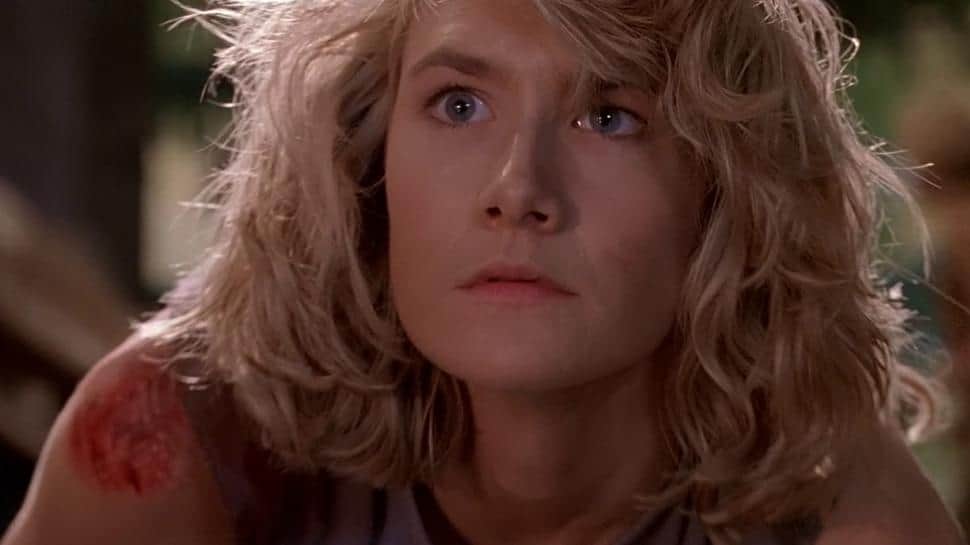
Laura Dern Overjoyed that Her Jurassic Park Character is Feminist Icon

Sunday, January 12, 2020

Laura Dern is the Secret to JURASSIC PARK's Longevity

Laura Dern is overjoyed that her Jurassic Park character Dr. Ellie Sattler is a feminist icon for women.

The no-nonsense paleobotanist needs no leading man to save her in the 1993 movie, directed by Steven Spielberg, as she battles velociraptors to save the lives of Sam Neill and Jeff Goldblum at the ill-fated dinosaur park.

Since then, Laura revealed that she's been approached by women who love telling her how much they adore Ellie.
“I’ve had so many girls and women come up to me over the years talking about her being an icon for them, and that’s meant so much to me," she told Deadline.

And the 52-year-old is proud that she played such a strong character in Spielberg’s groundbreaking film.

RELATED: 10 Scariest Moments From The Jurassic Park Franchise

"I think the thing I love the most about playing Ellie Sattler, and this was the early ’90s, was that it was the first CGI movie ever," Laura explained. "We were going to do, it felt like, this wild thing that Steven wanted to attempt, which had never been done before.

"And he wanted to make sure that if all worked well, that the female in the centre of the story was as much of a bada*s and as fearless as anyone else. He took it seriously, and she was kind of a feminist.”

The Golden Globe-winning actress is excited to reprise her role for the upcoming Jurassic World 3, alongside her original Jurassic Park co-stars, ahead of a 2021 cinema release.

"It’s exciting to continue that journey and see what they come up with, and I’m excited to learn. Steven seems excited. Sam and Jeff seem excited, and I love that, so it’s really fun to think about," she gushed.

Source: www.film-news.co.uk/

Pages