Blogs

Hummingbird-Size Dinosaur May Actually be a Lizard

Saturday, July 25, 2020

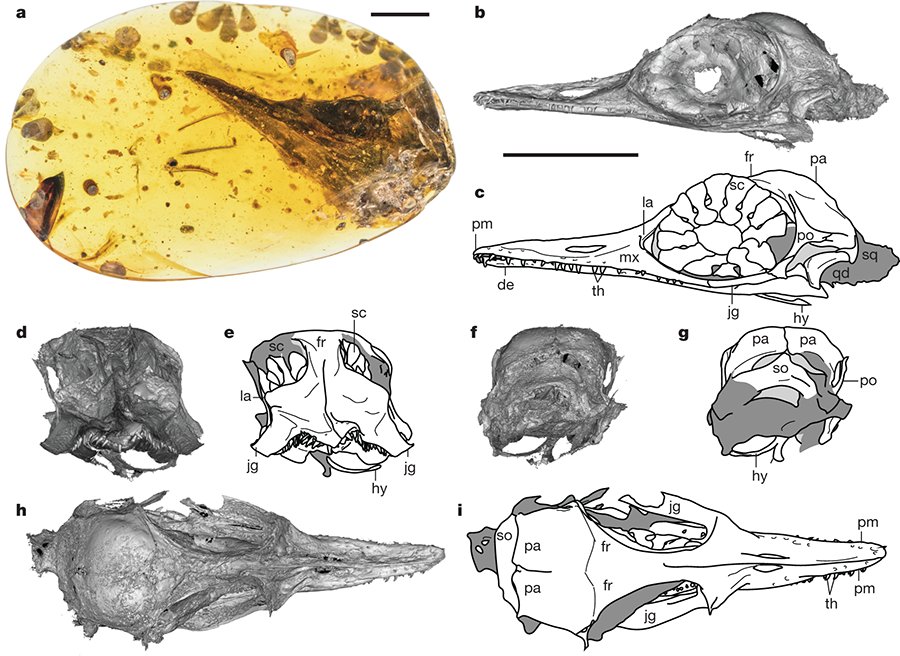
Researchers initially thought this skull belonged to a bird-like dinosaur. Now, evidence suggests that it's the head of a lizard. (Image: © Lida Xing)

The jury's still out until another specimen of the species gets analyzed.

A fossil attributed to a teensy, feathered dinosaur may not be a dinosaur at all, but rather a ... lizard, according to new research. With the new criticism, the March study — titled "Hummingbird-sized dinosaur from the Cretaceous period of Myanmar" was retracted yesterday (July 22) from the journal Nature where it had been published, according to a statement in the journal. 

The creature’s 99 million-year-old skull was entombed in amber when scientists discovered it in a mine in Myanmar (formerly Burma), and while the creature was somewhat of a weirdo with its bird-like head and roughly 100 super-sharp teeth, researchers concluded this was likely the smallest dinosaur ever found. (It likely weighed just 0.07 ounces (2 grams), the weight of two dollar bills, Live Science previously reported.)

Whether the animal (Oculudentavis khaungraae) was a bird-like dinosaur or a lizard, that doesn’t negate the finding's importance, the study’s scientists say. "It's just a really weird animal and an important discovery regardless of whether it's a weird bird or a weird lizard with a bird head," study co-lead researcher Jingmai O'Connor, a senior professor of vertebrate paleontology at the Chinese Academy of Sciences, told Live Science in an email.

One study posted on bioRxiv, a preprint database where studies are “published" before they undergo review by science peers, posits that the specimen is a lizard. In this new study, Zhiheng Li, from the Institute of Vertebrate Paleontology and Paleoanthropology at the Chinese Academy of Sciences, and colleagues looked back through the computed tomography (CT) scans of the little animal. They found several features of the animal that contradicted the idea of a bird-like dinosaur and said that it aligned much better with lizard traits. These included features of the animal’s lizard-like teeth and the features on its fenestra, or the openings in the skull behind the eye sockets that are found in animals such as dinosaurs and lizards.


A CT (computed tomography) scan of Oculudentavis khaungraae's skull. It even appears that the creatures's tongue is preserved, the researchers said.  (Image credit: Gang Li )

O'Connor and her colleagues posted their response, also on bioRxiv, saying that while they "welcome any new interpretation or alternative hypothesis," of the creature, this new research "failed to provide conclusive evidence for the reidentification." However, O'Connor did tell Live Science that "I do think we were wrong and that Oculudentavis is a lizard, not a bird — you just can't prove it unequivocally with the available evidence."

So, the jury is still out on the creature’s true identity. Another team of researchers (different from the bioRxiv group) is studying a different specimen of the same species, but they have yet to publish their findings. If the creature is, in fact, a lizard, the fossil could represent a "new and strange instance of convergent evolution between widely disparate reptile groups," O'Connor said. (Convergent evolution occurs when two organisms that are not closely related evolve similar traits. In this case, the creature had a bird-like head.)

O'Connor noted that she had tested whether the specimen was a bird or a lizard in a phylogenetic, or family tree, analysis, that included several fossil birds. "As long as any other birds were included in the analysis, Oculudentavis was resolved as a bird," O'Connor said. "Removal of all birds made it resolve as a lizard but also caused major reptile clades to collapse, showing just how weird the specimen is."

In addition, O'Connor said that Burmese amber is known to preserve hummingbird-size birds that lived during the Cretaceous period (145 million to 65 million years ago) in what is now Myanmar. However, it's possible this creature wasn't among them, she said.

The Society of Vertebrate Paleontology (SVP) published a letter in April (a month after the original Nature study came out) asking that its members refrain from using Burmese amber collected in or exported from Myanmar since June 2017, because profits earned from selling this amber might fuel the country's decades-long civil war, according to a 2019 piece published in Science magazine. However, the piece that O'Connor and her colleagues examined was found in 2016.

Originally published on Live Science.

Meteors More Massive Than The Dinosaur-Killing Asteroid Struck Earth 800 Million Years Ago

Friday, July 24, 2020

An artist's illustration shows how craters on the moon preserve evidence of its violent past. (Image: © Murayama/Osaka University)

Data gathered by Japan's lunar orbiter Kaguya revealed clues about ancient impacts.

About 800 million years ago, a flurry of small asteroids slammed into the moon, pocking the lunar surface with clusters of craters. But the moon wasn't the only victim of this cosmic bombardment.

If the moon experienced multiple asteroid strikes during this time, its close neighbor and parent planet — Earth — was probably also scarred by the same cosmic "storm," even if time has long since erased all traces of those ancient impacts. And that massive bombardment may have turned Earth into a giant snowball, researchers reported in a new study.

Judging by the size and number of the lunar craters, that asteroid storm would have been substantial. Scientists estimated that the collective heft of the asteroids that hit the Earth and moon may have been up to 60 times the mass of the asteroid that slammed into what is now Mexico and formed the Chicxulub crater, ending the reign of the dinosaurs.

Even when seen from Earth without much magnification, the moon's face is marred by thousands of craters, created by whizzing space rocks that pelted the early solar system. By studying the size and clustering of impact craters on different parts of the lunar surface, scientists can approximate the ages of these scars, a technique known as "crater chronology," lead study author Kentaro Terada, a professor in the Department of Earth and Space Science at Osaka University in Japan, told Live Science in an email.

For the new study, Terada and his co-authors analyzed lunar data collected by the Japanese space agency's moonbound mission Selenological and Engineering Explorer (SELENE), launched in 2007. (This probe quickly became known as "Kaguya" after Kaguya-hime, a moon princess in a popular Japanese folktale, Live Science sister site Space.com reported that year.)


Kaguya mapped the moon's enigmatic far side — the hemisphere that always faces away from Earth and is sometimes mistakenly called the “dark side” even though it receives sunlight — and on Feb. 10, 2009, Kaguya captured a stunning movie of Earth eclipsing the sun, the first moon's-eye-view of such an event. Upon the completion of its mission, Kaguya was sent diving into the moon in a controlled crash on June 10, 2009, Space.com reported.


Scientists suspected that Kaguya's observations of lunar craters could reveal much about ancient impacts on Earth. Craters on the moon don't erode as they do on Earth; while asteroid impacts on Earth that are older than 600 million years are weathered into nothingness by volcanic activity and erosion, very old impacts on the moon remain well-preserved, Terada said in the email.

Counting craters


From Kaguya's data, the researchers investigated 59 large lunar craters ranging from 12 to 58 miles (20 to 93 kilometers) in diameter. Then, in the big craters' ejecta — the circle of surrounding material ejected by the impact — the study authors counted the number of smaller craters measuring from 300 feet (0.1 km) up to 0.6 miles (1 km) in diameter. Scientists approximate the age of surfaces in the solar system by calculating the density of their craters. 


Soil samples were previously collected by the Apollo 11 mission from one of those big craters — Copernicus — dating it to about 800 million years ago. And eight of the big craters all had similar numbers of smaller craters in their ejecta, hinting that they formed around the same time, probably as a result of an asteroid shower, Terada explained. 


As the Earth and moon have coexisted as cosmic partners for approximately 4.5 billion years, "this new finding provides us with crucial insight into the Earth-moon system," the scientists wrote in the study. "Asteroid showers must have occurred not only on the moon but also on the Earth," they said.

Because the moon preserves a near-pristine record of these ancient impacts, scientists can look to the moon as "a witness to the history of the solar system," shedding light on Earth's long-vanished impact history, Terada said.

Based on the orbits of known asteroid groups around 800 million years ago, the scientists suspected that the storm was caused by a disruption of Eulalia, a rocky, carbon-rich body in our solar system's asteroid belt, measuring about 25 miles (40 km) in diameter. When the scientists modeled the size and quantity of projectiles that smashed into the moon and Earth, they calculated that the mass of the space debris would have added up to millions of billions of kilograms, according to the study.

This offers an intriguing new perspective on a dramatic climate shift in Earth's distant past that appeared between 800 million and 700 million years ago, the authors wrote. 

During this glacial period, known as "snowball Earth," the planet underwent a global deep freeze, with its entire surface blanketed in ice from pole to pole. Scientists suspected  that volcanoes or other "workings of the Earth" led to the big chill, but this new lunar evidence hints that the trigger may have originated in space, and the so-called snowball Earth may have resulted from an asteroid bombardment.

"Lunar crater chronology provides new insight into external forcing from asteroids that might have driven the global environmental change," Terada said.

The findings were published online July 21 in the journal Nature.

Originally published on Live Science.

Asio ecuadoriensis: Giant Predatory Owls Once Lived in Ecuador

Thursday, July 23, 2020

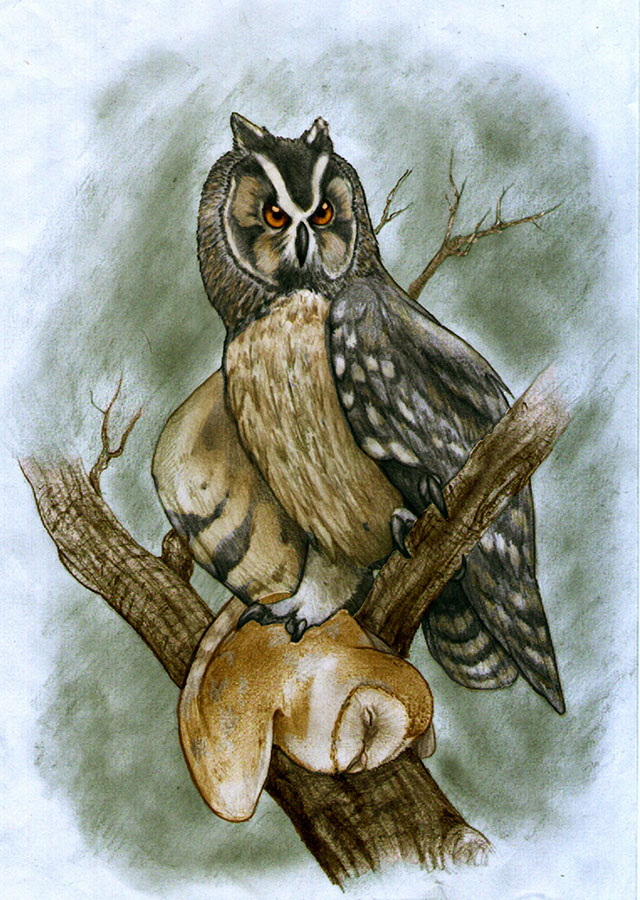
Life reconstruction of Asio ecuadoriensis. Image credit: Sebastián Rozadilla.

An extinct species of giant owl that lived 40,000 years ago (Pleistocene epoch) and preyed on smaller owls has been identified from fossils found in the Cangagua Formation in the Chimborazo province of Ecuador.

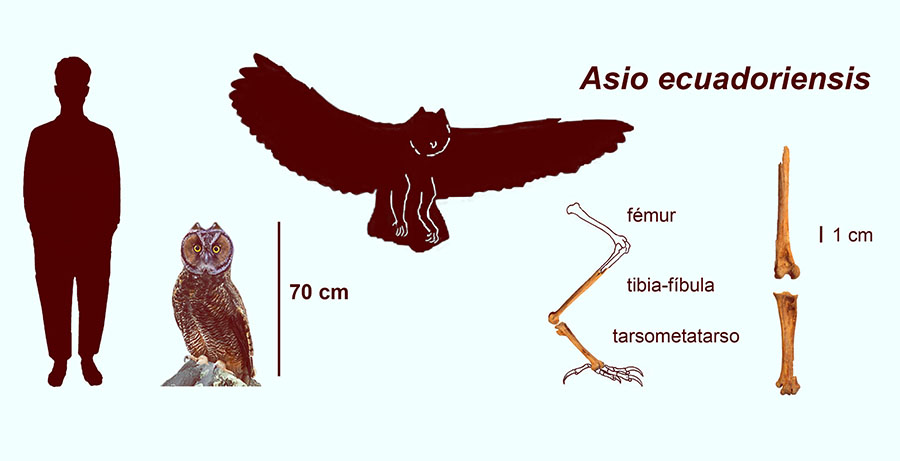
Named Asio ecuadoriensis, the ancient bird was more than 70 cm (2.3 feet) tall and had a wingspan of over 1.5 m (4.9 feet).

It had longer and more robust legs than any other extant or extinct member of its genus Asio (typical or true owls).

“We think that the climate change that occurred about 10,000 years ago, when the Ice Age ended, was partly responsible for the extinction of these large predatory birds,” said co-author Dr. Federico Agnolin, a paleontologist with the Museo Argentino de Ciencias Naturales Bernardino Rivadavia, the Concejo Nacional de Investigaciones Científicas y Técnicas, and the Fundación de Historia Natural ‘Félix de Azara.’

The fossilized bones of Asio ecuadoriensis were collected from a small cave site Dr. Agnolin and colleagues interpreted as a fossil owl burrow.

The paleontologists also found several specimens from three extant owl species (Glaucidium sp.Tyto furcata and Athene cunicularia) and skeletal remains of different mammals, including rabbits and rodents.

Size comparison between Asio ecuadoriensis and a human (left) and the preserved material of the ancient owl species (right). Image credit: Lo Coco et al, doi: 10.1007/s10336-020-01756-x.

“The fossil owl remains of TytoAthene and Glaucidium show breakage and weathering, typical of stomach acid-derived abrasion of owls,” they said.

“This indicates that, as occurs with mammals coming from the site, they would be prey items of the owl that is the owner of the burrow.”

“The large size of Asio ecuadoriensis, as well as the absence of acid-derived weathering of the bones, may constitute indirect evidence that this species is the owner of the burrow.”

Asio ecuadoriensis is probably an owl-specialized predator,” they added.

“It is well known that owls usually prey on raptors, but predation on owls by owls is uncommon and remains poorly explored in the literature.”

“If correctly interpreted, the present contribution may constitute the first fossil evidence of owl being killed by owls.”

The team’s paper was published recently in the Journal of Ornithology.

_____

G.E. Lo Coco et al. 2020. Late Pleistocene owls (Aves, Strigiformes) from Ecuador, with the description of a new species. J Ornithol 161, 713-721; doi: 10.1007/s10336-020-01756-x

Source: www.sci-news.com/

Jurassic Park: 12 Behind-The-Scenes Facts About The Epic Dinosaur Movie

Wednesday, July 22, 2020

No conversation about the most influential films of all time is legitimate without discussion of Steven Spielberg’s Jurassic Park. While the marketing made the joke that the movie was “65 million years in the making,” that isn’t a wholly misleading statement, as it truly is a technical marvel built on everything cinema had accomplished up until its making. Following its release, it generated a revolution in Hollywood, and ushered in a new era. Of course, none of any of that happens without some behind-the-scenes craziness, and the it’s certainly true that the sci-fi adventure is definitely full of fun stories and weird details.

Combing through various interviews, specials, and featurettes, we have performed a deep dive into the making of the epic blockbuster, and have built this list of great behind-the-scenes facts to know about Jurassic Park. From the birth of CGI dinosaurs to plenty of on-set silliness, we have it all for you below:

A Video Of A T-Rex Walking Changed The Movie And The Film World Forever

When Steven Spielberg started working on Jurassic Park, his plan for photography of full-scale dinosaurs in long shots was to use go motion animation – building on the techniques used in films like the original King Kong (which was a huge inspiration for the director in the making of the movie). That all changed, however, when Spielberg was asked by artists at Industrial Light And Magic about the possibility of using CGI for the work. Not initially convinced it would work, the director had them do a test and was blown away by what they made, which featured a Tyrannosaurus Rex walking across a still nature image, and then chasing a herd of Gallimimus. 

Phil Tippett, who had been hired to do the go motion, quipped that he was about to become extinct, and Spielberg ended up giving that line to Ian Malcolm when Alan Grant talks about living dinosaurs ending paleontology as a study.

Spielberg Did Dinosaur Sounds On Set That Really Weren’t Helpful

Actors today are well-versed in shooting opposite things/people that don’t exist until they are built in a computer, but it was a brand new experience for the stars of Jurassic Park. To his credit, Steven Spielberg tried to help out and add to the experience for the actors by making his own dinosaur sounds during production… but it turns out that his stars didn’t really love those efforts. To quote Sam Neill from the Blu-ray special features, “That was kind of more funny than anything, and the acting part was not laughing. It’s not easy.

The Production In Hawaii Was Hit By A Massive Hurricane

Production for Jurassic Park was primarily split between two locations, the Hawaiian island of Kaua'i and Los Angeles, California, but the former is a bit more notable since the latter doesn’t include any stories about natural disasters. Shortly before the crew was ready to wrap things up on the Pacific island, Hurricane Iniki rocked the production and forced everything to be shut down for a day. This caused some scheduling hiccups as a result and forced some things to move around, but one nice benefit for the movie is that some of the footage of the storm is featured in the film.

The Rippled Water Effect Was Stupidly Hard To Figure Out

The rippled water effect during the Tyrannosaurus Rex’s approach is one of the most iconic shots in Jurassic Park – and it’s also one that drove members of the crew totally batty. Steven Spielberg was inspired to include the effect when he noticed his rear view mirror shaking while listening to Earth Wind And Fire in his car, but the filmmakers he assigned to make it happen for the movie were baffled. Michael Lantieri, who worked on Special Dinosaur Effects for the film, finally figured it out when playing his guitar, discovering that a particular note/frequency did the trick. A special rig using a guitar string was then used on set!

The Sound Team Used Some Weird Sources For Dinosaur Sounds

The job of a sound designer seems like a fun one, taking two random sounds and manipulating them to create something wholly new and convincing. Jurassic Park is a wonderful example of this. Did you know that T-Rex footsteps are the sound of falling trees, or that their roar is a combination of baby elephant, lion, and crocodile? How about that the Velociraptor sound comes from mixing a walrus and a dolphin? You don’t hear it when first listening, but try to keep this in mind the next time you watch the film, and you’ll be amazed how clear it is.

Rain Effects Turned Out To Be A Huge Problem During The First T-Rex Attack Scene

As groundbreaking as the visual effects in Jurassic Park are, there will never be enough good things said about the dinosaurs that were built by the great wizard Stan Winston and his company – especially the Tyrannosaurus Rex. The prehistoric creature is perfection, brought to life with amazing care and detail… but that level detail of detail actually proved somewhat problematic on set. The calculations for the robot’s functionality were based on certain expectations for weight, and what was not accounted for was the amount of water that the foam layer would soak up from the rain machines. Engineers would work quickly to try and dry it between set-ups, but it got to the point where the whole thing would start violently trembling when moving.

Stan Winston’s Studio Made A Baby Triceratops That Was Never Used

The brilliant work that Stan Winston’s Studio did for Jurassic Park notably also included the sick Triceratops that Ellie Sattler and Alan Grant try to care for – but it may surprise you to learn that it wasn’t originally going to be the only three-horned dinosaur in the blockbuster. During pre-production, the effects house also went through the effort of making a baby Triceratops, though it was never actually used. Fortunately, behind the scenes footage still exists!

Jeff Goldblum Came Up With The Idea Of Trying To Be A Hero With The T-Rex

One of the best character-defining moments for Ian Malcolm in Jurassic Park comes during the Tyrannosaurus Rex attack when he stupidly tries to copy Alan Grant’s distraction move with the flares, instead screwing up a plan that was working prior to his involvement. It’s a great moment – and we have Jeff Goldblum to thank for it. The script originally called for Ian to basically make the same move as Gennaro (the lawyer) and run away like a coward, but Malcolm pitched the best intentions move as something different, and Spielberg made the change.

The T-Rex Wasn’t Initially In The Final Scene

Jurassic Park is a film that hits you with epic thrills in its final moments, as our protagonists are saved at the last minute from the terrifying Velociraptors by the shockingly quiet Tyrannosaurus Rex – but that wasn’t the ending that was featured in David Koepp’s script. Initially the idea was that the raptors would get caught up in the displayed T-Rex skeleton (one getting crushed between the jaws, other being stabbed by a rib), but by the time the production got to shooting that sequence they were brimming with confidence regarding CGI possibilities. Thus, the original ending was scrapped in favor of Rexy’s hero moment.

Spielberg First Listened To John Williams’ Jurassic Park Score While Working On Schindler’s List

Over the course of his career, Steven Spielberg has made multiple attempts to have two of his movies released in the same calendar year, but one of the strangest pairings is definitely Jurassic Park and Schindler’s List in 1993. While both are definably Spielberg, they are radically different films, and what made the situation weird (and, per the director, regrettable) is that he had to work on them simultaneously. A perfect illustration of this is that the filmmaker never got to visit any of John Williams’ scoring sessions for the dinosaur-filled adventure, and instead first listened to the various tracks while commuting to set in Poland on his next production.

Tim And Lex Switched Ages Because Of An Audition For Hook

Fans of both Steven Spielberg’s movie and Michael Crichton’s book will note that one of the notable changes made in Jurassic Park that Tim is Lex’s older brother in the source material – and weirdly that wasn’t an alteration initially made to try and benefit the story or the character relationships. Instead, the change was motivated by a promise that Spielberg made to Joseph Mazzello when the young actor tried out for a part in 1991’s Hook. Mazzello didn’t book that gig, but the filmmaker told him, “Don’t worry Joey, I’m gonna get you in a movie this summer.” You can guess what that project turned out to be.

Jurassic Park Completed Production Nearly Two Weeks Ahead Of Schedule

With Jurassic Park being such a massive production and having so many constantly-moving parts, you’d think that it would be a film that ended up needing more time for production than the original schedule allowed – but instead it managed to wrap principal photography a full 12 days early. As much as things changed on set, what allowed this to happen was meticulous planning done by Steven Spielberg, who went as far as to create scaled models versions of scenes and used a lipstick camera to find all of the angles he wanted to shoot.

If you now find yourself hungry to re-watch Jurassic Park, you can do so not only by purchasing it on digital or Blu-ray/DVD.

Source: www.cinemablend.com/

All Dinosaur And Human Villains From The Jurassic Franchise, Ranked

Tuesday, July 21, 2020

In the Jurassic Park franchise, some of the villains (human and non-human) are more iconic than the main characters. Here are all villains, ranked.

With the giant adventures seen in the Jurassic Park and Jurassic World movies, audiences need a good cast of protagonists to follow and whether it's Sam Neill's Alan Grant, Jeff Goldblum's Ian Malcolm, or Chris Pratt's Owen Grady, these films usually have great heroes.

However, the hero of a story is only one side of the coin - on the other is the villain who usually drives the plot forward in these films. These come in the forms of both human and dinosaur - some have even become more iconic than the leading characters.

19 - The Juvenile T-Rex From Jurassic Park III

Sporting a vibrant green hide, this Tyrannosaurus Rex showed much potential, but after not even a minute or two after being introduced, it comes face to face with the dreaded Spinosaurus, leading to a fight that became quite controversial due to the juvenile being killed off rather quickly.

This fight was hated amongst fans so much that even Colin Trevorrow referenced it by having the classic Rexy destroy a Spinosaurus skeleton during the climax of Jurassic World and there were plans for a rematch during the escape from Isla Nublar in Fallen Kingdom that fell through.

18 - The Raptor Pack From Jurassic Park III

Other than a few decent chases and scares, this was definitely the least memorable velociraptor pack in the long line in the series, despite the overhaul of the design to include the dark red and purple hides for the males. The most noteworthy of this pack would be the alpha female who provides a sinister threat and only appears briefly, until the end.

Even then, the end left fans disappointed, seeing as they don't attack or harm anyone. They just grab their eggs and leave, making their entire build-up over the movie's runtime seem worthless.

17 - Gunnar Eversol From Jurassic World: Fallen Kingdom

Far from bad, this villain, played by Toby Jones, simply just did not get enough time on screen to really shine in a movie that already has several villains to choose from. He's a greedy and pompous man who got viewers to hate his guts enough during the final act of the movie.

The biggest issue with him was his comeuppance, or rather, the lack thereof. There is a great build-up to his demise at the teeth of the Indoraptor, only for the movie to have his death take place off-screen to keep things PG-13. This made the villain, overall, feel wasted and not nearly as memorable as others from the same movie.

16 - The Pteranodon Flock In Jurassic Park III

One of the more underrated dinosaur threats of the franchise were these avian creatures that mixed beauty and beast together in one: elegant and regal sky-bound creatures that soar through the clouds with grace but also happen to be deadly foes if you stumble into their territory, much as the heroes did in the second act, leading to an intense chase through the aviary.

Originally, these winged dinosaurs were going to have an even bigger role, with an attack on the beach after the encounter with the raptors. Instead, this was replaced with our heroes being saved in an anti-climax that was the result of the movie's highly troubled production.

15 - Vic Hoskins From Jurassic World

Obsessed with turning raptor packs into military weapons of war, this villain was far from deep or thought-provoking, but he was effective in making things worse for our heroes and getting audiences to wish for his demise, due to a charismatic and slimy performance by Vincent D'onofrio and his more genuine chemistry with actors like Chris Pratt.

Unlike the previous human entry, this villain's fall from grace is much more satisfying, due to a visible attack from Delta, the velociraptor whom he impolitely spoke to and irritated earlier in the film.

14 - The Compsognathus (Or Compys) From The Lost World: Jurassic Park

One of these tiny critters might not seem that imposing, but much like a piranha, an attack by the whole pack becomes a terrifying scene to witness. Originally the cause of death of the more vile version of John Hammond in Michael Crighton's Jurassic Park novel, the Compys have one show-stealing sequence in the movie's sequel.

Peter Stormare's character, Dieter Stark, gets lost after separating from the group, leading to one of the slower and terror fueled deaths in the series, as many Compy chase him off-screen - only for the audience to hear his panicked screams while his blood fills the nearby creek. This was one of several deaths that help the movies more resemble horror.

13 - Ken Wheatley From Jurassic World: Fallen Kingdom

While Roland from The Lost World had some honor, Wheatley can be considered his dark counterpart, as he hunts like a coward, pulling teeth from captured dinosaurs for his necklace, nearly causes the death of Owen Grady, and does it all for just a paycheck. It's clear that this character is only meant to be hated.

This leads to one of the more entertaining kills in the franchise when he attempts to rip the tooth of the unstable Indoraptor that plays possum to lead him into a trap. After having his arm ripped off by the Indoraptor in a surprisingly bloodless fashion, audiences rooted for the hybrid to finish the job, which it gladly obliged.

12 - The Allosaurus From Battle At Big Rock

Taking place after the events of Fallen Kingdom, this short film directed by Colin Trevorrow surprised fans of the Jurassic franchise and provided a short but delightful story about a family surviving an encounter with several dinosaurs in their camper trailers.

Continuing to embrace the horror side of these prehistoric clones, the fully grown Allosaurus that attacks the family managed to leave an impact in less than 10 minutes, which is very impressive. If this short is meant to give a taste as to what is to come from Jurassic World: Dominion, fans are excited to see more from a world with these creatures.

11 - Dr. Henry Wu From The Jurassic World Movies

After a brief appearance in Jurassic Park, this character has actually been working in secret behind the scenes and in between movies to become a mad scientist that rivals the likes of Dr. Frankenstein. Unlike Hoskins, however, Wu actually brings up a good point about humans being accustomed to being the cat in a 'cat eats canary' world.

The twist of Wu being the villain and creator of hybrids like the Indominus Rex and the Indoraptor was surprising at first, but once fans read the expanded material, his character has become one of the standout human characters across the franchise, whose fate will likely reach an end in Jurassic World: Dominion.

10 - The Feral Raptors From The Lost World: Jurassic Park

These raptors seemed to be absent through most of the movie until the heroes and the hunters reach the long grassy fields, which led to these territorial beasts picking off the humans quicker than Jason Voorhees takes out camp counselors.

After that, it becomes a very intense cat and mouse game through an InGen town, with the pack going after each hero through different buildings. The only downside to these menacing hunters is that one of them is ridiculously taken out by a small girl doing gymnastics in one of the most mocked scenes in the movie.

9 - Dennis Nedry From Jurassic Park

Without this villain, audiences never would have experienced the brilliant adventure that takes the heroes across Isla Nublar to face many dinosaur threats. All of this because of a greedy slob who wouldn't take no for an answer.

Wayne Knight's devious character may not be threatening or imposing, but much like with Wheatley, he's a man with no redeeming qualities to him whatsoever. From the moment he appears to his glorious encounter with the deadly Dilophosaurus, audiences eagerly await his demise and the wait paid off.

8 - The Big One And Her Pack From Jurassic Park

The first dinosaur to kill someone in the franchise was the newest yet most cunning creature to be transferred into the park. Simply nicknamed 'The Big One,' this raptor is proven to be fearsome just from Robert Muldoon's words about her killing most of the pack and making the survivors her betas.

Providing some of the scariest moments from the iconic first film, these raptors are the reason why some people are afraid of kitchens. Fans know this pack of hunters were effective as villains when the movie made them happy to see the other main dinosaur threat of the movie to save the day.

7 - Peter Ludlow From The Lost World: Jurassic Park

The nephew of John Hammond, this InGen director is everything John Hammond was in the book: greedy, no morals, and completely devoid of respect. His entire operation on Isla Sorna is just to make money, which made audiences easily dislike him, but then the way he treats Ian Malcolm and his own uncle is enough to wish for his demise.

Another satisfying death of a villain comes when after everything from Isla Sorna to the destruction in San Diego leads him back to the ship, where he is crippled by the Buck and then finished off by the infant Rex as payback for everything he caused.

6 - The Spinosaurus From Jurassic Park III

While the third film is often considered the worst in the franchise, it did have some redeeming qualities, one of them being the main antagonist: the Spinosaurus. Even before the expanded material revealed that this creature was an accidental hybrid created by Henry Wu, this creature, on its own, was a standout villain from the moment he shows up.

With a unique and bone-chilling roar, green eyes, and an imposing physique, this theropod chases the heroes throughout the movie and seems almost unstoppable. Even with the controversial fight against the Rex, the Spino does have its fans and some are hoping for its return in Jurassic World: Dominion.

5 - Eli Mills From Jurassic World: Fallen Kingdom

Wheatley was bad, Nedry was worse, but then there was Mills, who seems decent enough at first, but as the movie goes on, the more his schemes are unveiled and the worse he gets as a person. He commits more and more acts that make the viewers come to not just hate him, but despise him for everything he does and every word he speaks.

Following Wu, he also has his own bomb to drop on Claire, in which he asks how what he's doing is any different than what she and Owen did in Jurassic World. All this leading to what many fans consider to be the best and satisfying death in the series: when Mills is attacked and murdered by, not one, not two, but three dinosaurs that tear him apart.

4 - The Indoraptor From Jurassic World: Fallen Kingdom

This unstable and horrifying hybrid is not a dinosaur at all: it is a genetic monster straight out of a horror movie that makes its predecessor look fake in comparison. The moment the Indoraptor escapes from his cage and into the Lockwood Manor, the movie becomes the closest to a horror movie the franchise will probably ever get.

The Indoraptor is a prototype, which is why the creature is constantly twitching and fumbling. It's the dinosaur equivalent to a psychotic murderer who needs a straightjacket, making it more unpredictable and out of control, thus making it scarier.

3 - The Buck And Doe From The Lost World: Jurassic Park

Rexy from the first movie made such an impact that creating new Rex antagonists for the sequel required them to stand out on their own. Luckily, Steven Spielberg nailed it with a father/mother duo that comes close to rivaling the original Rex. There are even some fans of The Lost World who find them to be their favorite Rexes.

Throughout the second movie, the heroes and hunters are constantly being hunted by these angry Rexes who have some great kills (Eddie's, in particular, is a fan favorite), but the Buck steals the show when he arrives in San Diego for a climax that harkens back to movies like GodzillaKing Kong, and The Beast From 20,000 Fathoms.

2 - The Indominus Rex From Jurassic World

Genetically designing a new dinosaur from the DNA of T-Rex and Velociraptor: what could go wrong? The answer is a giant, super smart, and very dangerous monster who feels more threatening due to being more than just an animal attacking humans: she plans, she hunts, she dominates, she is an actual villain.

This creature was so powerful and impossible to kill that it required the combined efforts of three different dinosaurs to take her down: that deserves credit. The creature also represents a social commentary on corporate greed caring more about money and generating more public buzz than the quality of the product.

1 - Rexy From Jurassic Park And More

Though this Queen of Isla Nublar is more along the lines of an anti-hero, she does pose a terrifying threat in her first appearance, with every second of her screentime in the first two acts dedicated to her being a force of nature that likely left some children viewers scarred for life. Her roar has gone down in history as one of Hollywood's most iconic sounds.

Even in Jurassic World: Fallen Kingdom, Rexy still provides some thrills and scares for the heroes and villains alike. The opening of this movie definitely brought Rexy back to her roots in a refreshing scene that shows why Rexy will forever be the one true poster child of this franchise. Above any human or dinosaur, she will always reign as Queen.

Source: https://screenrant.com/

Irisosaurus yimenensis: Fossils of New Herbivorous Dinosaur Found in China

Tuesday, July 21, 2020

Life reconstruction of Irisosaurus yimenensis. Image credit: Ang Li.

Paleontologists in China have found the fossilized fragments from a new genus and species of non-sauropodan sauropodomorph dinosaur that walked our planet approximately 195 million years ago (Early Jurassic period).

Irisosaurus yimenensis is a small, early member of Sauropodomorpha, a group of long-necked herbivorous dinosaurs that incorporates sauropods — such as DiplodocusBrontosaurus and Titanosaurus — and their ancestors.

The dinosaur’s partial skeleton was found in the Fengjiahe Formation near Zhanmatian village in China’s Yunnan province in 2018.

The specimen was analyzed by Yunnan University paleontologist Claire Peyre de Fabrègues and her colleagues.

“Sauropodomorph dinosaurs appeared during the Late Triassic epoch,” the researchers said.

“The most ancient forms have been recovered in a supercontinent called Gondwana, although several Triassic genera were also found in the supercontinent Laurasia.”

“By the Early Jurassic epoch, the group was most likely present on all the continents, even though specimens are still to be retrieved from Oceania.”

“At that time, one hotspot for non-sauropodan sauropodomorph diversity was southern Asia.”

“In this context, southern China, and particularly the Yunnan province and its many Lower Jurassic layers, is an optimal location to study sauropodomorph Jurassic paleobiodiversity and the underlying evolutionary processes.”

Outline of Irisosaurus yimenensis displaying the preserved material; the most informative elements are figured: (a) outline, (b) tooth, (c) left maxilla, (d) middle cervical, (e) posterior cervical, (f) anterior dorsal, (g) middle dorsal neural spine, (h) right scapula, (i) right humerus, (j) right ulna, (k) right manus. Scale bars – 1 m in (a), 1 cm in (b), 5 cm in (c-g), 10 cm in (h-k). Image credit: Peyre de Fabrègues et al, doi: 10.1038/s41598-020-67754-4.

Irisosaurus yimenensis was about 5 m (16.4 feet) in length, had long neck and tail, and walked on two legs.

“Based on the preserved material, Irisosaurus yimenensis has a body plan close to that of the so-called ‘core prosauropods’ in having, for instance, cervical vertebrae longer than most dorsal vertebrae, gracile forelimbs, a deltopectoral crest extending half of the total length of the humerus and a unique carpal-metacarpal complex,” Dr. de Fabrègues and co-authors said.

The team’s phylogenetic analysis confirmed that Irisosaurus yimenensis belongs to non-sauropodan sauropodomorphs.

The study also indicated that the new dinosaur is as a sister species to Mussaurus, a genus of herbivorous sauropodomorph dinosaurs that lived in what is now Argentina some 215 million years ago (Late Triassic epoch).

“Despite an already high diversity of early-branching sauropodomorphs in the Early Jurassic of China, this study reveals yet another new species, adding to the known dinosaurian diversity and highlighting an unprecedented evolutionary mechanism that would have led some Chinese forms to a specialized herbivorous diet,” the authors said.

Their paper was published online in the journal Scientific Reports.

_____

C. Peyre de Fabrègues et al. 2020. A new species of early-diverging Sauropodiformes from the Lower Jurassic Fengjiahe Formation of Yunnan Province, China. Sci Rep 10, 10961; doi: 10.1038/s41598-020-67754-4

Source: www.sci-news.com/

10 Abandoned Jurassic Park/World Scenes That Fans Would Love To Have Seen

Monday, July 20, 2020

Jurassic Park and the Jurassic World movies are some of the biggest films of the past 25 years. Here are some cut scenes that fans would like to see.

After breaking new ground in 1993, The Jurassic films have had a long run, with five big-budget movies, a 10 minute short that went viral, and a sixth movie currently in production. Jurassic Park and the Jurassic World movies have become some of the biggest theatrical events in the past 25 years.

With such ambitious projects usually come planned scenes that for one reason or another end up on the cutting room floor, even ones that were in the final script. This started a tradition of scenes and ideas from previous movies being reworked into scenes for a sequel, while others are still deleted and have fans wishing for their return.

10 - The River Raft Chase From Jurassic Park

Despite plans and concept art for this scene straight out of the book, it was removed from the final script due to screenwriter David Koepp feeling the scene would have felt redundant in the end. However, it would be the inspiration for the Universal Studios Theme Park ride.

The sequence was going to feature Alan Grant, Lex, and Tim finding a river raft and using it to traverse through Isla Nublar with ease, looking at more dinosaurs. It would then become a dangerous scene when they drift by a sleeping Rexy who would wake up and chase the heroes through the water and into a lagoon.

9 - The Pteranodon Ambush From Jurassic Park III

The third film in the franchise became known for its troubled production, with the script being rewritten again and again, even while filming. Instead of the rushed and anti-climactic ending where the heroes are saved by the military, there was supposed to be a much longer action sequence that probably would have been the superior ending.

The scene would have featured Alan Grant discovering that it was the Pteranodons that killed the men who brought Eric Kirby. When the helicopters come, they are attacked by a flock of the pterosaurs leading to an intense and action-packed escape. This scene would be somewhat reworked into a scene in Jurassic World.

8 - Iris' Death From Fallen Kingdom

The tradition of scenes bring deleted continues even to the latest movie, Jurassic World: Fallen Kingdom. In the final movie, the caretaker Iris seems to just vanish altogether from the final act, but according to the actress and behind the scenes stills, she was originally going to fend off the Indoraptor to protect Maisie.

In a movie with so many satisfying villains kills, it would have helped sell the darker tone of the movie by having the main villainous monster kill the one decent person who cared for Maisie.

7 - Udesky's Fight Against The Raptors From Jurassic Park III

Remember the mercenary Udesky from the third movie? Most do not because his character seemed forgettable and just there to add to the body count. According to Jurassic Park Universe, Udesky was originally going to do more than just get killed by the pack of raptors.

Udesky was to have fallen but immediately grab a large branch to fend off the raptors who would overpower him before finishing him off. The only surviving evidence of this scene is a still image of Udesky holding the branch - yet another scene that probably would have made the movie have a better runtime.

6 - How The Baby Rex's Leg Was Broken In The Lost World

In the final cut, the seemingly more honorable character of Roland is believed to have broken the leg of the infant Tyrannosaur, but in a scene that was deleted, it was actually a drunken Peter Ludlow who stumbles and breaks its leg.

This scene would have worked in not only making audiences hate Ludlow even more, but also would have made his demise even more satisfying, seeing how the Buck cripples Ludlow by biting his leg, forcing him to try and crawl away before the infant finishes the job. Payback is a cruel mistress.

5 - Alternate Opening For Fallen Kingdom

What was already considered a great prologue to the movie that felt like a return to roots for the series with the stormy Rexy and Mosasaurus sequence was actually supposed to be completely different and was teased via early concept art from the film.

Whalers would be on the trail of a pod of poor mammals when both parties get attacked by the escaped marine reptile. A whale would be killed before the Mosasaurus would do battle with the massive boat, all before the title card would drop. This has led to many fans speculating and hoping the scene will be reworked into Jurassic World: Dominion.

4 - The Buck Attacking The Family In The Lost World

In the movie, the Buck Rex breaks into a suburban backyard to drink from a swimming pool, scaring the young boy in the house. This scene is played more for dark humor, as the parents look out the window to see their dog being eaten by the Buck and scream.

In the script and a deleted behind the scenes image, however, it was supposed to be even scarier, with the Rex breaking through the wall to scare the family. This scene was filmed but never released in any version of the movie.

3 - The Battle Of The Spinosaurus And The T-Rex In Fallen Kingdom

The battle between these two titan reptiles was so controversial in Jurassic Park III that it was even mocked in Jurassic World. Despite the controversy, there are fans who would like to not only see the Spinosaurus returned, but have a rematch with the veteran Rexy to prove who is the Queen of the Jurassic World.

This rematch almost happened in Jurassic World: Fallen Kindom. During the explosive escape of Isla Nublar's destruction: originally there was going to be a giant battle between Rexy and the Spinosaurus. This was replaced with the Carnotaurus and the Sinoceratops battle - yet another scene fans hope returns in Dominion.

2 - The Alternate Ending For Jurassic Park

When it comes to the first movie, the majority of viewers loved how it ended, but there were plans and even storyboards for an ending in which the Rex would chase after the heroes once defeating the raptor pack. This chase would have been used to build even more suspense as they escaped to the helicopter.

Rexy would have bitten down on the runner for the helicopter and attempted to pull it down, only for the helicopter to get free and fly away. This scene was reworked and retooled into the opening scene of Fallen Kingdom, with Rexy attacking the intruders on her island.

1 - The Super Raptor In The Lost World

Spielberg's sequel went through nine different drafts of the script during production, with many different ideas, including alternate endings and even more dinosaurs in a movie already filled with so many new ones, to begin with. But, there is one that has fans very curious about details.

According to Spielberg, there were plans for something called a Super Raptor, which Spielberg decided to remove because he felt it would have been too much of a horror movie and too much like an alien. However, Spielberg did include this Super Raptor in the form of the Indoraptor in Jurassic World: Fallen Kingdom.

Source: https://screenrant.com/

Copedelphys superstes: Paleontologists Discover New Species of Marsupial in Brule Formation

Sunday, July 19, 2020

An illustrated construction of the new marsupial species Copedelphys superstes by North Dakota Geological Survey staff member Becky Barnes. Special to the Forum

Paleontologists unearthed five species of ancient marsupials, including one brand new, previously undiscovered species, in the Brule Formation on two ranches near Dickinson.

These marsupials from the oligocene — roughly 30-32 million years ago — are similar to tiny opossums, about the size of a field mouse or a pocket-sized tree possum native to modern South America, North Dakota Paleontology Society senior paleontologist Clint Boyd said.

The new species is distinct from previously discovered species because of the shape of its teeth, which are only about 1-2 millimeters in size. The difference between what they observe of one species to the next can come down to an extra cusp on a tooth.

“Most of this work is based on studying the teeth, the morphology of the teeth of these animals,” Boyd said. “We compare the teeth that we find to already known species in other places. Most of these animals are in the Great Plains regions — Nebraska, South Dakota, Montana. We compare what we’ve got to what's been described previously and see what species have been documented.”

The paleontologists — Boyd, along with fellow NDGS paleontologist Jeff Persons, Smithsonian National Museum of Natural History paleontologist Robert Emry and William Korth of the Rochester Institute of Vertebrate Paleontology — are attempting to pinpoint the end of an era for marsupials in North Dakota. At some point, the population goes from a diverse set of species down to just one species.

Finding five species means they still haven’t pinpointed that timeframe, but Boyd said it is still valuable information that scientists can use in the future.

“Ideally, when we’re sampling through the rocks like that, what you’d like to find is that point where you go from one layer and everything is fine and then you go to the next layer where you’re losing diversity,” Boyd said. “But even if you don’t, you can say in these rocks, you’re not finding that pattern and that tells researchers that if they’ve got younger rocks, they need to go and look for that there. It’s still useful data even if we aren’t the ones that get to put our finger right on when it happened.”

Last year, the same paleontologists released a study on rodents in the Brule Formation that found fewer species of rodents there than in a sampling from Nebraska from a similar timeframe. They were expecting to see a similar case with the marsupials, but they actually found a similar sampling of species as other studies from different places in the same timeframe.

Because the species diversity in rodents was lower than other places while the diversity in marsupials was consistent, that tells the scientists there was something in the specific environment in North Dakota that was harming rodents but not marsupials.

“In other studies that we’ve completed and published, the trends were not what you expect,” Boyd said. “So it’s nice to find that in one subset of animals they are doing what we expect them to do. It doesn’t mean everything we’re doing with these rocks is wrong, but it’s telling us that something like rainfall or vegetation is causing some parts of the system to react differently. Having some of these specimens come back the way you expected is a little bit reassuring.”

Paleontologists focus on small animals like marsupials and rodents because they are much better indicators of what is going on in a specific place than larger animals. A tiny possum has to live in its optimal habitat and can’t travel very far, whereas a larger animal like a deer can travel hundreds of miles a year.

“If we want to know what’s happening with the vegetation and what rainfall is happening at the same spot, it’s important to study these smaller animals,” Boyd said.

Finding these specimens took years of work. Paleontologists have been studying the Brule Formation in North Dakota going all the way back to the 1940s. And the rock specimens from which these marsupials were found were collected as far back as the 1970s.

They start by finding fossils of larger animals and figure out what layer of rock they are coming from and then dig that rock out and take it back to the lab. They then soak the rock in boxes with fine screens that catch all of the fossils from the rock.

“Sometimes we get jaws full of teeth and sometimes it’s just little teeth,” Boyd said. “And we have to collect several hundred of them so we can get some overlap and tell this is the first molar, this is the second molar, et cetera. It’s slow, painstaking work. Say you wash a hundred pounds of rock, you might get a handful of teeth out of that. We’re talking about washing several tons of rock to find those teeth.”

Source: www.inforum.com/
Jurassic World: Dominion Set Photos Reveal a Snowy Arctic Scene

Friday, July 17, 2020

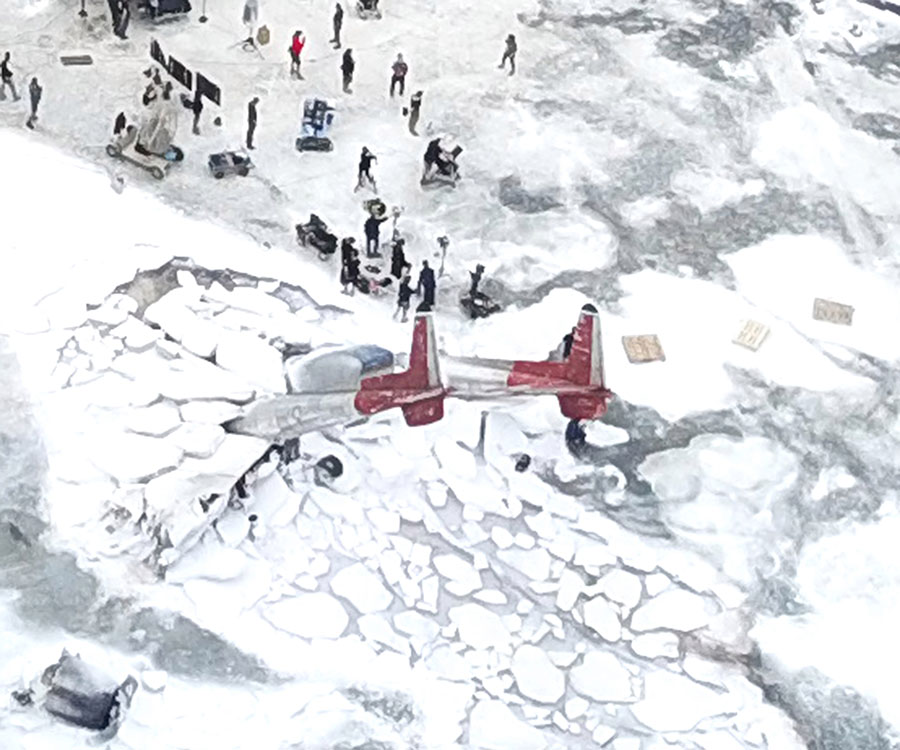
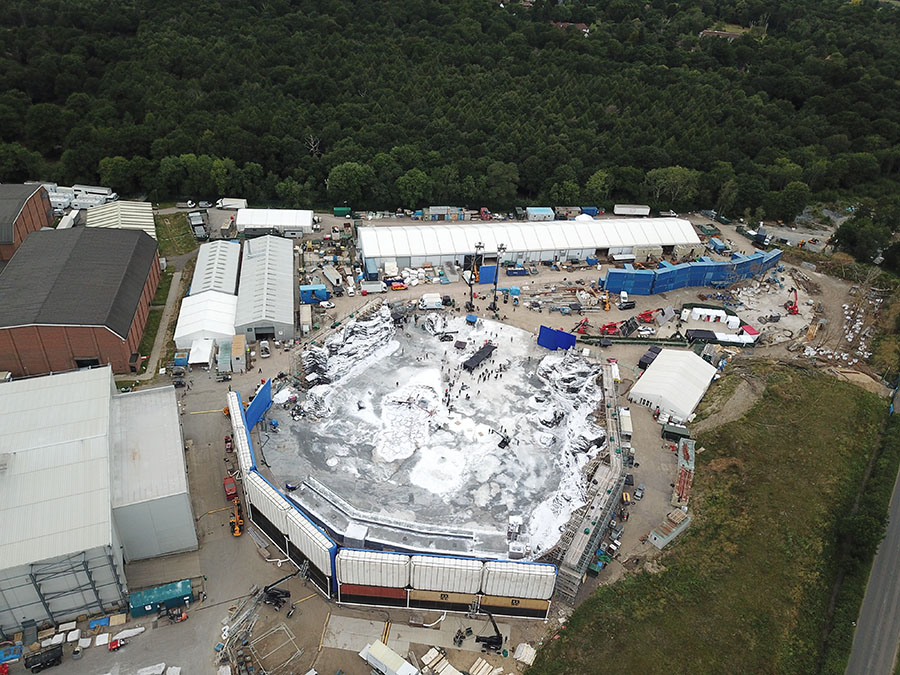
Aerial pictures of Pinewood Studios show what looks to be a crash scene with a plane stuck in snow in an arctic environment. Credit: Splash News

New set photos have surfaced from Jurassic World: Dominion -- the first film to resume filming in the United Kingdom during the pandemic.

New Jurassic World: Dominion set photos reveal a snowy backdrop of a plane crash at Pinewood Studios, Berkshire.

Aerial snapshots released by The Sun show what looks like the scene of a jet crash in an Arctic setting, with the tail end of a jet sticking out of the ice.

These photos come after months of coronavirus-related delays and implementation of safety measures for the cast and crew, including drive-through testing.

The photos show the set of Jurassic World: Dominion which recently resumed filming after lockdown. Credit: Splash News

"This is the last thing anyone expected so soon," one source said. "Everyone was excited about getting things back up and running on set but this could totally derail that. There are millions and millions of pounds at stake here."

Jurassic World: Dominion is the first major movie project to resume filming in the United Kingdom in the era of post-coronavirus lockdown. Production had been abandoned in March after Pinewood Studios' staff were sent home due pandemic.

It was recently reported that many of the crew had tested positive for COVID-19 on the first day back filming, causing another shutdown. However, Universal Pictures denied these claims.

Directed and co-written by Colin Trevorrow, Jurassic World: Dominion stars Sam Neill, Laura Dern, Jeff Goldblum, Bryce Dallas Howard, Chris Pratt, Jake Johnson, Omar Sy, Justice Smith, Daniella Pineda, Mamoudou Athie, DeWanda Wise and Dichen Lachman.

The film arrives in theaters June 11, 2021.

Source: www.cbr.com/
This Dinosaur May Have Shed Its Feathers Like Modern Songbirds

Friday, July 17, 2020

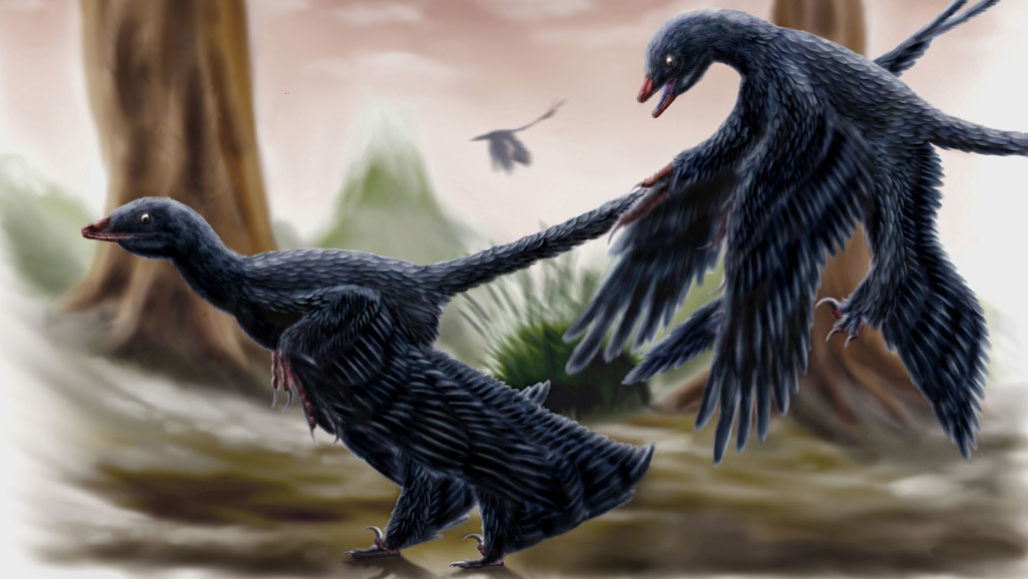
New fossil analyses of Microraptor, a nonbird feathered dinosaur that lived about 120 million years ago, reveal its molting behavior — and suggest the dinosaur was a frequent flyer.  DURBED/WIKIMEDIA COMMONS (CC BY-SA 3.0)

The first fossilized signs of sequential molting support the idea that Microraptor was a flyer.

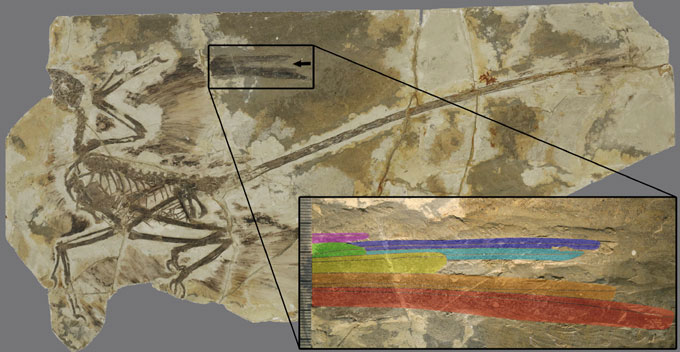
A patch of three oddly short feathers spotted among the fossilized plumage of Microraptor may be the first evidence of a nonbird dinosaur molting. The fossil find further suggests that Microraptor, which lived 120 million years ago, may have shed only a few feathers at a time — just like modern songbirds, researchers report July 15 in Current Biology. Such “sequential molting,” they say, suggests that Microraptor was an adept and frequent flyer.

Unlike many aquatic birds, modern songbirds lose only a few feathers at a time, enabling them to stay aloft year-round for foraging or to escape predators. Microraptor’s shorter feathers appear in just a small patch on one of the dinosaur’s four wings — suggesting that the dinosaur molted sequentially, too, bird ecologist Yosef Kiat at the University of Haifa in Israel and colleagues report.

All modern, adult birds molt at least once a year to replace old, damaged feathers, or to exchange their bright summer colors for drab winter camouflage. Genetic reconstructions of bird lineages have previously suggested that sequential molting has existed in birds for at least 70 million years, and was a trait of the common ancestor of all modern birds. But this is the first fossil evidence of a nonbird dinosaur exhibiting this behavior. Furthermore, the researchers say, the find would push back the estimated origins of sequential molting by 50 million years or so.

An odd gap (arrow) in the plumage on the right forelimb of this Microraptor fossil was created by molting, with three new feathers coming in (colored in the inset as green, yellow and orange), researchers say. The different lengths of the new feathers suggest a sequential molting strategy: the longest (red) is fully grown, while the other new feathers are at different stages of growth. The older, not-yet-replaced feathers are colored pink, purple and blue. Such sequential molting could have enabled Microraptor to fly year-round. Y. KIAT ET AL/CURR BIO 2020

Microraptor may have been one of the earliest flyers — depending on how one defines flying. Previous analyses have suggested that the dinosaur didn’t just glide from tree to tree, but was able to launch itself from the ground using its wings and back legs (SN: 10/28/16).

The new find supports this, suggesting “that not only could Microraptor fly, but it could fly well, and [that] flying was an indispensable part of its lifestyle,” says vertebrate paleontologist Steve Brusatte of the University of Edinburgh, who was not involved in the study. That makes Microraptor one of the most convincing cases of a nonbird dinosaur that could fly, Brusatte adds.

CITATIONS

Y. Kiat et alSequential molt in a feathered dinosaur and implications for early paravian ecology and locomotionCurrent Biology. Published online July 15, 2020. doi: 10.1016/j.cub.2020.06.046.

Source: www.sciencenews.org/

Pages