Blogs

10 of The Coolest Spots Around Colorado For Kids (and Adults) Obsessed With Dinosaurs

Friday, July 10, 2020

The Dinosaur National Monument is among five geologic hot spots that earth science lovers should check out. (John Fielder, Loveland Reporter-Herald)

Colorado is a regular hotbed of dinosaur activity — or at least it was an eon or so ago when dinosaurs existed — which means our state has more unique dinosaur-related activities for kids, families and dino-loving adults than hadrosaurs had teeth. (For the uninitiated, that’s paleontological lingo for a lot. Get with it.) In fact, with all of our well-preserved dino finds, we’re one of the most important locations in the world for paleontology.

Colorado played a major role in the Bone Wars, or Great Dinosaur Rush, of the late 19th century, and new finds are still happening today. Here are 10 of the coolest spots around the state for digging, fossil-peeping, hanging with life-sized animatronic dinosaurs and even sleeping in a dinosaur-themed Best Western. So many dinosaur activities, so little time.

Dinosaur National Monument

There are so many fossils at Dinosaur National Monument that its gateway town is named Dinosaur, which is exactly as the dinosaurs would have wanted it, had they known what towns or national monuments are. The main attraction is the Quarry Exhibit Hall, which houses a wall that contains 1,500 dinosaur bones. Gaze upon the glory that is the remains of deceased Stegosaurus, Apatosaurus, Camarasaurus and more species of dinosaurs. You can touch some fossils, too, because touching 150-million-year-old creature remains is not at all freaky. 4545 Colorado 40, Dinosaur, 435-781-7700

Trail Through Time

About 26 miles west of Grand Junction sits Mack, and its Trail Through Time hiking trail. The 1.5-mile loop winds its way around an active quarry and stops at 21 interpretative sites, where you’ll learn about the Camarasauruses and Diplodocuses (and see their pretty good-sized fossils in the rocks) that used to stomp and chomp around the area. Note: It gets very hot here in summer, so take lots of water or save your trip for spring or fall. The parking lot is north of Interstate 70, off the Rabbit Valley Road exit.

Garden Park Fossil Area

The Garden Park Fossil Area near Cañon City is a big-time fossil discovery site. Fossils discovered here, which include the first complete Allosaurus skeleton and the first known remains of Ceratosaurus and Diplodocus, are in museums all over the country. Today, you can view the quarries and fossils in the rocks via trails and overlooks. Six miles north of Cañon City along Fremont County Road 9; there will be a sign for the pull-off area.

Royal Gorge Dinosaur Experience

One of our state’s newer dinosaur adventures, the Royal Gorge Dinosaur Experience features life-sized animatronic dinosaurs and (why not?) a ropes course. There are two main parts to this Cañon City prehistoric wonderland, an indoors and an outdoors. Indoors, there’s a 10,000-square-foot museum, interactive kids’ exhibit and paleo lab where fossils from the nearby Garden Park Fossil Area are being restored. Outdoors, there’s that ropes course (again, why not?), kids’ dig pit and dinosaur wild walk, where 16 life-sized animatronic dinosaurs make you feel like you’re inside Jurassic Park, without all the deaths. 44895 W. U.S. 50, Cañon City, 719-275-2726

Picket Wire Canyonlands

Picket Wire Canyonlands outside of La Junta is the largest dinosaur trackway in North America. The site has more than 1,900 150-million-year-old Apatosaurus and Allosaurus footprints, which is pretty darn cool. You can see them by taking an 11.2-mile (round-trip) hike from the Withers Canyon Trailhead or by taking a guided auto tour (you need your own truck or SUV). It gets hot in summer, so May, June, September and October are the best months to visit.

Rocky Mountain Dinosaur Resource Center

Woodland Park’s Rocky Mountain Dinosaur Resource Center has lots for kids to do, from feeling dinosaur poop (you know you’re curious) to making their own magnetic dino creations to watching real life paleo technicians and scientists hard at work in the Paleo Lab. And then of course there are all the dinosaur skulls and skeletons to gawk at, including the Denversaurus, which sounds made up but apparently isn’t. 201 S. Fairview St., Woodland Park, 719-686-1820

Denver’s Dino Hotel

For a close-to-home staycation, there’s a dinosaur-themed Best Western in Lakewood. Kids will love the Stegosaurus statue out front (named Stanley, because of course you’ll want to greet him by name), dino skeletons in the lobby, the Jurassic dig pit and baroque cherub murals throughout (kidding; they’re of dinosaurs, too). Adults will love that the kids are entertained by all the prehistoric décor, and that there’s a hot tub. 3440 S. Vance St., Lakewood, 303-989-5500

Dinosaur Ridge

To view the dinosaur tracks and fossils at Morrison’s Dinosaur Ridge, you can walk the 1.4-mile one-way paved (and warning: uphill) road, jump on the 45- to 60-minute guided tour bus or take the hop on/hop off shuttle. You’ll want to do one of those things, because getting up close and personal with fossilized Iguanodon footprints is pretty neat. There’s also the indoor Trek Through Time exhibit hall with giant back-lit murals of dinosaurs in their natural habitats, fossils and hands-on stations, as well as kid dig areas where aspiring paleontologists can excavate dino bones and sea-life fossils. 16831 W. Alameda Parkway, Morrison, 303-697-3466

Morrison Natural History Museum

You’ll find dinosaurs at lots of museums around Colorado, and they’re all very awe-inducing, but two are must-visits for the young, short, aspiring paleontologist set. The Morrison Natural History Museum is the most legit, with world-class experts researching and excavating fossils right there in the tiny museum. Curious kids can interact with touchable exhibits, squeal over baby dinosaur tracks, assist in the cleaning of real fossils and stick their heads inside a T-Rex’s mouth with banana-sized fossilized teeth. 501 Colorado 8, Morrison, 303-697-1873

Museums of Western Colorado

The Museums of Western Colorado’s Dinosaur Journey in Fruita (dubbed “the heart of dinosaur country”) is the perfect mix of fun and educational. On Team Fun: robotic reconstructions of dinosaurs, an earthquake simulator, a sandbox for making your own dino tracks and a quarry site where kids can dig for actual Jurassic-era bones. Repping Team Education are 15,000 fossil specimens, a dinosaur library for little readers and a viewable paleontology laboratory. 550 Jurassic Court (Roar!), Fruita, 970-858-7282

Source: https://theknow.denverpost.com/
Famous Jurassic Park Dinosaur Was More Powerful than Previously Thought

Friday, July 10, 2020

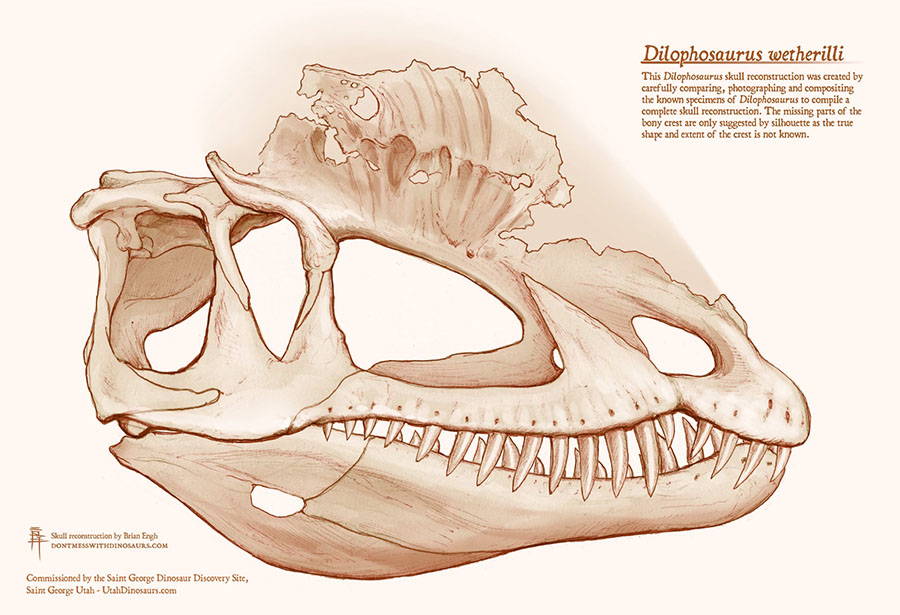
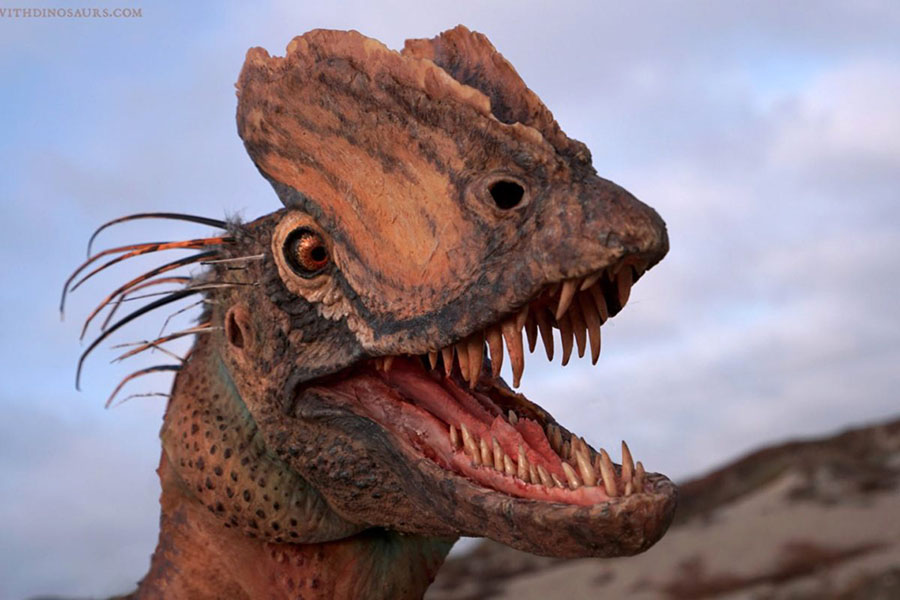
An artist’s interpretation of Dilophosaurus wetherilli, a theropod dinosaur that lived in what is now North America during the Early Jurassic, about 193 million years ago. Image credit: Brian Engh / The Saint George Dinosaur Discovery Site.

Dilophosaurus wetherilli was the largest animal known to have lived on land in North America during the Early Jurassic. Despite its charismatic presence in pop culture, major aspects of Dilophosaurus wetherilli’s skeletal anatomy, taxonomy and evolutionary relationships were unknown until now.

“It’s pretty much the best, worst-known dinosaur. Until this study, nobody knew what Dilophosaurus wetherilli looked like or how it evolved,” said study lead author Dr. Adam Marsh, a paleontologist in the Jackson School of Geosciences at the University of Texas at Austin and Petrified Forest National Park.

Seeking answers to these questions, Dr. Marsh and his colleague, Jackson School’s Professor Timothy Rowe, examined five most-complete specimens of Dilophosaurus wetherilli, all from the middle and lower part of the Kayenta Formation in the Navajo Nation in northern Arizona.

“Our study adds clarity to a muddled research record that reaches back to the first Dilophosaurus wetherilli fossil to be discovered, the specimen that set the standard for all following Dilophosaurus wetherilli discoveries,” the researchers explained.

“That fossil was rebuilt with plaster, but the 1954 paper describing the find isn’t clear about what was reconstructed — a fact that makes it difficult to determine how much of the early work was based on the actual fossil record.”

Early descriptions characterize Dilophosaurus wetherilli as having a fragile crest and weak jaws, a description that influenced the dinosaur’s depiction in the Jurassic Park book and movie as a svelte dinosaur that subdued its prey with venom.

But the study authors found the opposite. The jawbones show signs of serving as scaffolding for powerful muscles. They also found that some bones were mottled with air pockets, which would have helped reinforce the skeleton, including its dual crest.

“They’re kind of like bubble wrap — the bone is protected and strengthened,” Dr. Marsh said.

These air sacs are not unique to Dilophosaurus wetherilli. Modern birds and the world’s most massive dinosaurs also have bones filled with air. In both cases, the air sacs lighten the load, which helped big dinosaurs manage their bulky bodies and birds take to the skies.

Many birds use the air sacs to perform other functions, from inflating stretchy areas of skin during mating rituals, to creating booming calls and dispersing heat.

The intricate array of air pockets and ducts that extend from Dilophosaurus wetherilli’s sinus cavity into its crests means that the dinosaur may have been able to perform similar feats with its headgear.

Marsh & Rowe found evidence that Dilophosaurus wetherilli’s skull served as scaffolding for powerful jaw muscles, shattering the image of the dinosaur as more fragile and svelte that has been promoted in scientific literature and popular culture. Image credit: Brian Engh / The Saint George Dinosaur Discovery Site.

To learn more about how the fossils compared with one another, the team recorded hundreds of anatomical characteristics of each fossil.

The scientists then used an algorithm to see how the specimens compared with the first fossil — which confirmed that they were indeed all Dilophosaurus wetherilli.

The algorithm also revealed that there’s a significant evolutionary gap between this species and its closest dinosaur relatives, which indicates there are probably many other relatives yet to be discovered.

“The research is already being put into action,” Dr. Marsh said.

“In the midst of the analysis, we discovered that a small braincase in the Jackson School’s collections belonged to a Dilophosaurus wetherilli.”

“We realized that it wasn’t a new type of dinosaur, but a juvenile Dilophosaurus wetherilli, which is really cool.”

The study was published online in the Journal of Paleontology.

_____

Adam D. Marsh & Timothy B. Rowe. 2020. A comprehensive anatomical and phylogenetic evaluation of Dilophosaurus wetherilli (Dinosauria, Theropoda) with descriptions of new specimens from the Kayenta Formation of northern Arizona. Journal of Paleontology 94, supplement S78: 1-103; doi: 10.1017/jpa.2020.14

This article is based on text provided by the University of Texas at Austin.

Source: www.sci-news.com/

Underwater Titans: Giant Sea Scorpions – Some Larger Than Humans – Were Fierce Marine Predators

Thursday, July 9, 2020

Credit: Dimitris Siskopoulos/Wiki commonc, CC BY-SA

Let’s turn back the hands of time. Before extinction knocked dinosaurs off their pillar, before the “Great Dying” extinction wiped out 95% of all organisms – we had the Paleozoic Era.

During this age in Earth’s history, between 541 million and 252 million years ago, arthropods (animals with exoskeletons such as insects, crustaceans, scorpions, and horseshoe crabs) were exploring the extremes of size, from tiny to huge.

In fact, some Paleozoic arthropods represent the largest animals on Earth at the time. If you were to take a swim in the Paleozoic oceans, you may have been fortunate (or unfortunate) enough to find one of the most fearsome of these extinct arthropods: the sea scorpions, Eurypterida.

Our new research, published in Gondwana Research, is the most comprehensive collection of information on these fascinating creatures that once roamed Australian waters.

A sight to behold

Although Eurypterida looked broadly like scorpions (with a similar body shape, albeit built for swimming), they were not. They were more like the cousins of modern scorpions.

An exceptional part of the sea scorpion evolutionary story is how they fit into the narrative of Paleozoic gigantism.

A Eurypterus remipes fossil. This sea scorpion existed more than 400 million years ago and was usually less than one foot in length, but relatives are believed to have reached up to eight feet. Credit: H. Zell/Wiki commons, CC BY-SA

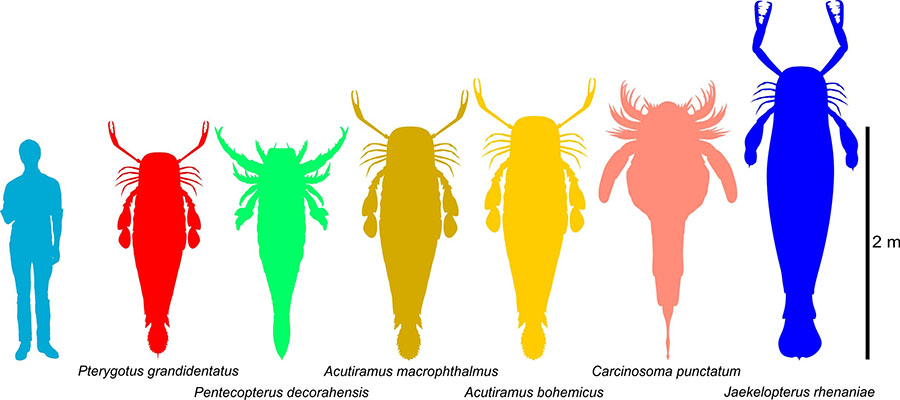
Sea scorpions include the largest marine predators to have ever arisen in the fossil record, including one species thought to have been more than 2.5 metres long, Jaekelopterus rhenaniae. Back then, some of these giants were effectively in the same place in their food web as the modern great white shark.

These likely agile swimmers would have used their large front limbs, armed with claws, to grab their prey, which they would then crush between the teeth-like structures on their legs (called gnathobasic spines).

While we’re not sure exactly what these large animals ate, it’s likely fish and smaller arthropods would have been on the menu. And if humans had been around swimming in the sea, maybe us too!

A fascinating (but murky) history

Australia is famous for its array of curious animals, including unique modern species such as the platypus. And this uniqueness extends far into the fossil record, with sea scorpions being a case in point.

The size of the largest extinct sea scorpions, relative to a human. Credit: Slate Weasel/Wiki commons. Modified.

But the scientific record and study of Australian sea scorpions has been patchy. The first documented specimen, published in 1899, consisted of a fragmented exoskeleton section found in Melbourne.

Prior to our new research examining the completeness of the group in Australia, there were about ten records – and only one other attempt to pool everything together. As such, the diversity and spread of these fossils was fairly uncertain.

For us, revisiting these amazing fossils resulted in a few trips to different Australian museums. We also had specimens sent to us at the University of New England to examine in person.

This journey of palaeontological discovery uncovered many sea scorpion fossils than hadn’t previously been noted. As a result, we now have evidence of a possible six different groups that existed in Australia.

Examples of Australian sea scorpion fossils, their two groups and the time range. Blue represents the family Pterygotidae and orange represents the family Adelophthalmidae.

Collating these specimens together in our most recent publication, we illustrate the Pterygotidae (the family of sea scorpions that reached 2.5 metres long) dominated the group’s Australian fossil record. Although this had been noted before, the abundance of material from different locations and time periods, especially from Victoria, was unexpected.

Back to the source

Besides showcasing the largest number of Australian sea scorpions, our paper also outlines the overall lack of information on these animals.

Despite there being much fragmented material, there is only one (mostly) complete specimen, Adelophthalmus waterstoni, measuring just 5.7cm long.

Future research will involve revisiting the sites where these specimens were originally collected, in the hope of finding more complete specimens. Not only will this help document Australian sea scorpion species better, it will also allow for a more complete understanding of the environments in which they lived.

Ultimately, one thing is clear – there is much left to uncover about these titans that swam through Australia’s prehistoric oceans.

Written by Russell Dean Christopher Bicknell, Post-doctoral researcher in Palaeobiology, University of New England and Patrick Mark Smith, Technical Officer – Paleontology, Australian Museum.

Originally published on The Conversation / https://scitechdaily.com/

Researchers Discover An Ancient Rodent That Lived 2.6 Million Years Ago In Eastern Morocco

Thursday, July 9, 2020

Golunda Ellioti, the ancestor of Golunda aouraghei from Morocco. / DR

Researchers from Morocco and Spain discovered a large and ancient species of the genus Golunda, a rodent species that mainly lives in Asia. The rodent lived 2.6 million years ago in eastern Morocco and went extinct after its failed attempts to adapt.

Paleontologists from Morocco and Spain discovered Africa’s last representative of the Golunda genus, a rodent species that mainly lives in India. The newly discovered extinct species lived about 2.6 million years ago in eastern Morocco, where its fossils were excavated.

In a study entitled «Golunda aouraghei, SP. NOV., The Last Representative of the Genus Golunda in Africa» and published by the Journal of Vertebrate Paleontology, reserchares explain that the ancient rodent, they named «Golunda aouraghei», weighed between 150-170 grams.

It is larger than its Indian cousin Golunda ellioti, who only weighs 60 grams. The latter, also known as the Indian bush rat, is the only living representative of the Golunda genus.

«It is a large species of Golunda representing the youngest occurrence of the genus in Africa», reserachers wrote in their study.

A Moroccan rodent with ancestors in Asia

Through this discovery, researchers concluded that in the Guefait site in the plio-pleistocene basin of Ain Beni-Mathar this rat lived and adapted to the aridity of the area.

«Its dental morphology, for example, reflects its adaptation to a more abrasive diet than that of its ancestor, due to the increased aridity at the end of the Pliocene and beginning of the Pleistocene in North Africa», Pedro Pinero from the Faculty of Natural Sciences and the Museum of the National University of La Plata (Argentina) told EFE.

ESEM photographs of Golunda aouraghei, sp. nov., from Guefaït-4. / DR

The researcher who heads the study indicates, however, that even after adapting to the aridity of the region, the Golunda aouraghei could not survive for too long and went extinct. The same study reveals also that the rat made its way to North Africa through the Arabian peninsula.

«We believe that this genus is native to northern India, and that during the Pliocene it managed to reach Africa by crossing the two extremes of the Red Sea (Sinai Peninsula and the Mandeb Strait), and managed to settle both north and east of the continent», Pinero explained. Indeed, fossils of the rodent were discovered in both Algeria and Ethiopia before.

The studied remains from Morocco were recovered from sediment collected at the Guefait-4 site during excavation campaigns that took place in 2015, 2017 and 2018.

The fossils of the ancient Moroccan rat are currently kept at the Musée Universitaire d’Archéologie et du Patrimoine in Oujda.

Source: https://en.yabiladi.com/

Paleontologists Find Fossil of 70-Million-Year-Old Polar Raptor

Thursday, July 9, 2020

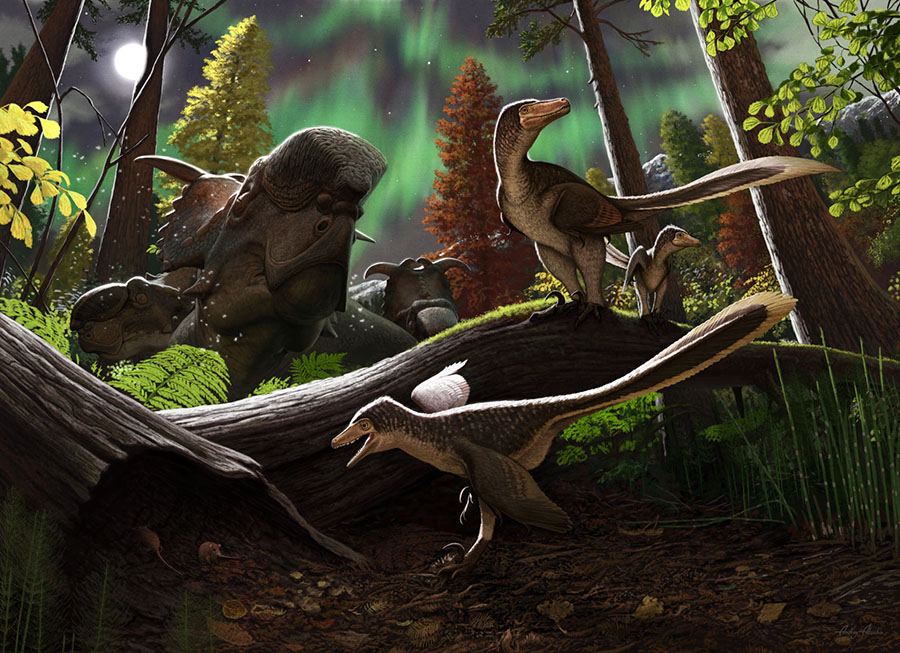
Life reconstruction of the Alaskan saurornitholestine dinosaur in its environment. Image credit: Andrey Atuchin.

Paleontologists have uncovered the fossilized jawbone of a juvenile dromaeosaurid (raptor) dinosaur that lived 70 million years ago in what is now northern Alaska.

Dromaeosauridae is a group of small to medium-sized feathered predatory dinosaurs that flourished in the Cretaceous period.

These dinosaurs lived all over the world, but their bones are often small and delicate and rarely preserve well in the fossil record, complicating efforts to understand the paths they took as they dispersed between continents.

North American dromaeosaurids are thought to trace their origins to Asia, and Alaska would have been a key region for the dispersal of their ancestors.

The new fossil is a tantalizing clue toward understanding what kinds of dromaeosaurs inhabited this crucial region.

“There are places where dinosaur fossils are so common that a scrap of bone, in most cases, cannot really add anything scientifically informative anymore,” said lead author Dr. Alfio Alessandro Chiarenza, a paleontologist at the Imperial College London.

“This is not the case with this Alaskan specimen.”

“Even with such an incomplete jaw fragment, we were not only able to work out the evolutionary relationships of this dinosaur, but also to picture something more on the biology of these animals, ultimately gaining more information on this ancient Arctic ecosystem.”

The fossilized jawbone of the Alaskan saurornitholestine dinosaur. Image credit: A. Chiarenza.

The dromaeosaurid jawbone, which is 1.4 cm long and preserves the tip of the lower jaw and two teeth, was collected from exposures of the Prince Creek Formation in northern Alaska.

Based on tooth shape and other characteristics, Dr. Chiarenza and colleagues attributed the fossil to a saurornitholestine dromaeosaurid.

The early developmental stage of the specimen suggests this individual was still young and was likely born nearby.

“This study of a predatory dinosaur jaw from a baby provides the first physical proof that at least some dinosaurs not only lived in the far north, but they thrived there,” said co-author Dr. Anthony Fiorillo, a researcher at Southern Methodist University.

“One might even say, our study shows that the ancient north was a great place to raise a family and now we have to figure out why.”

“This is the first confirmed non-dental fossil specimen from a member of Dromaeosauridae in the Arctic, expanding on the role of Beringia as a dispersal route for this clade between Asia and North America,” the paleontologists said.

“Furthermore, the juvenile nature of this individual adds to a growing body of data that suggests Cretaceous Arctic dinosaurs of Alaska did not undergo long-distance migration, but rather they were year-round residents of these paleopolar latitudes.”

The study was published online today in the journal PLoS ONE.

_____

A.A. Chiarenza et al. 2020. The first juvenile dromaeosaurid (Dinosauria: Theropoda) from Arctic Alaska. PLoS ONE 15 (7): e0235078; doi: 10.1371/journal.pone.0235078

Source: www.sci-news.com/

How Jurassic World 3 Production Shutdown Helped Improve Dominion

Thursday, July 9, 2020

Jurassic World 3 director Colin Trevorrow discusses how the timing of Dominion's production shutdown wound up helping the upcoming movie.

Jurassic World: Dominion director Colin Trevorrow has revealed the timing of the movie's shutdown due to the coronavirus had its advantages. The upcoming blockbuster is the third and final film in the Jurassic World series starring Bryce Dallas Howard and Chris Pratt. Following the events of Jurassic World: Fallen Kingdom, the movie will focus on dinosaurs out in the world. Previously, Trevorrow teased this idea with a photo of the movie filming in snow, suggesting dinosaurs may be seen in that environment. Jurassic World: Dominion will also feature the exciting returns of several actors from the original Jurassic Park movies, including Laura Dern and Sam Neill. Recently, Neill revealed their roles aren't mere cameos, either, explaining they appear throughout the film.

Unfortunately, the upcoming movie has already faced challenges. Like virtually every other Hollywood production, Jurassic World: Dominion was forced to stop shooting in the middle of March. Luckily, Trevorrow revealed he was continuing work on the film from home only a couple weeks later. More good news came last month, when Universal announced its $5 million plan to resume filming Jurassic World: Dominion in July. Now, as production restarts, Trevorrow discusses how the movie's filming schedule and timing of the shutdown worked to its advantage.

In an interview with Empire, Trevorrow acknowledged, "For many of us, Dominion was already the biggest creative challenge of our lives, before the lockdown.” However, he also revealed the order scenes were filmed helped, explaining, "The shooting schedule really worked to our advantage – the first four weeks we put to film were mostly sequences with dinosaurs in them. So that allowed us to get a head start on VFX and workshop some of the newer elements without the pressure of a looming deadline."

Based on Trevorrow's comments, it sounds like he and others who continued work on the film during lockdown made the most of their time away from set. In this case, it worked out nicely that many of the scenes requiring special effects work were shot first, as it gave creatives more time to work on those moments. Trevorrow's comments echo what other filmmakers and actors have said in the past about the advantages of the shutdowns. For instance, The Batman star Robert Pattinson admitted time off from his film wasn't "the worst thing in the world."

Separately, Trevorrow's remarks about what was filmed before the shutdown lend more credibility to Jurassic World: Dominion's "dinosaurs in snow" idea. Since most of the scenes already shot had dinosaurs in them, it seems even more likely now the director's set photo was from one of those sequences. As shooting resumes, hopefully Trevorrow and others will continue to tease the film, offering information about where else the dinosaurs may turn up. If not, audiences will find out when Jurassic World: Dominion releases next year.

Source: Empire / https://screenrant.com/

What Jurassic Park’s Pile Of Poop Is Really Made Out Of

Wednesday, July 8, 2020

Jurassic Park features a famous scene with a hefty pile of poop, and here's what the very convincing looking droppings were made from.

It didn't come from a real Triceratops so what exactly was Jurassic Park's big pile of poop made from? While James Cameron once mulled an R-rated version of Michael Crichton's best-seller Jurassic Park, it was Steven Spielberg who ended up in the director's chair. In addition to being a specularly well-crafted summer blockbuster, the movie was famed for its groundbreaking use of CGI to bring its dinosaurs to life. In all, there are only around five minutes of computer-generated effects in the entire film, but it set a new standard in visual effects.

Spielberg later returned for The Lost World: Jurassic Park, but while it features some nice setpieces it lacked the heart of the original, and the director later confessed his boredom making it. Jurassic Park III was a success in 2001 but was a critical dud and the franchise went into hibernation for nearly fifteen years, coming back with 2015's Jurassic World. This fourth entry was a gigantic blockbuster that grossed over $1.6 billion worldwide and confirmed there was still an audience for the franchise. Jurassic World: Fallen Kingdom continued the saga in 2018, which saw the destruction of the original island.

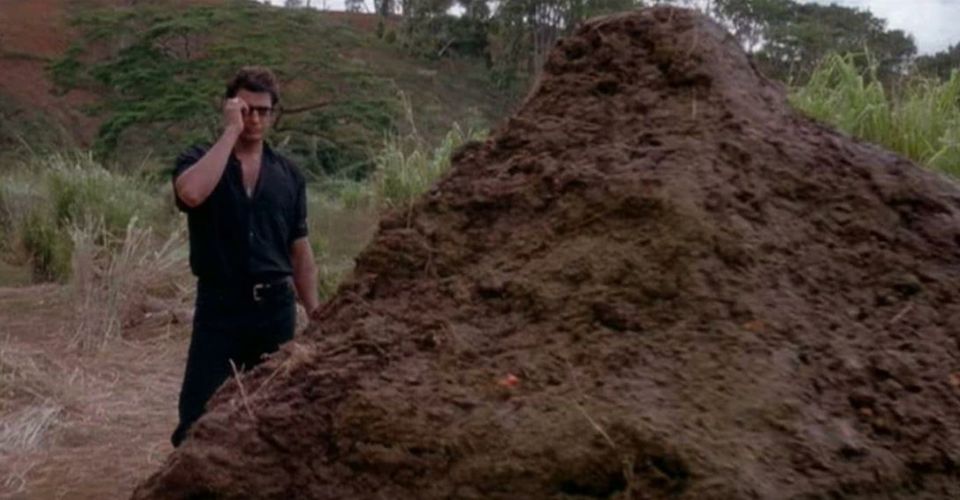
Jurassic Park is still the one to beat and is a movie positively brimming with famous sequences and lines of dialogue. One of these is Ian Malcolm casually approaching a rather hefty pile of Triceratops droppings and declaring "That is one big pile of s***." Laura Dern's Ellie is also seen digging her arm into a particularly meaty pile of poop, making it a scene that lingers in the memory. In an interview with Vulture, the movie's co-producer Gerald R. Molen revealed what this pile was made from.

Jurassic Park's pile of poop is made from mud, clay and straw, and for texture it was smeared with honey to attract insects, completing the effect. Big piles of poop is a semi-recurring theme in the series, with Jurassic Park III seeing the cast wading through Spinosaurus droppings to retrieve a phone; this particular pile was made from gallons of oatmeal. A deleted scene from Jurassic World also saw Chris Pratt and Bryce Dallas Howard's characters smearing themselves with poop to mask their scents, but this sequence was mercifully deleted due to its grossness and misfiring attempts at comedy.

The upcoming Jurassic World: Dominion is set to close out the current trilogy, with Sam Neill, Laura Dern and Jeff Goldblum all reprising their roles. There are no reports on Jurassic Park's pile of poop returning for one last hurrah, however.

Source: https://screenrant.com/

Kongonaphon kely: Tiny Dinosaur Relative Roamed Triassic Madagascar

Wednesday, July 8, 2020

Life restoration of Kongonaphon kely. Image credit: Alex Boersma.

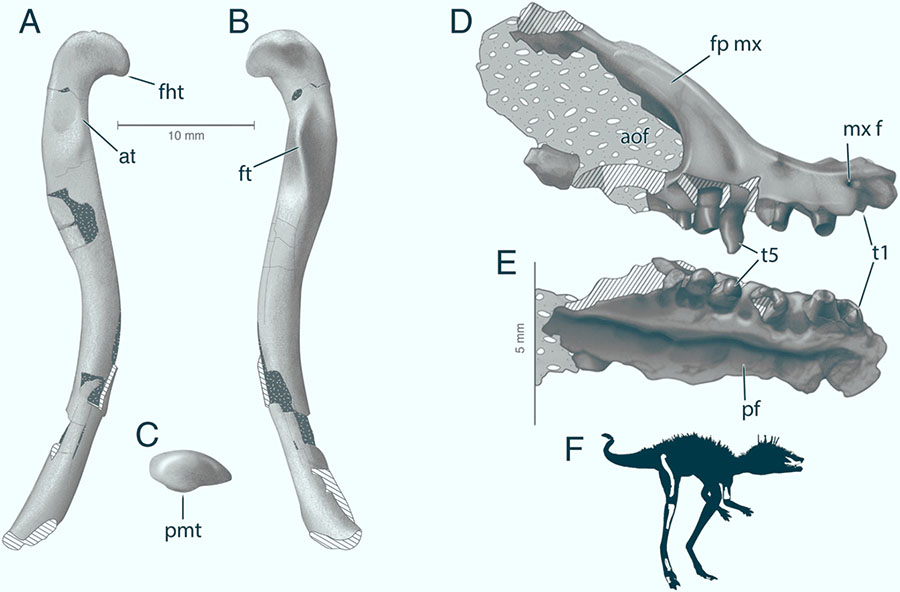
A new genus and species of ornithodiran — an early relative of dinosaurs and pterosaurs — that lived around 237 million years ago (Triassic period) has been identified from the fossilized remains found in southwestern Madagascar. Named Kongonaphon kely, the ancient reptile was surprisingly small (estimated height – 10 cm, or 3.9 inches). Its tiny body size may help explain the origins of flight in pterosaurs and the presence of ‘fuzz’ on the skin of both pterosaurs and dinosaurs.

“There’s a general perception of dinosaurs as being giants. But this new animal is very close to the divergence of dinosaurs and pterosaurs, and it’s shockingly small,” said Dr. Christian Kammerer, a research curator in paleontology at the North Carolina Museum of Natural Sciences.

“Discovery of this tiny relative of dinosaurs and pterosaurs emphasizes the importance of Madagascar’s fossil record for improving knowledge of vertebrate history during times that are poorly known in other places,” added University of Antananarivo’s Professor Lovasoa Ranivoharimanana.

The partial skeleton of Kongonaphon kely was found in 1998 in the Morondava Basin of southwestern Madagascar.

Life restoration of Kongonaphon kely. Image credit: Frank Ippolito, American Museum of Natural History.

Kongonaphon kely isn’t the first small animal known near the root of the ornithodiran family tree, but previously, such specimens were considered isolated exceptions to the rule,” Dr. Kammerer said.

“In general, the scientific thought was that body size remained similar among the first archosaurs — the larger reptile group that includes birds, crocodilians, non-avian dinosaurs, and pterosaurs — and the earliest ornithodirans, before increasing to gigantic proportions in the dinosaur lineage.”

“Recent discoveries like Kongonaphon kely have given us a much better understanding of the early evolution of ornithodirans. Analyzing changes in body size throughout archosaur evolution, we found compelling evidence that it decreased sharply early in the history of the dinosaur-pterosaur lineage.”

“This miniaturization event indicates that the dinosaur and pterosaur lineages originated from extremely small ancestors yielding important implications for their paleobiology.”

Anatomy of the femur and maxilla of Kongonaphon kely: (A) right femur in anterolateral, (B) posteromedial, and (C) proximal views; (D) right maxilla in right lateral and (E) palatal views; (F) preserved elements in the holotype, presented in a silhouette of Kongonaphon kely. Abbreviations: aof – antorbital fenestra, at – anterior trochanter, fht – tip of femoral head, fp mx – facial process of maxilla, ft – fourth trochanter, mx f – maxillary foramen, pf – palatine fossa, pmt – posterior medial tubercle, t – maxillary tooth. Image credit: Frank Ippolito / American Museum of Natural History.

Pitted microwear on Kongonaphon kely’s conical teeth indicates a diet of hard-shelled insects.

This shift to insectivory, which is associated with diminutive body size, may have helped early ornithodirans survive by occupying a niche different from their mostly meat-eating contemporaneous relatives.

The study also suggests that fuzzy skin coverings ranging from simple filaments to feathers, known on both the dinosaur and pterosaur sides of the ornithodiran tree, may have originated for thermoregulation in this small-bodied common ancestor.

That’s because heat retention in small bodies is difficult, and the mid-late Triassic was a time of climatic extremes, inferred to have sharp shifts in temperature between hot days and cold nights.

The discovery is reported in a paper in the Proceedings of the National Academy of Sciences.

_____

Christian F. Kammerer et al. A tiny ornithodiran archosaur from the Triassic of Madagascar and the role of miniaturization in dinosaur and pterosaur ancestry. PNAS, published online July 6, 2020; doi: 10.1073/pnas.1916631117

Source: www.sci-news.com/

Scientists Discover Fossil of Giant Predator Fish in Argentina

Tuesday, July 7, 2020

Argentinean palaeontologists in Patagonia have found the remains of a massive carnivorous fish with razor sharp teeth. The species was "amongst the largest predatory fish that existed in the history of Earth."

A 70-million-year-old fossil of a 6-meter-long fish that lived among dinosaurs has been discovered in Argentina, a team of paleontologists said. 

In Argentina's southern Patagonia region, researchers "found the remains of a predator fish that was more than six meters long," a carnivorous animal with sharp teeth and a "scary appearance."

The Argentinian paleontologists published their findings in the scientific journal Alcheringa: An Australasian Journal of Palaeontology.

The fossil belonged to the Xiphactinus genus, "amongst the largest predatory fish that existed in the history of Earth," according to the paleontologists.

They described the body of the fish as having been "notably slim" but that it ended in a massive head with large jaws and teeth "as sharp as needles, several centimeters long."

The giant fish "swam in the Patagonian seas at the end of the Cretaceous Period, when the temperature there was much more temperate than now," the study said.

'Preserved stomach contents'

The fossils of the giant fish were found nearby the Colhue Huapial lake, some 1,400 kilometers south of the capital Buenos Aires.

Julieta de Pasqua, one of the authors of the study, said examples of the Xiphactinus have also been discovered in other parts of the world, "some of which even have preserved stomach contents."

Previously, this species of fish had only been found in the northern hemisphere, with only one other example recently uncovered in Venezuela.

Patagonia is considered one of the greatest paleontological centers in the world. It is home to an important reservoir of dinosaur fossils, as well as fossils of other prehistoric sea and land species that are said to have ruled the area around 80 million years ago. 

In February last year, paleontologists discovered fossils from a heretofore unknown species of dinosaur in Argentine Patagonia, estimated to have been about nine or 10 meters in length.

The "new" dinosaur belonged to the sauropod group and was notable for its large bony spikes covering its long neck and back. The dinosaur was labeled "Bajadasaurus pronuspinax," referring to the Bajada Colorada geological formation in Neuquen province, western Argentina, where the remains of the animal that lived approximately 140 million years ago were found. 

Paleontologist Pablo Gallina described Bajadasaurus as a member of the dicraeosaurid family within the larger sauropod group. 

Source: www.dw.com/

Jurassic Park Statue Imagines Raptor Pen Breakout That Wasn’t in the Movie

Monday, July 6, 2020

A cool (and expensive) new Jurassic Park collectible statue shows the infamous raptor pen breakout that the movie never showed. Clever girl!

Jurassic Park collectible statue reveals the infamous raptor breakout that isn't shown in the movie. Steven Spielberg's classic 1993 film was based on the novel of the same name by Michael Critchon and helped create a whole blockbuster franchise. Despite there now being five Jurassic Park films (if one includes the new Jurassic World installments), the original Jurassic Park is still considered the very best. Through its story about the fictional amusement park where dinosaurs live once again and the humans who get trapped inside, Jurassic Park thrilled audience back when it was released and still does so now. In fact, Jurassic Park just topped the box office once again two weeks ago.

While the tyrannosaurus rex poses a terrifying threat in Jurassic Park, it's the velociraptors who are truly the villains of the film. The opening of Jurassic Park even establishes just how fearsome they can be when one manages to kill a park employee during an enclosure transfer. Initially, the raptors are kept locked in their enclosures, but following the park's loss of power, they manage to escape. For much of the film, they terrorize (and even kill) several of the poor humans stuck inside the unopened Jurassic Park.

While Jurassic Park never fully explored how the raptors broke free from their enclosures, a new statue from Chronicle Collectibles imagines that very moment. The statue depicts a raptor standing in the middle of broken wires, ready to run free and wreak havoc. It feels like the perfect purchase for a die-hard Jurassic Park fan, but be warned: It costs $549.99.

Considering how the raptor breakout wasn't shown in Jurassic Park, it's actually a clever subject for this statue. In a way, it enhances the film and reveals something new, even if it's something fans have probably already imagined. The raptors play major roles in all Jurassic Park films, including the newest installments. In fact, Jurassic World turned the raptors into the good guys and gave some of them names, like beloved dino Blue.

Audiences will get to revisit the world of Jurassic Park one more time with next year's Jurassic World: Dominionwhich aims to resume filming tomorrow, July 6, after being shut down since March. Fans of the original film have even more reason to be excited for this next one since it'll see the returns of Alan  Grant (Sam Neill), Ellie Sattler (Laura Dern), and Ian Malcolm (Jeff Goldblum). While Goldblum appeared in the previous film, Jurassic World: Fallen Kingdom, it was only for a quick cameo. Jurassic World: Dominion, however, will feature all three in more substantial roles. Maybe they'll be reunited with some raptors along the way.

Source: Chronicle Collectibles / https://screenrant.com/

Pages