Blogs

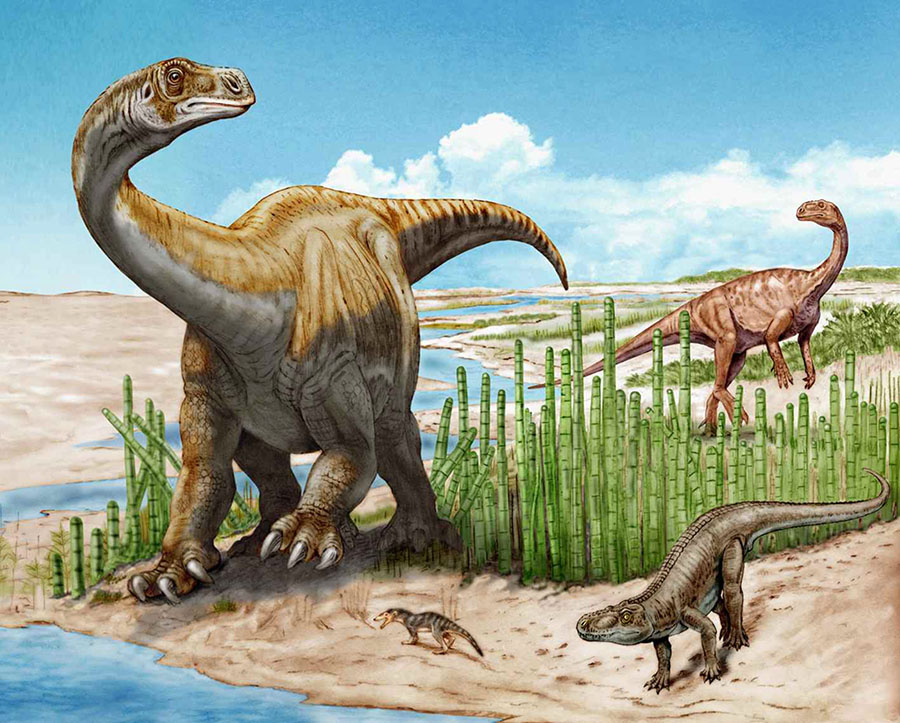
Schleitheimia schutzi: New Species of Plant-Eating Dinosaur Identified in Switzerland
Friday, July 17, 2020

Schleitheimia schutzi (left) and Plateosaurus (right). Image credit: Beat Scheffold.

A new genus and species of long-necked herbivorous dinosaur that lived during the Triassic period has been identified from fossils found in northern Switzerland.

Schleitheimia schutzi lived approximately 210 million years ago (Triassic period) in what is now Switzerland.

The ancient animal is one of the earliest representatives of Sauropodomorpha, a large group of long-necked, herbivorous dinosaurs that includes the sauropods and their ancestral relatives.

“Sauropod dinosaurs are certainly among the most conspicuous elements of Mesozoic terrestrial vertebrate faunas,” lead author Professor Oliver Rauhut from the Bavarian Natural History Collections and the Ludwig-Maximilians-Universität and his colleagues from Germany and Switzerland said in their paper.

“They include the largest terrestrial vertebrates and were the dominant herbivores in many Jurassic and Cretaceous ecosystems, probably accounting for a great part of vertebrate body mass in many environments in which they were abundant.”

“However, the origin and early evolution of the group is still less well understood.”

The fragmentary fossilized remains of Schleitheimia schutzi were found in the  Swiss canton of Schaffhausen.

The fossils were long considered to belong to Plateosaurus, a genus of herbivorous dinosaurs that lived during the Triassic period, around 214 to 204 million years ago, in what are now Central and Northern Europe, Greenland, and North America.

Professor Rauhut and co-authors re-examined the specimens and concluded that they were from a distinct species of sauropodomorph dinosaur.

“Although Schleitheimia schutzi probably looked quite similar to Plateosaurus, this dinosaur with an estimated 9 to 10 m (29.5-33 feet) body length is already significantly larger than the latter,” the paleontologists said.

“The new species was apparently very robust and, like its gigantic descendants, probably moved on all fours, while Plateosaurus mostly walked on its hind legs.”

The discovery of Schleitheimia schutzi shows that at least three different species of early sauropodomorph dinosaurs lived 210-220 million years ago in what is now Switzerland.

Schleitheimia schutzi is a derived sauropodiform and might even represent the immediate outgroup to sauropods,” the researchers said.

“In the context of a phylogenetic analysis, the new species indicates that the Triassic/Jurassic extinction event probably only had a minor effect on sauropodomorph evolution, and that the ascent of sauropods was delayed until the late Early Jurassic, when other early sauropodomorph lineages perished in the Pliensbachian/Toarcian extinction event and gave way to an explosive radiation of that clade.”

The team’s paper was published in the July 1, 2020 edition of the Swiss Journal of Geosciences.

_____

O.W.M. Rauhut et al. 2020. A derived sauropodiform dinosaur and other sauropodomorph material from the Late Triassic of Canton Schaffhausen, Switzerland. Swiss J Geosci 113 (8); doi: 10.1186/s00015-020-00360-8

Source: www.sci-news.com/

Jurassic World: Dominion’s Sam Neill Teases The Sequel’s Scares

Tuesday, July 14, 2020

There are few movie franchises quite as iconic as Jurassic Park. Steven Spielberg pushed filmmaking boundaries with his original 1993 movie, and the property was given new life thanks to the Jurassic World franchise. The generations of fans are eager to see the current trilogy wrap up with Colin Trevorrow's Jurassic World: Dominion, which will reunite the new cast with the trio of OG stars Jeff Goldblum, Laura Dern, and Sam Neill. The latter actor has been open about his excitement for the upcoming blockbuster, and now Naill is teasing the various scares that will come throughout the course of its runtime.

The Jurassic franchise has always featured a thrilling mixture of practical and visual effects which are used to bring the various dinosaurs to life. The dinos are both beautiful and utterly terrifying depending on the scene, with the humans often trying their best to survive each encounter with the genetically altered creations. Sam Neill was recently asked about why his character Alan Grant would get back into the fray in Jurassic World: Dominion after barely surviving two previous adventures, to which he said:

That’s a good question. I can’t give anything away, but a real-life dinosaur is a compelling thing to someone who has devoted his life to them. There will be screaming. We know this.

Well, that's delightfully cryptic. It looks like Alan Grant will be appearing in Jurassic World: Dominion out of the character's necessity. He is an expert on paleontology, and with the dinosaurs no longer confined to Isla Nublar and living among us, the character's intentions are clear. But he should also expect to be scared as hell throughout the course of the upcoming sequel's runtime.

Sam Neill's comments to The Guardian provides an answer to one of the countless questions currently surrounding Jurassic World: Dominion. Moviegoers are eager to see how and why the original trio of Jurassic Park heroes gets involved in the new adventure. Neill has been sharing small tidbits of information, which have only helped to build anticipation for Colin Trevorrow's upcoming threequel.

Jurassic World: Dominion's story might be kept under wraps for the time being, but Sam Neill's various teases are helping to paint a picture regarding the return of Alan Grant, Ellie Sattler, and Ian Malcolm. While Jeff Goldblum previously returned in Jurassic World: Fallen Kingdom, but in a very limited role. But according to Neill's previous comments, the OG trio will have meaty roles and be seen throughout the entirety of Dominion.

With the move gearing up to continue filming, Jurassic World: Dominion is currently expected to arrive in theaters on June 11th, 2021. In the meantime, check out our 2020 release list to plan your next trip to the movies.

Source: https://www.cinemablend.com/

Jurassic Park's Best Video Game Was On The SNES

Wednesday, July 15, 2020

Jurassic Park is a series about dinosaurs escaping their cells and eating humans, yet its best game was on the SNES 27 years ago. Here's why.

With Jurassic Park's explosive popularity, combined with its limitless potential for video game adaptations, one would assume that there are a plethora of high-quality dinosaur shooters on the market, but the unfortunate truth is that the best game based off of Spielberg's science fiction thriller was on the Super Nintendo. Ever since its release in 1993, Jurassic Park games have ranged from uninspired rip-offs of other popular games to mediocre point-and-click snooze-fests.

The Super Nintendo release was simply titled Jurassic Park and was developed by Ocean. Players explored Isla Nublar as Dr. Grant, armed with a gun capable of firing various types of ammunition which the player could find throughout their adventure. The game requires players to locate keys to access buildings, manage their ammo, and grab powerups that allow them to access areas they couldn't access before. Jurassic Park also transitions between an overhead perspective and a first-person perspective when indoors, which was an impressive amount of gameplay variety at the time.

Its best achievement is the combination of exploration that games like Zelda and Metroid made so popular with elements of survival horror like would be later seen in titles such as Resident Evil. The game was daring to be something unique, which is more than can be said for most Jurassic Park games.

What Other Jurassic Park Video Games Got Wrong

For example, 2011's Jurassic Park: The Game is practically an animated spin-off that requires the viewer to press specific buttons at specific times to keep the film rolling. The game features no further interactivity than quick-time events, which makes it significantly less engaging than it could have been. Other popular games in the Jurassic Park franchise, such as the various arcade installments, are of decent quality, but they serve little purpose other than to pull quarters from players.

The sequel to the Super Nintendo installment, Jurassic Park 2: The Chaos Continues, is an unimaginative copy of Contra, except the player spends their time shooting at dinosaurs instead of aliens, and even the character designs look exactly like Contra. Another popular Jurassic Park game, Jurassic World: Evolution is just a simple business simulation and park-builder title. While both of these titles are certainly fine games in their own right, they're held back by a lack of distinct and unique qualities besides sporting the Jurassic Park brand and featuring dinosaurs as set dressing.

The Super Nintendo Jurassic Park isn't a perfect game either. It's a lengthy experience without a save feature, and messages from other characters cover the player's entire field of view during gameplay. Its first-person segments may have impressed gamers in the 90s, but they've aged like milk and are as clunky to navigate as they are ugly. The game is no masterpiece, but it dared to be unique and stand out from its competition regardless of its recognizable name. Jurassic Park games released since may be more polished and appealing to the eye, but they lack a sense of creativity and ambition that pushed the Super Nintendo game to truly stand out among the crowd.

Source: https://screenrant.com/

Biosignatures May Reveal a Wealth of New Data Locked Inside Old Fossils

Tuesday, July 14, 2020

Credit: CC0 Public Domain

Step aside, skeletons—a new world of biochemical 'signatures' found in all kinds of ancient fossils is revealing itself to paleontologists, providing a new avenue for insights into major evolutionary questions.

In a new study published in the journal Science Advances, Yale researchers outline a novel approach to finding biological signals long thought to be lost in the process of fossilization. The new approach has already yielded valuable information about the soft shells that encased the first dinosaur eggs and shown that an ancient creature known as the Tully Monster was a very unusual vertebrate.

"What we're discovering is that molecular, carbonaceous residues almost always preserve a microscopic clue within fossils," said Jasmina Wiemann, a graduate student in the Department of Earth & Planetary Sciences at Yale and first author of the study. "Fossil organic matter is a wild mix of things, based on the chemical degradation products of original biomolecules."

Working with Yale paleontologist Derek Briggs and Yale chemist Jason Crawford—both co-authors of the study—Wiemann analyzed the molecular composition of 113 animal fossils dating back 541 million years. It is the largest fossil data set to be analyzed by chemical means.

What they found was an abundance of soft tissues that fossilize into polymers. Recognizing these polymers and the soft tissues they represent may help researchers determine how various animals relate to each other in evolutionary history.

"We show that proteins, lipids, and sugars in all types of animal tissues converge in composition during fossilization through processes such as lipoxidation and glycoxidation to form polymers," said Briggs, the G. Evelyn Hutchinson Professor of Geology & Geophysics in the Yale Faculty of Arts and Sciences.

Wiemann used Raman spectral analysis—a non-destructive chemical analysis technique—to determine whether there are identifiable biochemical signatures that survive within these polymers.

Thus far, she and her colleagues have found three main categories of signatures: biomineralization signals (which helped determine the soft nature of early dinosaur egg shells); tissue signals that differentiate between, for example, insect cuticle and vertebrate cartilage (used to identify the Tully Monster as a vertebrate); and phylogenetic signals that are based on fossilization products of amino acids, revealing how animals are related.

The researchers said understanding biological signatures in fossils has the potential to fundamentally advance scientific knowledge about the evolution of life on Earth.

"With this approach, we can go in a number of different research directions, representing big questions for animal evolution with answers that we thought were beyond the reach of fossils," Wiemann said.

More information: Jasmina Wiemann et al. Phylogenetic and physiological signals in metazoan fossil biomolecules, Science Advances (2020). DOI: 10.1126/sciadv.aba6883

Journal information: Science Advances

Provided by Yale University  Source: https://phys.org/

Aratasaurus museunacionali: New Feathered Carnivorous Dinosaur Found in Brazil

Wednesday, July 15, 2020

Life reconstruction of Aratasaurus museunacionali. Image credit: Maurilio Oliveira.

Paleontologists have announced the discovery of a new genus and species of coelurosaurian dinosaur, Aratasaurus museunacionali, from the Romualdo Formation in the Araripe Basin, Brazil.

Aratasaurus museunacionali roamed the Earth during the Cretaceous period, approximately 104 million years ago.

The new dinosaur was a type of coelurosaur, a large group of small, lightly built, theropod dinosaurs which are more closely related to birds than to carnosaurs.

Its remains were recovered from the Romualdo Formation, which is known worldwide for the large number of well-preserved fossils.

The fossil material is preserved in a dark shale slab with originally 1.2 m by 0.8 m (3.9 by 2.6 feet), and a thickness of around 3 cm (1.2 inches).

Aratasaurus museunacionali is known by an incomplete but articulated right hind limb with the distal portion of the femur, proximal half of tibia and incomplete pes,” said senior author Dr. Alexander Kellner from the Laboratory of Systematics and Taphonomy of Fossil Vertebrates at the Museu Nacional/Universidade Federal do Rio de Janeiro and colleagues.

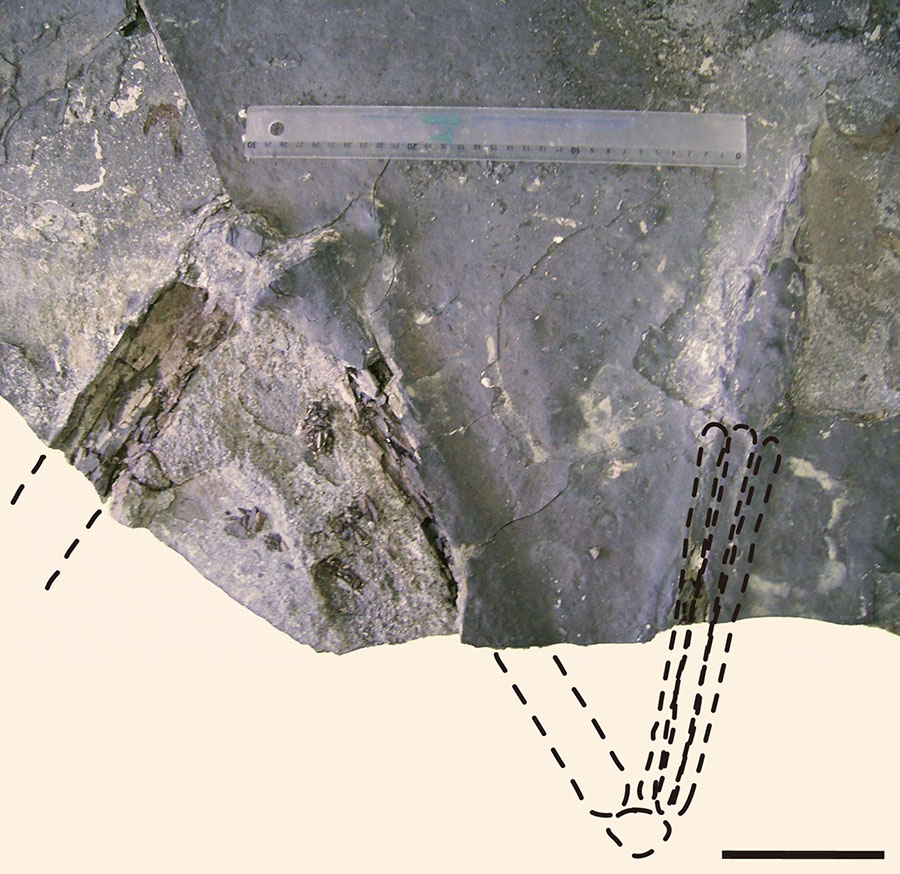
The holotype of Aratasaurus museunacionali, showing the femur and tibia before preparation. Scale bar – 10 cm. Image credit: Sayão et al, doi: 10.1038/s41598-020-67822-9.

The bones showed that this Aratasaurus museunacionali specimen was a juvenile, with an estimated body length around 3.12 m (10.2 feet) and a body mass of 34.25 kg.

The extinct creature is closely related to Zuolong salleei, a coelurosaurian dinosaur that lived some 160 million years ago (Jurassic period) in China.

“The material known from Aratasaurus museunacionali differs from derived coelurosaurian groups (e.g. Tyrannosauroidea, Ornithomimosauria) and Megaraptora mainly regarding by the cnemial crest and the disposition and morphology of metatarsals,” the paleontologists said.

“Among basal coelurosaurs, the new Brazilian theropod has a tibia similar to that of Zuolong salleei, and the pes more similar with that of Aarun zhaoi and Tanycolagreus topwilsoni.”

“The new taxon represents the first occurrence of basal coelurosaurians in the Araripe Basin and suggests a widespread distribution of this group during the Lower Cretaceous,” they said.

The discovery of Aratasaurus museunacionali is reported in a paper in the journal Scientific Reports.

_____

J.M. Sayão et al. 2020. The first theropod dinosaur (Coelurosauria, Theropoda) from the base of the Romualdo Formation (Albian), Araripe Basin, Northeast Brazil. Sci Rep 10, 10892; doi: 10.1038/s41598-020-67822-9

Source: www.sci-news.com/

Insights Into Climate Change During Origin Of Dinosaurs

Tuesday, July 14, 2020

A dinosaur-like reptile leaves muddy footprints along the shoreline of a lake during a rainstorm some 234 million years ago in northwestern Argentina. Credit: Jorge Gonzalez/NHMU

The Triassic Period, about 252 to 201 million years ago, was a time of volatile change, particularly during an interval known as the Carnian (about 237 to 227 million years ago). Three dramatic events occurred on Earth: the first dinosaurs appeared, gigantic volcanic eruptions called the Wrangellia large igneous province spewed out greenhouse gasses and the climate suddenly shifted to warmer, more humid conditions that scientists call the Carnian Pluvial Episode (CPE).

Recent work suggests that the Wrangellia eruptions caused the CPE, and that the resulting climate change may have spurred the early diversification of dinosaurs. But the lack of precise absolute dates for many Carnian sediments makes comparisons difficult. Additionally, few detailed paleoclimatic data exist for many regions outside of Europe, making it unclear whether the CPE was truly a global climate event or conclusively linking it to dinosaur diversification.

In a new study in the journal Gondwana Research, an international group led by Adriana Mancuso, a National Scientific and Technical Research Council (CONICET) researcher at the Instituto Argentino de Nivología, Glaciología y Ciencias Ambientales in Mendoza, Argentina, demonstrated that the CPE affected the southern hemisphere, specifically South America, which strengthens the case that it was a global climate event. The study was published online on June 15, 2020.

"There are ample Triassic, and specifically Carnian, rocks and fossils in South America, and Argentina in particular, but until now there were no paleoclimatic studies that could conclusively show that the Carnian Pluvial Episode occurred in the southern hemisphere," Mancuso said.

Photos (left) and 3D models (right) of dinosaur-like footprints from the Los Rastros Formation in the study area in northwestern Argentina. Credit: Randall Irmis/NHMU

The team, which included researchers at the University of Utah and the Berkeley Geochronology Center, studied Carnian rocks of the Los Rastros Formation, which are preserved in the Ischigualasto-Villa Unión Basin in northwest Argentina. For the first time, the team precisely dated volcanic ash preserved in lake sediments and pieced together the paleoclimate at this time.

"Our study focused on these rocks because they had the perfect combination of a good fossil record, dateable ash layers, and rich climate data preserved in lake sediments," said Randall Irmis of the Natural History Museum of Utah and Department of Geology & Geophysics at the University of Utah.

In order to date the ash layer, the scientists isolated small needle-like crystals of zircon, minerals that act like time-capsules. When zircon crystallizes during an eruption, it traps the element uranium in its crystal structure, but never incorporates lead. Any lead preserved in the crystals today is a result of the radioactive decay of uranium. Because scientists know this decay rate, they can measure the ratio of uranium and lead in each zircon crystal and calculate how far back in time the crystals formed. In the present study, this measurement was done on a precise mass spectrometer at the Berkeley Geochronology Center.

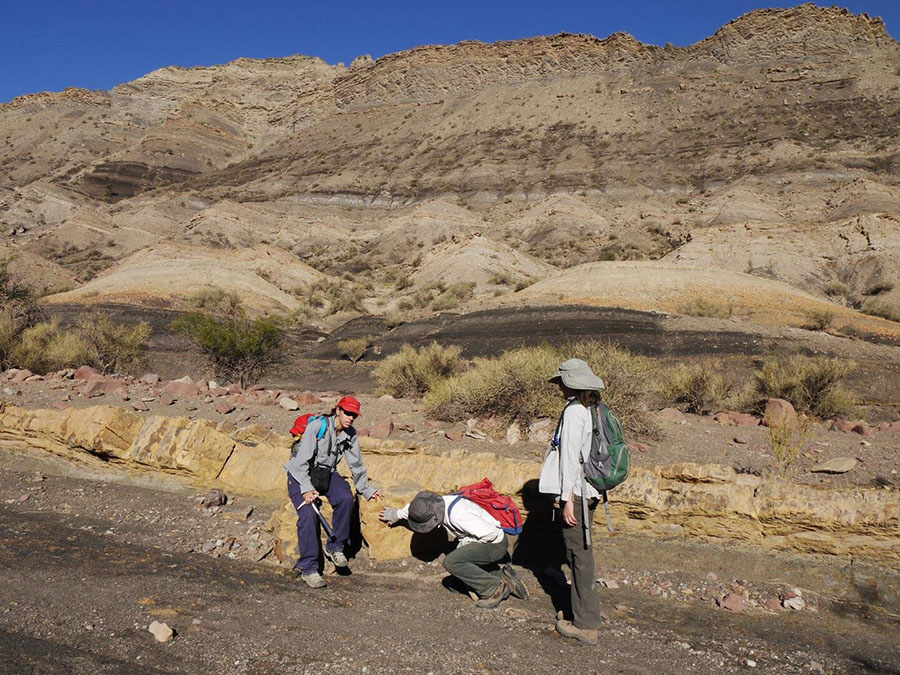
Co-authors Adriana Mancuso (left) and Cecilia Benavente (right), along with colleagues, examine dinosaur-like footprints in the Los Rastros Formation at the study area in northwestern Argentina. Credit: Randall Irmis

The scientists then obtained paleoclimatic data by looking at detailed features in the sediments— the types of clay preserved, and carbon and oxygen isotopes in freshwater limestone layers. With these measurements, the researchers estimated temperature, humidity and aridity and observed a distinct interval of particularly warm and humid conditions. Based on the absolute date from the same strata, they concluded that it matched in time with the CPE in the northern hemisphere. By using a variety of different analyses, the resulting paleoclimate inferences were more robust than previous assertions made from a single line of evidence.

This warm/humid interval also fortuitously includes layers that preserve fossil footprints of early dinosaurs or their closest relatives.

"Our study suggests that the appearance of dinosaurs in South America could be linked to the CPE, but the data available worldwide remains inconclusive. To make a more robust global link between the CPE and dinosaur diversification will require many more detailed studies of paleoclimate with precise ages like we were able to do for the Los Rastros Formation in Argentina," concluded Mancuso.


More information: Adriana C. Mancuso et al, Evidence for the Carnian Pluvial Episode in Gondwana: New multiproxy climate records and their bearing on early dinosaur diversification, Gondwana Research (2020). DOI: 10.1016/j.gr.2020.05.009

Provided by University of Utah

Source: https://phys.org/

Trierarchuncus prairiensis: New Species of Hook-Handed Dinosaur Uncovered in Montana

Tuesday, July 14, 2020

This life-size model of Trierarchuncus prairiensis was sculpted by Boban Filipovic, a paleontologist and artist from Serbia, and is on display at Badlands Dinosaur Museum, Dickinson, ND. Image credit: Boban Filipovic / Badlands Dinosaur Museum.

A new species of alvarezsaurid dinosaur that lived approximately 66 million years ago (Cretaceous period) has been unearthed in the Hell Creek Formation of Montana, the United States.

Dubbed Trierarchuncus prairiensis, the newly-discovered dinosaur is a member of Alvarezsauridae, a group of unusual insect-eating dinosaurs.

Alvarezsaurids were typically small (between 1 and 3 m, or 3.3 and 9.8 feet, long) and had exceptionally short arms with a huge hypertrophied claw at the end, very long legs, a long snout filled with tiny teeth, and a body covered in sleek primitive feathers.

They are known mainly from South America, Asia, and to a lesser extent North America.

Trierarchuncus prairiensis is the youngest known alvarezsaurid and was one of the very last dinosaurs, which went extinct during the end-Cretaceous mass extinction event.

The dinosaur’s fragmentary remains — three hand claws of different sizes — were collected from the Hell Creek Formation of Montana.

One claw is the most complete known for Alvarezsauridae and shows their hand claws were more hooked/curved than previously thought.

The extra hookedness/curvature would have been beneficial for digging or breaking apart rotten wood to search for insect prey.

The three claws of Trierarchuncus prairiensis with a human hand for scale. Image credit: Badlands Dinosaur Museum.

“The new fossils represent a growth series from juvenile to adult,” said lead author Dr. Denver Fowler of Badlands Dinosaur Museum and colleagues.

“This is important as it is recognized that dinosaurs changed in shape, often significantly, as they grew.”

“Indeed, the fossils show that as Trierarchuncus prairiensis grew its hand claw became more robust; blood vessel grooves on the sides of the claw became more deeply embedded in bone; and the claw surface developed from being smooth in young individuals, into a rough surface texture in adults.”

“Change through growth is significant as some previously named species of alvarezsaurids were described based on fossils that were small and probably pertained to young individuals,” the paleontologists said.

“The new findings suggest that some of the supposedly unique features of these previously named species may in fact be due to their immature condition, rather than representing defining characteristics of a species.”

The discovery is reported in a paper in the journal Cretaceous Research.

_____

Denver W. Fowler et alTrierarchuncus prairiensis gen. et sp. nov., the last alvarezsaurid: Hell Creek Formation (uppermost Maastrichtian), Montana. Cretaceous Research, published online July 10, 2020; doi: 10.1016/j.cretres.2020.104560

Source: www.sci-news.com/

Dinosaur Survival Horror Game "DEATHGROUND" Revealed

Saturday, July 11, 2020

Jaw Drop Games reveals Deathground, a co-op survival horror game filled with carnivorous dinosaurs, now seeking funding on Kickstarter.

If there's something gamers never get tired of, it's survival horror games on PC. If there's something else, it's dinosaurs. That's why Deathground has already received a surprising amount of attention after just releasing both the game's first teaser trailer and launching its Kickstarter. Deathground's a game designed to please – and terrify.

According to Deathground's Kickstarter, it's a first-person solo or co-op survival horror game, where the player or players face off against a variety of AI-controlled dinosaurs. Players will have an arsenal of tools and weapons at their hands with which to either stealth around carnivorous dinosaurs or to take them on directly. Deathground will also feature special classes so that every character feels unique. Otherwise, it's a fairly standard gameplay loop. Players enter a stage, search for loot and then go to an extraction point, all while avoiding hungry dinos.

In Deathground's pre-alpha reveal trailer, it shows players escaping through warehouses, dinosaur facilities, and jungle just like if they were escaping Jurassic Park. Only velociraptor enemies were shown to start, but a tyrannosaurus rex was also shown at the end of the trailer. Note that the trailer is pre-rendered, pre-alpha gameplay and may not represent the final product. It also doesn't mean the game is even in a playable state yet.

Deathground's Kickstarter is live right now and ends on August 7 at 10:19 AM PT. Its goal is just over $100,000, of which almost $30,000 has already been earned. For the first week, Kickstarter backers can reserve a copy of the game for around $16. After the early bird pricing expires, it'll cost around 19 to back for a copy of the game. The game is developed by Jaw Drop Games, which also recently revealed the rhythm first-person shooter Gun Jam.

Deathground is tentatively planned to release in September 2021 on PC.

Source: https://gamerant.com/

Ankylorhiza tiedemani: Large Dolphin from Oligocene Epoch was Fast-Swimming Apex Predator

Saturday, July 11, 2020

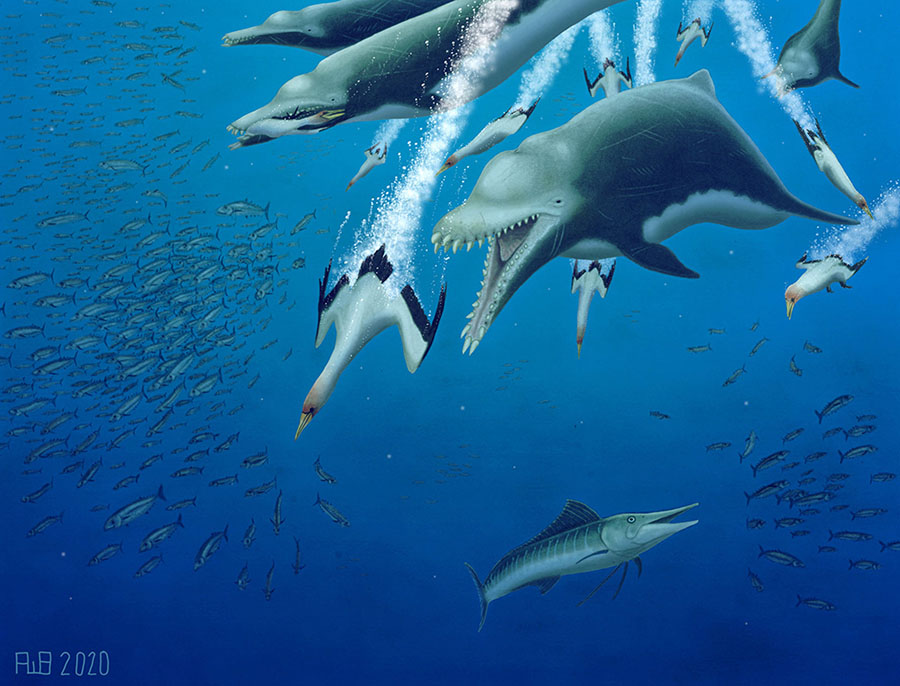
Life restoration of a pod of Ankylorhiza tiedemani. Image credit: Robert Boessenecker.

Paleontologists have found and described the first nearly complete skeleton of Ankylorhiza tiedemani, an extinct large dolphin that lived about 24 million years ago (Oligocene Epoch).

With a body length of 4.8 m (15.7 feet), Ankylorhiza tiedemani was the largest member of the group Odontoceti (toothed whales) during the Oligocene — a size not surpassed until the early Miocene by sperm whales.

The extinct animal was first described in the 1800s from a large fragmentary skull. Its first skeleton was discovered in the 1970s by then Charleston Museum Natural History curator Albert Sanders.

The nearly complete skeleton analyzed in the new study was found in the 1990s in South Carolina by commercial paleontologist Mark Havenstein. It was later acquired by private fossil collector Mace Brown and subsequently donated to the Mace Brown Museum of Natural History at the College of Charleston.

The specimen includes a well-preserved skull, most of the vertebral column, ribcage and one flipper.

“The discovery is important because it is one of the first skeletons found of a very early member of the toothed whales (dolphins, porpoises, and sperm whales), shortly after they diverged around 35-36 million years ago from baleen whales,” said Dr. Robert Boessenecker, a paleontologist in the Department of Geology and Environmental Geosciences at the College of Charleston.

“What makes that important is its evolutionary position as a very early branching dolphin.”

“Most early dolphins are known only from skulls, so having a skeleton with flippers and most of the vertebrae gives us an unprecedented look into the evolution of swimming adaptations.”

“That unprecedented window surprisingly told us that baleen whales and dolphins have many similarities owing to convergent evolution since their evolutionary split 35 million years ago.”

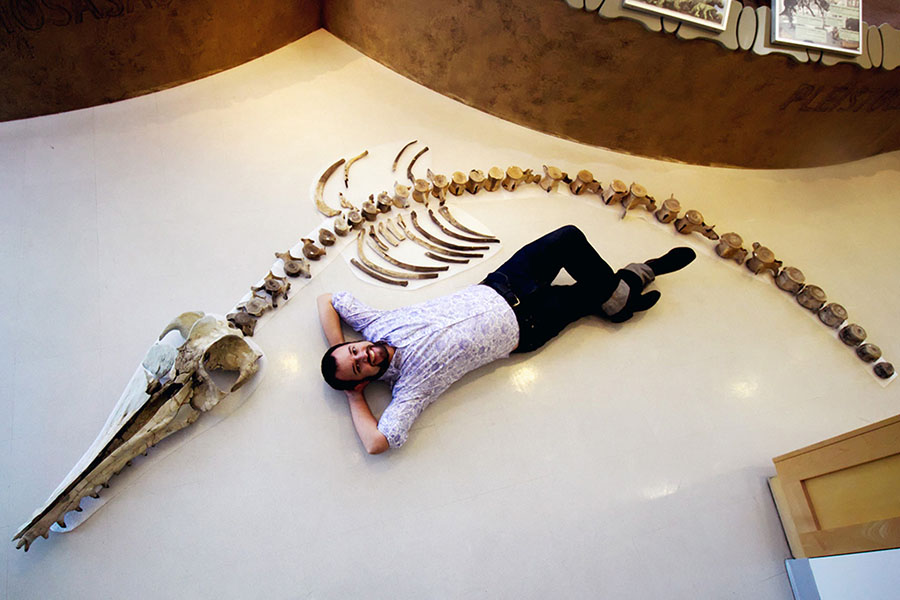
The skeleton of Ankylorhiza tiedemani and Dr. Boessenecker. Image credit: College of Charleston.

The skeleton of Ankylorhiza tiedemani shows a few adaptations for faster swimming than other smaller dolphins, but also shows several primitive features.

“These primitive features are surprising because paleontologists and biologists long assumed that many of the adaptations for rapid swimming in baleen whales and toothed whales were ancient adaptations shared thanks to their common heritage over the past 35 million years,” Dr. Boessenecker said.

“The degree to which baleen whales and dolphins independently arrive at the same overall swimming adaptations, rather than these traits evolving once in the common ancestor of both groups, surprised us,” he added.

“Some examples include the narrowing of the tail stock, increase in the number of tail vertebrae, and shortening of the humerus (upper arm bone) in the flipper.”

“This is not apparent in different lineages of seals and sea lions, for example, which evolved into different modes of swimming and have very different looking postcranial skeletons.”

“It’s as if the addition of extra finger bones in the flipper and the locking of the elbow joint has forced both major groups of cetaceans down a similar evolutionary pathway in terms of locomotion.”

Multiple lines of evidence show that Ankylorhiza tiedemani was a top predator in the community in which it lived.

The species was very clearly preying upon large-bodied prey like a killer whale, and is the first echolocating whale to become an apex predator.

When Ankylorhiza tiedemani became extinct by about 23 million years ago, killer sperm whales and the shark-toothed dolphin Squalodon evolved and reoccupied the niche within 5 million years.

After the last killer sperm whales died out about 5 million years ago, the niche was left open until the ice ages, with the evolution of killer whales about 1 or 2 million years ago.

“Whales and dolphins have a complicated and long evolutionary history, and at a glance, you may not get that impression from modern species,” Dr. Boessenecker said.

“The fossil record has really cracked open this long, winding evolutionary path, and fossils like Ankylorhiza tiedemani help illuminate how this happened.”

The findings were published in the journal Current Biology.

_____

Robert W. Boessenecker et al. Convergent Evolution of Swimming Adaptations in Modern Whales Revealed by a Large Macrophagous Dolphin from the Oligocene of South Carolina. Current Biology, published online July 9, 2020; doi: 10.1016/j.cub.2020.06.012

Source: www.sci-news.com/

Leithia melitensis: Enormous Dormice Once Roamed Mediterranean Islands

Friday, July 10, 2020

An artist’s impression of the giant dormouse Leithia melitensis (left) and its nearest living relative the garden dormouse (right). Image credit: James Sadler, University of York.

An international team of paleontologists from the UK, Italy and Switzerland has created the first digital reconstruction of the skull of Leithia melitensis, an extinct gigantic dormouse that lived on Malta and Sicily around two million years ago.

Leithia melitensis was first described by the Scottish naturalist Andrew Leith Adams in 1863.

Roughly the size of a cat, the ancient rodent is by far the largest known dormouse species, being at least twice the size of other insular species both extant and extinct.

Leithia melitensis is an example of island gigantism, a biological phenomenon in which the body size of an animal isolated on an island increases dramatically.

Alongside the gigantic dormice, the Mediterranean islands of Malta and Sicily were also home to giant swans and owls as well as dwarf deer, hippos and elephants.

“While island dwarfism is relatively well understood, as with limited resources on an island animals may need to shrink to survive, the causes of gigantism are less obvious,” said senior author Dr. Philip Cox, a researcher in the Department of Archaeology and the Hull York Medical School at the University of York.

“Perhaps, with fewer terrestrial predators, larger animals are able to survive as there is less need for hiding in small spaces, or it could be a case of co-evolution with predatory birds where rodents get bigger to make them less vulnerable to being scooped up in talons.”

Composite skull of Leithia melitensis: (A) dorsal view, (B) ventral view, (C) anterior view, (D) posterior view, (E) left lateral view. Image credit: Hennekam et al, doi: 10.5334/oq.79.

In the new study, the scientists digitally pieced together fossilized fragments from five skulls of Leithia melitensis to reconstruct the first complete skull of the species.

The reconstructed skull is 10 cm (3.9 inches) long — the length of the entire body and tail of many types of modern dormouse.

“Having only a few fossilized pieces of broken skulls available made it difficult to study this fascinating animal accurately,” said lead author Jesse Hennekam, a PhD student in the Hull York Medical School at the University of York.

“This new reconstruction gives us a much better understanding of what the giant dormouse may have looked like and how it may have lived.”

The results were published in the journal Open Quaternary.

_____

J.J. Hennekam et al. 2020. Virtual Cranial Reconstruction of the Endemic Gigantic Dormouse Leithia melitensis (Rodentia, Gliridae) from Poggio Schinaldo, Sicily. Open Quaternary 6 (1); doi: 10.5334/oq.79

Source: www.sci-news.com/

Pages