Blogs

Lusovenator santosi: New Predatory Dinosaur Identified in Portugal

Wednesday, July 29, 2020

An artist’s impression of Lusovenator santosi. Image credit: Carlos de Miguel Chaves.

A team of paleontologists from Portugal and Spain has found fossil fragments from a new genus and species of carcharodontosaurian dinosaur.

The new dinosaur, scientifically named Lusovenator santosi, lived in what is now Portugal between 153 and 145 million years ago (Jurassic period).

The ancient predator was about 3.5 m (11.5 feet) long and 1 m tall (3.3 feet), and walked on two hind limbs.

It belongs to Carcharodontosauria, a large group of carnivorous theropod dinosaurs from the Jurassic and Cretaceous periods in the clade Allosauria.

Lusovenator santosi as an early branching carcharodontosaurian allosauroid,” said team leader Dr. Elisabete Malafaia from the Universidade de Lisboa and the Universidad Nacional de Educación a Distancia and her colleagues.

“It represents the oldest member of Carcharodontosauria defined in the Upper Jurassic of the ancient supercontinent Laurasia and extends the record of this group, which was already represented in the Lower Cretaceous of Europe.”

Selected elements of Lusovenator santosi and other carcharodontosaurs showing some of the features that clearly nest the new species within Carcharodontosauria: (A) Lusovenator santosi, right ilium in medial view; (B) possible carcharodontosaur from Tendaguru, right ilium in medial view; (C, D) Lusovenator santosi, right ischium in (C) proximal and (D) lateral views; (E, F) Acrocanthosaurus atokensis, left ischium in (E) proximal and (F) lateral views; (G, H) Lusovenator santosi, middle caudal vertebrae in (G) lateral and (H) dorsal views (I, J) Veteropristisaurus milneri, middle caudal vertebrae in (I) lateral and (J) dorsal views. Abbreviations: acdl – anterior centrodiapophyseal lamina, alr – anterior lateral ridge, ilc – iliac peduncle, pamr – preacetabular medial ridge, polr – posterior lateral ridge, sprl – spinoprezygapophyseal lamina. Scale bars – 100 mm (A-F) and 50 mm (G-J). Image credit: Malafaia et al, doi: 10.1080/02724634.2020.1768106.

The paleontologists described Lusovenator santosi from two specimens found in Portugal’s Lusitanian Basin.

One of the specimens is a 153-million-year-old partial skeleton of a juvenile individual from Praia de Valmitão, the locality of Ribamar and municipality of Lourinhã.

The second specimen is 8 million years younger, and belongs to a large-sized individual of Lusovenator santosi. It was collected at Praia de Cambelas, in the locality of São Pedro da Cadeira and municipality of Torres Vedras.

“Despite the great similarity in the theropod faunal composition, the recognition of a carcharodontosaurian allosauroid taxon provides a component of the Upper Jurassic Lusitanian Basin distinct from its contemporaneous Morrison Formation in North America,” the researchers said.

“The development of a terrestrial dispersal route connecting these landmasses after the late Tithonian (145 million years ago) could explain the absence of Carcharodontosauria in the diverse theropod faunas of the Morrison Formation and, additionally, their presence during the Early and Late Cretaceous of North America.”

“The new carcharodontosaurian theropod provides the first evidence for sympatry among allosauroid theropods in the Late Jurassic of Europe,” they said.

“Additionally, the discovery of Lusovenator santosi sheds light on a poorly known period of carcharodontosaurian history and adds important data to the knowledge of the early evolution of these allosauroids.”

paper on the discovery was published this month in the Journal of Vertebrate Paleontology.

_____

Elisabete Malafaia et al. A new carcharodontosaurian theropod from the Lusitanian Basin: evidence of allosauroid sympatry in the European Late Jurassic. Journal of Vertebrate Paleontology, published online July 10, 2020; doi: 10.1080/02724634.2020.1768106

Source: http://www.sci-news.com/

Jurassic Park: 10 Things You Never Knew About The Franchise

Thursday, July 30, 2020

Jurassic Park and World are the one and only dinosaur franchise out there, and here's more things about it that you never knew.

When Steven Spielberg released Jurassic Park in 1993, moviegoers were in awe of the film's entertaining action sequences, stunning special effects, and underlying cautionary tale about humanity's propensity to tamper with nature for profit. Close to 30 years later, moviegoers remain in awe of the film, whose success launched a major franchise including video games, comics, and theme park rides.

Four cinematic sequels later, and with a fifth on the way, the Jurassic Park/Jurassic World franchise is considered a milestone in both popular culture and moviemaking. Massive tyrannosaurs and swift velociraptors still haunt the public consciousness while breeding new life into the importance of paleontology – or the study of dinosaurs.

10 - Jurassic Park & The Lost World Are Based On Michael Crichton Novels

In 1990, Universal Pictures and Amblin Entertainment purchased the rights to Michael Crichton's forthcoming science fiction novel Jurassic Park. The book proved to be a massive success, which fueled interest in Stephen Spielberg's film.

Crichton published a sequel, The Lost World, in 1995. Universal Studios and Amblin Entertainment again purchased the rights to the novel, bringing Spielberg back to direct. While The Lost World was not as financially or critically successful as its predecessor, it's still hailed by fans as a compelling sequel.

9 - Subsequent Films Are Not Based On The Books

The rest of the films in the Jurassic Park franchise deviate from the Michael Crichton books. 2001's Jurassic Park III, directed by Joe Johnston, sees Sam Neill's character Dr. Alan Grant returning to Isla Sorna after being promised additional research funding.

The franchise wasn't revived in theatres again until 2015's Jurassic World, which stars Chris Pratt and Bryce Dallas Howard as employs at the fully functional Jurassic World on Isla Nubar – the theme park Richard Attenborough's character John Hammond hoped to develop in the original film. Jurassic World was followed up by 2018's Fallen KingdomDominion will be released in 2021.

8 - The Franchise Generated At Least $5 Billion In Revenue

While it doesn't compare to Star Wars or BatmanJurassic Park is a very profitable franchise. Box office sales for the films alone are in excess of $5 billion dollars. This doesn't account for merchandise or home video sales.

In addition to the standard features, Lego has also produced animated tie-ins to Jurassic World. Netflix and Steven Spielberg's production company DreamWorks are also in talks to develop an animated series called Jurassic World: Camp Cretaceous.

7 - Jurassic World Was Developed In 2001, But Not Released Until 2015

During the production of Jurassic Park III in 2001, Spielberg formulated a story idea for a fourth film. Multiple scripts were developed by multiple writers, including well-known screenwriters like John Sayles and Mark Protosevich.

The 2007 to 2008 writer's strike slowed down talks to make the feature. In 2012, Rise of the Planet of the Apes screenwriters Rick Jaffa and Amanda Silver were hired to develop a new script. Colin Trevorrow, then known for the indie comedy Safety Not Guaranteed, was hired to direct and co-write the screenplay.

6 - Jurassic World Is The Highest Grossing In The Franchise (So Far)

2015's Jurassic World earned $1.6 billion in worldwide theatres. Its sequel, Fallen Kingdom, brought in an impressive $1.3 billion. Both films, even with their larger budgets, surpassed the original Jurassic Park by hundreds of millions.

The Lost World and Jurassic Park III lag behind the rest of the franchise. The Lost World made just over $600 million in theatres, while Jurassic Park III brought in $350 million – a weak performance compared to the rest of the films.

5 - Jurassic Park Was The Highest Grossing Movie Of All Time Until Titanic Beat It

During its original theatrical run, Jurassic Park earned over $900 million worldwide, beating the record for the highest-grossing film. The movie sold 86.2 million tickets during this run, exceeding Spielberg's previous box office gem ET.

Jurassic Park lost this top spot to James Cameron's Titanic, the first movie to ever make more than $1 billion in theaters. Later showings of the original Jurassic Park added to its theatrical earnings, which now stands at around $1.03 billion.

4 - The Special Effects Inspired George Lucas To Make The Star Wars Prequels

Much of Jurassic Park's legacy lies in the film's use of cutting-edge, computer-generated special effects. Spielberg's crew proved that filmmaking technologies long thought too expensive or impossible were actually accessible. By combining these new innovations with classic animatronic creatures, Jurassic Park takes its viewers on one believable adventure.

Star Wars creator George Lucas was so impressed by what Spielberg created in the movie that he decided to revive his franchise after years of dodging the question. In essence, Jurassic Park paved the way for the Star Wars prequels, as well as Peter Jackson's Lord of the Rings trilogy.

3 - Steven Speilberg Cancelled A Planned Tie-In Animation Series

After the theatrical success of Jurassic Park, Amblin Entertainment worked with Spielberg to developed an animated series entitled Escape from Jurassic Park. The cartoon would continue to trace John Hammond's attempts to open Jurassic Park to the public as his corporate rival, Biosyn, works to open a similar park in Brazil.

The project was slated to have a very large budget, and producers envisioned it as an adult-oriented series accessible to all ages. Before production could begin, Spielberg had to give it his seal of approval. Spielberg ultimately said no, as he was tired with all the promotional and merchandising efforts surrounding his film. Concept art for the would-be cartoon can be found online.

2 - Alexander Payne Worked On The Screenplay For Jurassic Park III

Oscar winner Alexander Payne, known for dark comedies like Election and Sideways, actually worked on the script for Jurassic Park III. The original screenwriter Craig Rosenberg wanted the film to revolve around a group of teens marooned on an island occupied by dinosaurs. After his script was rejected, Peter Buchman wrote a script involving parallel stories related to John Hammond's genetically altered beasts.

Buchman's script was deemed too complicated, so Payne and fellow screenwriter Jim Taylor were brought on board to simplify it and add more depth to the characters. Payne later shared that much of the humor he interjected was cut out since director Joe Johnston decided to focus more on the action.

1 - The Original Trio Will Return For Jurassic World: Dominion

Sam Neill returned to the franchise in Jurassic Park III as Dr. Alan Grant. Jeff Goldblum appeared in Fallen Kingdom as Dr. Ian Malcolm. However, Laura Dern has not revisited the story since playing Dr. Ellie Sattler in the original film.

Thankfully, all three actors will be joining Chris Pratt and Bryce Dallas Howard in 2021's Dominion. This ensemble film is the third Jurassic World title, and the fifth in the franchise. Little is known about the original cast's role in the upcoming movie, though Neill has teased that their presence will be more than just glorified cameos.

Source: https://screenrant.com/

Miocene Fossil from Africa Provides New Evidence for Origin of American Crocodiles

Tuesday, July 28, 2020

Life appearance of Crocodylus checchiai from As Sahabi, Libya. Image credit: D.A. Iurino.

A team of paleontologists from Italy and Spain has compared the only well-preserved skull of Crocodylus checchiai, an extinct species of crocodile that lived in what is now Libya about 7 million years ago (Miocene epoch), to those of the four living species of crocodiles from the Americas and found that the ancient African reptile is closely related to the American crocodiles. The findings suggest that crocodiles may have migrated from Africa to America during the Miocene.

The skull and associated lower jaw of an adult Crocodylus checchiai were collected in 1938 at the paleontological site of As Sahabi in northern Libya.

The specimen was described in 1947 by the Italian paleontologist Angiola Maria Maccagno and then hosted in the collections of the Istituto di Paleontologia dell’Università di Roma.

In order to improve the knowledge about Crocodylus checchiai and its possible relationships with the American crocodiles, Dr. Massimo Delfino from the Università di Torino and the Universitat Autònoma de Barcelona and his colleagues tried to locate the original Crocodylus checchiai skull.

The researchers succeeded in finding it in the collection of the Museo Universitario di Scienze della Terra of Sapienza University of Rome.

They then used computed tomography (CT) imaging to re-examine the well-preserved specimen.

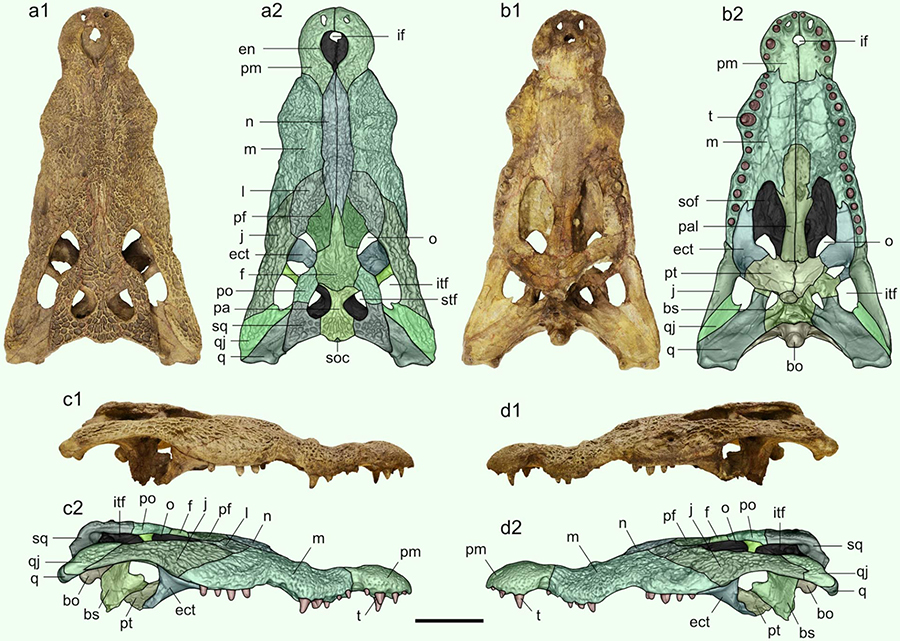
The 7-million-year-old skull of Crocodylus checchiai from As Sahabi, Libya, in dorsal (a1, a2), ventral (b1, b2), right lateral (c1, c2) and left lateral (d1, d2) views. Anatomical abbreviations: bo – basioccipital, bs – basisphenoid, ect – ectopterygoid, en – external naris, f – frontal, if – incisive foramen, itf – infratemporal fenestra, j – jugal, l – lacrimal, m – maxilla, n – nasal, o – orbit, pa – parietal, pal – palatine, pf – prefrontal, pm – premaxilla, po – postorbital, pt – pterygoid, q – quadrate, qj – quadratojugal, soc – supraoccipital, sof – suborbital fenestra, sq – squamosal, stf – supratemporal fenestra, t – tooth. Scale bar – 10 cm. Image credit: Delfino et al, doi: 10.1038/s41598-020-68482-5.

They identified several new inner structures including a protrusion in the middle of the snout that has not been identified on any other African crocodile species.

This unique structure, called the mid-rostral boss, is also present in the four living American crocodile species: Crocodylus intermediusC. moreletii, C. acutus and C. rhombifer, and indicates a close evolutionary relationship between Crocodylus checchiai and the crocodiles from the Americas.

“Analyses of the evolutionary relationships between species suggest that Crocodylus checchiai may be part of the same lineage as the four American crocodile species,” the scientists said.

“The remains of Crocodylus checchiai have been dated to around 7 million years ago while the oldest remains of an American crocodile, the extinct Crocodylus falconensis, have been dated to around 5 million years ago.”

“Based on these findings, we propose that crocodiles reached America by migrating westwards from Australasia via Africa.”

The findings were published in the journal Scientific Reports.

_____

M. Delfino et al. 2020. Old African fossils provide new evidence for the origin of the American crocodiles. Sci Rep 10, 11127; doi: 10.1038/s41598-020-68482-5

Source: www.sci-news.com/

Jurassic World 3 Is A Global, Epic Story

Monday, July 27, 2020

Director Colin Trevorrow confirms that the scale of Jurassic World 3 will be epic, taking the story away from an island setting to a global one.

Director Colin Trevorrow confirmed that the scale of Jurassic World: Dominion will be epic, taking the story away from an island setting to a global one. The latest entry in the franchise follows on from Jurassic World: Fallen Kingdom, which ended with the dinosaurs escaping into the wider world and Dr. Ian Malcolm (Jeff Goldblum) cautioning that the planet will now have to learn to live alongside dinosaurs.

Goldblum, who had a glorified cameo in Jurassic World: Fallen Kingdom, will return in a full role for the franchise's sixth movie, alongside original stars Sam Neill (Dr. Alan Grant) and Laura Dern (Dr. Ellie Sattler). They will join Chris Pratt and Bryce Dallas Howard, who have anchored the current trilogy. Trevorrow returns to the director's chair, and also wrote the script, for Jurassic World: Dominion. Recent photos from the set of the shoot, showing a plane downed in an arctic landscape, suggest that the action will take place in new environments that haven't been seen in the franchise before.

And now Trevorrow, talking as part of the Collider's "Directors on Directing" panel during San Diego Comic-Con@Home has confirmed what many suspected, that Jurassic World: Dominion will take place in various locations across the world. Trevorrow calls the scale "epic." He adds that the movie will not just focus on a small group of people on an island, which has been the standard set-up for the Jurassic movies so far. You can read his full comments below.

"I'm sure if you saw the last movie you know this is not just some people on an island anymore. It's a large-scale, global, epic story with characters from the original Jurassic Park all in major roles, and of course Bryce and Chris."

Trevorrow does go on to say, though, that once all of the spectacle is taken into account, the movie is just like any other - "a couple people in the center of a circle trying to make something feel real and honest." From these comments, it sounds like Trevorrow is attempting to balance the grand scale of his narrative with some stories that still feel human and relatable.

For fans of the franchise, the fact that the action in Jurassic World: Dominion is moving away from the island setting has both positive and negative possibilities. On the one hand, seeing dinosaurs wreaking havoc in the wider world will certainly bring something fresh and new to the table. However, there's also the risk of losing the heart of the movie in the midst of all the globe-trotting action.

That said, it sounds like Trevorrow feels he has a handle on that. Later in the panel, he says that he used the production shutdown to work on visual effects rather than changing the script. Jurassic World: Dominion is looking likely to be the most ambitious movie in the franchise yet, but hopefully it also manages to be a good movie at the same time.

Source: https://screenrant.com/

7 Fun Dinosaur Facts To Impress Your Kids With

Sunday, July 26, 2020

Kids love learning about dinosaurs. Now you can tout your own knowledge and impress the kids with these fun dinosaur facts!

If your child is like the majority of most young kids, then chances are your child finds dinosaurs absolutely fascinating. After all, who isn't impressed with these large, incredible creatures who roamed the Earth millions of years ago? Dinosaurs are incredible!

With shows like Dino Dana and Dinosaur Train, our kids pick up tons of dino facts that they love to share with us. Luckily, though, you can tout your own knowledge and impress the kids with these fun dinosaur facts!

7 - Turns Out The T-Rex Wasn't Actually The Dinosaur King; That's The Spinosaurus

That's right: Scientists now believe that the Spinosaurus was the largest carnivorous (meat-eating) dinosaur to exist. In fact, experts say this dinosaur was somewhere between 41 and 59 ft long and weighed up to 23 tons!

The Spinosaurus, which looked like a massive crocodile, lived both on land and in water in a region of modern-day North Africa during the Cretaceous Period, which occurred about 70 to 145 million years ago.

6 - Not All Dinosaurs Were Big, Either

Although most people believe that all dinosaurs were huge, that's not actually the case. In fact, some dinosaurs, like the Compsognathus, were actually about the same size as a chicken! Furthermore, most dinosaurs were no larger than the size of a small car, making them similar in size to rhinos and other modern mammals.

5 - Not Everything That Lived During The Age Of Dinosaurs Was Actually A Dinosaur

Species like the Pterodactyl and Plesiosaur lived at the same time as dinosaurs, but scientists say that those creatures weren't actually dinosaurs. Instead, Pterodactyls were flying reptiles that lived during the age of dinosaurs and Plesiosaurs were actually water-based reptiles.

Furthermore, many reptiles actually pre-date reptiles dinosaurs. In fact, archosaurs and therapsids lived well before the first dinosaurs appeared nearly 230 million years ago.

4 - Turns Out The Apatosaurus And Brontosaurus Are The Same Dinosaur

That's right: The Apatosaurus is actually the "correct" name for the well-known Brontosaurus. Othniel Charles Marsh first discovered Apatosaurus bones back in 1877. Then, when he later found a larger set of similar bones, he falsely assumed that he'd discovered a new species. However, scientists later determined that the second set of bones were just bones of an adult Apatosaurus. By the time this discovery was made, the name Brontosaurus had already caught on, and it's only been in recent years that there's been a widespread effort to correct terminology.

3 - The Movie Jurassic Park Didn't Do The Velociraptor Justice

Although the Velociraptor does have some terrifying claws, the dinosaur was actually a lot smaller than they portrayed in the movie Jurassic Park. In fact, the tiny carnivore was actually closer to the size of a turkey than a human, with a fully-grown Velociraptor only standing about 6 ft tall and weighing just 33 pounds!

Furthermore, many scientists believe that the Velociraptor had feathers and actually used its hind claws to tear apart its prey, not its front ones.

2 - Stegosaurus Plates Aren't Actually Part Of Their Skeleton

Most of us know that the stegosaurus was a large herbivore dinosaur with plates along its spine. However, scientists have since discovered that Stegosaurus plates actually rose out of the dinosaur's skin, meaning they were not attached to the spine or other part of the Stegosaurus' skeletal frame.

Another fun fact about the Stegosaurus: Although they were some of the largest dinosaurs to ever walk the Earth, their brains were only about the size of a modern dog's brain!

1 - Over 1,000 Unique Species Of Dinosaurs Existed

We've known about dinosaur fossils for a long time, but efforts to really discover and  study fossils didn't really take off until the early 19th century. Since that time, though, paleontologists have named over 1,000 different species of dinosaurs... and the list continues to grow as they continue to discover new fossils. In fact, paleontologists have discovered dinosaur fossils on every continent of Earth, including Antarctica!

Obviously we could spout of dinosaur facts all day long, but who likes a know-it-all? While you may not want to go overboard with your new-found dino knowledge, your kids will love the information about some of the world's most fascinating creatures. Enjoy the dinosaur obsessions while they last, moms!

Source: www.moms.com/

Why You Should Indulge Your Child's Dinosaur Obsession

Sunday, July 26, 2020

When some children are quite young, they begin to show what scientists call “intense interest” in certain topics--like dinosaurs.

Kids go through phases. Sometimes it’s all about space, trains, unicorns, or cars. But for many young children, dinosaurs can capture the imagination like nothing else. But what happens when a child is so obsessed with these pre-historic creatures that it’s almost all they can talk about?

Don’t be concerned if a little one seems a bit pre-occupied. In fact, they might just have a future in it. According to recent reporting in The New York Times, Evan Johnson-Ransom could recite countless facts about dozens of dinosaurs when he was a little kid. Now, he’s a vertebrate paleontologist who is studying the evolution of feeding behaviors in dinosaurs like the Tyrannosaurus Rex. He credits his mother and grandmother for indulging him in his passions at an early age.

When some children are quite young, they begin to show what scientists call “intense interest” in certain topics. For many, these interests begin to wane in adolescence. But for a few, the interests can deepen and create a path for further exploration that could lead to a purposeful career or calling.

Having an intense interest is especially important for cognitive development. According to CNN, a 2008 study found that intense interests over a long period of time, “particularly in a conceptual domain like dinosaurs, can help children develop increased knowledge and persistence, a better attention span, and deeper information-processing skills. In short, they make better learners and smarter kids.”

The important distinction is when kids develop “conceptual” interests as opposed to “situational” interests. Conceptual interests arise when a child is deeply interested in the subject— all things dinosaurs. Situational interests happen when a child is interested in something in the moment—like when a lion suddenly roars. Kids with conceptual interests tend to dive deeply into a subject area that develops over time.

A piece in Distractify reported that “A study carried out at the universities of Indiana and Wisconsin found that children who develop an intense interest do better later in life. Joyce M. Alexander of Indiana University and her team found that this type of interest, especially those that demand a conceptual domain, ‘enhance perseverance, improve attention and enhance skills of complex thinking as the processing of information.’”

RELATED: 15 of the Best Dinosaur Movies for Kids

For some kids, a passion for dinosaurs happens more organically over time. Ben R., a 13-year-old from Texas, first became interested in dinosaurs as a result of a Pokémon obsession as a young child. His devotion to dinosaurs emerged as a way to understand fantastical creatures that really existed.

“Science seems natural for me because I always wanted to answer questions that every kid has like ‘how did animals get here?’ Dinosaurs got me very interested in science and I started to learn more on my own about pre-historic marine life, evolution, and the history of life Earth—things like that,” Ben said. “I want to work in a research lab and figure out mysteries. I want to contribute. I love science.”

Other studies have also concluded that children with sustained interests have more of a capacity to develop above-average intelligence. While many parents are considering homeschooling, unschooling, or cooperative schooling for the 2020-2021 school year, zoning in on a child’s natural interests could help facilitate deeper growth and mastery in a variety of subjects including science, history, language arts, and math. Leveraging a child’s passion by incorporating their own interests into individualized lessons is a common teaching methodology in alternative education.

Through science and entertainment content, parents can help kids deepen their love of dinosaurs. From revisiting the Jurassic Park franchise to watching the mind-blowing reenactments of dinosaur wars of the critically-acclaimed series, Walking with Dinosaurs, dino lovers everywhere can find something to enjoy.

Parents can also find multiple virtual field trips online at renowned museums that house exceptional dinosaur collections including the Field Museum in Chicago and the Smithsonian National Museum of Natural History.

Source: www.moms.com/

Jurassic World: Dominion Will Have More Animatronic Dinosaurs Than Any Movie In The Series

Saturday, July 25, 2020

Practical effects are back in season with the Jurassic World series.

If you thought practical effects had gone the way of the dinosaurs, think again. Jurassic World: Dominion is actually being shot using more animatronics than the other movies in the Jurassic World trilogy.

Speaking to Collider as part of their virtual Comic-Con event, Jurassic World writer and director Colin Trevorrow had this to say about the state of practical effects in 2020 and the Jurassic franchise more specifically.

"We've actually gone more practical with every Jurassic movie we've made since the first one, and we've made more animatronics in this one than we have in the previous two," he said. "And the thing that I've found, especially in working in the past couple months, is that we finally reached a point where it's possible to… digital extensions on animatronics will be able to match the texture and the level of fidelity that, on film, an animatronic is going to be able to bring. And you didn't use to be able to really mix them. You could really see the seams. And so that part of it is very exciting for me."

It's good news to anyone that prefers the look of real-life animatronics over fully-CG dinos, and practical effects aren't the only thing making a return from the Jurassic Park franchise's past. As we reported last month, series' protagonists Alan Grant (Sam Neill), Ellie Sattler (Laura Dern), and Dr. Ian Malcolm (Jeff Goldblum) are making a return in Dominion, but – unlike Malcolm's role in Jurassic World: Fallen Kingdom – the returning characters are likely to play a larger role in the story. 

Jurassic World: Dominion is set for release on June 11: 2021.

Source: www.gamesradar.com/

Foxes Started Eating Human Food Remains as Early as 42,000 Years Ago

Friday, July 24, 2020

The red fox (Vulpes vulpes). Image credit: Shorty Ox.

A team of scientists from the University of Tübingen has studied the diet of Arctic foxes (Vulpes lagopus) and red foxes (Vulpes vulpes) that lived during the Paleolithic period in southwestern Germany.

Foxes love leftovers. In the wild, they regularly feed on scraps left behind by larger predators like bears and wolves, but the closer foxes live to human civilization, the more of their diet is made up of foods that humans leave behind.

University of Tübingen researcher Chris Baumann and colleagues hypothesized that if this commensal relationship goes back to ancient times, then foxes might be useful indicators of human impact in the past.

They compared ratios of carbon and nitrogen isotopes between the remains of various herbivores, large carnivores, and red and Arctic foxes from several Paleolithic archaeological sites in the Ach Valley (Hohle Fels, Geißenklösterle and Sirgenstein) and the Lone Valley (Bockstein, Hohlenstein-Stadel and Vogelherd) in Germany.

At sites older than 42,000 years, when Neanderthals sparsely occupied the region, fox diets were similar to their local large carnivores.

“In this study, we were seeking to discover whether human hunting activity may have provided advantages for some animal species,” Baumann said.

“Originally, the main food source for red and Arctic foxes was small mammals, which the foxes hunted. That was the case in the Middle Paleolithic, more than 42,000 years ago.”

“In southwestern Germany that was the time of the Neanderthals and the Swabian Jura was only sparsely populated.”

But in the younger sites, as Homo sapiens became common in the area, foxes developed a more unique diet consisting largely of reindeer, which are too big for foxes to hunt but which are known to have been important game for ancient humans of the time.

The results suggest that during the Upper Paleolithic, these foxes made a shift from feeding on scraps left by local large predators to eating food left behind by humans. This indicates that foxes’ reliance on human food goes back a good 42,000 years.

Summary figure for the commensal fox hypothesis. Image credit: Baumann et al, doi: 10.1371/journal.pone.0235692.

“The isotopic data from the fox bones indicate that the composition of several animals’ diets changed,” said University of Tübingen’s Professor Hervé Bocherens, co-author on the study.

“We assume that these foxes now lived mainly on meat waste left behind by humans, or perhaps were even fed by them.”

“The data showed the meat was from large animals that the foxes could not bring down — such as mammoth and reindeer.”

“The humans dragged the whole reindeer into their caves. But the huge mammoths were butchered in the place they were killed.”

The team proposes that, with further studies investigating this fox-human relationship, ancient fox diets may be useful indicators of human impact on ecosystems over time.

“Dietary reconstructions of Ice Age foxes have shown that early modern humans had an influence on the local ecosystem as early as 40,000 years ago,” the authors said.

“The more humans populated a particular region, the more the foxes adapted to them.”

The findings were published online in the journal PLoS ONE.

_____

C. Baumann et al. 2020. Fox dietary ecology as a tracer of human impact on Pleistocene ecosystems. PLoS ONE 15 (7): e0235692; doi: 10.1371/journal.pone.0235692

Source: www.sci-news.com/

Fossils Of Flying Reptile Found In Mexico For The First Time

Friday, July 24, 2020

The fossil, found in Coahuila, is believed to be 93 million years old.

The foot bone of a Pterosauria was found in Acuña, Coahuila.

Scientists have found fossil evidence in Coahuila of a flying reptile whose existence in Mexico was previously unknown.

Mexican, British and German scientists discovered metatarsal, or foot bone, fossils of a Pterosauria order flying reptile in a quarry in the municipality of Acuña, which borders Texas.

Héctor Rivera Sylva, director of the paleontology department at the Museum of the Desert in Saltillo and co-author of a paper on the discovery, said the fossils are of the Ornithocheirus genus.

“We’ve made a very important discovery for science. … It’s the youngest evidence of that family in the world,” he said, explaining that the fossils are believed to be 93 million years old.

The Ornithocheirus genus was thought to have gone extinct 96 million years ago, Rivera said.

The fossils are currently being held at the Paleontology Museum in Múzquiz, Coahuila.

Rivera said that Ornithocheirus genus flying reptiles were extremely skillful at catching fish, adding that evidence suggests that they were capable of flying enormous distances. Fossils of the same genus have been found in England and Brazil, he said.

Scientists have found many other prehistoric reptile fossils in Coahuila, including a tooth and vertebra of a Parkosaurus dinosaur, a genus that lived more than 70 million years ago. Before the discovery, that genus’ existence in Mexico was also unknown.

Source: El Universal (sp)

Meet Tongoenas burleyi, Extinct Giant Pigeon from Tonga

Friday, July 24, 2020

Tongoenas burleyi (right) likely featured the brightly colored plumage of other canopy-dwelling pigeons on the Pacific islands. On the left is the Kanaka pigeon (Caloenas canacorum), another large extinct Tongan species. Image credit: Danielle Byerley.

A new extinct genus and species of pigeon has been identified from fossils found on six islands (Foa, Lifuka, ‘Uiha, Ha‘afeva, Tongatapu, and ‘Eua) in the Kingdom of Tonga.

Tongoenas burleyi inhabited the Tongan islands for at least 60,000 years, but vanished within a century or two of human arrival around 2,850 years ago.

This canopy-dwelling species was about 51 cm (20 inches) long, not including the tail, weighed at least five times as much as the average city pigeon, and could fly.

“When I first found Tongoenas burleyi fossils in a cave on the Tongan island of ‘Eua, I was immediately impressed by their size,” said lead author Dr. David Steadman, curator of ornithology at the Florida Museum of Natural History.

“I said, ‘Oh my God, I’ve never seen a pigeon that big.’ It was clearly something different.”

“Once we began excavating charred and broken remains of Tongoenas burleyi at archaeological sites, we knew it was another human-caused extinction. Pigeons and doves just plain taste good,” he added.

Tongoenas burleyi co-evolved with fruit-bearing trees in the mango, guava and chinaberry families, acting as an essential forest cultivator by spreading seeds to new locations.

Tongoenas burleyi was likely capable of swallowing fruit as big as a tennis ball,” Dr. Steadman said.

“Some of these trees have big, fleshy fruit, clearly adapted for a big pigeon to gulp whole and pass the seeds.”

“Of the fruit-eating pigeons, this bird is the largest and could have gulped bigger canopy fruit than any others. It takes co-evolution to the extreme.”

Dr. Steadman hypothesized Tongoenas burleyi featured the bright, even gaudy, plumage of other pigeons that live in treetops, where intense colors provide better camouflage than the muted browns and grays of pigeons that live on the ground.

“The absence of Tongoenas burleyi from the Tongan islands could threaten the long-term survival of local trees that depended on the pigeon as a seed transporter,” said co-author Oona Takano, a doctoral student at the University of New Mexico.

Tongoenas burleyi provided an important service by moving seeds to other islands. The pigeon species on Tonga today are too small to eat large fruits, which imperils certain fruit trees.”

In their study, the researchers analyzed the features of the hindlimbs (femur, tibiotarsus, tarsometatarsus) of the Papuan-Oceanic pigeons and doves, dividing them into three groups: tree-dwelling species, ground-dwellers and those that live both on the ground and in trees.

“We dedicated the study to the memory of W. Arthur ‘Art’ Whistler, whose expertise in West Polynesian botany was unsurpassed. Whistler died from COVID-19 in April,” Dr. Steadman said.

“There wasn’t a plant on Fiji or Tonga that Art didn’t know, including all of the pigeon-dispersed fruits. He was a true plant nerd and complete salt of the Earth. He always made time for people.”

The study was published in the journal Zootaxa.

_____

David W. Steadman& Oona M. Takano. 2020. A new genus and species of pigeon (Aves, Columbidae) from the Kingdom of Tonga, with an evaluation of hindlimb osteology of columbids from Oceania. Zootaxa 4810 (3); doi: 10.11646/zootaxa.4810.3.1

This article is based on text provided by the Florida Museum of Natural History.

Source: www.sci-news.com/

Pages