Blogs

Why Jurassic Park's Dinosaurs Don't Have Feathers?
Tuesday, July 2, 2019

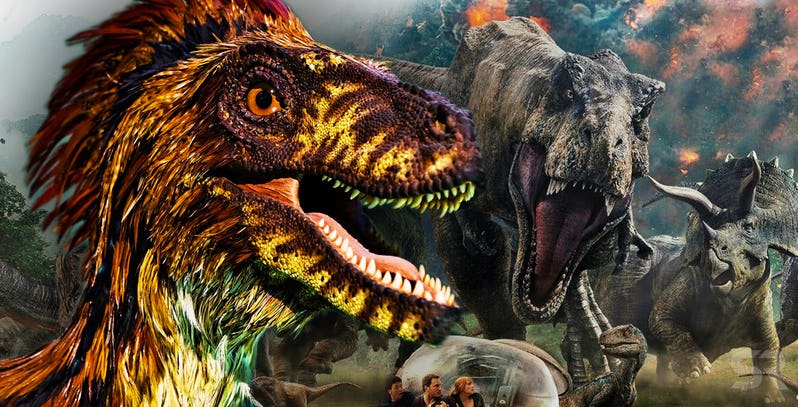
Raptor-with-feathers-and-T-Rex-in-Jurassic-World

One question that remains about Jurassic Park is why the dinosaurs don't have feathers in any of the movies. The original sci-fi thriller directed by Steven Spielberg released in 1993, based on the popular novel by Michael Crichton.

Jurassic Park focused on a wildlife theme park constructed by the billionaire philanthropist John Hammond (Richard Attenborough). The park featured a number of dinosaurs that had been genetically created by a team of scientists in order to bring some of the species out of extinction. A group of visitors, including Hammond's grandkids, toured around the park before an act of sabotage caused the security system to go awry, putting everyone on the island in danger. Jurassic Park was an instant hit and spawned two sequels before the franchise was revived in 2015 with Jurassic World.

While regarded as one of the finest blockbusters ever, Jurassic Park has come under fire with criticism from expert paleontologists. They often point out inaccuracies centering on the movies' depiction of dinosaurs. When the first Jurassic Park film premiered, it was at the start in a major shift of the public understanding of dinosaurs, perhaps the biggest being the fact the creatures actually had feathers.
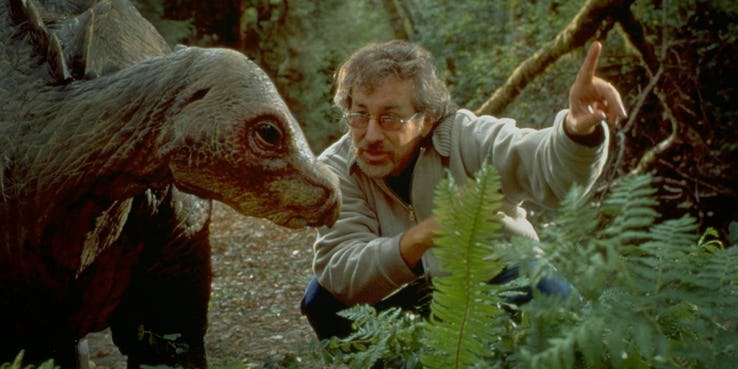
Lost-World-Jurassic-Park-Spielberg

In recent decades, it has been determined that all species of dinosaurs had feathers, at least when they're at a young age. Even though the word "dinosaur" translates to "fearsome lizard" in Greek, the creatures didn't derive from reptiles, they are ancestors of birds. While the original Jurassic Park does acknowledge this evolving perspective, it and all of the succeeding films still went with the more classical versions of the creatures, much to the dismay of paleontologists. The reasoning most likely fell into the Hollywood blockbuster effect.

Many of the dinosaur species featured in Jurassic Park should have had feathers, including the velociraptors. It was believed that Spielberg and the creative minds behind the movie decided to avoid the feathers due to their plan to realize them via CGI. Developing animatronic dinosaurs that looked realistic was challenging enough so the task of CGI in the 1990s would have made everything much more difficult and expensive. The reasoning behind this being continued through the subsequent movies, though, is more about how imposing the featherless versions look.

In 2015, Jurassic World provided an in-universe explanation for the featherless dinosaurs. As a nod to the mystery from viewers and the flak from paleontologists, Dr. Wu (B.D. Wong) explained that the dinosaurs have been genetically modified and their DNA is not completely from dinos. He shared that he had been using that method his whole career which explained why the dinosaurs in Jurassic Park also weren't historically accurate in the decades prior. It seems more likely that the filmmakers went with how most people would perceive dinosaurs in the hopes that dino experts would take notice.

Source: https://screenrant.com

Toy Dinosaurs Help 5-Year-Old Deal With Death

Tuesday, July 2, 2019

Five-year-old Kessler Burdt, a kindergartner at Altoona Elementary School, is wild about dinosaurs. So much so that upon meeting him with his new Mohawk haircut for summer, one could almost see him take on the persona of a dinosaur, curling up his forelimbs and making piercing, screeching sounds.  Kessler has a herd of dinosaurs. He rolls their scientific names off the tip of his tongue as if they were everyday words for someone entering the first grade. There’s an Apatosaurus, a Brachiosaurus, a Diplodocus, two Stegosauruses, a Styracosaurus, and a Triceratops. The leader of the pack is a Tyrannosaurus Rex named Jeffrey, the only dinosaur Kessler has named. Jeffrey has a habit of getting into mischief, in particular with food. Jeffrey loves to eat anything from candy at Halloween to cookies at Christmas to bunny and chick PEEPS of all colors at Easter.    Just as some families have “Elf of the Shelf” in December, the Burdt family has “Dinovember.” “That’s when my dinosaurs come alive at night when I’m sleeping,” shared Kessler. They move around to different locations in the house. When he wakes up, he has to find them in the most unusual places outside of his bedroom where they reside most of the time.  This past November was tough for Kessler. On the same day, not only did his Uncle Scott pass away from colon cancer but he also lost his one and only betta fish, Mosasaurus. Kessler didn’t find out about his fish until about a week later. During this time, his herd of dinosaurs could hear Kessler’s muffled whimpers as he cried himself to sleep, sometimes about his Uncle Scott, and other times about Mosasaurus.   Kessler was sad about both losses. So by early December, the dinosaurs decided they had to do something. Jeffrey the T-Rex corralled the dinosaur herd, as well as Rudolph the Red-Nosed Reindeer, and off they went to PetSmart to find Kessler a new finned friend. Of course, the dinosaurs got into some trouble while they were there. What they didn’t know is that their actions were being photographically documented every single step of the way.  The next morning when Kessler woke up, there was a note from the dinosaurs next to a water-filled container with his new fish. He promptly named it Night Shadow.   The Burdts are huge fans of the Star Wars movies. So as Kessler cared for his new fish, he felt at peace, knowing that his Uncle Scott and Mosasaurus were together: Although their physical bodies were gone, like Jedi masters, both were now “one with the Force.”

Five-year-old Kessler Burdt, a kindergartner at Altoona Elementary School, is wild about dinosaurs. So much so that upon meeting him with his new Mohawk haircut for summer, one could almost see him take on the persona of a dinosaur, curling up his forelimbs and making piercing, screeching sounds.

Kessler has a herd of dinosaurs. He rolls their scientific names off the tip of his tongue as if they were everyday words for someone entering the first grade. There’s an Apatosaurus, a Brachiosaurus, a Diplodocus, two Stegosauruses, a Styracosaurus, and a Triceratops. The leader of the pack is a Tyrannosaurus Rex named Jeffrey, the only dinosaur Kessler has named. Jeffrey has a habit of getting into mischief, in particular with food. Jeffrey loves to eat anything from candy at Halloween to cookies at Christmas to bunny and chick PEEPS of all colors at Easter.  

Just as some families have “Elf of the Shelf” in December, the Burdt family has “Dinovember.” “That’s when my dinosaurs come alive at night when I’m sleeping,” shared Kessler. They move around to different locations in the house. When he wakes up, he has to find them in the most unusual places outside of his bedroom where they reside most of the time.

This past November was tough for Kessler. On the same day, not only did his Uncle Scott pass away from colon cancer but he also lost his one and only betta fish, Mosasaurus. Kessler didn’t find out about his fish until about a week later. During this time, his herd of dinosaurs could hear Kessler’s muffled whimpers as he cried himself to sleep, sometimes about his Uncle Scott, and other times about Mosasaurus. 

Kessler was sad about both losses. So by early December, the dinosaurs decided they had to do something. Jeffrey the T-Rex corralled the dinosaur herd, as well as Rudolph the Red-Nosed Reindeer, and off they went to PetSmart to find Kessler a new finned friend. Of course, the dinosaurs got into some trouble while they were there. What they didn’t know is that their actions were being photographically documented every single step of the way.

The next morning when Kessler woke up, there was a note from the dinosaurs next to a water-filled container with his new fish. He promptly named it Night Shadow. 

The Burdts are huge fans of the Star Wars movies. So as Kessler cared for his new fish, he felt at peace, knowing that his Uncle Scott and Mosasaurus were together: Although their physical bodies were gone, like Jedi masters, both were now “one with the Force.”

Source: http://volumeone.org

Asteroid in September Not as Dangerous as Dinosaur Killer

Tuesday, July 2, 2019

The asteroid is called 2006 QV89 and it is currently travelling at around 27,400 miles per hour.

Sixty-six million years ago, a 6-mile-wide asteroid smashed into what is now the Gulf of Mexico. Red-hot debris blasted into the atmosphere and fell back to Earth, causing planet-wide fires. After that, dust and soot filled the air for years, blocking most of the sunlight from the surface of the planet. The net result is that about 75% of life on Earth, including all dinosaurs, went extinct.

On Sept. 9 this year, asteroid 2006 QV89 will come calling. While its size, a mere 130 feet across, makes it far less dangerous than the dinosaur killer, if it hit a major city, it certainly would destroy most or all of it and kill perhaps millions of people. But you probably don’t need to worry too much. NASA and the European Space Agency (ESA) estimates there is only a 1 in 7,299 chance it will strike Earth. Their best estimate is that it will miss Earth by more than 4 million miles. That’s more than 16 times the moon’s distance from us.

ESA keeps a tally of known asteroids that pose a collision risk with Earth. You can find it at http://neo.ssa.esa.int/risk-page. While this 1 in 7,300 risk isn’t very high, an asteroid designated 2010 RF12 poses a 1 in 16 chance of collision with Earth on Sept. 5, 2095. While that asteroid is less than 35 feet across, it will create a spectacular sight if it does enter our atmosphere, and it still could cause considerable damage.

No other known asteroid poses a significant risk in the near future, so this upcoming near-miss will be our closest dance with asteroid destruction for a while.

Until the next asteroid with a high collision risk is discovered.

Source: https://oklahoman.com

Paleontologists Cheer a New Golden Age of Dinosaur Discoveries

Thursday, July 4, 2019

PHOTOGRAPH BY ROBERT CLARK, NATIONAL GEOGRAPHIC CREATIVE

“We’ve named more new dinosaurs in the last 20 years than in the previous 150,” says one researcher.

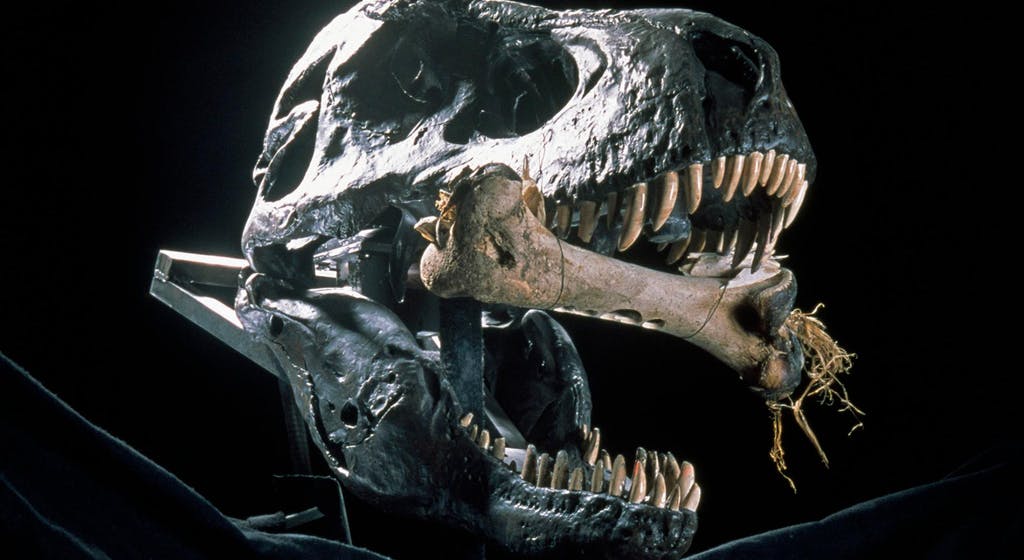
Staff at the Royal Saskatchewan Museum in Regina recently unveiled a prehistoric monster: the world’s largest Tyrannosaurus rex. This fearsome killing machine measured 13 metres in length and weighed about 8,800 kilograms when it roamed Saskatchewan some 66 million years ago. “The skeleton is so large that we had to remove a section of flooring to fit it in,” said Ryan McKellar, the museum’s curator of invertebrate paleontology.

Thought to have survived into its early 30s, this is not only the largest T. rex ever documented, but the oldest. “By Tyrannosaurus standards, it had an unusually long life. And it was a violent one. Riddled across the skeleton are pathologies – spots where scarred bone records large injuries,” said Scott Persons, a postdoctoral researcher in the department of biological sciences at the University of Alberta, who was lead author on the study of the massive beast. The injuries include broken ribs, an infected jaw, an impacted tooth and a bite on its tail.

The T. rex, nicknamed Scotty is on display at the Royal Saskatchewan Museum in Regina. Photo courtesy of “The Saskatchewanderer”, Royal Saskatechewan Museum in Regina.

Impressive as it may be, this T. rex is just one of a series of major dinosaur finds made in Canada in recent years. “The rate of dinosaur discoveries in Canada in the last decade is as high as that of the Great Canadian Dinosaur Rush of the 1920s,” said David Evans, chair in vertebrate paleontology at the Royal Ontario Museum and an associate professor of ecology and evolutionary biology at the University of Toronto. This Canadian boom is part of a worldwide phenomenon. China, Mongolia, South America and Africa have emerged in recent years as paleontological hot spots. “It’s incredible. We’ve named more new dinosaurs in the last 20 years than in the previous 150,” said Dr. Evans.

This modern-day gold rush of dinosaur discoveries has been accompanied by a dramatic shift in the scientific perception of these primordial giants. Forget the stereotypical images of dinosaurs as sluggish, dim-witted, swamp-bound monsters. They are now regarded as lively and socially complex creatures of astounding diversity that ran the gamut from scurrying, turkey-sized meat-eaters to lumbering, plant-eating colossi.

More dinosaurs are being found because there are more people looking and because scientists are digging in places where no one has dug before. Dr. Evans, who has personally been involved with 10 significant finds in the last six years, has been searching in the previously overlooked Milk River Valley, a remote landscape of jagged hoodoos and rolling grasslands that extends from southern Alberta into northern Montana.

From this forbidding terrain, Dr. Evans has unearthed several new species of armoured dinosaurs from the late Cretaceous period (about 100 million to 66 million years ago). He is especially enthused about a rare type of ankylosaur that was uncovered just south of the U.S. border by a Montana mining company, and acquired by the ROM in 2016. Dr. Evans and Victoria Arbour, the curator of paleontology at the Royal BC Museum, collaborated on the scientific study of the creature, which they named Zuul due to its resemblance to the spiky-faced monster in the 1984 film Ghostbusters.

The most complete dinosaur of its kind yet discovered in North America, Zuul had a wide, flat body, four legs, and a long, spike-lined tail with a heavy club on the end. “It’s quite striking. There are six rows of ornamental spikes or horns extending from the neck to the tail and these horns are beautifully ridged like an antelope’s,” said Dr. Evans.

Another remarkable armour-plated dinosaur called a nodosaur was found near Fort McMurray, Alberta, in 2011. Unveiled in 2017 and now on display at the province’s Royal Tyrrell Museum of Paleontology in Drumheller, the quality of its fossilized remains has stunned researchers, who describe it as the best-preserved armoured dinosaur ever discovered. Not only are its bones and armour intact, but the fossil also contained the creature’s stomach contents and even a thin film of organic material, thought to be the residue of ginger-hued pigments from the skin and horns. “It’s the Mona Lisa of dinosaurs,” said Caleb Brown, curator of dinosaur systematics and evolution at the Royal Tyrrell, in a museum press release. “We don’t just have a skeleton. We have a dinosaur as it would have been.”

Another notable recent Canadian breakthrough includes the first feathered dinosaurs found in the Western hemisphere. These fossils belong to a group of dinosaurs called ornithomimids (Latin for bird-mimics), whose long legs, slender necks and toothless beaks gave them a resemblance to modern flightless birds like ostriches. Yet, ironically, until their remains turned up in Alberta’s Badlands, no one knew that these animals also sported feathers. Darla Zelenitsky, an assistant professor in the University of Calgary’s department of geoscience, who authored a 2012 study on three of the four specimens verified to date, said the feathers are preserved as dark-coloured impressions on the bones and on the surrounding sandstone.

Fossil specimen of Ornithomimus sp. (TMP 1995.110.1), Royal Tyrrell Museum. This specimen was recovered from the middle Dinosaur Park Formation of Alberta. Photo courtesy of Wikipedia.

Although these creatures were covered in downy feathers throughout their lives, the adults developed larger feathers on the arms, forming wing-like structures. “The longer feathers were probably used primarily for courtship purposes as these dinosaurs were much too large to fly,” said Dr. Zelenitsky.

Alberta is not the only place in Canada where dinosaur remains are coming to light. Fossils of small dinosaurs have also been unearthed in Nova Scotia that date back 200 million years to the early Jurassic period, while in northeastern British Columbia, paleontologist Rich McCrea has uncovered one of the world’s most diverse dinosaur trackways. More than a thousand footprints from at least 12 different types of dinosaurs have been documented, yet only a fifth of the entire site has been exposed. “We may be dealing with more than 5,000 tracks by the time we’re done,” said Dr. McCrea.

Considering the rapidity of finds in recent years, one has to wonder how much longer this scientific surge can continue. The evidence suggests that it won’t end anytime soon, says U of A’s Dr. Persons. “It’s estimated that we’ve only found one percent of all the [species of] dinosaurs that ever were. You have to remember that dinosaurs existed for 160 million years. Rest assured, there is no shortage of ancient critters out there waiting to be found.”

Source: www.universityaffairs.ca

When The Dinosaurs Died, Lichens Thrived

Saturday, June 29, 2019

Yellow and black lichen on water worn rock, Macquarie Island. (Photo: Barry Becker)

Mass extinctions hurt land plants, but DNA shows that some fungus/plant combo organisms rose up.

When an asteroid smacked into the Earth 66 million years ago, it triggered mass extinctions all over the planet. The most famous victims were the dinosaurs, but early birds, insects, and other life forms took a hit too. The collision caused clouds of ash to block the sun and cool the planet's temperature, devastating plant life. But a new study in Scientific Reports shows that while land plants struggled, some kinds of lichens -- organisms made of fungi and algae living together -- seized the moment and evolved into new forms to take up plants' role in the ecosystem.

"We thought that lichens would be affected negatively, but in the three groups we looked at, they seized the chance and diversified rapidly," says Jen-Pang Huang, the paper's first author, a former postdoctoral researcher at the Field Museum now at Academia Sinica in Taipei. "Some lichens grow sophisticated 3D structures like plant leaves, and these ones filled the niches of plants that died out."

The researchers got interested in studying the effects of the mass extinction on lichens after reading a paper about how the asteroid strike also caused many species of early birds to go extinct. "I read it on the train, and I thought, 'My god, the poor lichens, they must have suffered too, how can we trace what happened to them?'" says Thorsten Lumbsch, senior author on the study and the Field Museum's curator of lichenized fungi.

You've seen lichens a million times, even if you didn't realize it. "Lichens are everywhere," says Huang. "If you go on a walk in the city, the rough spots or gray spots you see on rocks or walls or trees, those are common crust lichens. On the ground, they sometimes look like chewing gum. And if you go into a more pristine forest, you can find orange, yellow, and vivid violet colors -- lichens are really pretty." They're what scientists call "symbiotic organisms" -- they're made up of two different life forms sharing one body and working together. They're a partnership between a fungus and an organism that can perform photosynthesis, making energy from sunlight -- either a tiny algae plant, or a special kind of blue-green bacterium. Fungi, which include mushrooms and molds, are on their own branch on the tree of life, separate from plants and animals (and actually more closely related to us than to plants). The main role of fungi is to break down decomposing material.

During the mass extinction 66 million years ago, plants suffered since ash from the asteroid blocked out sunlight and lowered temperatures. But the mass extinction seemed to be a good thing for fungi -- they don't rely on sunlight for food and just need lots of dead stuff, and the fossil record shows an increase in fungal spores at this time. Since lichens contain a plant and a fungus, scientists wondered whether they were affected negatively like a plant or positively like a fungus.

"We originally expected lichens to be affected in a negative way, since they contain green things that need light," says Huang.

To see how lichens were affected by the mass extinction, the scientists had to get creative -- there aren't many fossil lichens from that time frame. But while the researchers didn't have lichen fossils, they did have lots of modern lichen DNA.

From observing fungi growing in lab settings, scientists know generally how often genetic mutations show up in fungal DNA -- how frequently a letter in the DNA sequence accidentally gets switched during the DNA copying process. That's called the mutation rate. And if you know the mutation rate, if you compare the DNA sequences of two different species, you can generally extrapolate how long ago they must have had a common ancestor with the same DNA.

The researchers fed DNA sequences of three families of lichens into a software program that compared their DNA and figured out what their family tree must look like, including estimates of how long ago it branched into the groups we see today. They bolstered this information with the few lichen fossils they did have, from 100 and 400 million years ago. And the results pointed to a lichen boom after 66 million years ago, at least for some of the leafier lichen families.

"Some groups don't show a change, so they didn't suffer or benefit from the changes to the environment," says Lumbsch, who in addition to his work on lichens is the Vice President of Science and Education at the Field. "Some lichens went extinct, and the leafy macrolichens filled those niches. I was really happy when I saw that not all the lichens suffered."

The results underline how profoundly the natural world we know today was shaped by this mass extinction. "If you could go back 40 million years, the most prominent groups in vegetation, birds, fungi -- they'd be more similar to what you see now than what you'd see 70 million years ago," says Lumbsch. "Most of what we see around us nowadays in nature originated after the dinosaurs."

And since this study shows how lichens responded to mass extinction 66 million years ago, it could shed light on how species will respond to the mass extinction the planet is currently undergoing. "Before we lose the world's biodiversity, we should document it, because we don't know when we'll need it," says Huang. "Lichens are environmental indicators -- by simply doing a biodiversity study, we can infer air quality and pollution levels."

Beyond the potential implications in understanding environmental impacts and mass extinctions, the researchers point to the ways the study deepens our understanding of the world around us.

"For me, it's fascinating because you would not be able to do this without large molecular datasets. This would have been impossible ten years ago," says Lumbsch. "It's another piece to the puzzle to understanding what's around us in nature."

"We expect a lot of patterns from studying other organisms, but fungi don't follow the pattern. Fungi are weird," says Huang. "They're really unpredictable, really diverse, really fun."

This study was contributed to by researchers from the Field Museum, Kasetsart University, Brigham Young University, and Academia Sinica.


Story Source:

Materials provided by Field MuseumNote: Content may be edited for style and length.


Journal Reference:

  1. Jen-Pan Huang, Ekaphan Kraichak, Steven D. Leavitt, Matthew P. Nelsen, H. Thorsten Lumbsch. Accelerated diversifications in three diverse families of morphologically complex lichen-forming fungi link to major historical eventsScientific Reports, 2019; 9 (1) DOI: 10.1038/s41598-019-44881-1

Source: www.sciencedaily.com

The Biggest Dinosaur to Ever Walk the Earth Just Wants to Text You

Sunday, June 30, 2019

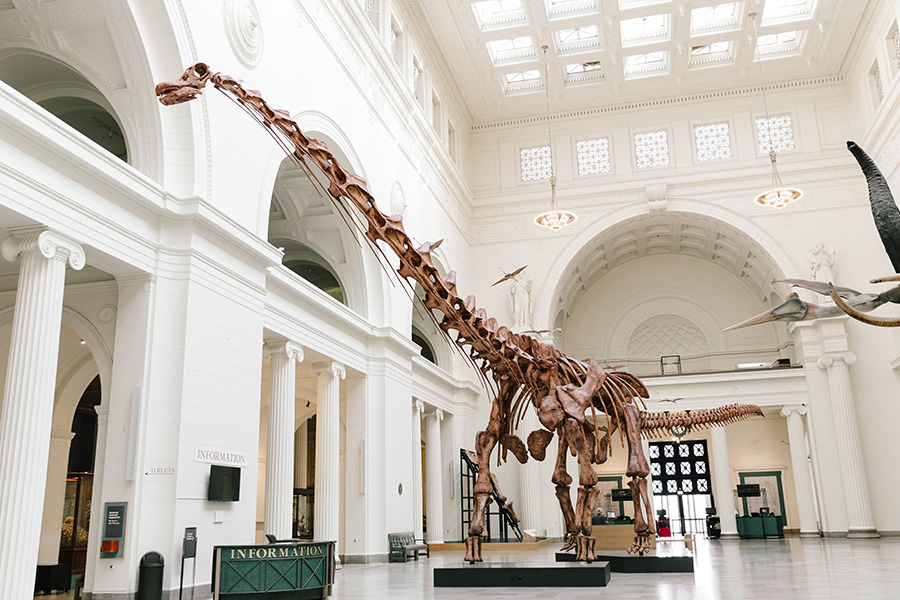
Máximo is a titanosaur called Patagotitan mayorum, the largest dinosaur ever discovered. Credit: The Field Museum

The biggest dinosaur ever discovered just wishes you'd drop him a line.

In a new program launched by Chicago's Field Museum, the cast skeleton of the titanosaur dubbed Máximo will text you back answers to questions about the dinosaur's life in prehistoric Patagonia — or anything else you'd like to gab about. Want to know Máximo's favorite color? Ask away! Want Máximo to know how handsome he looks in that selfie you took with him? The gentle giant will gently thank you. 

The "Message Máximo" project aims to get dino fans personally involved with fun facts about the museum's largest resident, said Andrea Ledesma, project manager for Message Máximo. "We wanted a way for visitors to interact with Máximo that was fun and surprising, but still engaging with the actual science," Ledesma told Live Science.

You can reach Máximo via text at 70221 or through online chat at the dino's web page. Behind the scenes, a chatbot set up to answer a wide range of questions responds to queries, Ledesma said. Programmers engineered Máximo's chatbot to field expected questions like "Where are you from?" and "Why is your neck so long?" as well as a few out-of-left-field queries that no one's yet asked, like "Did you see 'Jurassic Park'?" (Sorry, kids, did I say chatbot? I meant the dinosaur is totally talking to you.)

Máximo can also tell a knock-knock joke, which I won't spoil for you.

So far, the response to Máximo's chatty new persona has been positive, Ledesma said, with over 500 conversations logged on the May 8 public launch. "Overall, from the conversations, the reception to the project has been pretty positive."

Máximo is a cast (meaning, not the actual bones) created in the likes of a Patagotitan mayoruma type of sauropod, or long-necked dinosaur, in the group titanosauria. The largest dinosaur ever found, this creature's bones stretch 122 feet (37 meters) across the Field Museum's large main floor, Stanley Field Hall. At 28 feet (8.5 m) tall, Máximo's head peaks over the walkway encircling the main hall. When alive, Máximo would have weighed 70 tons, or as much as 10 African elephants.

Máximo lived 101 million years ago, during the Cretaceous period (facts I know from asking Máximo himself). In my own brief chat with the dinosaur, he also told me that he is an herbivore. "If you know of any place that makes an excellent fern salad, fern taco, fern pizza … please let me know."

Máximo passed my city-loyalty test, too. "I am having a wonderful time in Chicago," he said. "I love the many tall glass trees. Or skyscrapers, I think you say."

Máximo entered the Field Museum last summer, taking the former place of Sue the T. rex, who now enjoys a view of the Cretaceous sky upstairs.

Source: www.livescience.com

Royal Tyrrell Museum Unveils Learning Lounge With Life-Sized Albertosaurus Skeleton

Tuesday, July 2, 2019

Royal Tyrrell Museum unveils learning lounge with life-sized Albertosaurus skeleton | CTV News

Drumheller's iconic museum has opened its newly-constructed expansion ahead of what's expected to be one of its busiest weekends of the year.

The ribbon has been cut on the 1,300 square metre (14,000 square foot) learning lounge at the world renowned Royal Tyrrell Museum of Paleontology. The expansion will include a life-sized bronze Albertosaurus skeleton and hands-on activities for visitors.

"Although Alberta doesn't really have an official dinosaur," said Andy Neuman, executive director of the Royal Tyrrell Museum. "If they did, it would be the Albertosaurus."

A bronze Albertosaurus statue is the main attraction in the Royal Tyrrell Museum's new learning lounge

The expansion cost $9.3 million and construction began in 2017. Roughly 60 per cent of the cost was funded by the Government of Alberta and the federal government contributed the remainder.

Roughly 450,000 people visit the museum each year, with the majority making the trip to Drumheller during the summer season.  

"Drumheller is about 8,000 people. I would not be surprised to see 15,000 tourists in town this weekend," said Neuman. "This is sort of the kick off for our really busy season."

The museum first opened in 1985 and has attracted more than 13 million visitors over the years.

Source: https://calgary.ctvnews.ca

Some Extinct Relatives of Living Crocodylians Were Vegetarians

Saturday, June 29, 2019

Life reconstructions of extinct crocodyliforms. Differences in tooth shape are related to differences in diets. Image credit: Jorge Gonzalez.

A veggie diet arose in extinct crocodyliforms — the distant cousins of living crocodylians (alligators, caimans, crocodiles, and gharials) — at least three times, according to new research.

“The most interesting thing we discovered was how frequently it seems extinct crocodyliforms ate plants,” said lead author Keegan Melstrom, a doctoral student in the Department of Geology and Geophysics and the Natural History Museum of Utah at the University of Utah.

“Our study indicates that complexly-shaped teeth, which we infer to indicate herbivory, appear in the extinct relatives of crocodiles at least three times and maybe as many as six.”

All living crocodylians possess a similar general body shape and ecology to match their lifestyle as semiaquatic generalist carnivores, which includes relatively simple, conical teeth.

Extinct crocodyliforms showed a different pattern, including species with many specializations not seen today. One such specialization is a feature known as heterodonty: regionalized differences in tooth size or shape.

“Carnivores possess simple teeth whereas herbivores have much more complex teeth. Omnivores fall somewhere in between,” Melstrom said.

“Part of my earlier research showed that this pattern holds in living reptiles that have teeth, such as crocodylians and lizards. So these results told us that the basic pattern between diet and teeth is found in both mammals and reptiles, despite very different tooth shapes, and is applicable to extinct reptiles.”

False color 3D images showing the range in shape of crocodyliform teeth. Carnivores (left), such as the living caiman, have simple teeth, whereas herbivores (right) have much more complex teeth. Image credit: Keegan Melstrom, Natural History Museum of Utah.

To infer what those extinct crocodyliforms most likely ate, Melstrom and his colleague, University of Utah’s Dr. Randall Irmis, compared the tooth complexity of extinct crocodyliforms to those of living animals using a method originally developed for use in living mammals.

Overall, the researchers measured 146 teeth from 16 different species of extinct crocodyliforms.

Using a combination of quantitative dental measurements and other morphological features, they reconstructed the diets of those extinct crocodyliforms.

The results show that those animals had a wider range of dental complexities and presumed dietary ecologies than had been appreciated previously.

“Plant-eating crocodyliforms appeared early in the evolutionary history of the group, shortly after the end-Triassic mass extinction, and persisted until the end-Cretaceous mass extinction that killed off all dinosaurs except birds,” the scientists said.

“Our analysis suggests that herbivory arose independently a minimum of three times, and possibly six times, in Mesozoic crocodyliforms.”

The research appears in the journal Current Biology.

_____

Keegan M. Melstrom & Randall B. Irmis. Repeated Evolution of Herbivorous Crocodyliforms during the Age of Dinosaurs. Current Biology, published online June 27, 2019; doi: 10.1016/j.cub.2019.05.076

Source: www.sci-news.com

Pachystruthio dmanisensis: Giant Birds Roamed Europe Two Million Years Ago

Saturday, June 29, 2019

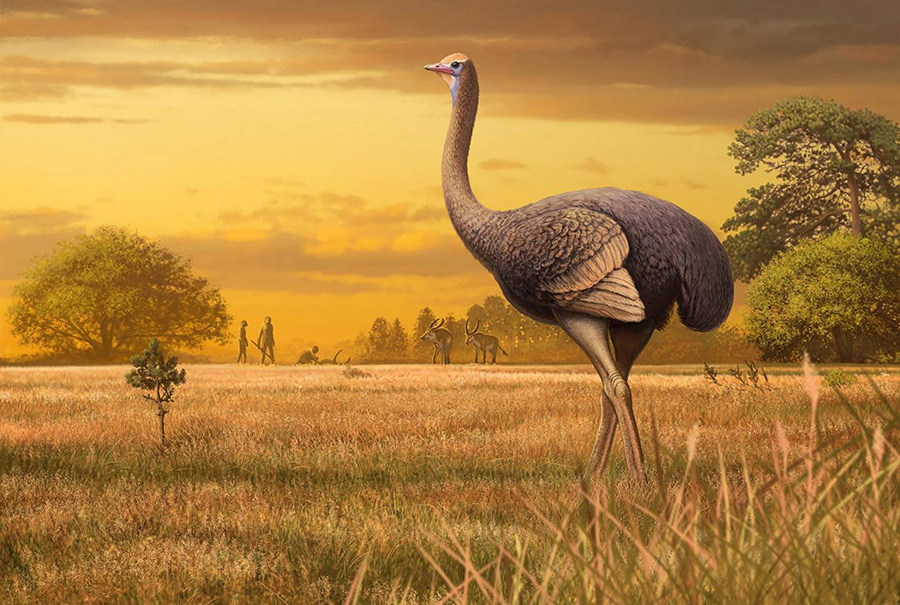
Pachystruthio dmanisensis. Image credit: Andrey Atuchin.

A giant ostrich-like bird that lived about two million years ago (Pleistocene epoch) has been identified from a fossilized femur found in the Crimean Peninsula, Ukraine.

Named Pachystruthio dmanisensis, the ancient bird was at least 11.5 feet (3.5 m) tall and had an estimated body mass of about 450 kg.

These values make it one of the largest known birds — comparable to the elephant bird Aepyornis maximus — and the only bird of such giant size in Europe and the Northern Hemisphere in general.

In contrast to very large birds from Madagascar, New Zealand and Australia, Pachystruthio dmanisensis was a good runner, which may be explained by its co-existence with large carnivorous mammals.

“Its femur is comparable to modern ostriches as well as smaller species of moa and terror birds. Speed may have been essential to the bird’s survival,” said Dr. Nikita Zelenkov from the Borissiak Paleontological Institute and colleagues.

“Alongside its bones, we found fossils of highly-specialized, massive carnivores from the Ice Age. They included giant cheetah, giant hyenas and saber-toothed cats, which were able to prey on mammoths.”

The nearly complete left femur of Pachystruthio dmanisensis came from the recently-discovered Taurida karst cave in the Belogorsk region, the Crimean Peninsula.

“When I first felt the weight of the bird whose thigh bone I was holding in my hand, I thought it must be a Malagasy elephant bird fossil because no birds of this size have ever been reported from Europe. However, the structure of the bone unexpectedly told a different story,” Dr. Zelenkov said.

“We don’t have enough data yet to say whether it was most closely related to ostriches or to other birds, but we estimate it weighed about 450 kg. This formidable weight is nearly double the largest moa, three times the largest living bird, the common ostrich, and nearly as much as an adult polar bear.”

The paleontologists also found the remains of Pachystruthio dmanisensis and a similar range of fossil mammals at the site of Dmanisi in Georgia.

Pachystruthio dmanisensis was likely a typical component of eastern European faunas at the time of early hominin arrival,” they said.

“We suggest that this giant bird, together with early Homo and a variety of mammals, reached the northern Black Sea region via the southern Caucasus and Anatolia, because the older (Pliocene) finds of this fauna are known from Georgia and Turkey.”

paper describing the discovery was published in the Journal of Vertebrate Paleontology.

_____

Nikita V. Zelenkov et al. A giant early Pleistocene bird from eastern Europe: unexpected component of terrestrial faunas at the time of early Homo arrival. Journal of Vertebrate Paleontology, published online June 26, 2019; doi: 10.1080/02724634.2019.1605521

Source: www.sci-news.com

Vespersaurus paranaensis: Desert-Dwelling Carnivorous Dinosaur Found in Brazil

Friday, June 28, 2019

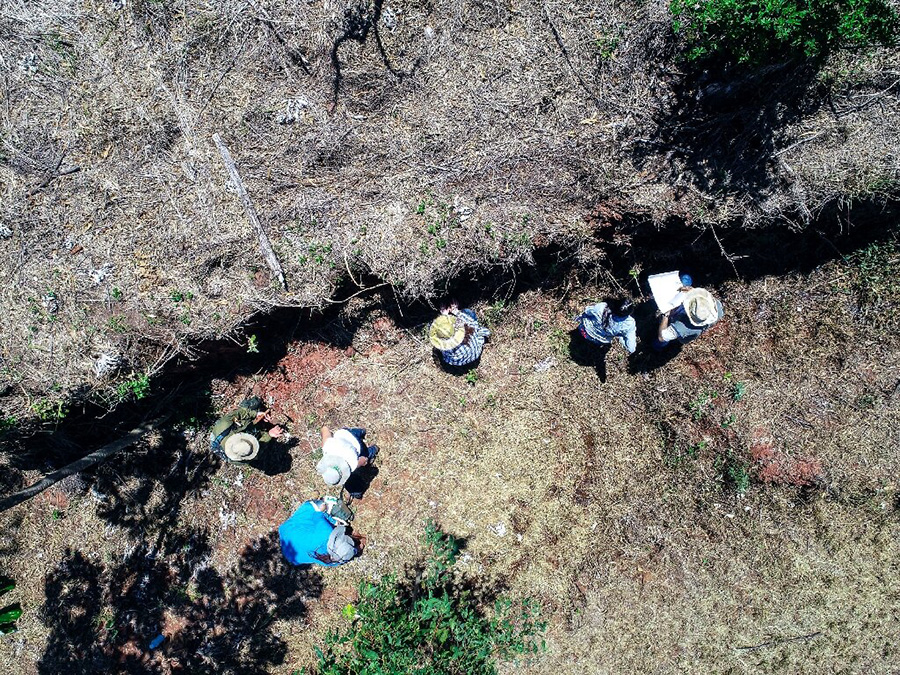
State University of Maringa paleontologists work at the site where fossilised bones of a dinosaur were found in Maringa, Parana state, Brazil

A desert-based carnivorous dinosaur that used claws to capture small prey 90 million years ago has been unearthed in southern Brazil.

Just over a meter and a half in length (five feet), the fossil remains of the Vespersaurus paranaensis were found in Cruzeiro do Oeste municipality of Parana state, a team of paleontologists from Brazil and Argentina said in a statement.

The Vespersaurus was a theropod, a group of two-footed, meat-eating dinosaurs that included the better known Tyrannosaurus and Velociraptor.

Footprints now believed to belong to this new species of dinosaur were discovered in Cruzeiro do Oeste in the 1970s.

Factfile on the carnivorous theropod dinosaur, adapted to the prehistoric desert conditions of southern Brazil 90 million years ago

"It's incredible that, nearly 50 years later, it seems that we have discovered what type of dinosaur would have produced those enigmatic footprints," said Paulo Manzig of the Paleontology Museum of Cruzeiro do Oeste.

The northeastern region of Parana was once a desert and the dinosaur's remains suggest that the Vespersaurus was well adapted to that type of climate.

Other dinosaur species have been found there and, according to the scientists, the latest discovery must "catapult" paleontological investigations in the region.

"It is a rich but little explored area that would surely bring great news to the world of paleontology," said Neurides Martins of the Paleontology Museum of Cruzeiro do Oeste.

Source: https://phys.org

Pages