Blogs

Jurassic Park: What Happened To Nedry's Barbasol Can?

Friday, June 28, 2019

What happened to Dennis Nedry's Barbasol can after his unfortunate encounter with a hungry Dilophosaurus in Jurassic Park?

The original Jurassic Park is considered one of the best summer blockbusters of all time, with the film being an almost perfect mix of suspense, action, and great characters. It also introduced the world to the wonders of Jeff Goldblum as Ian Malcolm. The movie was based on the best-selling novel by Michael Crichton, with the story involving a park where cloned dinosaurs run amok when the security defenses break down.

Jurassic Park was an enormous worldwide success and Steven Spielberg would return again for 1997's The Lost World. Spielberg would later admit he lacked passion while working on the sequel, so while it still features great setpieces, it didn't receive the acclaim that greeted the first movie. Joe Johnston came on to direct Jurassic Park 3 in 2001 and while it was another success, it received mixed reviews and is the lowest grossing of the series. The franchise went on extended hiatus until Jurassic World arrived in 2015, which was followed by 2018's Fallen Kingdom.

The new trilogy is set to conclude with Jurassic World 3 in 2021. For fans of the series, there was close to a 15-year wait between the third and fourth entries, with only 2011's Jurassic Park: The Game to bridge the gap. This title was developed by the now-defunct Telltale Games (The Walking Dead) and is a point-and-click adventure that takes place at the same time as the original movie. One of the most enduring mysteries of Jurassic Park is the fate of Dennis Nedry's Barbasol can. Nedry was a computer programmer who accepted a bribe from rival company BioSyn to smuggle dinosaur embryos out of the park. He's given a can of shaving cream with a hidden compartment where he can place the embryos.

Unfortunately for him, he crashes on his way to the dock and is killed by a Dilophosaurus, with the Barbasol can buried in mud. What happened to this can has become a talking point among some viewers, who wonder why it was never a plot point in later sequels. Nevertheless, the original, unused script for Jurassic Park 4 by John Sayles (The Alienist) featured the can as a MacGuffin, and it also plays an important role in Jurassic Park: The Game. The story reveals that when Nedry failed to reach the dock, two BioSyn employees came to find him. They discover his corpse and the can, but when they're attacked by dinosaurs, smuggler Nima is the only survivor.

A mercenary later attempts to steal the can from Nima, but while Jurassic Park: The Game has two endings available, neither one works out well for the can or its contents. In one ending, if Nima is greedy and tries to retrieve the can, she's eaten by the T.rex and the canister is left on Isla Nublar. The other ending has Nima be heroic and save the life of another character, resulting in the can being crushed by the T. rex.

Jurassic Park: The Game was intended to be a canon entry in the franchise, though its current status is unknown following the Jurassic World movies. The game itself has been somewhat forgotten in recent years, but with the island having blown up in Jurassic World: Fallen Kingdom, it's explanation for the fate of the Barbasol can is likely the only one fans will get.

Source: https://screenrant.com

Paleontologists Uncover New Insights into Non-Iridescent Feather Colors in Prehistoric Birds

Friday, June 28, 2019

Reconstruction of Eocoracias brachyptera with hypothesized plumage coloration. Image credit: Marta Zaher, University of Bristol.

An international team of paleontologists from the United Kingdom and Germany has shown that blue feather melanosomes are highly distinct from melanosomes that are from feathers expressing black, reddish-brown, brown and iridescent.

A pigment called melanin gives black, reddish brown and gray colors to birds and is involved in creating bright iridescent sheens in bird feathers.

This can be observed by studying the melanin packages called melanosomes, which are shaped like little cylindrical objects less than one-thousandth of a millimeter and vary in shape from sausage shapes to little meatballs.

However, besides iridescent colors, which is structural, birds also make non-iridescent structural colors. Those are, for example, blue color tones in parrots and kingfishers.

Until now, it was not known if such colors could be discovered in fossils.

Paleontologists have shown that the feather itself, which is made of keratin, does not fossilize while the melanin does.

Therefore, if a blue feather fossilized, the dark pigment may be the only surviving feature and the feather may be interpreted as black or brown.

Eocoracias brachyptera fossil sample. Image credit: Sven Traenkner / Senckenberg Research Institute / Nature Museum in Frankfurt.

Now Dr. Frane Barbarovic from the University of Bristol and the University of Sheffield and colleagues have shown that blue feather melanosomes are distinct from melanosomes that are from feathers expressing black, reddish-brown, brown and iridescent, but overlap significantly with some gray feather melanosomes.

By looking at plumage colorations of modern representatives of fossil specimen and reconstructing which color was the most likely present in the fossil specimen, the researchers were able to discriminate between melanosomes significant for gray and blue color, leading to the reconstruction of an ancient bird species called Eocoracias brachyptera as a predominantly blue bird.

“We have discovered that melanosomes in blue feathers have a distinct range in size from most of color categories and we can, therefore, constrain which fossils may have been blue originally,” Dr. Barbarovic said.

“The overlap with gray color may suggest some common mechanism in how melanosomes are involved in making gray coloration and how these structural blue colors are formed.”

The research was published in the Journal of the Royal Society Interface.

_____

Frane Babarović et al. 2019. Characterization of melanosomes involved in the production of non-iridescent structural feather colours and their detection in the fossil record. J. R. Soc. Interface 16 (155); doi: 10.1098/rsif.2018.0921

Source: www.sci-news.com

Jurassic Parkway: A 14-Metre-Long Spinosaur Crosses The Ben Franklin Bridge Into Philadelphia

Thursday, June 27, 2019

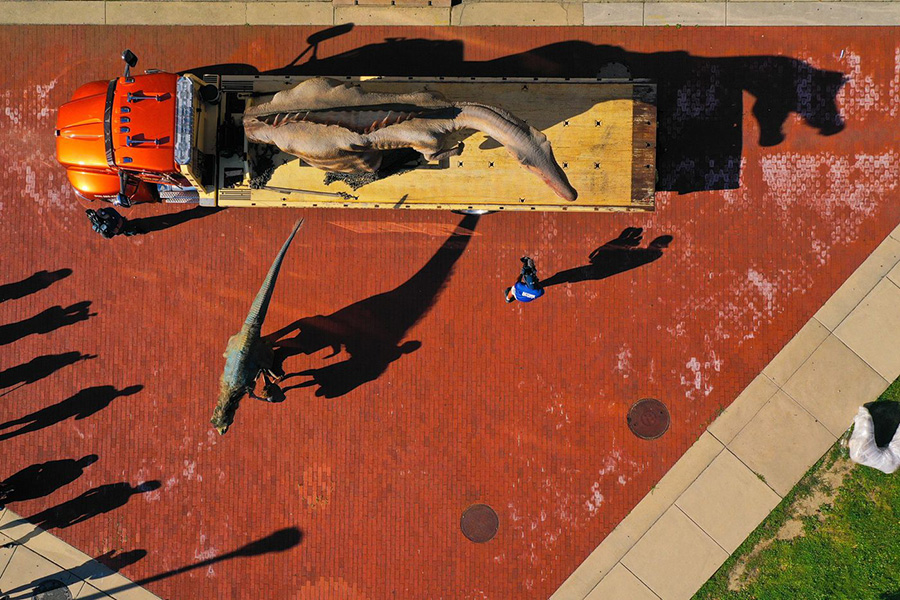
Jurassic Parkway: A 45-foot-long dinosaur crosses the Ben Franklin Bridge into Philadelphia. DAVID MAIALETTI / STAFF PHOTOGRAPHER

It’s hard to imagine dinosaurs roaming the streets of Philadelphia. But in the immortal words of Dr. Ian Malcolm of Jurassic Park fame, “Life, uh, finds a way.”

Just after sunrise on Wednesday morning, a Spinosaurus was found staring down cars and bystanders as she trekked from Somerdale, N.J., to the Ben Franklin Parkway. Along the way, the 2,100-pound dinosaur swiveled heads down I-295, around City Hall, and in front of the Philadelphia Museum of Art.

Baring a full set of razor-sharp teeth, the carnivore was chained safely to a flatbed truck, evoking not panic but celeb-spotting awe. Morning joggers stopped in their tracks, mouths agape. Pedestrians whipped out smartphones split-seconds after catching a glimpse of the brown fin arching out of its spine. Cars honked. Tourists cheered. One traffic cop cocked his head, right ear almost to his shoulder, completely dumbfounded by the giant, crocodile-headed creature passing through the intersection at Eighth and Arch.

A truck carrying a 40-foot-long animatronic Spinosaurus travels across the Ben Franklin Bridge to The Academy of Natural Sciences on June 26, 2019 in Philadelphia, PA. DAVID MAIALETTI / STAFF PHOTOGRAPHER

“We’ve escorted everything from tanks to naval guns and everyone from the president to the pope,” said Dave McWilliam, one of several police escorts clearing traffic for the Spinosaurus en route from a storage facility. “But this marks the very first dinosaur.”

While perhaps not as identifiable as the pope, the 45-foot-long theropod will be presiding over Philadelphia for the next several months as the largest dinosaur in the Academy of Natural Sciences’ “Dinosaurs Around the World” exhibit. It will open Sunday, June 30.

The Spinosaurus is joined by 10 other dinosaurs in the six-month exhibit. Find her roaring outside the museum, flanked by a slightly smaller, spiky-necked Amargasaurus.

Inside, “Dinosaurs Around the World” transports visitors back 200 million years, to when the world’s dinosaurs lived on one super-continent, Pangaea, before the Earth’s tectonic plates splintered it apart.

 A 40-foot-long animatronic Spinosaurus is hoisted into place outside The Academy of Natural Sciences on June 26, 2019 in Philadelphia, PA. DAVID MAIALETTI / STAFF PHOTOGRAPHER

The first stop of the adventure falls in the forests of Argentina, where a 19-foot-long, 5-foot-tall Herrerasaurus swivels its olive-green head and blinks its fiery eyes. It’s one of the earliest dinosaurs in existence, and the oldest in the 4,800-square-foot exhibit.

“The dinosaurs are all made with brand-new, top-of-the-line technology, so all of their movements are really smooth and natural,” says Jennifer Sontchi, the Academy’s senior exhibits director. Each dinosaur’s backdrop mimics its native environment. “It allows you to see them as the animals they are and not the monsters of which they’re often portrayed.”

Most of the models, such as the ready-to-pounce Velociraptor and the docile Protoceratops, are true to size. The lean Velociraptor — characteristic claws gleaming, tail swaying, jaw chomping — resembles a predatory ostrich. The Protoceratops, blinking balefully, more like a baby elephant.

The Academy of Natural Sciences is opening a new exhibition, Dinosaurs Around the World, on June 30. It features more than a dozen animatronic dinosaurs. One of them, a 40-foot-long animatronic Spinosaurus. DAVID SWANSON / Staff Photographer

Scattered throughout, graphic displays dive into the evolution of Pangaea and its affect on the dinosaurs. When the reptiles first appeared, there were only about 10 different types. As land drifted into different latitudes — causing drastic climate changes — new species proliferated. Today, paleontologists have discovered more than 1,000 types.

Time moves as one tours the exhibit, winding down to the end of the Cretaceous Period, when dinosaurs became extinct 66 million years ago. It’s believed by most scientists that a six-mile-wide asteroid crashed into the Gulf of Mexico, eradicating all dinosaur life — save for the birds. (Yes, all present-day birds are considered dinosaurs.)

It’s hard to resist pulling out your phone to snap a shot of these realistic robots. As a crane slowly maneuvered the Spinosaurus to the sidewalk in front of the Academy, several sweaty runners posed for selfies, while kindergartners stopped to point and giggle.

Glenn Holden, of On The Scene, the install team, carries part of the tail of the 40-foot-long animatronic Spinosaurus outside The Academy of Natural Sciences on June 26, 2019 in Philadelphia, PA. DAVID MAIALETTI / STAFF PHOTOGRAPHER

“You walk out in the morning with a latte in your hand, and suddenly there’s a dinosaur in front of you,” said McWilliam, standing next to a scaly foot the size of a mailbox, waiting to be attached. “It’s just something you’d never expect.”

June 30 through Jan. 20, 2020, Academy of Natural Sciences of Drexel University, 1900 Benjamin Franklin Pkwy., $20.95-$24.95 plus $7 for “Dinosaurs Around the World,” 215-299-1000, ansp.org

Source: www.inquirer.com

How The Dragon Got Its Frill

Wednesday, June 26, 2019

SIB Swiss Institute of Bioinformatics

The frilled dragon exhibits a distinctive large erectile ruff. This lizard usually keeps the frill folded back against its body but can spread it as a spectacular display to scare off predators. Researchers at the University of Geneva (UNIGE), Switzerland, and the SIB Swiss Institute of Bioinformatics report in the journal eLife that an ancestral embryonic gill of the dragon embryo turns into a neck pocket that expands and folds, forming the frill. The researchers then demonstrate that this robust folding pattern emerges from mechanical forces during the homogeneous growth of the frill skin, due to the tensions resulting from its attachment to the neck and head.

In Jurassic Park, while the computer programmer Dennis Nedry attempts to smuggle dinosaur embryos off the island, he gets attacked and killed by a mid-sized dinosaur that erects a frightening neck frill. This fictional dinosaur is clearly inspired from a real animal known as the 'frilled dragon', that lives today in northern Australia and southern New Guinea. These lizards, also known as Chlamydosaurus kingii, have a large disc of skin that sits around their head and neck. This frill is usually folded back against the body, but can spread in a spectacular fashion to scare off predators and competitors. Folding of the left and right sides of the frill occurs at three pre-formed ridges. But, it remains unclear which ancestral structure evolved to become the dragon's frill, and how the ridges in the frill form during development.

Recycling gills

A multidisciplinary team led by Michel Milinkovitch, Professor at the Department of Genetics and Evolution of the UNIGE Faculty of Science and Group Leader at the SIB Swiss Institute of Bioinformatics, shows today that the dragon's frill, as well as bones and cartilages that support it, develop from the branchial arches. These are a series of bands of tissue in the embryo that evolved to become the gill supports in fish, and that now give rise to multiple structures in the ear and neck of land vertebrates. In most species, the second branchial arch will eventually fuse with the arches behind it. But in the frilled dragon, this arch continues instead to expand, leading to the formation of the dragon's spectacular frill. "These changes in the development of gill arches highlight how evolution is able to "recycle" old structures into new forms playing different roles," enthuses Michel Milinkovitch.

Mechanical process rather than molecular genetic signal

As the frill develops, the front side of the skin forms three successive folds, which make up the pre-formed ridges. Studying the formation of these ridges, the Swiss team reveals that they do not emerge from increased growth at the folding sites, but from physical forces -- whereby the growth of the frill is constrained by its attachment to the neck. This causes the top layer to buckle, creating the folds of the frill. "We then simulated this process in a computer model and discovered that we could trace how the folds develop in the frills of the real lizard embryos," continues Michel Milinkovitch.

These results provide further evidence that physical processes, as well as genetic programs, can shape tissues and organs during an embryo's development.


Story Source:

Materials provided by Université de GenèveNote: Content may be edited for style and length.


Journal Reference:

  1. Sophie A Montandon, Anamarija Fofonjka, Michel C Milinkovitch. Elastic instability during branchial ectoderm development causes folding of the Chlamydosaurus erectile frilleLife, 2019; 8 DOI: 10.7554/eLife.44455

Source: www.sciencedaily.com

Blue Color Tones in Fossilized Prehistoric Feathers

Wednesday, June 26, 2019

Eocoracias brachyptera fossil sample used for this study. The rich black texture on the surface is fossilized plumage of the bird. Fossil is stored at Senckenberg Research Institute.  CREDIT Sven Traenkner, photographer at the Senckenberg Research Institute and Nature Museum in Frankfurt.

Examining fossilised pigments, scientists from the University of Bristol have uncovered new insights into blue colour tones in prehistoric birds.

For some time, paleontologists have known that melanin pigment can preserve in fossils and have been able to reconstruct fossil colour patterns.

Melanin pigment gives black, reddish brown and grey colours to birds and is involved in creating bright iridescent sheens in bird feathers.

This can be observed by studying the melanin packages called melanosomes, which are shaped like little cylindrical objects less than one-thousandth of a millimetre and vary in shape from sausage shapes to little meatballs.

However, besides iridescent colours, which is structural, birds also make non-iridescent structural colours.

Those are, for example, blue colour tones in parrots and kingfishers. Until now, it was not known if such colours could be discovered in fossils.

This blue structural colour is created by the dense arrangement of cavities inside feathers, which scatters the blue light. Underneath is a layer of melanin that absorbs unscattered light.

Paleontologists have shown that the feather itself, which is made of keratin, does not fossilise while the melanin does. Therefore, if a blue feather fossilised, the dark pigment may be the only surviving feature and the feather may be interpreted as black or brown.

Now researchers from the University of Bristol, led by Frane Barbarovic who is currently at the University of Sheffield, have shown that blue feather melanosomes are highly distinct from melanosomes that are from feathers expressing black, reddish-brown, brown and iridescent, but overlap significantly with some grey feather melanosomes.

By looking at plumage colourations of modern representatives of fossil specimen and reconstructing which colour was the most likely present in the fossil specimen, they were able to discriminate between melanosomes significant for grey and blue colour, leading to the reconstruction of prehistoric Eocoracias brachyptera as a predominantly blue bird.

Frane Barbarovic said: "We have discovered that melanosomes in blue feathers have a distinct range in size from most of colour categories and we can, therefore, constrain which fossils may have been blue originally.

"The overlap with grey colour may suggest some common mechanism in how melanosomes are involved in making grey colouration and how these structural blue colours are formed.

"Based on these results in our publication we have also hypothesized potential evolutionary transition between blue and grey colour."

The research team now need to understand which birds are more likely to be blue based on their ecologies and modes of life. The blue colour is common in nature, but the ecology of this colour and its function in the life of birds is still elusive.

Frane Barbarovic added: "We also need to understand how grey colour is made. This is made in a very different way in birds than it is in mammals. We believe it is related to how the melanosome shape can result in a kind of self-assembling process in the feather and the surface tension of the melanosomes pull them into certain configurations inside a feather as it forms."

UNIVERSITY OF BRISTOL

Source: www.eurekalert.org

Discovering and Preserving Montana's Dinosaurs

Wednesday, June 26, 2019

Credit: Great Plains Dinosaur Museum & Field Station

Montana is full of rich history, but we’re really diving into our artifacts as we’re discussing how Malta, Montana and the Judith River Formation is playing such a vital role in preserving dinosaur history.

Experts say Malta and Phillips County have always been at the heart of paleontology. It’s why they want Montana and surrounding communities to learn why their backyard is so scientifically important, why it should be protected and further studied.

This weekend the Great Plains Museum in Malta is bringing in around 20 well-known paleontologists like Dr. Phil Currie who helped found the Royal Tyrell Museum of Paleontology in Alberta. Organizers say these paleontologists are not just experts in paleontology, but they’re experts in the Judith River Formation,  the fossil-bearing geologic formation in the Malta area.

“This is our most famous dinosaur formation. When paleontologists come to work on dinosaurs here this is the rock unit that they come to work in. And it’s world renown. All these top discoveries happening here,” said Cary Woodruff, the Director of Paleontology at the Great Plains Museum in Malta, Mont.

Experts say about two years ago an "armored" dinosaur named Zuul was just found in Havre. This is just one example of why experts are saying the Judith River Formation is important for understanding dinosaurs in Montana and what was happening during that time in western North America.

Source: www.abcfoxmontana.com

Scientists Unearth HUGE Adult Triceratops Skeleton From Denver Construction Site–68 Million Years Old

Tuesday, June 25, 2019

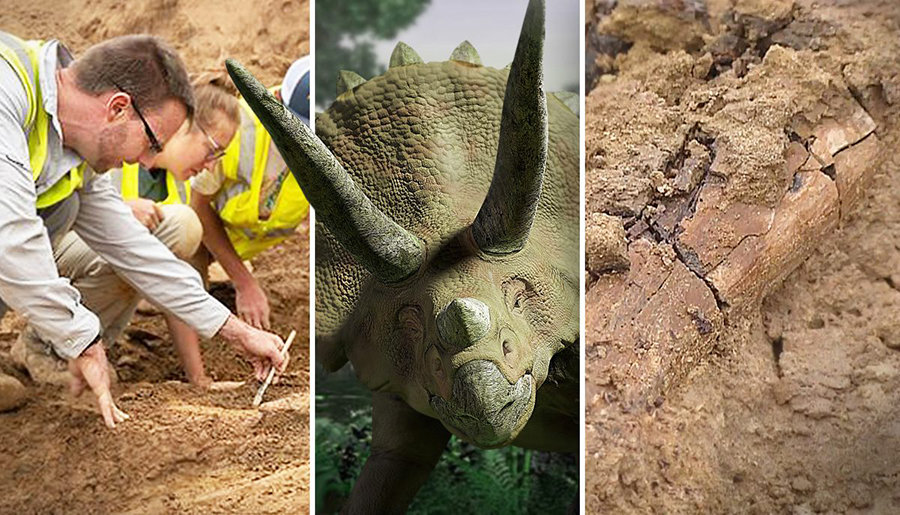
(L) (Denver Museum of Nature & Science | Facebook); (C) (Shutterstock); (R) (CBS Denver | Screen shot)

In Denver, Colorado, it’s not uncommon for construction workers to unearth reptilian fossils that are tens of millions of years old.

A recent dinosaur excavation near a south Denver retirement community that began last May was reason for excitement even by Denver standards.

A team of paleontologists from the Denver Museum of Nature and Science appeared at the site in Highlands Ranch after getting a call from Brinkmann Contractors, a construction company working there. They had informed the experts about what they had stumbled upon and gave them permission to extract the bones for further study.

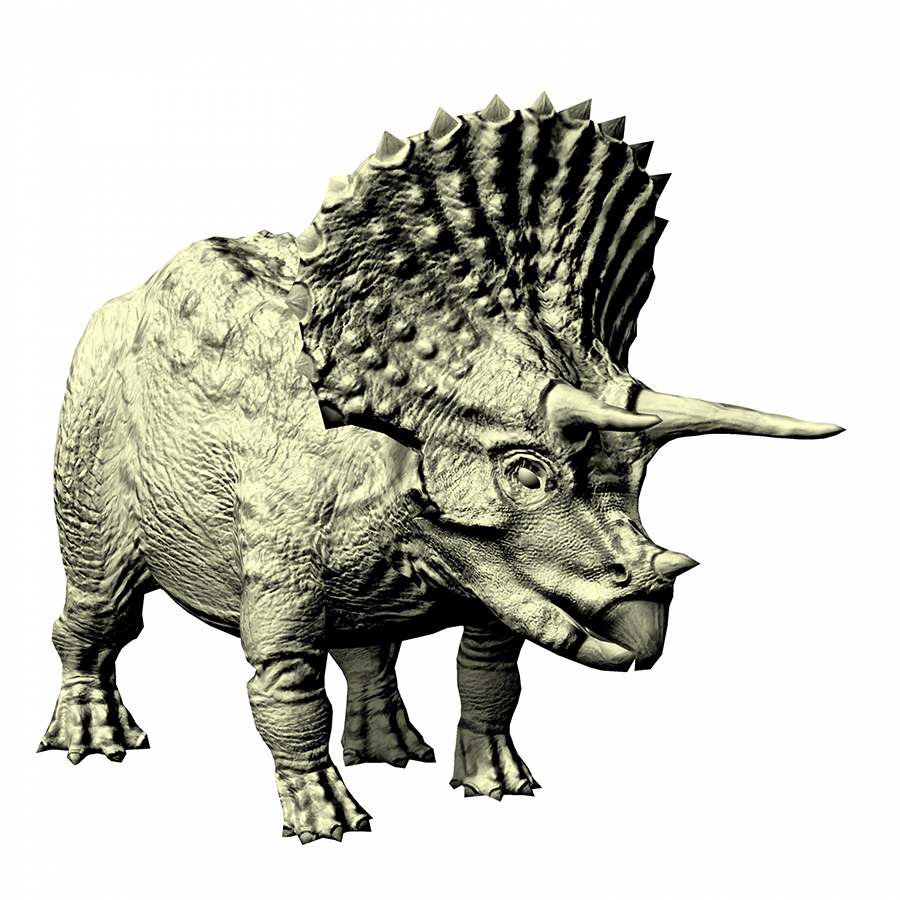
Illustration – Shutterstock | David Herraez Calzada

The scientists then unearthed a “horned” dinosaur, which they have now confirmed to be a Triceratops, from the bedrock. The rock layer of the dig site dates back some 68 million years.

As the team began to carefully expose the find, it got pretty exciting; they began pulling huge fossils from the ground. The find consisted of a partial skeleton of an adult triceratops, and a pretty big one at that—definitely an exciting prospect for the team.

The excavation took several weeks—far longer than expected, and was still underway as late as last week—as they kept finding more and more bones. Among these were several ribs, an arm and a leg bone, as well as the ancient animal’s brain case.

“It’s always exciting to get a call about possible fossils, and I can’t wait to share more details as we continue to dig,” said Tyler Lyson, curator of vertebrate paleontology at the museum, in a press release.

“Finds like this, while relatively rare, are a great reminder of how dynamic our planet is and how much more there is out there to discover.”

Illustration – Public Domain Pictures | Piotr Siedlecki

Despite an underground aquifer and unrelenting rain, the team managed to package the very heavy bones in plaster-cast “jackets” for transportation with minimal disturbance to the specimens. The fossils are now in the capable hands of the museum staff.

Denver is a known “hot spot” for dinosaur fossils—especially the Triceratops. The likelihood of stumbling on more skeletons is high, say scientists, according to CNN.

Another horned lizard was found at a construction site in 2017. The specimen was a torosaurus—very similar to the triceratops except for one bone, said Natalie Toth, one of the scientists at the recent Highlands Ranch site.

During construction of Coors’ Field in the early 90s, Denver construction workers also stumbled on a 7-foot-long, 1,000-pound (approx. 454-kilogram) triceratops skull, as well as several other dinosaur skeletons.

For this reason, “Jurassic Park” was one of the first names for the stadium to be considered. The Triceratops did make its appearance as the Rockies’ mascot Dinger.

Source: www.theepochtimes.com

John Hammond Was Supposed to Die in Jurassic Park

Tuesday, June 25, 2019

Those that have read the original book know full well that John Hammond wasn’t supposed to make it out of the park and that his death would eventually be chalked up to an accident that happened during a business trip to his park. But the death that awaited him could have been much more gruesome than the one he received in the book.

If you recall he was startled by the pre-recorded roar of a T-Rex and as a result went tumbling down a hillside where he was attacked by a pack of the small but lethal dinosaurs that came to be known as ‘compies’ and met his end at the claws of his own creations. It kind of depends on who you ask but even Jeremy Dick of MovieWeb seems to make it sound as though Hammond had what was coming to him in the book. Of course if you really look at it from a different perspective the man in the book was a great deal different from the character that the late Richard Attenborough portrayed in the movie.

Both men were highly ambitious and didn’t like being told they couldn’t do something, but for some reason the man in the book seemed a bit colder, a little more ruthless when it came to getting his way, while Richard’s iteration of Hammond was more like the kindly old grandfather that was also a shrewd businessman with far-reaching ambitions. In other words one of them seemed cold and willing to do whatever it took while the other was more likely to cave in the pursuit of something that nature vetoed a long, long time ago. But I’m getting off point just a bit since the deaths of the two men could have been different had Hammond been slated for an early death in the first movie. It sounds as though he was hiding in one of the large rooms, perhaps looking melancholy at one of the displays of the park, when one of the velociraptors found him and tore him apart, giving him a rather gruesome death. But Spielberg decided to spare him instead and allowed Hammond into the second movie, which kind of deviated in a big way from the book but wasn’t quite enough to raise a tremendous stink among fans. After all the movie made Hammond into a very likable guy whereas the lawyer was the one that people might have shrugged their shoulders at and said ‘meh’ when he was chomped in half. Even with Dennis Nedry, who was perhaps the silliest of the antagonists, finally met his end people were still likely to go ‘meh’, simply because it didn’t seem like he mattered much anymore.

But John Hammond was the guy that got this whole ball of wax rolling from a story standpoint, so it’s not too hard to see how he could be seen as something of an antagonist hiding in plain sight during the book. In the movie it was simply too much to believe that he would be one of those being taken out by a dinosaur since he was too nice of a guy. He was a bit of an irritant since he didn’t want to see the writing on the wall that humanity, one of the most violent and ruinous species in the world, mixed in with dinosaurs, who were destructive simply in their very means of survival at times, could not possibly coexist, even for a matter of moments. The distance between the two species is simply too great, and as it’s been seen in the movies that have come along since, the propensity for violence between dinosaurs and human beings is something that runs along a thin edge and can become ugly very quickly. After all, humanity has come to learn that our place in this world varies from day to day, and that unless we subjugate or somehow learn to coexist with the animals around us then there’s a good chance that we’ll end up destroying them or being consumed by them in some way, shape, or form.

Nature selected dinosaurs a long time ago for extinction no matter how harsh that sounds or how fatalistic it might be. Minds like that of John Hammond are typically called great but at the same time they’re usually lacking in something called humility since they see what they CAN do, not what they SHOULD do. The lost history of this world is something that humanity is usually better off observing instead of witnessing firsthand since the histories that have come and gone haven’t always been kind. Hammond however, and those like him that came in the movies after, had to learn the hard way, and unless Spielberg had stepped in to let him into the second movie, Hammond would have perished in a most painful and horrifying manner.

Source: www.tvovermind.com

‘Fire-Breathing Dinosaurs? The Hilarious History of Creationist Pseudoscience at Its Silliest’ Book Review

Sunday, June 23, 2019

The fire breathing Parasaurolophus from Duane T. Gish’s books Dinosaurs By Design and Dinosaurs: Those Terrible Lizards. Despite having no evidence supporting it and being repeatedly debunked many people still share the theory and believe it to have been plausible.

Yes, people actually believe this.

Fire-Breathing Dinosaurs? The Hilarious History of Creationist Pseudoscience at Its Silliest (2019, Cambridge Scholars Publishing), by Philip J. Senter, Professor of Zoology at Fayetteville State University in North Carolina, represents the culmination of his research over the last decade on Young Earth Creationists’ thoughts about dinosaurs. “Young Earth Creationism” refers to a subset of Christian fundamentalists — roughly 8-22% of the American population — who deny not only the validity of Darwinian evolutionary theory, but also the geological evidence indicating that our planet is billions of years old.
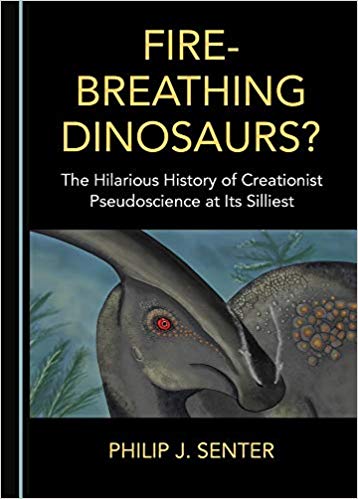
Fire-Breathing Dinosaurs? The Hilarious History of Creationist Pseudoscience at Its Silliest 1st Edition

This necessitates the collapsing of all prehistory into modern history so that, among other things, dinosaurs and people would have coexisted. Because evidence for such cohabitation is absent from the fossil record, Young Earth Creationists instead look for confirmation of humankind’s interactions with living dinosaurs in ancient art and folklore, as well as legend and scripture, in which they see depictions and tales of monsters (especially dragons) as the imperfect recollections of ancient humans’ real experiences.

As the title indicates, the majority of Fire-Breathing Dinosaurs? — Chapters 5 through 14 — deals with a particularly imaginative claim originally made by notoriously fast-talking Young Earth Creationist Duane Gish, that some dinosaurs could literally breathe fire, just like the dragons of fantasy. Those interested in speculative biology are guaranteed to find these chapters especially thrilling, as Senter breaks down how fire-breathing could work in a living organism, only to then reveal the serious pitfalls an animal possessing such a mechanism would face.

From “Fire-Breathing Dinosaurs? Physics, Fossils, and Functional Morphology vs. Pseudoscience,” Skeptical Inquirer Vol. 41, #4

Conversely, Chapter 4 (which is actually the longest in the book) deals with the various Young Earth Creationist claims regarding those myths, legends, and works of art which allegedly describe and depict dinosaurs. In each case, Senter works to debunk these claims and demonstrate what the particular stories or art in question actually contain.

He does not however consider why Young Earth Creationists would interpret this material in such a way, or what such interpretations might mean. Another downside is that Senter has declined to include photographs of the art in question, instead substituting “humorous” cartoon drawings of the pieces discussed.

Other material in the book includes a brief primer on dinosaur paleontology, the publication of The Genesis Flood (1961) by John C. Whitcomb and Henry Morris (the book which popularized Young Earth Creationism among mainline American Protestants), and a concise summary of Senter’s work tracing the origin of dragon legends and his evaluation of the biblical monsters Behemoth and Leviathan, which Young Earth Creationists claim are actually dinosaurs. While I remain skeptical of Senter’s overall evaluation of Leviathan and (especially) Behemoth, I think his contentions are provocative and worth further examinations by qualified biblical scholars.

The book’s final chapter (Chapter 17) and epilogue shifts focus from the academic to the personal, as Senter speaks about his own Christian faith — he is a member of the Greek Orthodox Church — which includes his belief in a non-literal interpretation of the Hebrew Bible and theistic evolution.

Throughout Fire-Breathing Dinosaurs? Senter diligently cites his sources, including many primary documents culled directly from Young Earth Creationist literature, efforts that should be applauded. Most scholars operating outside the Young Earth Creationist faith have largely ignored their thoughts about dinosaurs, instead focusing their attention on the politics surrounding the teaching of creationism in public school science classrooms.

This dearth of attention is unfortunate, as it results in an incomplete picture of the subjunctive world which Young Earth Creationists imagine themselves inhabiting, a world that has important lessons to teach us about how history is interpreted and constructed, and how the language and power of science is used (and abused) within our culture.

It’s because of this strength that I’m disheartened to say that Dinosaurs? also contains some serious flaws, the first being an issue of tone. To be frank, from the subtitle to the last page, I found much of Senter’s language to be downright derogatory toward Young Earth Creationists’ beliefs, in an oddly juvenile manner.

Evidently fond of culinary-themed putdowns, Senter repeatedly refers to Young-Earth Creationists as “silly soup chefs,” and their theology as a “silly soup” or “goofy goulash.” The crayon drawings that pepper Chapter 4 continue this trend, depicting a generic Young Earth Creationist as a little cartoon “silly chef,” constantly befuddled by ancient art and myths.

While these may not sound like the most grievous of insults, they are repeated so frequently as to quickly become obnoxious. And for anyone still not offended, there are points where Senter just resorts to calling Young Earth Creationist theology “dumb” and “stupid,” too. All this was particularly shocking for me, especially in light of a previous Skeptical Inquirer (Vol. 36 No. 4, 2012) article by Senter, in which he stated the importance of writing about other peoples’ religious views with “wording that is diplomatic and respectful, avoiding ridicule.”

Senter Cartoon

The second major fault is Senter’s evident unfamiliarity with the existing scholarly literature on Young Earth Creationism written by non-Young Earth Creationists. References to such standard works as Ronald Number’s The Creationists, Lloyd R. Bailey’s Genesis, Creation, and Creationism, Christopher P. Toumey’s God’s Own Scientists and, more recently, the ethnographic research of anthropologist James F. Bielo, are entirely absent. The lack of consultation with these works shows an apparent disinterest in understanding where Young Earth Creationism comes from, why its adherents hold the views they do, and what we can learn from them, culturally.

It also leads Senter to make some embarrassing mistakes, such as tracing Young Earth Creationism back to the early 1960s and Whitcomb and Morris. The true father of Young Earth Creationism was the Canadian Seventh-Day Adventist George McCready Price, who developed the basic core beliefs in the early 20th-Century, which include the coexistence of dinosaurs and humankind in the days before Noah’s flood.

Also absent is any acknowledgment of the role many Victorian-era naturalists and early geologists played in the formulation of Young Earth Creationist-style ideas via their liberal mixing of paleontology and biblical scripture, openly identifying Mesozoic fossil reptiles with dragons, monsters, and demons, as outlined in the work of scholars like Christopher McGowan, Ralph O’Connor and Melanie Keene. Senter makes only the briefest of references to this latter fact in Chapter 2, but largely glosses over it, perhaps wanting to spare his fellow scientists any culpability in originating the kind of ideas he finds so unbearably “silly.”

Ultimately, Senter’s Fire-Breathing Dinosaurs? is a mixed bag. While it contains some excellent scholarship, it’s packaged in a way that many will undoubtedly find off-putting, and crippled by its lack of consultation with key secondary sources. Its strongest aspect is undoubtedly the comprehensive database of primary sources it provides on Young Earth Creationist claims about dinosaurs, a virtual goldmine for any future researchers interested in this same topic.

Source: www.adventuresinpoortaste.com

The 12 Best Quotes from Jurassic Park

Saturday, June 22, 2019

Jurassic Park. Those words can send shivers down the spine of any dinosaur fanatic. The 1993 science-fiction slash action slash adventure film is a bona fide classic of modern cinema and a general all-around great way to spend a couple hours. Though the franchise has seen better days—seriously, Fallen Kingdom?—the original can’t be beat for its perfect storm of realistic effects, charming characters and expert direction from a certain Mr. Steven Spielberg.

But it’s not all teeth and claws. The humans occupying screen space manage to squeeze in some highly quotable material between maulings. And, no, they’re not all Jeff Goldblum. Here are 12 of the best.

1. That awe-inspiring bienvenue

“Welcome to Jurassic Park.” — John Hammond

Simple, straightforward and effective as hell. Entrepreneur and kindly grandfather John Hammond’s weighty words feel directed as much toward viewers as they do the protagonists.

2. Ian Malcolm being blunt

“That is one big pile of shit.” — Ian Malcolm

Indeed. That is one big pile of shit.

3. Ian Malcolm waxing philosophical

“Life, uh, finds a way.” — Ian Malcolm

This has been memed to hell and back. You know this. We know this.

4. Ellie Sattler perfecting the art of the playful dig

“There is no doubt our attractions will drive kids out of their minds.” — John Hammond
“What are those?” — Dr. Alan Grant
“Small versions of adults, honey.” — Ellie Sattler

Oh, snap.

5. Ellie Sattler, the feminist

“God creates dinosaurs. God destroys dinosaurs. God creates man. Man destroys God. Man creates dinosaurs … ” — Ian Malcolm
“Dinosaurs eat man. Woman inherits the earth.” — Ellie Sattler

Laura Dern absolutely sells this one, which is nice seeing as she is one of two female characters in this overwhelmingly male cast.

6. Ellie Sattler, the feminist: Part II

“Look, we can discuss sexism in survival situations when I get back.” — Ellie Sattler

It’s a shame we don’t actually get to hear this discussion.

7. Because raptors are smart, you know?

“Clever girl.” — Robert Muldoon

Jurassic Park’s game warden wraps up what we’re all thinking about the island’s shrewdest animals. They can open doors!

8. Grab those glutes

“Hold onto your butts.” — Ray Arnold

Samuel L. Jackson doesn’t get much screen time in this one, but the actor did manage to score one of the film’s most indelible one-liners.

9. You’re too young to be telling dad jokes, kid

“What do you call a blind dinosaur?” — Tim Murphy
“I don’t know.” — Dr. Alan Grant
“A do-you-think-he-saurus. What do you call a blind dinosaur’s dog?” — Tim Murphy
“You got me.” — Dr. Alan Grant
“A do-you-think-he-saurus rex.” — Tim Murphy

10. Because it’s not a ‘90s flick without a hacker

“It’s a UNIX system! I know this!” — Lex Murphy

Lex saves the day, teaching us all a valuable lesson in the process: Never underestimate the power of a computer nerd.

11. All that money, and you can’t even keep the dinosaurs in their enclosures?

“Spared no expense!” — John Hammond

Hammond is a capitalist through and through, believing anything can be fixed if enough money is thrown at it. Oft-repeated, this line becomes something like a mantra for the visionary. Is he trying to convince the park visitors or himself?

12. Lesson learned … kind of

“Mr. Hammond, after careful consideration, I’ve decided not to endorse your park.” — Dr. Alan Grant
“So have I.” — John Hammond

The final words of the film seem to close the door quite firmly on the potential for future dinosaur mishaps. Surely no one would be foolish enough to try this again. Right? Right?

Source: www.pastemagazine.com

Pages