Blogs

‘Jurassic Park’ is an Inherently Feminist Interpretation

Tuesday, June 18, 2019

It’s been 26 years since Jurassic Park, the 1993 Steven Spielberg classic, hit theaters and it’s amazing how well it holds up. Sure, the T-Rex feels a little clunkier than she used to, and Jeff Goldblum’s black leather look is definitely dated, but still just as easy on the eyes. Truth is that it’s a movie that’s as thrilling and fun to watch now as the day it was released. But the most surprising thing about the film is how modern it feels in its treatment of it’s female character, from Dr. Ellie Sattler (Laura Dern) all the way to the dinosaurs – every single dinosaur in the park being a bad ass lady. In fact, the idea that they’ve all been genetically engineered to be female in order to prevent reproduction in the wild is a central tenet of Jurassic Park.

Lurking away under the surface of this well-loved roller-coaster ride that is Jurassic Park, lies a recurrent phobia of something even more frightening than giant pre-historic predatory dinosaurs: feminism. The film is dense with references to the female body and, more specifically, controlled reproduction – blood to create ‘baby dinosaurs’, the eggs, the “pulling up of dinosaurs’ skirts.” This is best depicted in the scene where the three scientists are on a tour of the facility and they get to experience how the eggs are hatched.

They are all in awe of the process until they start learning the details of how it works. They are appalled and confused when it is revealed that there is “No illegal breeding in Jurassic Park.” because all of the dinosaurs are female.  Malcolm jokingly asks “How do you know they’re all female? Does somebody walk into the enclosure and look under the dinosaur’s skirt?” Only to find out that the dinosaurs sexes are maintained by denying them the genetic code they need to become male. 

So, reproduction is forced upon female animals in a lab, by men, to make money. Them they break free, resist, and make babies in their own way. The resulting story is not just a cautionary tale of what happens when scientists and corporate interests combine, but an exploration of the threat that feminism poses to the family unit when seen through the eyes of the patriarchy.

Largely, Steven Spielberg is not known for overtly feminist portrayals of women in film. His work primarily focuses on similar motifs, chiefly that of father/son relationships. Yet, in rewatching Jurassic Park, it struck me that not only is Dern’s Dr. Ellie Sattler a portrayal of a female scientist that is largely unseen in film, but she is, on numerous occasions, keenly aware of her gender and how this leads to her treatment.

A paleobotanist, Dr. Ellie Sattler is clearly respected in her field of her work. Unlike previous female scientists, Ellie is not merely present to fulfill the Male Gaze, or to act as a plot device driving the narrative forward. Too often in film and television, women scientists are there to either look attractive, or to simply proffer information to their male counterpart without little discussion. Here, Ellie is not only an expert in her field, she is respected by her colleagues.

Ellie is unafraid and undeterred to shove her arm into a pile of dinosaur droppings in order to help heal a sick triceratops. That scene, which comes roughly 40-minutes into Jurassic Park, has always stuck with me. Partly because, well, ew, but also because of how truly uneventful this entire scene is. No one is particularly impressed or surprised that Ellie decides to deep dive into dinosaur feces. There’s no snotty remark about her gender, or astonishment that she’s not gagging at the prospect. It’s par for the course: She’s just doing her job. This is largely due to the fact that the men, around her, are scientists and they view her as an equal, not on the basis of her sex but on the merit of her work.

This idea is further reinforced by the varying kinds of human women we see on screen in Jurassic Park. There was Lex (Ariana Richards), a vegetarian teenage hacker, who in the manages to save her brother from being raptor food. That scene is also iconic for all the layers of technology that was used to make it but that’s for another article.

Lex is good at what she does and she knows it, even though utterly terrified she ultimately saves everyone’s lives by managing to reboot the park’s computer system after it was sabotaged by Newman Nedry (Wayne Knight). A young woman with an interest in STEM is something we’re only beginning to see normalized on screen. There are examples of women in STEM in media all the way from Scully (Gillian Anderson) in the 1990’s to Shuri (Letitia Wright) in Black Panther they are just few and far between. Especially compared to the rate that white men are depicted in STEM.

That being said, it takes two to tango, which is why the men that these women are partnered with onscreen matter. The original Jurassic Park stands out among action films largely because its protagonists weren’t regular action heroes. They were scientists — cool ones, sure, but not the kind of people you would expect to be running around a jungle fighting off massive and dangerous creatures. And what’s more, they didn’t so much solve the problem with violence as they deduced a creative solution and implemented it.

Goldblum may have reached peak internet icon status in 2018, but can you imagine him holding up an action franchise a la Bruce Willis? Sam Neill has a kind of rugged appeal, but he’s not Rambo. He’s not traditionally macho — if anything, he’s a nerd who’s just so excited to be around his long-lost monsters. And he and Ellie were equal and professional partners above anything else.

While Ellie is Grant’s (Neil) partner, her narrative is not dependent on her involvement with him, and indeed, much of her narrative development takes place away from Grant. Returning to the compound while Grant is left to look after the children, arguably taking on the parental role, often reserved for women in these situations, Ellie is compelled to offer her help in order to reboot the system. She is aware of the dangers, but does so anyway. Her action, which she quickly undertakes with little debate, is decisive. She knows that her help is needed and despite her fears, she rapidly offers her services.

Both Muldoon (Bob Peck) and Arnold (Samuel L. Jackson) accept Ellie’s participation without question. Muldoon is an interesting character especially in the depiction of “Macho Men” supporting the women around them. He was Jurassic Park‘s game warden and shown as being proficient with weaponry and was a skilled hunter. He is a refreshing portray of a hyper masculine or a “Macho Man” because he views Ellie as an equal and not a liability.

It is only John Hammond (Richard Attenborough), far older than the rest, who questions her decision. It is interesting that it is Hammond who expresses his displeasure with her involvement in the mission, largely given the noticeable generation gap between the three men in the room. Perhaps this is Spielberg’s attempt at noting the necessary progression in the treatment of women. Ellie herself explicitly draws attention to Hammond’s objections, bluntly stating, “Look … We can discuss sexism in survival situations when I get back.”

Ellie is willing to get involved and does not require rescuing, unlike her partner Alan, who spends the majority of the film both fulfilling a paternal role, but also hoping to find safety. Ellie is already safe through her decision to stay with the triceratops, but she is prepared to risk this in order to guarantee the safety of others. Ultimately, it is Ellie that rescues Alan, Lex (Ariana Richards), and Tim (Joseph Mazzello) as it is through her resetting the breakers on the park and reactivating the parks security system that allows them to retreat from danger.

Most importantly, Ellie is not an overtly sexualized character nor is she there to serve as simple set decoration. Her clothes and styling are functional and appropriate to her job and she is allowed to be intelligent and brave without acting hysterical or panicked. The film affords her a fully developed, engaging, and interesting role. She’s also an unapologetic feminist.

While their Jeep is parked outside the T. Rex exhibit, Ian Malcolm (Goldblum)waxes poetic about the nature of this experiment: “God creates dinosaurs. God destroys dinosaurs. God creates man. Man destroys god. Man creates dinosaurs.” Sattler doesn’t miss a beat, “Dinosaurs eat man,” she continues. “Woman inherits the Earth.”

Jurassic Park is a movie that still holds up today. It’s not a perfect film there is a significant lack of people of color but for its faults, it’s a shining example of how to treat women in films. It allows it’s female characters to be layered and multidimensional, they aren’t used as sex symbols, and as dinosaurs they really wreck stuff up.The sequels play out similar themes of reproductive anxieties but less successfully and become increasingly more conventional.

By the time we reach the 2015 Jurassic World, the imprisoned dinosaurs have become more, not less frightening. Instead of Grant’s nuanced journey towards fatherhood we have the classic trope of a career woman who neglects the children and who needs to be taught a lesson. It’s disappointing that decades later, the franchise has become significantly more dictatorial about gender performance. But then, these films can all be enjoyed for nothing more than the Frankenstein-esque, gleefully monstrous, Hold-Onto-Your-Butts science fiction horror.

Source: https://butwhythopodcast.com

A New History Reveals How The Wealthy Elite Helped Shape Modern Natural History Museums In America

Tuesday, June 18, 2019

Assembling the Dinosaur audiobook cover art

The first 6 months of 1905 saw two prominent, celebrity-studded, and copiously publicized unveilings of full-size dinosaur exhibits. In February, the American Museum of Natural History (AMNH) in New York unveiled its Brontosaurus mount; in April, Andrew Carnegie’s donation of a cast of Diplodocus carnegii (his “namesake,” as he liked to call it) was presented to the British Museum in London. As Lukas Rieppel explains in his book, Assembling the Dinosaur, neither the timing, nor the place, nor the form of these events rested on coincidence.

In the past decade, the “Long Gilded Age” of American natural history museums—roughly the last third of the 19th century and the first decade of the 20th—has been subjected to an unprecedented number of treatments (13). Rieppel’s book is a welcome addition to this body of literature, not in the least because of his approach, which seeks to frame the dinosaur “as an object of technical knowledge with social, cultural, and economic history.”

The result is a book about dinosaurs that features surprisingly few of them (and fewer fossil hunters still). If that sounds like criticism, it is not. Rieppel’s focus is on the people who used dinosaur mounts to convert monetary capital into social capital and, in so doing, built the natural history museums that define the museum landscape today.

At the turn of the 20th century, a time in which big things mattered, dinosaurs were a natural point of attraction for wealthy plutocrats. And because natural history museums could be instrumentalized to translate them into social capital and ideological metaphor, this created an almost natural bond between such institutions and wealthy benefactors looking for recognition.

Rieppel frames America’s big natural history museums as tools for the dissemination of ideas about capitalism and society as much as they are tools for disseminating ideas about natural history. He shows how various financial and administrative mechanisms from capitalist ventures (particularly industry) shaped the operations of natural history museums and led to a strict regulation of both their internal and external relations.

The main focus is on the AMNH, arguably the United States’s most important natural history museum, and its main figurehead, the paleontologist Henry Fairfield Osborn. In a sense, this book is a careful deconstruction of Osborn’s efforts to instrumentalize natural history for ideological ends—ideologies that usually served the agenda of the AMNH’s backers. A good example of this would be his advocacy of “aristogenesis,” a concept that holds that evolution proceeds in a predetermined path that favors the “best” genes—an idea obviously attractive to patricians at the top of New York’s social order.

The same events were taking place in other new institutions, including Chicago’s Field Museum and Pittsburgh’s Carnegie Museum, both of which feature prominently in Rieppel’s narrative. He describes how wealthy philanthropists such as Marshall Field and Andrew Carnegie shaped these institutions in much the same form as they had done with their commercial ventures: by applying a strict social hierarchy and rigorous bookkeeping throughout their respective organizations.

With the exception of Osborn, Rieppel may be somewhat guilty of underestimating intermediary figures such as William Holland and Frederick Skiff, who actually converted their proprietors’ ideas into practice. These museum directors were not just delegates of their wealthy proprietors; they were also their social equals and representatives, and although they rarely misunderstood the museum’s role in generating social capital for their bosses, they also had agendas of their own. This could make things difficult when the museum’s interests failed to coincide with the interests of its patrons. Even Holland, for example—no stranger to sycophancy—occasionally issued stern reprimands to Carnegie when he felt his boss was losing sight of the museum’s interests.

Unlike the previous generation of collectors, the pressure was on new museum curators to prove themselves as the defenders of “pure” scientific interests. But, as Rieppel emphasizes, they eventually came to serve the same sociocommercial agenda because “pure” science was a highly valued ideological commodity whose aura could be made to fit more openly commercial agendas, too.

Assembling the Dinosaur is a solid entry into the growing body of literature on Gilded Age American paleontology, but it is particularly valuable for its contribution to enhancing our understanding of how science and its representation during that period were influenced by, and in turn affected, society as a whole. By incorporating cultural, economic, and scientific developments, Rieppel shines new light on the history of both American paleontology and museum exhibition practice.

References

  1. 1. P. D. Brinkman, The Second Jurassic Dinosaur Rush: Museums and Paleontology in America at the Turn of the Twentieth Century (Univ. Chicago Press, 2010).

  2. 2. R. J. Gangewere, Palace of Culture: Andrew Carnegie’s Museums and Library in Pittsburgh (Univ. Pittsburgh Press, 2011).

  3. 3. I. Nieuwland, American Dinosaur Abroad: A Cultural History of Carnegie’s Plaster Diplodocus (Univ. Pittsburgh Press, 2019).

Source: https://blogs.sciencemag.org

World's Largest Dinosaur Show in Bangkok

Tuesday, June 18, 2019

A troupe of 18 dinosaurs will be seen roaming Impact Arena, Muang Thong Thani, for the next three months.

This is the second time the Thai audience will be left in awe, eye to eye with the extinct reptiles that have been brought back to life in the globally acclaimed production "Walking With Dinosaurs -- The Arena Spectacular", which will return to the Kingdom with 10 shows from Sept 12-15.

Hailed as the world's biggest and best dinosaur show, watched by over 9 million people in 250 cities across the globe, the live theatrical arena show first visited Bangkok nine years ago with 15 life-size dinosaurs recreated to give us a picture of what the primeval world was like.

The new version, however, features updated, state-of-the-art technology and a total of 18 gigantic creatures of actual size representing nine separate species from the entire 200-million-year reign of the dinosaurs.

Stegosaurus and Allosaurus. photo by Patrick Murphy

They include the Tyrannosaurus rex, the terror of the ancient terrain; the Plateosaurus and Liliensternus from the Triassic period; the Stegosaurus, Brachiosaurus and Allosaurus from the Jurassic period; as well as Torosaurus, Ankylosaurus and Utahraptor from the Cretaceous period.

The largest of them, the Brachiosaurus, is 11m tall and 17m from nose to tail. It took a team of 50 -- including engineers, fabricators, skin makers, artists, painters and animatronic experts -- a year to build this US$20 million (623.8 million baht) production.

Based on an award-winning BBC television series of the same title, the show will once again take the audience to explore the history of the world -- from the splitting of the earth's continents to the transition from the arid desert of the Triassic period to the lush green prairies and forces of the later Jurassic -- and what forced the extinction of the dinosaurs.

This updated production will premiere in Bangkok on Sept 12 at 6.30pm, followed by three rounds a day at 10.30am, 2.30pm and 6.30pm from Sept 13-15.

Source: www.bangkokpost.com
100-Mln-Year Old Fossilized Dinosaur Footprints Discovered in East China

Monday, June 17, 2019

A China-U.S. joint research team announced in Beijing that they had discovered four nearly 100-million-year old fossilized dinosaur footprints in eastern China's Jiangsu Province.

Found in a scenic spot in Maling Mountain Scenic Area in the city of Xinyi, the tracks can help with the study on the distribution and evolution of China's dinosaur groups during the Lower Cretaceous period, according to the team.

The research was conducted by paleontologists from the China University of Geosciences (Beijing), University of Colorado, Yingliang global stone museum and Dexu Institute of Paleontology.

"The dinosaur footprints had been mistaken for the footprints of Li Cunxiao (858-894), a famous general in the late Tang Dynasty (618-907), and the tiger he fought," said Xing Lida, a researcher with the team.

"Three toes of two sauropod footprints have been lost over the years, making its outline resemble a human foot," he added.

Researchers are now working with the local authorities to protect the rare tracks.

The findings have been published in the academic journal Geological Bulletin of China.

Source: www.xinhuanet.com

Jurassic Park: 5 Things The Books Do Better Than The Movies (& 5 Things They Do Worse)

Sunday, June 16, 2019

Michael Crichton continues to be one of the most prolific writers in the world, even years after his tragic death from lymphoma. His books have sold over 200 million copies worldwide, and over a dozen of them have been turned into films. One of his most popular series of books to also become a hit film franchise is Jurassic Parkcentered around cloned dinosaurs running rogue in a theme park.

As with most book to film adaptations, there are plenty of differences. The books do a fantastic job of exploring the science around the creation of the dinosaurs in much greater detail, but they do a poor job of developing the human characters they terrorize, resulting in a loss of emotional connection. Certain aspects of the books will always be superior to the films, but others were altered for the better, successfully capturing the majesty, terror, and awe inherent to the franchise. Here are five things the books did better than the movies, and five things they did worse.

10 DO BETTER: ESTABLISH JOHN HAMMOND AS A VILLAIN

Though Lord Richard Attenborough did a tremendous job breathing life into the character of John Hammond, his depiction is completely at odds with the megalomaniac park owner in the book series. John Hammond is not a lovable, avuncular figure but a cynical, greedy man who puts profit above human life.

Steven Spielberg clearly wanted to bring more humanity to Hammond, giving all of his more negative traits to the character of Donald Gennaro, the “bloodsucking lawyer” that gets eaten whilst on the toilet by a T-Rex. This means Hammond, a man who wanted to play God, gets off easy for wanting to exploit his own creations.

DO WORSE: MAKE TIM THE HACKER

Most child actors fall into one of two categories; ridiculously cute and innocent, or precocious and mature for their age. The kids in Jurassic Park manage to be both, and offer some of the best scenes in it. In the novel, none only does much of their personality not come across, but their characteristics are inverted.

Instead of being the older sibling who’s a brilliant hacker, Lex Murphy is the younger sibling, and Tim is the kid who’s good with computers (though is still obsessed with dinosaurs). Switching their roles established a balance of competent female characters to male characters when combined with Dr. Ellie Sattler.

DO BETTER: KILL OFF JOHN HAMMOND

In the books, John Hammond is a greedy billionaire only interested in his theme park turning a profit, and no sooner are people dying on his island than he’s already drumming up plans to make a bigger, better one. He learns absolutely nothing from his mistakes, and in true Jurassic Park fashion, he gets his comeuppance for his hubris.

In the Jurassic Park novel, John Hammond dies in a suitably malicious way and doesn’t make it off the island as a survivor. He’s frightened by the recorded roar of a T-Rex, falls down a steep hillside and breaks his ankle, before being surrounded by compys who make quick work of him in his wounded state.

DO WORSE: CHARACTER DEVELOPMENT

The cast of the Jurassic Park films had a challenge on their hands when they committed to portraying Dr. Alan Grant, Dr. Ellie Sattler, Dr. Ian Malcolm, and company. Michael Crichton penned some fairly bland characters, leaving it up to the actors to give them personality and depth.

In the books, Dr. Alan Grant is simply “barrel-chested” with a beard, a rugged alpha male type who hates intellectuals and loved kids. Dr. Ellie Sattler is his 24 year old student, long-necked and blonde (who isn’t romantically involved with him), and Dr. Ian Malcolm is a droning egghead who speaks in monotone parables and has none of Jeff Goldblum’s charm.

DO BETTER: INTRODUCE HENRY WU MUCH EARLIER

In the Jurassic World movies, Head of Research and Cloning Dr. Henry Wu has emerged as a central antagonist with diabolical intentions. In some ways, he represents the archetype of John Hammond from the books, with little regard for human life in the pursuit of scientific breakthroughs.

In Jurassic Park he has little more than a cameo, whereas in the book he’s responsible for breaking down all of the intricate scientific jargon throughout. He’s given much more backstory, from his long career with Hammond, to the trial and error of their experiments, all of which would have been helpful context to have in the films.

DO WORSE: ACTION AND SUSPENSE

While no one can deny that Michael Crichton introduced some amazing concepts into the world of science fiction with his Jurassic Park books, they don’t always leap off the page. This is due to his dry prose, which favors long expository paragraphs of scientific jargon over action, suspense, and character development.

The films were much more suited as a medium for capturing the dramatic tension and suspense of visitors being trapped in a theme park full of roaming dinosaurs. Crichton’s writing could produce a clean, clear image of the action, while competent directors translated it from clinical and dull to exciting and dynamic.

DO BETTER: ROBERT MULDOON

Though he was a supporting character in Jurassic Park, Robert Muldoon had a much more expansive role in the books (yes plural!). In the film, the accomplished Game Warden from Kenya was responsible for all the dinosaurs in the park, particularly the velociraptors. He’s killed at the conclusion of the film (but not before saying his immortal line, "Clever Girl"), whereas in the books he survives by climbing into a pipe the raptors can’t get to.

Both versions of Muldoon are honestly epic; book Muldoon has a handlebar mustache, a rocket launcher, and an alcohol problem. Movie Muldoon has a British accent, a high intellect, and a great pair of legs. But the books did Muldoon right by letting him not only survive, but blow up raptors with a bazooka.

DO WORSE: FIND OUT THE DINOSAURS ARE BREEDING

Film is a medium that packs the same narrative punch visually as books do with the written word describing it. In the Jurassic Park novel, it’s Dr. Ian Malcom that discovers that the dinosaurs are breeding out in the park on their own, bringing it up to Hammond and the others while on the initial park tour.

In the film, it’s Dr. Alan Grant who discovers this because he happens upon a nest of recently hatched eggs while stranded in the park with Hammond’s grandchildren. The look on his face and terror in his eyes tell you all you need to know; the dinosaurs have taken control back from the humans, and now they’re multiplying.

DO BETTER: EXPLORE THE SCIENCE

Due to the nature of film, often pieces of core information have to be explored visually or expressed through a few lines of expository dialogue. This is to keep the pace moving, when large dumps of backstory or context would cause scenes to drag. It’s also why viewers may find themselves more confused, especially with some of the scientifically rich concepts found in Michael Crichton’s books.

If you’re keen on knowing more about the science he introduced in Jurassic Park, you’re better off reading his novels. He earned his medical degree from Harvard, and his books are often praised for their meticulous scientific research. Though the science in Jurassic Park is fictitious, it’s based on real principles.

DO WORSE: ALREADY HAVE THE DINOSAURS ESCAPING

Michael Crichton made the call in his Jurassic Park books to drop his readers right into the middle of the action, with the dinosaurs already having escaped from the park.  This changes the tone of the books completely, certain plot points, and alters the way certain characters interact with each other.

In the first film, viewers are given plenty of time to get comfortable and marvel at the dinosaurs, reflecting the characters’ own awe before reflecting their terror when the dinosaurs go rogue. The film’s setup provides for a pretty great payout, with clear lessons being learned from the debacle by all the characters involved.

Source: https://screenrant.com

10 Things Jurassic Park Gets Completely Wrong About Dinosaurs

Sunday, June 16, 2019

When Jurassic Park came out in 1993, much of the “science” it based its premise on was an amalgamation of fictitious concepts rooted in factual Paleontological research. It’s what made the book it was based on by Michael Crichton so hard to put down; so much of it seemed actually plausible. Could dinosaur DNA actually be combined with the frog DNA of today to create new life? Did Brachiosauruses move in herds? Did Velociraptors hunt in packs?

Some leniency must be given to a film that deals with genetic experimentation. It can easily explain away many of its inaccuracies with the premise that JP scientists tweaked their dinosaurs to have certain desirable traits, not found in their normal genetic makeup (Jurassic Park III and Jurassic World showcase this prominently). Jurassic Park answered a lot of our burning Dino questions, but its hybrid science was like its dinosaurs; flashy and cool, but not always dependable. As paleontologists continue to uncover the truth about the dinosaurs featured in the film (and its many sequels), it remains to be seen whether or not the movies will decide to implement the facts about dinosaurs (where are the feathers?!), or continue to keep grounding them in movie magic. Here’s all the things that Jurassic Park gets completely wrong about dinosaurs.

10 T-REX HAD EXCELLENT VISION

One of the most famous scenes in Jurassic Park occurs when the colossal T-Rex has her snout pressed up against Dr. Alan Grant and John Hammond’s grandchildren. He tells them not to move, believing that if they remain perfectly still, she won’t be able to track them with her poor eyesight.

This couldn’t be further from the truth! Paleontological research has shown that the T-Rex had excellent vision, similar to a bird of prey such as a hawk or an eagle. As we know, they can spot a field mouse in the grass from sixty feet in the air. And even if she couldn’t have seen them, her heightened sense of smell would have located them even in the rain.

DILOPHOSAURUS HAD NO NECK FAN OR VENOM

An iconic and enduring symbol of the harrowing dangers of Jurassic Park, the dilophosaurus, with its multi-colored neck fan and ability to spit venom to blind its victims was almost entirely a complete fabrication. No fossil evidence had shown that the dilophosaurus had any such fan, though it did have a ridge of feathers down the back of its head.

When Jurassic Park was being made, there was a carnivore who’s fossilized tooth was found to have grooves in it like a venomous snake, implying at the very least it could secrete venom when it bit its prey. However, that couldn’t be linked to the Dilophosaurus, which was also 20 feet long and 1,000 pounds, indicating it didn’t need a fan or venom to be a threat.

DINOSAURS DON'T HOLD THEIR ARMS LIKE KANGAROOS

When imagining one of the bipedal carnivores of Jurassic Park, most people think that all of them walked with their arms held upright, elbows at their sides, and wrists down-turned like they’re a kangaroo or pushing a shopping cart. Paleontologists argue that they held their hands more like they were clutching a ball.

This also throws into question how the Velociraptors could open doors in the film. Raptors were intelligent, sure, but no more so than the average bird of today, and not as intelligent as dolphins like Dr. Alan Grant claims in Jurassic Park III. They weren’t figuring out how to open doors or follow sign language.

VELOCIRAPTORS LOOKED LIKE TURKEYS

Velociraptors are arguably some of the scariest species in Jurassic Park. With their long, agile bodies (6 feet), long snouts full of razor sharp teeth, and protruding claws, they are reptilian death machines. But the version of the raptors we see in the film is a far cry from the real ones that existed in prehistoric times.

For one thing, Velociraptors were much smaller than you’d expect, about the size of a Thanksgiving turkey. You could have drop kicked one into the Cretaceous if you wanted to. The film raptors much more closely resemble their cousin, Deinonychus, but that name doesn’t sound nearly as cool. They also lacked many facial muscles, just like birds of today, so much of their scary snarling was added for dramatic effect.

T-REX CAN'T OUTPACE A CAR

For some time, there was a common misconception among Paleontologists that a T-Rex could run up to 40 mph. This was the prevailing mode of thought when Jurassic Park was made, making it seem entirely plausible that the T-Rex could, at least for a time, match the speed of the escaping jeep containing Dr. Sattler, Ian Malcolm, and Robert Muldoon.

We now know that a T-Rex has a running speed of only about half that, or even 15 mph. They often didn’t need to go any faster because the herbivores they were snacking on were quite lumbering as well. This means you were SOL on foot, but in a car, could easily get away from one.

A MOSASAUR AND A T-REX WERE THE SAME SIZE

One of the most interesting additions to the long list of dinosaur species featured in the Jurassic Park franchise was the Mosasaur featured in Jurassic World. Like a much scarier version of Free Willy, it hung out in a giant tank and did tricks for large crowds, with small children pressed against the glass in awe.

The Mosasaur in the film is much larger than its real life counterpart by almost two times. In reality, the Mosasaur was a little larger than a T-Rex, yet in the film it munches on an Indominus Rex like its a Super Sized Dino Meal. They didn’t surface from underwater long enough to perform such a feat, and also didn’t have frills on their backs.

DINO DNA IS TOO OLD TO READ

Michael Crichton did a great job of combining real world scientific analysis and biochemistry with fiction, and one of the reasons why his Jurassic Park books were so popular is because there was an element of truth to their magic. But as much as it would be neat to think we could extract Dino DNA from amber, it’s just not possible for a number of reasons.

The foremost reason is that Dino DNA is just too old. Paleogeneticists maintain that after 1.5 million years, nucleotide bonds that make up DNA wouldn’t be long enough to extract any meaningful data. If dinosaurs have been extinct for 65 million years, how could any of their nucleotide bonds be present in mosquito blood?

THE SPINOSAURUS WASN'T A VIOLENT PREDATOR

As the Jurassic Park franchise continued after The Lost World (and Michael Crichton’s second book), different filmmakers and creative teams decided to try different narrative elements, like further genetic experimentation with dinosaurs, to varying degrees of success. Were more terrifying dinosaurs created? Yes. Were they accurate? No.

Jurassic Park III featured a Spinosaurus, a large carnivore with a sail on its back that was able to kill a T-Rex. Not only was that not possible since it primarily just ate fish, it wouldn’t have known how to interact with a species it was separated from by 35 million years. It was assumed that some sort of biological survival mode would kick in, regardless of how the real species would have interacted.

DINO DROPPINGS WEREN'T THAT MASSIVE

Early on in Jurassic Park, Dr. Sattler encounters a sick triceratops and beside it, a giant pile of its droppings. We’re talking a massive pile that’s taller than her and Ian Malcom, both of whom somehow don’t pass out due to the stench that would undoubtedly be enough to knock them off their feet.

Fans have debated whether or not it was all from the sick triceratops or from a herd of them, but regardless, the largest known Coprolite (fossilized Dino droppings) ever recorded was only 40 inches long, implying the filmmakers chose the gigantic amount for shock value. Especially since the largest amount of droppings thought to be possibly excreted from the biggest dinosaur recorded could be 15 liters at most.

PTEROSAURS AND PTERANODONS COULDN'T PICK UP HUMANS

Pteranodons were introduced in Jurassic Park III in a particularly harrowing sequence involving Dr. Alan Grant and visitors in an aviary. They were seen again in Jurassic World, as well as their smaller cousins Pterosaurs. While it was pretty epic finally seeing some winged dinosaurs in the franchise, the way they behaved was far from accurate.

As large as Pteranodons were, they lacked the grasping ability of modern day winged predators such as eagles or falcons. This made it difficult for them to perch, much less grab at humans - they ate their aquatic prey much like a pelican. Jurassic World shows Pterosaurs, not nearly as big as Pteranodons, lifting entire humans off the ground, which couldn’t possibly have happened unless they were genetically altered.

Source: https://screenrant.com

India Gets First Ever Dinosaur Museum, Fossil Park in Gujarat

Friday, June 14, 2019

Gujarat Chief Minister Vijay Rupani recently inaugurated India’s first Dinosaur Museum and Fossil Park at Raiyoli village near Mahisagar district’s Balasinor town. 

The park is now open to the public.

Raiyoli village is the third largest in the world and is known to be the second largest dinosaur hatchery, from where around 10,000 dinosaur eggs were found. It is widely believed that the place and other spots surrounding it used to be a dwelling place for these gigantic creatures.

During the inauguration, the Chief Minister revealed that the state government would be allocating Rs 10 crore to promote this spot internationally for tourism. He added that Gujarat will soon feature on the world tourism map, and that this museum will be its latest addition.

The museum features around 50 sculptures of dinosaurs, including one life-size Rajasaurus narmadensis, the fossil that was found in Gujarat.

It also has 3D projections installed, which will provide a 360 degree virtual reality presentation. It will have gaming consoles, interactive kiosks, and many other high-end facilities.

Further, the museum will have detailed information on dinosaurs—from its origin to extinction. 

Source: www.tribuneindia.com

Giant Cambrian Trilobite Species Unearthed in Australia

Saturday, June 15, 2019

An artist’s impression of Redlichia rex on the Cambrian seafloor. Image credit: Katrina Kenny.

Paleontologists have unearthed fossils of a giant trilobite species that inhabited Australian waters approximately 500 million years ago (Cambrian period).

Trilobites are a group of extinct marine arthropods that resemble modern-day horseshoe crabs and are related to modern crustaceans and insects.

These creatures appeared in ancient oceans in the Early Cambrian period, about 540 million years ago, and disappeared in the mass extinction at the end of the Permian period, about 252 million years ago.

They were extremely diverse, with about 20,000 species, and their fossil exoskeletons can be found all around the world.

Dubbed Redlichia rex, the newly-discovered species is the largest Cambrian trilobite discovered in Australia.

It grew to around 12 inches (30 cm) in length, which is almost twice the size of other Australian trilobites of similar age.

“We decided to name this new species of trilobite Redlichia rex — similar to Tyrannosaurus rex — because of its giant size, as well as its formidable legs with spines used for crushing and shredding food, which may have been other trilobites,” said James Holmes, a PhD student with the University of Adelaide.

A specimen of Redlichia rex from the Emu Bay Shale, Kangaroo Island, Australia. Scale bar – 10 mm. Image credit: Holmes et al, doi: 10.1080/14772019.2019.1605411.

The preservation of ‘soft parts’ — such as the antennae and legs — in fossilized trilobites is extremely rare.

Redlichia rex was discovered at the Emu Bay Shale on Kangaroo Island, South Australia, a world-renowned deposit famous for this type of preservation.

“Interestingly, trilobite specimens from the Emu Bay Shale — including Redlichia rex — exhibit injuries that were caused by shell-crushing predators,” said Dr. Diego García-Bellido, a researcher at the University of Adelaide and the South Australian Museum.

“There are also large specimens of fossilized coprolites containing trilobite fragments in this fossil deposit.”

“The large size of injured Redlichia rex specimens and the associated coprolites suggests that either much bigger predators were targeting Redlichia rex, such as Anomalocaris, an even larger shrimp-like creature, or that the new species had cannibalistic tendencies.”

One of the major drivers of the Cambrian explosion was likely an evolutionary ‘arms race’ between predators and prey, with each developing more effective measures of defense and attack.

“The overall size and crushing legs of Redlichia rex are a likely consequence of the arms race that occurred at this time. This giant trilobite was likely the terror of smaller creatures on the Cambrian seafloor,” Holmes said.

The discovery is described in a paper published online in the Journal of Systematic Palaeontology.

_____

James D. Holmes et al. The trilobite Redlichia from the lower Cambrian Emu Bay Shale Konservat-Lagerstätte of South Australia: systematics, ontogeny and soft-part anatomy. Journal of Systematic Palaeontology, published online June 12, 2019; doi: 10.1080/14772019.2019.1605411

Source: www.sci-news.com

Ideas That Changed The World: EVOLUTION

Saturday, June 15, 2019

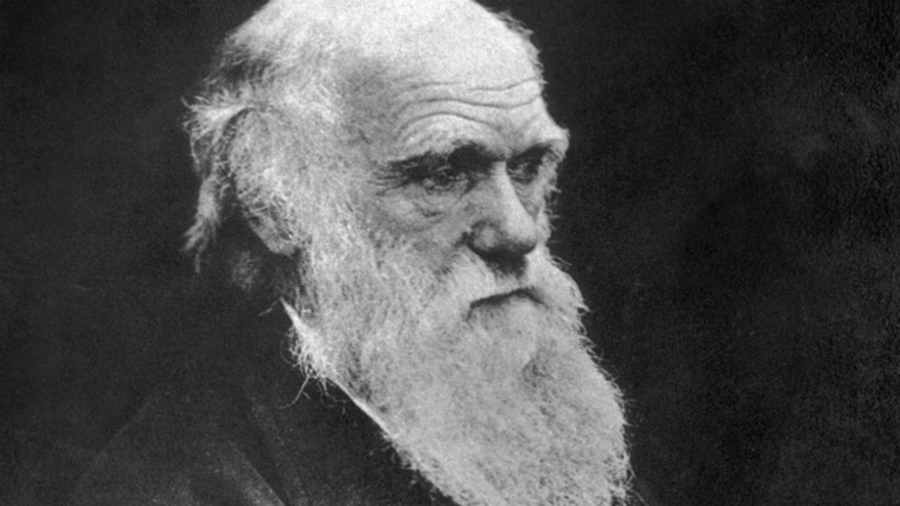
Spencer Arnold Collection/Hulton Archive/Getty Images Charles Darwin published his book On the Origin of Species in 1859

How Charles Darwin revolutionised our understanding of 'creation'.

“The central idea of biological evolution is that all life on Earth shares a common ancestor,” according to Understanding Evolution, a joint project of the University of California Museum of Paleontology and the US National Center for Science Education.

From this spark of life developed the millions of different species that make up the Earth’s natural world. At its heart, “evolution means that we’re all distant cousins: humans and oak trees, hummingbirds and whales”, the information site adds.

The process is made up of tiny genetic changes over generations - affecting the shape of a bird’s beak, for instance, or the colour of a flower - as an adaptation to environmental factors.

If a living thing possesses a particular genetic quirk that gives it an advantage in its environment, it is more likely to successfully reproduce - a process known as “natural selection”.

Over successive generations, the once-rare feature becomes standard, and given enough time, this process results in the formation of separate species - at last count, 8.7 million of them.

How did it develop?

In 1831, a young British naturalist called Charles Darwin joined the crew of the HMS Beagle to accompany the ship on a five-year voyage around the coastline of South America, returning via New Zealand, Australia and Tahiti.

“Over the course of the trip, Darwin collected a variety of natural specimens, including birds, plants and fossils,” says Biography. Based on his observations, he “began to develop a revolutionary theory about the origin of living beings that was contrary to the popular view of other naturalists at the time”, the site continues.

Aware that his ideas were deeply transgressive, Darwin waited until 1859 before he finally published a comprehensive overview of his findings, entitled On The Origin of Species.

Although elements of what we now know as evolution had been discussed in the scientific community before Darwin’s groundbreaking work, he was the first to posit a complete theory accounting for the development of the natural world.

The book quickly became a bestseller far beyond academic circles, generating a heated public debate about his radical vision and its implications for humanity, science and religion.

In 1871, Darwin published a second tome, The Descent of Man, which focused on how the principles of evolution and natural selection shaped the development of humankind.

How did his theories change the world?

Darwin presciently understood the impact his work would have on our understanding of the world. “When the views entertained in this volume on the origin of species, or when analogous views are generally admitted, we can dimly foresee that there will be a considerable revolution in natural history,” he wrote in the concluding chapter of On The Origin of Species.

Indeed, not only is the book “a foundational text of the biological sciences”, the ideas within it “influenced all sorts of other disciplines, including anthropology, religious studies and the Classics”, say history professor Julia Kindt and entomologist Tanya Letty, both of the University of Sydney, in an article on The Conversation.

Darwin’s work also had a massive cultural impact, setting up a generations-long battle between mainstream science and religious conservatism

By far the most controversial aspect of evolution theory was its apparent contradiction of the biblical account of creation, in which God created animals and people, intentionally and in their complete form.

The image of monkeys evolving into men - a crude bastardisation of Dawin’s actual theory, which posited that humans and apes shared a common distant ancestor - exposed him to condemnation and ridicule.

The most infamous clash came in 1925, when Tennessee legislators passed the Butler Act, which forbade the teaching of the theory of evolution in the US state’s public schools.

The American Civil Liberties Union immediately offered to fund the legal expenses of any teacher willing to defy the Act, and soon found a volunteer in John T. Scopes.

Although Scopes was found guilty and fined $100, the verdict proved a pyrrhic victory for the anti-evolution movement.

A clear consensus emerged in press coverage of the trial that defence attorney Clarence Darrow had outperformed his creationist opponents. In addition, the case for the defence “succeeded in publicising scientific evidence for evolution”, says the US Public Broadcasting Service (PBS), and the Scopes trial is ultimately credited with shifting public opinion in favour of evolution.

Nonetheless, nearly 100 years on, the teaching of evolution in schools continues to be a sensitive subject, particularly in parts of the US.

The impact and the controversy alike show that evolution has never merely been an academic issue, writes Dame Gillian Beer, who edited the Oxford World’s Classics edition of On The Origin of Species.

Rather, “readers have taken away from it quite different, and often contradictory, stories about the rise or the fall of mankind, about the ‘survival of the fittest’ or the need for collaboration, about diversity and selection”, she says.

 “That ability to generate broad understandings of life underpins the work’s revolutionary success,” Beer concludes. 

Source: www.theweek.co.uk

Prosaurolophus maximus: Duck-Billed Dinosaur Fossil Discovery Reveals New Details About Its Appearance

Friday, June 14, 2019

Artist's illustration of the hadrosaur in the study. Photo courtesy Julius Csotonyi
 

The discovery of juvenile specimens of the duck-billed dinosaur Prosaurolophus maximus greatly improves our understanding of the growth and life cycle of hadrosaurs, according to new research out of the University of Calgary’s Faculty of Science and the Royal Tyrrell Museum.

Showy snout and bony crest on forehead developed as Prosaurolophus matured

Prosaurolophus is a large, herbivorous duck-billed dinosaur that lived in southern Alberta and northern Montana around 75 million years ago. Unlike many duck-bills, which had a large bony crest on their head, Prosaurolophus had only a small crest on the forehead. These fossils are the youngest and smallest individuals known for the species, and researchers were interested in determining how the crest changed as the animal grew, as this feature has been thought to be related to sexual maturity and mate attraction.

“We noticed that the bony crest grew very slowly in Prosaurolophus and remained small, unlike what happened in some duck-bills, which rapidly developed a large bony crest,” says Eamon Drysdale, graduate student in the Department of Geoscience and the study’s lead author. “Instead, rapid changes in the snout as the animal matured suggest that a soft tissue structure may have associated with the nostrils and used for display. “

“In Prosaurolophus, the snout would have been the primary display feature rather than the large head crest of other duck-bills.” Drysdale adds.

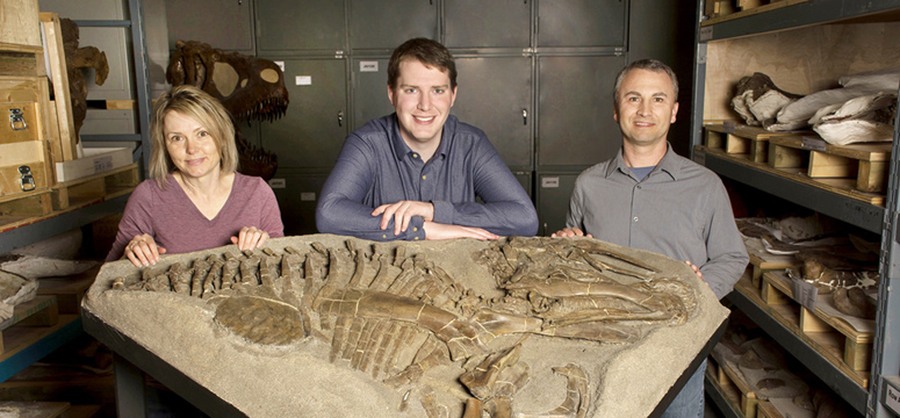
Skeleton of a duck-billed dinosaur Prosaurolophus in collections at Royal Tyrrell Museum, that was found in ancient oceanic sediments. Researchers Eamon Drysdale, centre, François Therrien, right, and Darla Zelenitsky. Royal Tyrrell Museum of Palaeontology photo

Preserved fossils discovered in ancient inland sea

This idea of a showy, fleshy snout had been hypothesized previously by paleontologists, and the new study now offers evidence to support this premise.

“Gathering evidence to support this hypothesis was difficult because it required finding the fossils of juvenile individuals, which are very rare,” says Dr. Darla Zelenitsky, PhD, assistant professor in the Department of Geoscience and Drysdale’s supervisor.

“It took over 30 years for the Royal Tyrrell Museum to recover a decent growth series for the species,” Zelenitsky tells. “Our students are now benefiting from the collection and preservation of these fossils by the museum.”

The unusual setting in which the fossils were discovered also shed light on the environments in which Prosaurolophus lived.

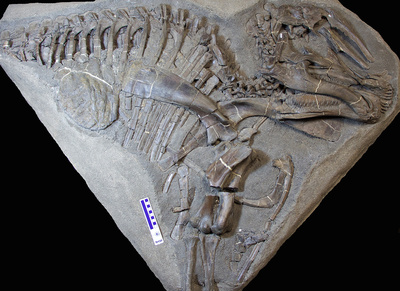
Front half of the skeleton of a juvenile Prosaurolophus dinosaur. Photo courtesy Eamon Drysdale, specimen at the Royal Tyrrell Museum

Dinosaurs were land dwellers, so their remains are usually found in rocks deposited in rivers and lakes. This was not the case for the three juvenile Prosaurolophus fossils featured in this study, which were found in muds deposited at the bottom of an inland sea that covered Alberta about 75 million years ago.

“It was very fortuitous that three young individuals of the same dinosaur species happened to float out to sea and sink to the bottom where they were buried,” says François Therrien, curator at the Royal Tyrrell Museum, who also supervised Drysdale. “Their preservation in the fine mud contributed to the fossilization of large patches of skin showing the flanks of these animals were covered in a mosaic of large and small scales.”

As for why and how these dinosaurs ended up at sea, Drysdale says “It may have been that these particular dinosaurs spent a lot of time in coastal areas. Living close to the coast, these animals may have been more easily washed out to sea after they died.”

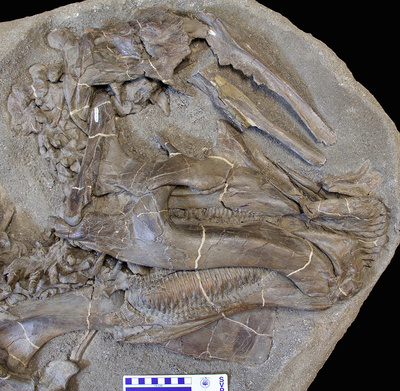
The skull of a juvenile Prosaurolophus dinosaur has a smaller bony crest forehead and a shorter snout than that of adults of the same species. Photo courtesy Eamon Drysdale, specimen at the Royal Tyrrell Museum

The research group also included Dr. Dave Weishampel, PhD, from Johns Hopkins University School of Medicine, and Dr. David Evans, PhD, from the Royal Ontario Museum. The study was published in the May issue of the Journal of Vertebrate Paleontology.

Drysdale graduated with an MSc at the June 6 convocation ceremony; he plans to continue his post-graduate education by pursuing a PhD in dinosaur paleontology and hopes to continue conducting research in Alberta.

Source: https://ucalgary.ca

Pages