nandi's blog

10 Dinosaur Games You Definitely Need to Play

Saturday, March 25, 2017

Digging up old fossils.

It's hard to believe that there ever were big ass creatures like dinosaurs living on the same planet humans inhabit today. Maybe that's why we have such a fascination with them, and why Jurassic Park captured our imagination for decades (which is why the Jurassic World movies are a thing). Dinos really have every great quality. They can be scary, cute, cool, and fascinating all at the same time.

The ancient reptiles have invaded just about every form of entertainment, including games. They have a mindblowing level of diversity - from club-tailed ankylosauruses to pack-predator velociraptors - and the games starring them are almost as far flung. From horror titles to cutesy platformers, dinosaurs are everywhere in gaming. In case you're looking for a few games to knock you down a few links in the food chain, here is a list of some of the dinosaur games you definitely need to play.

Primal Carnage

Primal Carnage

There just aren't many multiplayer shooters that allow you to munch on your enemies as a monstrous T-Rex, but Primal Carnage makes it happen. As a human, you play a typical first-person shooter in terms of controls, weapon variety, and overall feel. The human classes get an arsenal of dino-dropping gadgets and weapons, from sniper rifles and tranquilizer darts to assault rifles and rocket launchers. But you don't want to hear about the human side, you're here for the man-eating reptiles.

The dinosaur team is just as varied in their abilities. You can play as the speedy raptors, high-flying Pteranodon, bull-like Carnotaurus, and venom spitting Dilophosaurus. All of these dinos create a mix that's built to surprise the humans. The Pteranodon can swoop down and pluck human players right off their feet, and drop them to their deaths. Carnotaurus can charge into enemies like a battering ram. But the ultimate experience is playing as the massive T-Rex, snatching up hunters with your massive jaws and ripping them to shreds.

Dino D-Day

What if the Nazi's infamous military research yielded something even more terrifying than impractically huge tanks?Maybe a way to bring prehistoric, dino death machines back to life? Well, they would probably put machine guns on their heads and train them to do their dirty work. In Dino D-Day, that is the exact situation. The Nazis have a dinosaur army at their beck and call, and the historical WW2 battlefields have become prehistoric feeding frenzies.

Alongside the German soldiers, who are armed with the standard set of World War 2 weapons, players can take control of Nazi Velociraptors, a Styracosaurus that functions as a quadrupedal machine gun turret, and a T-Rex with guns attached to the sides of its face. The matches feel a bit one sided, because the allies' only dino friend is a three-legged, baby triceratops, but how often do you get to battle ancient dinosaur Nazis in an online multiplayer game?

Turok: Dinosaur Hunter

The N64 shooter Turok: Dinosaur Hunter bears many of the scars of an early console shooter. You don't really have to aim because the game's auto aim just does it for you, and the platforming sections are so difficult it's just cruel. The shooting may seem a bit dated by today's twin stick, Call of Duty standards, but Turok is still a blast to play.

The best part of the original Turok, and the reason why it's on this list, is you actually get to fight dinosaurs. It really has no story to speak of. You just start off the game killing random human attackers and charging raptors, but eventually the giant monkeys and dinosaurs start brandishing alien weaponry, like mechanical arms and energy cannons. And it's all just leading up to a battle against a T-Rex boss with, you guessed it, a laser attached to its head.

Dino Crisis

Looking for a little more horror in your dinosaur adventure? Look no further. Dino Crisis is a classic PlayStation title that takes the tank mechanics and fixed camera gameplay of the Resident Evil series and drops them into a Jurassic Park-like setting. Meaning dinosaurs are out to eat your face off, and there's no fast way to turn and run.

Take a classic Resident Evil game, replace all of the zombies and mutated monsters with velociraptors and mutated prehistoric monstrosities, and you know exactly what to expect. The game is all about waiting for the next scare. The fixed camera sets you up for frightening ambushes, limited ammo ups the intensity of encounters, and there's cheesy dialogue galore. Dino Crisis has it all.

Jurassic Park (Sega Genesis)

Even decades after its release, this 16-bit action platformer is still a must play dinosaur title. Tranquilizing dinos and taking on the vicious velociraptors is no less intense than when the game's graphics were cutting edge back in 1993.

You play as Dr. Alan Grant as he navigates the environments seen in the first movie, from jungles infested with raptors and triceratops, to the Visitor's Center guarded by a massive T-Rex. Best of all, you can play as one of the island's escaped velociraptors at it attempts to evade or eat its human captors. Few things are more satisfying than pouncing on security guards as one of Jurassic Park's most dangerous predators.

Super Mario World 2: Yoshi's Island

What's a Mario game doing on this list? Well, one of Mario's best buds is a saddle-wearing dinosaur. To leave Yoshi off of this list would be a crime against every video game dinosaur out there. So, here he is. In Yoshi's Island, you don't play as the mustachioed plumber, but instead as an entire race of friendly dinosaurs.

Mario is in a bit of a vulnerable state in Yoshi's Island. He's a defenseless baby and must rely on Yoshi to guard him while the dino attempts to rescue Baby Luigi from the clutches of Baby Bowser. This was the game that locked down all of Yoshi's now-standard abilities, allowing him to toss eggs at enemies, eat anything with his long tongue, and flutter jump to extreme heights. Not only is Yoshi's Island a must play title on the SNES, it represents the best of the most popular video game dinosaur ever.

Skylanders Trap Team

I know what you're thinking: "Skylanders is a game about cute, mystical monsters, not dinosaurs." To which, I say to you, "Wrong!" Skylanders allows players to take a variety of bizarre characterizations of animals, mythic monsters, and heck, even vegetables, then level up the collectible toys as you play. But if you didn't think a children's game built around monsters wouldn't include some awesome dinosaurs, I'm here to open your eyes.

There are dozens of characters to collect, but the most awesome by far (especially for dino enthusiasts) is Chopper. This charming little guy is a young T-Rex that is a bit tech savvy. Along with his vicious roar attack, he can blast his enemies with the rockets attached to his sides, and use his helicopter backpack to dice up enemies or become one of the first airborne tyrannosauruses in gaming.

Monster Hunter 3

The Monster Hunter series might not feature dinosaurs per se, but the massive creatures you battle in the game are incredibly similar to their prehistoric counterparts. Can we just say they're close enough? I mean, taking on humongous beasts with complex attack patterns and various weak points using giant weapons is something we can all get on board with, right?

In Monster Hunter, you choose a class of hunter who can carry anything from unreasonably large warhammers, to unreasonably large daggers. The intricate inventory system, battle mechanics, and unique hunting features make each battle unique. Facing off against these mighty creatures is incredibly thrilling. With monster designs that are undeniably inspired by ancient dinosaurs (and dragons. There's lots of dragons), this is the closest to hunting dinosaurs you're going to get.

Primal Rage

Need some dinosaur fighting game representation on this list? It's right here, baby! Gaming never fails to follow trends, and in the mid-90s what could have been more trendy than mixing a Mortal Kombat-style fighting game with prehistoric apes and dinosaurs? Primal Rage is one of the most memorable games of its era, though not necessarily for being great.

You choose a variety of beast combatants that range from King Kong-like apes to T-Rexes with varying degrees of evil motivations. Each monster is revered by the world's lowly human inhabitants as gods and they happily cheer you on as you battle your foe with special moves and combos. What makes the game unique is you can eat your opponent's cheering humans for health bonuses, and following the likes of other successful fighting game franchises of the time, each prehistoric combatant can finish off opponents with a match-ending fatality.

Jurassic Park: The Lost World Arcade

Yes, we generally stick to the console side of gaming here at GamesRadar, but this dino adventure is just too good not to get a mention. Light gun shooters may have come and gone on the console space, but in your local arcade, they are just as entertaining as ever. When it comes to dino blasting action, Jurassic Park: The Lost World's arcade cabinet, remains king.

The on-rails shooter takes you through all the events of the 1997 film. From the stampede intro that challenges players to avoid the bowel excretions of a brachiosaurus, to face to face engagements with the king of all dinosaurs, every second of the entire game is challenging and thrilling. Throw in a co-op player, and you've got an unforgettable quarter-sucking experience.

Life finds a way

There you have it. Those are our picks for the dinosaur games you definitely need to play before you become a fossil yourself. Do you have any favorites to add, or memorable moments from one of these games that you want to share?

Source: www.gamesradar.com/

The Dinosaur "Bone Wars"

Tuesday, January 7, 2020

An unknown paleontologist, 1860 Getty

1877 was a banner year for American dinosaurs: three major finds in the West turned the region into a “paleontologist’s El Dorado.”

How much is that dinosaur in the window? It’s a vexing question, particularly for paleontologists. Science and commerce are not necessarily compatible, and the dinosaur fossil market abounds with bootlegged imports and fakes. In the U.S., it’s finders-keepers if your dino discovery is on private land. “Sue,” the T. rex, sold for $8.3 million in 1997.

Here’s where the historian Lukas Rieppel comes in. He’s been writing about the first Gilded Age of the late nineteenth century, when rare dinosaur bones were valued the same way as other scarce resources, like gold, silver, and coal.

Rieppel explores the sale of a mother lode of dinosaur bones discovered at Como Bluff in Wyoming, in 1877. That was a miracle year for American dinosaurs: three major finds in the West turned the region into a “paleontologist’s El Dorado, making the United States the international center of dinosaur research, publication, and display.”

It also fueled “bone wars” between the country’s most famous paleontologists. The personalities of Othniel Charles Marsh, of the Peabody Museum at Yale, and Edward Drinker Cope, of the Philadelphia Academy of Natural Sciences, have obscured the “transactional relationships that dominated 19th-century natural history.” Marsh and Cope were independently wealthy and spent fortunes buying dinosaurs.

“The market for fossils was notoriously prone to deception and outright fraud,” writes Rieppel. Out in the “Wild West,” there was no “established legal or regulatory framework, contracts were generally hard to enforce and disputes often had to be settled through informal arbitration procedures.” The traditional face-to-face deal was often out of the question, and “trust did not scale up nearly as well,” even though railroad and telegraph lines bridged great distances. Rieppel writes:

[h]aggling over dinosaurs relied on a a set of transactional practices established in America’s bourgeoning mineral industry for clues on how to behave. Notably, these included a set of negotiation tactics designed to exploit rather than overcome the deficit of trust…

The first dinosaur fossils discovered in the U.S. were on the East Coast. These were donated to scientific institutions by their discoverers. But the three western bone quarries discovered in 1877 were offered for sale. This was a “deep shift in the economic status of American dinosaurs, marking their transition from a gift into an object of economic exchange.”

White settlers on the frontier were already familiar with a booming (and busting) extractive economy. Fossil hunting and mining became intimately linked. The mineral industry, however, “was a notoriously speculative bubble full of prospectors lured by the promise of striking it rich.” Few did. But there were always suckers to gull into the promise of a deep mine… of perhaps nothing at all.

Source: https://daily.jstor.org/

Here's How the 'Jurassic Park' Movies Haven't Kept Up With the Times, According to Experts.

Friday, January 3, 2020

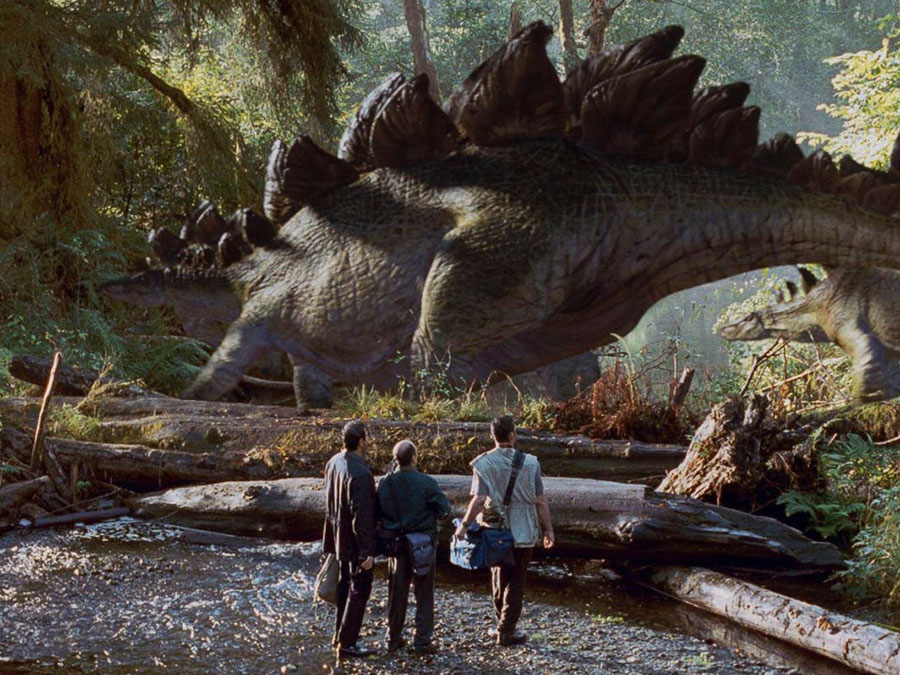
In the 1997 movie "The Lost World: Jurassic Park," a herd of stegosaurus meet a group of scientists. Universal

  • Paleontologists have uncovered many dinosaur fossils since the original "Jurassic Park" movie came out in 1993. The discoveries have changed their understanding of how dinosaurs looked, sounded, and acted.

  • Each film in the franchise introduces new dinosaurs, but most of the creatures we see on screen are not scientifically accurate. 

  • Business Insider asked four dinosaur experts — including the science adviser on all five "Jurassic Park" and "Jurassic World" films — to weigh in on what Spielberg's movies got right and wrong.

  • A sixth film in the "Jurassic Park" franchise is scheduled to come out in 2021.

The original "Jurassic Park" movie hit the big screen more than 25 years ago. But even now, a mention of the Tyrannosaurus rex brings to mind (for many of us, at least) the brown-green, scaly monster that roars like a lion in that film.

When Steven Spielberg made the Hollywood blockbuster, paleontologists didn't know much about the T. rex — only seven or eight skeletons existed in the fossil record. Since then, however, a dozen more T. rex skeletons have been found, changing our understanding of the creatures

Now, scientists know that the T. rex was likely colorful and bird-like, preferring opportunistic scavenging to chasing down prey.

"It's possible that it had feathers, was pink, and danced to attract mates," paleontologist Jack Horner, who served as the science adviser for the five "Jurassic Park" movies, told Business Insider. "That's a pretty big change from what see in the movies."

Similar factual inconsistencies apply to the other dinosaurs depicted in the films, too. For example, paleontologists now know that the long-necked Brachiasaurus didn't have elephant-like feet. The Dilophosaurus didn't spit venom, and raptors probably had the beginnings of feathered wings. 

Business Insider chatted with four paleontologists, including Horner, about how our understanding of the dinosaurs depicted in "Jurassic Park" has changed over time, and where the on-screen depictions diverge from the fossil record.

According to Horner, Spielberg purposefully chose to depict most of his dinosaurs as scaly and grey, brown, or green in color. Horner sees that as the biggest factual inconsistency in the movies.

In the 1993 movie, "Jurassic Park," a Tyrannosaurus rex escapes its paddock. Universal Pictures

Horner recalled meeting with Spielberg before any animatronic models or puppets were made.

"I sat down one afternoon with Steven and he was talking about the dinosaurs and he had all the art work for storyboards, in which all the dinosaurs were grey and brown, and not very interesting," Horner said. "I said, 'Steven we know velociraptor, at least, was probably feathered like birds and probably very colorful.' He just started laughing and said technicolor, feathered dinosaurs wouldn't be scary enough."

Three decades after that conversation, scientists are even more certain that dinosaurs like oviraptors (relatives of velociraptors) and T. rexes had feathers.

A full-grown Tyrannosaurus rex weighed about 6 to 9 tons. It stood about 12 to 13 feet high at the hip, and was about 40 to 43 feet long. Illustration by Zhao Chuang/Courtesy of PNSO

Since the first "Jurassic Park" movie came out, paleontologists have discovered that many dinosaurs not only had feathers, but also likely had the beginnings of wings.

"We know now that many dinosaurs were dancers," Horner said. "The feathers were for display, as muscles in their tails helped them wave and woggle and flaunt their feathers."

The dances were to attract mates, he added.

Typically, paleontologists come across evidence of feathers in the fossil record by discovering feather impressions caked into rock and sediment. But last month, researchers announced the discovery of feathers trapped in amber.

A Mesophthirus angeli crawling on dinosaur feathers trapped in mid-Cretaceous amber. Taiping Gao

In a December study, scientists described two feathers from the mid-Cretaceous period (about 100 million years ago) found in the Kachin Province of Myanmar. The authors said the feathers belonged to a type of non-flying dinosaur.

The amber samples were so well preserved that they contained a form of prehistoric parasite akin to lice on the feathers. 

Scientists haven't been able to extract DNA from these parasites, however, so any attempt to clone a T. rex from ancient blood (like the scientists in "Jurassic Park" do) remains a pipe dream. 

Dinosaur feathers probably came in a rainbow of colors. "Barney the purple dinosaur is not a crazy idea," paleontologist Gregory Erickson told Business Insider.

A researcher works to train velociraptors in the movie "Jurassic World." Universal

So far, scientists only know the feather colors of a few dinosaurs, which they discovered by examining proteins in feathers called melanosomes.

A flying dinosaur called Sinosauropteryx had a bright, red-and-white tail, while the feathered, winged Microraptor sported a sleek, black sheen like a raven, according to a 2012 study. Even non-flying dinosaurs like the Borealopelta were more reddish-brown than greenish-grey.

Experts now think an adult T. rex rocked a mullet of feathers on its head, neck, and tail.

An artist's depiction of a full-grown, feathered Tyrannosaurus rex. Illustration by Zhao Chuang/courtesy of PNSO

Feathers are rarely preserved in the fossil record, so they haven't been found on a T. rex specimen. But other dinosaur fossils, including those from other tyrannosaur species and their relatives, do have preserved feathers.

Mark Norell, a curator at the American Museum of Natural History, told Business Insider that means paleontologists can "safely assume" T. rex had feathers as well.

Scientists think they had patches of feathers on attention-getting areas like the head and tail. Horner thinks this may have attracted mates. The rest of adult T. rexes' bodies were mostly covered in scales.

Like the T. rexes in "Jurassic Park," however, real T. rexes did use their sharp, constantly growing teeth to attack prey.

In the 1997 movie, "The Lost World: Jurassic Park," a T. rex corners people behind a waterfall. Universal

The T. rex had the rare ability to bite through solid bone and digest it. The dino had a bite force of 7,800 pounds, equivalent to the weight of about three Mini Cooper cars. 

In the "Jurassic Park" movies, the T. rex is shown chomping down on other dinosaurs (and cars), then shaking its victim side to side. But Erickson said that's not quite how the predator ate.

"T. rex did puncture-and-pull feeding, in which it bit deeply into muscles and pulled straight back like a Komodo dragon does," he said.

But the T. rex couldn't run — instead, it walked quickly, at an impressive speed of up to 25 mph.

An oncoming T. rex in the 1993 film "Jurassic Park." "Jurassic Park"

An adult T. rex's long stride allowed it to hit speeds of 10 to 25 mph. But the dinosaur never reached a suspended gait, since it always had at least one leg on the ground at all times.

So it's unlikely the T. rex in "Jurassic Park" could have kept up with a Jeep in high gear.

According to paleontologist Scott Persons, the "Jurassic Park" T. rex also has broken wrists.

A Tyrannosaurus rex from the 2018 movie Jurassic World Fallen Kingdom. Universal Pictures via Associated Press

The wrists of the T. rex in the 1993 movie, Persons told Business Insider, are twisted unnaturally so that the animal's fingers point downward. An anatomically accurate rex, meanwhile, has sideways fingers, so it "looks like he's always clapping," Persons said.

This would have been easy to change in the more recent films in the franchise, he added, but the filmmakers are keeping the wrists consistent because they "want the dinosaur to look the way it originally did in 'Jurassic Park.'"

What's more, it's still unclear whether the T. rex ever really roared.

A T. rex roars in "Jurassic Park." Universal

Scientists aren't sure what dinosaurs like velociraptors and T. rexes sounded like, but their best guesses are based on their closest living relatives: crocodiles and birds.

2016 study suggested that the T. rex probably didn't roar, but most likely cooed, hooted, and made deep-throated booming sounds like the modern-day emu.

In the third "Jurassic Park" film, paleontologist Alan Grant figures out the sound a velociraptor makes by using a 3D-printed resonance chamber from a fossilized velociraptor.

A velociraptor poises to attack in the movie "Jurassic Park III." Universal Pictures

In the movie, he then uses the sound to communicate with the dinosaur's living relatives.

Horner said that's similar to something his lab at Montana State University once did, though they were researching a duck-billed dinosaur, not a raptor.

His team took a CAT-scan of a duck-billed dinosaur skull to get an image of the internal structure of the dino's inner nose.

"Then we made a rapid-type prototype and molded it, and were able to simulate air going through it to see what kind of sound the dinosaur would make," he said. According to that prototype, Horner added, the duck bill would produce a deep sound, like birds or an elephant.

Overall, Horner said, the franchise did a good job relaying that dinosaurs like velociraptors were the warm-blooded ancestors of today's birds, rather than cold-blooded reptiles.

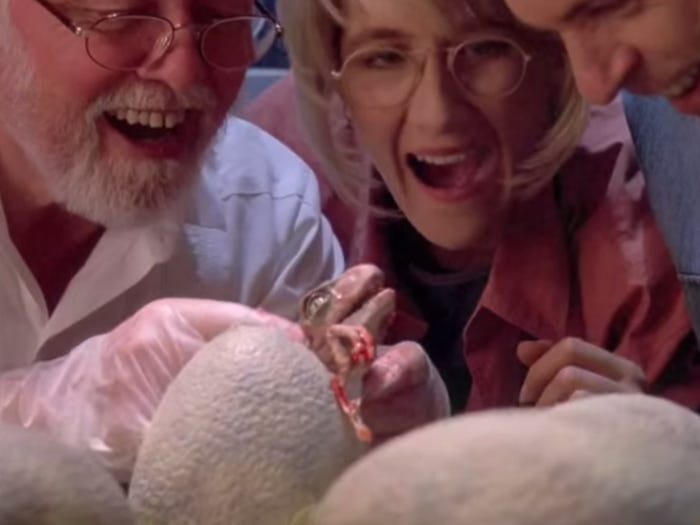
Three characters in "Jurassic Park" observe a velociraptor being born. Universal via YouTube

In the iconic kitchen scene in which velociraptors are hunting two children, one of the creatures breathes on the cold surface of the kitchen window, causing condensation.

That's a clear indication that the dinosaurs were warm-blooded, since it shows the raptor's internal temperature was warmer than its environment. At the time the movie came out in 1993, debate still raged among paleontologists about whether dinosaurs were warm- or cold-blooded.

Although paleontologists still don't agree about exactly where dinosaurs fall on the cold- to warm-blooded spectrum, a 2014 study found that the creatures most likely fell somewhere in the middle, unable to fully regulate their internal temperatures but "also not entirely at the whim of the environment."

A recent study suggests that a dinosaur's ability to regulate its body temperature was related to its size.

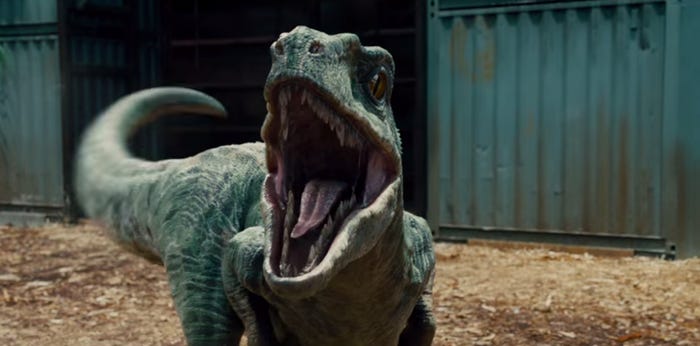
A velociraptor from the movie "Jurassic World: Fallen Kingdom." Universal via YouTube

As the animals evolved to become smaller over time, the research suggests, their metabolic rates increased. That gradually led dinosaurs to become more warm-blooded.

Velociraptors, for example, were only 3 feet long and the size of a small turkey, which might explain why they were able to regulate their body temperatures. (The raptors depicted in the "Jurassic Park" films were far bigger than their real-life counterparts.)

Persons offered a few other qualms with some of the movie's additional dinosaur stars. "The 'Jurassic Park' triceratops is in desperate need of a face lift," he said.

In "Jurassic Park," paleobotanist Ellie Sattler (played by Laura Dern) visits a triceratops. Universal Pictures

The Triceratops' head was among the largest of all land animals, making up roughly one-third of the length of the dinosaur's 30-foot body. The largest Triceratops skull ever found is 8.2 feet long.

The herbivore sported three horns: two long, curved horns above its eyes and a smaller horn on its snout. The snout horn of the triceratops in "Jurassic Park" (pictured above) is far too big, Persons said.

Real triceratops also had a frill that was used in combat and to attract mates.

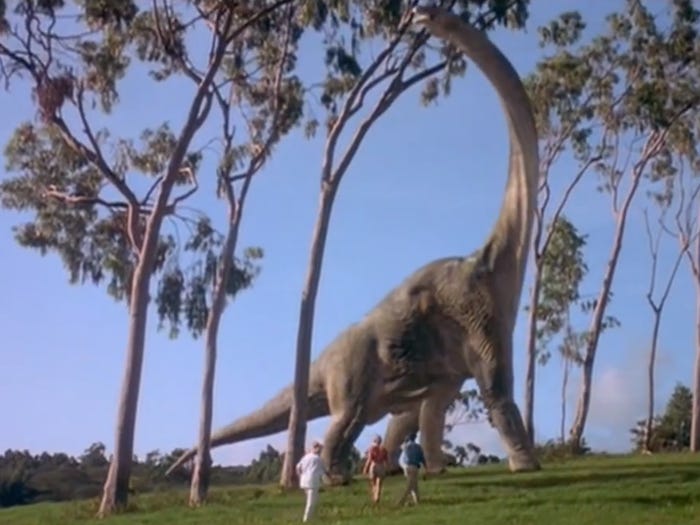
The first dinosaur that enters the screen in "Jurassic Park" is a Brachiosaurus. But it, too, was depicted incorrectly, Persons said.

A sauropod dinosaur in the movie "Jurassic Park." Jurassic park

"Its feet are wrong," Persons added.

In the movie, the Brachiosaurus is shown with feet like an elephant; in reality, it had one big claw on the first toe of each front foot and claws on the first three toes of its back feet.

The most controversial dinosaur depiction in the whole franchise, according to Persons, is the Dilophosaurus.

A Dilophosaurus in "Jurassic Park." Universal via YouTube

"A lot of paleontologists get very, very upset about Dilophosaurus," Persons said.

In the movie, the dog-sized dinosaur hunts down an unwitting computer programmer (played by Wayne Knight) by extending a circular neck frill and blinding him with poisonous spit.

The real Dilophosaurus was bigger than its on-screen depiction, Persons said — it grew up to 20 feet in length. And it probably didn't spit venom. 

"Odds are you wouldn't have dinosaurs that do that," he said.

Persons thinks it's possible the dinosaur could have had a neck frill, but there's no evidence for that in the fossil record. 

"If you look at the modern world, lots of animals have huge, flashy structures like lion manes, or the Frilled-neck lizard in Australia," he said. "I would say the odds are you are going to get some of that — there's going to be a dinosaur or that has some large flashy structure you didn't know about."

Homer said one dinosaur in "Jurassic Park III" got him into particular trouble with some of the movie's die-hard dinosaur fans.

A Spinosaurus reconstruction from the Museu Blau in Barcelona, Spain. Martin Thoma/Wikimedia Commons

"For 'Jurassic Park III,' Steven [Spielberg] wanted another nasty dinosaur, and I said, 'Well Spiniosaurus is the biggest meat eater, there's evidence of 50-foot-long ones,' so that got into the movie," Horner said.

In the movie, a Spiniosaurus clashes with and kills a T. rex.

But now, Horner said, experts know that Spiniosaurus probably only ate fish and likely couldn't have left the water.

"The battles rages on with 6th graders," he said. "I get almost-hate mail that says Spiniosaurus couldn't take down a T. rex, and I agree with them."

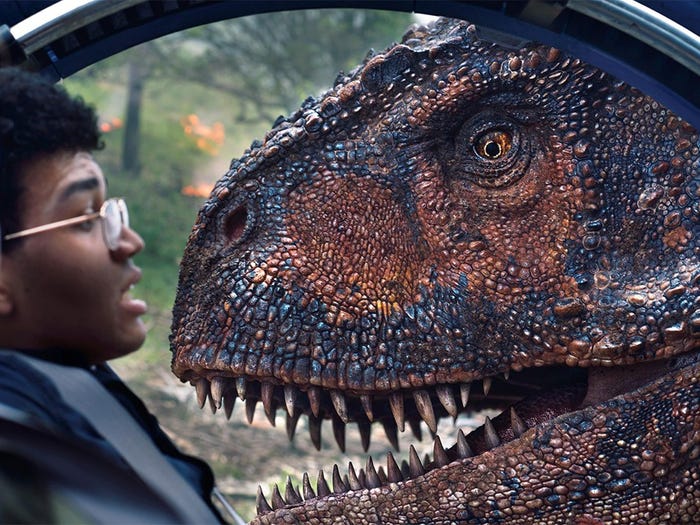
Horner also took issue with the dinosaur billed as a Stygimoloch in "Jurassic World: Fallen Kingdom."

A 66-million-year-old fossil Stygimoloch spinifer skull found in North Dakota, on display at the Museum für Naturkunde Berlin. Sebastian Wallroth

Before starting production on that movie, Horner said, the filmmakers sent him a script that included a Stygimoloch, which he didn't think actually existed. (In the film, it's the little domed-headed dinosaur that Chris Pratt's character uses to escape.)

"I was a little taken aback that they were using that," Horner said. He and other paleontologists think the Stygimoloch isn't its own species, but rather a juvenile Pachycephalosaurus — another type of thick-skulled dino.

"Clearly my advising was absolutely minimal at that point," he added.

To Horner, the most accurate dinosaur in the franchise was the Indominus rex from the movie "Jurassic World."

The Indominus rex dinosaur roars in the movie "Jurassic World." Universal Pictures and Amblin Entertainment

Indominus rex is a fictional cross between a T. rex and a velociraptor that's genetically engineered by scientists in the movie. Since it was a "made dinosaur," according to Horner, there are no standards of accuracy for it to live up to.

Persons, meanwhile, said his favorite dinosaur (in terms of its accuracy) was the Carnotaurus in "Jurassic World: Fallen Kingdom."

A carnotaurus sniffs its prey in the movie "Jurassic World: Fallen Kingdom." Universal

"The carnotaurus was pretty good reconstruction — a good CGI model," he said.

Only a single carnotaurus skeleton has ever been found in the fossil record — it was unearthed in Argentina. That two-legged predator sported two distinct horns above its eyes, a feature not found in any other dinosaur.

Norell, for his part, said "the franchise really has not kept up with the contemporary research at all."

Alan Grant in the movie "Jurassic Park" leans on a Triceratops. Universal Pictures/"Jurassic Park"

But according to Horner, there's a good reason for that: The dinosaurs in the original film "set the stage for basically the whole story and all the way through the first three 'Jurassic Park' movies," he said.

In the early 1990s, Horner added, Stan Winston — the live-action dinosaur technician for the first three "Jurassic Park" movies — didn't have the technology to create feathered, animatronic dinosaurs.

"Technically it wasn't possible at the time, so the first 'Jurassic Park' was what it was," Horner said. Then it didn't make sense to change the dinosaurs in the later films, he added, because the whole premise was that "we went out and got this DNA and that's what the resulting dinosaurs looked like."

"But 'Jurassic Park' is not supposed to be a documentary, and I won't pick on it for not being one," Norell said.

A T. rex stares down two people in front of an overturned Jeep in "Jurassic Park." Universal Pictures

Ultimately, for paleontologists like Horner, Persons, Norell, and Erickson, the value of the "Jurassic Park" movies isn't in their accuracy.

Horner said the number of graduate students looking to work in his field skyrocketed after the movie came out.

"In the early 1990s I had a hard time getting graduate students to work in paleontology," he said. "After the movie came out, I was flooded with them."

Source: www.businessinsider.com/

New Study Shows How Tyrannosaurus rex Grew Up

Friday, January 3, 2020

A juvenile Tyrannosaurus rex, based on the Jane specimen, walking through a lake. Image credit: PaleoEquii / CC BY-SA 4.0.

In the early 2000s, the fossilized skeletons of two small tyrannosaurs were collected from the famous Hell Creek Formation of Carter County, Montana. Nicknamed Jane and Petey, the individuals would have been slightly taller than a draft horse and twice as long. Settling a debate about whether Jane and Petey represent a separate genus of pygmy tyrannosaurs (Nanotyrannus) or rather just juveniles of Tyrannosaurus rex, an analysis of sliced bones from the two specimens suggests the latter.

“Historically, many museums would collect the biggest, most impressive fossils of a dinosaur species for display and ignore the others,” said Dr. Holly Woodward, a paleontologist in the Oklahoma State University Center for Health Sciences.

“The problem is that those smaller fossils may be from younger animals. So, for a long while we’ve had large gaps in our understanding of how dinosaurs grew up, and T. rex is no exception.”

The smaller size of the Jane and Petey specimens is what make them so incredibly important.

Not only can paleontologists study how the bones and proportions changed as T. rex matured, but they can also utilize paleohistology– the study of fossil bone microstructure– to learn about juvenile growth rates and ages.

In the study, Dr. Woodward and colleagues removed thin slices from the leg bones of Jane and Petey and examined them at high magnification.

The researchers compared the organization of bone fibers and other microstructures in the specimens, finding that they appeared to have been growing, as evidenced by growth rings in the bone in a spaced-out pattern not typically seen in adults.

The bones also lacked the closely spaced series of lines present in adults that signals growth is complete.

The authors determined that small T. rex were growing as fast as modern-day warm-blooded animals.

They also found that Jane and Petey were teenaged T. rex when they died; 13 and 15 years old, respectively.

The results also support that a skull specimen at the Cleveland Museum of Natural History, which was classified as Nanotyrannus in 1988, is actually a young T. rex.

“Because it took T. rex up to twenty years to reach adult size, the tyrant king probably underwent drastic changes as it matured,” Dr. Woodward said.

“Juveniles such as Jane and Petey were fast, fleet footed, and had knife-like teeth for cutting, whereas adults were lumbering bone crushers.”

“Not only that, but we discovered that growing T. rex could do a neat trick: if its food source was scarce during a particular year, it just didn’t grow as much. And if food was plentiful, it grew a lot.”

The findings appear in the January 1, 2020 issue of the journal Science Advances.

_____

Holly N. Woodward et al. 2020. Growing up Tyrannosaurus rex: Osteohistology refutes the pygmy ‘Nanotyrannus’ and supports ontogenetic niche partitioning in juvenile TyrannosaurusScience Advances 6 (1): eaax6250; doi: 10.1126/sciadv.aax6250

Source: www.sci-news.com/

Dryptosaurus Skeletal Mount

Saturday, December 28, 2019

 Leaping Laelaps-inspired mount of two Dryptosaurus skeletons. Pics by Johnmeszaros (Atlas Obscura User)

The way these carnivorous dinosaurs are posed is an homage to a classic work of paleoart.

Discovered in 1866 in a New Jersey marl pit, Dryptosaurus was the first partially-complete skeleton of a carnivorous theropod dinosaur in North America.

The paleontologist Edward Drinker Cope originally named the species Laelaps after a hunting dog from Greek mythology. But after it was discovered that the taxonomic name had previously been used for a species of beetle, Cope’s paleontological rival Othniel Marsh renamed the dinosaur Dryptosaurus (from the Greek for “tearing lizard”) in 1877.

Dryptosaurus is a distant and somewhat smaller relative of Tyrannosaurus rex. In the late Cretaceous when both species lived, North America was divided down the middle by an interior sea, which allowed Dryptosaurus to evolve without competition from its larger cousin.

Though Dryptosaurus has fallen into relative obscurity today, it was one of the most popular prehistoric animals in North America in the late 1800s, primarily due to a painting called “Leaping Laelaps” created by the artist Charles Knight. Knight’s work depicted two of these dinosaurs fighting as active, agile animals—a sharp contrast to other paleoart of the time which illustrated dinosaurs as sluggish, tail-dragging monsters.

In 2014, the New Jersey State Museum honored the theropod with a mount of two Dryptosaurus skeletons posed like the subjects of Knight’s painting. Since the original Dryptosaurus remains are incomplete—consisting of a partial jaw, hips, legs, claws and some vertebrae—many parts of the two skeletal reconstructions are estimates based on closely related tyrannosaurids such as Appalachiosaurus, whose fossils have been found in the southeastern United States.

Know Before You Go

The New Jersey State Museum is open Tuesday to Sunday from 9 a.m. to 4:45 p.m. Admission is free, though donations are greatly appreciated. The Dryptosaurus reconstruction is located on the second floor of the museum in the “Written in the Rocks” exhibit. Street parking is available near the museum, along with a limited number of free visitor spots in the nearby State House garage.

Source: www.atlasobscura.com/

Alalcomenaeus: 500-Million-Old Fossilized Brain Has Totally Changed Our Minds

Friday, December 27, 2019

Credit: Howco International

Fossils of just about everything have been unearthed, from ancient feathers to entire dinosaur skeletons preserved in opal, but there is one thing nobody thought could survive hundreds of thousands of years—until now.

Brain matter from a Cambrian arthropod that crawled around 500 mililon years ago has proven many paleontologists wrong about brain decay being inevitable. Previous research suggests that no matter what it may be protected by, soft neural matter will break down long before fossilization can even start. Minds have suddenly been changed. Alalcomenaeus may have been a tiny creature, but its exoskeleton was tough enough to ward off decomposition.

There was an “unusual abundance of exceptionally preserved [animal and plant life] in Cambrian deposits, which capture details of the non-biomineralized anatomy that would normally be lost to decay, even under other pathways for exceptional preservation,” according to the Harvard research team who made the find in Utah and recently published a study in Proceedings of the Royal Society B.

This is kind of a big deal when humans have known about the brain’s tendency to break down after death for so long that even the ancient Egyptians knew it had to go during the mummification process. There was no point in trying to preserve it like some other organs (never mind that the heart was believed to be the epicenter of thinking back then). It seems that an organ that can’t be mummified would never stay intact long enough to fossilize, but what appeared to be a stain on the Alalcomenaeus fossil that was recently dug up was found to be its brain.

An Alalcomenaeus brain doesn’t exactly look like a human brain. It really has no resemblance to a human brain at all, but is more of a central nervous system that mirrors those of many extant arthropods, with an elongated brain structure that runs from its head to its upper back. Neural tissue connects to the creature’s four eyes and four pairs of segmented nerves. More nerves from the brain extend all the way down its back.

This system of nerves appeared as a dark stain on the specimen, but because neural tissue is rich in carbon, the traces of carbon in that stain gave it away as a brain frozen in time. The connection of this structure to the Alalcomenaeus’ eyes signified optic nerves, further proof that it really was nerve tissue. That evidently wasn’t the only soft tissue that has been fossilized in this species. Part of another specimen’s gut was also observed, and guts are infamous for succumbing to decay.

While there have been doubts about these stains being the leftovers of decay-related microbes that had long since devoured any soft tissue, the stain in the recently studied Alalcomenaeus specimen was thought of as too precise and symmetrical to be another blob of bacteria.

“Our study represents, to our knowledge, the first case of consistent anatomical organization of the exceptionally preserved CNS of [Alalcomenaeus],” the researchers said, adding that paleontologists need “to gravitate away from the preconception that nervous tissues are too labile to become fossilized, as evidence keeps accumulating that neurological preservation is possible through [certain conditions].”

Could it be possible that a fossilized human brain is buried somewhere deep beneath the surface? Unlikely, but if accidentally mummified brains have been found, you never know.

Source: www.syfy.com/ (via Proceedings of the Royal Society B)

Flowering Plants Reached Australia 126 Million Years Ago: Study

Thursday, December 26, 2019

Rocks containing microscopic pollen were collected to determine the age of fossil leaves from Castle Cove, Otway Ranges, Victoria, Australia. Image credit: Vera Korasidis.

Australia’s oldest angiosperms (flowering plants) are approximately 126 million years old, and they resembled modern magnolias, buttercups and laurels, according to new research published in the Review of Palaeobotany and Palynology.

“Our research, completed on dinosaur-bearing rocks throughout Victoria, suggests that warming temperatures allowed the first flowering plants to migrate to the cooler regions at the Earth’s poles,” said Smithsonian Institution researcher Vera Korasidis, who performed the study while she was a research assistant at the University of Melbourne.

“The true diversity of primitive flowers in southern near-polar settings has only just been discovered because ‘sieving’ practices resulted in pollen grains, produced by the earlier flowers, being ‘rinsed down the sink’ for over 50 years.”

In the study, Dr. Korasidis and her colleague, University of Melbourne’s Dr. Barbara Wagstaff, analyzed the fossilized pollen and leaves of ancient angiosperms from numerous sites — such as the Otway and Gippsland basins — in Victoria, southeastern Australia.

“We reconstructed our earliest flower-bearing forests, from 126-100 million years ago (Cretaceous period), to conclude that climate change prevented or slowed the expansion of flowers into Australasia with the temperatures at the high southern latitudes too cold to support the earliest flowering plants,” they explained.

“We also established that the first flowers related to 72% of today’s living angiosperm species that first appeared in southern Australia about 108 million years ago — 17 million years after the first flowers evolved in equatorial regions,” they said.

“The world’s oldest flower, Montsechia, is 130 million years old and was discovered in Spain.”

“Our study would help to piece together Australia’s paleoclimate record and understand the interaction between climate, carbon dioxide and the evolution of faunas and floras,” Dr. Korasidis said.

_____

Vera Korasidis & Barbara Wagstaff. 2020. The rise of flowering plants in the high southern latitudes of Australia. Review of Palaeobotany and Palynology 272: 104126; doi: 10.1016/j.revpalbo.2019.104126

Source: www.sci-news.com/

Dinosaur-Track Trove Unearthed in NE China

Thursday, December 26, 2019

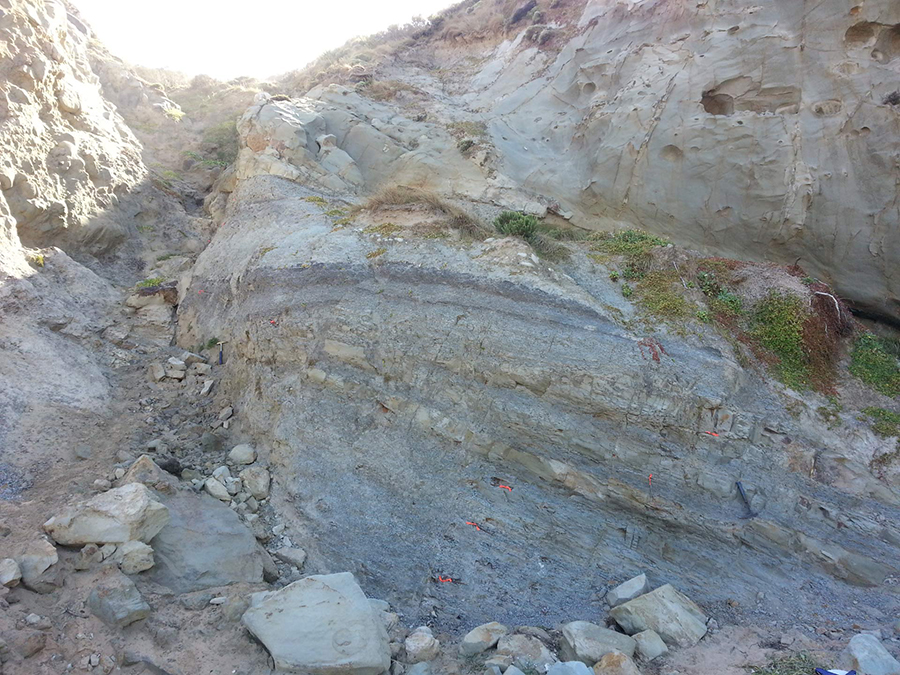
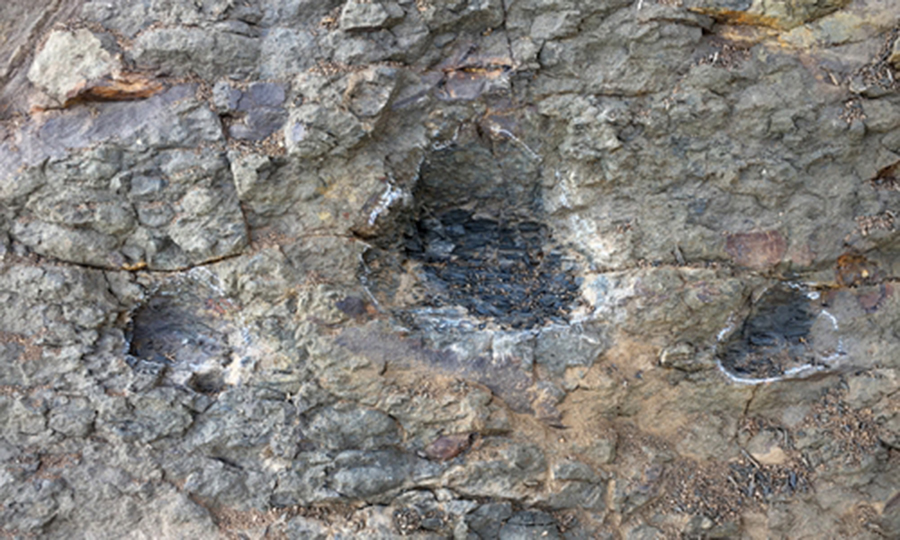
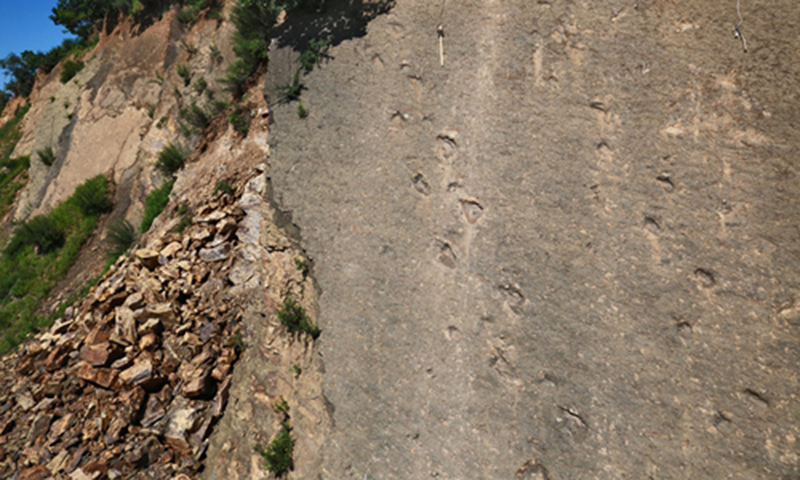
Scientists unearth dinosaur tracks in Northeast China's Heilongjiang Province. At an angle of nearly 70 degrees, the site's steepness presents research difficulties. (Photo: Courtesy of Xing Lida)

An international research team led by a Chinese scientis, announced the discovery of a trove of dinosaur tracks in Northeast China's Heilongjiang Province, and the finding could lead to further discoveries of dinosaur habits and environmental changes, scientists said.

The site in Yilan county, Harbin, Heilongjiang comprises more than 70 lower Cretaceous tracks along five routes including parallel sauropod track ways, a toe-trace dominated tridactyl ornithopod track way and elongate tridactyl theropod tracks, with the latter tentatively believed to be left while swimming, reads a statement from Xing Lida, an expert at the Beijing-based China University of Geosciences and leading member of the research team, sent to the Global Times on Tuesday.

The combination of a possible swim and walking track suggests that they were formed at different times and in different environments.

The site was first reported in 2018 by Zhu Li, a fossil hobbyist, who led Xing and his team to the scene.

Scientists unearth dinosaur tracks in Northeast China's Heilongjiang Province. At an angle of nearly 70 degrees, the site's steepness presents research difficulties. (Photo: Courtesy of Xing Lida)

Since the dinosaur footprints were left on a steep cliff with an angle of more than 70 degrees, the team has had to use a rope ladder and a sky lift to reach them.

While there are abundant fossil resources in Heilongjiang, records on bones and footprints from the lower Cretaceous period are rare, the statement said, noting that this finding has filled in the record blanks about dinosaur fossils in the area and reflected the diversity of the area.

Xing said that the assemblage contains a large number of well-preserved footprints and is of significant value in researching the evolution of dinosaurs and further understanding dinosaurs' activities, habits and their living environment.

It will also help understanding the ancient environment of the area and climate change, he said.

Source: www.ecns.cn/

Dendromaia unamakiensis: 305-Million-Year-Old Fossil Shows Parent Caring for Its Offspring

Wednesday, December 25, 2019

An artist’s impression of an adult and a juvenile Dendromaia unamakiensis. Image credit: Henry Sharpe.

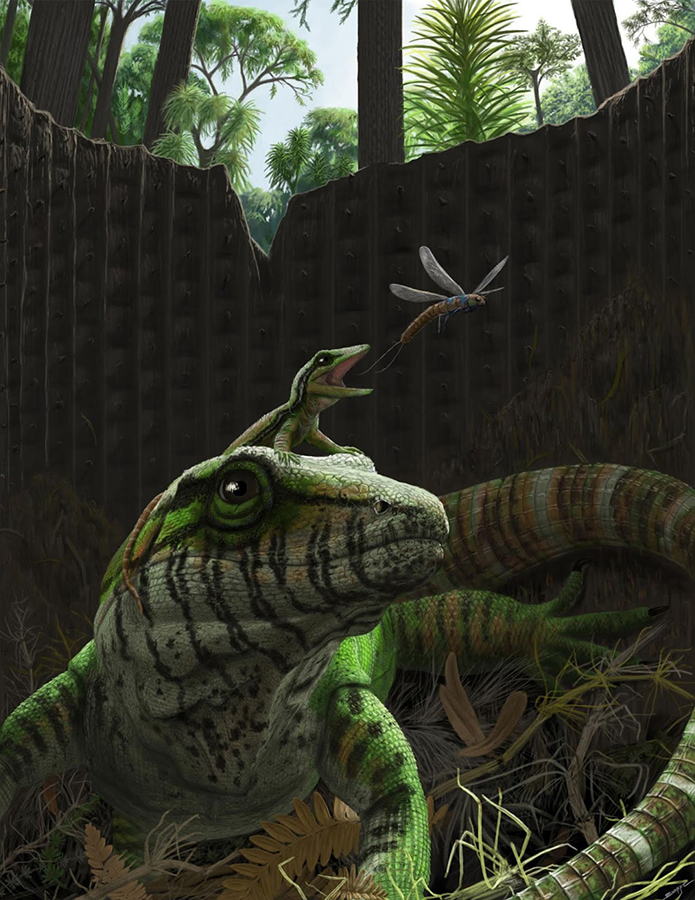
A Carboniferous-period fossil found in Nova Scotia, Canada, shows an ancient creature called a varanopid synapsid (family Varanopidae) caring for its young.

“Parental care is a behavioral strategy where parents make an investment or divert resources from themselves to increase the health and chances of survival for their offspring,” said paleontologist Professor Hillary Maddin and her colleagues from Carleton University and Fundy Treasures.

“While there are a variety of parental care strategies, prolonged postnatal care is amongst the most costly to a parent.”

“This form of parental care is particularly common in mammals, as all mammalian offspring demand nourishment from their mothers.”

“However, there is still little understanding of the evolutionary history of this behavior.”

The 305-million-year-old specimen of Dendromaia unamakiensis. Image credit: Maddin et al, doi: 10.1038/s41559-019-1030-z.

Professor Maddin’s team found the fossilized remains of an adult creature and an associated juvenile inside a lithified tree stump on Cape Breton Island, Nova Scotia.

The specimen represents not only a new species but also belongs to an entirely new genus of varanopid synapsid.

The researchers named the ancient animal Dendromaia unamakiensis.

“This is the earliest evidence of prolonged postnatal care in a vertebrate,” Professor Maddin said.

“The adult animal appears to be concealing and protecting a juvenile in a den. This behavior is very common in mammals today.”

“It is interesting to see this animal, which is on the evolutionary line leading to mammals, exhibiting this behavior so early.”

The discovery is reported in a paper in the journal Nature Ecology & Evolution.

_____

H.C. Maddin et al. 2020. Varanopid from the Carboniferous of Nova Scotia reveals evidence of parental care in amniotes. Nat Ecol Evol 4: 50-56; doi: 10.1038/s41559-019-1030-z

Source: www.sci-news.com/

365-Million-Year-Old Lungfish Unearthed in South Africa

Tuesday, December 24, 2019

Illustration of Isityumzi mlomomde (lower right) and other Late Devonian freshwater ecosystem creatures including the early tetrapod Unzantsia. Image credit: Maggie Newman.

A new genus and species of lungfish that lived approximately 365 million years ago (Famennian stage of the Late Devonian period) has been identified from fossils found in South Africa.

Lungfish (subclass Dipnoi) are a group of lobe-finned fish with their origins stretching back to the Early Devonian period, over 410 million years ago.

They reached a peak of diversity and abundance throughout the Devonian with close to 100 species described from that time period.

More than 25 species originated in the eastern Gondwanan (Australia) waters and others are known to have lived in temperate tropical and subtropical waters of China and Morocco.

The newly-discovered species represents the only record of Late Devonian lungfish remains from the western Gondwana (South America and Africa).

Named Isityumzi mlomomde, the ancient creature is also the only lungfish known from the Witpoort Formation of South Africa.

Isityumzi mlomomde was found about 10,000 km from a previous species described in Morocco, and is of interest because it existed in a high latitude (70 degrees south) or polar environment at the time,” said Dr. Alice Clement, a paleontologist at Flinders University and corresponding author of a paper published in the journal PeerJ.

Isityumzi mlomomde’s tooth plates, scales and two parasphenoids (a bone in the cranium of many vertebrates) were found between 1999 and 2017 by Dr. Robert Gess, a paleontologist with Rhodes University, Albany Museum, and Wits University and co-author of the paper.

“This lungfish material is significant for a number of reasons,” Dr. Clement explained.

“Firstly, it represents the only Late Devonian lungfish known from the western Gondwana. During this period, about 372-359 million years ago, South Africa was situated next to the South Pole.”

“Secondly, Isityumzi mlomomde seems to have lived in a thriving ecosystem, indicating this region was not as cold as the polar regions of today.”

“The animal would still have been subject to long periods of winter darkness, very different to the freshwater habitats that lungfish live in today when there are only six known species of lungfish living only in Africa, South America and Australia.”

_____

R.W. Gess & A.M. Clement. 2019. A high latitude Devonian lungfish, from the Famennian of South Africa. PeerJ 7: e8073; doi: 10.7717/peerj.8073

Source: www.sci-news.com/

Pages