nandi's blog

Spinosaurus Tail Shows ‘Jurassic Park III’ Dinosaur Was a Swimming ‘Monster’

Friday, May 1, 2020

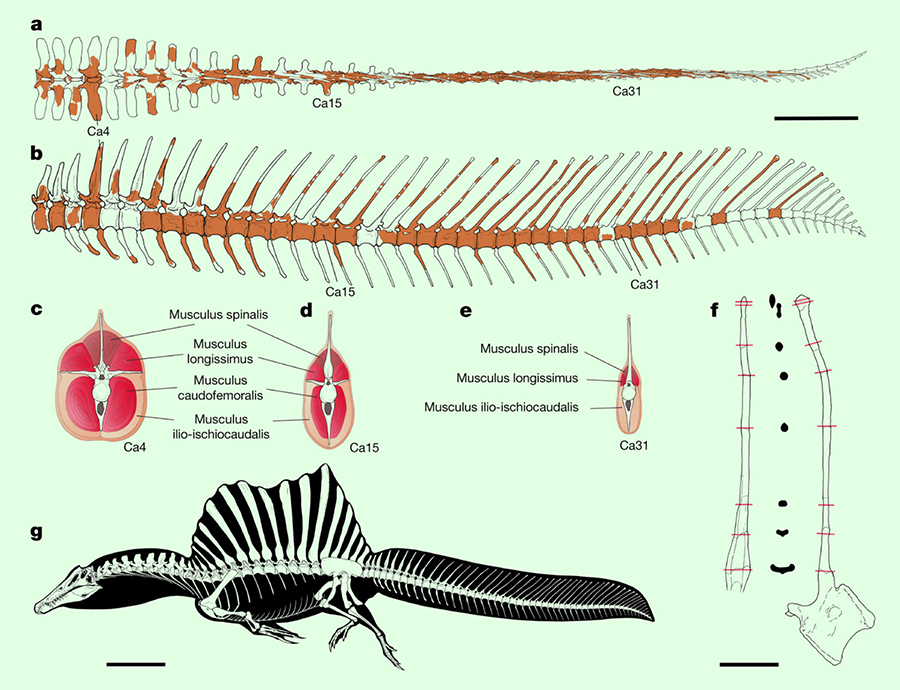
 This diagram shows a reconstruction of the tail skeleton of spinosaurus, with missing bones shown in white. arco Auditore, Gabriele Bindellini/Handout via REUTERS

One of the biggest, meanest dinosaurs to ever walk the earth was also a swimming terror in the freshwater rivers of prehistoric Africa, according to new research based on a Spinosaurus tail fossil.

The spinosaurus had the ferocity of a T. rex and the swimming skills of a crocodile, even though it was an ancient ancestor to modern-day birds, according to the study published in the journal Nature.

“This discovery overturns decades-old ideas that non-bird dinosaurs were restricted to terrestrial environments,” said co-author Stephanie Pierce, a vertebrae paleontologist and biomechanist at Harvard University.

“So yes, we believe that this discovery does indeed revolutionize our understanding of dinosaur biology.”

The hulking predator had a big, flexible fan on its back, weighed a whopping seven tons and measured about 15 metres (50 feet) from the tip of its tail to the end of its long, narrow, tooth-filled head — a head adapted for breathing just above the surface of a lake or river.

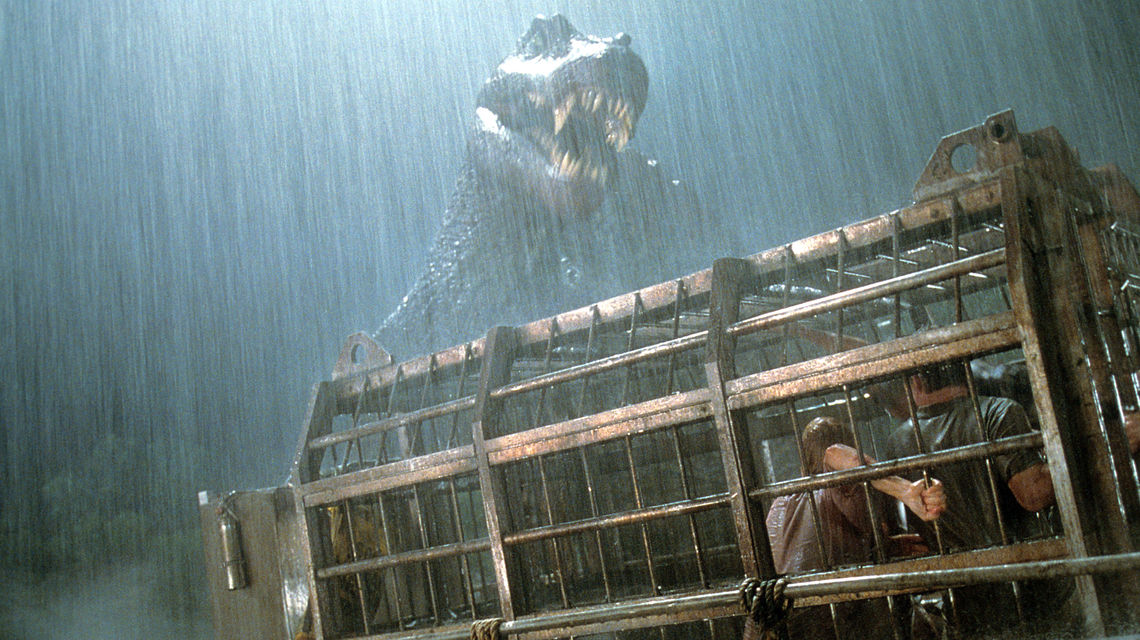
Spinosaurus is perhaps best known in pop culture as the main monster in Jurassic Park III, although that portrayal was based largely on unconfirmed theories at the time that it could swim (and beat a T. rex in a fight).

The swimming theory has now been proven correct, according to the new research paper.

Spinosaurus was a “river monster” with a paddle-like tail and an appetite for large fish, lead study author Nizar Ibrahim told Reuters.

“Spinosaurus had a highly specialized tail — a propulsive structure that would have allowed this river monster to actively pursue prey in the water column,” said Ibrahim, a paleontologist and anatomist at the University of Detroit Mercy.

It’s not the first time Ibrahim has argued that spinosaurus could swim, but he says this new evidence sheds more light on exactly how the big-toothed baddie dominated on land and in the water.

Spinosaurus lived about 95 million years ago during the Cretaceous period, when it would have made a modern-day crocodile (or human) look like a chew toy by comparison.

“It had so many adaptations to an aquatic existence,” said David Martill, a study co-author and paleontologist at the University of Portsmouth.

He listed several water-dwelling features of the dinosaur, including: “nostrils high on the skull and further back from the tip, flat bottomed toe-bones and claws, dense and thickened bone for buoyancy control, and this newly discovered tail form.”

“It would have been at least as aquatic as Nile crocodiles,” Martill told Reuters.

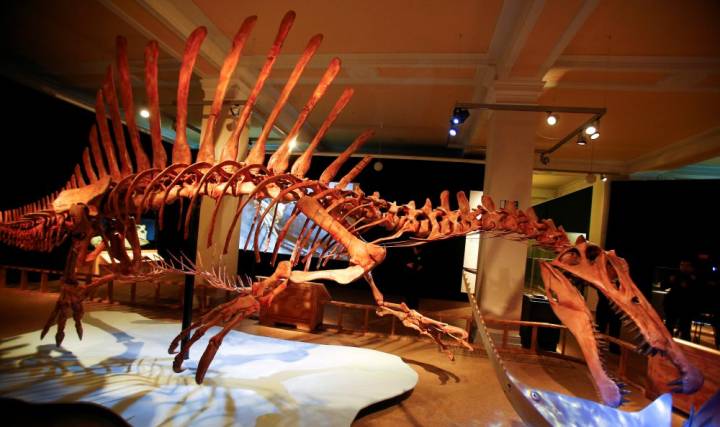
 A skeleton model of a Spinosaurus is seen at the exhibition “Spinosaurus” at the Natural History Museum in Berlin, Germany, Feb. 8, 2016. REUTERS/Hannibal Hanschke

Researchers created plastic models of the tail and attached it to a robot to test its swimming skills, according to study co-author George Lauder, a fish biologist and biomechanist at Harvard University.

Lauder says spinosaurus used to swim like a crocodile, swishing its tail laterally to propel itself through the water.

Paleontologists have known about spinosaurus for decades, but their research has been painfully slow because many of the most important fossils were destroyed during the Second World War.

Spinosaurus research got a shot in the arm when a new skeleton was unearthed in Morocco in 2008. Ibrahim and his team published evidence of the dinosaur’s swimming skills in 2014, although some archeologists weren’t convinced.

The latest discovery is based on additional fossils unearthed since 2015 — long after Jurassic Park III ran with the idea that it could swim.

The research team did not offer their direct opinions on how spinosaurus was portrayed in the film, but Pierce did offer her opinion on the “spinosaurus vs. T. rex” debate.

“It just might topple T. rex as the most famous and exciting meat-eating dinosaur,” she said.

Source: https://globalnews.ca/ —With files from Reuters

Jurassic World 3: 8 Questions We Still Have About Jurassic World: Dominion

Friday, May 1, 2020

Just when you thought it was safe to wander into a dinosaur free world, Jurassic World: Dominion has charted a course to deliver some seriously brutal action involving creatures that haven’t roamed this planet for eons. Years after the Lockwood Manor incident released various species of prehistoric creatures to the far corners of the world, Jurassic World 3 is ready to tell us just what happened after that fateful night ensured a lot of people would be losing sleep for some time to come.

While we could sit here asking tons of questions like whether or not Blue will ever become a domesticated dinosaur, or if Owen and Claire will ever make it work as a couple, we’re not here to discuss the finer points of Jurassic World: Dominion’s potential plot. Rather, we’re here to wonder just how and when we’ll get to learn more about the shape this film is going to take. The adventure 65 million years in the making continues with this new film, so let’s begin asking some outstanding questions we have surrounding Jurassic World 3.

Will Jurassic World: Dominion Be Able To Resume Production In 2020?

Earlier this year, Jurassic World: Dominion had to press pause in its early days of production. As the COVID-19 pandemic forced director Colin Trevorrow to put away his dinosaur toys for the time being, the first big question that surrounds Jurassic World 3’s production is whether it’ll be able to pick back up where it left off before the end of the year.

The answer will, of course, depend on how this current medical crisis shakes out throughout the world. But with the British Columbia portion of the shoot only covering the first part of Jurassic World: Dominion’s filming phase, the sooner things can start back up again the better. Especially when that very subject dovetails into another question we have about this film.

Can Jurassic World: Dominion Still Make Its 2021 Release Date?

While it’s not a watershed anniversary, Jurassic World: Dominion is set to debut on June 11, 2021. Dropping on the exact day that Jurassic Park opened back in 1993, it feels like a good omen that this latest adventure into the world of Michael Crichton’s sci-fi masterwork would take its first bows on that particular date.

Of course, with production on Jurassic World 3 being delayed, as mentioned above, there’s a valid concern about whether the film will be finished in time to stay in this particular debut window. As co-writer/director Colin Trevorrow is working on aspects of the film while sheltering at home, there’s a chance that the slack could be picked up and by time Jurassic World: Dominion starts filming again, all will still be on track.

When Will We See The Jurassic World: Dominion Trailer?

As the production status and release date for Jurassic World 3 are in question, there’s another huge query looming alongside all of the others: when are we going to see the first trailer for the film? With this year’s shifting release schedule pertaining to completed films thrown into chaos, there’s no easy answer to when our initial peek at Jurassic World: Dominion might land.

If this fall’s Universal Pictures releases stay locked into place, and if the studio still feels they have a 2021 release to advertise, Jurassic World 3 could see its first trailer drop as early as this October, when the Tom Hanks sci-fi drama BIOS is set to hit theaters. However, if the next Jurassic World movie happens to move to another blockbuster friendly release slot, it’ll depend on where Jurassic World: Dominion shifts to, and what other films are around to properly advertise it in the right window of time.

What Is The True Meaning Behind Jurassic World: Dominion’s Title?

With the revelation that Jurassic World: Dominion is the official title for what we’ve previously called Jurassic World 3, fans have turned their attention away from trying to guess what the title of this third film will be. Now the question is, what does the specific subtitle to this new Jurassic World film mean in the long run?

Speculation will run rampant, and already we’ve discussed a theory of what Jurassic World: Dominion promises fans of the franchise. We’re still not totally sure if that guess is correct or totally off base, but for now it seems like a good stepping stone for the time being. It may be one simple word, but “Dominion” and its exact definition have even gotten Chris Pratt to think a little deeper about what this new movie is about. So that path of thought is probably a good one to keep walking on for the time being.

How Will Jurassic World: Dominion Use The Original Jurassic Park Cast?

A title is only one piece of the mystery that is Jurassic World 3’s plot is currently dangling in front of the franchise fans trying to sleuth out what sort of trouble the world is in this time out. An even greater component that people should probably be discussing is the fact that Jurassic World: Dominion isn’t only bringing back Chris Pratt’s Owen Grady and Bryce Dallas Howard’s Claire Dearing, as well as  other Jurassic World fixtures , but there’s also the fact that several original Jurassic Park cast members are returning as well.

With Dr. Alan Grant, Dr. Ellie Sattler, and Dr. Ian Malcolm all reuniting for Jurassic World 3’s fun and games, there’s a possibility that Sam Neill, Laura Dern, and Jeff Goldblum’s big reteaming could be a mere exercise in fan service cameo bait. However, with all three of them back together, and the public clamoring for them to reassemble in the name of further dinosaur adventures, there could be a possibility that the story for Jurassic World: Dominion is so big, these classic characters will be able to coexist with the new kids without a problem.

Could We See Lex And Tim Return To The Jurassic Franchise?

All throughout Jurassic World’s in-progress trilogy, we’ve seen the lore of the original film teased out in clues, hints, and mentions in this brave new dinosaur world. Jurassic World: Fallen Kingdom took the first gigantic step with the reintroduction of Jeff Goldblum’s Dr. Ian Malcolm, setting the table for the reunion we just discussed above. But if Drs. Grant, Sattler, and Malcolm can return, can’t Lex and Tim Murphy join in on the fun as well?

Last seen in The Lost World: Jurassic Park, the grandchildren of John Hammond haven’t factored into series history for some time now. With Joseph Mazzello recently stating he hopes the world can see what Tim Murphy has been up to in the last couple of decades, and Ariana Richards also rumored to be up for a returnJurassic World: Dominion could see the younger generation of Jurassic action back in the saddle as well.

Are There Going To Be More Shorts Like Battle At Big Rock To Set Up Jurassic World: Dominion?

Almost as if it was magic, one special cable showing of Jurassic World yielded a nice surprise for those who didn’t expect it: the debut of the live-action short Battle At Big Rock. Long rumored to be a theatrical surprise for those who were going to see Fast & Furious Presents: Hobbs & Shaw, the Colin Trevorrow directed vignette showed audiences a new family of Jurassic World characters, and a new dose of dino induced terror.

With that short stoking the fires for Jurassic World: Dominion, it has to be asked whether or not we’ll be seeing one or two more shorts similar to Battle At Big Rock, in the name of laying down the foundation for the sort of world Jurassic World 3 will be taking place in. If there are to be more shorts of a similar caliber, we might see them drop in the months that will see this new film at its most advertised state. Not to mention, should Jurassic World: Fallen Kingdom have a cable TV premiere not too long before Jurassic World: Dominion’s theatrical release, that’d be a perfect time to drop another short but deadly appetizer.

Will Jurassic World: Dominion Conclude The Jurassic Park Series?

Trilogies tend to have a tendency to wrap up huge arcs, say goodbye to major characters, and end entire series in their third entries. That sort of setup is usually telegraphed in the promotion and behind the scenes going on with a film like Jurassic World: Dominion; and yet, so far, none of that sort of “end of an era” talk has hit Jurassic World 3’s promotional canon.

Lacking in any sort of conclusive talk about whether or not the Jurassic World series will be ending with the next film, our final question is if our presumption that Jurassic World: Dominion will tie everything together in a massive adventure is true or not. Turning back once again to the Chris Pratt hype machine, his comment that this third film would be the Avengers: Endgame of the Jurassic Park series doesn’t do anyone any favors when it comes to trying to dispel such thoughts.

But much like any of the other questions we’ve asked above, we’ll have to wait until we get closer to our next brush with prehistory until we get those answers. For the time being, we only know some very limited details about where Jurassic World: Dominion is heading, and for the time being we’ll be awaiting the film’s release to the public on June 11, 2021. 

Source: www.cinemablend.com/

Spinosaurus aegyptiacus: The First Known Aquatic Dinosaur

Friday, May 1, 2020

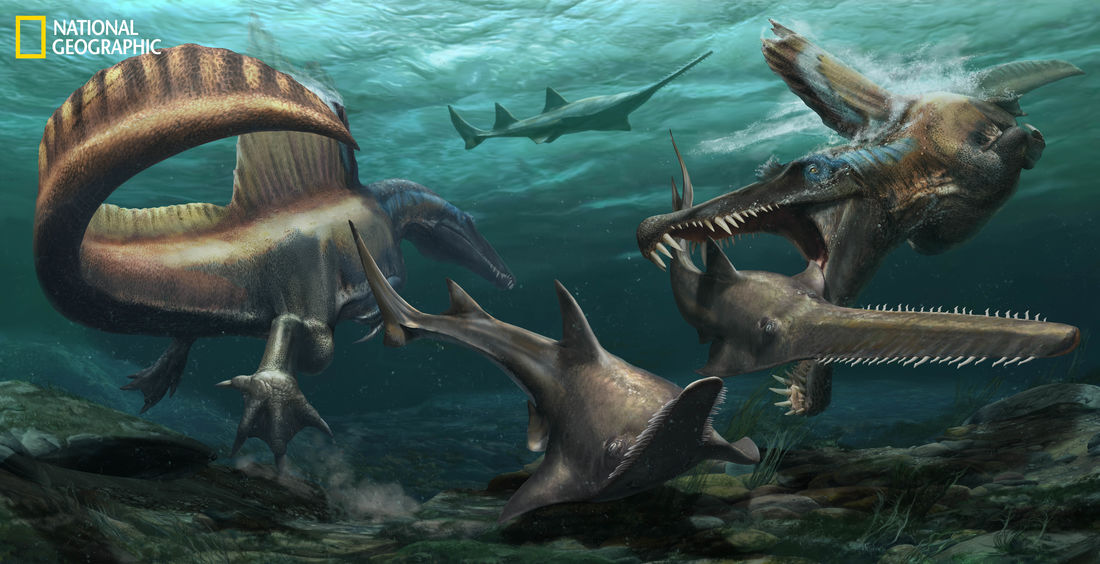
Two Spinosaurus aegyptiacus hunt Onchopristis, a prehistoric sawfish, in the waters of the Kem Kem river system in what is now Morocco. Image credit: Jason Treat / National Geographic Staff / Mesa Schumacher / Davide Bonadonna / Nizar Ibrahim, University of Detroit Mercy.

A species of carnivorous dinosaur called Spinosaurus aegyptiacus used tail-propelled swimming locomotion to hunt for prey in rivers, according to a new analysis of the world’s only existing skeleton of this ancient predator, found in the Kem Kem region of the Moroccan Sahara.

Spinosaurus aegyptiacus is a giant theropod dinosaur that lived about 95 million years ago (Cretaceous period) in what is now North Africa.

In a previous study, this creature had been identified as a fish-eating dinosaur with adaptations for an amphibious lifestyle, supported by its relatively short hindlimbs, wide feet, dense bones and elongated jaws studded with conical teeth.

However, suggestions that it may have been a truly water-dwelling dinosaur were met with considerable opposition, in large part because the partial skeleton provided little to no evidence of the propulsive structure needed to move such a giant dinosaur through water.

A research team led by National Geographic Explorer and University of Detroit Mercy paleontologist Nizar Ibrahim to the Kem Kem site where parts of the Spinosaurus aegyptiacus skeleton had first been uncovered in 2008.

Between 2015 and 2019, the researchers recovered many more fossils, including a remarkably complete, fin-like tail capable of extensive lateral movement and characterized by extremely long spines.

They then used photogrammetry to digitally capture the anatomy of the tail of Spinosaurus aegyptiacus.

Reconstructed skeleton and tail of Spinosaurus aegyptiacus. Scale bars – 50 cm (a-e), 10 cm (f), 1 m (g). Image credit: Ibrahim et al, doi: 10.1038/s41586-020-2190-3.

To quantitatively assess the performance of the tail, they made a flexible model and attached it to a robotic system that mimics swimming movements.

They then compared the swimming performance of the model Spinosaurus aegyptiacus tail to those from crocodiles, newts and other dinosaurs.

The results were fully consistent with the idea of a truly water-dwelling, tail-propelled, river monster.

“This dinosaur was actively pursuing prey in the water column, not just standing in shallow waters waiting for fish to swim by. It probably spent most of its life in the water,” Dr. Ibrahim said.

“This new discovery changes our current understanding of dinosaurs and reflects Dr. Ibrahim’s boundless curiosity and dedication to uncovering the secrets of the Sahara’s dinosaurs,” added Alex Moen, vice president of explorer programs at the National Geographic Society.

“His work is at the nexus of science and exploration, and embodies the unique role National Geographic has in illuminating the wonder of our world.”

This research, supported by a grant from the National Geographic Society, is described in a paper in the journal Nature.

_____

N. Ibrahim et al. Tail-propelled aquatic locomotion in a theropod dinosaur. Nature, published online April 29, 2020; doi: 10.1038/s41586-020-2190-3

Source: www.sci-news.com/

Adalatherium hui: Paleontologists Find 66-Million-Year-Old Fossil of Bizarre Mammal

Friday, May 1, 2020

Life reconstruction of Adalatherium hui. Image credit: Andrey Atuchin / Denver Museum of Nature & Science.

A new species of gondwanatherian mammal from the Cretaceous Period has been identified from a very well-preserved fossilized skeleton found on the island of Madagascar.

Named Adalatherium hui, the ancient creature lived about 66 million years ago (Cretaceous period) among dinosaurs, massive crocodiles, and snakes.

It belongs to Gondwanatheria, a lesser known group of mammals that are only known from the ancient supercontinent of Gondwana and previously were represented by only a single skull and isolated jaws and teeth.

Gondwanatherian fossils were first found in Argentina in the 1980s, but have since also been found in Africa, India, the Antarctic Peninsula, and Madagascar.

“Gondwanatherians were first thought to be related to modern-day sloths, anteaters, and armadillos but now are known to have been part of a grand evolutionary experiment, doing their own thing, an experiment that failed and was snuffed out in the Eocene, about 45 million years ago,” said lead author Dr. David Krause, a vertebrate paleontologist in the Department of Earth Sciences at the Denver Museum of Nature and Science and the Department of Anatomical Sciences at Stony Brook University.

The well-preserved skeleton of Adalatherium hui — the most complete for any mammal from the entire Mesozoic of the southern hemisphere — was recovered from the Maevarano Formation, northwestern Madagascar.

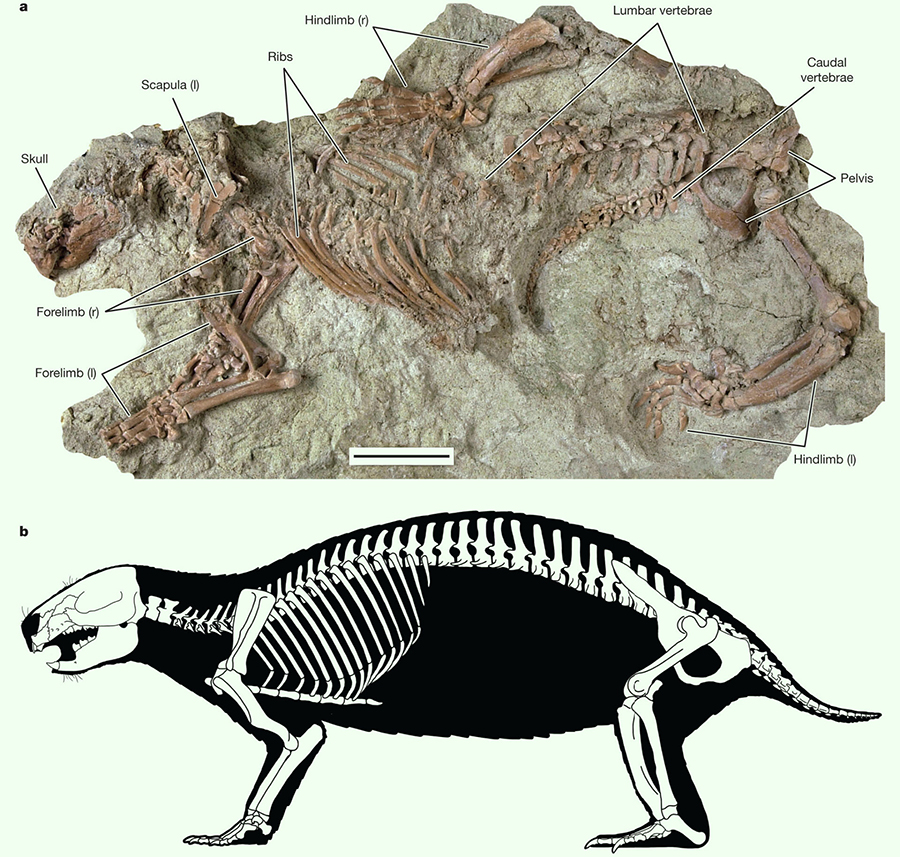
Skull and postcranial skeleton of Adalatherium hui: (a) top view, as preserved; scale bar – 5 cm; (b) reconstruction in left lateral view; left and right sides indicated as (l) and (r), respectively. Image credit: Krause et al, doi: 10.1038/s41586-020-2234-8.

Around the size of a domestic cat at about 3.1 kg, the ancient mammal was unusual in that it was very large for its day; most mammals that lived alongside dinosaurs were much smaller, mouse-sized on average.

“Knowing what we know about the skeletal anatomy of all living and extinct mammals, it is difficult to imagine that a mammal like Adalatherium hui could have evolved; it bends and even breaks a lot of rules,” Dr. Krause said.

“In fact, although a life-like reconstruction might lead one to think that Adalatherium hui was a run-of-the-mill badger, its normality is literally only skin deep.”

Adalatherium hui is the oddest of oddballs,” said co-author Dr. Simone Hoffmann, a paleontologist in the New York Institute of Technology.

“Trying to figure out how it moved is nearly impossible because, for instance, its front end is telling us a different story than its back end.”

Adalatherium hui had primitive features in its snout region that hadn’t been seen for a hundred million years in the lineage leading to modern mammals.

“Its nasal cavity exhibits an amazing mosaic of features, some of which are very standard for a mammal, but some that I’ve never seen in anything before,” added co-author Dr. James Rossie, a paleontologist in the Department of Anthropology at Stony Brook University.

Adalatherium hui had more foramina — holes that served as passageways for nerves and blood vessels supplying a very sensitive snout that was covered with whiskers — on its face than any known mammal.

And there is one very large hole on the top of its snout for which there is just no parallel in any known mammal, living or extinct.

The teeth of Adalatherium hui are vastly different in construction than any known mammal. Its backbone had more vertebrae than any Mesozoic mammal and one of its leg bones was strangely curved.

According to the team, the plate tectonic history of Gondwana provides independent evidence for why this mammal is so bizarre.

Adalatherium hui was found in rocks dated to near the end of the Cretaceous period, at 66 million years ago. Madagascar, with the Indian subcontinent attached to the east, separated from Africa over a hundred million years before and finally became isolated as an island in the Indian Ocean when the Indian subcontinent detached at approximately 88 million years ago and drifted northward,” Dr. Krause said.

“That left the lineage that ultimately resulted in Adalatherium hui to evolve, isolated from mainland populations, for over 20 million years — ample time to develop its many ludicrous features.”

The discovery of Adalatherium hui is reported in a paper in the journal Nature.

_____

D.W. Krause et al. Skeleton of a Cretaceous mammal from Madagascar reflects long-term insularity. Nature, published online April 29, 2020; doi: 10.1038/s41586-020-2234-8

Source: www.sci-news.com/

When Jurassic Park Came Out, People Didn't Think It Would Win The Box Office

Thursday, April 30, 2020

What do you think of when you hear the phrase “The Big Ticket For ‘93”? In hindsight, people may think that Jurassic Park is a shoo-in for this lofty honor. However, if you were to travel back to the months leading up to that particular summer, you’d have seen that this statement was intended to sell another film. Believe it or not, when Jurassic Park came out, Last Action Hero was the movie people thought was going to take the box office crown.

Asked whether or not anyone on the set of Jurassic Park knew the Steven Spielberg film would be as big as it turned out to be, actor Joseph Mazzello told IGN the following story, as part of the many pieces of trivia included in the watch-along commentary:

I remember very distinctly that [Jurassic Park’s] big competition was a movie called Last Action Hero, with [Arnold] Schwarzenegger. It was a big thing where it was like … ‘Which film’s gonna make it to number 1?’ So we thought it was gonna obviously do well, but as a kid I really didn’t think about that stuff.

Historical hindsight aside, looking at the landscape of Hollywood at the time would have made Last Action Hero a safe bet. It was all thanks to the previous occasion Spielberg and Schwarzenegger saw projects take flight at the box office, as 1991 saw Terminator 2: Judgement Day propel Arnold and company to unprecedented success. Meanwhile, Jurassic Park’s director saw himself in a bit of a rough patch, as Steven Spielberg’s Hook was a mixed bag of box office results that were considered disappointing, even if they looked good on paper.

With Arnold Schwarzenegger riding an all-time high in his career, Jurassic Park’s pedigree shined best when it came to the fact that best-selling sci-fi author Michael Crichton was the mind behind the film’s story and some of its early script work. Still, that didn’t stop Last Action Hero from promising the world to audiences, with a trailer like the one below:

As we’ve seen in the course of events that followed, Jurassic Park debuted on June 11, 1993, with a $50.1 million opening weekend that broke the record set by Batman Returns the previous year. Meanwhile, Last Action Hero opened the week after on June 18, and ended its domestic box office run grossing roughly the amount that Jurassic Park’s opening weekend brought in.

The success of Steven Spielberg’s big dinosaur movie was something that the cast may not have seen coming, but once Joseph Mazzello and company saw the results, it felt all the more unbelievable. Mazzello said:

We saw it was number 1, and then it just stayed number 1 week after week after week, and at the time became the highest grossing movie ever. … That was something I just could never have possibly imagined. Ever.

Joseph Mazzello’s life would change because of of Jurassic Park's success, as he not only scored gigs because of his role of Tim Murphy, but he also got to benefit from the experience of having Steven Spielberg as a mentor. It’s hard to imagine that Mazzello could have starred in Hook instead of Jurassic Park; just as it’s difficult to think of a world where Last Action Hero somehow topped the box office.

That’s what’s so fun about the theatrical box office: you never truly know where the next surprise lies. With history firmly on the side of the adventure 65 million years in the making, we would get sequels, video games and tons of other content that would open up the world of Jurassic Park.

Though time hasn’t totally forgotten about Arnold Schwarzenegger’s supposed misfire, as Last Action Hero has its own contingent of fans that have made it into a cult classic. So you could say that everybody went home happy at the end of the day, even if the scales will always be tipped very much in the favor of Jurassic Park. Curse you, Bill Clinton.

Jurassic World: Dominion continues the rich history of Jurassic franchise excitement on June 11, 2021.

Source: www.cinemablend.com/

New Spinosaurus Fossil Proves The Villain Of Jurassic Park III Could Indeed Swim

Thursday, April 30, 2020

Credit: Universal/Getty Images

Jurassic Park III isn't exactly well-regarded by fans or critics, but it sure was way ahead of its time in terms of presenting accurate dino-behavior. Spinosaurus aegyptiacus, aka the dreaded, spine-backed antagonist from the 2001 film, is now considered to be the first dinosaur that was able to live underwater. This scientific discovery (supported by a grant from the National Geographic Society) comes to us via a tail fossil unearthed by a team of international scientists digging in the Moroccan desert.

"This dinosaur has a tail with an unexpected and unique shape that consists of extremely tall neural spines and elongate chevrons, which forms a large, flexible fin-like organ capable of extensive lateral excursion," reads the abstract of the study published by Nature.com.

That's just a real fancy way of saying that the animal's tail was more suited to water than it was to land. Through the use of "a robotic flapping apparatus," the researchers were able "to measure undulatory forces in physical models of different tail shapes." This led to the conclusion that the Spinosaurus had a "greater thrust and efficiency in water than the tail shapes of terrestrial dinosaurs."

The hope is to use the fondly-named "Flapper" device in future experiments that may shed some light on the purpose of the dinosaur's characteristic sail. Over the years, academics have posited different theories, the most predominant of which state that the sail probably helped with movement in water and/or the absorption of sunlight.

Two Spinosaurus hunt Onchopristis, a prehistoric sawfish, in the waters of the Kem Kem river system in what is now Morocco. (Jason Treat, NG Staff, and Mesa Schumacher / Art: Davide Bonadonna / Source: Nizar Ibrahim, University of Detroit Mercy)

Dr. David Unwin, co-author of the paper and professor at the University of Leicester, described the predatory Spinosaurus as a straight-up "river monster." Awesome!

"The Spinosaurus’ fin-like tail is a game changing discovery for us that fundamentally alters our understanding of how this dinosaur lived and hunted," he said in a statement to the college. "As well as its tail, many other features of this dinosaur, such as the high position of the nostrils, heavy bones, short legs, and paddle-like feet point to a life spent in the water rather than on land."

Until today, it was widely accepted that dinosaurs lived exclusively on land. The archaeological remnants were discovered in North Africa's Kem Kem Beds, a famous deposit of biological remains from the Cretaceous period. Led by National Geographic Explorer Dr. Nizar Ibrahim (who is also a paleontologist for the University of Detroit Mercy), the excavation began in Morocco in 2015, with the discovery arriving three years later in 2018.

Guzun Ion molding the tail of the flesh model of Spinosaurus. (Paolo Verzone/National Geographic)

“This discovery is the nail in the coffin for the idea that non-avian dinosaurs never invaded the aquatic realm," Ibrahim said. “This dinosaur was actively pursuing prey in the water column, not just standing in shallow waters waiting for fish to swim by. It probably spent most of its life in the water.”

Despite the enormity of the breakthrough, David Martill, another member of the party and a Professor of Palaeobiology at the University of Portsmouth, is still left with some big, dinosaur-sized questions.

“One thing that still puzzles me though, is why only Spinosaurus became aquatic among the dinosaurs," he said. "Why are there no aquatic iguanodons, or stegosaurs?"

Alan Grant may have some theories, but he won't be back to school us in prehistory until Jurassic World: Dominion arrives in theaters next summer. For more on this discovery, visit natgeo.com.

Source: www.syfy.com/

Stellasaurus ancellae: Ceratopsian Dinosaur With Star-Like Skull Named After David Bowie

Thursday, April 30, 2020

The Stellasaurus is thought to have roamed what is now Montana 75million years ago. Credit: SWNS:South West News Service

Stellasaurus, or star lizard, was more than 20ft long and weighed more than two tons.

It roamed what is now Montana 75million years ago and belonged to the Ceratopsians — plant-eaters that included Triceratops.

Its “star” — huge beak, horns and frills — has inspired rock fan experts to christen it after 1972 Bowie hit Starman.

Palaeontologist Jack Wilson said: “The skull ornamentation is astonishing, almost star-like.

“Ceratopsids evolved many forms of ornamentation including horns above the nose, eyes and bony frills which projected from the back.

“They were unique to each dinosaur and were ‘display structures’ for mating purposes, similar to peacock feathers.”

Stellasaurus’s fossilised skull was found in 1986 by Carrie Ancell but has only now been identified as a new species.

Mr Wilson, a PhD student at Montana State University in the US, added: “Stellasaurus lived with other dinosaurs such as T. rex and raptors.”

The dino also links two previously-known CeratopsiansStyracosaurus and Einiosaurus.

Source: www.thesun.co.uk/

Jurassic World 3 Fans Can Win A Chance To Be Eaten By A Dinosaur

Thursday, April 30, 2020

As part of the fundraising All In Challenge, fans can enter to win the chance to be eaten by a dinosaur in the upcoming Jurassic World: Dominion.

One lucky fan can win the chance to be eaten by a dinosaur in the upcoming Jurassic World: Dominion. The first Jurassic World revived the dinosaurs-are-real-again franchise back in 2015 to great success, earning over $1.6 billion worldwide. The sequel, Jurassic World: Fallen Kingdom, earned less, but was still considered a financial win. The next installment, which was only given the subtitle Dominion back in February when production began, is expected to complete the trilogy and bring the franchise to a close. While it's currently slated for release on June 11, 2021, it could get pushed back due to the coronavirus pandemic, which has temporarily halted production. Director Colin Trevorrow is still editing the film at home to prevent any extra delays.

Anticipation for Jurassic World: Dominion is high thanks to the news that the stars of the original Jurassic Park - Laura Dern, Sam Neill, and Jeff Goldblum - will all be returning. In fact, Jurassic World: Dominion will see the return of a lot of familiar faces, with Chris Pratt and Bryce Dallas Howard leading them once again. Specific plot details are unknown, but the film is expected to pick up on the tease shared in Fallen Kingdom's post-credits scene, which revealed the lab-created dinosaurs have officially made their way out into the world.

Despite production being delayed, Pratt is using Jurassic World: Dominion to raise money for a good cause. Pratt is the latest celebrity to join the All In Challenge, which has been amassing a large number of well-known figures to help raise money for food organizations during the coronavirus pandemic. As Pratt shared on Twitter, fans can enter for a chance to win the opportunity to get eaten by a dinosaur in Jurassic World: Dominion by donating money to the campaign. You can see his message below:

https://twitter.com/JurassicOutpost/status/1255641728746430466

Other celebrities who have joined the challenge include Hugh Jackman and Ryan Reynolds, who agreed to put aside their well-documented "feud" to sell lemonade with whoever wins their particular sweepstakes. It's hard to say which sounds more appealing, that or getting eaten by a dinosaur. In the end, it might depend on what kind of dinosaur it is.

The coronavirus pandemic has heavily impacted almost all aspects of everyday life, and clearly the entertainment industry hasn't been left unscathed. In this time of immense uncertainty, it's refreshing to see some positive news, and the All In Challenge certainly seems to promote that. If you've ever dreamed of being eaten by a massive dinosaur, your time has come. Plus, this tells fans something about Jurassic World: Dominion: There's going to be quite the body count.

Source: https://screenrant.com/

Jurassic World: Camp Cretaceous, Latest Animated Series On The Cards

Wednesday, April 29, 2020

Source: Anime Superhero News

Jurassic World: Camp Cretaceous is a forthcoming animated series that will release directly on Netflix. It is created by DreamWorks Animation, Scott Kreamer and Lane Lueras are the showrunners of the animated series. The Netflix series will set in the universe of Jurassic Park and will follow the events of the initial Jurassic World film. A third movie in the franchise of Jurassic World is scheduled to release in 2021.

The animated series will be the first TV series of Jurassic Park as earlier Universal has attempted three times, but due to some reasons, it cant happened, unfortunately. Here’s Everything You Should Know About

When Will Jurassic World: Camp Cretaceous Release On Netflix?

There is no release date announced for Jurassic World: Camp Cretaceous till now, but according to the sources, it will release on Netflix around the globe about sometime in August 2020. We will provide you new updates as soon as any latest news on the animated series appears.

Source: Geek.com

What To Expect From The Upcoming Series Jurassic World: Camp Cretaceous?

The synopsis of the animated series says, ‘Six teenagers visiting an adventure camp on the reverse side of Isla Nublar must unite together to defend when dinosaurs wreak destruction on the island.’

The series will follow the incidents of the first movie of Jurassic World, and the plot will be much similar to the first film. Six teenagers will try their best to defend from the dangerous dinosaurs present in Jurassic Park.

While talking about the upcoming Netflix animation movie, Jurassic World: Camp Cretaceous, director of the Jurassic World franchise, Colin Trevorrow said in a statement: ‘The animation is beautiful, it’s very much fascinating and emotional. I believe that children are going to like these characters. The writers are so very invested in making something we can all be proud of. If it’s a hit and people want more, we’re ready. Just say the word.’

Source: https://thedigitalwise.com/

'Life of Pi' and 'Jurassic World' Actor Irrfan Khan Dies at 53

Thursday, April 30, 2020

Irrfan Khan starred as Simon Masrani in "Jurassic World." Universal Pictures

  • The Bollywood actor Irrfan Khan has died at 53 after being admitted into a Mumbai hospital with a colon infection.

  • Khan was known worldwide for his performances in "Slumdog Millionaire," "Life of Pi," "Jurassic World," and "The Amazing Spider-Man."

  • Khan was found to have an endocrine tumor in 2018, a rare illness affecting cells that release hormones into the bloodstream, and he openly spoke about the intense pain and uncertainty of life.

  • Tributes have been pouring in for the actor, with the "Jurassic World" director, Colin Trevorrow, tweeting: "Deeply sad to have lost #IrrfanKhan. A thoughtful man who found beauty in the world around him, even in pain."

The renowned Bollywood actor Irrfan Khan, who was known worldwide for his roles in "Life of Pi" and "Jurassic World," has died at the age of 53.

The "Slumdog Millionaire" actor was admitted to a hospital with a colon infection and died in Mumbai.

As the BBC reported, a statement released by his representatives said: "Surrounded by his love, his family for whom he most cared about, he left for heaven abode, leaving behind truly a legacy of his own. We all pray and hope that he is at peace."

Khan had posted on Twitter in 2018 to confirm that he had an endocrine tumor, a rare illness affecting cells that release hormones into the bloodstream.

https://twitter.com/irrfank/status/974578690066669568/photo/1

Shortly after this, he released an open letter detailing the "intensity" of his pain and his "uncertainty" of life during the treatment for this cancer.

Khan rose to Western prominence for his role in "Slumdog Millionaire," a 2008 film that won eight Oscars including best picture. He also had key roles in "Jurassic World," "Inferno," "Life of Pi," and "The Amazing Spider-Man," and he continued to make Bollywood films throughout his career.

He was known for delivering understated, intelligent performances with nuance and was regarded as one of India's finest actors. Tributes have been pouring in for the actor.

The "Jurassic World" director, Colin Trevorrow, tweeted: "Deeply sad to have lost #IrrfanKhan. A thoughtful man who found beauty in the world around him, even in pain. In our last correspondence, he asked me to remember 'the wonderful aspects of our existence' in the darkest of days."

https://twitter.com/colintrevorrow/status/1255404601702002702/photo/1

His "Piku" costar Amitabh Bachchan tweeted that Khan was an "incredible talent .. a gracious colleague .. a prolific contributor to the World of Cinema .. left us too soon .. creating a huge vacuum."

https://twitter.com/SrBachchan/status/1255387239330263041?ref_src=twsrc%...

Khan's final completed film role was in "Angrezi Medium," while he had two films in preproduction: "Takadum" and "The Wicked Path."

Source: www.insider.com/

Pages