nandi's blog

Dinosaurs: 10 Things You Never Knew About The Nostalgic Show

Saturday, May 16, 2020

Dinosaurs: 10 Things You Never Knew About The Nostalgic Show

In order to make Dinosaurs so striking, a lot of work was put behind the scenes, which lead to a variety of fun facts and stories.

Remember Dinosaurs, the 1990s children's sitcom about a suburban nuclear family of Jurassic creatures? Today, it is fondly remembered as one of the most iconic shows on ABC's famous TGIF lineup. Dinosaurs was a visual feast and relic of its time.

The puppetry and animatronics were stunning, and watching it today provides a rush of nostalgia like no other. In order to make Dinosaurs so striking, a lot of work had to be put in behind the scenes, which lead to a variety of facts and stories that happened during the making of the show. Here are 10 things you probably didn't know about it.

10 - Jim Henson Thought Of The Show In The Late 80s

Legendary puppeteer and television producer Jim Henson tragically passed away in 1990, one year before Dinosaurs aired its first episode on ABC. However, the show still sprouted from the man's creative mind, as he came up with the idea back in 1988 whilst developing technology for the Teenage Mutant Ninja Turtles movie (more on that later).

Unfortunately, Henson did not live long enough to see his dino-vision come alive on screen, but the Muppets creator's influence is still all over the series, from the one-of-a-king aesthetic right down to the irreplaceable humor.

9 - The Dinosaurs' Names Are Oil Companies

The primary family in Dinosaurs is the Sinclair family, transparently named after the Sinclair oil company whose gas station mascot is a giant green dinosaur. As kids, we may have been able to pick up on that one, but we probably missed how several of the other dinosaurs' names came from big oil corporations as well.

Roy Hess, B.P. Richfield, and Grandma Ethyl Phillips were all characters on the show. Reading their names today, we cannot help but notice a pattern, a cryptic nod to what these prehistoric beings would slowly turn into over a few million years.

8 - Jim Belushi Turned Down Playing Earl Sinclair

Earl Sinclair is the main character and blue collared patriarch of the Sinclair family on Dinosaurs. He was played by none other than Stuart Pankin, yet Pankin was not actually ABC's first choice for the role. The network originally offered the role to Jim Belushi, brother of comedy legend John Belushi.

Jim turned down the role of Earl because he wanted to become a movie star rather than a TV actor. Ironically, Belushi would eventually become best known for playing a family man in the hit sitcom According To Jim. His role on that show is not that different from Earl Sinclair... except, of course, According To Jim didn't have any dinosaurs.

7 - The Baby Shared A Voice Actor With Elmo

Ever noticed that the iconic Baby dinosaur in the Sinclair family had a familiar voice? One that sounds similar to that of a certain little red monster on Sesame Street? Well, such is probably because Dinosaurs' "The Baby" was voiced by Kevin Clash, the man best known for voicing Elmo.

Clash created Elmo's signature falsetto tenor and worked as the character's primary puppeteer from 1985 to 2012. Between 1991 and 1994, he evidently made time to voice The Baby as well. He also performed in LabyrinthTeenage Mutant Ninja Turtles, and several Muppets films, more than giving back to the Jim Henson Company that launched his career.

6 - TMNT Led The Way For Dinosaurs

We promised we'd say more on how Teenage Mutant Ninja Turtles influenced Dinosaurs, well here it is! Not only did working on TMNT inspire Jim Henson to create Dinosaurs, but the 1990 film also provided his Creature Shop with the technology that would bring the show to life.

Animatronic costumes being operated remotely via radio controllers was very novel stuff in the early 90s. As an homage, there were tentative plans to have a crossover between the Turtles and the Dinosaurs, but the former being a New Line Cinema production and the latter a Disney property sadly ensured that this never took place.

5 - The Simpsons Tried To Mock The Series

In 1992, Dinosaurs got jabbed at by another iconic family sitcom, The Simpsons. At the beginning of The Simpsons' season 3 episode "Black Widower," the titular family is watching a show that resembles Dinosaurs on their television.

Bart exclaims, "It's like they saw our lives and put it right up on screen," suggesting heavy-handedly that Dinosaurs ripped off The Simpsons. In reality, as we know, Henson conceived Dinosaurs in 1988, one year before The Simpsons aired its first episode. Still, getting mocked on The Simpsons is somewhat of a badge of honor, even if that badge is factually unwarranted.

4 - There Was Almost A Movie

During Dinosaurs' fourth and final season, Disney was considering a feature film spinoff for the show. Unfortunately, the series was facing declining ratings at this point in its run, leading to its cancellation and no movie. Plans for the film were still just developmental by the time it got scrapped, so we have no idea what it would have been about, or whether it would have been a theatrical release or a television special.

From the likes of The Muppets Movie, though, we know that the Jim Henson Company usually does a fantastic job transitioning from TV to the movies. Seeing what they could do with Dinosaurs would've been a sure treat.

3 - Nintendo Considered A Video Game

The Dinosaurs movie was not the only alternative media spinoff considered for Dinosaurs. For a while in 1993, Nintendo was contemplating making a video game based on the series for its Super Nintendo console.

Discussions for the game took place in a time when many popular TV shows were getting video game adaptations. These games rarely succeeded, though, often straying from their television source materials and facing scathing reviews. Thus, the TV-to-game model of the 1990s passed by the time Dinosaurs reached its height, and Nintendo lost interest in the project.

2 - It Was Outrageously Expensive

On top of the declining ratings, one of the biggest reasons that Dinosaurs met cancellation after its fourth season was the series' unbelievably costly budget. Each half-hour episode allegedly required over a million dollars to make. Between the elaborate sets, special effects, animatronics, puppets, skilled crews, and actors, the show was simply far too expensive to sustain.

Today, a million dollars per episode is somewhat standard for a sitcom, but back in the 1990s, the dollar went farther and shows were put together more frugally, placing Dinosaurs in a pricey class of its own.

1 - The Finale Was Planned From The Beginning

Dinosaurs' harrowing final episode remains far too ripe in our childhood memories. During the finale, Earl's company accidentally wipes out all vegetation on earth and then creates a global winter. The episode ends with the Sinclair family huddled in their freezing home as the outside world becomes an ice age.

Evidently, this is the end of dinosaurs everywhere and watching it more than frightened the show's young target audience. To make matters more disturbing, this ending was planned from the show's very beginning, as the creators always knew that extinction was on the horizon for the dinos and could not imagine wrapping up the series without depicting it.

Source: https://screenrant.com/

New Research Examining Dinosaur Tooth Fossils Provides Crucial Insight Into Vertebrate Evolution

Saturday, May 16, 2020

Robert Reisz examined fossils from the embryos of Lufengosaurus, an early sauropodomorph species that predates more recognizable sauropods. Credit: David Mazierski

In the age of giant reptiles, sauropods were the biggest of all. Long-tailed, long-necked species like Diplodocus and Apatosaurus were the largest dinosaurs. From tip to tail, some sauropods were up to 40 metres long.

These giant herbivores ranged across the globe and thrived throughout the age of dinosaurs, nearly 150 million years.

"Sauropods are the one group that was successful from the beginning of the age of dinosaurs until the very end," says Robert Reisz, a paleontologist and professor of biology at U of T Mississauga.

Despite their enormous size, sauropods had relatively small heads and mouths. They fed by ripping plant material from trees and bushes, and would have needed to eat almost constantly.

But sauropods did not have the extensive chewing capabilities of the large headed duckbill dinosaurs which are well known for their massive dental batteries. Instead, sauropods like titanosaurs and diplodocids evolved a different strategy for dealing with harsh, hard to process plant materials, using simplified, small, pencil shaped, rapidly growing new teeth that were worn down and replaced very quickly.

In research published in Nature Communications, Reisz examined fossils from the embryos of Lufengosaurus, an early sauropodomorph species that predates more recognizable sauropods like titanosaurs and diplodocids, which came later. Found in China's Yunnan province, the fossils provided a record of Lufengosaurus at different stages of development, and showed distinct phases of tooth development.

In one of these phases, Lufengosaurus embryos had pencil-like teeth that resemble those found in some adult diplodocid and titanosaur sauropods. The finding suggests that the similar tooth structures that emerged in later sauropod species evolved through the retention of features present in the early stages of development of their distant predecessors.

"This evolutionary phenomenon, called paedomorphosis, is more frequently associated with small animals, but in this case, we seem to see it in big animals too," Reisz says.

While Reisz' sauropod research relied on rare embryo fossils, his examination of an even more ancient reptile relied upon a relative abundance of specimens.

Captorhinus aguti is a reptile that lived in the Permian Period (289 million years ago), well before the age of dinosaurs. In research published in Current Biology, Reisz studied 95 Captorhinus fossils to identify whether these four-legged reptiles displayed traits associated with brain lateralization—the asymmetrical brain function that can be observed in humans, birds, mammals and reptiles.

"The best-known lateralization is human right-handedness, and we know that right-handed people also prefer to eat on the right side," says Reisz.

This project came about because Diane Scott, research assistant to Reisz, noticed that in one nearly perfect skull of this reptile one side of the dentition was more worn than the other side. Reisz's team used the large number of lower jaws of this reptile, all from a single site, in order to understand it's population-level chewing preferences.

"When you only have one specimen, it doesn't really tell you a story," says Reisz. "Maybe there was something wrong with that individual—a muscle anomaly that caused it to happen. But here, we have a population-level examination, all from a single pocket."

The right jaws of Captorhinus showed more wear than the left, suggesting that even 289 million years ago, reptiles were displaying traits associated with brain asymmetry.

"It's circumstantial evidence, but we think this indicates a subdivision of the brain, and suggests that functional brain asymmetry is a deeply nested phenomenon in vertebrate evolution, and this is the first time that we've seen it in fossils."


More information: Robert R. Reisz et al. Early Jurassic dinosaur fetal dental development and its significance for the evolution of sauropod dentition, Nature Communications (2020). DOI: 10.1038/s41467-020-16045-7

Robert R. Reisz et al. Lateralized Feeding Behavior in a Paleozoic Reptile, Current Biology (2020). DOI: 10.1016/j.cub.2020.04.026

Journal information: Nature CommunicationsCurrent Biology 

Provided by University of Toronto Mississauga

Source: https://phys.org/

Study: Giant Carnivorous Dinosaurs were Optimized for Energy-Efficient Walking

Friday, May 15, 2020

Daspletosaurus chasing Spinops. Image credit: Julius Csotonyi.

Non-avian theropod dinosaurs like Tyrannosaurus rex relied less on speed, more on energy-saving, according to a new study published in the journal PLoS ONE.

Theropod dinosaurs were the dominant terrestrial carnivores during much of the Mesozoic era.

These dinosaurs ranged in mass from 200 g to 9,000 kg and occupied much of the available niche space.

While no single adaptation is likely to explain such widespread dominance and diversity of form, the bipedal locomotory system employed by theropods is invoked as an important reason for the success of this lineage.

Plenty of research has explored the relationship between their locomotion and lifestyle. Much of this work has focused on running speeds, but Dr. Alexander Dececchi of Mount Marty College and colleagues argue that speed might not be the most important factor, especially for the biggest theropods.

The researchers gathered data on limb proportions, body mass, and gaits of more than 70 species of theropod dinosaurs.

They then applied a variety of methods to estimate each dinosaur’s top speed as well as how much energy they expended while moving around at more relaxed walking speeds.

Among smaller to medium-sized species, longer legs appear to be an adaptation for faster running, in line with previous results.

But for the real titans, top running speed is limited by body size, so longer legs instead correlated with low-energy walking.

Running is important for hunters, but they generally spend much more time roaming around in search of food.

“While speed was a major advantage for dinosaurs who needed to hunt prey and also escape predators, the biggest theropods relied more on efficiency while foraging,” Dr. Dececchi and co-authors said.

“Among giant theropods, the champions were tyrannosaurs like T. rex, whose long legs were apparently well-adapted for reduced energy expenditure while prowling for prey.”

“Size matters. Smaller theropods were both hunter and the hunted, so their lives were lived at high speed. For giants like T. rex, a top predator with no natural enemies, life was a marathon not a sprint.”

_____

T.A. Dececchi et al. 2020. The fast and the frugal: Divergent locomotory strategies drive limb lengthening in theropod dinosaurs. PLoS ONE 15 (5): e0223698; doi: 10.1371/journal.pone.0223698

Source: www.sci-news.com/

Paleontologists Find Strange Ball-Like Structures in 80-Million-Year-Old Fossils

Friday, May 15, 2020

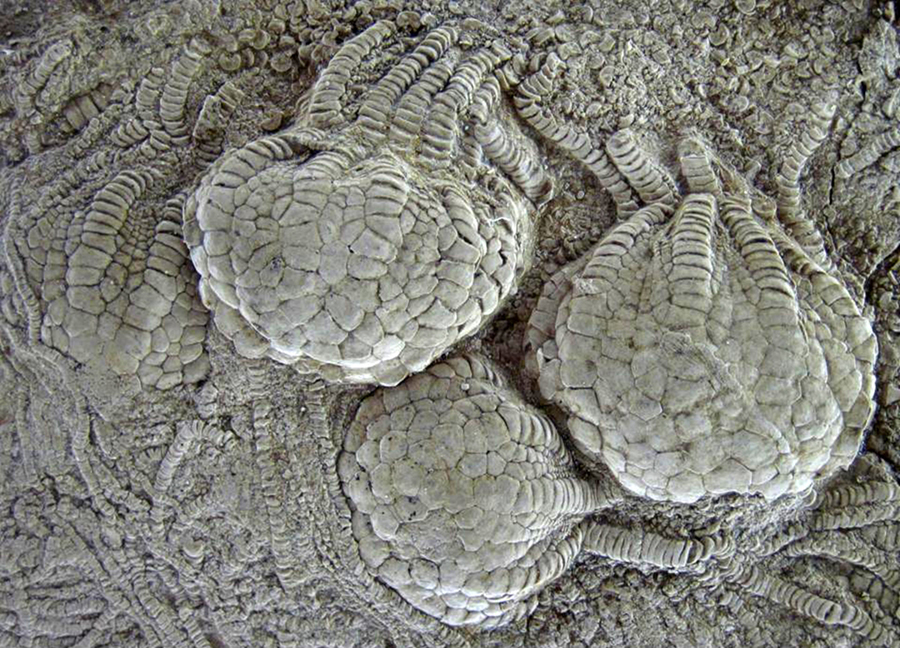
Uintacrinus socialis from the Niobrara Formation, Kansas, United States. Image credit: James St. John / CC BY 2.0.

A team of paleontologists from Australia and the UK has found fullerene-like structures in Cretaceous-period crinoids, marine animals related to starfish, sea urchins, and brittle stars. The researchers believe these strange structures might have acted as a buoyancy chamber to allow the animals to float in seawater but also protect them.

Crinoids, also known as sea lilies or feather-stars, are part of a large group of marine invertebrate animals called echinoderms. Other echinoderms are starfish, brittle stars, sand dollars, sea urchins, and sea cucumbers.

The skeleton of echinoderms is made of the mineral calcite, and consists of hundreds of individual plates of different shapes and sizes.

All living echinoderms have what is called pentameral symmetry, which means their bodies are organized in patterns of five; for example, the five arms of the common starfish. Crinoids may have as few as five arms, but usually they have arms in multiples of five.

Crinoids are unusual looking animals because they look more like plants than animals. Superficially, the stem or column of a crinoid resembles the stalk of a flower, the calyx or head resembles the sepals of a flower, and the arms resemble the petals of a flower.

These marine animals first appeared in the seas of the Cambrian period, about 300 million years before dinosaurs. They flourished during Paleozoic and Mesozoic eras, and some survive to the present day. Around 600 living species are known; most are free-living feather stars or comatulids living in the shallow seas.

“Crinoids were in a very dangerous place millions of years ago when the oceans were shallower and they shared them with predators such as crabs and fish,” said co-author Dr. Aaron Hunter, a researcher in the School of Earth Sciences at the University of Western Australia and the Department of Earth Sciences at the University of Cambridge.

“Survival was critical and the ball-like structures, able to withstand very heavy loads, formed around them to protect them from the harms of the ocean and aid buoyancy.”

“These animals could then spread around the world and have been found in chalk rocks from Texas, US to Kalbarri in Western Australia. They could form a snow shoe to sit on the bottom of the shallow oceans or float and relocate to safer places.”

Marsupites testudinarius. Image credit: Ghedoghedo / CC BY-SA 3.0.

Dr. Hunter and his colleague, Dr. Jennifer Hoyal Cuthill from the Institute of Analytics & Data Science & School of Life Sciences at the University of Essex, the Department of Earth Sciences at the University of Cambridge, and the Earth-Life Science Institute at Tokyo Institute of Technology, analyzed the fossilized remains of Marsupites testudinarius and Uintacrinus socialis, two crinoid species that lived 80 million years ago (Cretaceous period).

Both species possessed long feeding arms and an enlarged, close-to-spherical head, composed of 16 large plates in Marsupites testudinarius but many more, small plates in Uintacrinus socialis.

According to the team, the heads of these animals show structural similarities to carbon fullerene and fulleroid molecules, respectively.

Marsupites testudinarius had fewer but relatively large plates, creating a stable structure,” Dr. Hunter said.

Uintacrinus socialis on the other hand has far more complex plates that form a dome.”

“The structures are also found in the carbon molecule buckminsterfullerene but this is the first time we have found such a structure in fossils and it still remains a mystery why these successful structures did not evolve again.”

The findings were published in the journal Palaeontology.

_____

Jennifer F. Hoyal Cuthill & Aaron W. Hunter. Fullerene-like structures of Cretaceous crinoids reveal topologically limited skeletal possibilities. Palaeontology, published online February 18, 2020; doi: 10.1111/pala.12474

Source: www.sci-news.com/

Fossil Footprints Found In Sydney Suburb Are From The Earliest Swimming Tetrapods In Australia

Thursday, May 14, 2020

Credit: Journal of Paleontology (2020). DOI: 10.1017/jpa.2020.22

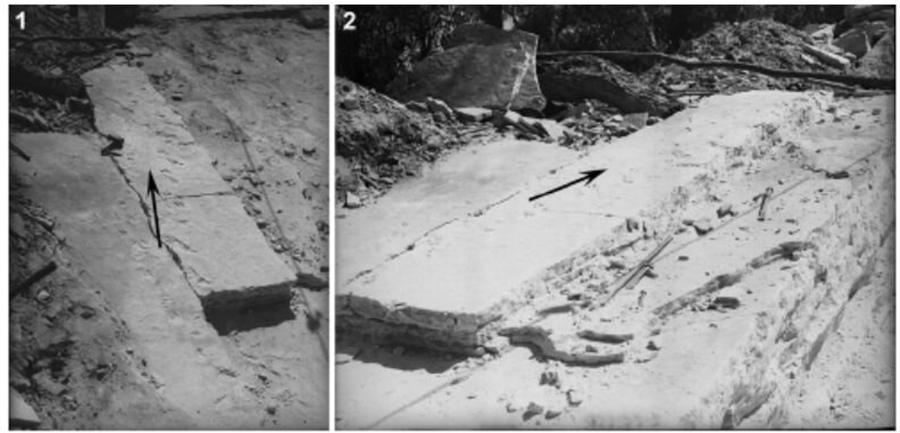
Fossil footprints discovered nearly 80 years ago in a sandstone quarry at Berowra have been identified as the traces of a four-legged animal swimming in a river nearly a quarter of a billion years ago.

The footprints were identified by Roy Minden Farman, a former masters student at the University of New England in Armidale, who noticed them in a storage facility of artefacts belonging to the Australian Museum. The study was published last week in the Journal of Paleontology.

The footprints come from rocks that formed at the bottom of large rivers that once covered the Sydney region in the Middle Triassic period (around 240 million years ago) before the appearance of dinosaurs. The sand at the bottom of these rivers eventually turned to stone, and is now famously used as building materials across Sydney region, where it is referred to as Sydney sandstone. The owner of the sandstone quarry at Berowra, Geoffrey Scarrott, first noticed the footprints as they were being unearthed in the 1940s. They were eventually transferred to the Australian Museum in Sydney, where they were displayed for a short period in the 1950s, but were later moved into the research collections.

The trackway measures 4.2 meters long and consists of at least 35 foot and handprints. Only two fingers from each hand and foot made their impressions in the sandy bottom, making the precise identity of the animal difficult to establish. Researchers at the University of New England determined that it was likely a temnospondyl (an extinct group of salamander-like amphibians) between 0.8 and 1.35 m long, the bones of which are reasonably well-known from rocks in the Sydney region. Despite this, animal fossils are extremely rare in Sydney sandstone.

The tracks are also significant because they are the oldest record of a swimming tetrapod—that is, all animals with four legs, including humans—from Australia. "The foot and hand prints, along with the gaps between the sequence of traces, were unlike anything I had seen before. This led me to believe the animal was swimming in water," said Farman, who led the study. Farman later confirmed that the animal was merely brushing the river bottom with its hands and feet rather than making full contact with the ground, as would be expected if the animal was walking. All tetrapods evolved from fishy ancestors and emerged onto land 360 million years ago, roughly 100 million years earlier than the Berowra footprints. The footprints of these early tetrapods are usually made on land, therefore, the tracks made by a swimming animal are a valuable insight into how these animals moved 240 million years ago.

The original quarry where the fossils were found has since been developed, and is no longer accessible.


More information: Roy M. Farman et al. Australia's earliest tetrapod swimming traces from the Hawkesbury Sandstone (Middle Triassic) of the Sydney Basin, Journal of Paleontology (2020). DOI: 10.1017/jpa.2020.22

Journal information: Journal of Paleontology 

Provided by University of New England

Source: https://phys.org/

Parents Build Amazing Jurassic Park Themed Bedroom With a Jeep Bed For Their Son

Thursday, May 14, 2020

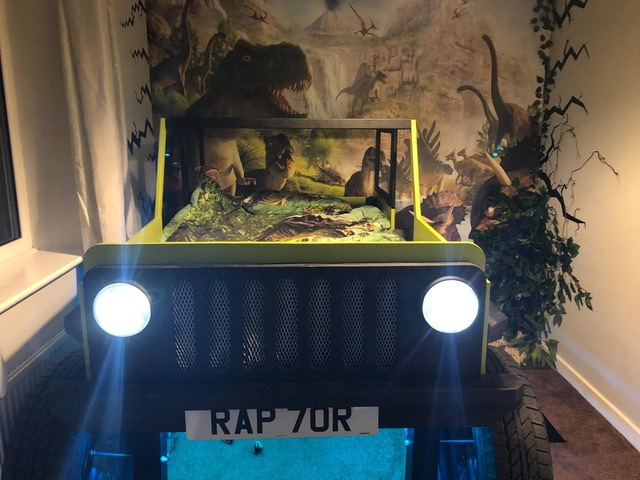
A mum and dad have made an epic Jurassic Park-themed bedroom for £250. Credit: Latestdeals.co.uk

A MUM and dad have revealed how they have made an epic Jurassic Park-themed bedroom for their son which includes an incredible Jeep bed.

Abigail Talbot, 23, and Darren Block, 42, spent just £250 on the amazing room transformation for their son Horatio, two.

Abigail, a support staff for engineers at energy company SSE, and Darren, a blacksmith and bicycle mechanic, live in Manchester and are also parents to Aria, one.

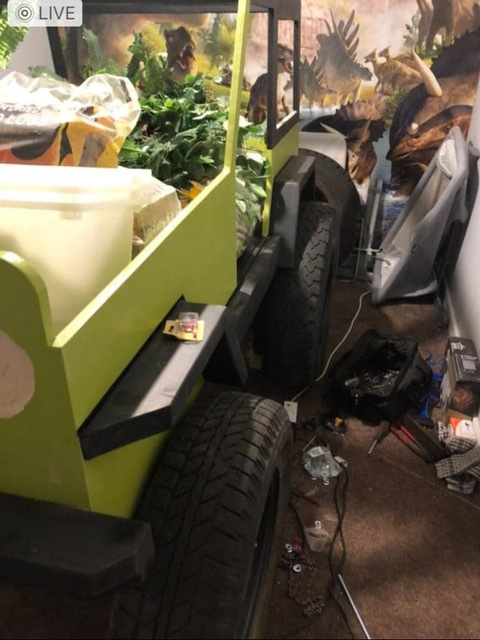
The Jeep was the perfect focal point for the dinosaur-themed room, which they cut from MDF and softwood timber and accessorised with products from eBay and Amazon. 

Abigail told money-saving community LatestDeals.co.uk: "We assembled the jeep body, added the legs, filled and sanded the screw holes with body filler and sand flat, then added the wheel arches and filled and sanded the joints and also wood slats for the bed.

“The trickiest bit is getting the angles of the cuts to fit. Car body filler hides a lot of mistakes.”

They made a Jeep bed to be the focal point of the themed bedroom. Credit: Latestdeals.co.uk

Abigail said she then added the grille and primed the wood with spray paint, before adding a few coats of paint. 

She said: “I used exterior paint as it's more hard wearing. I also used car pinstripe tape to make the finish neater where the colours join.

"Next was the wallpaper, before moving the Jeep into position. We added the wheels and grille and painted cracks on the wall to add to the feature using scrap off cuts of MDF.

"I used cheap plastic plants and firewood logs from Aldi to create the scenery and stuck it down with car body filler.

“We covered the rest of the MDF with a thin layer of filler and pressed in some cheap gravel. I used all the MDF I had left instead of throwing it away.”

The couple then added cheap artificial grass under the Jeep to create an area for Horatio to play, and this was stuck down with double sided tape.

The bed was the most expensive part of the project, and cost £200. Credit: Latestdeals.co.uk

She added: "Cheap plug-in LED light strips from Amazon added to the Jeep. He can change the colour to what he likes with a little remote.

"The process is messy due to the woodwork and with the MDF you need appropriate ventilation.

"Once all the pieces of wood have been cut, you will need to build the bed in the room you are putting it in as it's heavy and won't fit through door frames.”

Mum Abigail Talbot, 23, made the dinosaur room for son Horatio, two, with the help of partner Darren Block, 42. Credit: Latestdeals.co.uk

Abigail said the overall cost was around £250 for the entire bedroom, with the bed costing £200. 

She said: "Our local timber yard is still open so we were able to source all of our materials from there but B&Q stock all the products required. 

“The headlights were from Halfords. We tweaked them so they could be wired to a plug.

"The wheels were gifted to us by one of our local scrap yards, Gadbury Auto Salvage.

The room's dinosaur wallpaper was from Amazon for less than £30. Credit: Latestdeals.co.uk

"Car body filler to fill all the joints and screw holes just finishes the bed off, and truck bed liner paint which you can buy from Halfords was also great and cheap too.

"It doesn't scratch or wear easily so we have used it on all the areas that our boy comes in contact with often.

"All the fake plants are from eBay and were as cheap as chips and the bookshelves are spice racks that were painted to match his bed. The wallpaper was from Amazon for less than £30.

“The sky is painted to look like the stars at night. This was done prior to the lockdown by Marshalls Night Sky Ceilings but it really adds to the overall look at night time.”

Darren cut from the bed shape from MDF and softwood timber and accessorised with products from eBay and Amazon. Credit: Latestdeals.co.uk

Abigail says that getting stuck into a DIY challenge such as this one is a great way to be creative and productive during what is a stressful time for families.

She said: “It's a great little project that will keep people busy during lockdown and it's something amazing for the kids.

“I’m relieved now it's done and so happy that our little boy loves it. It was a big step for him because it was the transition from a cot to a bed.

"The next project after the garden will be a bed for Aria!”

Source: www.thesun.co.uk/

13 Dumb Decisions In Jurassic Park Movies We Can't Forgive

Tuesday, May 12, 2020

That talking raptor will be seared in our brains for eternity.

A sixth Jurassic Park film is on the way! Whether you liked the last film or not, it's always fun to see dinosaurs on a big screen tearing each other (and humans) apart for our amusement.

From the spectacular Steven Spielberg outings to the dividing Colin Trevorrow (directed and produced) installments, we've been dazzled, delighted and horrified by the adventures on screen.

After five movies (so far), the series has taken a number of bizarre turns, and while a few have been greatly received, there have been a number of crashes in the series. These could have flattened the franchise, and the big ones almost killed them forever, and in their honour its best we address them.

The filmmakers behind the Jurassic Park movies have made some wild decisions over the years, and most of them have been downright dumb. Whether it was to appease fans, or serve a greater purpose in the franchise is yet to be seen, but in the meantime they are just gosh-darned awful.

Let's take a look at twelve decisions from the Jurassic Park movies that were so dumb that we have to question where the heads of the people who made them were at.

13. The Mitchell Brothers' Backstory - Jurassic World

If a Jurassic Park film is compelled to put kid characters in the story to add tension, the least the film can do is make the characters likable.

In the three previous installments before Jurassic World, the kid characters' relationship to the heroic grownups was established and that was it. We didn't need to know what Tim and Lex' home-life was like, Kelly's broken relationship with Ian was made clear earlier, and Eric Kirby's life was explained by his parents.

What audiences didn't need to see in Jurassic World (in the first scene no less), was a weird expository backstory behind Gray and Zach Mitchell, Claire's nephews. The divorce of their parents ultimately doesn't mean anything, and Zach's weird staring competitions with clusters of teenage girls is not only uncomfortable but is never addressed in the films.

Gray (the younger brother) is arguably the most consistent, and if we're all being honest, would have worked better alone. If the script punched his character up to be a little more impulsive, Zach could have been cut out entirely.

But fundmanetally, we didn't need to know the family lives of these kids. They're Claire's nephews who are taking a VIP tour of the park. Enough said.

12. Dr. Ian Malcolm's Cameo Appearance - Jurassic World: Fallen Kingdom

Jurassic Park alumni and internet thirst-trap Jeff Goldblum stirred hype for the fifth dinosaur outing when not only was he cast to return to the franchise, but even appeared in trailers.

Unfortunately, what the trailers showed was almost the same amount of screen-time Ian Malcolm actually appeared in the film.

Dropping in for two short segments; not only does Ian Malcolm not appear in any other scenes (or even referenced) in the film, but his presence could be cut from the film and make absolutely no change to the plot.

You decide what's more insulting; the shameless tease of bringing back one of the original characters, or the fact that it was squandered on meaningless exposition?

Had the promotional materials kept Ian Malcolm out, his cameo appearance would have been a delightful wink to audiences old enough to remember Malcolm's turquoise jewelry and glistening chest.

The decision to include Malcolm in the film was obviously a nice "why not?" from Jeff, but his presence was wasted nonetheless.

Malcolm is set to make a proper return (along with Alan and Ellie) in the sixth film, and here's hoping it's more than a quick wave in all his salt & pepper glory.

11. Talking To The Velociraptors - Jurassic Park III

At the beginning of JP3, the audience is provided a scene in which a replicated Velociraptor larynx is blown like a flute, mimicking those haunting cackles we've heard in previous films. This obviously brings back worrisome memories for Alan, but the moment passes and it's never brought up again.

Later in the film; events transpire that seemingly fall into place. The intelligence of the Raptors setting a trap for the humans, one of them calling for help when pinned against a cage door, and the inevitable realization that the Raptors are hunting the humans because Billy pilfered two of their eggs.

What does all this mean you might ask? Well, the final interaction the battered and bruised humans have with a dinosaur on Isla Sorna, is with the hunting Velociraptors who want their eggs back.

The humans offer the eggs back, and as a distraction, Alan takes out the raptor larynx and plays some classical beats to confuse and scatter the raptors.

It's one of the dumbest moments in the film, and would have been less painful if there hadn't seen anything similar earlier on in the film. But don't worry, I'll get to THAT bit later.

10. T-Rex Loose In The City - The Lost World: Jurassic Park

Ask yourself; do you remember much of this part from The Lost World?

After successfully defeating the Raptors, the survivors helicopter off the island and it feels like the movie could stop there. But because of plot reasons, the film carries on for what feels like forever with a hammy third act that shows a T-Rex rampaging through San Diego in search of its baby.

Don't get me wrong, dinosaurs loose in a city does feel like a natural course of escalation the Jurassic Park films would have eventually gone down (and it might be the case in Dominion), but after spending a large amount of the film on Isla Sorna, the film should have cut out when everyone evacuated the island.

Up to this point the film had already blessed us with some nail-biting sequences involving one or more T-Rex'; the film didn't need to glue a third one onto the end.

The film tags this sequence onto the end, thinking it's something audiences needed to see.

Had this been a major plot for a third movie, it would have been greatly received. But tagging this plot point on after over an hour on the island just feels exhausting and a last-minute addition.

9. Zara's Brutal Death - Jurassic World

Jurassic Park films have never shied away from gruesome deaths; Dennis Nedry, Dieter Stark and Ray Arnold, were characters whose deaths were horribly implied in the worst possible way.

When Jurassic World stepped up to bat, the film decided to show rather than suggest, and while it was a bold and interesting choice, whom the film picked to be the winner of such a heinous death was none other than Claire's obedient assistant, Zara.

There are two things wrong with how Zara died; the first being the Mouse Trap cavalcade in which the character is rubbed out.

Amidst the skirmish at the park, Zara is picked up by Pteranodons, nearly drowned and then swallowed up by a Mosasaurus. Already it's overkill.

The second point is this is the kind of death that should have been saved for an antagonist. Not even Vincent D'Onofrio's character (can anyone remember his name?) gets taken out so viciously.

Zara isn't a villain in the movie. She doesn't do anything cruel, she's tasked with looking after Claire's bratty nephews and when things go bad her priority is to find them.

Who decided that one of the biggest deaths in the film, should go to someone so undeserving?

8. Nostalgia For The First Park - Jurassic World

Jurassic World was a long-awaited soft-reboot/sequel, and the idea of "what if the park DID open?" is a great idea to get the ball rolling on a new trilogy.

Being set in the same universe as the previous three films is an interesting step given the events prior, and so acknowledging the first films was unavoidable.

It's why, the character of Lowery, played by Jake Johnson, is such a frustrating presence in the film. Being a comedic actor, his quips do add much needed light humor, but he's also serving as a reminder of how "legit" the first Jurassic Park was.

News flash: EVERYONE KNOW THE FIRST FILM WAS GREAT!

Audience members seeing Jurassic World had most likely seen the first film, and know how much fun and inspired it was. To have a self-aware character wearing an original Jurassic Park shirt (and be chastised for it) isn't just dumb, it's an embarrassing acknowledgement that the movie we're watching right now isn't as good as the original.

The character of Lowery might as well stand up and tell the audience watching "hey, this film isn't going to be as good as the original".

You're right Lowery, I didn't need you to tell us that.

7. Gymnastics Save The Day - The Lost World: Jurassic Park

The Lost World might still get lumped into the category as "bad Jurassic Park" from time to time, but there are genuinely exciting and tense moments in the film, and one of the best sequences in the film has to be the Velociraptors making their entrance.

The whole sequence plays out like sharks at the beach as they snack on the InGen mercenaries in "THE LONG GRASS!", and when Ian Malcolm and his gang enter, the stakes are raised for people we actually care about.

After sprinting through the long grass, the survivors enter an InGen base, only to be ambushed by the Raptors. Ian's daughter Kelly, who has been nothing but a burden through the whole film, finally proves her worth and the foreshadowing of her gymnastics is paid off.

Kelly performs a few impressive twirling moves before calling out to a Raptor about to devour her daddy and kicks it through a window. Now I know disposing of Raptors is a tricky thing to do without a T-Rex in the room, but to have an eleven year old girl have the strength to beat one of these things is just moronic.

Come on, Spielberg! You're better than this.

6. The Indoraptor - Jurassic World: Fallen Kingdom

There were so many things wrong with the last Jurassic Park film, but the one that really takes the biscuit is the introduction of yet ANOTHER hybrid antagonistic dinosaur for Owen and Co. to contend with.

Put aside the fact that the Indoraptor is just like the Indominus Rex, the concept behind this big baddie is so dumb that it could take volumes of textbooks to explain the stupidity of this creature.

The dinosaurs of Jurassic Park were scary and dangerous enough, and while the Indominus Rex was a hybrid, there was a reason and explanation behind its creation. The Indoraptor was created to serve as a weapon for sale (hence that stupid laser-guided system), but for whom exactly?

Coupled with the fact that this thing has a personality (it fakes paralysis after being hit with a tranq dart and smiles!), and the Indoraptor becomes the dumbest thing in a film with cloned kids and dinosaur auctions. The Indoraptor isn't just a bad plot-point, it's a repeated one too.

Thankfully. Colin Trevorrow has stated there are no more dinosaur hybrids. But who's to say he hasn't got a new dumb idea up his sleeve? You've seen The Book Of Henry, haven't you?

5. Killing The T-Rex - Jurassic Park III

There's nothing wrong with introducing new "villain" dinosaurs to the Jurassic Park franchise. After a while Raptors and T-Rex' would get repetitive, so in Jurassic Park III it was exciting to see a new and terrifying creature take the mantle as the scary, looming threat.

Cue the Spinosaurus; a giant meat-eater with a rad mohawk backbone. This thing was bigger, meaner, and seemed to have a genuine grudge against Alan and the Kirby family. But how does the film establish this thing as being "like nothing we've ever seen before"?

Not it's body count or its big teeth, but by killing a Tyrannosaurus Rex and establishing itself as the new big bad. The T-Rex is the king/queen of Jurassic Park, and JP3 flips the franchise the middle finger by having a fight between the two titans that ends with the T-Rex getting its neck snapped.

Had the movie not included the T-Rex at all, this wouldn't even be a problem. But having this new villain come in and kill the once anti-heroic T-Rex, and not meet a similar fate at the end feels like the franchise never appreciated how much fun the T-Rex was to begin with.

4. Making Humans The Big Bad - Jurassic World: Fallen Kingdom

Since the first film, there have always humans in a somewhat antagonistic role. But while Dennis Nedry and InGen rubbed their hands together and schemed, they were never purposefully evil.

The introduction of Eli Mills and making Dr. Wu a mad scientist, has made the new threats of the franchise to be money-grabbing comic book villains, akin to the Umbrella Corporation than just naive scientists playing with mosquito blood.

The dinosaurs are scary villains on their own, and the "science-gone-wrong" theme of the Indominus Rex and even the Indoraptor are acceptable enough, but the filmmakers had to put illogical motivations into the mix and turn some of the characters into something straight from a Saturday morning cartoon.

Breeding the dinosaurs to be used in combat zones is a dumb decision already, but we can get behind it because the purpose of Owen Grady's character is to be a Raptor-whisperer. To have a whole sect of characters who are straight-up evil feels lazy and uninspired at this point.

Surely no fan of the franchise can watch the new film in earnest, if it involves Christ Pratt having a fistfight with another human character while Blue cheers him on from the sidelines.

3. The Granddaughter Is Actually A Cloned Daughter - Jurassic World: Fallen Kingdom

One thing to remember about the Jurassic Park franchise is that the dinosaurs were resurrected with the power of science, and more observant fans did point out long ago that if the technology can bring back extinct animals, could it bring back humans?

This question is answered in Fallen Kingdom, and while it might have made for an interesting twist, it ultimately comes down to being one of the dumbest decisions in the entire franchise.

Jurassic Park is about dinosaurs in the modern day, not about crazy scientists bringing their daughters back to like and pretending they're their granddaughters.

The mythology of John Hammond (and now Lockwood) wasn't something any Jurassic Park fan cared about, but Fallen Kingdom goes out its way to deep-dive into the family heritage and the technology of the series to make the token kid of the movie a clone.

Maisie was a character that had one job; be the screaming, terrified child that the heroes had to save. Making her part of the plot in such a convoluted, and crazy way is not only a dumb diversion from the plot, but also hijacks the excitement of dinosaurs in the modern day.

Fingers crossed that was all a dream.

2. Freeing The Dinosaurs To "Find Harmony" - Jurassic World: Fallen Kingdom

If you were paying attention to literally ANY of the Jurassic Park movies, you will have noticed the running theme - that the idealism of bringing Dinosaurs back is wildly at odds with the natural order of things. To hijack the first film's most famous line "God creates dinosaurs. God destroys dinosaurs. God creates man. Man destroys God. Dinosaurs eat man. DINOSAURS inherits the earth."

This is all very well established, so quite why the writers of Fallen Kingdom decided to ignore it and have the finale of that movie feature all of the surviving dinosaurs being released as a humanitarian decision is just ludicrous. It was done as a means for the creatures to find some uneasy harmony with humans, but the reality is that Jurassic World is not a Flintstones prequel and there is no outcome where the dinosaurs don't simply eat as many people as they can until they're killed.

That might well be the actual plot of the final movie in the trilogy, but for a film that's all about dinosaur rights to end with such a stupid finale that defies all logic was unforgivably idiotic. The final, awful cherry on the most baffling, misguided of sundaes.

1. The Talking Velociraptor - Jurassic Park III

If time travel existed, someone should go back to the year 2000 and peer into the pitch meeting when this idea was being bounced around and see which "genius" thought it would sensible and not ridiculous to have talking dinosaurs.

How was this accepted? Was someone being blackmailed?

In the context of the film, Jurassic Park hero Alan Grant is flying back to the islands he escaped from two films prior, but it's clear he's still suffering some form of PTSD from the experience. While on the plane, Alan comes face to face with his ultimate nemesis; a Velociraptor, and wakes just in time to realize it was all a dream.

That in itself could be scary, but the fact that someone thought it would be a good idea to make the Raptor not only sit in the plane like a fellow passenger, but to make the creature's jaw flick up and down and utter Alan's name; is both mind blowing and awful.

The scene would have been effective if the Raptor started tearing other passengers apart, and THEN Alan woke up. But instead, the creators went for the dumbest idea, and JP3 will forever be known as the film with the talking Velociraptor.

Source: https://whatculture.com/

Can We Really Tell Male And Female Dinosaurs Apart?

Wednesday, May 13, 2020

Credit: CC0 Public Domain

Scientists worldwide have long debated our ability to identify male and female dinosaurs. Now, research led by Queen Mary University of London has shown that despite previous claims of success, it's very difficult to spot differences between the sexes.

In the new study, researchers analysed skulls from modern-day gharials, an endangered and giant crocodilian species, to see how easy it is to distinguish between males and females using only fossil records.

Male gharials are larger in size than females and possess a fleshy growth on the end of their snout, known as a ghara. Whilst the ghara is made from soft tissue, it is supported by a bony hollow near the nostrils, known as the narial fossa, which can be identified in their skulls.

The research team, which included Jordan Mallon from the Canadian Museum of Nature, Patrick Hennessey from Georgia Southern University and Lawrence Witmer from Ohio University, studied 106 gharial specimens in museums across the world. They found that aside from the presence of the narial fossa in males, it was still very hard to tell the sexes apart.

Dr. David Hone, Senior Lecturer in Zoology at Queen Mary University of London and author of the study, said: "Like dinosaurs, gharials are large, slow growing reptiles that lay eggs, which makes them a good model for studying extinct dinosaur species. Our research shows that even with prior knowledge of the sex of the specimen, it can still be difficult to tell male and female gharials apart. With most dinosaurs we don't have anywhere near that size of the dataset used for this study, and we don't know the sex of the animals, so we'd expect this task to be much harder."

In many species, males and females can look very different from each other. For example, antlers are largely only found in male deer and in peacocks, males are normally brightly-coloured with large, iridescent tail feathers whereas females are much more subdued in their colouration. This is known as sexual dimorphism and is very common within the animal kingdom. It is expected that dinosaurs also exhibit these differences, however this research suggests that in most cases this is far too difficult to tell from the skeleton alone.

Dr. Hone said: "Some animals show extraordinarily high levels of sexual dimorphism, for example huge size differences between males and females. Gharials sit somewhere in the middle as they do possess these large narial fossa that can help with identification. Our study suggests that unless the differences between the dinosaurs are really striking, or there is a clear feature like the fossa, we will struggle to tell a male and female dinosaur apart using our existing dinosaur skeletons."

The new research also challenges previous studies that have hinted at differences between the sexes in popular dinosaur species such as the Tyrannosaurus rex (T. rex), and led to common misconceptions amongst the general public.

"Many years ago, a scientific paper suggested that female T. rex are bigger than males. However, this was based on records from 25 broken specimens and our results show this level of data just isn't good enough to be able to make this conclusion," Dr. Hone added.


More information: Ontogeny of a sexually selected structure in an extant archosaur Gavialis gangeticus (Pseudosuchia: Crocodylia) with implications for sexual dimorphism in dinosaurs, D Hone, J Mallon, P Hennessey, L Witmer. PeerJ, 2020.

Journal information: PeerJ 

Provided by Queen Mary, University of London

Source: https://phys.org/

Jurassic Fossil Reveals Violent Squid Attack in Progress

Friday, May 8, 2020

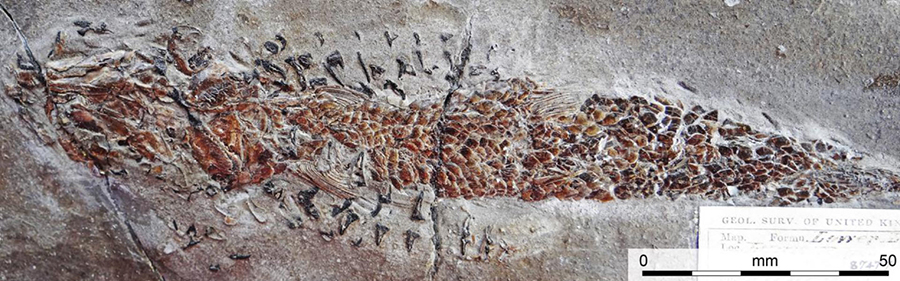
A close-up image showing the damaged head and body of Dorsetichthys bechei with the arms of Clarkeiteuthis montefiorei clamped around it. Image credit: Malcolm Hart, Proceedings of the Geologists’ Association.

An international team of paleontologists from the University of Plymouth, the University of Kansas and the Forge Fossils has found a specimen of the squid-like cephalopod Clarkeiteuthis montefiorei preserved with the herring-like fish Dorsetichthys bechei in its two arms; the bones in the head of the fish are broken in a manner that suggests a quite violent attack.

The 195-million-year-old specimen was found in the 19th century near Lyme Regis on the Jurassic coast of southern England.

The fossil predates previously recorded similar specimens by more than 10 million years.

“Since the 19th century, the Blue Lias and Charmouth Mudstone formations of the Dorset coast have provided large numbers of important body fossils that inform our knowledge of coleoid paleontology,” said lead author Professor Malcolm Hart, a paleontologist in the School of Geography, Earth & Environmental Sciences at the University of Plymouth.

“In many of these mudstones, specimens of paleobiological significance have been found, especially those with the arms and hooks with which the living animals caught their prey.”

“This, however, is a most unusual if not extraordinary fossil as predation events are only very occasionally found in the geological record.”

“It points to a particularly violent attack which ultimately appears to have caused the death, and subsequent preservation, of both animals.”

The fossilized remains indicate a brutal incident in which the head bones of the fish were apparently crushed by its attacker.

The researchers have two hypotheses for how the two animals ultimately came to be preserved together for eternity.

“Firstly, the fish was too large for its attacker or became stuck in its jaws so that the pair settled to the seafloor where they were preserved,” they said.

“Alternatively, Clarkeiteuthis montefiorei took its prey to the seafloor in a display of ‘distraction sinking’ to avoid the possibility of being attacked by another predator. However, in doing so it entered waters low in oxygen and suffocated.”

The scientists presented their findings this week at Sharing Geoscience Online, a virtual alternative to the traditional General Assembly held annually by the European Geosciences Union (EGU).

_____

Malcolm Hart et al. Life and Death in the Jurassic Seas of Dorset, Southern England. EGU 2020, abstract # 1466; doi: 10.5194/egusphere-egu2020-1466

Source: www.sci-news.com/

Funko Pop! Funkoverse: Jurassic Park Strategy Game Review

Thursday, May 7, 2020

Funko has unleashed a phenomenon with its Pop! vinyl figures. Many popular characters have been immortalized as figures including Mickey Mouse, Batman, Superman, Wonder Woman, Iron Man, Geralt of Rivia, Daenerys Targaryen and many, many more. The next step in the Funko Pop! world is the Funkoverse Strategy Game, a board game that includes exclusive Funkoverse Pop! Game Figures.

We were able to test out two different Funkoverse Strategy Games from Jurassic Park, one made for 2-4 players (see it on Amazon) and the other for 2 players (Amazon). The best part about these games is the cool collectible figures, and they’re smaller than the regular Funko Pop! vinyl figures.

The 2-4 Player base game includes figures for Dr. Alan Grant, Dr. Ellie Sattler, Ray Arnold, and a raptor. It has 2 playable maps: Visitor Center and Raptor Paddock.

The game has you playing as different characters, and name of the game is to defeat your rival by scoring the most points. Each character has basic moves and unique abilities to help give them an edge against other players. If you’ve played Magic the Gathering, this should feel familiar to you.

There are four available game scenarios, and with 2 different maps, players will encounter familiar moments from the film. It comes with instructions, and it can be overwhelming when you’re starting out and reading to understand the rules. Once you get the hang of the game, it becomes easy, and it helps with the many scenarios and maps for extended playtime. The scenarios are like the different modes in a multiplayer video game including Capture the Flag, Control Points, King of the Hill, etc.

What makes Funkoverse even better is that you can use the Funkoverse figures in other Funkoverse boards. Jurassic Park characters can enter the world of Harry Potter and DC, and Harry Potter can fend off dinosaurs in Jurassic Park, and Batman can go up against Voldemort. It’s kind of like the discontinued Disney Infinity and Skylanders where you can use different figures in different worlds.

The game also includes little items like dice and points, and in the Jurassic Park game, the points are amber with mosquitos.

Jurassic Park Expandalong with Dr. Ian Malcom and T. rex


The 2 player version includes the Funkoverse Pop! game figures for Dr. Ian Malcolm and the T. rex and 2 playable maps (the T. rex Paddock and Isla Nublar Lab), and two scenarios. The real reason to get this is for those who are fans of Jeff Goldblum and the T. rex.

Final Reaction


The games can be simple, but to make it really fun, we suggest playing with the maximum number of players allowed and the different scenarios. With more players, you’ll have to plan your moves even more carefully as you deal with different minds. With the figures and their unique abilities, different maps, and scenarios, it adds to the game’s replayability. Some of the scenarios will be familiar for those who love video game modes like Capture the Flag and King of the Hill.

The Funkoverse Jurassic Park Strategy Games are now available on Amazon.

Source: https://nerdreactor.com/

Pages