nandi's blog

Fossil Trove Sheds Light On Ancient Antipodean Ecology

Friday, April 3, 2020

Flake of clear yellow amber from Anglesea, Victoria containing a new, beautifully preserved biting midge ca. 41 million years old. Credit: Enrique Peñalver.

The oldest known animals and plants preserved in amber from Southern Gondwana are reported in Scientific Reports. Gondwana, the supercontinent made up of South America, Africa, Madagascar, India, Antarctica and Australia, broke away from the Pangea supercontinent around 200 million years ago. The findings further our understanding of ecology in Australia and New Zealand during the Late Triassic to mid-Paleogene periods (230-40 million years ago).

Jeffrey Stilwell and colleagues studied more than 5,800 amber pieces from the Macquarie Harbour Formation in Western Tasmania, dating back to the early Eocene Epoch (~54-52 million years ago) and Anglesea Coal Measures in Victoria, Australia, from the late middle Eocene (42-40 million years ago). The authors report a rare "frozen behaviour" of two mating long-legged flies (Dolichopodidae). The specimens also include the oldest known fossil ants from Southern Gondwana and the first Australian fossils of 'slender springtails', a tiny, wingless hexapod. Other organisms preserved in the amber include a cluster of juvenile spiders, biting midges (Ceratopogonidae), two liverwort and two moss species.

A rare example of ‘frozen behavior’ in the fossil record of two mating, long-legged flies in clear, honey-colored amber from Anglesea, Victoria ca. 41 million years old. Credit: Jeffrey Stilwell.

The authors also studied deposits found at locations in southeastern Australia, Tasmania and New Zealand. These include the oldest reported amber from Southern Pangea dating back to 230 million years ago, 96-92 million year old deposits from forests near the South Pole and an intact fossil of an insect called a felt scale (Eriococcidae) from 54-52 million years ago.

A large piece of amber with an association of two flies (long-legged on left and biting midge on right) with the first ever Australian fossil of a large mite of the extant genus, Leptus, Anglesea, Victoria, ca. 41 million years old. Credit: Enrique Peñalver.

The findings provide new insights into the ecology and evolution of Southern Gondwana and indicate that there may be a vast potential for future, similar finds in Australia and New Zealand.

More information: Amber from the Triassic to Paleogene of Australia and New Zealand as exceptional preservation of poorly known terrestrial ecosystems, Scientific Reports (2020). DOI: 10.1038/s41598-020-62252-z , https://www.nature.com/articles/s41598-020-62252-z

Journal information: Scientific Reports

Provided by Nature Publishing Group

Source: https://phys.org/

How Do We Know If A Dinosaur Skeleton Is From A Child Dinosaur Or An Adult Dinosaur?

Friday, April 3, 2020

Image: iStock

There are a couple of ways we can try to tell how old a dinosaur was when it died.

If you cut open a fossil dinosaur bone, you can see lines, just like if you were looking at rings in a tree. Trees rings happen when a tree grows slowly in a tough season like an icy cold winter. You can count the rings to see how many winters that tree has lived through. And because there is only one winter each year, then you know how many years old the tree is. Easy!

Animals, like dinosaurs, formed similar lines in their bones whenever they slowed down their growing. But there’s a catch: this might not happen once each year like in a tree.

Why would a dinosaur slow down its growing? A dinosaur might not grow very fast if there is not enough food to eat. This might happen if there hasn’t been much rain and so there are not as many plants around to eat. Or there might be loads of food around, but the dinosaur is using all its energy to fight other dinosaurs, rather than using it to grow.

There might be lots of times each year when the dinosaur stopped growing, and each time would make a growth line in its bones. So if you find a fossil with lots of growth lines, you might not be looking at the bones of a really old dinosaur, but a very busy, stressed-out dinosaur! So this is quite a complicated way to try and guess its age.

Use your head

Another way to try to guess the age of a dinosaur is to look at how its skull bones connect to each other. Lots of baby animals don’t have a solid skull. Instead, their skull is made up of different bits that gradually stick together into one piece as it grows.

We’re not sure whether baby dinosaurs had skulls that grew like this. Some scientists have tried to find out by looking at skulls from baby emus and alligators, both of which are a bit similar to dinosaurs. They discovered that emu chicks have skull bones that stick together as they grow, but baby alligators don’t! So that doesn’t really give us a clear answer either.

The growth of a dinosaur called Protoceratops, from newborn baby (on the left) to grown-up (on the right). (Image: Harry Nguyen/Wikimedia Commons)

Sometimes it’s really easy to tell how old a dinosaur was. If you find a dinosaur egg, you can use something called X-rays to look inside it and see if there is a baby dinosaur fossil inside. If there is, you know that dinosaur was 0 years old!

Then, if you find a bigger fossil from the same kind of dinosaur nearby, there is a chance that dinosaur was the baby dinosaur’s grown-up parent.

If you find a baby and a grown-up together, you can learn lots more things by looking at the differences between the two. It might tell you how the dinosaur changes size and shape as it gets older.

You might find a dinosaur that looks like a mixture between the two. That might be a “big kid” dinosaur that is well on its way to becoming a grown-up.

It’s still hard to tell exactly how old each dinosaur was. But scientists are like detectives, and they have lots of clever ideas that are helping them get better at it all the time.

______________________________________________________________________________

Caitlin Syme, PhD in Vertebrate Palaeontology, The University of Queensland

This article is republished from The Conversation under a Creative Commons license. Read the original article.

Source: www.gizmodo.com.au/

Oldest Ever Human Genetic Evidence Clarifies Dispute Over Our Ancestors

Thursday, April 2, 2020

Skeletal remains of Homo antecessor.  CREDIT Prof. José María Bermúdez de Castro

Genetic information from an 800.000-year-old human fossil has been retrieved for the first time. The results from the University of Copenhagen shed light on one of the branching points in the human family tree, reaching much further back in time than previously possible.

An important advancement in human evolution studies has been achieved after scientists retrieved the oldest human genetic data set from an 800,000-year-old tooth belonging to the hominin species Homo antecessor.

The findings by scientists from the University of Copenhagen (Denmark), in collaboration with colleagues from the CENIEH (National Research Center on Human Evolution) in Burgos, Spain, and other institutions, are published April 1st in Nature.

"Ancient protein analysis provides evidence for a close relationship between Homo antecessor, us (Homo sapiens), Neanderthals, and Denisovans. Our results support the idea that Homo antecessor was a sister group to the group containing Homo sapiens, Neanderthals, and Denisovans", says Frido Welker, Postdoctoral Research Fellow at the Globe Institute, University of Copenhagen, and first author on the paper.

Reconstructing the human family tree

By using a technique called mass spectrometry, researchers sequenced ancient proteins from dental enamel, and confidently determined the position of Homo antecessor in the human family tree.

The new molecular method, palaeoproteomics, developed by researchers at the Faculty of Health and Medical Sciences, University of Copenhagen, enables scientists to retrieve molecular evidence to accurately reconstruct human evolution from further back in time than ever before.

The human and the chimpanzee lineages split from each other about 9-7 million years ago. Scientists have relentlessly aimed to better understand the evolutionary relations between our species and the others, all now extinct, in the human lineage.

"Much of what we know so far is based either on the results of ancient DNA analysis, or on observations of the shape and the physical structure of fossils. Because of the chemical degradation of DNA over time, the oldest human DNA retrieved so far is dated at no more than approximately 400.000 years", says Enrico Cappellini, Associate Professor at the Globe Institute, University of Copenhagen, and leading author on the paper.

"Now, the analysis of ancient proteins with mass spectrometry, an approach commonly known as palaeoproteomics, allow us to overcome these limits", he adds.

Theories on human evolution

The fossils analyzed by the researchers were found by palaeoanthropologist José María Bermúdez de Castro and his team in 1994 in stratigraphic level TD6 from the Gran Dolina cave site, one of the archaeological and paleontological sites of the Sierra de Atapuerca, Spain.

Initial observations led to conclude that Homo antecessor was the last common ancestor to modern humans and Neanderthals, a conclusion based on the physical shape and appearance of the fossils. In the following years, the exact relation between Homo antecessor and other human groups, like ourselves and Neanderthals, has been discussed intensely among anthropologists.

Although the hypothesis that Homo antecessor could be the common ancestor of Neanderthals and modern humans is very difficult to fit into the evolutionary scenario of the genus Homo, new findings in TD6 and subsequent studies revealed several characters shared among the human species found in Atapuerca and the Neanderthals. In addition, new studies confirmed that the facial features of Homo antecessor are very similar to those of Homo sapiens and very different from those of the Neanderthals and their more recent ancestors.

"I am happy that the protein study provides evidence that the Homo antecessor species may be closely related to the last common ancestor of Homo sapiens, Neanderthals, and Denisovans. The features shared by Homo antecessor with these hominins clearly appeared much earlier than previously thought. Homo antecessor would therefore be a basal species of the emerging humanity formed by Neanderthals, Denisovans, and modern humans", adds José María Bermúdez de Castro, Scientific Co-director of the excavations in Atapuerca and co-corresponding author on the paper.

World class-expertise

Findings like these are made possible through an extensive collaboration between different research fields: from paleoanthropology to biochemistry, proteomics and population genomics.

Retrieval of ancient genetic material from the rarest fossil specimens requires top quality expertise and equipment. This is the reason behind the now ten-years-long strategic collaboration between Enrico Cappellini and Jesper Velgaard Olsen, Professor at the Novo Nordisk Foundation Center for Protein Research, University of Copenhagen and co-author on the paper.

"This study is an exciting milestone in palaeoproteomics. Using state of the art mass spectrometry, we determine the sequence of amino acids within protein remains from Homo antecessor dental enamel. We can then compare the ancient protein sequences we 'read' to those of other hominins, for example Neanderthals and Homo sapiens, to determine how they are genetically related", says Jesper Velgaard Olsen.

"I really look forward to seeing what palaeoproteomics will reveal in the future", concludes Enrico Cappellini.

###

The study of human evolution by palaeoproteomics will continue in the next years through the recently established EU-funded "Palaeoproteomics to Unleash Studies on Human History (PUSHH)" Marie S. Curie European Training Network (ETN), led by Enrico Cappellini, and involving many of the co-authors on the paper.

The research is mainly funded by VILLUM FONDEN, the Novo Nordisk Foundation, and the Marie Sklowowska-Curie Actions Individual Fellowship and International Training Network programmes.

Source: www.eurekalert.org/

Jurassic World 3: Colin Trevorrow Working On Movie From Home After Shutdown

Wednesday, April 1, 2020

Jurassic World: Dominion director Colin Trevorrow has continued to work on the film from home while production remains shut down due to coronavirus.

Production may be delayed, but director Colin Trevorrow is still working on Jurassic World: Dominion from home. The third Jurassic World film had only begun production in February, but the growing coronavirus pandemic shut it down a few weeks ago. Jurassic World: Dominion is far from the only production that has been forced to halt because of the crisis, with the ever-growing list of films including The Batman, The Matrix 4, Fantastic Beasts 3, and Marvel's Shang-Chi and the Legend of the Ten Rings. This has led to a great deal of uncertainty within the entertainment industry, as studios don't know when productions will be able to resume work. Future release dates could also be impacted by the current shutdowns.

Capping off the rebooted Jurassic World franchise, Jurassic World: Dominion will see the returns of many familiar faces, starting with Chris Pratt and Bryce Dallas-Howard as the franchise's current leads. Most excitingly, the film will bring back the stars of the original Jurassic Park: Laura Dern, Sam Neill, and Jeff Goldblum. Specific plot details have yet to be revealed, but fans are expecting Dominion to pick up where the post-credits scene from 2018's Jurassic World: Fallen Kingdom left off, with dinosaurs officially entering the real world.

Trevorrow shared on Instagram that he's still finding ways to work on Dominion while stuck at home. His post shows a picture of his computer monitor, which displays what is presumably an image from the film. Unfortunately, it's hard to tell exactly what is happening in it aside from the fact that it shows a figure with a bicycle and some buildings hidden in smoke. Check it out below:


View this post on Instagram


Working from home. #JurassicWorld

A post shared by Colin Trevorrow (@colin.trevorrow) on

Trevorrow isn't the only director working on a film from home, as James Gunn recently shared he's editing The Suicide Squad while self-isolating. However, Trevorrow working on Dominion after only shooting for about a month (or even less) shows just how much he clearly doesn't want to be delayed. The coronavirus pandemic has hit the entertainment industry, like all industries, incredibly hard, and experts believe the affects will be felt for a long time afterward.

It's reassuring that Trevorrow is still focusing on Dominion to avoid any further delays, though at some point he might run out of things to do. Jurassic World: Dominion is currently slated for release on June 11, 2021, but it could end up being pushed back if production doesn't resume soon. For the time being, however, Trevorrow is still hard at work.

Source: https://screenrant.com/

Jurassic World: Dominion's Sam Neill Breaks Silence On Filming Delay

Tuesday, March 31, 2020

As the coronavirus pandemic continues to spread across the world, many film and television projects across Hollywood remain on hold. This includes Jurassic World: Dominion, the sixth installment in the Jurassic Park franchise. The cast has remained relatively silent on the film’s delay, but the returning Sam Neill has now given his thoughts on the matter:

Suddenly, here we are. We have been cryogenically frozen, and Jurassic World: Dominion is on hold. Insects in amber. And like virtually every actor in the world right now, I’m not working. Dammit. But we will return. We will. And what joy it will be to be back on a set, doing what I love best, with just the kind of people I love: other actors and all the remarkable people it takes to make a movie. That rare privilege. And to put things into perspective – there are many many worse things than a suspended movie.

Sam Neill didn’t hold back when he spoke with Variety about the recent change of plans for Jurassic World: Dominion. The veteran actor is no doubt feeling what many of his peers are – a desire to be back in front of the camera.

Still, it’s nice to see Neill is still trying to stay optimistic in the midst of an uncertain situation, and he’s found plenty of ways to keep busy while staying at home. He went on to tell the trade he’s been relatively content with reading, singing, gardening and even helping to raise his grandchildren, who are about 2000 miles away.

Speculation that Sam Neil would return for the third installment in the Jurassic World series began last fall when the actor played coy about a possible appearance. He was later confirmed to be returning alongside original Jurassic Park stars Laura Dern and Jeff Goldblum. Their returns, along with those of the series’ new characters, have led some to tout the movie as the Avengers: Endgame of the Jurassic Park franchise.

Before production stopped, principal photography had just commenced in British Columbia last month before moving to England. Filming is also expected to take place in Hawaii and then move back to England where work will be done at Pinewood Studios. As of this writing, Universal has not announced a new production start date.

Coincidentally, Jurassic World: Domininon isn’t the only project to be delayed by COVID-19. Earlier this month, the company was forced to delay F9 -- which was scheduled to be released in May – until 2021.

While Sam Neill and many other high-profile actors are likely in good financial standing during this pandemic, it’s hard not to empathize with their desire to be out doing their jobs. Let’s hope they can get back to work (and back on our screens) as soon as possible. Jurassic World: Dominion is still scheduled to be released on June 11, 2021.

Source: www.cinemablend.com/

New Pterosaur Fossils Unearthed in Morocco

Friday, March 27, 2020

Anhanguera soaring the skies over the Kem Kem with Coloborhynchus and Ornithocheirus. Image credit: Megan Jacobs.

Paleontologists have uncovered the remains of three species of fish-eating toothed pterosaurs in the Cretaceous-period Kem Kem beds of Morocco.

Pterosaurs were Earth’s first winged vertebrates, with birds and bats making their appearances much later.

They thrived from about 210 to 65 million years ago, when they were wiped out by the asteroid that also doomed the non-avian dinosaurs.

Some pterosaurs, such as the giant azhdarchids, were the largest flying animals of all time, with wingspans exceeding 9.1 m (30 feet) and standing heights comparable to modern giraffes.

The three new specimens were obtained from fossil miners in a small village called Beggaa, just outside Erfoud in southeast Morocco.

They are 100 million years old (Cretaceous period), and belong to AnhangueraOrnithocheirus and Coloborhynchus genera.

Anhanguera was only known to be from Brazil. Ornithocheirus had until now only been found in England and Middle Asia.

Their addition raises the total diversity of pterosaurs from the Kem Kem beds to at least nine species, including five ornithocheird pterosaurs and at least four azhdarchids.

“Pterosaur remains are very rare, with most known from Europe, South America and Asia,” said study’s lead author Megan Jacobs, a doctoral candidate at Baylor University.

“These new finds are very exciting and provide a window into the world of pterosaurs in Cretaceous Africa.”

Jacobs and colleagues found that these African pterosaurs were quite similar to those found on other continents.

Their world included crocodile-like hunters and carnivorous dinosaurs, with few herbivores. Many predators, including the toothed pterosaurs, preyed on a superabundance of fish.

“For such large animals, they would have weighed very little,” Jacobs said.

“Their wingspans were around 3 to 4 m (10-13 feet), with their bones almost paper-thin and full of air, very similar to birds.”

“This allowed these awesome creatures to reach incredible sizes and still be able to take off and soar the skies.”

The study is published in the journal Cretaceous Research.

_____

Megan L. Jacobs et al. 2020. New toothed pterosaurs (Pterosauria: Ornithocheiridae) from the middle Cretaceous Kem Kem beds of Morocco and implications for pterosaur palaeobiogeography and diversity. Cretaceous Research 110: 104413; doi: 10.1016/j.cretres.2020.104413

Source: www.sci-news.com/

New Feathered Dinosaur Unveiled: Dineobellator notohesperus

Saturday, March 28, 2020

Dineobellator notohesperus. Image credit: Sergey Krasovskiy.

A new species of dromaeosaurid dinosaur being named Dineobellator notohesperus has been discovered by a team of U.S. paleontologists.

Dineobellator notohesperus lived some 67 million years ago (Cretaceous period) in what is now New Mexico.

Its partial skeleton was recovered from the Upper Cretaceous rocks of the San Juan Basin.

The ancient predator stood only about 1 m (3.3 feet) at the hip and was about 2 m (6.6 feet) long — similar in size to famous dromaeosaurids Velociraptor and Saurornitholestes.

“While dromaeosaurids are better known from places like the northern United States, Canada, and Asia, little is known of the group farther south in North America,” said Dr. Steven Jasinski, a paleontologist at the University of Pennsylvania, State Museum of Pennsylvania and the Don Sundquist Center of Excellence in Paleontology.

While not all of Dineobellator notohesperus’ bones were recovered, bones from the forearm have quill nobs — small bumps on the surface where feathers would be anchored by ligaments — an indication that the dinosaur bore feathers in life, similar to those inferred for Velociraptor.

Features of the animal’s forelimbs, including enlarged areas of the claws, suggest this dinosaur could strongly flex its arms and hands. This ability may have been useful for holding on to prey — using its hands for smaller animals such as birds and lizards, or perhaps its arms and feet for larger species such as other dinosaurs.

Skeletal reconstruction of Dineobellator notohesperus. Individual scale bars – 2 cm. Image credit: Jasinski et al, doi: 10.1038/s41598-020-61480-7.

Dineobellator notohesperus’ tail also possessed unique characteristics. While most dromaeosaurids’ tails were straight and stiffened with rod-like structures, the tail of this dinosaur was rather flexible at its base, allowing the rest of the tail to remain stiff and act like a rudder.

“Think of what happens with a cat’s tail as it is running. While the tail itself remains straight, it is also whipping around constantly as the animal is changing direction,” Dr. Jasinski said.

“A stiff tail that is highly mobile at its base allows for increased agility and changes in direction, and potentially aided Dineobellator notohesperus in pursuing prey, especially in more open habitats.”

Dineobellator notohesperus provides a clearer picture of the biology of North American dromaeosaurids, especially concerning the distribution of feathers among its members.

“As we find evidence of more members possessing feathers, we believe it is likely that all the dromaeosaurids had feathers,” Dr. Jasinski said.

“The discovery also hints at some of the predatory habits of a group of iconic meat-eating dinosaurs that lived just before the extinction event that killed off all the dinosaurs that weren’t birds.”

The discovery is reported in a paper published in the journal Scientific Reports.

_____

S.E. Jasinski et al. 2020. New Dromaeosaurid Dinosaur (Theropoda, Dromaeosauridae) from New Mexico and Biodiversity of Dromaeosaurids at the end of the Cretaceous. Sci Rep 10, 5105; doi: 10.1038/s41598-020-61480-7

Source:

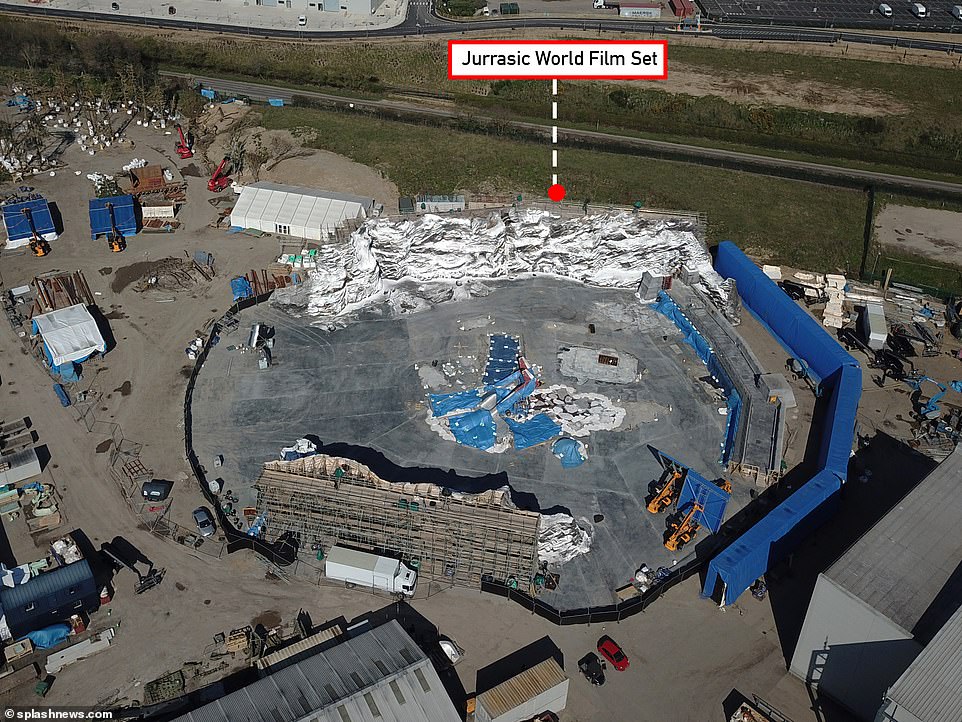
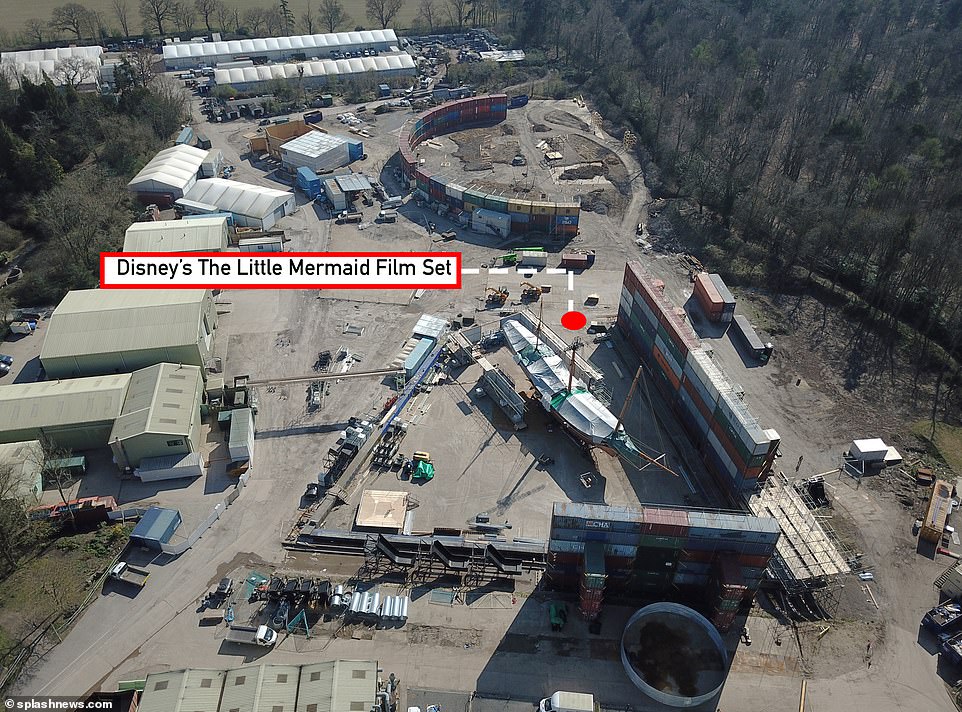
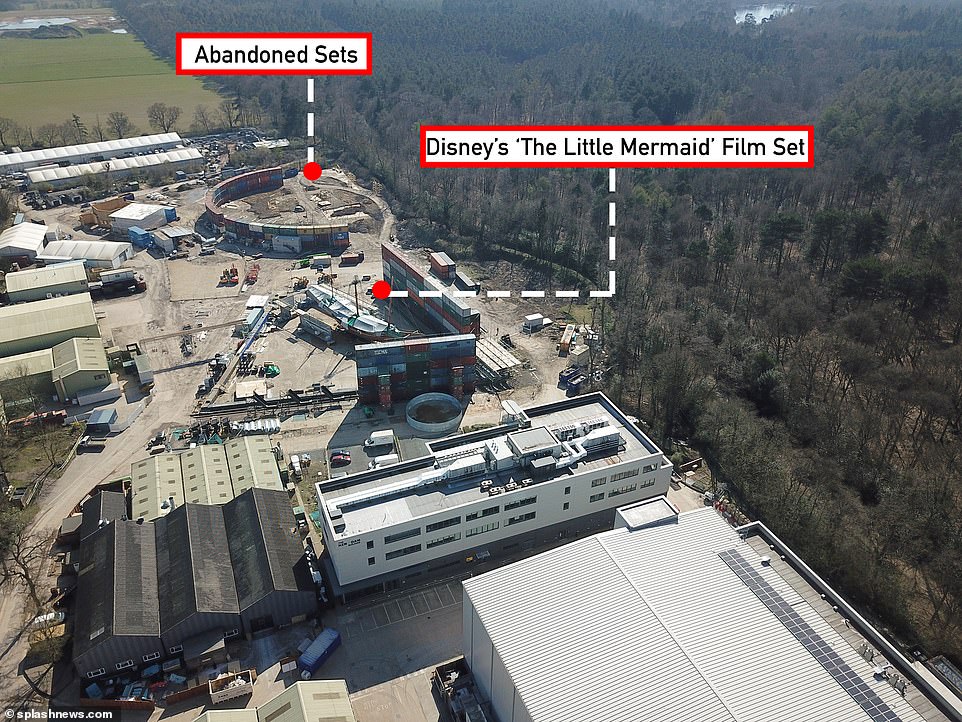
Haunting Aerial Pics Show Little Mermaid And Jurassic World Film Sets Frozen In Time In Pinewood Studios Lockdown

Sunday, March 29, 2020

HAUNTING aerial images show the film sets of The Little Mermaid and Jurassic World stopped mid-shoot amid the coronavirus lockdown.

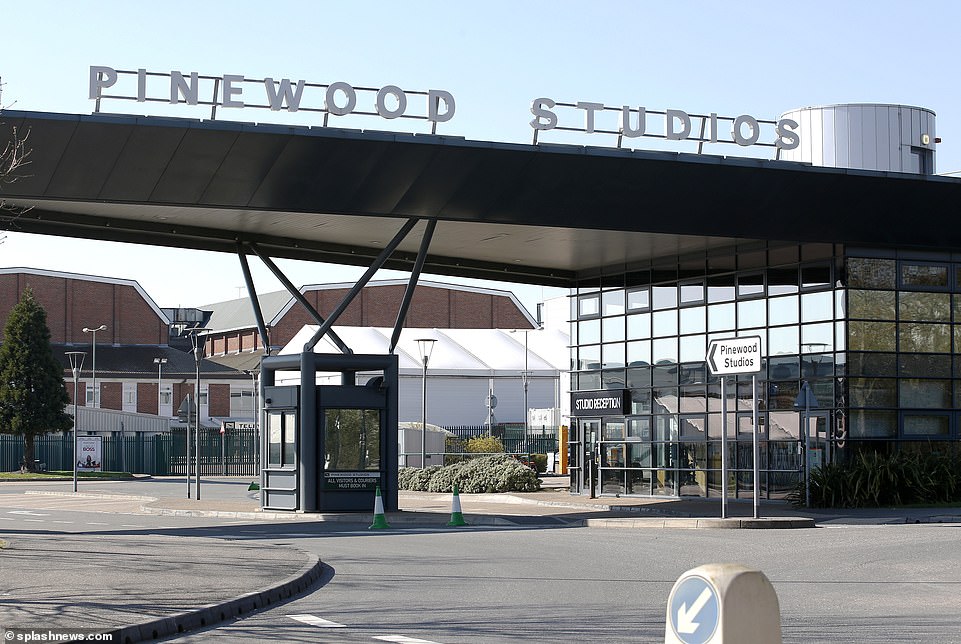
The elaborate sets at Pinewood Studios look like they were abandoned as Boris Johnson announced Britain would shut down to stop the spread of the killer virus.

Jurassic World: Dominion, which is still scheduled for release next year, is being filmed at Pinewood as well as at locations in Canada and Hawaii. It stars Chris Pratt, Bryce Dallas Howard, and Jeff Goldblum

A large ship for Disney's latest live-action film, starring Halle Bailey as the 16-year-old mermaid Ariel, is left stranded. The huge blue screens for the next Jurassic World film have also been left behind

Pinewood, which has 16 stages including the 59,202 sq ft 007 Stage, also has two TV studios, both standing at 8,988 sq ft. The Walt Disney Studios announced a 10-year lease on most of the studios last September

Filming stopped on some movies earlier this month, and it is likely the more severe restrictions announced last week saw all sets shut down.

A source told The Sun earlier in the month: "Filming just stopped today and everyone at Pinewood was sent home.

"Staff are being told the site will now be closed for 30 days starting from next Monday."

A spokesperson for Pinewood Studios said at the time: "Pinewood Group are continuing to follow guidance set out by the Government, and the studios remain fully operational."

Pinewood has been at the heart of the British movie business for 80 years, with Bond movie No Time To Die among the productions filmed on its legendary 007 stage.

Star Wars: The Rise of Skywalker, 2019's final chapter in the sci-fi hit's franchise, was also shot there in recent years.

Jurassic World: Dominion, which is scheduled for release next year, is being filmed at Pinewood as well as at locations in Canada and Hawaii.

It stars Chris Pratt and Bryce Dallas Howard, alongside Jurassic Park originals Laura Dern, Jeff Goldblum and Sam Neill.

Stark aerial photos show elaborate film sets for Jurassic World and The Little Mermaid at Pinewood Studios in Uxbridge closed after Britain was plunged into the coronavirus lockdown this week

A Pinewood Studios spokesman said: "The studios will remain open and accessible as we continue to monitor the situation regarding COVID-19.

"The health and wellbeing of our staff, productions and tenant companies is paramount, and we are following government guidance as the situation evolves.

"In line with the Government’s rules we have further reduced our workforce at the Studios to those who absolutely cannot work at home and those who ensure the well-being of all persons on-site."

Coronavirus has played havoc with many filming schedules, with streaming giant Netflix last week suspending all film and TV production.

Source: www.thesun.co.uk/

Forget Jurassic Park: Age of Reptiles is the True King of the Dinosaurs

Saturday, March 28, 2020

The Eisner-Award winning Age of Reptiles devised by artist Ricardo Delgado is a gritty, yet vibrant imagining of life during the Mesozoic period.

The comic strip medium is a tricky beast when it comes to utilizing the full potential of the craft. It can be said that, like painting or film, a good creator can use the limitations of the format while harnessing its strengths to craft an experience greater than the sum of its parts. Perhaps no series in the field of comics exemplifies this ethic better than the Eisner-Award winning Age of Reptiles, the lovingly developed dinosaur epic devised by artist Ricardo Delgado. Published by Dark Horse Comics over a span of 22 years, Age of Reptiles is a gritty, yet vibrant imagining of life during the Mesozoic period done mostly in the style of a nature documentary. Gripping, violent and unceasingly immersive, Delgado’s evolution as a storyteller over the course of the four miniseries is the real treat here - as are the incredibly detailed depictions of dinosaurs, if you like that kind of thing.

Age of Reptiles is comprised of four separate miniseries (as well as a few shorter stories), with a 12-year gap in-between the second two. Each of the series follows separate groups of saurian creatures as they vie for survival in ancient prehistory. Those of you expecting Disney shenanigans will be pleased to know that the series is entirely silent, imbuing an experiential feel to each story not unlike a program on Animal Planet.

While the presupposed realism of the piece may feel refreshing in that manner, the brutality is true to nature as well, and Delgado, formerly an artist for such Disney films such as Atlantis: The Lost EmpireThe Incredibles, and Dinosaur does not relent on this particular regard. One thing we can be pretty certain of is that dinosaurs hunted, fought, killed and ate, and even with pop culture fixtures like Jurassic Park illustrating this for the public, Delgado still manages to surprise with stunning nightmare-esque sequences of rapturous (and raptor-ous), ripping action.

But Delgado does more than that. If one great thing can be said for Age of Reptile’s later series, it is that they bring you into this world of the Cretaceous period in as immersive a way as one can hope. Portraying animals in their natural habitat without the aid of language is not an easy task, but Delgado uses a mixture of scientific realism (even to the point of coloring the ancient lizards similarly to their modern equivalents) and hyper-attention to environment and lighting to build a cohesive world complete with a sense of wonder.

Delgado has stated that the first two series, Tribal Warfare (1993) and The Hunt (1997), were comparatively amateurish compared to his later works. While certainly there is slightly more anthropomorphizing on his part in the earlier series, it’s impossible to deny his sense of drama and mastery of the elements of action that characterize the later series The Journey (2009) and Ancient Egyptians (2015).

One quality in his work Delgado exercises is that he gets in the reader's head through his panel-sequencing and taps into certain primal experiences when arranging his sequences. One great highlight would be the climactic battle of The Journey on an ancient Pacific shoreline between a mother Tyrannosaur and the terrifying sea serpent known as the Mosasaur. As this battle of the titans goes down - handily beating Game of Thrones in the depiction of dragons battling by the way - Delgado relies on the reader’s breathing to simulate the sound of beating waves coming into the beach.

Delgado best demonstrates his devotion to hyper-realism in these instances, and when combined with his detailed pencil-work, complex sequencing and flowing sense of motion, the experience thrusts the reader into the savage, yet fascinating world of his characters, characters whom, despite their huge claws, massive jaws and meat-encrusted teeth still jump off the page in their primitive pathos.

Perhaps the best exhibition of his mastery of these elements hard-won through years of television animation and storyboard work in films would be the most recent series Ancient Egyptians. The series stars a lone Spinosaurus, as it vies for survival and mating rights in a forested lagoon surrounded by hostile clades of roaming thunder lizards. An homage to both the Clint Eastwood spaghetti westerns starring “The Man With No Name” and the beautiful, breathable film-style of auteur director Akira Kurosawa, Ancient Egyptians is a hyper-violent, yet daring dive into a foreign world of monstrous creatures that feels both strange yet familiar.

Fans and lovers of both nature docs and dinosaurs can enjoy this one. Age of Reptiles can be a little grisly for kids, but can surely serve as a blunt education on how the earth existed when ruled by reptiles.

Source: https://screenrant.com/

6 Incredible Dinosaur Fossil Discoveries

Saturday, March 28, 2020

Courtesy of the Royal Tyrrell Museum of Palaeontology, Drumheller, Canada

While huge dinosaur skeletons sure look impressive towering over us in museums, there’s only so much we can learn from dusty old bones. But occasionally more striking specimens turn up bearing skin or feathers, encased in gemstones, and even preserving traces of DNA, against all odds. New Atlas rounds up some of the most incredible fossil finds of recent years.

Feathered tail

The amber preserved the feathers and the soft tissue of the dinosaur's tail, allowing the scientists to study the evolution of feathers and pinpoint the species. Royal Saskatchewan Museum (RSM/ R.C. McKellar)

Amber is great at preserving insects, although it rarely captures vertebrates. But in 2015, a truly stunning piece of amber turned up in a market in Myanmar, containing a section of a dinosaur’s tail, complete with feathers.

A total of eight vertebrae were found inside the amber, surrounded by fluffy feathers and soft tissues. Judging by CT scans, the bones and the feathers were found to be more “primitive” than those of modern birds or their relatives. Scientists were even able to take samples from the tissue where it meets the surface, and determined that it belonged to a small member of the Coelurosaur family. They also found traces of a compound from red blood cells, which you just can’t get in dusty old bones.

Whole skull in amber

A seemingly mature skull specimen preserved in Burmese amber reveals a new species, Oculudentavis khaungraae, that could represent the smallest known Mesozoic dinosaur in the fossil record. Xing Lida

On the other side of the coin, an entire skull was recently discovered encased in amber. The new species to which it belongs, named Oculudentavis, is not only the smallest dinosaur ever found, but it appears to be a kind of “missing link” to modern birds.

The creature had a beak full of sharp teeth, indicating it probably ate insects. While it looks decidedly bird-like, CT scans reveal it had quite reptilian eyes, meaning it helps patch up gaps in the evolutionary tree.

Bog-pickled brain

The discovery raises the possibility that some dinosaurs had larger brains than we thought. University of Cambridge

Soft tissues just don’t last very long, as animal or microbial scavengers eat it away. But if you keep those things away and the conditions are right, tissues can be preserved for much longer. And that’s exactly what happened to one hapless Iguanodon, who fell into a swamp 133 million years ago.

Thanks to highly-acidic and low-oxygen water, the swamp effectively pickled the dinosaur’s brain. That preserved it long enough for the soft tissue to become mineralized the same way bone does during fossilization. The end result is an exceptionally detailed look at parts of these ancient animals that we don’t normally get to see. Scientists were even able to make out the impressions of tiny features like collagen strands and blood vessels.

“Sleeping” fossil with skin and scales

The nodosaur is on display at the Royal Tyrrell Museum in Alberta, Canada. ケラトプスユウタ

Normally, the pressure of layers of rock built up over millions of years of squashes fossils flat, so it’s hard to get a sense of how dinosaurs looked as living, three-dimensional creatures. But in 2011, palaeontologists found a fossil that was so exceptionally well-preserved that it looked like it was just taking a nap.

The fossil is a new species of nodosaur, and more than just bones have been preserved. It’s wrapped in its heavy coat of armor, with skin and scales still intact, revealing that it was a reddish-brown color with a lighter belly. Not only that, its stomach contents are still in there, too, giving new insights into its diet.

This stunning nodosaur can be seen at the Royal Tyrrell Museum in Alberta, Canada.

Opalized herd

An opalized fossil of a toebone from Fostoria. Robert A. Smith, Australian Opal Centre

Fossils are mostly found imprinted in rock, but in rare cases they can actually turn up encased in opal. When that happens, it’s usually just a small shell here or a tooth there – but last year palaeontologists in Australia discovered an entire herd of opalized dinosaurs.

Opals form when silica-infused water pools in cracks and hollows in rock, eventually hardening into the shape of their container. Sometimes, those hollows are left behind after bones decay away. In this case, these blue-green shimmering gems are shaped like toes, vertebrae, shoulder blades and other bones from a new species in the Iguanodon family.

The haul contained not only 60 bones from one dinosaur – the most complete individual skeleton ever found in opal – but also opalized bones from at least three other animals, which have never been found together before.

Dino DNA

Left: Two cartilage cells shown still connected in a way that resembles the final stages of cell division. Center: A cell containing structures that resemble chromosomes. Right: An isolated dinosaur cartilage cell with red staining that indicates the presence of DNA. Science China Press

Despite what movies may tell us, DNA is far too fragile to ever be discovered from creatures that lived tens of millions of years ago. Or at least, that’s what conventional thinking says. But a recent (and somewhat controversial) study found evidence of dinosaur DNA in fossils.

While studying skull fragments from a young Hypacrosaurus, researchers discovered well-preserved cartilage cells. When they applied staining substances that bind to DNA fragments, a pattern emerged that matched what would be expected for modern cells.

The results are so groundbreaking that the results have been called into question by other scientists. But even if dino DNA is in there, it will be too degraded to do much with besides rethink our entire understanding of what can survive the ravages of time.

Source: https://newatlas.com/

Pages