nandi's blog

"Trespasser: The Lost World": Jurassic Park's Forgotten Digital Sequel

Monday, October 14, 2019

Time to revive some good old memories of this glorious flawed game. It was ahead of its time and I wish we could one day either get a remastered or a remake of this game.

The story pretty much acts both a sequel and prequel to the rest of Jurassic Park as you play a native-american woman named Anne who was left stranded on Isla Sorna after surviving a plane crash and along your travels you discover the origins of Jurassic Park via Hammond's memoirs provided by the voice talent of the late Richard Attenborough. However the game's continuity is a blend of both Film canon and Novel canon 

Unlike many shooters, you control an awkwardly coded arm to pick up your weapons. It takes some time to master the control over Anne's arm.

Follow us: PW on Instagram | PW on Facebook

Source: /www.scified.com

How The Study Of Dinosaurs Could Help Us

Monday, October 14, 2019

Spinosaurus skeleton. Credit: AFP

China’s leading paleontologist on why the country has emerged as a dinosaur hub and how the discipline can help us navigate the climate crisis.

Before he became China’s best-known paleontologist Xu Xing had wanted to be many other things: an Einstein-inspired physicist and a Shaolin monk, a Karl Marx inspired economist, and a C++ programmer. His admission letter to Peking University (PKU) indicated paleontology as his major, the only option on offer. It was a rationed spot at the famed university that was offered to only a handful of students from his home province of Xinjiang. In Xu’s mind, however, thoughts about dinosaurs were as non-existent as real ones.

Today, at 50, Beijing-based Xu is the “go-to-man in China for anything people want to know about dinosaurs,” paleontologist Paul Barrett, from London’s Natural History Museum, once said. Xu is based in the Institute of Vertebrate Paleontology and Paleoanthropology (IVPP) in Beijing under the Chinese Academy of Sciences and is credited with discovering over 70 new prehistoric species, the most for any verterbrate palaeontologist living today. One of Xu’s discoveries is the controversial four-winged Microraptor from Liaoning, discovered in 2003, which challenged the mainstream view that the ability to fly, as it developed in ground-dwelling dinosaurs, was powered to lift the reptiles off the ground. Xu’s Microraptor offered a different position: that flight developed with dinosaurs who were gliding down from trees. “Nearly 15-20 years later, we have new data and new analysis to support our hypothesis,” he says.

Outside the ninth floor window of Xu’s office, Beijing’s skies are hazy with pollution. Fossils from South Korea, part of his ongoing research, are lined neatly near a microscope. Xu agrees that paleontology research, unlike cutting edge communication technologies, is not going to boost the country’s GDP. “For the general public, the very first question would be: what’s the use of this? Science is basically about understanding the world we live in at a fundamental level, but also, in building a knowledge system. Paleontology is part of this big knowledge system. It can help human beings better survive in the future.”

The last two decades have witnessed active digging and excavating globally, says Xu, but China has somehow emerged as the hub for dinosaurs. “The reason that is China and some other countries were less explored previously, so the discoveries here are more likely to be new ones which also makes it scientifically more important,” he says.

Fossils have been discovered across 21 of China’s 34 provinces and autonomous regions. In a recent talk at the Polish Embassy in Beijing, Xu said the discoveries span periods of 200 to 66 million years ago, from the Early and Middle Jurassic hotbeds in Sichuan and Yunnan provinces, to the Cretaceous fossils at Liaoning. In fact, Zhucheng in Shandong province has the largest dinosaur fossil find where 7,600 fossils were recovered from a 300 m-long pit. The Zhucheng Geopark is currently closed for renovations till 2021 when it will be opened as a theme park and footprint museum.

“We were very lucky. When we started working we immediately found some new species,” he says. These discoveries are partly because of luck in spotting sedimentary rocks close to the surface. Fossils have also been uncovered at an astonishing rate as the ground gets dug up to accommodate more high-rises to meet the demands of China’s booming housing sector. Over the years, local people, too, have come forward to share their accidental finds, mostly for free.

By the mid-’90s, after a “typical” undergraduate life of not caring much for his subject, Xu developed a deep interest in paleontology. By 1999, he had co-authored a paper about the Beipiaosaurus, named after Beipiao in Liaoning province in northeast China and amongst the largest dinosaurs from the early Cretaceous period. During this time, he had learned how to camp out for 40 days in the Gobi desert, how to convert a makeshift kitchen into a portable case for fossils, and why summer is the best time to go digging. There was also a lot of luck.

“There was a time when a camera crew asked us to pretend to dig in the desert for good visuals, my colleague threw his hat in the wind to narrow down on a random spot. He started digging there and found a new species!” says Xu, with a laugh.

“The mid-90s was a very good time for doing science in China,” he says. The first big change was the internet. “If you wanted to contact people in those days outside China, the only way you can do so is by writing letters and the international post was very expensive. It was important for us to keep updated on new work in our field and the internet changed that.”

With that brought a network of the “best minds” in the field. “Paleontology is an international science and there are a lot of collaborations since you have to compare lots of different species from across the globe. For that reason you have more visitors from outside the country than other scientific disciplines in China,” says Xu.

As a climate crisis grips the world, Xu says there is much to learn from paleontology on the interactions between life and the environment. “Paleontology can do empirical study on extinction and that is really important for us to understand. Not just at an individual level but species and fossil records show multiple evidence of mass extinctions. Several palaeontologists are studying the fate of whole eco-systems. Those things without paleontology will be hard to understand,” he says.

Source: https://indianexpress.com

Dinosaur Discovery Sheds New Light On How Raptors Evolved

Saturday, October 12, 2019

A well-preserved fossil of a small, feathered “raptor” dinosaur called Saurornitholestes langstoni shows that North American raptors evolved separately from Asian raptors, including the famous Velociraptor. (Illustration: Jan Sovak)

Near-complete fossil found in Alberta reveals that North American and Asian raptors had distinct family trees.

The discovery of a nearly complete fossil of a small, feathered dinosaur in an Alberta provincial park sheds new light on how “raptor” dinosaurs evolved around the world, according to new research by University of Alberta paleontologists. 

The 76-million-year-old species, known as Saurornitholestes langstoni, was long thought to be so closely related to Velociraptor from Mongolia that some researchers called it Velociraptor langstoni

The new research, by world-renowned paleontologists Philip Currie and Clive Coy from the U of A and David Evans of the Royal Ontario Museum, illustrates how Saurornitholestes differs from Velociraptor. It also shows that Saurornitholestes had a specialized tooth for preening feathers and provides new evidence that the raptor lineage from North America that includes Saurornitholestes is distinct from an Asian lineage that includes the famous Velociraptor

“Paleontology in general is a gigantic puzzle where most of the pieces are missing. The discovery and description of this specimen represents the recovery of many pieces of the puzzle,” said Currie, who holds the Canada Research Chair in Dinosaur Paleobiology.

 “This ranks in the top discoveries of my career. It is pretty amazing.”

‘Scientific gold mine’ 

Saurornitholestes is a small, feathered carnivorous dinosaur within the dromaeosaurid family—also known as raptors—that was previously known from fragmentary remains. Discovered by Coy in Alberta’s Dinosaur Provincial Park in 2014, the new skeleton is remarkably complete and exquisitely preserved, with all the bones except for the tail preserved in life position. 

“Because of their small size and delicate bones, small meat-eating dinosaur skeletons are exceptionally rare in the fossil record. The new skeleton is by far the most complete and best-preserved raptor skeleton ever found in North America. It’s a scientific gold mine,” said Evans.

The research, which focuses on the skull, shows that the North American form has a shorter and deeper skull than the Velociraptor. At the front of the fossil's mouth, the researchers also discovered a flat tooth with long ridges, which was likely used for preening feathers. The same tooth has since been identified in Velociraptor and other dromaeosaurids.

“The new anatomical information we have clearly shows that the North American dromaeosaurids are a separate lineage from the Asian dromaeosaurids, although they do have a common ancestor,” said Currie. 

“This changes our understanding of intercontinental movements of these animals and ultimately will help us understand their evolution.”

Future research will investigate the remainder of the skeleton as well as additional analyses on the relationships between dromaeosaurids.

The study, “Cranial Anatomy of New Specimens of Saurornitholestes langstoni (Dinosauria, Theropoda, Dromaeosauridae) From the Dinosaur Park Formation (Campanian) of Alberta,” was published in The Anatomical Record

Source: https://www.folio.ca

Giant Reptiles Once Ruled Australia. Their Loss Sparked An Ecological Disaster

Saturday, October 12, 2019

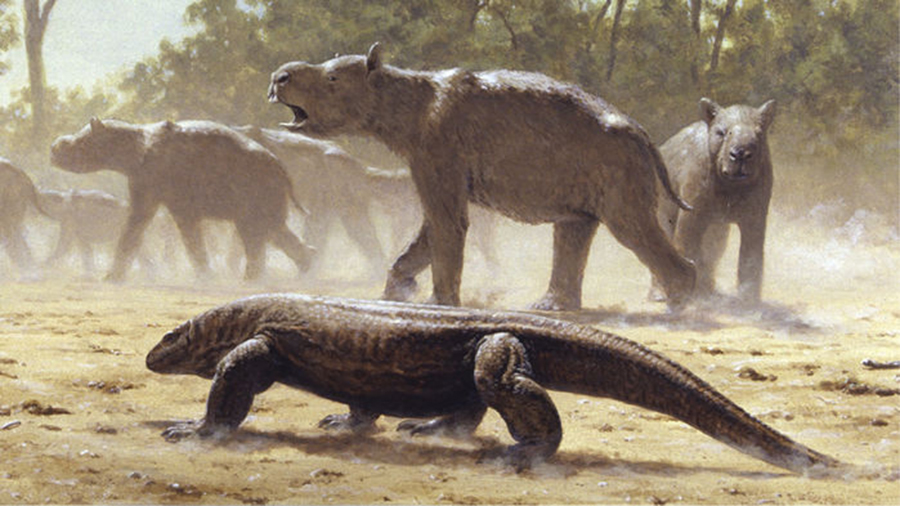
An enormous Komodo dragon relative, Megalania, stalks a herd of giant herbivorous marsupials. Credit: LAURIE BEIRNE

Saber-toothed cats, short-faced bears, and other ferocious mammals were the top predators of the ice age across most of the world. But not in Australia. Here, reptiles ruled: land-living crocs, monstrous snakes, and enormous relatives of the Komodo dragon, according to a study presented yesterday at the annual meeting of the Society of Vertebrate Paleontology here. The disappearance of these animals, the researchers argue, made room for mammalian predators to take over and set the stage for a massive extinction crisis that accelerated when Europeans arrived 200 years ago.

“Between the expansion of agriculture in Australia, which changed the landscape, and the predators that we brought in, there was no way for native animals to escape,” says Kenny Travouillon, a paleontologist at the Western Australian Museum in Perth who was not involved in the study.

The new picture emerged after Gilbert Price, a paleontologist at the University of Queensland in St. Lucia, Australia, and colleagues scoured the scientific literature on new fossil discoveries from the past 15 years or so. Added together, the finds showed that Australia had a much greater diversity of ice age reptiles than is widely accepted. These include 200-kilogram relatives of Komodo dragons, three to four times the size of those around today, and long-legged, land-living crocodiles. Price and others have also made new unpublished fossil discoveries that bolster the idea of a continent dominated by reptilian predators for much of the past 25 million years, up until at least 100,000 years ago.

“We think of the age of the dinosaurs as when reptiles like dinosaurs and crocs were dominant,” says Larisa DeSantis, a paleoecologist at Vanderbilt University in Nashville who was not involved with the research. “So, it’s exciting to think Australia was dominated by reptilian predators in its recent history.”

Travouillon says the idea that Australia was once dominated by reptiles was first proposed in the 1990s. But it fell out of favor as some research instead focused on native mammal predators, such as the marsupial lion, Thylacoleo. However, a better understanding of Australia’s fossil record is confirming “that originally the land predators were reptiles,” he says.

Most of these large reptiles, and the only large native mammal carnivores, had finally vanished by about 40,000 years ago along with Australia’s other megafauna, possibly because of changing climate. That left only small mammalian predators like the dog-size Tasmanian tiger and the even smaller Tasmanian devil to step into the role of apex predators across the continent. Price suggests these left ecosystems out of kilter.

Things got worse about 4000 years ago when people introduced the dingo, a placental mammal from Asia that was a more efficient hunter than the Tasmanian tiger or devil and quickly outcompeted them. But it was the European introduction of the cat and the red fox in the past 200 years that has caused the most damage. These animals devastated small marsupials, which had evolved alongside the reptiles but were not used to dealing with more intelligent and effective placental mammal predators.

“Our research demonstrates that it’s not normal for our continent to be dominated by placental mammals as top predators,” Price says, which have “reigned unchecked in the absence of the now-extinct ice age giants.”

The dingo was likely responsible for the loss of the Tasmanian devil and Tasmanian tiger. But cats and foxes have been implicated in the loss of 28 to 30 species and subspecies of Australian mammals in the past 200 years. “That represents 50% of global mammal extinctions over that time,” he says, “which is an absolute ecological disaster.”

And it all began with the disappearance of the ice age reptiles, Price argues. “We’re still facing the ecological fallout of their losses.”

Source: www.sciencemag.org

Why Jurassic World 3 Should Wrap The Original Cast's Stories For Good

Sunday, October 13, 2019

How can you not get excited over the fact that Jurassic World 3 is going to mark the return of Sam Neill’s Dr. Alan Grant and Laura Dern’s Dr. Ellie Sattler?! Along with Jeff Goldblum reprising Dr. Ian Malcolm again, the Jurassic Park all-star trio is reuniting to help bring some extra bang to director Colin Trevorrow’s big threequel to the Jurassic World series. If franchise fans are lucky, this will also wrap up their stories for good.

Yes, it’s awesome that Jurassic World 3 is bringing those beloved characters back, but if Trevorrow and his team are not careful, these supposedly substantial roles could be disappointing. Or worse, they could lead to an unhealthy extension of Jurassic Park’s franchise lore. If this is to be a true celebration of the franchiseJurassic World 3 should keep the following points in mind when using Alan, Ellie and Ian for their storytelling needs in the future.

The Jurassic World Series Has Done Pretty Well Without Them

The presence of Jurassic Park royalty is nothing to sniff at, considering that even as far back as when Jurassic World was announced, the world wondered if Dr. Grant, Dr. Sattler, and Dr. Malcolm would return, or even what they’d been up to, by the point of that first legacyquel. Though fans had to wait until Jurassic World: Fallen Kingdom to see Jeff Goldblum bookend that film’s events as Dr. Ian Malcolm, we still hadn’t seen Sam Neill or Laura Dern’s faces at that point.

Now that we’re getting the Jurassic band back together, it’s certainly time to celebrate! At the same time, it’s hard not to admit that Jurassic World’s first two films have worked rather well in the absence of the three doctors from Jurassic Park. While there’s certainly a respect and deep ties to the series’ past in those two films, the creative forces behind this new trilogy haven’t dwelled too much on their roots.

Jurassic World Is Really A Trilogy About Owen And Claire

If we’re telling the truth, as much as Jurassic Park’s original trilogy may have been defined by the actions of the Grant/Malcolm/Sattler triangle, Jurassic World has been defined by those adventures had by Chris Pratt’s Owen Grady and Bryce Dallas Howard’s Claire Dearing. Bringing back fan favorite characters certainly spice things up, and if this is the final Jurassic World film, it’s a fitting end.

But if the Jurassic World series is going to continue past Jurassic World 3, Owen and Claire will undoubtedly have to remain the front and center leads of the saga. Unless there’s a development that wraps up their characters up once and for all in Jurassic World 3, our intrepid leads still need to be the focus. And even if they aren’t, there’s another possibility that makes for an interesting continuation of the Jurassic saga.

Battle At Big Rock Already Set Up Some Cool New Jurassic World Characters

With the short film Battle At Big Rock, director Colin Trevorrow and co-writer Emily Carmichael bridged the gap between Jurassic World: Fallen Kingdom and Jurassic World 3’s future story. In that mini-adventure, there was a concentrated dose of character development and action-adventure that built up the presence of a new family in the Jurassic World saga.

If anyone should take over the Jurassic World saga after Owen and Claire depart, the family unit led by André Holland’s Dennis and Natalie Martinez’s Mariana should be given the first shot to take the reins. In such a short span, their characters and their children created a compelling narrative that packed a Jurassic franchise punch; so naturally people are going to be curious what they’ll get up to in the future.

It Would Make Their Appearance in Jurassic World 3 Mean Something

Bringing back Sam Neill, Laura Dern, and Jeff Goldblum in Jurassic World 3 is a pretty momentous occasion. Now that it’s actually happening, it could be a moment that tips events in the franchise into larger territory than has ever been charted in the legacyquel saga. With those sorts of stakes, it’s important to know where you’re going with your characters, and part of that intent should be to make sure this appearance actually means something to the series.

Jurassic World 3 shouldn’t be an excuse to try and work these characters back into the fabric of the entire series. Rather, it should be a fitting close to their adventures, with an ending that rights their fates once and for all. Otherwise, it cheapens the memory of Dr. Grant, Dr. Malcolm and Dr. Sattler, and turns a cool story idea into stunt casting.

Their Appearances In Jurassic World 3 Would Be A Fitting End To The Series

The future of the Jurassic World saga past the third entry in the series is unknown. While there’s certainly a potential for huge developments past Jurassic World 3, the real question is should it continue beyond Colin Trevorrow’s return to the franchise? Should this be the end, bringing in the Jurassic Park trio would not only be a fantastic end to their respective stories, it would be a perfect ending for the story that Jurassic World is trying to tell on the whole.

Resolving the story of John Hammond’s dream park and the consequences of its success have been the driving force of all the events leading up to Jurassic World 3. No one would be better qualified to sew up the series in style than the legendary characters that first experienced that dream and the fallout firsthand. The three doctors who saw Jurassic Park come to a disastrous end have enough clout and knowledge to send things off for good, and in the most fitting way possible.

Drs. Alan Grant, Ellie Sattler and Ian Malcolm have all remained pillars of the Jurassic Park lore, despite their roles being omitted or limited in the Jurassic World films. Jurassic World 3’s inclusion of their characters shouldn’t be used merely in the name of boosting box office grosses, or worse, to draw them into a series of increasingly ridiculous adventures.

To focus solely on their characters would be detrimental to everything built on the back of Owen Grady and Claire Dearing’s adventures thus far, as well as the entire Jurassic series. Whether it’s to close out the Jurassic World series in total, or to help set the stage for the next evolution of the franchise, having Jurassic Park’s legendary characters should be a temporary measure, rather than a long term strategy for continuing the trajectory of the film series they helped build.

Jurassic World 3 bursts into theaters on June 11, 2021. However, if you’re looking for an adventure to enjoy in the meantime, you can check both the 2019 release schedule, as well as the calendar for 2020. It’s going to be a bit of a wait, and you don’t want to miss out on any of the fun during the interim!

Source: www.cinemablend.com

Next Big Luxury Design Trend? Think Dinosaur Fossils

Friday, October 11, 2019

Article image credited to Getty Images | Andrew Howe

Homeowners are showing interest in dinosaur fossils as one-of-a-kind fixtures sure to spark interest and envy.

Imagine walking into a luxury listing — the glimmer of exquisite chandeliers, the smell of freshly-cut flowers and hand-crafted candles, a picture-perfect view of a private beach or bay, and a dinosaur?

According to recent reports in the Wall Street Journal and National Geographic, luxury homeowners and buyers are showing interest in dinosaur fossils as one-of-a-kind fixtures sure to spark interest and envy.

“Private fossil collectors are pretty common these days,” National Geographic reporter Richard Conniff writes in the October issue of the magazine. “Some are serious enough to pass for professional paleontologists. The passion for paleontology among private collectors means that dinosaurs and other fossil giants can turn up in homes and businesses almost anywhere.”

Conniff found private collectors in the United States, Europe, and Asia with some shelling out millions for authentic full-body fossils of Allosauruses, Ichthyosauruses, Stegosauruses, and Tyrannosaurus rexes.

“I was amazed by these dinosaur skeletons in the middle of New York,” Henry Kriegstein told Nat Geo while standing under a 17-foot-long Mosasaur suspended in his bay-side living room.

Kriegstein said the investment in the Mosasaur was worth it as it gave him and his family “a very spiritual feeling of connection with the history of life.”

Another collector, who remained anonymous, said his recent purchases of two full skeletons and a skull wouldn’t be on display in his main residence. Instead, he’d display them in his private museum located on his Tucson, Ariz. estate.

Homeowners aren’t the only ones interested in the giant reptiles that once ruled the Earth — a real estate developer is hoping a $1.5 million Allosaurus will make his newly-built $37.95 million Beverly Hills mansion stand out in an uber-competitive Los Angeles luxury market.

The 12,500-square-foot home has five bedrooms, a wellness center with a sauna and steam room, a movie theater and game room, a 1,000-foot-long driveway, and 10,000 square feet of outdoor space opening to a pristine view of downtown LA.

Even with all of those features, developer Tim Ralston of MLR Development thought the home still needed a special touch.

“It seems like there is a desire among some of these high-end homeowners to have a distinctive visual feature as a focal point of the home,” Ralston told the Journal.

Ralston partnered with a private collector to borrow the 155-million-year-old dinosaur, which is carefully placed in the entry hall underneath a dazzling array of golden orbs hanging from the ceiling.

The Allosaurus isn’t included in the $37.95 million price tag, but it can be bought separately, explained listing agent Stefan Pommepuy of The Agency.

“We’re launching it today, and today is our big twilight VIP event, so we haven’t actually taken buyers through the space just yet,” Pommepuy added during a phone call with Inman.

“But based on feedback, people find it intriguing, cool, innovative and sexy.”

Although eye-catching, maintaining an authentic dinosaur skull or skeleton takes plenty of work, and paleontologists often worry that inexperienced collectors may damage fossils.

Furthermore, the trend has also the fueled counterfeit fossil market and has opened the door for authentic fossils to be illegally excavated and sold on the black market.

“Assorted scandals—faked specimens from China, illicitly smuggled dinosaur bones from Mongolia, and careless or illegal excavations everywhere—have sustained the hostility of some academic paleontologists toward private collectors,” according to the National Geographic report. “So has the tendency to treat precious fossils merely as aesthetic objects, or worse.”

With that in mind, some paleontologists and curators have begun to work with private collectors — teaching them the tricks of the trade and even convincing them to donate their fossils to museums — in exchange for a tax deduction, of course.

“Dinosaurs are ‘not really conducive to the home environment and are not easy to dust,'” one curator told National Geographic.

Source: www.inman.com

Paleontological Surprise: Gigantic Predator Dinosaur May Have Arisen in Asia

Friday, October 11, 2019

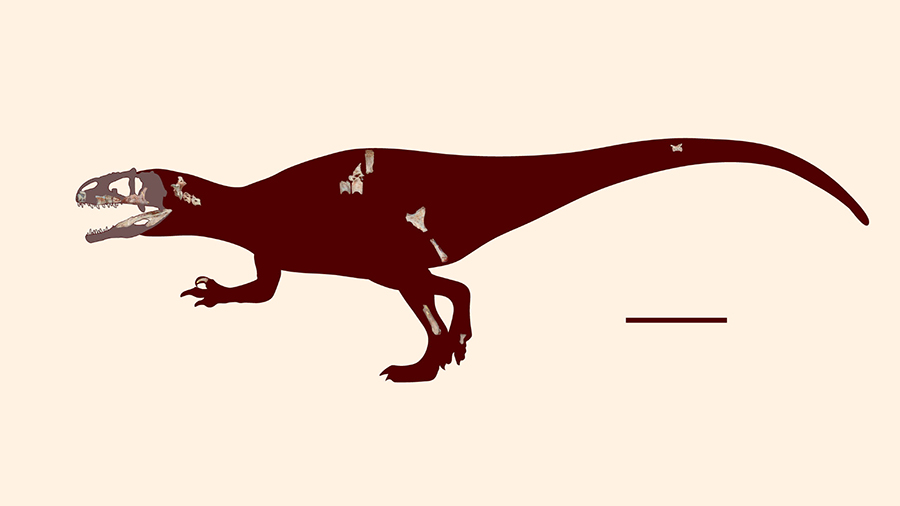
Skeletal reconstruction of Siamraptor suwati. Scale bar – 1 m. Image credit: Chokchaloemwong et al, doi: 10.1371/journal.pone.0222489.

Meet Siamraptor: Bigger than T. rex and cousin to allosaurs, a previously unknown, primitive form of Carcharodontosaurus was found in Thailand for the first time.

Before the great and powerful T. rex came the even greater and more powerful allosaurid offshoot known as carcharodontosaurus, a cousin of allosaurus but as much as four times bigger. Carcharodontosauruses were known to bite each other in the head and to have bedeviled North America, Europe and Africa.

Now the discovery of carcharodontosaurus fossils in Thailand, and a relatively primitive sort at that, suggests that this mega-predator with gigantic serrated fangs may have arisen in Europe – and Southeast Asia. The discovery of the carcharodontosaurus remains and the new origin theory were reported Wednesday by Dr. Duangsuda Cholchaloemwong of Nakhon Ratchasima Rajabhat University and colleagues in PLOS One.

The specimens found at the Khok Kruat formation in Thailand, dating to the Cretaceous period, were a previously unknown species of carcharodontosaurus that the team named Siamraptor suwati.

Siam means Thailand, raptor means robber and suwati is for Suwat Liptapanlop, a donor to paleontological research. Siamraptor apparently lived in a river basin, Cholchaloemwong tells Haaretz.

The continents Laurasia-Gondwana, 200 million years ago. Credit: United States Geological Survey

Although the Japanese-Thai paleontological team didn’t find a whole Siamraptor, they found a number of bone fragments from four individual specimens. Crucially, these included jawbones, vertebrae, and bits of hip, limbs and tail.

Given certain primitive characteristics relative to other carcharodontosaurus species, Siamraptor indicates that the clade may have evolved in the central-eastern parts of Laurasia – the northern supercontinent that encompassed the land masses known today as North America, Europe and Asia. Since carcharodontosauruses were found in North Africa – Niger, Morocco, Algeria and Egypt – an early type evidently also reached Gondwana, the even bigger supercontinent that encompassed the current  Africa and Arabia, South America,  Antarctica, Australia, and Indian subcontinent.

The origins of the great predatory dinosaurs are murky, because despite all their popularity, the truth is that not many specimens have been found, let alone good ones. Tyrannosaurs may have originated as much as 160 million years ago and at most (as far as is known) they could grow to 12 meters in length. In North America carcharodontosaurus  and T. rex did coexist, Cholchaloemwong confirms – but in any case it seems the Carcharodontosaurus came first. And the biggest carcharodontosaurus, found in what is today North Africa (C. saharicus) could be as long as almost 14 meters in length.

The newly recognized Siamraptor is a basal species, though lived about 115 million years ago, apparently – well after the group arose. It was a mere eight meters long and three meters tall, Cholchaloemwong tells Haaretz. In this context basal means that Siamraptor’s split off very early from the rest of the carcharodontosauria, Cholchaloemwong says.

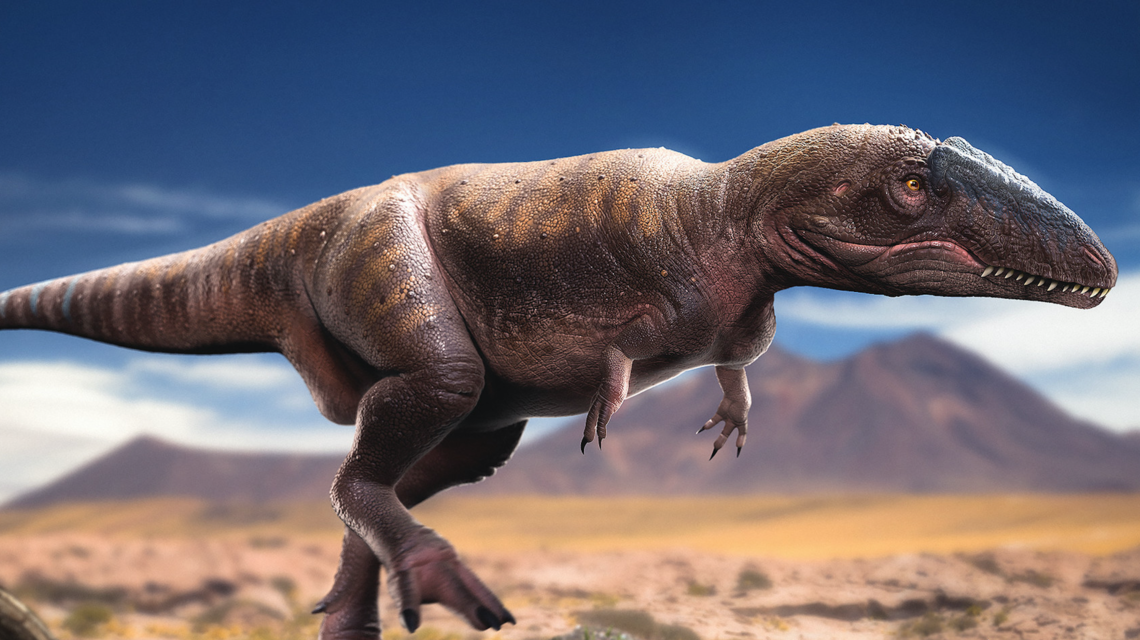
Life restoration of C. saharicus Carcharodontosaurus reconstruction. Credit: Fred Wierum

Big in Siam

In contrast to other mega-predators, carcharodontosaurus had a remarkable skeletal pneumatic system, the authors write – which turns out to mean, their bones were reminiscent of those of birds, which are characterized by air sacs.

This light skeleton may have meant that although the creature weighed about 7 tons, Carcharodontosaurus was nifty and could move fast, Cholchaloemwong says. We may never know who was the biggest at the Cretaceous ball, nor does it matter. All these species - Carcharodontosauruses, allosaurs, tyrannosaurs and giganotosaurs could eat you in a single bite and spit out your shoes.

But the cliché that it’s not a competition isn’t quite true. It was. Separate research estimated that because of their enormous size and appetite, each carcharodontosaurus would have needed about 500 square kilometers of territory. Numerous forensic studies detected deep bite marks on the skulls and bodies of the therapod monsters, including Carcharodontosauruses, that were apparently caused by other therapod monsters. In the case of inter-species aggression, the battles could have been over territory or in order to eat – there’s no rule that one dinosaur couldn't eat another. In fact some suspect the tyrannosaurus rex of being a cannibal.

Siamraptor skull reconstruction. Credit: Chokchaloemwong et al., 2019

Intra-species aggression could have been over territory, females, or – again – predation.

If these giants were biting each other for the sake of predation rather than to protect their territory, they would have had their work cut out for them. A study by Donald Henderson at the Royal Tyrrell Museum estimated that a carcharodontosaurus could lift a maximum of 424 kg (935 pounds) with its jaws – about the size of a grizzly bear. Or a half-grown hippo.

Wondrously, this dinosaur could open its mouth very wide, a little bit like snakes can, in its case thanks to loosely articulated jaw bones, all the better to bite its prey. Or each other in the head.

So if carcharodontosaurus came first and was bigger and entirely just as impressive, why does everybody and his dog know about the T-rex and allosaur, but not the carcharodontosaurus? Nomenclature, science, nomenclature. If you want your animal to be known, give it a name people can pronounce. Siamraptor fits the bill. Wait for it: Siamraptor vs Predator vs Alien.

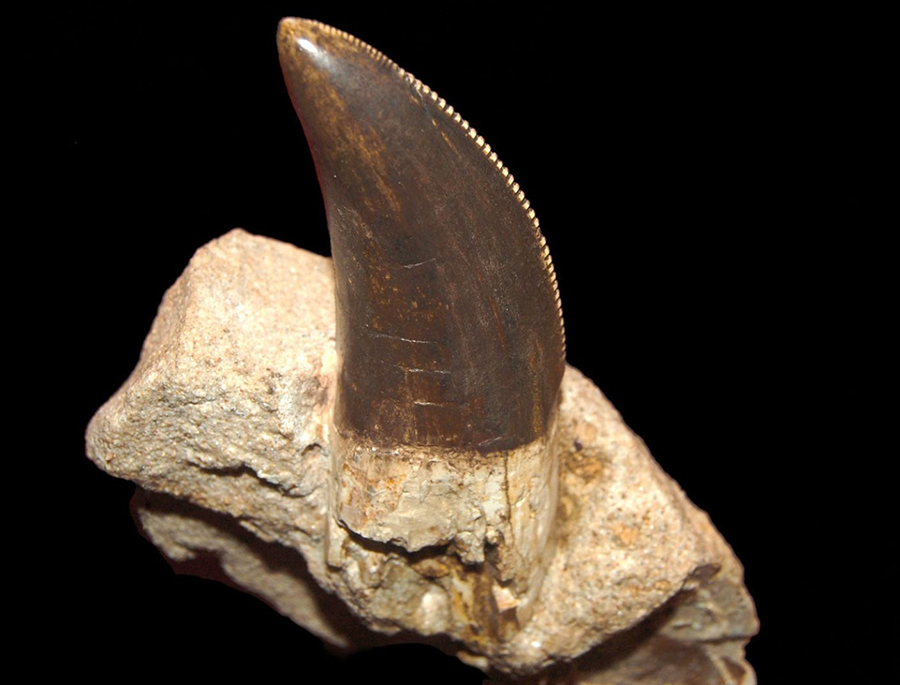
Carcharodontosaurus tooth, kept at the Naturhistorisches Museum Vienna. Credit: Gyik Toma (Tommy) / the paleobea

Source: www.haaretz.com

Canada's Best Selling Coins Are Dinosaur Themed & They Are The Coolest Thing

Thursday, October 10, 2019

canadianmint | Instagram

The collection is called 'Dinosaurs of Canada' and it's a pretty good deal!

The Royal Canadian Mint has just revealed their best-selling coins of the week, and number one might be the best thing that you see today! In the top spot is a three-piece coin collection called ‘Dinosaurs of Canada,’ and it is literally everything that you didn’t even know you wanted. With free shipping and three coins in the pack, maybe it’s time to take up a new hobby?

After allowing Canadians to get all nostalgic over their Transformer coins earlier this year, the Royal Canadian Mint is now back at it again with some pretty wild dinosaur coins that will totally have you reminiscing about your childhood.

Already available on their website, the three-coin set features three different prehistoric wonders, all on 25-cent coins. The collection is described as being, "A fun set of special-themed 25-cent coins that celebrate Canada’s prehistoric past".

Better still, the collection is totally Canadian. The description reads, “Tucked inside an exhibit-ready pop-up folder, these special-themed coins feature three different dinosaurs that were discovered in Canada—the proof is in their names!”

According to the product description, the Canadian dinosaurs featured in the collection are a "spiky Edmontonia longiceps", "a Pachyrhinosaurus canadensis charging headlong at a rival", and a "hungry Albertosaurus sarcophagus".

The intention behind the set is to give collectors a little taste of what Late Cretaceous Canada looked like, between 72-68 million years ago.

The coins are also on a bit of a sale right now. For just $19.95, as a three-coin set, they currently come with free shipping. It’s almost a no brainer if you're a dino or coin lover. 

Better still, other buyers and collectors have given the coins a star rating of almost five out of five, so it’s a pretty good purchase to get the ball rolling if you’re a new collector.

To view the full collection, you can visit the Royal Canadian Mint website by clicking here.

Source: www.narcity.com

Siamraptor suwati: New Giant Carnivorous Dinosaur Unveiled

Friday, October 11, 2019

Siamraptor suwati. Credit: Marcio L. Castro

Paleontologists have announced the discovery of a new genus and species of carcharodontosaurian dinosaur, based on the fossilized remains found in Thailand.

Dubbed Siamraptor suwati by its discoverers, the newly-discovered dinosaur lived approximately 120 million years ago (Cretaceous period).

The ancient creature was a member of Carcharodontosauria, a group of large carnivorous dinosaurs from the Jurassic and Cretaceous periods.

In fact, Siamraptor suwati is the oldest carcharodontosaurian dinosaur known and is the first of its kind from Southeast Asia.

Skeletal reconstruction of Siamraptor suwati. Scale bar – 1 m. Image credit: Chokchaloemwong et al, doi: 10.1371/journal.pone.0222489.

The fossilized remains of at least four Siamraptor suwati individuals — skull, backbone, limbs, and hips — were recovered from the Khok Kruat Formation in Nakhon Ratchasima province, Thailand.

The fossils were analyzed by Dr. Duangsuda Chokchaloemwong of Nakhon Ratchasima Rajabhat University and her colleagues from Thailand and Japan.

“The phylogenetic analyses revealed that Siamraptor suwati is a basal species of Carcharodontosauria, involving a new sight of the paleobiogeographical context of this group,” the paleontologists said.

Siamraptor suwati is the best preserved carcharodontosaurian theropod in Southeast Asia, and it sheds new light on the early evolutionary history of Carcharodontosauria.”

Locality map of new theropod material and stratigraphy of Khorat Group: A – map of Nakhon Ratchasima Province, Thailand; B – distribution map of the Khok Kruat Formation in Nakhon Ratchasima Province; C – enlarged locality map of Suranaree and Khok Kruat subdistricts with the subdistrict boundaries; D – a photograph of the excavation site; E – stratigraphic column of the Khorat Group. A red-colored star indicates the new theropod locality, the dotted lines indicate the subdistrict boundaries, and the gray-colored lines indicate the roads in C, respectively. Image credit: Chokchaloemwong et al, doi: 10.1371/journal.pone.0222489.

The team’s paper was published online October 9, 2019 in the journal PLoS ONE.

_____

D. Chokchaloemwong et al. 2019. A new carcharodontosaurian theropod (Dinosauria: Saurischia) from the Lower Cretaceous of Thailand. PLoS ONE 14 (10): e0222489; doi: 10.1371/journal.pone.0222489

Source: www.sci-news.com

Revealed: Icthyosaur Fossil Hidden For 170 Years Due To Religious Concerns

Monday, October 7, 2019

Ichthyosaur skeleton

A fossil of a prehistoric sea marine reptile, the Ichthyosaurus, has finally been revealed after staying hidden for 170 years by God-fearing individuals who didn’t want to make any waves in their community by showing up with 160 million-year-old evidence of life in tow.

Religions have historically not been too open about new scientific findings which clash with established dogma. So when a family in England in 1850 inadvertently unearthed a prehistoric fossil, an Ichthyosaurus, to be precise, they promptly re-buried it because it flew in the face of the religious teachings the family held dear. And the find preceded Charles Darwin and his theory of evolution by a few years, so one can only imagine how mystified these folks were at the sight of this enormous, lizard-like fish skeleton.

In fairness to the Temperley clan, of Somerset, the discovery must be framed within the context of their times, Victorian England, a time in which faith ruled communities and folks believed their origin stories lay in the Bible. Understanding the period in which they lived makes the reasons they re-buried the fossil all the more clear.

CGI restoration of Ichthyosaurus communis

Now, however, the fossil is the family’s pride and joy, and more than that, it’s part of their brand and business. Julian Temperley is the head of the family’s distillery, which makes brandy cider, and he is featuring the fossil on an array of product logos. How times have changed!

He told the story of how his ancestors first discovered the Ichthyosaurus in an interview with IFL Science, a web page devoted to science and nature. He explained how his relatives first found the fossil on their property in 1850.

Initially, they took it back to the family home, where everyone marvelled over this curious object. But they felt keeping it, or trying to understand what it actually was, or displaying it, was “denying god,” Temperley said. Hence, they took it back to the quarry where it had been unearthed and promptly re-buried it.  “Fossils weren’t really explained until Darwin came along,” Temperley said. “Up until then, if you believed in fossils you were denying the Bible.”

Over the ensuing decades, he added, “whenever we visited Somerset as kids, we dug it up and were generally amazed.” As the years passed and the strictures of the church loosened, the family came to realize the fossil was something to be prized, and shown.

But it was an act of nature, a flood in 2013 — 2014, that was the deciding factor in the skeleton’s favour. “We realized it was not a good idea to leave it buried,” Temperley told IFL Science. “I thought we ought to look after it.” Consequently, he spent more than $3,500 (USD) to have the skeleton fully restored and mounted.

Hawkins' specimens are still the showpieces of the Natural History Museum

But the “fish lizard” is paying him back, as it’s now an integral part of his family’s brand of brandy cider. “Putting it with ageing spirits,” Temperley noted wryly, “seems like the right thing to do.”

Although the hidden fossil of the Ichthyosaurus found on the Temperley property so long ago is a rare discovery, the 90 million year old remains are not the only one of their kind. Though the creature has been extinct for many centuries, the longest skeleton found was almost 11.5 feet, discovered by an archaeologist in the 1990s.

That one hangs at a museum in London, and while it may be the largest, it doesn’t have the distinction of adorning a family label — that unique honour goes only to the Temperley creature, truly one of a kind.

Source: www.thevintagenews.com

Pages