nandi's blog

Westworld Hints That JURASSIC PARK Exists In The Show’s Universe

Wednesday, March 25, 2020

The latest episode of Westworld hints that a version of Jurassic Park might exist in their universe, thanks to the Game of Thrones showrunners.

The latest episode of Westworld included a surprising Game of Thrones crossover, and also suggested that Jurassic Park exists - or is at least being being created - in the same universe as well. Westworld's third season takes the hosts outside the web of park realities. Dolores (Evan Rachel Wood) brought several hosts with her to the outside world in order to take vengeance out on humanity.

In Westworld season 3, episode 2, "The Winter Line," Bernard (Jeffrey Wright) goes back to look for Maeve (Thandie Newton). During Bernard's search, he walks through a floor of Delos technicians, working on animatronics while they wait for layoffs. In a surprise cameo, two technicians were played by Game of Thrones showrunners David Benioff and D.B. Weiss, who were dismantling a Drogon bot to sell for parts.

This Westword/Game of Thrones crossover is shocking enough, however, the show also used the cameos to tease the existence of Jurassic Park. D. B. Weiss's technician mentions he plans to sell the dragon to a start-up in Costa Rica. In Jurassic Park, the fictional island where John Hammond establishes the park is off the Costa Rican coast. This island is also the home to the dinosaurs of the reboot series Jurassic World. Neither technician in this Westworld scene mentions the Costa Rican island by name, but it's hard to imagine anywhere else that would want - or could spare no expense on - such a huge animatronic. This version of Drogon, then, would be the basis for creating robotic dinosaurs in the new Jurassic Park, with their own techs able to use the existing parts and tissue.

Obviously, the Westworld version of Jurassic Park would be quite different. The Jurassic Park dinosaurs are brought to life through genetically altered frog DNA, not robotics. However, in the future timeline of Westworld, it makes a lot of sense for a Jurassic Park-like attraction to open up. Even though the Westworld revolt was horrifying, it hasn't stopped Delos from continuing operations. In a world where robotics and artificial reality are not only feasible, but incredibly profitable, Delos would naturally inspire copycat "start-ups." Even if this iteration of Jurassic Park isn't an exact replica of the park seen in the film, it would no doubt come to the same bloody ending.

The existence of Jurassic Park in Westworld is fun to imagine, particularly because of how both stem from the mind of Michael Crichton. Crichton wrote and directed the original Westworld film in 1973, and wrote the Jurassic Park novel in 1990. In a way, the original Westworld already inspired Jurassic Park. Both properties deal with the hubris of man, creating things that destroy them in the end. While there is a difference between the usage of technology to create, both properties utilize their fantastical settings in similar ways.

Whatever it ultimately means, Westworld's fun Game of Thrones Easter egg manages to add an additional layer with one quick line. This type of cameo is meant in good fun more than anything else. However, it's still a nice tribute to an iconic HBO series and an all-time classic film. That said, if Drogon is going to an iteration of Jurassic Park, then hopefully the island doesn't have any bells.

Source: https://screenrant.com/

Ikaria wariootia: Oldest Bilaterian Fossil Found in Australia

Wednesday, March 25, 2020

Reconstruction of Ikaria wariootia in life position. Image credit: Sohail Wasif / University of California, Riverside.

Ikaria wariootia, a wormlike creature that lived more than 555 million years ago (Ediacaran period) in what is now Australia, is the earliest bilaterian, according to new research led by University of California, Riverside researcher Scott Evans.

Bilaterians are animals with bilateral symmetry as an embryo, i.e. having a left and a right side that are mirror images of each other. They have a head and a tail as well as a back and a belly.

The development of bilateral symmetry was a critical step in the evolution of animal life, giving organisms the ability to move purposefully and a common, yet successful way to organize their bodies.

A multitude of animals, from worms to insects to dinosaurs to humans, are organized around this same basic bilaterian body plan.

Evolutionary biologists studying the genetics of modern animals predicted the oldest ancestor of all bilaterians would have been simple and small, with rudimentary sensory organs.

Preserving and identifying the fossilized remains of such an animal was thought to be difficult, if not impossible.

For 15 years, paleontologists agreed that Helminthoidichnites, fossilized burrows found in Ediacaran-period deposits in Nilpena, South Australia, were made by bilaterians.

But there was no sign of the creature that made Helminthoidichnites-types burrows, leaving scientists with nothing but speculation.

Dr. Evans and colleagues noticed miniscule, oval impressions near some of these burrows.

They used a 3D laser scanner that revealed the regular, consistent shape of a cylindrical body with a distinct head and tail and faintly grooved musculature.

Dubbed Ikaria wariootia, the animal ranged between 2-7 mm long and about 1-2.5 mm wide, with the largest the size and shape of a grain of rice — just the right size to have made the burrows.

Type specimen of Ikaria wariootia from Nilpena, including (A) photograph; and (B-D) 3D laser scans; notice distinct bilateral symmetry (wider end identified by white star in C and deeper end by black star in D). Scale bars – 1 mm. Image credit: Evans et al, doi: 10.1073/pnas.2001045117.

“We thought these animals should have existed during this interval, but always understood they would be difficult to recognize. Once we had the 3D scans, we knew that we had made an important discovery,” Dr. Evans said.

“Burrows of Ikaria wariootia occur lower than anything else. It’s the oldest fossil we get with this type of complexity,” said University of California, Riverside’s Professor Mary Droser.

“Dickinsonia and other big things were probably evolutionary dead ends. We knew that we also had lots of little things and thought these might have been the early bilaterians that we were looking for.”

In spite of its relatively simple shape, Ikaria wariootia was complex compared to other fossils from this period.

It burrowed in thin layers of well-oxygenated sand on the ocean floor in search of organic matter, indicating rudimentary sensory abilities.

The depth and curvature of Ikaria wariootia represent clearly distinct front and rear ends, supporting the directed movement found in the burrows.

The burrows also preserve crosswise, V-shaped ridges, suggesting Ikaria wariootia moved by contracting muscles across its body like a worm, known as peristaltic locomotion.

Evidence of sediment displacement in the burrows and signs the organism fed on buried organic matter reveal Ikaria wariootia probably had a mouth, anus, and gut.

“This is what evolutionary biologists predicted. It’s really exciting that what we have found lines up so neatly with their prediction,” Professor Droser said.

The study was published in the Proceedings of the National Academy of Sciences.

_____

Scott D. Evans et al. Discovery of the oldest bilaterian from the Ediacaran of South Australia. PNAS, published online March 23, 2020; doi: 10.1073/pnas.2001045117

Source: www.sci-news.com/

Asteriornis maastrichtensis: Meet Wonderchicken, Bird from Final Part of Dinosaur Era

Tuesday, March 24, 2020

Asteriornis maastrichtensis is the first modern bird from the age of dinosaurs found in the northern hemisphere. Image credit: Philip Krzeminski.

A new species of ancient bird has been identified from a nearly complete, three-dimensionally preserved skull and associated bones found in Belgium. A detailed analysis of the skull shows that it combines landfowl- and waterfowl-like features, suggesting that the bird is close to the last common ancestor of modern chickens and ducks.

Nicknamed the Wonderchicken and scientifically named Asteriornis maastrichtensis, the prehistoric bird lived 66.75 million years ago (Cretaceous period).

Its fossilized remains were discovered in a limestone quarry near the Belgian-Dutch border.

“The moment I first saw what was beneath the rock was the most exciting moment of my scientific career,” said Dr. Daniel Field, an evolutionary paleobiologist in the Department of Earth Sciences at the University of Cambridge.

“This is one of the best-preserved fossil bird skulls of any age, from anywhere in the world. We almost had to pinch ourselves when we saw it, knowing that it was from such an important time in Earth’s history.”

“Finding the skull blew my mind. Without cutting-edge CT scans, we never would have known that we were holding the oldest modern bird skull in the world,” said co-author Juan Benito, a researcher in the Department of Earth Sciences at the University of Cambridge and the Department of Biology & Biochemistry at the University of Bath.

The skull of Asteriornis maastrichtensis is clearly recognizable as a modern bird.

It combines many features common to the group that includes living chickens and ducks — a group called Galloanserae.

“The origins of living bird diversity are shrouded in mystery — other than knowing that modern birds arose at some point towards the end of the age of dinosaurs, we have very little fossil evidence of them until after the asteroid hit,” said co-author and Ph.D. student Albert Chen, also from the University of Cambridge and the University of Bath.

“This fossil provides our earliest direct glimpse of what modern birds were like during the initial stages of their evolutionary history.”

The fact that Asteriornis maastrichtensis was found in Europe is another thing which makes it so extraordinary.

“The Late Cretaceous fossil record of birds from Europe is extremely sparse. The discovery of Asteriornis maastrichtensis provides some of the first evidence that Europe was a key area in the early evolutionary history of modern birds,” said co-author Dr. John Jagt, a researcher in the Natuurhistorische Museum Maastricht, the Netherlands.

“This fossil tells us that early on, at least some modern birds were fairly small-bodied, ground-dwelling birds that lived near the seashore. Asteriornis maastrichtensis now gives us a search image for future fossil discoveries — hopefully it ushers in a new era of fossil finds that help clarify how, when and where modern birds first evolved,” Dr. Field added.

The discovery is reported in a paper in the journal Nature.

_____

D.J. Field et al. 2020. Late Cretaceous neornithine from Europe illuminates the origins of crown birds. Nature 579, 397-401; doi: 10.1038/s41586-020-2096-0

Source: www.sci-news.com/

Jurassic World 3 Director Brings In Baby Triceratops Animatronic’s Paintjob

Friday, February 21, 2020

The Jurassic World 3 director Colin Trevorrow recently shared an adorable update on one of the film’s animatronic dinosaurs.

On the social media page like Twitter, Trevorrow shared an image of a baby Triceratops. He captioned the photo by saying ‘ready’. He also added credit to John Nolan Studios for building the animatronic in a followup tweet.

The director of the Jurassic World initially shared an image of the baby dinosaur earlier this month itself. In the video, the animatronic was complete, but the main thing was that it was not painted. With the exceptions of its horns and beak, the whole model was completely white. Now, it has received a total makeover to make the whole thing look as realistic as possible.

The director has been vocal in the past about not wanting to use so much CGI. As a result of this, Jurassic World: Fallen Kingdom the second film in the franchise used more of puppets and animatronics than the first. The new photo and the footage, it seems like the third film in the franchise will continue this Jurassic Park tradition.

Jurassic World 3 will be their third film in the whole Jurassic World trilogy. The first film of Jurassic World was directed by Trevorrow, while it’s a sequel, Jurassic World: Fallen Kingdom, was helmed by J.A. Bayona. Both films went to the total gross amount of 1 billion dollars at the global box office.

The film directed by Colin Trevorrow, Jurassic World 3, which is starring Bryce Dallas Howard, Chris Pratt, Sam Neill, Laura Dern, Jake Johnson, Omary Sy, and also Jeff Goldblum. The film is very much set to be released on June 11, 2021.

That means that there is still a lot of time left, the fans of the movie have to wait around one more year for the third part to come out.

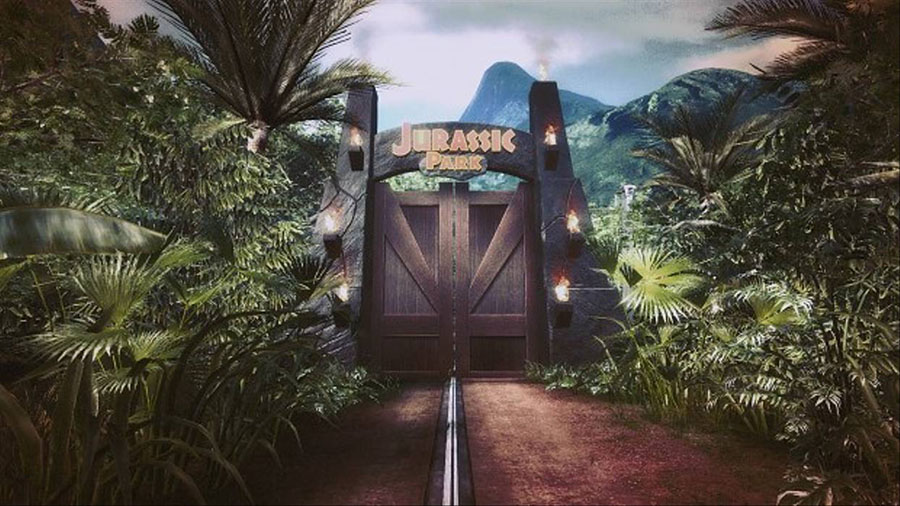
Incredible Jurassic Park Game Built In Half-Life 2 Spares No Expense

Saturday, March 21, 2020

Have you ever wondered what it might be like to explore an accurate recreation of Jurassic Park in first-person? Wonder no more, because Jurassic Life - a mod that brings the infamous park to Half-Life 2 - is now playable from beginning the end. This is an entirely original adventure, inspired by the classic movie and built in Valve's iconic FPS.

As you can see from the gameplay-filled trailer belowJurassic Life looks like it could have been made from scratch. There's barely a trace of Half-Life to be found as players explore the park and encounter a range of dinosaurs. You'll play as Robert Muldoon, a warden with one very simple task: contain the dinosaur outbreak, or die trying.

Okay, maybe simple was the wrong word. But with a range of weapons, from machetes to shotguns, Muldoon clearly has a fighting chance against the scaly hordes. Honestly, this whole project is like the Dino Crisis/Half-Life/Jurassic Park crossover I never knew I needed, and I'm fully here for it.

"In Jurassic Life, you play game warden Robert Muldoon who was hired to keep order in the quite extraordinary Jurassic Park, located on Isla Nublar," reads the trailer description. "Our story is not strictly based on the movies or novels but rather our own tale with inspiration gathered from the world of Jurassic Park"

Apparently the project was put on hold for several years, but old and new volunteers were able to come together again and finally get the game over the line. The project is expected to be available in full later this year, and you can read all about the team's amazing work so far right here.

Credit: JurassicLifeStaff

"We have accomplished the impossible," the team of volunteers wrote as part of the mod description. "The Jurassic Life story campaign finally can be played out from the very first cut-scene to the final credits. It's been a long journey but we've made it... for the most part. Before everyone takes out their champagne and party hats, we aren't at the end just yet. There is much to be refined and polished and still worked upon before final release."

With work still to be done, the team wants to make it clear that you can get involved and offer help. Simply reach out via the mod page and let them know you're willing to pitch in. After all, life... finds a way.

Featured Image Credit: Valve/JurassicLifeStaff

Source: www.ladbible.com/

Unprecedented Preservation Of Fossil Feces From The La Brea Tar Pits

Saturday, March 21, 2020

Example coprolites from Rancho La Brea (A) prior to asphalt removal with surrounding sediments, (B) showing intact pellets with plant material, (C) isolated, cleaned pellets. Figure 2, from: Mychajliw et al. 2020. Exceptionally preserved asphaltic coprolites expand the spatiotemporal range of a North American paleoecological proxy. Credit: Carrie Howard

While Rancho La Brea, commonly known as the La Brea Tar Pits, is famous for its thousands of bones of large extinct mammals, big insights are coming from small fossils, thanks to new excavation and chemical techniques.

A team of researchers from La Brea Tar Pits, the University of Oklahoma and the University of California Irvine report the first coprolites—or fossil feces—ever discovered in an asphaltic—or tar pit—context. These hundreds of fossilized rodent pellets were found during the excavation of a parking garage for the Los Angeles County Museum of Art in Hancock Park in 2016, which had also yielded the more traditional La Brea fossils, such as extinct mammoths, dire wolves and saber-toothed cats.

Alexis Mychajliw, a postdoctoral research associate at OU, is the lead author of the study. The details of the research team's findings were published in Scientific Reports.

"It's incredible that after more than a century of excavation and study, we are still unearthing new types of fossils from La Brea's treasure trove of deposits," said Emily Lindsey, assistant curator at La Brea Tar Pits. "These tiny finds may lead to big discoveries about the climate and ecosystems of Ice Age Los Angeles."

Researchers were skeptical at first, given the abundance of urban rats in the area.

"We noted the occasional rodent fecal pellet in the processed matrix before, but it was easy to explain it away as modern contamination," said Laura Tewksbury, senior preparator at La Brea Tar Pits.

But, with more and more pellets appearing encased in asphalt, Tewksbury recalled, "We stared at the sheer number of pellets in silence for a minute, before looking at each other and stating, 'There's just no way that much is contamination.'"

Indeed, radiocarbon dates generated at UC Irvine would confirm the pellets were ~50,000 years old.

Rancho La Brea has been associated with the image of big animals getting stuck in "tar pits," or shallow, sticky asphalt pools, with carnivores attracted en masse by struggling herbivore prey. But these coprolites tell a new story of how fossils can be preserved at Rancho La Brea.

"The intact nature and density of the fossils require a taphonomic explanation other than entrapment. The preservation is more likely the result of an asphalt seep overtaking an existing rodent nest," noted Karin Rice, preparator at La Brea Tar Pits.

Using a suite of cutting-edge tools, including stable isotope analysis and scanning electron microscopy, the researchers demonstrated that the fecal pellets were associated with beautifully preserved twigs, leaves, and seeds, apparently as part of an intact nest made by a woodrat. Woodrats—also known as packrats—are well-known in the paleontological community for their hoarding behavior that produces massive nests that can be preserved for thousands of years. Slices of plant material from these nests, in turn, represent snapshots of vegetation and climate conditions of the past.

"This nest provides an unparalleled view of what was beneath the feet of Rancho La Brea's famous megafauna," Mychajliw said. "And to me, it emphasizes the importance of studying small mammals, too. Woodrats survived the Ice Age and still build nests in local urban green spaces like Griffith Park! By studying these nests, we have a direct line from the past to the present through which to trace human impacts on Los Angeles' nature over time."


More information: Mychajliw, A.M., Rice, K.A., Tewksbury, L.R. et al. Exceptionally preserved asphaltic coprolites expand the spatiotemporal range of a North American paleoecological proxy. Sci Rep 10, 5069 (2020). https://doi.org/10.1038/s41598-020-61996-y

Journal information: Scientific Reports 

Provided by University of Oklahoma 

Source: https://phys.org/

Canadian Dinosaurs Stayed Put For The Winter, New Study Shows

Wednesday, March 25, 2020

Researchers compared samples of strontium signatures in teeth to arrive at results.

Study of isotopes in dinosaur teeth confirm that Late Cretaceous hadrosaurs were non-migratory.

Were Canadian dinosaurs snowbirds or locals? Until now, no techniques had been developed that could conclusively answer if Canadian dinosaurs were migratory. 

Dinosaur migration has been debated by paleontologists for decades, as similar species of dinosaurs can be found from Montana up to Alaska. As a significant amount of that area would have experienced near-total darkness during the winters, some researchers have suggested that some dinosaur species may have migrated south from Alaska and the Yukon for the winter in search of a better climate, while others have maintained that dinosaurs could tough out the Cretaceous arctic winters.

A new study by David Terrill, PhD student in the Department of Geoscience, found that — while some dinosaurs were indeed migratory — the brave creatures likely did not migrate to escape winter conditions. The study, published in the journal Biology Letters, part of the Royal Society, details part of Terrill’s thesis studying dinosaur migration, and represents the first attempt to use strontium isotopes to study dinosaur migration.  

New application of strontium isotopes key to solving mystery

Along with his supervisors and co-authors, Dr. Charles Henderson, PhD, and  Dr. Jason S. Anderson, PhD, Terrill studied the chemistry of tooth enamel of a single duckbill dinosaur. The researchers focused on a particular element, strontium, which substitutes for calcium in teeth. Strontium is an element with multiple isotopes (atoms of different masses that are otherwise identical), and these isotopes occur in different concentrations in different locations. This means that every location can have its own strontium ‘signature,’ which enters the body of animals through their food and water before becoming part of their bones and teeth.

To figure out the unique signatures of different places in Cretaceous Alberta, the researchers measured the strontium signatures from non-migrating animals, such as crocodiles and freshwater fish, from four different fossil sites in Alberta. They compared those strontium signatures to what they found in the teeth of the duckbill dinosaur. 

The study also details the probable movement range of an individual dinosaur. These results suggest that hadrosaurs were not likely to be long-range migrators, and is in agreement with past work suggesting these dinosaurs likely did not migrate to escape winter conditions. 

“The results suggest our dinosaur did migrate, though only for a short distance, and lived in an area between Dinosaur Provincial Park and Medicine Hat, a range like what can be seen in modern elephant populations,” Terrill explains.

This dinosaur was a local, through and through!

While strontium isotopes have been previously used in migration studies in archaeological materials, they have never been used to study dinosaur migration. This study represents the first of its kind to be published in a major journal, and suggests that this technique could be applied to the study of migration in other dinosaur species. Migration is an important process for animals in modern environments; having the tools to properly study migration is therefore also of great importance in paleoecology.

Funding for the research was provided by an NSERC grant to Henderson, as well as a grant from the Dinosaur Research Institute. Most of the lab work was performed in the Department of Physics and Astronomy in Dr. Michael Wieser's stable isotope lab, with some specimens provided by the Royal Tyrrell Museum in Drumheller.

Source: www.ucalgary.ca/

A 7-Year-Old Boy Drowned at Creationist Kent Hovind’s “Dinosaur Adventure Land”

Saturday, March 21, 2020

A 7-year-old boy drowned while visiting “Dinosaur Adventure Land,” Creationist Kent Hovind‘s dirt-cheap attempt at replicating the Creation Museum.

The incident happened Sunday, according to the Monroe Journal (which is behind a paywall). The boy was declared dead after ambulance workers took him to a local hospital. An autopsy is pending.

The article says that while life jackets are available near the lake, the boy wasn’t wearing one. It’s possible, Hovind told the paper, that the boy slipped on a nearby dock before falling into the water, considering there was a mark on his head (presumably a scar of some sort). For now, it appears to be an accident and there’s no indication the family plans to sue Hovind or the attraction.

It’s worth mentioning that the park is uninsured and everyone is told they’re entering at their own risk. The park itself is Hovind’s attempt to debunk evolution, which he calls the “dumbest religion in the history of the world.” In the past, I would’ve said the only things at risk are your brain cells. I guess I was wrong.

Hovind didn’t reply to a request for comment.

(Screenshot via YouTube)

Source: https://friendlyatheist.patheos.com/

Darkness, Not Cold, Likely Responsible For Dinosaur-Killing Extinction

Saturday, March 21, 2020

Roughly 66 million years ago an asteroid slammed into the Yucatan peninsula. New research shows darkness, not cold, likely drove a mass extinction after the impact. Credit: NASA

New research finds soot from global fires ignited by an asteroid impact could have blocked sunlight long enough to drive the mass extinction that killed most life on Earth, including the dinosaurs, 66 million years ago.

The Cretaceous–Paleogene extinction event wiped out about 75 percent of all species on Earth. An asteroid impact at the tip of Mexico's Yucatán Peninsula caused a period of prolonged cold and darkness, called an impact winter, that likely fueled a large part of the mass extinction. But scientists have had a hard time teasing out the details of the impact winter and what the exact mechanism was that killed life on Earth.

A new study in AGU's journal Geophysical Research Letters simulates the contributions of the impact's sulfur, dust, and soot emissions to the extreme darkness and cold of the impact winter. The results show the cold would have been severe but likely not devastating enough to drive a mass extinction. However, soot emissions from global forest fires darkened the sky enough to kill off photosynthesizers at the base of the food web for well over a year, according to the study.

"This low light seems to be a really big signal that would potentially be devastating to life," said Clay Tabor, a geoscientist at the University of Connecticut and lead author of the new study. "It seems like these low light conditions are a probable explanation for a large part of the extinction."

The results help scientists better understand this intriguing mass extinction that ultimately paved the way for humans and other mammals to evolve. But the study also provides insight into what might happen in a nuclear winter scenario, according to Tabor.

"The main driver of a nuclear winter is actually from soot in a similar type situation," Tabor said. "What it really highlights is just how potentially impactful soot can be on the climate system."

The impact and extinction

The Chicxulub asteroid impact spewed clouds of ejecta into the upper atmosphere that then rained back down to Earth. The returning particles would have had enough energy to broil Earth's surface and ignite global forest fires. Soot from the fires, along with sulfur compounds and dust, blocked out sunlight, causing an impact winter lasting several years. Previous research estimates average global temperatures plummeted by at least 26 degrees Celsius (47 degrees Fahrenheit).

Scientists know the extreme darkness and cold were devastating to life on Earth but are still teasing apart which component was more harmful to life and whether the soot, sulfate, or dust particles were most disruptive to the climate.

Credit: American Geophysical Union

In the new study, Tabor and his colleagues used a sophisticated climate model to simulate the climatic effects of soot, sulfates, and dust from the impact.

Their results suggest soot emissions from global fires absorbed the most sunlight for the longest amount of time. The model showed soot particles were so good at absorbing sunlight that photosynthesis levels dropped to below one percent of normal for well over a year.

"Based on the properties of soot and its ability to effectively absorb incoming sunlight, it did a very good job at blocking sunlight from reaching the surface," Tabor said. "In comparison to the dust, which didn't stay in the atmosphere for nearly as long, and the sulfur, which didn't block as much light, the soot could actually block almost all light from reaching the surface for at least a year."

A refuge for life

The darkness would have been devastating to photosynthesizers and could explain the mass extinction through a collapse of the food web, according to the researchers. All life on Earth depends on photosynthesizers like plants and algae that harvest energy from sunlight.

Interestingly, the temperature drop likely wasn't as disturbing to life as the darkness, according to the study.

"It's interesting that in their model, soot doesn't necessarily cause a much larger cooling when compared other types of aerosol particles produced by the impact-but soot does cause surface sunlight to decline a lot more," said Manoj Joshi, a climate dynamics professor at the University of East Anglia in the United Kingdom who was not connected to the new study.

In regions like the high latitudes, the results suggest oceans didn't cool significantly more than they do during a normal cycle of the seasons.

"Even though the ocean cools by a decent amount, it doesn't cool by that much everywhere, particularly in the higher latitude regions," Tabor said. "In comparison to the almost two years without photosynthetic activity from soot, it seems to be a secondary importance."

As a result, high latitude coastal regions may have been refuges for life in the months after the impact. Plants and animals living in the Arctic or Antarctic are already used to large temperature swings, extreme cold, and low light, so they may have had a better chance of surviving the impact winter, according to the researchers.


More information: Clay R. Tabor et al. Causes and Climatic Consequences of the Impact Winter at the Cretaceous‐Paleogene Boundary, Geophysical Research Letters (2020). DOI: 10.1029/2019GL085572

Julia Brugger et al. Baby, it's cold outside: Climate model simulations of the effects of the asteroid impact at the end of the Cretaceous, Geophysical Research Letters (2016). DOI: 10.1002/2016GL072241

Journal information: Geophysical Research Letters 

Provided by American Geophysical Union 

Source: https://phys.org/

One Piece Recreates THAT Jurassic Park Scene

Friday, March 20, 2020

In Episode 924, One Piece pays homage to an iconic moment from the 1993 classic Jurassic Park.

WARNING: The following contains spoilders for One Piece Episode 924, "The Capital in an Uproar! Another Assassin Targets Sanji," now available on Funimation, Crunchyroll and VRV.

Following a two-week hiatus, One Piece has returned, and in a big way: by paying tribute Jurassic Park. While the idea of the hit anime series featuring dinosaur pirates is certainly more than a little over the top, it embraces an iconic scene from the 1993 sci-fi adventure when Page One demolishes the soba shop in which Sanji is hidden.

The Hunt For Sanji

One of Kaido's biggest assassins, Page One consumed an artificial Devil Fruit that transformed him into a Spinosaurus. He has been sent to scout out Sanji (using the alias Sangoro) following a public fight a few episodes earlier. Attacking any soba shop he can find, Page One eventually frightens the civilians into calling for Sangoro, which draws the real Sanji to the fight.

Eventually, Sanji kicks Page One in the head, but that doesn't faze the beast. Instead, he simply calls for Drake and Hawkins, more of Kaido's Headliners, to fight. At first, Sanji is worried Page One knows his true identity -- not some soba cook, but rather as a member of the Straw Hat Crew. However, it soon becomes apparent that isn't the case, much to Sanji's relief. But the episode ends before the fight can truly begin.

The Scene

Page One is introduced from the perspective of a soba shop owner, who stares at a cup of hot tea as something heavy marches outside. With every step, the tea ripples, until Page One carves a hole through the wall with his mighty claws.

The scene evokes the iconic moment in Jurassic Park when the T. rex is introduced. The vibrations from each of his heavy steps cause the water to ripple in a cup of water, leading up to the moment when the Tyrannosaurus bursts through power lines in much the same way Page One barges into the soba shop.

Of course, there is one key difference between Page One and a T. rex: Page One is a Spinosaurus. Famously, the Spinosaurus appeared in Jurassic Park III, in which it attacked and killed a T. rex. In some ways, the presence of a Spinosaurus ripping off the T. rex's big scene might seem like a further insult. However, it won't be long before Sanji, a mere human, brings Spinosaurus down to size.

Source: www.cbr.com/

Pages