Blogs

New Duck-Billed Dinosaur Unveiled: Kamuysaurus japonicus

Saturday, September 7, 2019

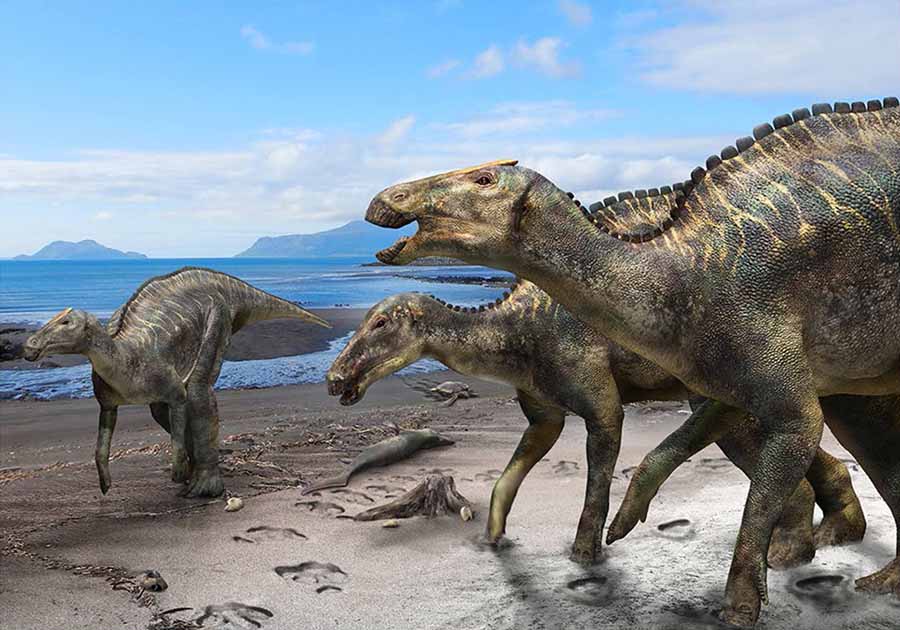
Life reconstruction of Kamuysaurus japonicus with a carcass of a mosasaur (Phosphorosaurus ponpetelegans), a sea turtle (Mesodermochelys undulates), and shells of ammonoids (Patagiosites compressus and Gaudryceras hobetsense) and bivalves (Nannonavis elongatus) on the beach. Image credit: Kobayashi et al, doi: 10.1038/s41598-019-48607-1.

The newly-identified dinosaur, named Kamuysaurus japonicus, lived some 72 million years ago (Cretaceous period).

It belongs to the family Hadrosauridae, one of the most successful groups of herbivorous dinosaurs in the Late Cretaceous period.

The fossil remains of these dinosaurs are common in the uppermost Cretaceous deposits in the supercontinent Laurasia (North America, Asia, and Europe) and some areas of the supercontinent Gondwana (South America and Antarctica).

The nearly complete skeleton of Kamuysaurus japonicus was recovered from the outer shelf deposits of the Upper Cretaceous Hakobuchi Formation in Hobetsu area of Mukawa town in Hokkaido in 2013.

It is the first nearly complete mid-to-large sized dinosaur skeleton from Japan.

A nearly-complete skeleton of Kamuysaurus japonicus. Image credit: Hobetsu Musem / Hokkaido University Museum.

The specimen was analyzed by paleontologists from Japan, the United States and Mongolia who concluded the dinosaur belonged to the hadrosaurid clade Edmontosaurini and was closely related to other hadrosaurids from the Far East such as Laiyangosaurus from China and Kerberosaurus from Siberia.

“The individual was an adult aged 9 or older, measured 26 feet (8 m) long and weighed 4 or 5.3 tons — depending on whether it was walking on two or four legs respectively — when it was alive,” said lead author Professor Yoshitsugu Kobayashi from the Hokkaido University Museum and colleagues.

The researchers also identified a number of unique features, including a small crest on the skull and a short row of neural spines that point forwards.

“We found that Kamuysaurus japonicus has three unique characteristics that are not shared by other dinosaurs in the Edmontosaurini clade: the low position of the cranial bone notch, the short ascending process of the jaw bone, and the anterior inclination of the neural spines of the sixth to twelfth dorsal vertebrae,” they explained.

Carcass of Kamuysaurus japonicus, floating in the sea, with two mosasaurs (Mosasaurus hobetsuensis), two sea turtles (Mesodermochelys undulates), and four ammonoids (Pachydiscus japonicus). Image credit: Kobayashi et al, doi: 10.1038/s41598-019-48607-1.

According to the team, the discovery of Kamuysaurus japonicus in a marine-influenced environment is rare for hadrosaurids and contributes to understanding of their diversity in these environments.

“There is a possibility that the ancestors of the Hadrosauridae family and its subfamilies, Hadrosaurinae and Lambeosaurinae, preferred to inhabit areas near the ocean, suggesting the coastline environment was an important factor in the diversification of the hadrosaurids in its early evolution, especially in North America,” the scientists said.

The discovery is reported in a paper in the journal Scientific Reports.

_____

Yoshitsugu Kobayashi et al. 2019. A New Hadrosaurine (Dinosauria: Hadrosauridae) from the Marine Deposits of the Late Cretaceous Hakobuchi Formation, Yezo Group, Japan. Scientific Reports 9, article number: 12389; doi: 10.1038/s41598-019-48607-1

Source: www.sci-news.com

Why Buy the New Jurassic World 5-Movie Collection on 4k Blu-Ray?

Friday, September 6, 2019

Jurassic World 5-Movie Collection (2019) vs. Jurassic World 5-Movie Collection SteelBook (2018)

The Jurassic World 5-Movie Collection on 4k Blu-ray releases to stores on Sept. 10 but many are asking what this collection has that the Jurassic World 5-Movie Collection released a year ago doesn’t have. Let’s take a look at the differences between the two and why you might consider buying the 2019 edition.

New packaging. Last year’s Jurassic World 5-Movie Collection was a Limited Edition SteelBook that wasn’t exclusive to Best Buy or any other retailers. The SteelBooks are pretty much only available now from 3rd parties on Amazon or eBay. The new Jurassic World 5-Movie Collection is standard plastic case collection with slipcover.

There’s new artwork. The new Jurassic World 5-Movie Collection features the famous Jurassic Park logo embedded in hot lava. The more generic cover isn’t quite as cool as the SteelBook artwork that featured the Velociraptor named “Blue,” but nevertheless is distinctly Jurassic Park.

10 discs versus 6. The new Jurassic World 5-Movie Collection on Ultra HD Blu-ray also includes Blu-ray copies of each film. The SteelBook edition did not. This makes it more practical for those of you who still have Blu-ray players around the house or want to share the discs with friends. (But it also means more extras. Read on.)

As far as extras it looks like the new 5-Movie Collection includes twice the amount of bonus material as the SteelBook given the 10-disc capacity of this collection. The new collection has the all the extras spread out to each Blu-ray Disc, while the SteelBook crammed bonus content for the last two films on the UHD BDs. (See all extras below.)

Differences in proprietary technology logos. The new edition shows Dolby Vision on the back slipcover, whereas the SteelBook edition did not (it only mentioned HDR10). Keep in mind the last two movies: Jurassic World and Jurassic World: Fallen Kingdom offered Dolby Vision on the 4k Blu-rays, while the older films used HDR10. Each disc likely includes the same HDR as the original UHD BD releases.

The new collection does not show the D-Box Motion Code either — the home entertainment technology that can communicate with D-BOX motion enabled chairs. However, even though the logo was removed from the slipcover it may not mean the codes were stripped out.

What stays the same? Disc specs. The 4k Blu-rays feature 2160p resolution at various aspect ratios (depending on the film). And, each of the films uses either Dolby Vision or HDR10. Audio is provided in DTS:X at best or DTS-HD Master Audio. And, like the SteelBook edition there are digital copies to redeem with Movies Anywhere partners in Digital UHD where available.

The Jurassic World 5-Movie Collection (Release Date: Sept. 10, 2019) is available to order from Amazon for $68.66 (List: $74.98).

Jurassic World 5-Movie Collection Discs & Extras

Disc 1 – Jurassic Park:

  • Includes 4K UHD, Blu-ray and a digital copy of Jurassic Park (Subject to expiration. Go to NBCUCodes.com for details.)
  • Features High Dynamic Range (HDR) for Brighter, Deeper, More Lifelike Color

Disc 2 – Jurassic Park:

  • Return to Jurassic Park: Dawn of a New Era
  • Return to Jurassic Park: Making Prehistory
  • Return to Jurassic Park: The Next Step in Evolution
  • The Making of Jurassic Park
  • Original Featurette on the Making of the Film
  • Steven Spielberg Directs Jurassic Park
  • Hurricane in Kauai Featurette
  • Early Pre-Production Meetings
  • Location Scouting
  • Phil Tippett Animatics: Raptors in the Kitchen
  • Animatics: T-Rex Attack
  • ILM And Jurassic Park: Before and After the Visual Effects
  • Foley Artists
  • Storyboards
  • Production Archives: Photographs, Design Sketches and Conceptual Paintings
  • Jurassic Park: Making the Game
  • Trailer

Disc 3 – The Lost World: Jurassic Park:

  • Includes 4K UHD, Blu-ray and a digital copy of The Lost World: Jurassic Park (Subject to expiration. Go to NBCUCodes.com for details.)
  • Features High Dynamic Range (HDR) for Brighter, Deeper, More Lifelike Color

Disc 4 – The Lost World: Jurassic Park:

  • Return to Jurassic Park: Finding The Lost World
  • Return to Jurassic Park: Something Survived
  • Deleted Scenes
  • The Making of The Lost World
  • Original Featurette on the Making of the Film
  • The Jurassic Park Phenomenon: A Discussion with Author Michael Crichton
  • The Compie Dance Number: Thank You Steven Spielberg From ILM
  • ILM & The Lost World: Before & After the Visual Effects
  • Production Archives: Production Photographs, Illustrations and Conceptual Drawings, Models, The World of Jurassic Park, The Magic of ILM, Posters and Toys
  • Storyboards
  • Trailer

Disc 5 – Jurassic Park III:

  • Includes 4K UHD, Blu-ray and a digital copy of Jurassic Park III (Subject to expiration. Go to NBCUCodes.com for details.)
  • Features High Dynamic Range (HDR) for Brighter, Deeper, More Lifelike Color
  • Feature Commentary with Special Effects Team

Disc 6 – Jurassic Park III:

  • Return To Jurassic Park: The Third Adventure
  • The Making of Jurassic Park III
  • The Dinosaurs of Jurassic Park III
  • The Special Effects of Jurassic Park III
  • The Industrial Light & Magic Press Reel
  • The Sounds of Jurassic Park III
  • The Art of Jurassic Park III
  • Montana: Finding New Dinosaurs
  • Tour of Stan Winston Studio
  • Spinosaurus Attacks the Plane
  • Raptors Attack Udesky
  • The Lake
  • A Visit to ILM
  • Dinosaur Turntables
  • Storyboards to Final Feature Comparison
  • Production Photographs
  • Feature Commentary with Special Effects Team
  • Trailer

Disc 7 – Jurassic World:

  • Includes 4K UHD, Blu-ray and a digital copy of Jurassic World (Subject to expiration. Go to NBCUCodes.com for details.)
  • Features High Dynamic Range (HDR) for Brighter, Deeper, More Lifelike Color

Disc 8 – Jurassic World:

  • Deleted Scenes
  • Chris & Colin Take on the World
  • Welcome to Jurassic World
  • Dinosaurs Roam Once Again
  • Jurassic World: All-Access Pass
  • Innovation Center Tour with Chris Pratt
  • Jurassic’s Closest Shaves – Presented by Barbasol®

Disc 9 – Jurassic World: Fallen Kingdom:

  • Includes 4K UHD, Blu-ray and a digital copy of Jurassic World: Fallen Kingdom (Subject to expiration. Go to NBCUCodes.com for details.)
  • Features High Dynamic Range (HDR) for Brighter, Deeper, More Lifelike Color
  • On Set with Chris & Bryce
  • The Kingdom Evolves
  • Return to Hawaii
  • Island Action
  • Aboard the Arcadia
  • Birth of the Indoraptor
  • Start the Bidding!
  • Death by Dino
  • Monster in a Mansion
  • Rooftop Showdown
  • Malcolm’s Return
  • VFX Evolved
  • Fallen Kingdom: The Conversation
  • A Song for the Kingdom
  • Chris Pratt’s Jurassic Journals
  • Jurassic Then and Now – Presented by Barbasol®

Disc 10 – Jurassic World: Fallen Kingdom:

  • On Set with Chris & Bryce
  • The Kingdom Evolves
  • Return to Hawaii
  • Island Action
  • Aboard the Arcadia
  • Birth of the Indoraptor
  • Start the Bidding!
  • Death by Dino
  • Monster in a Mansion
  • Rooftop Showdown
  • Malcolm’s Return
  • VFX Evolved
  • Fallen Kingdom: The Conversation
  • A Song for the Kingdom
  • Chris Pratt’s Jurassic Journals
  • Jurassic Then and Now – Presented by Barbasol®

Source: https://hd-report.com

Tyrannosaurus rex Had ‘Thermostat’ in Its Head

Friday, September 6, 2019

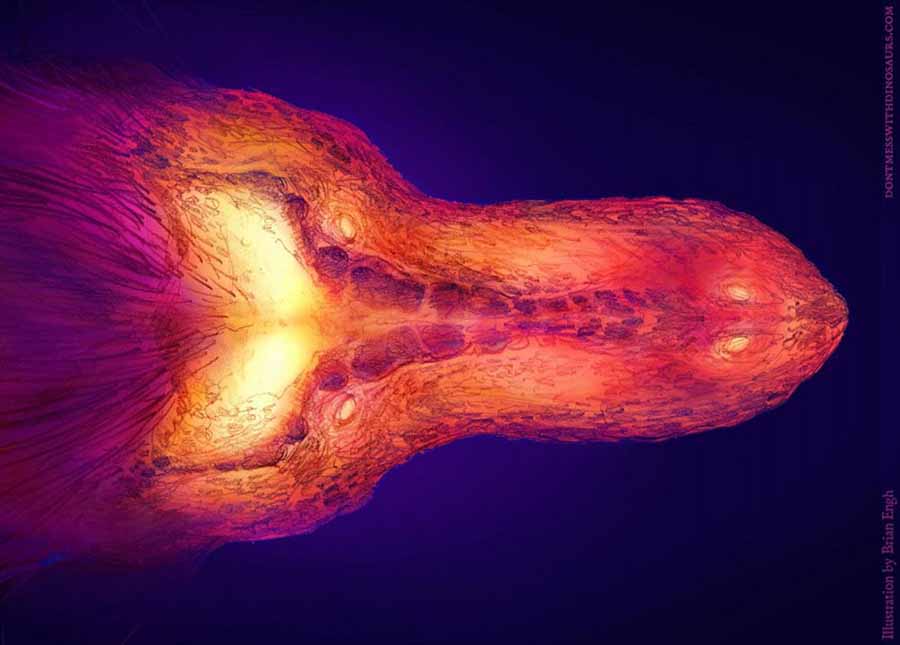
A graphic thermal image of a T. rex with its dorsotemporal fenestra glowing on the skull. Image credit: Brian Engh.

T. rex had two large holes — called the dorsotemporal fenestra — in the roof of its skull.

In the past, paleontologists believed these holes were filled with muscles that assist with jaw movements.

The new study suggests blood vessels in the dorsotemporal fenestra acted as an internal thermostat, much like alligators have today for body temperature control.

“It’s really weird for a muscle to come up from the jaw, make a 90-degree turn, and go along the roof of the skull,” said University of Missouri’s Professor Casey Holliday, lead author of the study.

“Yet, we now have a lot of compelling evidence for blood vessels in this area, based on our work with alligators and other reptiles.”

Using thermal imaging, Professor Holliday and colleagues examined alligators at the St. Augustine Alligator Farm Zoological Park in Florida.

A graphic thermal image of a T. rex skull. Image credit: Brian Engh.

“An alligator’s body heat depends on its environment,” said co-author Dr. Kent Vliet, a researcher in the Department of Biology at the University of Florida.

“Therefore, we noticed when it was cooler and the alligators are trying to warm up, our thermal imaging showed big hot spots in these holes in the roof of their skull, indicating a rise in temperature.”

“Yet, later in the day when it’s warmer, the holes appear dark, like they were turned off to keep cool.”

“This is consistent with prior evidence that alligators have a cross-current circulatory system — or an internal thermostat, so to speak.”

The scientists then took their thermal imaging data and examined fossilized remains of dinosaurs and crocodiles to see how these holes in the skull changed over time.

“We know that, similarly to the T. rex, alligators have holes on the roof of their skulls, and they are filled with blood vessels,” said Ohio University’s Professor Larry Witmer, co-author of the study.

“Yet, for over 100 years we’ve been putting muscles into a similar space with dinosaurs.”

“By using some anatomy and physiology of current animals, we can show that we can overturn those early hypotheses about the anatomy of this part of the T. rex’s skull.”

_____

Casey M. Holliday et al. The Frontoparietal Fossa and Dorsotemporal Fenestra of Archosaurs and Their Significance for Interpretations of Vascular and Muscular Anatomy in Dinosaurs. Anatomical Record, published online July 1, 2019; doi: 10.1002/ar.24218

Source: www.sci-news.com

NASA Photo Captures Skull Of 'Dinosaur-Like' Alien On Mars

Saturday, September 7, 2019

A UFO expert claimed to have spotted what appeared to be a skull of a dinosaur-like creature on Mars. The UFO expert saw the image through one of the photos taken by NASA’s Spirit rover.

The claim regarding the strange skull-like object on Mars was made by Scott Waring of the UFO-centered blog ET Data Base. According to Waring, he came across the image of the object as he was going through the previous photos taken by NASA on Mars.

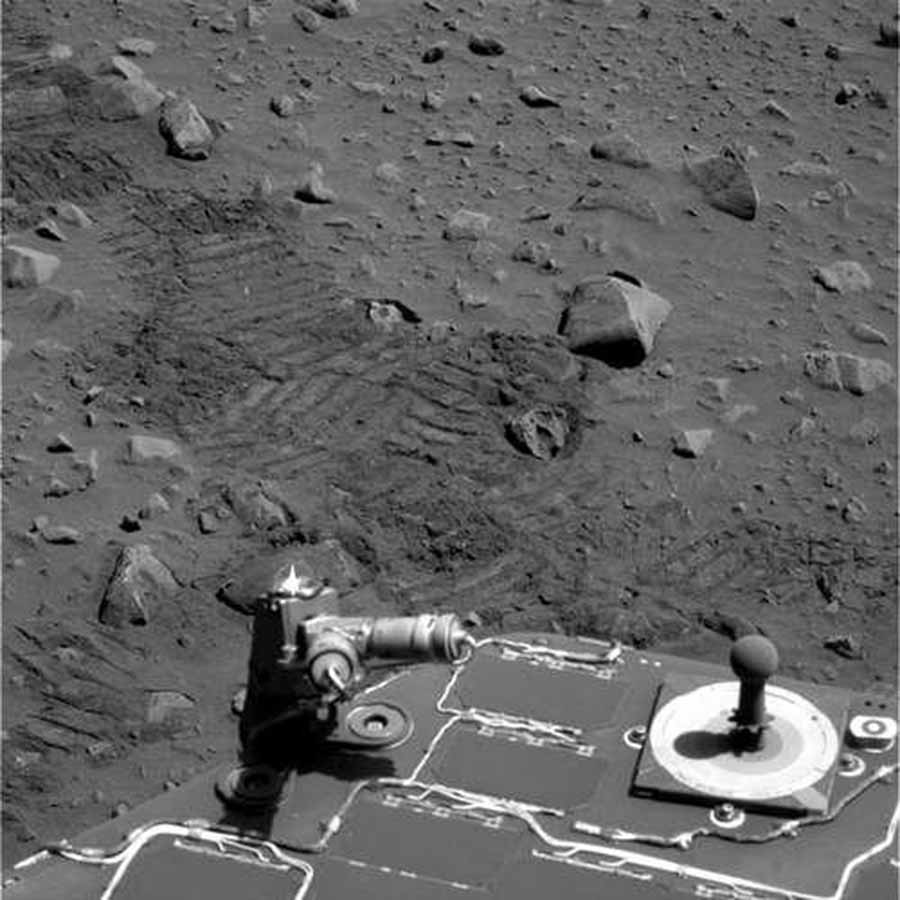
As he was browsing through the various galleries, he came across a photo that was taken by the Spirit rover on SOL 109. In the image, an object that looks like a skull of a dinosaur can be seen near the center of the photo, just above the body of the rover.

As seen in the image, the object looks like it had been pressed into the Martian soil. Since the tracks made by Spirit surround the object, Waring accused NASA of intentionally running over the alleged skull using the rover.

The alleged 'dinosaur skull' on Mars

Based on the photo, several prominent features of the skull can be spotted such as the eyes, a horn and an elongated mouth. Waring noted that it looked like a skull of a creature that was part-reptile and part-bird.

“I was looking through the old Spirit rover photos when I found a screaming face in the dirt,” he wrote in a blog post. “It was a skull that resembled part reptilian and part bird.”

The appearance of the object led Waring to speculate that it could be a fossil of a dinosaur-like creature that once lived on Mars.

“If you found this in your backyard, would you even hesitate at thinking it was a dinosaur fossil?” Waring wrote. “You would probably assume it’s as such instantly. The fact that it’s on Mars alone should rock the world of paleontology.”

This isn’t the first time that Waring claimed to have spotted something resembling a reptile on Mars. Earlier in June, he said he saw a carving of a reptilian face on the Red Planet. Interestingly, he said the carving was made on a wall of an alien structure.

Right Panoramic Camera Non-linearized Full frame EDR acquired on Sol 109 of Spirit's mission to Gusev Crater at approximately 11:28:11 Mars local solar time, camera commanded to use Filter 1 (436 nm). Photo: NASA/JPL/Cornell

A PERFECT CASE OF PAREIDOLIA

The centerpiece of recent interest is the dinosaur skull protruding from the Martian regolith, teeth still embedded, sparkling efferdent white. There are no sockets for these teeth. Dinosaur dentures gave this senior citizen a few extra good years. The jaw line of the skull has no joint or connection point with the skull. So our minds make up the deficits, fill in the blanks and we agree with others and convince ourselves that this is a fossilized skull. Who knows how this animal could have evolved differently.

But evolve it did – within our minds. Referencing online dictionaries [ref], “Pareidolia is the imagined perception of a pattern (or meaning) where it does not actually exist, as in considering the moon to have human features.” I must admit that I do not seek out these “discoveries” on Mars but I enjoy looking at them and there are many scientists at JPL that have the same bent. Mars never fails to deliver and caters to everyone, but when skulls and fossils are seen, it is actually us catering to the everyday images and wishes we hold in our minds.

Source: www.ibtimes.com

Did a Dinosaur Crush a Solitary Turtle in the Late Jurassic of Switzerland?

Sunday, September 8, 2019

Suggested reconstruction of a sauropod dinosaur foot stepping onto the turtle.  (Paleorxiv Papers)

A Swiss team has found an ancient fossil of sea turtle which appears to have been crushed by a dinosaur in the Jura Mountains.

“The configuration of the fossil turtle suggests that the shell was possibly trodden on by a large sauropod dinosaur,” reads a paper on the finding which was published by the Swiss Journal of Geosciences.

The fossil was unearthed in the Swiss mountains that gave the Jurassic period its name.

The turtle shell was found during an extensive dig in the Jura Mountains, which gave the Jurassic Period its name, undertaken at the start of the 21st century.

The construction of Highway A16 gave rise to the paleontological project dubbed “Paléontologie A16”.

These excavations unearthed sweeping dinosaur track sites which were concentrated in tidal flat environments and a diverse vertebrate fossil collection from the Kimmerdigian age.

The discovery of the turtle remains in a region roamed by dinosaurs indicates that “thalassochelydian turtles occasionally visited these tidal flat environments.”

The paleontologists note that it is possible that female turtles regularly crossed tidal flats to reach the beach and lay eggs but if this were the case one would expect a higher number of such findings.

Another theory is that the fossil corresponds to a stranded turtle that got stuck in a mudflat and/or dried out in the sun on its way to the sea.

Christian Püntener, Jean-Paul Billon-Bruyat, Daniel Marty and Géraldine Paratte penned the paper on this unusual finding.

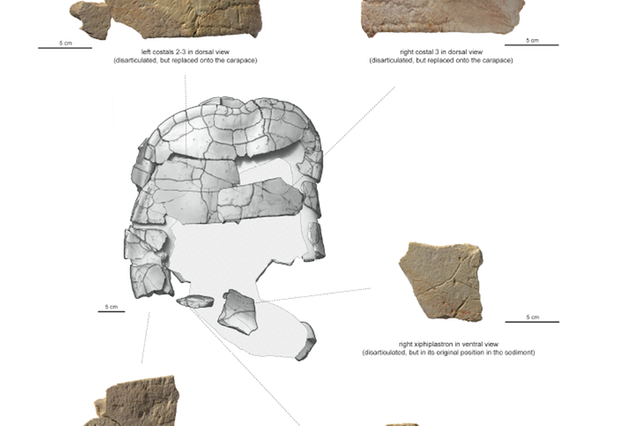
This image illustrates the disarticulated parts of the sea turtle fossil found by Swiss paleontologists.  (Paleorxiv Papers)

Source: www.swissinfo.ch

From Dragons to Giants, Here's What People First Thought of Dinosaur Bones

Friday, September 6, 2019

A reconstruction of the fossil skull of the Pachycephalosaurus that has theropod-like teeth. PHOTOGRAPH BY BRIAN BOYLE, ROYAL ONTARIO MUSEUM

Karuika asks: Who was the first person to figure out what dinosaur bones were?

From around 250 to 66 million years ago various dinosaurs roamed the Earth. Today the only dinosaurs left are birds, which are coelurosauria theropods — funny enough the same sub-group Tyrannosauruses belong to. (Think about that the next time you're enjoying a McDinosaur sandwich or scrambling up some dinosaur eggs for breakfast.)

Beyond their avian progeny, all that mostly remains of these once dominate creatures are fossilized bones, footprints, and poop. While many dinosaurs were actually quite small, some were comparatively massive, bringing us to the question of the hour — what did people first think when they pulled huge dinosaur bones out of the earth?

To begin with, it is generally thought humans have been discovering dinosaur bones about as long as we've been humaning. And it appears that at least some of the giant creatures of ancient legend likely stemmed from the discovery of dinosaur bones and fossils, and the subsequent attempts of ancient peoples to explain what they were.

For example, 4th century BC Chinese historian Chang Qu reported the discovery of massive "dragon bones" in the region of Wuchen. At the time and indeed for many centuries after (including some still today), the Chinese felt that these bones had potent healing powers, resulting in many of them being ground down to be drunk in a special elixirs.

As for the exact medicinal purposes, in the 2nd century AD Shennong Bencaojing, it states,

Dragon bone… mainly treats heart and abdominal demonic influx, spiritual miasma, and old ghosts; it also treats cough and counterflow of qi, diarrhea and dysentery with pus and blood, vaginal discharge, hardness and binding in the abdomen, and fright epilepsy in children. Dragon teeth mainly treats epilepsy, madness, manic running about, binding qi below the heart, inability to catch one's breath, and various kinds of spasms. It kills spiritual disrupters. Protracted taking may make the body light, enable one to communicate with the spirit light, and lengthen one's life span.

While fossilized bones may not actually make such an effective cure-all, all things considered, the classic depictions of dragons and our modern understanding of what certain dinosaurs looked like are actually in the ballpark of accurate.

Moving over to the ancient Greeks, they are also believed to have stumbled across massive dinosaur bones and similarly assumed they came from long-dead giant creatures, in some cases seeming to think they came from giant human-like creatures.

Moving up to that better documented history, in the 16th through 19th centuries, the idea that the Earth was only about six thousand years old was firmly entrenched in the Western world, leading to these fossils creating a major puzzle for the scientists studying them. Even Meriwether Lewis of the famed Lewis and Clark expedition found a dinosaur bone in Billings Montana, but in his case, he decided it must have come from a massive fish, which was a common way they were explained away given that no creatures that then walked the earth seemed to match up.

The various ideas thrown around around during these centuries were described by Robert Plot in his 1677 Natural History of Oxfordshire:

[are] the Stones we find in the Forms of Shell-fish, be Lapides sui generis [fossils], naturally produced by some extraordinary plastic virtue, latent in the Earth or Quarries where they are found? Or, [do] they rather owe their Form and Figuration to the Shells of the Fishes they represent, brought to the places where they are now found by a Deluge, Earth-quake, or some other such means, and there being filled with Mud, Clay, and petrifying Juices, have in tract of time been turned into Stones, as we now find them, still retaining the same Shape in the whole, with the same Lineations, Sutures, Eminencies, Cavities, Orifices, Points, that they had whilst they were Shells?

Plot goes on to explain the idea behind the "plastic virtue" hypothesis was that the fossils were some form of salt crystals that had by some unknown process formed and grown in the ground and just happened to resemble bones.

Triceratops mounted skeleton at Los Angeles Museum of Natural History.

However, Plot argues against this then popular notion stating,

Come we next to such [stones] as concern the … Members of the Body: Amongst which, I have one… that has exactly the Figure of the lowermost part of the Thigh-Bone of a Man or at least of some other Animal…a little above the Sinus, where it seems to have been broken off, shewing the marrow within of a shining Spar-like Substance of its true Colour and Figure, in the hollow of the Bone…

After comparing the bone to an elephant's, he decided it could not have come from one of them. He instead concluded,

It remains, that (notwithstanding their extravagant Magnitude) they must have been the bones of Men or Women: Nor doth any thing hinder but they may have been so, provided it be clearly made out, that there have been Men and Women of proportionable Stature in all Ages of the World, down even to our own Days

Thus, much like is thought to have happened with certain ancient peoples, he decided some of these bones must have come from giant humans of the past. During Plot's era, the Bible's mention of such giants was often put put forth as evidence, such as in Numbers where it states,

The land that we have gone through as spies is a land that devours its inhabitants; and all the people that we saw in it are of great size. There we saw the Nephilim… and to ourselves we seemed like grasshoppers, and so we seemed to them.

Though the bone Plot was describing has since been lost to history, he left detailed drawings, from which it's thought to have come from the lower part of the femur of a Megalosaurus (literally, Great Lizard).

Modern restoration of Megalosaurus.

But before it was called the Megalosaurus, it had a rather more humorous name. You see, in 1763 a physician called Richard Brookes studying Plot's drawings dubbed it "Scrotum Humanum" because he thought it looked like a set of petrified testicles. (To be clear, Brookes knew it wasn't a fossil of a giant scrotum, but nevertheless decided to name it thus because apparently men of all eras of human history can't help but make genital jokes at every opportunity.)

While hilarious, in the 20th century, this posed a problem for the International Commission for Zoological Nomenclature when it eventually came time to formally classify the Megalosaurus as such. The problem was, of course, that Brookes had named it first.

Eventually the ICZN decided that since nobody after Brookes had called it Scrotum Humanum, even though he was the first to name it, that name could safely be deemed invalid. Thus Megalosaurus won out, which is unfortunate because discussion of the rather large Scrotum Humanum would have provided great companion jokes to ones about Uranus in science classes the world over.

Moving swiftly on, humanity continued to have little clear idea of what dinosaurs were until William Buckland's work on the aforementioned Megalosaurus in 1824.

As for the word "dinosaur" itself, this wouldn't be coined until 1842 when British scientist Sir Richard Owen noted that the few dinosaur fossils that had been scientifically studied at that point all shared several characteristics. For the curious, those species were the Megalosaurus, Hylaeosaurus and Iguanodon. He further concluded that the fossils could not have come from any creature that currently roamed the Earth and thus came up with a new name — dinosaur, meaning "terrible/powerful/wondrous lizards".

Of course, it should be noted that despite being knighted for his life's work in 1883, Owen was renowned for stealing other people's ideas and calling them his own, in at least one case even after having previously ridiculed the person he stole the ideas from — paleontologist Gideon Mantell. In several instances, Owen would attempt to take credit for some of Mantell's pioneering work on the Iguanodon, while downplaying Mantell's contributions in the process.

Modern restoration of Megalosaurus.

To add insult to injury, it is speculated that the much more distinguished Owen actively worked to stop some of Mantell's work and papers from getting published.

To further illustrate Owen's character and rivalry with Mantell, after near financial ruin in 1838, his wife leaving him in 1839, and his daughter dying in 1840, Mantell would become crippled after a fall from a carriage on October 11, 1841. Previous to the accident, he had frequently suffered from leg and back pain, but the source of it was dismissed as likely due to the long hours of work he put in and the like. Things got worse when a coach he was on crashed, shortly before which Mantell leapt from it. In the aftermath, his former pain became extreme and he ceased to be able to use his legs properly. As he writes, "I cannot stoop, or use any exertion without producing loss of sensation and power in the limbs… and could I choose my destiny, I would gladly leave this weary pilgrimage." He later laments in his journal, "my long probation of suffering will be terminated by a painful and lingering death."

What does any of that have to do with Owen? To add insult to injury, after Mantell died from an opium overdose taken to help relieve some of his constant and extreme pain, several obituaries were published of Mantell, all glowing — except one…

This one was anonymously written, though analyses of the writing style and general tone left few among the local scientific community with any doubt of who had written it.

In it, Owen starts off praising Mantell, stating, "On Wednesday evening last, at the age of about 63 or 64, died the renowned geologist, Gideon Algernon Mantell…" It goes on to note how Mantell's memoir on the Iguanodon saw him the recipient of the prestigious Royal Medal. Of course, later in the article, Owen claims Mantell's work for which he won that medal was actually stolen from others, including himself:

The history of the fossil reptile for the discovery of which Dr. Mantell's name will be longest recollected in science, is a remarkable instance of this. Few who have become acquainted with the Iguanodon, by the perusal of the Medals of Creation would suspect that to Covier we owe the first recognition of its reptilian character, to Clift the first perception of the resemblance of its teeth to those of the Iguano, to Conybear its name, and to Owen its true affinities among reptiles, and the correction of the error respecting its build and alleged horn…

The article then goes on to outline Dr. Mantell's supposed various failings as a scientist such as his "reluctance to the revelation of a truth when it dispossessed him of a pretty illustration", as well as accusing him of once again stealing people's work:

To touch lightly on other weaknesses of this enthusiastic diffuser of geological knowledge… we must also notice that a consciousness of the intrinsic want of exact scientific, and especially anatomical, knowledge, which compelled him privately to have recourse to those possessing it… produced extreme susceptibility of any doubt expressed of the accuracy or originality of that which he advanced; and in his popular summaries of geological facts, he was too apt to forget the sources of information which he had acknowledge in his original memoirs.

It finally concludes as it started — on a compliment, "Dr. Mantell has, however, done much after his kind for the advancement of geology, and certainly more than any man living to bring it into attractive popular notice."

It's commonly stated from here that, out of spite, Owen also had a piece of Mantell's deformed spine pickled and put on a shelf in the Hunterian Museum in London where Owen was the curator. However, while this was done, the examination and study of his spine was done at the behest of Mantell himself.

British scientist Sir Richard Owen.

Thus, an autopsy was performed and an examination of Mantell's spine showed he had a rather severe and, at least at the time, peculiar case of scoliosis. As to what was so interesting about this case, one of the physicians involved, Dr. William Adams, states, it was discovered "that the severest degree of deformity of the spine may exist internally, without the usual indications in respect of the deviation of the spinous processes externally."

In other words, in other such cases, it was clear the spine was not straight from visual observation of the person's back where a curve could be observed. Mantell's spine, however, exhibited severe scoliosis, but in such a way that upon external examination methods of the day where the person was lying down or standing up, it otherwise appeared straight.

To Adam's knowledge, such a thing had never been observed before, but if Mantell had this particular brand of scoliosis, surely many others did as well. But how to detect it. Mulling over the problem inspired Dr. Adams to come up with a method to make such a deformity visible with external examination, thus giving the world the Adam's forward bend test which many a school student even today has no doubt recollections of being subjected to periodically.

Going back to Owen, as to why he seems to have hated Mantell so much, this isn't fully clear, though it may have simply been Mantell's work sometimes resulted in showing Owen's to be incorrect in various assumptions, jealousy of a scientist he deemed inferior to himself, or it could just be that Owen was a bit of a dick. As noted by famed biologist Thomas Henry Huxley, "[I]t is astonishing with what an intense feeling of hatred Owen is regarded by the majority of his contemporaries, with Mantell as arch-hater. The truth is, [Owen] is the superior of most, and does not conceal that he knows it, and it must be confessed that he does some very ill-natured tricks now and then."

Of course, if you steal other people's work long enough, eventually you'll get caught, especially when you're one of the world's leading scientists in your field. Owen's misstep occurred when he was awarded the prestigious Royal Medal from the Royal Society for his supposedly pioneering discovery and analyses of belemnites, which he called the Belemnites owenii, after himself and gave no credit to anyone else for the ideas in the paper. It turns out, however, four years previous he'd attended a Geological Society get together in which an amateur scientist by the name of Chaning Pearce gave a lecture and published a paper on that very same creature…

While Owen was allowed to keep his medal even after it was revealed he'd stolen the work of Pearce, the rumors that he'd similarly "borrowed" other ideas without credit and this subsequent proof resulted in the loss of much of his former academic prestige. Things didn't improve over the following years and Owen was eventually given the boot from the Royal Society in 1862 despite his long and rather distinguished career.

While he would never again do any scientific work of significance, his post plagiarist career did prove to be a huge boon for those who enjoy museums. You see, up until this point, museums were not places readily open to the public, and to get access, you usually needed to be an academic. They were places for research, not for random plebeians to gawk at things.

After losing any shred of respect from his peers, he eventually devoted his energies into his role as the superintendent of the natural history department of the British Museum. Among other things, as superintendent, he pushed for and helped develop London's now famed Natural History Museum, London. He also instituted a number of changes such as encouraging the general public to come visit the museum at their leisure, devoted the majority of the displays for public use, had labels and descriptions added below each display explaining what each was of so anybody, not just the educated, could understand what they were looking at, etc. Many among the scientific community fought against these changes, but he did it anyway, giving us the modern idea of a museum in the process.

In any event, after Owen, Mantell's, and their contemporaries' work finally revealed these long extinct creatures for what they were, interest in dinosaurs exploded resulting in what has come to be known as the "Bone Wars" between rival paleontologists in the 1890s which got so heated, some paleontologists literally resorted to dynamiting mines to beat their rivals in discoveries.

The most famous such rivals were Othniel Marsh of the Peabody Museum of Natural History at Yale and Edward Cope of the Academy of Natural Sciences of Philadelphia.

While the pair started out friendly, even choosing to name species after one another, they eventually became bitter enemies, and when they weren't doing everything in their power to find dinosaur bones as fast as possible, they were writing and giving talks insulting one another's work, attempting to get each other's funding canceled, stealing discoveries from one another or, when not possible, trying to destroy the other's work. In the end, the product of this rivalry was the discovery of a whopping 142 different species of dinosaurs. (For the record, Marsh discovered 86 and Cope 56.)

Before ending, any discussion of this wild west era of dinosaur bone hunting and scholarship would be remiss without noting the unsung hero of it all — Mary Anning, who is credited with finding many of the fossils used by other scientists for "their" discoveries like of the long-extinct Ichthyosaur, Plesiosaurus (in fact finding the first complete Plesiosaurus), and the flying Pterosaur.

Anning was also noted to be popularly consulted by scientists the world over for her expertise in identifying types of dinosaurs from their bones and various insights she had on them, with many world renowned scientists actually choosing to make the journey to her little shop in person where she sold these bones in Dorset England.

Almost completely uneducated formally and having grown up relatively poor, with her father dying when she was 11, Anning's expertise came from literally a lifetime of practice, as her family lived near the cliffs near Lyme Regis and from a little girl she helped dig out bones and sell them in their shop.

Portrait of Mary Anning.

Without access to a formal scientific education, she eventually took to dissecting many modern animals to learn more about anatomy. She also was an insatiable reader of every scientific paper she could get her hands on related to geology, palaeontology and animals. In many cases, unable to afford to buy copies of the papers, she'd simply borrow them from others and then meticulously copy them herself, with reportedly astoundingly exact replication of technical illustrations.

On that note, Lady Harriet Silvester would describe Anning in 1824,

The extraordinary thing in this young woman is that she has made herself so thoroughly acquainted with the science that the moment she finds any bones she knows to what tribe they belong. She fixes the bones on a frame with cement and then makes drawings and has them engraved… It is certainly a wonderful instance of divine favour—that this poor, ignorant girl should be so blessed, for by reading and application she has arrived to that degree of knowledge as to be in the habit of writing and talking with professors and other clever men on the subject, and they all acknowledge that she understands more of the science than anyone else in this kingdom.

Despite finding some of the best known specimens of these creatures and risking her life on a daily basis during her hunt for fossils around the dangerous cliffs, Anning got little public credit for her discoveries owing to a number of factors including that she was a woman, from a dissenting religious sect against the Church of England, and otherwise, as noted, had no real formal education. So it was quite easy for scientists to take any ideas she had and the bones she dug up and claim all of it as their own discovery. As Anning herself would lament, "The world has used me so unkindly, I fear it has made me suspicious of everyone."

A companion of hers, Anna Inney, would go on to state, "these men of learning have sucked her brains, and made a great deal of publishing works, of which she furnished the contents, while she derived none of the advantages."

That said, given the esteem she was regarded among many scientists, some of them did desire she be given credit for her contributions, such as famed Swiss palaeontologist Louis Agassiz who was one of many to visit Anning's shop and to pick her brain about various things, ultimately crediting her in his book Studies of Fossil Fish.

Further praising her work a few years later was an article in The Bristol Mirror, stating,

This persevering female has for years gone daily in search of fossil remains of importance at every tide, for many miles under the hanging cliffs at Lyme, whose fallen masses are her immediate object, as they alone contain these valuable relics of a former world, which must be snatched at the moment of their fall, at the continual risk of being crushed by the half suspended fragments they leave behind, or be left to be destroyed by the returning tide: – to her exertions we owe nearly all the fine specimens of Ichthyosauri of the great collections …

Of the dangers of her work, Anning once wrote to a friend, Charlotte Murchison, in 1833,

Perhaps you will laugh when I say that the death of my old faithful dog has quite upset me, the cliff that fell upon him and killed him in a moment before my eyes, and close to my feet … it was but a moment between me and the same fate.

Beyond academic credit, in one lean stretch where Anning's family was unable to find any new fossils and they had to start selling off all their worldy possessions just to eat and keep a roof over their heads, one of their best customers, Lieutenant-Colonel Thomas James Birch, decided to auction off many of the bones he'd bought from them and instead of keeping the money, gave it to Anning's family.

Of this, in a letter to the Gideon Mantell, Birch stated the auction was,

for the benefit of the poor woman… who… in truth found almost all the fine things which have been submitted to scientific investigation … I may never again possess what I am about to part with, yet in doing it I shall have the satisfaction of knowing that the money will be well applied.

Beyond the approximately £400 this brought in (about £48,000 today), this also significantly raised the awareness among the scientific community of the family's contributions to this particular branch of science.

Further, when she lost her life savings apparently after being swindled by a conman in 1835, the aforementioned William Buckland managed to convince the British government and the British Association for the Advancement of Science to give her a pension of £25 per year (about £3,000 today) in recognition of her work's importance to science.

On top of this, when she was dying of breast cancer in the 1840s and couldn't continue on in her work as before, the Geological Society provided additional financial support to make sure she was taken care of.

After her death, they also commemorated a stained-glass window in 1850 in her memory with the inscription:

This window is sacred to the memory of Mary Anning of this parish, who died 9 March AD 1847 and is erected by the vicar and some members of the Geological Society of London in commemoration of her usefulness in furthering the science of geology, as also of her benevolence of heart and integrity of life.

The president of the Geological Society, Henry De la Beche, would also write a eulogy for her, which stated in part,

I cannot close this notice of our losses by death without adverting to that of one, who though not placed among even the easier classes of society, but one who had to earn her daily bread by her labour, yet contributed by her talents and untiring researches in no small degree to our knowledge…

This was the first eulogy for a woman the society had ever published, and the first time such a eulogy had been given for a non-fellow.

This article originally appeared on Today I Found Out.

Source: www.wearethemighty.com

10 Places Every Dinosaur Fan Needs To Visit

Friday, September 6, 2019

Getty Photos

Many are fascinated with dinosaurs, soaking up facts about these large creatures and watching movies that star them. And thankfully, there are several spots around the world that focus on dinos, allowing guests to learn even more, dig up fossils, explore pieces from the past, and even interact with life-like ones.

For those who are ready for a new adventure and who are fans of these guys, consider traveling to the 10 places that are listed out down below. From museums and parks to filming locations and tourist attractions, these are the top places all dinosaur fans need to see!

10 - PARQUE CRETÁCICO IN SUCRE, BOLIVIA

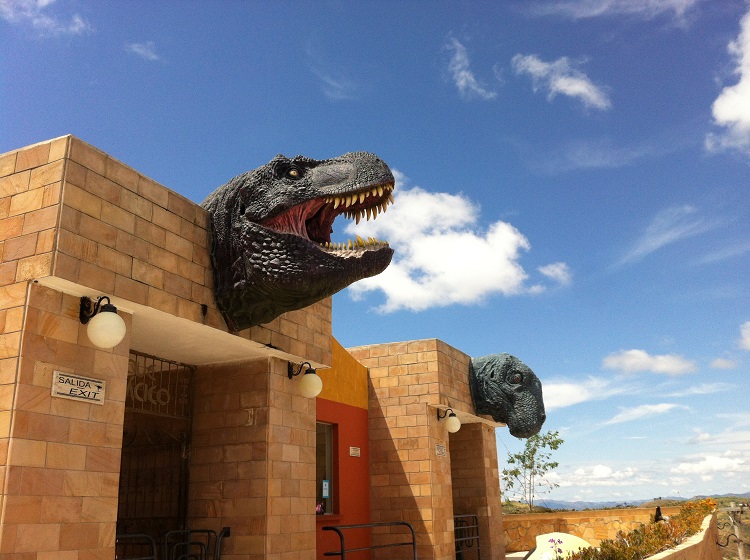
Cretaceous Park has tours, life-size skeletons and the world's largest site of dinosaur tracks. Yes, the main thing to see here is Cal Orcko, the site of the planet’s most extensive dinosaur footprints, with over 5,000 individual prints from at least 8 species.

There are also over 20 life-sized replicas of 12 different species of dinosaurs to check out, so guests can imagine what life was once like in Sucre, Bolivia. This location also offers a Museum of Paleontology, library, gift shop and restaurant that people can enjoy.

9 - MUSEUM OF THE ROCKIES IN BOZEMAN, MONTANA

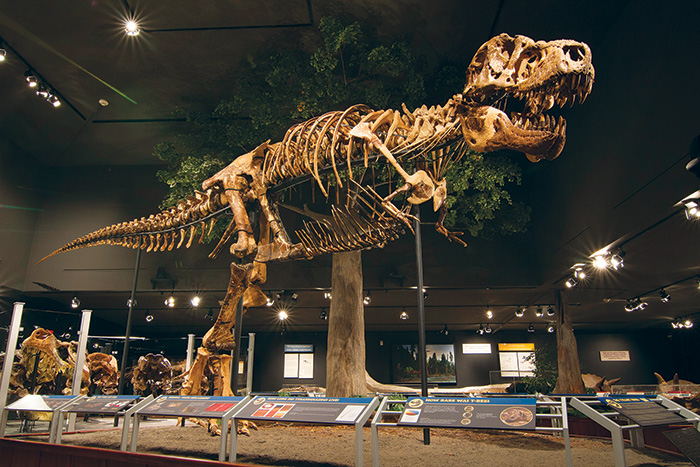
Tyrant Kings at Museum of the Rockies, Bozeman

The largest collection of dinosaur remains in the nation can be found at the Museum of the Rockies in Bozeman, Montana.

This museum also has several other notable displays, such as the biggest Tyrannosaurus skull that has ever been found, a T. rex thigh bone that has soft-tissue remains, two of the only complete T. rex specimens that have ever been found and one of the first female dinosaurs, which is also a T. rex. Furthermore, the curator of this spot, Jack Horner, was an adviser on the Jurassic Park movies!

8 - ROYAL TYRRELL MUSEUM IN ALBERTA, CANADA

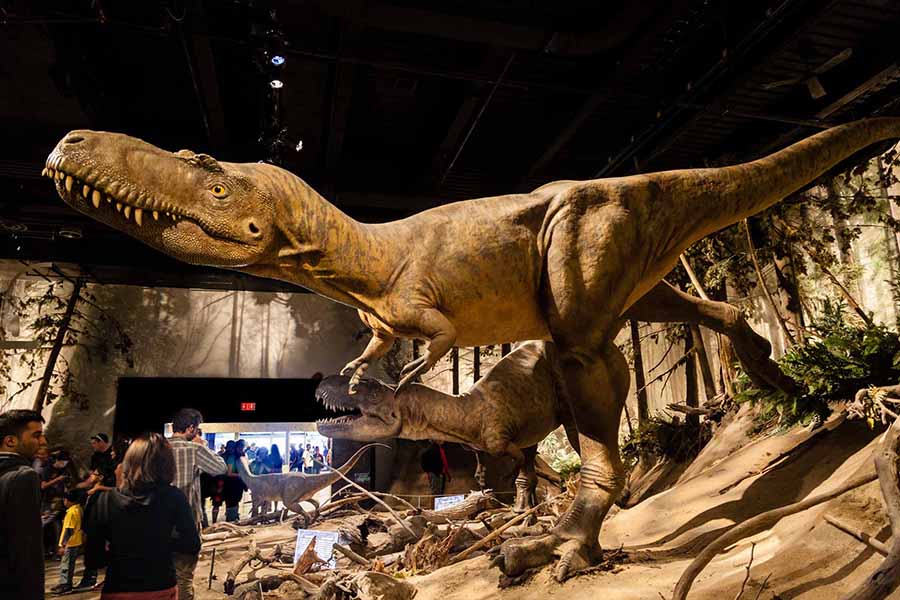
Royal Tyrrell Museum of Palaeontology

Part of the Royal Tyrrell Museum is the Dinosaur Hall, which has more than 40 dinosaur skeletons, as well as a Cretaceous Garden (showing the plants that used to be in Alberta, Age of Mammals & Ice Ages (showing Cenozoic mammals) and the Triassic Giant (the biggest known marine reptile in the world).

Also in this area is the World's Largest Dinosaur; this is a model of Tyrannosaurus rex that is 86 feet tall and 151 feet long, and inside, there are 106 stairs that lead to a viewing area in the mouth!

7 - AMERICAN MUSEUM OF NATURAL HISTORY IN NEW YORK, NEW YORK

New York City’s American Museum of Natural History is the biggest of its kind on the planet, with 28 buildings, 45 exhibition halls and 33 million specimens. And while this spot houses the biggest collection of mammal and dino fossils that is out there, most of them are hidden away and used primarily for research.

Still, some very cool exhibits can be seen, like a Tyrannosaurus rex built nearly entirely out of real bones, and an Edmontosaurus annectens, a herbivorous ornithopod dinosaur that is mummified.

6 - PHU WIANG NATIONAL PARK & SIRINDHORN DINOSAUR MUSEUM IN THAILAND

Phu Wiang National Park

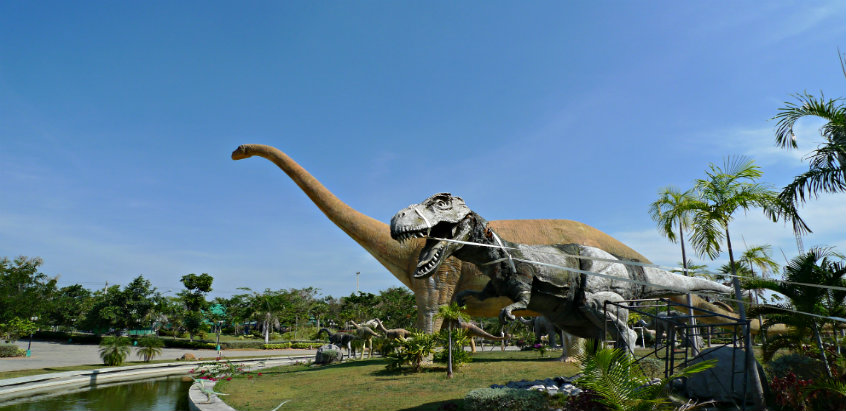
Thailand has several notable paleontological sites, museums and displays of fossilised footprints. One is the Phu Wiang National Park, which is one of the biggest dinosaur graveyards on the planet. There are also many fossils at the Sirindhorn Dinosaur Museum, which used to be called the Phu Kum Khao Fossil research center. While driving to and around these areas, visitors will see replicas of dinosaurs on the side of the road… including an animatronic Tyrannosaurus rex that will give out a life-like roar!

5 - JURASSIC PARK FILMING LOCATIONS IN HAWAII

9 Jurassic Park Filming Locations

Jurassic Park came out in 1993, after being based on Michael Crichton’s novel from 1990. In the story, the action takes place on Isla Nublar, near Costa Rica, but in real life, many of this popular film’s scenes were shot in Hawaii and, more specifically, Kauaʻi.

The well-known Gallimimus chase scene was filmed at Kualoa Ranch in Oahu, the opening scene was shot in Haiku, Maui, and the outside views of the Visitor Center were done at the Valley House Plantation Estate in Kauaʻi, according to LegendaryTrips.com.

4 - THE FIELD MUSEUM IN CHICAGO, ILLINOIS

The Field Museum | Chicago, Illinois

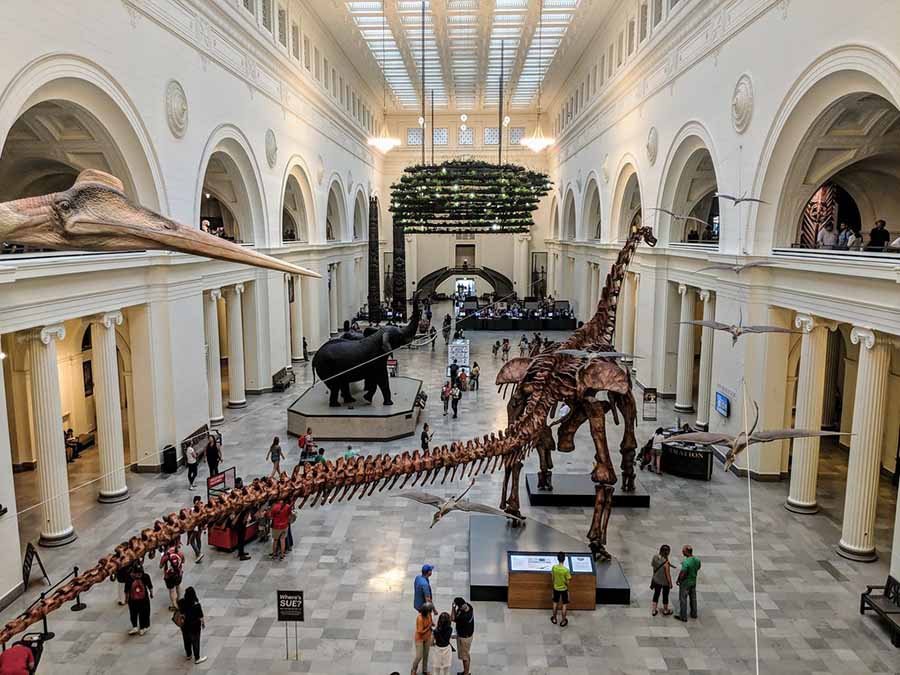
One of the biggest natural history museums in the world is Chicago’s Field Museum of Natural History. It has esteemed educational programs and artifacts, and the collections actually came from the 1893 World’s Columbian Exposition. The main thing that fans of dinosaurs will want to see here is Sue, the biggest T. rex specimen that has ever been found. She is over 40 feet long. She is 13 feet tall. She weighs between 8.4 and 14 metric tons. And she is 67 million years old.

3 - DINO PARK IN REHBURG-LOCCUM, GERMANY

Dino park - Picture of Dinopark Munchehagen

Dino Park, the biggest scientific adventure and theme park in Germany, is a place that the whole family can visit and enjoy. As an open-air museum, it offers up trails, facts, 230 (yes, over 200!) life-like replicas of dinosaurs and other prehistoric animals, more than 300 (yes, over 300!) fossilized dino tracks and a dino lab.

There is also a sun terrace by a natural pond that is filled with fun creatures and an exhibition about prehistoric giants of the seas, as well as an adventure playground.

2 - UNIVERSAL’S JURASSIC PARK IN ORLANDO, FLORIDA

Of course, many people are into dinosaurs due to the Jurassic Park movie, and at Universal’s theme parks, fans can feel like they are actually stepping into this story. In Orlando, for instance, there are rides, attractions and restaurants themed around these flicks at Islands of Adventure; there is the Pteranodon Flyers ride, the Raptor Encounter featuring the character Blue and the Jurassic Park River Adventure. This last ride puts guests face to face with a T. rex, so those who enjoy dinos and thrills have to experience this!

1 - UNIVERSAL’S JURASSIC WORLD IN UNIVERSAL CITY, CALIFORNIA

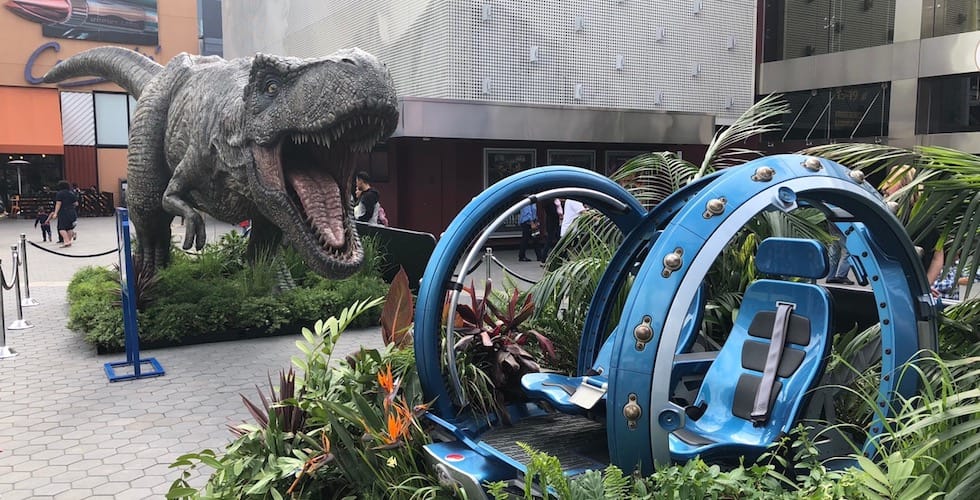
Universal Studios Hollywood has similar adventures that people can enjoy, such as the Raptor Encounter, DinoPlay, Isla Nu-Bar, the Jurassic Café and Jurassic Outfitters. The main attraction here, though - which is the last suggestion on this list of places to visit - is Jurassic World – The Ride. It is similar to the ride in Orlando, yet it promises to be “more real” and “more intense”. While on this, fans will even get to see some of the big, new, exciting dinosaurs from the Jurassic World movies.

Source: www.thetravel.com

Yilingia spiciformis: This 550 Million-Year-Old Worm May Change Animal Life Evolution Theory

Thursday, September 5, 2019

Yilingia spiciformis fossil (left), track marks (right), and artist’s reconstruction (center). Image: NIGPAS

Aquatic, worm-like animals capable of crawling through mud appeared at least 550 million years ago, according to new fossil evidence. The discovery is helping to resolve a longstanding question as to when segmented, mobile animals first appeared on the planet.

It’s the paleontological equivalent of finally being able to put a face to a name.

In this case, a team of scientists from Virginia Tech and the Chinese Academy of Sciences were able to connect an ancient species to the trail marks it left behind. Prior to this study, the same group of scientists detected animal tracks in rocks dated to between 551 million and 539 million years old. Trouble is, these tracks could not be connected to a specific organism, leaving the features ambiguous in nature; it’s exceptionally rare to find a fossilized creature resting next to its fossilized trail marks.

New research published in Nature showcases one such example. The fossilized remnants of a newly described creature, dubbed Yilingia spiciformis, were found in rocks pulled from China’s Dengying Formation in the Yangtze Gorges area. These rocks date back to the Ediacaran period, long before the appearance of dinosaurs and the Pangea supercontinent. The track marks found in these rocks are among the oldest known on Earth—and we finally know who made them.

“This discovery shows that segmented and mobile animals evolved by 550 million years ago,” said Shuhai Xiao, a paleontologist from Virginia Tech and the lead author of the new study, in a press release. “Mobility made it possible for animals to make an unmistakable footprint on Earth, both literally and metaphorically. Those are the kind of features you find in a group of animals called bilaterans. This group includes us humans and most animals. Animals and particularly humans are movers and shakers on Earth. Their ability to shape the face of the planet is ultimately tied to the origin of animal [mobility].”

Yilingia spiciformis fossil and associated tracks. Image: NIGPAS

Yilingia spiciformis featured a back, stomach, head, and tail. It looked similar to a millipede, featuring a long, narrow body composed of around 50 body segments. Yilingia spiciformis was around 26 millimeters (1 inch) wide and about 27 centimeters (10.6 inches) long. The creature would’ve dragged its body across the muddy ocean floor, creating trails as long as 58 centimeters (23 inches). In total, the scientists managed to identify 35 fossils of this species, along with 13 trace fossils of the trails. The “smoking gun” fossil, however, shows the creature with its associated trail mark.

The new research, in addition to offering a date for the emergence of bilateral symmetry in animals, also establishes an origin of directional mobility. Scientists had previously estimated an emergence date between 635 million and 539 million years ago based on other evidence, and this latest discovery further constrains these approximations.

“I think that this is a thorough piece of work based on years of detailed study of the Shibantan fossils,” Graham Shields, a professor of Geology at University College London, told Gizmodo. “Bilaterian animals are rare finds in the Ediacaran Period, and these are undoubtedly amazing examples with both trace and trace maker being preserved.”

Shields, who wasn’t involved with the new study, said the fossils “also have implications for the wider Earth system, as such energetic metabolisms were a first for the world and suggest that for the first time large organisms could actively mine the shallow seafloor, redistributing nutrients.” Prior to the emergence of these sea creatures, the only animals around were rooted to the seafloor, or they floated passively through the water, he said.

The discovery wasn’t a huge surprise for Shields, who said the newly discovered species is “in line” with modern animal groups such as annelid worms and arthropods—groups that would go on to dominate and diversify during the ensuing Cambrian period.

The discovery also made sense to Shields in that it’s consistent with his own work. New research published earlier shows that a weird carbon isotope anomaly dating back to the same period can be linked to the oxygenation of the world’s oceans, facilitating the rise of complex new organisms. A story of “co-evolution between life and the environment during these key early stages of animal evolution and diversification is all coming together,” Shields said.

Source: https://gizmodo.com

Maid of Honour's 'Outrageous' Wedding Outfit

Thursday, September 5, 2019

Meador was told to wear whatever she wanted - so she did. (Facebook)

It's not often that a bride tells her bridesmaids to wear whatever they want, so when one maid of honour heard those magic words she decided a T. rex costume was the way to go.

Christina Meador was thrilled when her older sister, Deanna Adams, asked her to be the maid of honour when she tied the knot in Texas this year.

Knowing that Meador isn't a fan of formal dresses and was on a tight budget, she told her sister to "pick any outfit" that she wanted.

But Adams probably didn't expect her little sister to shoot her a text soon after revealing she planned to wear a t-rex costume to her nuptials.

"I was trying to think of something that I would be willing to wear more than once and thought to myself, 'Well, she did say anything, and if I'm spending more than $75, I want it to be a dinosaur costume, because they're fantastic and I've always wanted one," Meador told the Daily Mail.

"I sent her a text so that she could have a laugh - surprisingly she was okay with it!"

Meador admits she second-guessed her outfit as Adams' August 10 wedding drew closer, and even bought a formal bridesmaids dress just in case she changed her mind on the big day.

But when the day arrived Meador discovered the dress no longer fit, as she had lost weight, leaving the dinosaur outfit as her only option.

Deanna, pictured with her husband Joby, said her sister was 'awesome' and she found the outfit hilarious

Luckily Adams was on board with the hilarious outfit and gave Meador her blessing to wear it, though the younger sister probably wishes she hadn't.

"It was hot!" Meador said of the outfit, which she donned in Texas' August heat.

She added that the outfit went down pretty well with the guests, and she later changed into something less prehistoric for the reception.

Meador shared a hilarious photo of the ceremony to Facebook soon after, joking that she "regrets nothing" about her outrageous outfit.

Christina captioned her Facebook post, which attracted more than 34,000 shares and 17,000 comments: 'When you're maid of honor and told you can wear anything you choose... I regret nothing'

The snap soon went viral, with thousands of people commending her carefree attitude and Adam's good humour about the whole thing.

Though some criticised Meador for "stealing her sister's thunder," Adams was quick to defend her little sister's brilliant ensemble.

"It's not a joke, it's a giant middle finger at spending thousands of dollars and putting ungodly amounts of pressure on ourselves just to please a bunch of people who, in the end, only want free food and drinks," she wrote on Facebook.

Source: https://honey.nine.com.au

How Colour Shaped Dinosaurs’ Lives

Thursday, September 5, 2019

Jeff J Mitchell/Getty Images

Pigment discovered in fossilised remains may explain how the ancient animals’ bodies worked.

Researchers studying dinosaur fossils have discovered that the colours of the ancient animals may have been radically different than previously believed.

And while exactly what those colours may have been has yet to be determined for most dinosaur species, the new findings suggest that pigment-producing structures go beyond how they looked and may have played a fundamental role inside their bodies too.

Palaeobiologists at University College Cork (UCC) found colour-controlling melanin in melanosomes - tiny structures found in animal cells - throughout dinosaurs’ bodies.

Melanin is the pigment that gives external organs and tissue such hair and eyes their colour. Skin is darker when there are higher levels of melanin, which is also believed to provide a barrier against UV damage caused by the Sun’s rays.

Scientists believe that external melanosomes could be the key to more accurately reconstructing the appearance of fossilised birds, reptiles and dinosaurs - and the discovery of the melanin-containing structures internally suggests they may reveal further characteristics as well.

“We’ve found it in places where we didn’t think it existed,” said Dr Maria McNamara, who co-led the new research - outlined in a paper in the journal Proceedings of the National Academy of Sciences of the United States of America.

“We’ve found melanosomes in lungs, the heart, liver, spleen, connective tissues, kidneys. They’re pretty much everywhere.”

The discovery of melanin in internal tissue suggests “intimate links” with dinosaurs’ metabolism and regulation of the chemical and physical state of their bodies.

The chemical signatures of the melanosomes were different according to which organ they came from, meaning scientists may be able to map the inner tissue of ancient vertebrates.

The findings also raise questions about melanin’s function in other animals - including humans.

“There’s the potential that melanin didn’t evolve for colour at all,” said McNamara. “That role may actually be secondary to much more important physiological functions.”

Other researchers agree that there is more to animal colour than visual means such as signalling, mating and camouflage, says Horizon magazine.

“For example, how do colours affect thermoregulation? Flight? Such functions may be complementary to, or even more significant, than purely visual functions,” said Dr Matthew Shawkey, an evolutionary biologist at Ghent University in Belgium.

Dr Steve Brusatte, a vertebrate palaeontologist and evolutionary biologist at the University of Edinburgh, said: “What started as a novelty of deciphering dinosaur colours has turned into a very serious field which is studying the origins of key pigment systems.”

It could reveal “how the evolution of colourful structures may have helped drive major evolutionary transitions like the origin of flight, and how colour is related to ecology and sexual selection”, added Dr Brusatte.

New synchrotron X-ray techniques were used by the UCC scientists to analyse the chemical make-up of fossils, revealing the never-before-seen internal melanin.

Source: www.theweek.co.uk

Pages