Blogs

'Jurassic World 3': The Real Reason the Movie Needs Original Characters to Return

Sunday, September 29, 2019

Left to Right: Laura Dern, Sam Neill and Jeff Goldblum. (Photos by Getty Images)

Fans greeted the news that Sam Neill, Laura Dern and Jeff Goldblum will join the cast of Jurassic World 3 with a roar of approval. Is this a shot in the arm the franchise needs after the relative disappointment of Fallen Kingdom, or is this Universal shamelessly pandering to nostalgia? 

Maybe it’s both. The return of the beloved principals of the first Jurassic Park is certainly welcome,  but how effective that return is depends on how well they are used. 

The most recent ‘Jurassic World’ fell short

The first Jurassic World in 2015 was a huge success, making $652 million here and $1.7 billion worldwide, making it the franchise leader before you adjust for inflation. Although some critics knocked it for being sexist and too derivative of Jurassic Park, it was generally well reviewed, with 72% on Rotten Tomatoes. 

Fallen Kingdom came out three years later, and something was missing – enthusiasm. The sequel made $417 million here, a disappointment somewhat salvaged by making $1.3 billion worldwide, but the reviews hit a franchise low of 48%. Fans and critics alike noted the dour tone, with a structure that seemed too close to The Lost World. Both the 1997 and 2018 contrived reasons to return to dinosaur islands failed to capture the wonder of their predecessors. Both movies also unleashed the dinosaurs on the mainland. 

One aspect of the sequel that burned some fans was that the trailers highlighted an appearance by Goldblum’s Ian Malcolm, but he turned out only to have a cameo, with almost his entire performance contained in the trailer. One hopes Universal isn’t making the same mistake again with Dern and Neill, although it sounds like all three will be more central to the story this time. 

What will the third ‘Jurassic World’ be about? 

Jurassic World 3, due out in June 2021, will deal with the aftermath of the dinosaurs reaching the mainland. The Lost World’s third act dealt with this too, but it cleaned up the mess relatively quickly. That movie had one dinosaur stomping around, while this one will have a whole bunch. 

Colin Trevorrow, returning to the director’s chair after only co-writing Fallen Kingdomtold EW the story”will be focused storytelling with dinosaurs all over the world. We really wanted this technology, this genetic power, to go open-source at the end of the film. What we’re suggesting is not just that these specific animals that we care about that were in captivity were freed, but also that the ability to create these animals has gone a little bit wider than our friend Dr. Wu. The open-sourcing of any technology, like nuclear power, that’s the scary side for me.”

In other words, it sounds like we get not only your traditional T-Rex’s and velociraptors, but your mutant hybrid dinosaurs that caused so much trouble in the previous movies. Those greedy humans just never learn, do they? Chris Pratt and Bryce Dallas Howard return as well. 

Will bringing back the old favorites work?

Many fans were delighted to see Neill, Dern and Goldblum back in the mix, with one person on Instagram saying, “BEST DAY EVER! YOU GUYS KNOW HOW TO MAKE HAPPY THE FANDOM!” A more cynical commenter on EW said, “The original title of this story was: “Universal resorts to Disney tactics by playing on Gen X nostalgia.” (…and Millennial’s disdain for watching ancient ’90s movies.)”

It almost goes without saying that Jurassic World 3 will make a ton of money. One hopes, however, that Universal isn’t just handing out the rose-colored glasses of nostalgia. Sam Neill and Laura Dern came back for Jurassic Park III, and that movie in some corners is like the forgotten stepchild, so there’s no guarantee their return will get the franchise back on course. 

To be fair, dinosaurs roaming the mainland isn’t something the franchise has played with for an entire movie, and if it fulfills the promise of the short film that came out, then Jurassic World 3 will make a good capper for the franchise – provided they stop there. 

Source: www.cheatsheet.com

Replicating Dinosaur Movements Through Robotics

Friday, September 27, 2019

Kamilo Melo has a BSc in Electronics (2004), MSc in Mechanics (2005) and PhD in Robotics (2013). His research at the Biorobotics Laboratory consists in the developement of biologically Infomed robots. His efforts are aimed to the understanding of animal locomotion and use of such principles for the design of Bio-robots and components for its deployment in disaster response missions. EPFL Lausanne, 19.02.2019 © Fred Merz | Lundi13

Combining fossils with robotics helps researchers understand the evolution of land vertebrates.

Making a legged robot walk is not as simple as it looks. Coordinating the motion of all its joints to achieve smooth motions, close to those of real animals, requires advanced engineering and careful observation of moving animals. But what if we don’t exactly know how the animal looks or moves, as it has been extinct for 300 million years?

This is the story of Orobates pabsti, an early tetrapod that lived millions of years before the dinosaurs existed. Its fossilized bones were recovered in what today is Germany in 2004. The excellent state of preservation of its fossilized bones, nearly complete and articulated, was complemented with fossilized footprints, also found in the region. This helped engineers like me in the Biorobotics laboratory of EPFL (working with Tomislav Horvat and Auke Ijspeert) and a great team of biologists (led by John Nyakatura at the Humboldt University of Berlin) to reconstruct its locomotion using a robot.

But why is the locomotion of Orobates important? Orobates is an ideal candidate for understanding how land vertebrates (including humans like us) evolved. These animals represent the transition from an amphibious lifestyle to land-living vertebrates capable of laying eggs on land. This places them in the evolutionary tree between the amphibians and more evolved animals including reptiles, birds, and mammals. Whether or not Orobates could walk on land seems crucial to be studied. For example, to shed light on debates related to when the dry land was finally colonized by animals. Locomotion experiments with living animals are difficult, but with an extinct animal is in fact, impossible.

We needed to find a way to reconstruct the locomotion of Orobates objectively. We thought that computer simulation was a good tool to do this, but legged locomotion is difficult to simulate. Intermittent impacts of the legs with the ground, contact friction, and the overall dynamics of the moving body of Orobates required a real-world verification to be valid. That is why we reconstructed the fossil of Orobates with a physical robot. This robot was a scaled version of the fossil, almost doubling its size. The mass distribution and other dynamically relevant parameters, like the speed at which the robot should move, were thoroughly studied to have both biologically and engineering significance.

Having this robot built, we were able to test a number of possible gaits that presumably Orobates executed when it was alive. We observed other modern animals whose morphology is similar to Orobates, like a salamander, a caiman, an iguana and a skink. We noticed that their gaits differ in their body height, the spine motion range, and their leg rotations as they swing them. These characteristics create a space where the living animals’ data and the possible gaits of the robot could be compared. We tested a number of gaits in this space to try to find the most stable, energetically efficient gait, that used force patterns similar to those of the living animals, and whose precision matching the footprints was high. We discover that the most likely gaits used by Orobates to walk were quite similar to those of the caiman. This suggested that their locomotion was rather advanced, compared to what was thought of these early tetrapods.

Kamilo Melo has a BSc in Electronics (2004), MSc in Mechanics (2005) and PhD in Robotics (2013). His research at the Biorobotics Laboratory consists in the developement of biologically Infomed robots. His efforts are aimed to the understanding of animal locomotion and use of such principles for the design of Bio-robots and components for its deployment in disaster response missions. EPFL Lausanne, 19.02.2019 © Fred Merz | Lundi13

Field test in Africa

Testing with the robot was also a great experience. It looked alive. To control this machine, it was necessary to solve inverse kinematics and dynamics problems, to coordinate the motion of the legs and the spine. To achieve smooth locomotion, the robot’s on-board computer sends commands to the motors at rates around 100 times per second. The actuators used are driven by a powerful and efficient maxon DC motor. We used 28 actuators, five per leg and eight in the spine. Few times a robot that complex and close to a real animal has been controlled to execute all these diverse motions.

We built in our experience in designing and controlling sprawling posture robots to make the robot of Orobates. After doing science with the salamander robot Pleurobot (please see Driven magazine in 2018), we also drew inspiration from the gaits and morphologies of Nile crocodiles and monitor lizards to build and test two such robots out in the field. We worked with BBC, filming wildlife documentaries in Africa. The TV series Spy in the Wild features our robots surrounded by wild animals on the banks of the Nile river. These robots survived two intense weeks of filming in extreme environmental conditions, and gave us new insights on robust design for complex real-world scenarios. That is the case with the K-Rock robots intended for disaster scenarios. Because of their posture, they have the ability to walk under tight passages and being amphibious, they can swim and walk in flooded areas filled with debris and obstacles.

Developing these robots, first with the Biorobotics Laboratory of EPFL and now in my private company KM-RoBoTa (part of YEP program of Maxon, and one of the start-ups at the Maxon Innovation Lab in Lausanne), sets the bar for the robust design of animal-like robots that are inspired by real animals and whose mobility capabilities have great potential to be used either for science or for engineering applications.

Actuators of the future

Advances in robotics like these make us think about the actuation mechanisms we currently use. With current technology, we can be fast, but we cannot move high inertias quickly and efficiently (allowing impacts, explosive motions, etc). Additionally, to increase the torque, we use gearboxes, which affect the transparency of the motion control by inertia and friction reducing the actuator bandwidth. New avenues of creating better actuators at different scales from soft robotics, to high power proprioceptive actuators often come with the burden of bulky peripheral systems, decreasing the power and torque density, or a high demand in power that overflows the dissipation requirements.

Step by step, like Orobates’ robot walked in its footprints, we are designing better actuation technology. But we are still far from providing our robots the desired real animal-like abilities. At least compared to what the animal muscles can do. There is a long, yet exciting research and development path for actuation and robotics design in the following decade worth to be walked.

Source: www.roboticsbusinessreview.com

New Research: How T. Rex Could Crush Bones Without Busting Its Own Skull?

Thursday, September 26, 2019

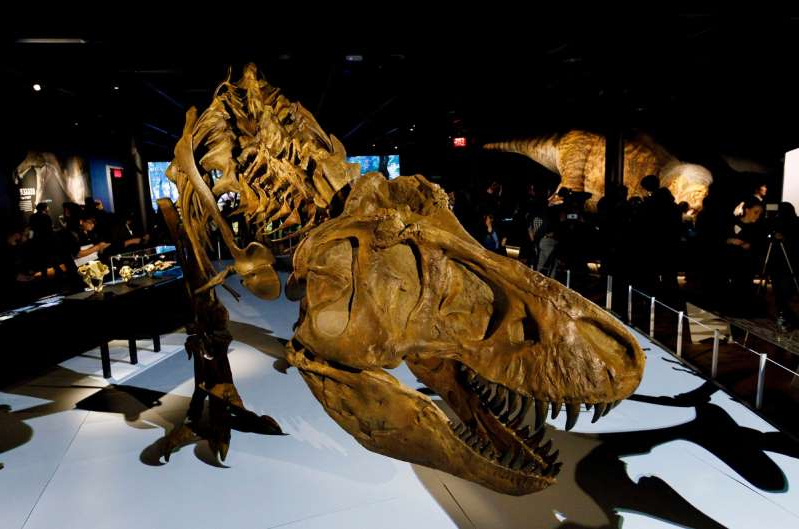
Image Source: JUSTIN LANE/EPA-EFE/Shutterstock

The mighty Tyrannosaurus rex was the ultimate food processor. It didn’t really mess around with tearing meat from bone in the way that smaller predators and scavengers of the day may have. Instead, it used its incredibly powerful jaws to crush absolutely everything, including bone, and wasn’t squeamish about swallowing it all.

But if that was the case, and the creature regularly slammed its jaws down onto the bones of dead or dying dinosaurs, it would seem equally likely that the T. rex’s own skull would crack or shatter as well. Researchers from the University of Missouri wanted to figure out why that didn’t happen, and how the mighty king of the dinosaurs was able to pulverize bone without cracking its own skull in the process.

To get to the bottom of this mystery, the researchers didn’t study just the bones themselves, but also the various tissues that held the jaw and skull in place. This gave them a better idea of the stresses the skull endured during feeding, and revealed an interesting quirk regarding the skull of the T. rex.

As it turns out, the jaws of the T. rex were less flexible side-to-side than previously thought. Unlike modern day birds and most reptiles, the T. rex’s jaw wouldn’t have had much wiggle room, and that would have aided in its stability.

“Dinosaurs are like modern-day birds, crocodiles and lizards in that they inherited particular joints in their skulls from fish—ball and socket joints, much like people’s hip joints—that seem to lend themselves, but not always, to movement like in snakes,” Casey Holliday, co-author of a new paper on the research published in an The Anatomical Record, said in a statement. “When you put a lot of force on things, there’s a tradeoff between movement and stability. Birds and lizards have more movement but less stability. When we applied their individual movements to the T. rex skull, we saw it did not like being wiggled in ways that the lizard and bird skulls do, which suggests more stiffness.”

The T. rex’s skull seems to have been built specifically for destroying just about anything, and based on what its fossils have told us, that’s exactly what it did.

Source: https://bgr.com

Battle at Big Rock Reignites Jurassic Park Nostalgia: Review, With Spoilers

Thursday, September 26, 2019

Universal released a short film, “Battle at Big Rock” on Sept. 15. The film takes place between Jurassic World: Fallen Kingdom and the next Jurassic film, set to be released in 2021. Graphic by James Neidhardt. 

I have never been a huge fan of the Jurassic Park franchise. While I do love the original movie and novel, the sequels have not done much for me. 

The Lost World: Jurassic Park was an okay movie; the only memorable part being the climax, where the T-Rex gets loose in San Diego and embarks on a rampage. It makes potent allusions to Sir Arthur Conan Doyle’s seminal science fiction novel and equally influential 1925 film adaptation, The Lost World. 

Jurassic Park III was absolutely dreadful, with baffling plot holes and questionable CGI even for the time of its release in 2001. Fourteen years later, Jurassic World was released; which was a genuinely decent film, with Chris Pratt and Colin Trevorrow’s directing being particular highlights for the film. 

I still have yet to see Jurassic World: Fallen Kingdom, the sequel to Jurassic World. I have heard mixed reviews, but I will never come to conclusions about a film without having seen it. 

With all of that history out of the way, fans are now treated to a short film set within the Jurassic Park/World universe titled Battle at Big Rock. This short film is directed by Trevorrow; returning after stepping down from directing Fallen Kingdom, instead opting to only write and produce the film. 

The short film follows a family as they embark on a camping trip in a world where dinosaurs coexist. This premise definitely raises my eyebrows, as I don’t know anyone who would go camping while dinosaurs exist in our food chain. It seems to be an incredibly irrational decision. I am proven right as there is a dinosaur attack and conflict within the first two minutes of the film. 

With that said, barring my reservations about the plot, I think the rest of the short is quite good.

I especially love when the dinosaurs first arrive, and the family witness a vicious schism in which there may be a fatality. That scene felt especially raw and real to me, specifically when the father tells his children: “This is nature.” 

That little bit of nuance, which in this case, something as fantastical and uncanny as a violent dinosaur battle given real life consequences and perspective, is what I always loved about the first Jurassic Park film and novel, whether it was used for humorous or dramatic effect.

The rest of the film is shot with beautiful and gripping cinematography and blocking, therefore adding to the tension and suspense of the situation. This is a testament to Colin Trevorrow’s directing and the fact that he is able to convey such high stakes and terror in such a short, eight-minute film. 

The story of the family is not developed and that does not matter, but what does matter is the way that Trevorrow encapsulates the claustrophobia the family feels as they struggle to survive once the dinosaur tears apart their camping home.

The ending is also phenomenal, with the little girl fending off the Allosaurus that tore apart her family’s shelter. 

The rest of the family gather and hug as the camera pans to show the remains of their shelter.

It is a powerful and striking image that cements the collateral damage and impact that the dinosaurs had on their trip, as well as the implication of the greater trauma that was inflicted on them.

I give this film an 8/10. This is a fantastic short film which really gets at the core of what made Jurassic Park such a charming and riveting film and novel in the first place: the juxtaposition between the fantastical and real human emotion.

Source: www.fdupillar.com

Greater Adria: A Lost Continent Has Been Discovered Under Europe

Wednesday, September 25, 2019

The long-lost continent of Greater Adria, which broke off from Northern Africa about 240 million years ago and began slipping beneath southern Europe about 100 million years ago.

The Mediterranean region is one of the most geographically complex on Earth, and geologists from the University of Utrecht, Netherlands, discovered the region has been hiding a big secret — a lost continent the size of Greenland that disappeared under Southern Europe long ago and has never before been mapped.

“Forget Atlantis. Without realising it, vast numbers of tourists spend their holiday each year on the lost continent of Greater Adria,” reads a release from the University of Utrecht.

Today, the sedimentary rock that was scraped off when the lost continent subducted into the Earth’s mantle make up the Apennines, parts of the Alps, the Balkans, Greece and Turkey.

Much of this lost continent was underwater and formed shallow coral reefs before it subducted into the Earth’s mantle under Southern Europe.

The research team of geologists from several different countries was led by Douwe van Hinsbergen, a professor of global tectonics and paleontology at Utrecht University, and the findings were published in in the journal Gondwana Research in September 2019.

GL MAP lost continent v2

Geologists discovered the lost continent by analyzing all the mountain ranges “from Spain to Iran” in detail for ten years, which led them to the discovery that a piece of continental crust as big as Greenland was pulled into the Earth’s mantle under Southern Europe.

The reason it had never been mapped before is because of the complicated geographical features of the region.

Plate tectonics, which explains how continents and oceans are formed by the movement of Earth’s tectonic plates, generally assumes that Earth’s various plates do not undergo internal deformation as they move along fault lines — in other words they do not buckle under their own weight. However, the Mediterranean is different, especially in Turkey.

"It is quite simply a geological mess: everything is curved, broken, and stacked," said Van Hinsbergen. "Compared to this, the Himalayas, for example, represent a rather simple system. There you can follow several large fault lines across a distance of more than 2000 km."

The research team analyzed the evolution of mountain ranges, which are formed by subduction, or the process of one plate diving beneath another.

"Most mountain chains that we investigated originated from a single continent that separated from North Africa more than 200 million years ago. The only remaining part of this continent is a strip that runs from Turin via the Adriatic Sea to the heel of the boot that forms Italy," said Van Hinsbergen.

That particular area is referred to as “Adria” by geologists, so Van Hinsbergen is calling the lost continent “Greater Adria.”

Van Hinsbergen created a visualization of the formation and destruction of Greater Adria by reconstructing the tectonic movements of the Mediterranean region for the last 240 years, which can be seen in the YouTube video below.

Greater Adria would have been attached to the north side of the prehistoric supercontinent of Gondwana, which was made up of almost the entire modern world – land masses which are now Africa, Antarctica, South America, Australia and parts of the Middle East and Asia

The reconstruction was made with advanced software that takes thousands of previously recorded data points about the Earth’s tectonic plate movements and magnetism stored in rocks (the research team had to manually input this data), and then the geologists “peeled” off the area layer by layer all the way back until the Triassic period, which created an intricate picture of the Earth’s geographical development over 240 million years.

The reconstruction isn’t just useful in teaching us about the Earth’s past — it can also help us predict what the Earth will look like in the future.

“Our research provided a large number of insights, also about volcanism and earthquakes, that we are already applying elsewhere,” said Van Hinsbergen. “You can even predict, to a certain extent, what a given area will look like in the far future.”

Source: www.my9nj.com

Rauisuchians: Croc-Like Carnivores Terrorized Triassic Dinosaurs in Southern Africa 210 Million Years Ago

Wednesday, September 25, 2019

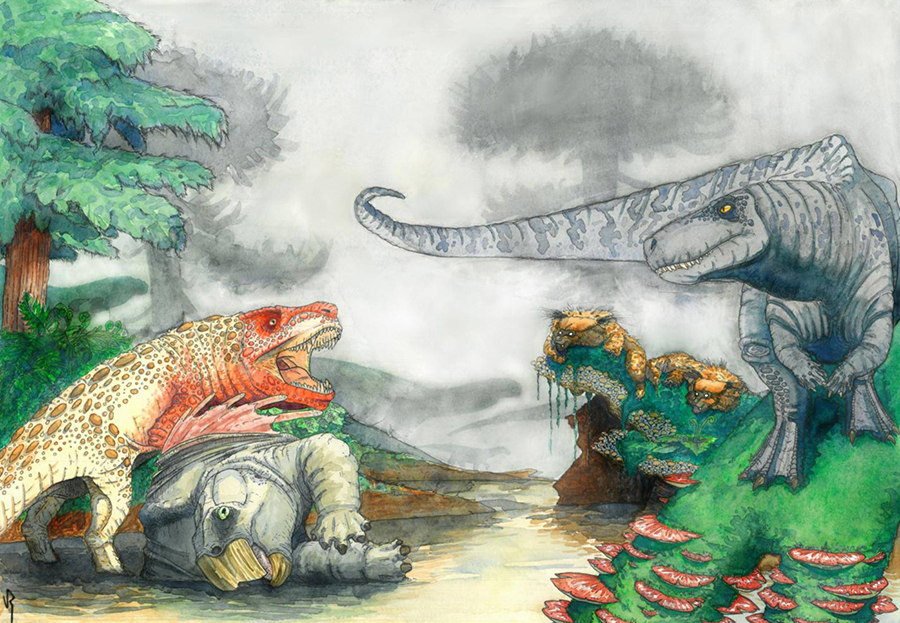
An artist’s reconstruction of two rauisuchians fighting over a desiccated corpse of a mammal-relative in the Triassic of southern Africa. In the background, dinosaurs and mammal-like reptiles form other parts of the ecosystem. Image credit: Viktor Radermacher.

Rauisuchians — predatory crocodile-like creatures that lived during the Triassic period, some 210 million years ago — preyed on early herbivorous dinosaurs and mammal relatives, according to a new study.

Rauisuchians are a group of massive Triassic archosaurs. These animals had huge skulls full of serrated, curved teeth, and a diversity of body shapes and sizes.

They are closely related to crocodiles as we know them today, and are generally considered to have gone extinct in the end-Triassic mass extinction.

“In the Triassic period, rauisuchians were widespread and their fossils are known from all continents except Antarctica,” said Rick Tolchard, a student in the Evolutionary Studies Institute and School of Geosciences at the University of the Witwatersrand in Johannesburg, South Africa.

“They went extinct about 200 million years ago, paving the way for dinosaurs to become the dominant large land animals.”

In the study, Tolchard and colleagues analyzed rauisuchian fossils — teeth, pieces of jaws, hind limbs and body armor — from the Elliot Formation of South Africa and Lesotho.

The specimens included some of the largest carnivorous members of the group, possibly up to 33 feet (10 m) long.

“These ancient fossils provide us with evidence of how at least two predator species hunted these vegetarian dinosaurs 210 million years ago,” Tolchard said.

“It is amazing to follow the clues left behind in fossilized teeth, jaws, limbs and other fossils to help us tell the ancient story of life in southern Africa.”

The study shows that the rauisuchians from the Elliot Formation were some of the latest-surviving members of their group, and that when they were alive, they were thriving close to the Antarctic Circle — the theoretical limit for their physiology.

“This study demonstrates the value of re-examining old specimens, and now we finally know what was preying on all those herbivorous dinosaurs,” said co-author Professor Jonah Choiniere, from the Wits Evolutionary Studies Institute.

The team’s paper will be published in the December 2019 issue of the Journal of African Earth Sciences.

_____

Frederick Tolchard et al. 2019. ‘Rauisuchian’ material from the lower Elliot Formation of South Africa and Lesotho: Implications for Late Triassic biogeography and biostratigraphy. Journal of African Earth Sciences 160: 103610; doi: 10.1016/j.jafrearsci.2019.103610

Source: www.sci-news.com

The 10 Highest Grossing Monster Movies Of All Time, Ranked

Tuesday, September 24, 2019

The genre of monster movies provides some of the most underrated performances in the film industry. Demographics of all ages find excitement in the movies that create a world of imagination. Various creatures from monsters to giant apes to sharks to dinosaurs to everything in between have been the focus of successful monster movies. Younger audiences get the joy of seeing a new world on the big screen while older fans can appreciate the artistry behind the story.

We will look at the most successful movies in the history of the genre. All these monster movies found a way to bring a huge audience into the box office with the intent of having them suspend their disbelief. Some movies did better than others with legendary statuses many years after release. Others have lost the touch with them not holding up through the years. These are the top ten highest grossing monster movies of all time.

10 - GODZILLA: KING OF THE MONSTERS: $385 MILLION

The recent release of Godzilla: King of the Monsters helped set the stage for an upcoming showdown film between Godzilla and Kong. This movie looked at the story of Godzilla with humans trying to get its help from various issues impacting the world.

Godzilla: King of the Monsters did not receive positive reviews and actually disappointed at the box office despite the big numbers. The $385 million domestic gross helped it slide into the top ten, but the studio had higher hopes given the nearly $200 million put into the making of the film.

9 - JAWS: $470 MILLION

The success of Jaws has seen it remain a beloved movie throughout the decades. This concept of a shark wreaking havoc did not have typical feel of a monster movie given sharks are real, but it perfectly played into the suspense nature of the film with some realistic elements.

Jaws is one of the most popular franchises in the history of the movie business with shark films becoming more frequent hoping to follow its legacy. An incredible $470 million box office gross was highly impressive in any era, but it was even more amazing back in 1975.

8 - GODZILLA (2014): $529 MILLION

The 2014 Godzilla film featured a cast of talented stars like Bryan Cranston, Elizabeth Olsen, Ken Watanabe and Aaron Taylor-Johnson. There was a lot of hype for a blockbuster Godzilla film and it led to box office success all over the world.

Godzilla raked in $529 million internationally as one of the bigger hits of the year. The reaction to the movie itself was mixed with some changes needed before committing to the Kong vs Godzilla plan. Regardless, the movie made enough to stake its claim as a top ten monster movie based on box office success.

7 - THE MEG: $530 MILLION

The recent 2018 film titled The Meg featured Jason Statham starring in the new version of a blockbuster shark movie. There was a bit of ridiculousness involved in The Meg with comedy putting it over the top in a way fans often expect and desire from a shark movie.

An impressive $530 million was grossed internationally with an unexpected sequel coming for the series. The Meg found even more success in select theaters as it was one of the most successful 4DX films with various motions adding to the experience.

6 - KING KONG: $550 MILLION

Naomi Watts, Jack Black and Adrien Brody led the cast of the star-studded 2004 King Kong film. It was the biggest film about the monster at this point and viewers certainly wanted to come out and see the movie. An amazing $550 million was grossed internationally as a massive success.

King Kong told the story with the advanced technology of the 2000s allowing us to see it in a new light along with some emotional moments to put it over the top. This monster movie showed that the genre could find the top tier success at the box office if done right.

5 - KONG: SKULL ISLAND: $566 MILLION

Kong: Skull Island was the most important project involved in Legendary’s Monsterverse franchise. This looked at the backstory of King Kong with the hopes of it doing well enough at the box office to set up the eventual Kong vs Godzilla film.

Brie Larson, Samuel L. Jackson and Tom Hiddleston were the main characters of the film as they all witnessed the legitimacy of the monster in person. Kong: Skull Island raked in $566 million as a huge success and surprisingly out-grossed Godzilla: King of the Monsters.

4 - THE LOST WORLD: JURASSIC PARK: $618 MILLION

The Jurassic Park franchise dominated the box office with a must-see movie theater experience. Fans would see The Lost World: Jurassic Park as the second film in the franchise. It was one of the most highly anticipated sequels in the history of the box office due to the success of the first movie.

Jeff Goldblum is the main cast member from the first film that returns with his character Ian Malcolm dealing with the aftermath of the first movie four years later. The Lost World: Jurassic Park did not have the same charm as the first movie, but the $618 million showed viewers were still interested in the story.

3 - JURASSIC PARK: $1 BILLION

The first Jurassic Park film was an experience every 90s kid will remember for the rest of their lives. Steven Spielberg brought the book to life with this imaginative story focusing on the theme park with dinosaurs turning into a terrifying experience.

Jurassic Park made a little over $1 billion at the box office which was extremely rare for a movie released all the way back in 1993. The computer-generated imagery helped portray the dinosaurs as real to suspend the audience’s disbelief. Jurassic Park is rightfully one of the most beloved movies and created an iconic franchise.

2 - JURASSIC WORLD: FALLEN KINGDOM: $1.3 BILLION

The 2018 release of Jurassic World: Fallen Kingdom was the second Jurassic World in a new version of the franchise following Jurassic Park. Chris Pratt and Bryce Dallas Howard had the lead roles of the humans dealing with the aftermath from the first Jurassic World movie.

The story continues that humans can’t control dinosaurs no matter how much they plan. Jurassic World: Fallen Kingdom did not receive as many positive reviews as the first film, but it made over $1.3 billion. The franchise continues to dominate the monster movie world with another sequel planned.

1 - JURASSIC WORLD: $1.6 BILLION

Jurassic World was the first film in the Jurassic Park/World franchise in almost fifteen years. It was done in the current time with another theme park meant to successfully achieve what was failed in the original Jurassic Park movie with various references to it.

The franchise had many more fans throughout the years with the original Jurassic Park winning over new viewers. It showed at the box office as it was a massive hit and one of the biggest movies of all time. Jurassic World grossed $1.6 billion as the top monster movie of all-time.

Source: www.therichest.com

Distant asteroid calamity shaped Life on Earth 466 Million Years Ago

Monday, September 23, 2019

Solar radiation reaching Earth's surface was reduced for at least 2 million years by dust in space. Art by Don Davis

The cataclysmic asteroid impact off Mexico’s coast that doomed the dinosaurs 66 million years ago was not the only time an astronomical event shaped the history of life on Earth.

Scientists declared that dust spawned by a gigantic collision in the asteroid belt between Mars and Jupiter 400 million years earlier triggered an ice age on Earth that ushered in a significant increase in marine biodiversity.

The event, occurring when life was concentrated in the seas and far before vertebrates first walked on land, set in motion evolutionary changes in invertebrates fundamental to marine ecosystems as they adapted to global cooling, they said.

The inner solar system was filled with enormous amounts of dust after an asteroid more than 90 miles (150 km) in diameter was struck by a smaller object perhaps 12 miles (20 km) wide, the researchers said. It was the solar system’s largest-known breakup event in the past 2 billion years.

Solar radiation reaching Earth’s surface was reduced for at least 2 million years by the dust in space and in the planet’s atmosphere, said study co-author Philipp Heck, an associate curator at the Field Museum in Chicago.

Another cooling mechanism was that the iron-rich meteoritic dust fertilized large parts of the ocean surface leading to increased plankton productivity and drawdown of atmospheric carbon dioxide, added Birger Schmitz, a geology professor at Lund University in Sweden and lead author of the research published in the journal Science Advances.

“In the last few decades, researchers have begun to understand that evolution of life on Earth is dependent on astronomical events also,” Schmitz said.

After noting the dinosaur-demise event caused by an asteroid perhaps 6 miles (10 km) wide, Schmitz added, “For the first time, scientists can now present another example of how an extraterrestrial event formed life on Earth.”

The researchers found traces of dust in sedimentary rocks formed at the time containing special helium isotopes and rare minerals that revealed its extraterrestrial origin.

Invertebrate groups that experienced diversification included horseshoe crab-like trilobites, clams, clam-like brachiopods and a group called gastropods that included snails and slugs.

The cooling event unfolded gradually, enabling marine life during the Ordovician Period to adapt, unlike the sudden impact that erased the dinosaurs. Earth’s climate changed from being tropical to semitropical worldwide to becoming divided into climate zones as it is today with frozen poles and tropical conditions at the equator.

Source: https://dunyanews.tv

‘Dinosaurs: The Myth-Busting Guide to Prehistoric Beasts’ Perpetuates Some Myths of Its Own

Friday, September 20, 2019

Dinosaurs: The Myth-Busting Guide to Prehistoric Beasts (2019, Happy Fox Books) is a collection of reprinted, full-color BBC Science Focus magazine articles from 2017 and 2019, available in both hardcover and paperback. Being such, it’s a little surprising that this book only has four credited authors. This includes two articles by paleobiologist Darren Naish, who first walks readers through the rise of the dinosaurs during the Triassic Period (p. 16-23) and then discusses dinosaur biomechanics (p. 38-45), and two by writer John Pickrell, asking how we can know what dinosaurs looked like (p. 26-35) and  considering Dougal Dixon’s classic work of speculative-evolution, The New Dinosaurs (1988), and how well it holds up today.

This leaves journalists Henry Nicholls to cover the extinctions of the dinosaurs (p. 64-73) and Brian Clegg (Big Data, 2017) to ask what a real-life Jurassic Park would be like (p. 89-96). This last article is more science-fiction than actual science since, as geneticist Beth Shapiro explains at the top, our chances of cloning a 5,000-year-old mammoth are slim-to-none, let alone a 65 million-year-old dinosaur.

Filling out the rest of Dinosaurs’ nearly 100-pages is a 13-page illustrated timeline of earth’s geological history from the very beginning to the present, a 14-page Q & A section dealing with various dinosaur trivia, and a set of canned profiles on the “Top 7 Dinosaurs”: T. rex, archaeopteryx, anklyosaurus, triceratops, velociraptor, brachiosaurus, and stegosaurus.

The book’s subtitle, “The Myth-Busting Guide to Prehistoric Beasts,” is something of a non-sequitur, as busting popular paleo-myths really isn’t the focus here. The closest we get is in Naish’s second article, which touches on the fact that dinosaurs likely didn’t roar like lions but rather rumbled like crocodilians (p. 41), and that some herbivorous dinosaurs did occasionally consume protein (p. 45), just like modern-day ungulates.

But neither of these asides constitutes the focus of Naish’s piece, or justifies the supposed theme of the book. In fact, Dinosaurs occasionally helps to foster some myths and common misconceptions. A blurb on page 56 addressing the question, “When Was the First Dinosaur Discovered?” cites folklorist Adrienne Mayor’s controversial idea that protoceratops bones found in Mongolia inspired the legendary griffin, a concept which has been repeatedly challenged but remains popular, nonetheless.

Then there’s the issue of how shockingly uneven the images throughout the book are, both in paleontological accuracy and the actual quality of the images themselves, with many appearing blurry or pixilated. While a few fine paintings by noted paleoartist Mark Witton can be spotted here and there, the bulk of the illustrations consist of atrocious, CGI-rendered stock dinosaurs.

Many of these images are not only unattractive but severely dated. A spinosaurus seen on page 11 is standing on two legs, while another one on pages 48-49 has a megalosaurus-style skull. Some images depict theropod dinosaurs with feathers and some don’t. Perhaps the most inexcusable is the archaeopteryx profiled on pages 24-25, which looks like a plucked chicken.

Perhaps nothing beats the pages which just resort to using photos of commercial dinosaur toys, like Papo’s Jurassic Park-inspired featherless “raptors,” or a T. rex in an anatomically impossible spine-snapping pose, or a couple of vintage, lizard-faced stegosaurus by Dor Mei and Imperial, respectively.

It’s not all bad, though. The highlight of the book, artistically speaking, is the section, “What If The Dinosaurs Had Survived?” which features original artwork by the talented James Gilleard. As noted above, this section deals with Dougal Dixon’s The New Dinosaurs (1988), which featured numerous illustrations by the author of speculative future-dinosaurs, and it’s fun to see Gilleard’s take on Dixon’s iconic creatures.

Ultimately, I can’t recommend Dinosaurs: The Myth-Busting Guide to Prehistoric Beasts. If you have the issues of BBC Science Focus magazine that the book drew from, then you already own it. I’ve heard it suggested Dinosaurs would be ideal for kids, but if this is the case, there are still far better, splendidly illustrated books on dinosaurs for young readers out there. Might I recommend Gilleard and Anne Rooney’s Lonely Planet Kid’s Dinosaur Atlas?

Source: www.adventuresinpoortaste.com

3 Reasons to Encourage Your Child's Love of Dinosaurs

Saturday, September 21, 2019

A child's interest in dinosaurs may benefit them in many ways.

For some children, dinosaurs are life. They can name countless dinosaurs off the top of their heads, they'll correct your pronunciation if you slaughter a dino name, and they'll laugh you out of the room if you suggest a Tyrannosaurus rex would eat a Stegosaurus (in fact, the Stegosaurus had been extinct for millions of years by the time T. rex came around).

But is this obsession with dinosaurs healthy? Wouldn't it be better for kids to branch out to other topics, as well?

In fact, research has found that, not only is it OK for kids to obsess over dinosaurs, this intense interest, known as a "conceptual interest," may benefit them.

A conceptual interest manifests as more than passing curiosity. Children who like dinosaur toys, for example, don't necessarily have a conceptual interest in dinosaurs. However, children who love memorizing facts about dinosaurs and want to know everything about them may have a conceptual interest. Kids with a conceptual interest have a self-motivated interest in learning, which impacts how they learn and what they learn in the future.

"Sustaining interests on conceptual domains can lead to a number of benefits for learning—increased knowledge and persistence, heightened attention and deeper levels of processing," researchers explained in ScienceDirect.

Here are a few ways children's interest in dinosaurs could benefit them long-term.


RELATED: 15 of the Best Dinosaur Movies for Kids

RELATED: 6 Seriously Science-y Dinosaur Books for Future Paleontologists

RELATED: 10 Tips for Aspiring Paleontologists


Enhanced verbal skills

Have you met determined preschool-age children with burning questions? Regardless of their language skills, they will do whatever it takes to get satisfactory responses—and woe betide the adult who gives half-baked answers.

That determination is likely the reason researchers found that "children who manifest conceptual interests during early childhood tend to be highly verbal," according to ScienceDirect. This is likely linked to children's desire to understand and be understood and to their exposure to a range of vocabulary words as a result of their frequent questions.

Improved comprehension

Another benefit linked to asking questions about a specific subject is children's improved ability to comprehend complex topics.

"Topic interest is highly correlated with deep-level indicators of understanding, such as elaborations and correct responses to comprehension questions," according to ScienceDirect.

Students with advanced comprehension skills tend to enjoy reading more than others and master age-appropriate skills quickly, according to Iowa Reading Research Center. And kids with improved mastery of reading tend to do well in school.

Higher levels of confidence

Another benefit of intense interests is the confidence kids derive from their solid understanding of a topic. It may be the first time in their lives they know more about something than a parent or teacher.

"It makes them feel powerful," pediatric psychiatrist Kelli Chen told The Cut. "Their parent may be able to name three or four dinosaurs and the kid can name 20, and the kid seems like a real authority."

Once children discover the excitement of having expertise, they may be interested in pursuing advanced learning in other topics—or the same topic if they're destined to become paleontologists.

Source: https://cbs12.com

Pages