Blogs

China Focus: Scientists Mark 90th Anniversary of Peking Man's Discovery

Wednesday, December 4, 2019

Global paleontologists gathered in Beijing to mark the 90th anniversary of the discovery of the first skull of Peking Man (pic), the homo erectus that lived in the suburbs of today’s capital of China about 700,000 years ago.

Global paleontologists gathered in Beijing to mark the 90th anniversary of the discovery of the first skull of Peking Man, the homo erectus that lived in the suburbs of today's capital of China about 700,000 years ago.

Nearly 200 Chinese and foreign scholars attended the international symposium on paleoanthropology to share their latest discoveries and push forward the research on human origin and evolution.

The first complete skull of Peking Man was found by Chinese archaeologist Pei Wenzhong in December 1929 at the Location 1, or the Peking Man Site, one of the four sites in Zhoukoudian in suburban Fangshan district where ancient human fossils were found.

The big collection of fossils, including six skulls, unearthed at Location 1 during 1920s and 1930s, were found to belong to over 40 individuals. Almost all of these fossils were missing during World War II.

Over the past 90 years, more fossils of ancient human dating back to the Pleistocene (about 2.9 million to 11,700 years ago) have been found at over 70 sites across China, Wu Xiujie, a researcher with the Institute of Vertebrate Paleontology and Paleoanthropology (IVPP) under the Chinese Academy of Sciences, said at the symposium.

The latest studies on Zhoukoudian sites show that the homo erectus in Far Eastern and African Homo can be grouped as the same species due to their similar characteristics, Wu said.

She said that different homo erectus branches may have existed in the late Middle Pleistocene of China with complex physical characteristics and large internal variation.

"The discovery of the Peking Man fossils indicated the existence of homo erectus, which was a giant leap in the research of human evolution at that time," said Gao Xing, a researcher of the IVPP.

Gao and other scholars have kept searching for clues about the missing fossils at home and abroad, but found none. "As long as there is any hope, we will spare no effort to look for them," he said.

"Zhoukoudian is not only a relic for visitors to remember, but also a research base full of academic vitality," Gao said. "More excavations and studies at the site are carried out."

The site was listed by the United Nations Educational, Scientific and Cultural Organization (UNESCO) as a world heritage in 1987.

"Zhoukoudian is more than a place where we found human fossils," said John W. Olsen from the University of Arizona, adding that the legacy is of great significance for its "interdisciplinary perspective, long-term international collaboration and integrated paleoanthropological orientation."

The participants also celebrated the 90th anniversary of the founding of the IVPP.

"I think IVPP is really now one of the most important institutions in the world in paleontology thanks to the efforts made by the remarkable scientists," said Philippe Janvier, a French paleontologist.

Jingmai O'Conner, a foreign researcher working in the IVPP, planned to stay there for only a few years as a postdoctoral researcher, but ten years later he is still working in the institute.

"Nowhere else in the world is there such a large number of expert paleontologists under one roof, nor such incredible collections, or the abundant resources to study them," he said.

The IVPP will continue to cultivate talents in the fields of paleontology, paleoanthropology, archaeology, stratigraphy and paleoenvironment, and establish a world-class scientific platform on studying biological evolution and the origin of human beings, said Deng Tao, director of the IVPP.

A total of 90 specimens from the IVPP are being showcased to the public on an exhibition opened Saturday to celebrate the two anniversaries, one of which is a skull fossil model of Peking Man.

Source: www.xinhuanet.com/

Study: Humans and Climate Change Drove Australian Megafauna to Extinction

Tuesday, December 3, 2019

A range of now extinct megafauna that was present when humans first arrived in Australia. Image credit: Peter Trusler, Monash University.

Ancient Australia’s super-sized animals, the megafauna, became extinct about 42,000 years ago, but the role of humans in their demise has been debated for decades. New research challenges the notion built from previous studies that our species was the principal driver of extinctions in Australia, and that climate change was at best a secondary contributor; instead, it reveals a more complex scenario where climate change could have limited the amount of available resources for giant animals, but that human appearance was likely another important and necessary contributor to explain the megafauna’s disappearance in many parts of the continent.

“There has been much debate among scientists about what conditions led to this extinction event,” said Dr. Frédérik Saltré, a researcher at Flinders University.

“Resolving this question is important because it is one of the oldest such extinction events anywhere after modern human beings evolved and left Africa.”

In the study, Dr. Saltré and colleagues analyzed fossil data, climate reconstructions, and archaeological information describing patterns in human migration across south-eastern Australia.

They developed and applied sophisticated mathematical models to test scenarios to explain regional variation in the periods during which people and megafauna coexisted.

They found that the extinction pattern could only be explained by the combination of people sharing the environment and the reduced of availability of freshwater due to climate change.

“The regional patterns in extinction are best explained by the hypothesis that people migrated across Australia, exploiting lakes and other sources of drinking water connecting the drier regions in between,” said Flinders University’s Professor Corey Bradshaw.

“It is plausible that megafauna species were attracted to the same freshwater sources as humans, thus increasing the chance of interactions.”

“The new insight that human pressure and climate change work together to trigger species extinction is a ‘stark warning’ for the immediate future of the planet’s biodiversity facing even stronger climate and habitat disruption,” Dr. Saltré said.

The findings are published in the journal Nature Communications.

_____

F. Saltré et al. 2019. Climate-human interaction associated with southeast Australian megafauna extinction patterns. Nat Commun 10, 5311; doi: 10.1038/s41467-019-13277-0

Source: www.sci-news.com/

Paleontologists Find Fossils of Six New Dragonfly Species

Wednesday, December 4, 2019

Ypshna brownleei, an image reversed left/right so that wing apices are to the right for ease of comparison. Scale bar is 5 mm. Image credit: S. Archibald & R. Cannings, doi: 10.4039/tce.2019.61.

Six new species of dragonflies that lived about 50 million years ago (early Eocene epoch) have been identified from fossils found in the Okanagan Highlands, an elevated hilly plateau area in British Columbia, Canada, and the U.S. state of Washington.

Dr. Bruce Archibald, a paleontologist at Simon Fraser University, and Royal BC Museum dragonfly expert Robert Cannings examined nine rare dragonfly fossils from the site of McAbee in British Columbia and from the town of Republic in northern Washington.

They found the fossils represent eight previously unknown species, six of which were well-enough preserved to be given scientific names: Antiquiala snyderaeIdemlinea versatilisYpshna brownleeiYpshna latipennataEoshna thompsonensis, and Auroradraco eos.

“While some of the fossil insect groups from these beds lived alongside the dinosaurs before eventually becoming extinct, and would be strange to see today, these dragonflies belong to modern families, mostly to a diverse group called the darners,” the researchers explained.

“They would not look out of place today flying beside a modern pond. Other dragonfly groups that are familiar today appear to have begun their diversification to modern dominance shortly after,” Dr. Archibald said.

“This is rather intriguing as many of the closely related damselflies that we’re looking at in our next project don’t appear so modern at all. Why these two groups had such different evolutionary trajectories, we don’t know.”

The new Ypshna species appear closely related to Parabaissaeshna ejerslevense, a fossil species of the same age from Denmark.

“This is not surprising, because North America and Europe were then connected by continual land across Greenland, when mild climates predominated right to the Arctic Ocean,” Dr. Archibald said.

“You could probably have walked from Kamloops to Copenhagen without getting your feet wet, through forest all the way.”

“It was wonderful to see a dragonfly from the club-tail family show up in these fossils,” Dr. Cannings said.

“They were pretty common in the Early Cretaceous period, but weren’t seen again until tens of millions of years after the time of our new fossil species.”

“This begins to fill in about a 66-million-year gap in their evolutionary history.”

paper describing the findings was published in The Canadian Entomologist.

_____

S. Archibald & R. Cannings. 2019. Fossil dragonflies (Odonata: Anisoptera) from the early Eocene Okanagan Highlands, western North America. The Canadian Entomologist 151 (6): 783-816; doi: 10.4039/tce.2019.61

Source: www.sci-news.com/

Taiwan-US Study Offers Breakthrough On Bird Flight

Tuesday, December 3, 2019

Study featured in 'Cell' sheds light on feathers through multi-disciplinary approach.

A joint Taiwan-U.S. study on the secret behind bird flight has been published in the latest issue of the scientific journal "Cell" and features the endemic Taiwan blue magpie on its cover.

Titled “The Making of a Flight Feather: Bio-architectural Principles and Adaptation,” the study explored how birds manage to fly based on the research of 25 avian species in Taiwan and 100-million-year-old fossils unearthed in Myanmar, reported CNA.

Through a multi-disciplinary approach combining biophysics, molecular biology, ornithology, and paleontology, the study delved into the structure and evolution of feathers that allow birds to take off and fly. The scientists involved in the study hail from ten different institutions, including China Medical University in Taichung and the University of Southern California (USC).

The research charted new territory by incorporating developmental biology, evolutionary biology, environmental ecology, and paleontology, said Chuong Cheng-ming (鍾正明), one of the authors of the study. He is also a fellow with Academia Sinica and a professor at USC's Department of Pathology.

The results could inspire the design and development of biomimetic materials as well as serve as a reference for innovations in biomedical engineering, CNA quoted him as saying.

Source: www.taiwannews.com.tw/

Jurassic World 3: Release Date Cast, Plot, Everything We Know So Far

Sunday, December 1, 2019

Since the announcements for the untitled Jurassic World 3 have been made in the past two months, fans are all set to be entertained. The last installment, Jurassic World: Fallen Kingdom, which was released in 2018, received mixed reviews from critics and audiences, but it cannot be ignored that it was still a big success at the box office. Therefore, we are all excitingly up for another Jurassic adventure.

Its not just the announcement that this film is happening but the disclosure about the cast, which we could only be drooling over so far. The major news about the actress is that the original cast of Jurassic Park (1993) and Jurassic Park III (2001) stars Sam Neill and Laura Dern will be reprising their roles after a long gap along with Jeff Goldblum who starred in The Lost World: Jurassic Park and Jurassic World: Fallen Kingdom. These three will be seen together for the first time in this film. Chris Patt and Bryce Dallas Howard will also revive their roles in Jurassic World 3.

The chiseled details about the plot are under the veil. According to Colin Trevorrow, this installment will be in touch with the roots of the original Jurassic Park movie, and it will taste as a “science thriller” following a “horror suspense.”

The writer and the director Trevorrow assured that it would be a non-Dino-war movie, “Dinosaurs can’t organise,” he continues, with rigorous buzz-killing logic. “Right now, we’ve got lethal predators in wild areas surrounding cities all over the world, [but] they don’t go pack hunting for humans in urban areas.” He explained.

“The world I get excited about is the one where a dinosaur might run out in front of your car on a foggy backroad, or invade your campground looking for food. A world where dinosaur interaction is unlikely but possible—the same way we watch out for bears or sharks. We invade their territory and pay the price, but we don’t go to war with them. If that were the case, we’d have lost that war a long time ago.” The leading actor, Chris Patt once teasingly suggested that this movie will jump by some time gap.

The shooting is said to be begun in the summer of 2020 and will be set to release on June 2021.

Source: https://gizmostory.com/

20 Jurassic Park Sets Every Fan Needs To Visit In Hawaii

Monday, December 2, 2019

travel.com

You don't have to be Jeff Goldblum, Laura Dern, or Chris Pratt to go to Jurassic Park. All you need to do is book a trip to Hawaii. After all, most of the Jurassic Park movies were shot on the islands that make up the incredibly beautiful State. Publications such as VisitTheUSAOnly In Your State, and Legendary Trips have given us the precise locations used in all three Jurassic Park films as well as in the Jurassic World movies.

The best part of all of this? You can visit each place and they won't look dissimilar to what you saw in the films. Sure, the sets won't be there, neither will the dinosaurs or Steven Spielberg, but otherwise they're exactly the same. Without further ado, here are 20 Jurassic Park sets that every fan needs to visit in Hawaii.

20 - THE NA PALI COAST WAS ALMOST ALWAYS USED IN THE OPENINGS

Jurassic Outpost and Hawaii

Visting the Na Pali Coast is A MUST before you leave this planet. It's simply one of the most incredible places on Earth. Here, the mountains jet up from the clear blue ocean. It's magical. This is why this Kauai location was used for the opening of the majority of the Jurassic Park and Jurassic World movies. Tours from the water will often show you the exact valley that the helicopter flew through in the first Jurassic Park.

19 - MANAWAIOPUNA FALLS WAS WERE THE HELICOPTER LANDED

Jurassic Outpost and trip Advisor

Manawaiopuna Falls on the island of Kauai is commonly referred to as "Jurassic Park Falls". This is because it was where the helicopter landed and took off from in Jurassic Park. The site is located on a private property but booking a tour with one of the helicopter companies, such as Island Helicopters will give you direct access to recreate the scene.

18 - THE BOWMANS HAD ISSUES IN KIPU KAI

Hawaiian Ocean Project and Pinterest

Most of The Lost World: Jurassic Park was filmed in California, but the opening scene where the rich Bowman family stop off on Isla Sorna was shot on one of Kauai's beaches, Kipu Kai. It's located on the southeastern side of Kauai near Moleuhu. It's difficult to access by foot so boating over is the best way to see it. Taking the Kipu Kai Ranch tour is your best bet.

17 - ISLA NUBLAR'S BOATS ARRIVED AT MAKAI RESEARCH PIER

Pinterest and Jurassic park Fandom

Kauai wasn't the only Hawaiian island that was used in the Jurassic Park and Jurassic World movies. At the beginning of Jurassic World, the Makai Research Pier on Oahu can be seen. In the movie, this is where the luxurious ferries landed. The actual site is open to the public. You can even book a whale watching tour that leaves from this beautiful pier.

16 - "IT WAS ALL A LIE!" ON HALONA BEACH, OAHU

Just Jared and Travel Big

The beach that Owen, Claire, and Franklin wash up on in Jurassic World: Fallen Kingdom is actually a major tourist destination on the island of Oahu. Halona Beach is particularly special since it's at the bottom of a steep, rocky trail and features stunning volcanic rock. It's also a spectacular place to take a dip.

15 - GRAY AND ZACH ESCAPED THE IDOMINUS REX AT MANOA FALLS, OAHU
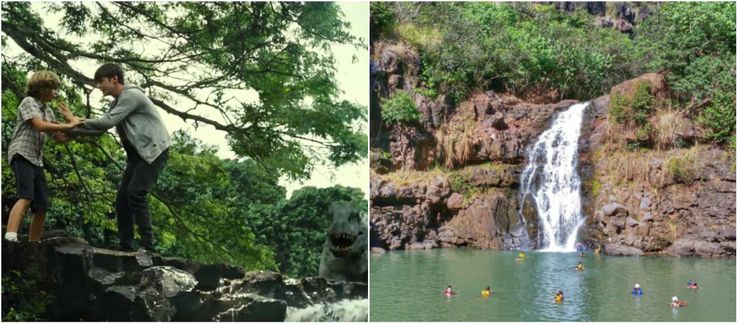
Jurassic World and Simple Most

Just about 9 kilometers northeast of Honolulu is the picturesque Manoa Falls. The serene swimming hole, which can be accessed on foot, was featured in Jurassic World when Gray and Zach were forced to jump off the falls to avoid the Indominus Rex. But jumping off these falls is not recommended. Instead, focus on swimming or chatting up the gorgeous visitors.

14 - DR. GRANT WAS RESCUED ON KAUAI'S PILAA BEACH

Youtube and Simple Most

Pilaa Beach isn't particularly easy to access, nor does it present good swimming opportunities due to the rocky ocean bottom and rip tides. But it was the location used to film the rescue scene at the end of Jurassic Park 3. The beach is located east of Kilauea on the northeast shore of the tropical island of Kauai.

13 - "IT'S A DINOSAUR"... WAS UTTERED AT JURASSIC KAHILI RANCH

Costume Wall and Movie Wall

You may not see a dinosaur, but you'll definitely be transported into a different world if you visit the Jurassic Kahili Ranch. This picturesque location was used near the beginning of the first Jurassic Park film when our main characters first saw the brachiosaurus. It was also used in multiple other Jurassic Park and Jurassic World films. The park can be found on Kauai about 16 km east of Princeville.

12 - MULDOON FED THE RAPTORS AT THE LIMAHULI GARDEN

Costume Wall and Pinterest

Back when velociraptors were scary and not freaking pets they were housed in a highly secure paddock on Isla Nublar. This location was found on Kauai in the Limahuli Garden which is part of the National Tropical Botanical Garden. What a coincidence since Kauai is also known as "the garden isle". You won't see any raptors here, thankfully, but you will see endangered flora and fauna.

11 - THE GATES NO LONGER STAND AT THE BASE OF MOUNT WAI’ALE’ALE
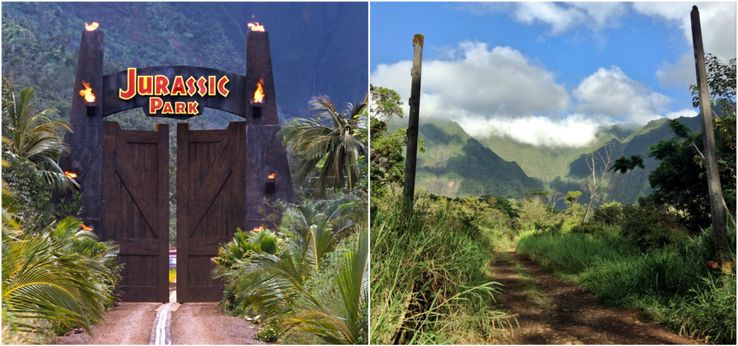
Jurassic World and Simple Most

Two poles can be found at the base of Mount Wai’ale’ale where the original Jurassic Park gates were constructed. The filmmakers left these poles on the island of Kauai to commemorate the filming and they've since become a major tourist attraction. The area was also used in several other shots from the movies but they are only accessible if you're a brave hiker.

10 - HO’OPI’I FALLS ON KAPA’A STREAM IN KAUI STOOD IN FOR THE DOMINICAN REPUBLIC
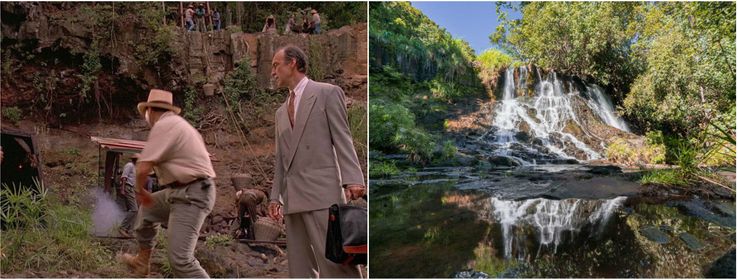
Youtube and Costume Wall

In Jurassic Park, there's a scene where the lawyer, Genero, visited the amber mines. It was supposed to take place in the Dominican Republic. But the filmmakers chose a location on Kauai that they made look like the Dominican Republic. It can be found on the Kapa'a Stream. These falls are relatively unknown to tourists but you can hike up to the falls by following the Kapa’a Stream.

9 - YOU CAN FLY THROUGH THE HANAPEPE VALLEY JUST LIKE THE CAST DID

Costume Wall and Movie Wall

Trekking through the remote Hanapepe Valley on Kauai is basically a no-go. But there are several helicopter tours that will fly you right through it. It's the valley used in the very first Jurassic Park movie when our main characters arrived on Isla Nublar. These helicopter tours tend to also take you to see the Manawaiopuna Falls that are also featured in Jurassic Park.

8 - NO NEED TO CLIMB AN ELECTRIFIED FENCE IN THE OLOKELE VALLEY ON KAUI

Costume Wall and Movie Wall

The Olokele Valley on Kauai, located near Waimea, was featured during the harrowing scene where Dr. Grant, Lex, and Tim had to climb the electrified fence while Dr. Sattler attempted to turn the power back on. While you won't find any towering fences there, you will find breathtaking views that will make your trip to Hawaii more than worth it.

7 - LANDING ON ISLA SORNA IS A LOT LIKE LANDING AT DILLINGHAM AIRFIELD
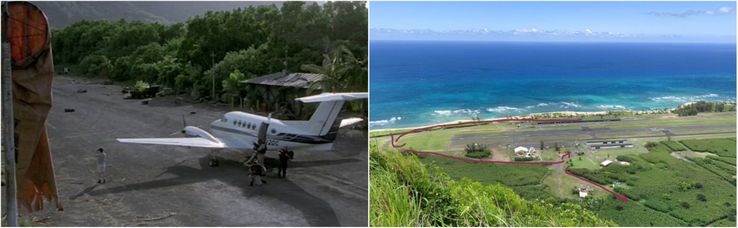
Jurassic World and Simple Most

The magic of filmmaking. Even though the airstrip featured in Jurassic Park 3 was supposed to be located in the middle of Isla Sorna, the actual location used is right on the coast of Oahu. The filmmakers managed to hide the ocean to make it look like it was located in the middle of a lush forest. This tiny landing strip is part of Dillingham Airfield, which is a public and military airport found two miles west of Mokuleia.

6 - STAMPEDING AT KUALOA RANCH
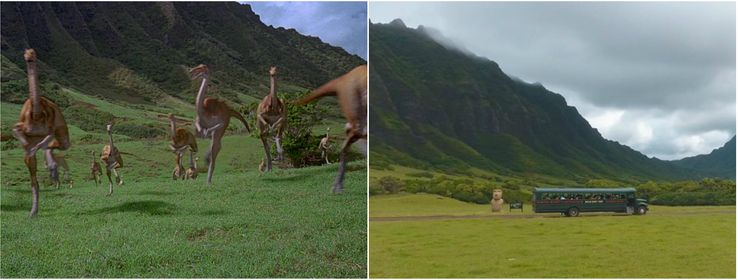
Pinterest and Jurassic park Fandom

The iconic gallimimus stampede sequence from the first Jurassic Park, as well as from Jurassic World, was shot alongside the emerald cliffs of Kualoa Ranch. This location was also used in Lost, Kong: Skull Island, and Jumanji: Welcome to the Jungle. The Oahu location is a great place to take a scenic trip. It's truly something out of this world.

5 - KUHIO HIGHWAY, KAPAA, KAUAI STOOD IN FOR SAN JOSE, COSTA RICA
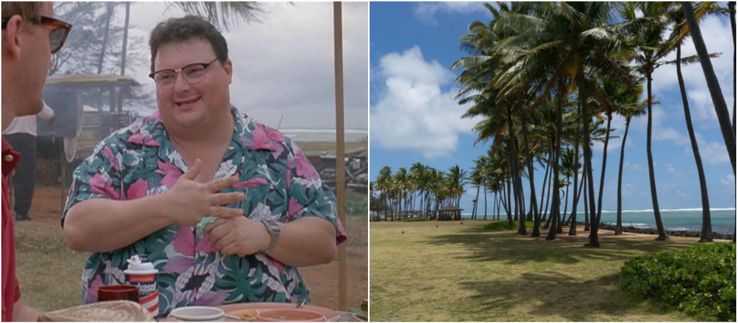
Jurassic World and Simple Most

Okay, so maybe Steven Spielberg cheaped-out when he decided to film the Dennis Nedry San Jose scene on a waterfront in Kapaa, Kauai. Not because he made Hawaii look like another part of the world, but because he put San Jose on the coast... In reality, it's a landlocked city in Costa Rica. Nevertheless, you can visit the very beach where a restaurant was constructed for this early scene in Jurassic Park.

4 - ALLERTON GARDEN IS WHERE YOU CAN FIND OUT THAT DINOSAURS REPRODUCE

Costume Wall and Movie Wall

Allerton Garden on Kauai, which is part of the National Tropical Garden site, was home to two important scenes from the first Jurassic Park. Firstly, it's a beautiful setting where Dr. Grant found the dinosaur eggs that proved the all-female population of prehistoric animals was mutating in order to reproduce. Additionally, it's also the location where Muldoon met his end at the jaws of a "clever girl".

3 - HUNTING FOR BLUE IN THE HE'EIA JUNGLE
Simple Most

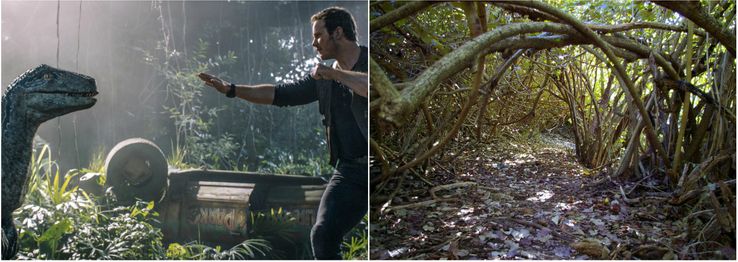
In Jurassic World: Fallen Kingdom, Owen Grady sets off into the abandoned park in order to find his pet velociraptor, Blue. After finding her, they are ambushed by hunters and Blue gets captured. Owen is knocked out and has to drag himself to safety and lava streams beside him. This dense location was filmed on the island of Oahu in the He'eia Jungle. It can be enjoyed by visitors although it's a bit of a hike.

2 - THE VISITOR'S CENTER WAS AT THE VALLEY HOUSE PLANTATION ESTATE ON KAUI
Pinterest and Jurassic park Fandom

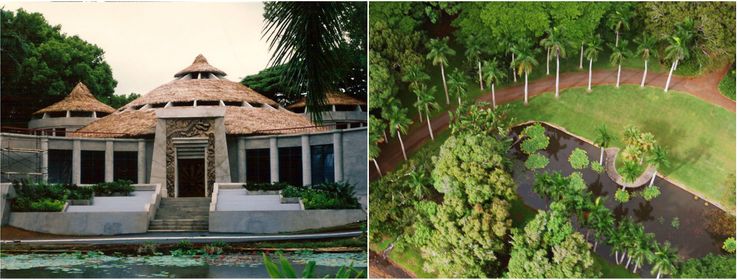
The Valley House Plantation Estate on the northern island of Kauai was the location where the exterior of the Visitor's Center from Jurassic Park was built. While all of the interior scenes were filmed at a studio in L.A., this was the place where the characters first got into the cars that took them around the island. The set no longer stands, but you can visit the plantation.

1 - GOODBYE TO ISLA NUBLAR AT HE'EIA KEA HARBOR

Pinterest and Jurassic park Fandom

Jurassic World: Fallen Kingdom was certainly not a fan favorite but it did take a risk in demolishing the original island from the movies. We got our last sense of this as we saw a brachiosaurus being enveloped by smoke while on the edge of a dock. This scene was filmed at He’eia Kea Harbor on the Hawaiian island of Oahu. It's a great location to visit, hope on a chartered boat, or simply take in the sights.

Sources: Express, HomeyHawaii, VisitTheUSA, Only In Your State, Legendary Trip

https://www.thetravel.com/

Chinese Research Concludes Egg Comes Before Chicken

Sunday, December 1, 2019

New fossil evidence could be key to answering origin of life. (CNA photo)

Chinese Academy of Sciences provides answer to long-time evolutionary dilemma based on fossil studies.

The Nanjing Institute of Geology and Paleontology (NIGPAS) in China announced Thursday (Nov. 28) that it has unraveled the answer to the chicken or egg causality dilemma — and potentially laid a new foundation for the history of biology.

NIGPAS researchers Yin Zong-jun (殷宗軍) and Zhu Mao-yan (朱茂炎) recently teamed up with University of Bristol, the Swedish Royal Museum of Natural History, and Swiss Light Source (SLS) to discover a 609 million-year-old fossil of Caveasphaera, a multicellular organism that resembles an animal embryo, in China's Guizhou Province. The team suspected the ball-shaped cell clusters could be the origin of animals today, according to CNA.

The study results were published in the biweekly scientific journal "Current Biology" on Wednesday (Nov. 27). The results pointed out that Caveasphaera appeared to share striking similarities with animal embryos and bridges the gap between single-cell and multicellular organisms.

Although further examinations still need to be performed, the fossils potentially explain how life came about. NIGPAS research team said the findings could lay a new foundation for the history of biology.

Founded in 1951, NIGPAS is part of the Chinese Academy of Sciences (CAS) and is known as one of the world's leading academic institutions specializing in invertebrate paleontology and stratigraphy. It has actively engaged in international research collaborations as well as academic exchanges, according to the NIGPAS website.

Source: www.taiwannews.com.tw/

90-Million-Year-Old ‘Comma’ Shrimp Fossil Sheds New Light on Modern Species

Friday, November 29, 2019

A 90-million-year-old comma shrimp fossil held between a researcher’s fingertips shows finely preserved details that allowed paleontologists to create 3-D reconstructions of what the creatures might have looked like while alive. (Photo: Javier Luque)

Tiny well-preserved fossils discovered in South America reveal oldest known relative of species that still thrives today.

The discovery of hundreds of finely preserved 90-million-year-old fossils in South America has revealed the oldest direct ancestor of the comma shrimp, a species that is still common today.

“Comma shrimp are small, delicate crustaceans with one of the poorest fossil records among marine arthropods—which is shocking as they are abundant today and live in soft sediments with good fossilization potential,” said the study’s lead author, Javier Luque, who conducted the research as a PhD candidate at the University of Alberta with colleagues from Yale University and the Smithsonian Tropical Research Institute.

The excellent condition of the shrimp fossils—named for their resemblance to the punctuation mark—allowed paleontologists to discern eyes, antennae, mouth parts and even fine hairs, and create a 3-D reconstruction of what the creatures might have looked like while alive.

“These fossils are of hundreds of adult males—which likely died suddenly in the water column while swarming during mating, falling slowly through the water with little or no damage,” said Sarah Gerken, co-author and professor at the University of Alaska Anchorage. “This left them in truly stunning condition.”

Marine fossils in the mountains

The scarcity of the fossils is partly due to where they lived—a shallow inner sea that ran through what is now the uplifted Andes mountains.

“Exceptionally preserved fossils provide a crucial glimpse into the Earth’s past,” explained Luque, who is now a post-doctoral associate at Yale. “Deposits like this are widely known from mid-to-high latitudes, but very few from modern tropical latitudes. This new fossil assemblage is the first of its kind in northern South America, and we hope it will become a reference for tropical paleontology in the region.”

The find follows on the heels of Luque’s discovery earlier this year of a “chimera” or “platypus crab” incorporating the features of many different marine arthropods.

“Both of these species are the first of a trove of fossils we are still exploring to understand the species preserved here and the processes that allowed their fossilization,” said Luque. 

“It will give us a closer glimpse into the tropics’ past, and we hope our discoveries will open new avenues for the study of exceptional preservation in past and present tropical settings.”

The study, “Exceptional Preservation of Comma Shrimp From a mid-Cretaceous Lagerstätte of Colombia, and the Origins of Crown Cumacea,“ was published in Proceedings of the Royal Society B.

Source: www.folio.ca/

Animal-Like Embryos Evolved Long Before Complex Animals, Scientists Say

Friday, November 29, 2019

to gastrulation; together with evidence of functional cell adhesion and development within an envelope, this is suggestive of a holozoan affinity. The image shows a life cycle of Caveasphaera and a simplified phylogenetic tree of Holozoa. Image credit: Yin et al, doi: 10.1016/j.cub.2019.10.057.

Complex animals evolved from single-celled ancestors, before diversifying into 30-40 distinct anatomical designs. When and how this major evolutionary transition occurred is the focus of intense debate. Now, an international team of researchers from the United Kingdom, China and Switzerland has found evidence that a key step in this transition occurred long before complex animals appear in the fossil record, in the fossilized embryos that resemble multicellular stages in the life cycle of single-celled relatives of animals.

University of Bristol’s Professor Philip Donoghue, Dr. Zongjun Yin from the Nanjing Institute of Geology and Palaeontology and colleagues focused on the fossils of Caveasphaera, a multicellular organism that lived 609 million years ago (Ediacaran period) in what is now China.

Individual Caveasphaera fossils are only about half a millimeter in diameter, but X-ray microscopy revealed that they were preserved all the way down to their component cells.

“This study shows the amazing detail that can be preserved in the fossil record but also the power of X-ray microscopes in uncovering secrets preserved in stone without destroying the fossils,” said Dr. Federica Marone, a scientist with the Paul Scherrer Institute.

“We were able to sort the fossils into growth stages, reconstructing the embryology of Caveasphaera,” added Dr. Kelly Vargas, a researcher at the University of Bristol.

“Our results show that Caveasphaera sorted its cells during embryo development, in just the same way as living animals, including humans, but we have no evidence that these embryos developed into more complex organisms,” Dr. Yin said.

Caveasphaera had a life cycle like the close living relatives of animals, which alternate between single-celled and multicellular stages.

“However, Caveasphaera goes one step further, reorganizing those cells during embryology,” said Dr. John Cunningham, also from the University of Bristol.

Caveasphaera is the earliest evidence of this most important step in the evolution of animals, which allowed them to develop distinct tissue layers and organs,” added Dr. Stefan Bengtson, from the Swedish Museum of Natural History.

“I’m not totally convinced that Caveasphaera is an animal. It looks a lot like the embryos of some starfish and corals — we don’t find the adult stages simply because they are harder to fossilize,” said Dr. Maoyan Zhu, from the Nanjing Institute of Geology and Palaeontology.

Caveasphaera shows features that look both like microbial relatives of animals and early embryo stages of primitive animals. We’re still searching for more fossils that may help us to decide,’ Professor Donoghue said.

“Either way, fossils of Caveasphaera tell us that animal-like embryonic development evolved long before the oldest definitive animals appear in the fossil record.”

The study was published in the journal Current Biology.

_____

Zongjun Yin et al. The Early Ediacaran Caveasphaera Foreshadows the Evolutionary Origin of Animal-like Embryology. Current Biology, published online November 27, 2019; doi: 10.1016/j.cub.2019.10.057

Source: www.sci-news.com/

Paleoart: The Strange History of Dinosaurs in Art – in Pictures

Sunday, July 23, 2017

 Charles R. Knight was one of the foremost American paleoartists. These predators likely represent paleontologists Othniel C. Marsh and Edward Drinker Cope, whose savage competition defined early American paleontology. Illustration: Craig Chesek/Courtesy of Taschen

Since the early 19th century, artists have depicted colourful – if sometimes fictional – dinosaurs and prehistoric environments, mingling science with unbridled fantasy. This art is the subject of a new book: Paleoart

All images courtesy of Taschen

Model room at the Crystal Palace by Philip Henry Delamotte, 1853

This engraving shows dinosaur sculptures being constructed on the grounds of the Crystal Palace by natural history artist Benjamin Waterhouse Hawkins, who made 33 beasts over two years. 1853 also saw the first mention of a dinosaur in fiction – in Charles Dickens’s Bleak House: ‘As much mud in the streets as if the waters had but newly retired from the face of the earth, and it would not be wonderful to meet a Megalosaurus, forty feet long or so, waddling like an elephantine lizard up Holborn Hill.’

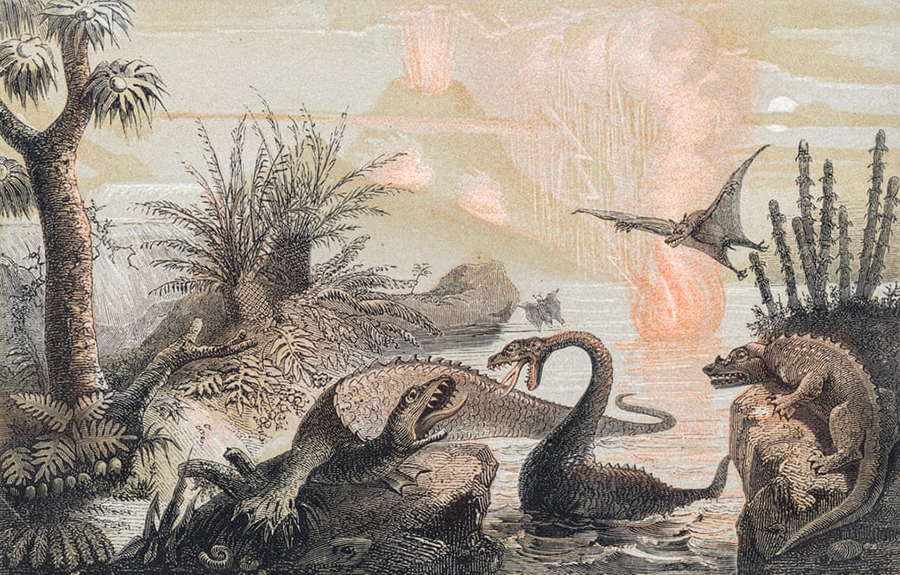
The Primitive World by Adolphe François Pannemaker, 1857

For the earliest ‘paleoartists’, fossil bones were blank slates upon which they could project their own imaginations. Pannemaker, like many artists of his time, inserted biblical and mythological imagery into his art; here, prehistory appears as apocalyptic war zone, replete with fire, lightning, and an erupting volcano.

The Ichthyosaur and the Plesiosaur (Lias Period) by Édouard Riou; engraved by Laurent Hotelin and Alexandre Hurel, 1863

From the very beginning, artists and scientists portrayed ichthyosaurs and plesiosaurs as dire enemies. Warring above the waves, the two reptiles became the single most prevalent motif in 19th-century paleoart, in part because they provided ideal allegorical vessels for the naval conflicts of the age.

Laelaps by Charles R Knight, 1897

Knight was one of the foremost American paleoartists, and Laelaps was profoundly influential for its remarkably credible depiction of anatomy and movement. Some believe that these predators represent the savagely competitive palaeontologists Othniel C Marsh and Edward Drinker Cope, both of whom would blow up dig sites with dynamite to obstruct the other’s discoveries.

Inostrancevia, devouring a Pareiasaurus by Alexei Petrovich Bystrow, 1933

These two species cropped up regularly in Soviet–era paleoart. Konstantin Konstantinovich Flyorov, who painted the same beasts early in his career, despised Bystrow’s interpretation, calling the rival artist ‘colour blind’.
Illustration: Borrissiak Paleontological Institute RAS

Mammoth (Elephas primigenius) by Zdeněk Burian, 1941

From the age 17, Czech artist Burian had hundreds of illustrated adventure stories, among them Kidnapped, The Jungle Book and Twenty Thousand Leagues Under the Sea. He began taking frequent camping trips to immerse himself in the natural world and in 1935, met palaeontologist Josef Augusta, who recognised Burian’s talent and imagination. Burian would go on to illustrate many of Augusta’s books on prehistory, rendering extinct animals with creative flair.
Illustration: zdenekburian.com

Tarbosaurus and armoured dinosaur by Konstantin Konstantinovich Flyorov, c. 1955

While the Russian Flyorov always identified primarily as a scientist, he never produced illustrations based on actual data. He regularly disregarded skeletal remains and rarely consulted palaeontologists on their behaviour or anatomy. Paired with his love for vibrant colour, Flyorov often created his beasts by taking modern animals and adding spikes, tusks, humps, and horns.
Illustration: Borrissiak Paleontological Institute RAS

Tyrannosaurus and Edmontosaurus by Ely Kish, c 1976

One of the few women to work in the field, Canadian artist Ely Kish’s subjects were often set in extreme weather conditions. Working from the late 1970s to the early 1990s, Kish was active at a time when scientists first recognised and publicised global climate change. She painted numerous scenes of the mass extinction that killed the dinosaurs, imbuing her images of prehistoric apocalypse with modern-day anxiety.
Photograph: Eleanor Kish, © Canadian Museum of Nature

Source: www.theguardian.com/

Pages