Blogs

Chicxulub Crater Study Reveals The Terrible End of the Dinosaurs
Tuesday, September 10, 2019

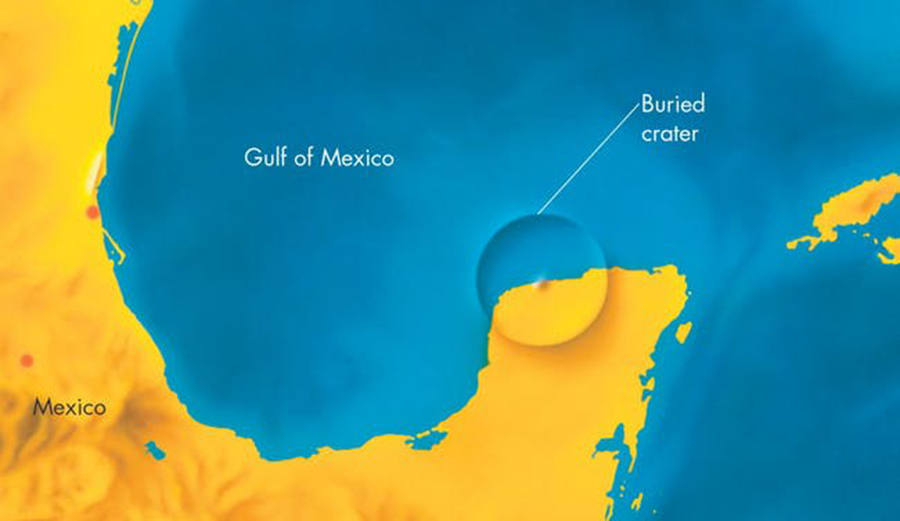
The Chicxulub crater, on the Yucatan peninsula is believed to be the impact that killed the dinosaurs

The Age of the Dinosaurs came to an abrupt, chaotic, and terrible end. 

While humans have gotten pretty good at destroying the Earth, nothing we’ve ever made has had the destructive force of the Cretaceous-Paleogene (K-PG) extinction event. Some 65 million years ago, three-fourths of all plant and animal life on Earth was suddenly made extinct, altering the course of the planet’s evolution. In September 2019, in a bit of CSI: Entire Planet, scientists got the most-detailed look yet at what happened in the aftermath of the K-PG event, reconstructing precisely how the Age of Dinosaurs came to a swift, fiery end.

Now known as the Chicxulub crater, the remnants of the Earth-shattering collision were studied from samples first found in 2016. Sediment in the crater painted a picture of the catastrophic moment in which the Earth was irrevocably changed.

In just a few seconds, the 112-mile wide crater formed. A few minutes later, a layer of melting rock approximately 131 feet (40 meters) spilled out as overflow. A few minutes more, and the rest of the Earth started to feel the terrible affects of the impact. Seawater thundered into the crater, carrying myriad materials and organisms.

Tsunamis quickly followed, battering the crater from all directions. Some came from the surrounding ocean, others from within the crater itself. Within as little as a half hour, chaos had taken hold on an unprecedented scale.

Remnants of charcoal found in the crater hint that there were more than tsunamis. On impact, pieces of burning wood and debris would have flown hundreds of feet into the air, landing in areas covered in trees and brush. Wildfires likely ran rampant as far as 930 miles from the actual crater. For a very short period of time — right before massive global cooling — the world was on fire.

These images show two views of the Chicxulub impact crater, observed by NASA's Shuttle Radar Topography Mission and the Landsat satellite.

These fires, in turn sent untold amounts of smoke into the air. Combine that with the sulfate aerosols released into the atmosphere after impact, and soon enough the sun was blocked out. Not a good day.

And the dinosaurs suffered it all.

“We fried them and then we froze them,” said Sean Gulick, a research professor at the University of Texas Institute for Geophysics said at the time. “Not all the dinosaurs died that day, but many dinosaurs did.”

Source: www.inverse.com/

Jurassic World 3: New Dinosaur Robot Revealed

Sunday, December 15, 2019

Jurassic World 3 New Dinosaur Robot Revealed

Jurassic World 3's director Colin Trevorrow shared a video on Twitter of an articulating dinosaur robot head, complete with moving eyes and tongue.

A new video posted by Jurassic World 3's director Colin Trevorrow shows off the movement and articulation of one of the film's upcoming dinosaurs. The Jurassic Park franchise arguably owes much of its success to robotic dinosaurs and practical effects, with many fans and critics alike citing the realistic look of the first film's robotic T-Rex, Triceratops, and Velociraptors as the main reason why Jurassic Park holds up so well even when viewed in the present day.

Although later films in the Jurassic Park universe leaned heavily into the use of computer-generated graphics in order to depict the dinosaurs on screen, there has always been a place for practical effects in the series. As technology advanced over time and the line between what is and what isn't CGI became harder and harder for viewers to determine, practical effects and computer graphics used together in tandem have slowly become the norm across most of the film industry.

Thankfully, it looks like practical effects aren't going anywhere soon, as Jurassic World 3's director Colin Trevorrow proved yesterday when he posted a video of an articulating robot head to TwitterThe creature appears to be a dinosaur, and can move its jaw, tongue, eyes, and eyelids independently of each other. Subtitling the video with the simple label of "Work," Trevorrow leaves little doubt in viewers minds they will one day be seeing this robotic animal on the big screen. Check out the embedded animatronic Jurassic World 3 dinosaur robot video below:

Practical effects aren't the only thing from the original Jurassic Park film returning for Jurassic World 3, as Jeff Goldblum, Laura Dern, and Sam Neill's characters are all set to make appearances as well. Although the plot of the film has yet to be revealed, one major Jurassic World 3 fan theory revolves around the creation of dinosaur-human hybrids, an idea which orginially was introduced in a scrapped script for Jurassic Park 4. While the above video appears to be of a skinless robot dinosaur, it possibly could be something else entirely.

When recalling the ending of Jurassic World: Fallen Kingdom, fans of the series are surely excited to see what will happen next. Jurassic World, being a soft reboot of the Jurassic Park franchise, tended to follow the basic outline of its original film in much the same way Star Wars: The Force Awakens mirrored the events of Star Wars: A New Hope. Fallen Kingdom followed suit for the most part, but then took a much different turn and surprised fans with bold new series choices. While viewers don't know what will happen next, at least now they know Jurassic World 3 will be continuing the franchise's tradition of using robot dinosaurs.

Source: https://screenrant.com/

Dinosaur Footprints Suggest That Jurassic Beasts Trotted Between Africa and Europe

Friday, December 13, 2019

Illustration of an allosaurus. Credit: Óscar Sanisidro © Institut Català de Paleontologia Miquel Crusafont

Dinosaur footprints found in several European countries, very similar to others in Morocco, suggest that they could have been dispersed between the two continents by land masses separated by a shallow sea more than 145 million years ago.

At the end of the Jurassic, as a consequence of the defragmentation of the Pangaea subcontinent, the countries that now form Europe were part of an archipelago surrounded by a shallow sea. In its interior, the Iberian Peninsula was located in the southernmost part, on the continent of Laurasia (which included present-day North America and Eurasia), but near Gondwana, the continent to the south.

Large predators strolled through these lands and their footprints have been found on different continents. Thus, for example, ichnites and bones of allosaurs and stegosaurs have been found in both North America and Portugal, suggesting that both territories were connected in some way.

Photograph of the traces analyzed: Megalosauripus transjuranicus (A) y Jurabrontes transjuranicus (B). Credit: Matteo Belvedere et al.

In a new study, published in the Journal of African Earth Sciences, a team of European scientists, with Spanish participation, has now recognized two types of dinosaur footprints related to large Jurassic predators in today’s Switzerland, Portugal, Spain (which belonged to Laurasia) and Morocco (which was in Gondwana).

The marks, called Megalosauripus transjuranicus and Jurabrontes curtedulensis, belonged to carnivorous theropods similar to Tyrannosaurus rex. “On the one hand, we have identified a type of large and slender footprints with a size of 30-50 cm and, on the other hand, other gigantic and robust footprints measuring more than 50 cm,” as Diego Castanera, from the Miquel Crusafont Catalan Institute of Palaeontology (ICP) of the Autonomous University of Barcelona and co-author of the work, has explained to SINC.

Shallow water trails

In order to distinguish the types of footprints, the team used a novel software called DigTrace, which made it possible to virtually compare the fossilized footprints. “We can’t determine with certainty what animal left a particular footstep since different related dinosaurs could leave very similar footprints,” says Castanera.

Comparison between the two types of footprints. Credit: Matteo Belvedere et al.

However, this study confirms that the differences between the two groups of footprints identified are important enough for their originators to be different but closely related dinosaurs.

Scientists thus suggest that they probably belonged to Allosaurus and Torvosaurus, since their remains have been found in the Upper Jurassic of Portugal, indicating the presence of two super-predators in the terrestrial ecosystems of the late Jurassic.

To confirm these data, the group of researchers stresses that more studies are needed, especially to answer an important question: how did the dinosaurs pass between Laurasia and Gondwana? “The answer is problematic because geological studies indicate that there was a deep sea between the two continents,” stresses the scientist.

The presence of the same species in such distant places forces scientists to propose dispersal routes between continents during the Mesozoic, the time during which dinosaurs lived. These large animals were thus able to move between Africa and Europe on land masses with short emersion periods and through southern Italy and the Balkans or through Iberia (what is nowadays the Iberian Peninsula).

Reference: “Late Jurassic globetrotters compared: A closer look at large and giant theropod tracks of North Africa and Europe” by Matteo Belvedere, Diego Castanera, Christian A. Meyer, Daniel Marty, Octavio Mateus, Bruno Camilo Silva, Vanda F. Santos and Alberto Cobos, 27 June 2019, Journal of African Earth Sciences. DOI: 10.1016/j.jafrearsci.2019.103547

Source: https://scitechdaily.com/

Dinosaur Discovery 'A Dream Come True' for U of R Physics Professor

Friday, December 13, 2019

University of Regina physics professor Mauricio Barbi shows off a piece of skin that belongs to a 72-million-year-old dinosaur. He was part of the team that found the preserved tissue on a dig. Researchers are looking into how this skin is connected to modern animals. (University of Regina Photography Dept)

Dinosaur skin allows for a world first in comparing specimen to modern animals.

Mauricio Barbi had three loves as a child: space, stars and dinosaurs. 

Now, he's a University of Regina professor who studies high energy particle physics but that hasn't stopped him from pursuing his passion for paleontology — or from being part of a 72-million-year-old dinosaur discovery that's broken new ground in the study of evolution.

"Since I was a little kid, I never wanted to be anything else; study the universe, study the planet and dinosaurs, of course," he told CBC Saskatchewan's Morning Edition

In 2012, his volunteer efforts with the Royal Saskatchewan Museum led him to trek through the Alberta Badlands alongside famed paleontologists Phil Currie and Phil Bell, the latter who had recently found a well-preserved hadrosaur.

During the excavation, a piece of three-dimensional skin came loose from the site — a discovery that had Barbi jumping out of his own skin.

A close-up of the dinosaur skin shows the clear preservation of the specimen. (University of Regina Photography Dept)

"When we found that skin, that was not only out of this planet, it was out of this universe," he said. 

It gave him the hope that research into this piece of well-preserved skin could shed light on the pigmentation of the dinosaur.

But the skin would in fact have a more exciting secret to yield. Closer analysis using the powerful microscope at the Canadian Light Source synchrotron in Saskatoon would show semi-circle cell structures. 

The team speculated that a combination of fortunate circumstances led to the incredible skin preservation. The animal may have died and been submerged partially underwater, which slowed the rate of decay, while the presence of mud and iron may have also helped preserve the tissue. 

This skin has given further insight into evolution beyond previously discovered bones and imprints of dinosaurs, said Barbi.

"With this, it gives another layer of information because now we have not only soft tissue preservation but the micro structure for the soft tissues, so you can try to connect those animals to current animals and compare them," he said.

The CLS allowed them to compare the skin of a dinosaur with modern animals, which found that the hadrosaur from the Late Cretaceous period in Alberta had skin that very closely resembles the skin of a modern crocodile.

For Barbi, it's the kind of momentous discovery he always hoped to make — one that delights the child in him that always loved dinosaurs. 

"For me, it's more than a dream come true."

-with files from CBC Saskatchewan's The Morning Edition

Source: www.cbc.ca/

Argentine Scientists Discover New Dinosaur Species: Nullotitan glaciaris

Friday, December 13, 2019

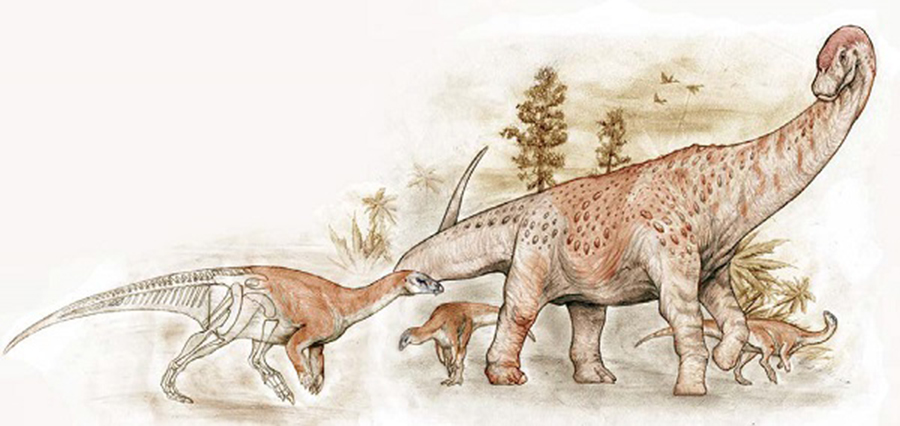
Isasicursor y Nullotitan/Sebastián Rozadilla

Argentine palaeontologists have discovered the remains of new herbivorous species of dinosaur that inhabited the country's southern El Calafate 70 million years ago.

Nullotitan (meaning "Nullo's giant", in honor of paleontologist Francisco Nullo) is a genus of lithostrotian titanosaur from the Chorrillo Formation from Santa Cruz Province in Argentina. The type and only species is Nullotitan glaciaris. It was a contemporary of the ornithopod Isasicursor which was described in the same paper.

Skeletal reconstruction showing known remains of Nullotitan. Author: Novas, F., Agnolin, F., Rozadilla, S., Aranciaga-Rolando, A., Brissón-Eli, F., Motta, M., Cerroni, M., Ezcurra, M., Martinelli, A., D'Angelo, J., Álvarez-Herrera, G., Gentil, A., Bogan, S., Chimento, N., García-Marsà, J., Lo Coco, G., Miquel, S., Brito, F., Vera, E., Loinaze, V., Fernandez, M., & Salgado, L.

Speaking about the discovery palaeontologist Fernando Novas said: "These (discoveries) are from a new archaeological site that is full of plant fossils, dinosaur fossils and other vertebrae. It reveals to us an ecosystem from around 70 millions of years ago, before dinosaurs became extinct.

Nullotitan is a huge sauropod. The found remains of the holotype point to an animal of more than 20 metres (66 ft) in length.

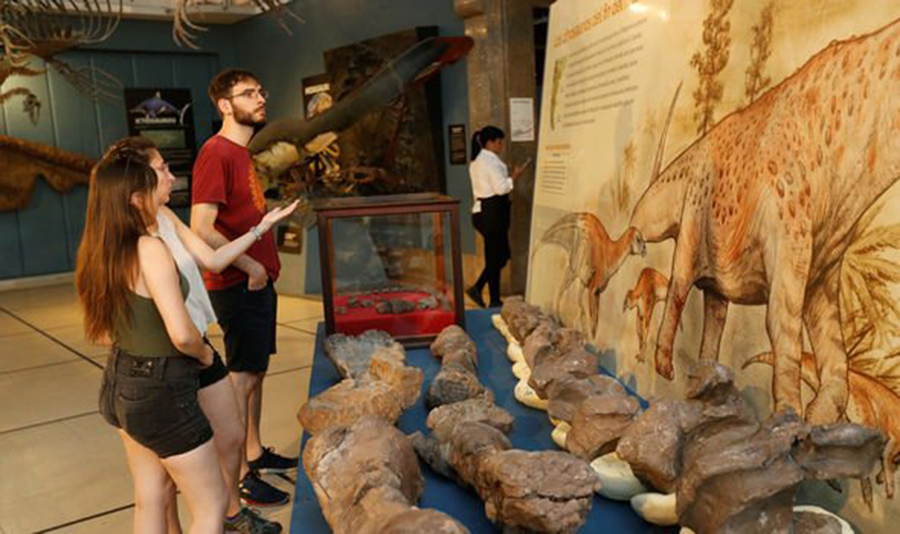
The remains are on display in the Museo Argentino de Ciencias Naturales Bernardino Rivadavia (Image: REUTERS)

The descriptors were able to identify some distinguishing features. Two of them are autapomorphies, unique derived properties. The anterior and middle tail vertebrae have sides and undersides that are eroded by numerous large depressions that do not pierce the bone wall. From the front or rear, the fibula has a striking, wavy bend.

In addition, there is a unique combination of characteristics that are not unique in themselves. The vertebral bodies of the anterior tail vertebrae are remarkably short, twice as wide across as horizontally long. At the middle tail vertebrae there is a large trough on the side that is covered from above by the side protrusion. The tail vertebrae are not pneumatized. The middle tail vertebrae have a deep longitudinal trough on the underside bounded by two thick ridges. The lower end of the tibia is flattened from the front to the rear and widened more across than with other titanosaurs.

Source: www.rte.ie/

Aegicetus gehennae: Fossil Whale Shows Transition Stage to Tail-Powered Swimming

Thursday, December 12, 2019

Aegicetus gehennae is believed to have looked similar to the Basilosaurus, ‘King of the Lizards’ (pictured). DOTTEDHIPPO/ISTOCK

Researchers from the University of Michigan have described a new fossilized whale that represents not only a new species, but also identifies an important step in the evolution of whale mechanics.

In 2007, paleontologists discovered a fossilized creature in the Egyptian desert they called Aegicetus gehennae, dating back to roughly 35 million years ago. The creature was aquatic and able to swim by undulating its mid-body and tail similar to how crocodiles move through water today, according to Philip Gingerich, professor emeritus in the U-M Department of Earth and Environmental Sciences and curator emeritus at the U-M Museum of Paleontology.

Details of the discovery were published in the journal PLOS ONE.

Whale evolution, according to fossil records, transformed land-dwelling ancestors walking on all fours to the ocean-dwelling cetaceans we know today. During the transition came an early, semi-aquatic whale known as the protocetid, present during mid-Eocene epoch 56 million years ago to 33.9 million years ago. Remains of this ancestor have been uncovered in parts of Africa, Asia and the Americas.

The fully aquatic modern whales use their tails to maneuver through the water, but protocetids were only semi-aquatic and had limbs that helped them swim. In their paper, Gingerich and his colleagues describe Aegicetus gehennae, the first late-Eocene protocetid.

The Aegicetus gehennae has a body shape similar to that of ancient whales from its time period, including the famous prehistoric predator, the Basilosaurus or “king lizard.” The researchers believe that the side-to-side undulatory swimming style could represent the evolutionary transition from the foot-powered swimming of early whale ancestors to the tail-powered swimming we see in modern whales.

“Early protocetid whales living 47 to 41 million years ago were foot-powered swimmers. Later, starting about 37 million years ago, whales became tail-powered swimmers,” said Gingerich, also a professor emeritus of ecology and evolutionary biology and of anthropology.

These are cervical and thoracic vertebrae of Aegicetus gehennae type specimen, an early ancestor of the modern whale. (Gingerich et al., 2019)

“This newly discovered fossil whale, Aegicetus, was intermediate in time and form and was transitional functionally in having the larger and more powerful vertebral column of a tail-powered swimmer,” Gingerich added.

The fossilized remains of Aegicetus gehennae were found in the Wadi Al Hitan World Heritage Site in the Western Desert of Egypt. The dating of the bones makes this extraordinary creature the youngest known protocetid. Roughly two-thirds of its bones were recovered, along with another partial skeleton of a second specimen – making Aegicetus among the best-preserved whales from this time period.

The specimen recovered that was mostly complete is believed to have been male, about 12 feet long and weighing in at nearly 2,000 pounds. When compared to earlier ancient whales, Aegicetus has a much more elongated body and tail with smaller hind legs that are very loosely connected to the spinal column. These traits point to a much more fully aquatic animal that was less of a foot-powered swimmer than its semi-aquatic ancestors.

The original fossils discovered at the dig site in Egypt have been held at the U-M Museum of Paleontology to be studied but will soon be returned to the Egyptian Geological Museum in Cairo. Molds and casts are currently being taken of nearly all of the specimens which will remain in Ann Arbor, Michigan.

Wadi Al Hitan is also known as the “Valley of the Whales.” It is a UNESCO World Heritage Site world renowned for yielding a collection of complete and nearly complete skeletons of prehistoric whales. During the dig of 2007, a partial skeleton of Aegicetus was found eroding from the harmful sediments in the eastern part of the World Heritage Site, but later that year the much more intact and complete skeleton was discovered.

Gingerich’s co-authors include Mohammed Sameh M. Antar of the Egyptian Environmental Affairs Agency and Iyad S. Zalmout of the Saudi Geological Survey. Their research in Egypt was sponsored by the Egyptian Geological Museum, the Egyptian Environmental Affairs Agency, the Egyptian Mineral Resources Authority, the University of Michigan Museum of Paleontology, The U.S. National Science Foundation, and the National Geographic Society.

The authors say the specimens described in their paper were uncovered, collected, and analyzed following the protocols outlined in a three-way memorandum of understanding between the Egyptian Geological Survey and Mining Authority, the Egyptian Environmental Affairs Agency, and the University of Michigan.

Source: www.courthousenews.com/

Which Was The First Dinosaur To Walk The Earth?

Friday, December 20, 2019

Nyasasaurus parringtoni by Nobu Tamura

The first dinosaurs walked the Earth around 243 million years ago.

Nyasasaurus Parringtoni is believed to be the earliest dinosaur to have ever lived on Earth. It predates all other dinosaurs by more than 10 million years. According to scientists, if this ancient-of-the-ancient is not the oldest dinosaur, then at least it is the closest relative to the earliest dinosaurs ever discovered. The dinosaur was first described by Alan J. Charing in the 1950s, in his doctoral thesis, but it was not until 2013 when it was formally described. Initially, the records of the earliest dinosaur were dated to the late Carnian age, which is approximately 231.4 million years ago. Nyasasaurus pirringtoni is believed to have walked the earth in the middle Triassic period, which is about 243 million years ago. The fossil of the dinosaur was discovered in Tanzania near Lake Nyasa, and the name Nyasasaurus means Lake Nyasa lizard.

Description

The only fossil found of the dinosaur was from the upper arm together with some backbone. The fossils were discovered in Ruhuhu Basin in the Southern part of Tanzania near Lake Nyasa. Although the discovery was made in the 1930s, In-depth study and description work were carried out recently. Very little is known about Nyasasaurus, and scientists deduce that it must have been between 6.5 feet and 10 feet long, including the tail. It is believed that the tail alone was about five feet and therefore the dinosaur must have been the size of a Labrador retriever dog. Since the skull bones were not found, the diet of the dinosaur has not been established. However, the fossils found show that the creature had the distinctive characteristics linking it to dinosaurs. It had a deltopectoral crest, which is a bony crest running along the upper arm bone. The bone holds the muscles on the shoulder to the upper arm bone. All dinosaurs had this unique elongated crest

Origin Of The Dinosaur

Following the discovery of Nyasasaurus parringtoni dinosaur in Tanzania, the scientists now believe that all dinosaurs originated in the Southern region of the supercontinent when the earth had only one continent (Pangaea), which is now part of India, Australia, Antarctica, Madagascar, Africa, and South America. The discovery suggests that the dinosaurs evolved during the middle Triassic period.

Bones of Nyasasaurus parringtoni were collected in southwest Tanzania in the 1930s from the Manda beds, which preserves fossils of many animals from the Triassic Period of Earth’s history.U of Washington

Name Of The Dinosaur

The dinosaur was named after the late professor Francis Rex Parrington. In the 1950s, Parrington was the supervisor of Alan J. Charig when he was studying for his PhD. Sterling Nesbitt published about Nyasasaurus parringtoni in 2012, and the late Charig was included as a co-author, although at the time Charing was already dead. Nesbitt is an American Paleontologist from the University of Washington. Parrington was a British paleontologist at the University of Cambridge. He was the director of the Cambridge university museum of zoology and a fellow of the Royal Society. Parrington died at the age of 76 on April 17, 1981.

Source: www.worldatlas.com/

Kupoupou stilwelli: New Species of Paleocene Penguin Bridges Gap in Penguin Family Tree

Wednesday, December 11, 2019

Kupoupou stilwelli. Image credit: Jacob Blokland.

Paleontologists in New Zealand have uncovered the fossilized bones from an extinct penguin that swam the oceans between 62.5 and 60 million years ago. Dubbed Kupoupou stilwelli, the ancient bird is the oldest penguin known with proportions close to its modern relatives.

Kupoupou stilwelli lived during the Paleocene epoch at a time when there was no ice cap at the South Pole and the seas around New Zealand were tropical or subtropical.

Numerous skeletal remains of the prehistoric penguin were recovered from the Takatika Grit of Chatham Island, part of the Chatham Islands located about 535 miles (860 km) off the east coast of New Zealand’s mainland.

The fossils were analyzed by Flinders University paleontologist Jacob Blokland and his colleagues.

“Next to its colossal human-sized cousins, including the recently described monster penguin Crossvallia waiparensisKupoupou stilwelli was comparatively small — no bigger than the modern king penguin (Aptenodytes patagonicus) which stands just under 3.6 feet (1.1 m) tall,” Blokland said.

“It also had proportionally shorter legs than some other early fossil penguins. In this respect, it was more like the penguins of today, meaning it would have waddled on land.”

“This penguin is the first that has modern proportions both in terms of its size and in its hind limb and foot bones (the tarsometatarsus) or foot shape.”

The discovery of Kupoupou stilwelli may link the origins of penguins themselves to the eastern region of New Zealand — from the Chatham Island archipelago to the eastern coast of the South Island, where other most ancient penguin fossils have been found.

“The study provides further support for the theory that penguins rapidly evolved shortly after the period when dinosaurs still walked the land and giant marine reptiles swam in the sea,” said Dr. Paul Scofield, from the University of Canterbury and the Canterbury Museum in Christchurch.

“We think it’s likely that the ancestors of penguins diverged from the lineage leading to their closest living relatives — such as albatross and petrels — during the Late Cretaceous period, and then many different species sprang up after the dinosaurs were wiped out.”

“It’s not impossible that penguins lost the ability to fly and gained the ability to swim after the extinction event of 66 million years ago, implying the birds underwent huge changes in a very short time.”

“If we ever find a penguin fossil from the Cretaceous period, we’ll know for sure.”

The team’s paper was published in the journal Palaeontologia Electronica.

_____

Jacob C. Blokland et al. 2019. Chatham Island Paleocene fossils provide insight into the palaeobiology, evolution, and diversity of early penguins (Aves, Sphenisciformes). Palaeontologia Electronica, article number: 22.3.78; doi: 10.26879/1009

Source: www.sci-news.com/

Whatever Happened to Timmy From Jurassic Park?

Saturday, December 14, 2019

Poor little Timmy from Jurassic Park was the kind of kid that you almost felt needed to be humbled just a bit in order to remind him that being a little know-it-all could get insanely annoying, but the fact that his character had to go through so much in Jurassic Park seems like it was more than enough. After all, he and his ‘Lex almost got eaten by a T. rex, he was stuck in a vehicle in a tree where he threw up on himself, he and Lex and Alan were almost tramped by a herd of panicked dinosaurs, he was electrocuted while climbing down from a fence, and then he and ‘Lex had to outsmart a pair of velociraptors. So yeah, Timmy learned a valuable lesson in humility via a series of life-threatening situations that most kids might not have survived. And to think, that actually wasn’t the most exciting part of the movie. Since then though Joseph Mazzello has continued to act, though he and Ariana Richards did have a cameo in the second Jurassic Park movie, The Lost World. Since then however he’s gone in a different direction and has become a director and screenwriter.

Joseph actually did win a Best Young Artist award for Jurassic Park and has been nominated for other movies throughout years and won several other awards, so it’s hard to think of why he’s not a bigger name than he is at this point. It could be that he’s kept pretty low key throughout the years and has focused more on his career than on being a known commodity in show business, but he has been in some notable movies and guest-starred on a few very popular shows. He was in Bohemian Rhapsody and he’s been featured in a few TV movies and short films throughout his career, but despite all this it would seem that people have almost forgotten about him. That seems to be the life of a child star at times though, people are all over you when you’re young and show a great deal of promise but might peel off as the years start to roll on and things aren’t going the way they need to. Of course some of them wise up and gain an education to go with their acting credits, which is quite intelligent since it gives them something to fall back on when all is said and done. In fact Joseph actually paid for his time at USC School of Cinematic Arts with the salary he pulled down for his cameo in The Lost World, which is enough to make you laugh considering what the tuition costs are for such a prestigious school.

In a big way Joseph seems like one of the smarter people in show business that’s been building his career and reputation around a very solid core of knowledge and experience that doesn’t stab wildly in one direction or the other but keeps closer to home base as he makes moves that are safe and measured without going all out at any given time. It’s true that he hasn’t been a huge name in the business but the guy has amassed a net worth of $1.5 million, which isn’t massive in Hollywood terms but is still impressive all the same since it’s a sign that he’s been smart enough to live within his means. Joseph had made a name for himself that doesn’t draw a lot of recognition, but the moment anyone mentions Timmy from Jurassic Park the lights come on and they have to suddenly realize that this is the kid that went through such hell during the movie. Seriously, no one really got beat up as much as he did and lived to tell the tale, except maybe Ian Malcolm, and he was put out of action pretty quickly.

All in all Joseph has been keeping his career moving forward in a very forward manner, writing, directing, and acting as he’s continued to push himself with each new project. At this time it doesn’t seem as though he has any big projects on the docket, but it’s very likely that he’ll be up to something eventually since it doesn’t seem as though he’s ready to call it quits just yet. It would be great to see Joseph and Ariana both come back for the final Jurassic World movie since we’ve already seen Jeff Goldblum come back for a short part in the second one, and as Cameron K. McEwan and Ian Sandwell of DigitalSpy have said it would also be great to see Laura Dern and Sam Neil back as well. It does sound as though B.D. Wong will be returning to get his final comeuppance, and to be honest it would be great to see the original actors, those that are still with us, take up their roles one more time.

Source: www.tvovermind.com/

480-Million-Year-Old Fossils Reveal Sea Lilies' Ancient Roots

Tuesday, December 10, 2019

A modern-day sea lily in the Marianas region. Credit: (c) NOAA Ocean Research and Exploration

Sea lilies, despite their name, aren't plants. They're animals related to starfish and sea urchins, with long feathery arms resting atop a stalk that keeps them anchored to the ocean floor. Sea lilies have been around for at least 480 million years—they first evolved hundreds of millions of years before the dinosaurs. For nearly two centuries, scientists have thought about how modern sea lilies evolved from their ancient ancestors. In a new study in the Journal of Paleontology, researchers are rewriting the sea lily family tree, aided by newly-discovered fossils that help show how these animals' arms evolved.

"These early fossils provide new key evidence showing that what we had thought about the origin of sea lilies since 1846 is wrong," says Tom Guensburg, the paper's lead author and a research associate at the Field Museum in Chicago. "It's not very often that we're challenging ideas that are almost two hundred years old."

Sea lilies are more formally known as crinoids, but they've earned their nickname—they really do look like flowers growing at the bottom of the ocean. They spend their adult lives stuck in one place, with stem-like stalks that attach them to the sea floor. At the top of these stalks are a cluster of arms, maybe the size of the palm of your hand. These arms trap tiny plankton floating through the water, which the sea lily then eats.

"Some people actually consider sea lilies and their relatives, the feather stars, the most beautiful animals. They come in any color—purple, bright red, green," says Guensburg. "They look plant-like, but when you actually look at their bodies, you find all the usual anatomy of complex animals like a digestive tract and nervous system—they're closer to vertebrates, and us, than almost any other invertebrate animals."

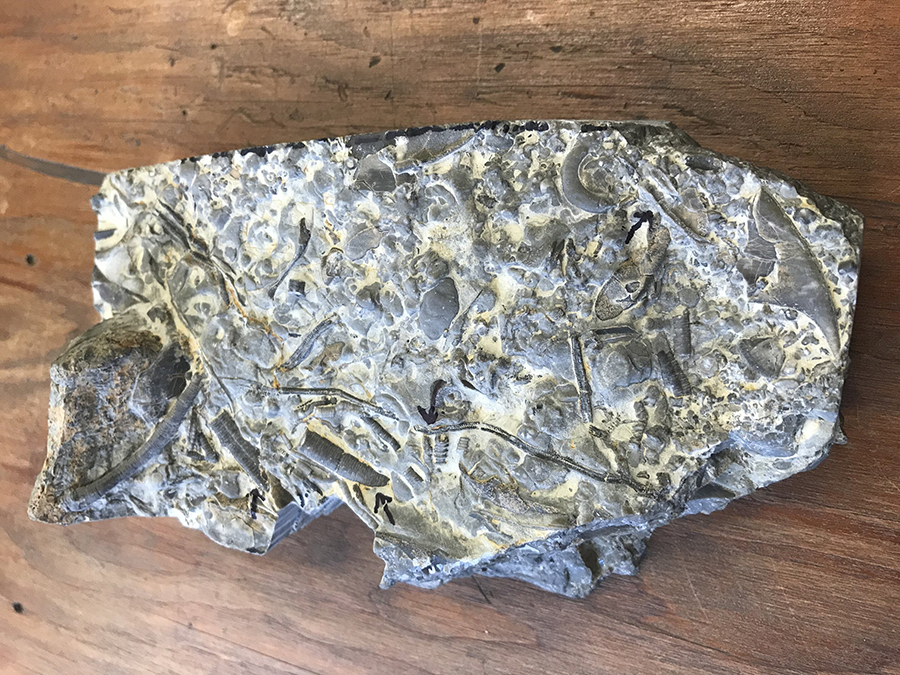
The newly-discovered Athenacrinus broweri, a sea lily that lived 480 million years ago. The arrows drawn on the fossil point out some of its long, skinny arms. Credit: (c) Field Museum, Kate Golembiewski

In the new paper, Guensburg and his colleagues describe a new kind of fossil sea lily they named Athenacrinus broweri, after the Greek goddess Athena. "Athena is often depicted with rangy, almost gangly limbs on ancient Greek vases; this fossil's arms are long and thin too," explains Guensburg. And, he adds, "Athena is the goddess of wisdom, and this fossil tells us something important about the origin of this group. This fossil has great significance."

This discovery has been a long time coming. In 1846, scientists were putting together the family tree of the echinoderms—animals like sea lilies, starfish, sand dollars, sea urchins, sea cucumbers, and a host of extinct groups. In the fossil record, they found ancient animals that look like modern sea lilies, with stalks ending in a bunch of delicate arms, called cystoids. They figured that both of these ancient animals must be closely related. But beginning in the 1950s, some scientists expressed doubts that cystoids belonged with the sea lilies—that similarities were superficial only. Still, evidence used to argue that crinoids and cystoids were only distantly related has been criticized to this day by those favoring the old traditional idea of crinoid origin.

Arm structure of Athenacrinus turned out to be key to figuring out how sea lilies evolved from earliest-known echinoderms, some of these up to 515 million years old. These earliest echinoderms didn't have arms yet, but they did have plates in their bodies similar to those found in earliest crinoid arms. So some of the plates in earliest crinoid arms preceded the origin of arms themselves. These plates are nowhere to be found in sea lilies beginning 450 million years ago. And while modern sea lilies have different arm plating, they have tissues that are remnants inherited from this ancient pattern. The new paper in the Journal of Paleontology shows that early sea lilies from 480 million years ago are the missing link between the earliest sea lily ancestors and what we see in living crinoids.

A cross-section of a fossilized Athenacrinus arm. The dark-colored upside-down triangle shows the arm's internal plates, which were key to learning about how sea lily arms evolved. Credit: (c) Field Museum, Tom Guensburg

Cystoids, meanwhile have different arms structures that, says Guensburg, indicate that cystoids don't even belong to the same class of animals as sea lilies. "These new fossils provide for the first time an accurate picture of what the earliest crinoid arms were like, and they are unlike any cystoid in important ways," says Guensburg; "No cystoid has such anatomy." That means, Guensburg says, that crinoids and cystoids are related only at the deepest, most primitive level in echinoderm history. "One of the most fascinating branches of the tree of life, echinoderms, needs rearranging," he notes. "That's a big deal."

And, he says, piecing together how sea lilies evolved helps broadens our understanding of all life: "What makes humans different from other animals is that we're curious about understanding our place in the universe and understanding our place in the history of life. This is a piece of that—it's what makes life interesting."


Provided by Field Museum Source: https://phys.org/

Pages