Blogs

First Evidence of Feathered Polar Dinosaurs Found in Australia

Wednesday, November 13, 2019

Credit: Uppsala universitet


A cache of 118 million-year-old fossilized dinosaur and bird feathers has been recovered from an ancient lake deposit that once lay beyond the southern polar circle.

Feathered dinosaur fossils are famous, but known from a handful of localities worldwide. Examples from the Southern Hemisphere are especially rare, and mainly include only isolated feathers.

An international team of scientists has analyzed a collection of 10 such fossil feathers found in Australia, which reveal an unexpected diversity of tufted hair-like 'proto-feathers' from meat-eating dinosaurs, together with downy body feathers, and wing feathers from primitive birds that would have been used for flight.

Uniquely, the fossil feathers from Australia were all entombed in fine muddy sediments that accumulated at the bottom of a shallow lake close to the South Pole during the Age of Dinosaurs.

"Dinosaur skeletons and even the fragile bones of early birds have been found at ancient high-latitudes before. Yet, to date, no directly attributable integumentary remains have been discovered to show that dinosaurs used feathers to survive in extreme polar habitats," said Dr. Benjamin Kear from Uppsala University in Sweden, a leading author on the study.

"These Australian fossil feathers are therefore highly significant because they came from dinosaurs and small birds that were living in a seasonally very cold environment with months of polar darkness every year."

The fossil feathers were discovered in the Koonwarra Fish Beds Geological Reserve, which is a heritage listed site 145 km southeast of Melbourne in Victoria, Australia.

"Fossil feathers have been known from Koonwarra since the early 1960s, and were recognized as evidence of ancient birds, but have otherwise received very little scientific attention. Our study is thus the first to comprehensively document these remains, which include new specimens that were examined using cutting-edge technologies," said Dr. Thomas Rich of the Melbourne Museum in Australia, who has led numerous expeditions to the Koonwarra locality.

A suite of advanced microscopic and spectroscopic techniques was employed to determine the anatomy and preservation of the Koonwarra fossil dinosaur and bird feathers.

"The Koonwarra feathers are preserved in incredible detail," said fossil bird expert Professor Patricia Vickers-Rich of Monash University and the Swinburne University of Technology in Melbourne.

"There are even tiny filament-like structures that would have 'zipped' the feather vanes together, just as in the flight feathers of modern birds."

However, unlike the structurally complex feathers of birds today, which are characterized by interlocking branches called barbs and barbules, different kinds of small dinosaurs had coverings that comprised much more simpler hair-like 'proto-feathers."

"Dinosaur 'proto-feathers' would have been used for insulation," said Dr. Martin Kundrát, of Pavol Jozef Safarik University in Slovakia, a leading author on the study.

"The discovery of 'proto-feathers' at Koonwarra therefore suggests that fluffy feather coats might have helped small dinosaurs keep warm in ancient polar habitats."

Microscopic remains of possible melanosomes—cellular structures that contain color pigments—were also detected on several of the fossil feathers found at Koonwarra.

These traces occurred across the uniformly dark feather surfaces, as well as in distinct bands that might represent original patterning from the polar dinosaurs and birds.

Melanic residues have been reported on fossil feathers from elsewhere around the world, and are widely acknowledged as indicators of dinosaur coloration.

The densely packed fossil melanosomes occurring on the Koonwarra feathers could suggest dark colors that perhaps assisted in camouflage, visual communication, and/or heat absorbance in cold polar climates.

Possible preservation of biomolecules was also assessed, but proved to be too degraded, and were apparently lost during weathering of the rock.

The Koonwarra fossil feathers provide the first record of dinosaur integument from the ancient polar regions, and hint what was once a global distribution of feathered dinosaurs and early birds.

Some of the fossil feathers found at Koonwarra are on display in the '600 Million Years' exhibition at the Melbourne Museum in Australia.


More information: Martin Kundrát et al. A polar dinosaur feather assemblage from Australia, Gondwana Research (2019). DOI: 10.1016/j.gr.2019.10.004

Provided by Uppsala University / Source: https://phys.org/

Paleontologists Find 170-Million-Year-Old Giant Pliosaur Fossil

Tuesday, November 12, 2019

Life reconstruction of the Arisdorf pliosaur with a diver for scale. Image credit: Joschua Knüppe.

Paleontologists in Switzerland have unearthed an exceptionally rare fossil jaw of an ancient creature known as a pliosaur.

Pliosaurs were a type of short-necked plesiosaur: marine reptiles built for speed compared to their long-necked cousins.

They lived between 220 million years ago (Triassic Period) and 70 million years ago (Cretaceous Period) and were mostly found in the prehistoric seas that covered modern-day Europe.

Also known as pliosauroids, pliosaurs were not dinosaurs, but distant cousins of modern turtles.

They had four powerful flipper-like limbs, large crocodile-like heads, extremely powerful jaws and enormous teeth, and hunted fish, cephalopod mollusks and other marine reptiles. They reached lengths of up to 50 feet (15 m), which exceeds the size of the largest toothed whales today.

“Pliosaurs were amongst the largest marine animals of their time, and were at the top of the food chain,” said Dr. Sven Sachs, a researcher at the Natural History Museum Bielefeld.

In a new study, Dr. Sachs and his colleagues from Switzerland and Sweden analyzed a partial jaw of a large-bodied plesiosaur that lived during the Jurassic period.

The specimen was collected by the fossil enthusiast Dr. Hans Holenweg from the Passwang Formation near Arisdorf in the Basel-Land canton of Switzerland.

“At around 170 million years old, the Arisdorf jaw represents one of the oldest occurrences of very large pliosaur apex predators in the fossil record, and may have come from an animal that was around 30 feet (9 m) long,” said Dr. Benjamin Kear, a paleontologist at Uppsala University.

Only the rear section of the Arisdorf jaw was recovered, but it has a total length of 1.6 feet (0.5 m).

The paleontologists estimate that the jaw was approximately 5 feet (1.5 m) long when complete.

“The Arisdorf pliosaur is the first find of its kind from Switzerland, and comes from a geological timeframe with a hitherto very sparse fossil record of pliosaurs and their relatives,” said Dr. Christian Klug, a scientist at the University of Zurich.

The study was published in the Swiss Journal of Palaeontology.

_____

S. Sachs et al. Rare evidence of a giant pliosaurid-like plesiosaur from the Middle Jurassic (lower Bajocian) of Switzerland. Swiss J Palaeontol, published online November 1, 2019; doi: 10.1007/s13358-019-00200-9

Source: www.sci-news.com/

Gnathovorax cabreirai: Oldest Carnivorous Dinosaur Fossil Unearthed in Brazil

Thursday, November 14, 2019

An amazingly well-preserved skeleton from the world's oldest-known meat-eating dinosaur has been unearthed in the south of Brazil. The skeleton is virtually intact — and includes razor-sharp teeth, pictured in this artist's impression, that would have made it a ferocious killer

A team of researchers from Universidade Federal de Santa Maria and Universidade de São Paulo, both in Brazil, has found and identified the oldest carnivorous dinosaur fossil to date. In their paper published in the journal PeerJ, the group describes their finding and where they believe it fits in the history of dinosaurs.

(A) Location map of the Marchezan site and the surface distribution of the geologic units in the area. (B) Schematic drawing of CAPPA/UFSM 0009 and associated specimens in the rock block before its final preparation. Silhouette of the associated individuals: (C) herrerasaurid; (D) cynodont/1; (E) rhynchosaur/1; (F) rhynchosaur/2 (collected near to the rock block); (F) cynodont/2. Silhouettes not to scale. (H) Reconstructed skeleton of Gnathovorax cabreirai. Credit: PeerJ (2019). DOI: 10.7717/peerj.7963

The researchers report that they found the fossil while digging near the city of Santa Maria in Rio Grande do Sul. They named it Gnathovorax cabreirai, which combines the name of the researcher credited with the discovery— Sergio Furtado Cabreira—with a loose translation of Latin that means "a jaw for devouring things." The researchers believe it is the oldest known example of a carnivorous dinosaur. They have dated the fossil to approximately 233 million years ago, which would put it during the Triassic, a time when South America was still part of Pangaea. They report that the fossil was intact and in excellent condition—so much so that they were able to put the head in a CT scanner, which gave them some information regarding the brain of the ancient creature. They believe it had good balance and good eyesight, two features that would have helped the dinosaur use its sharp teeth and claws to capture and eat prey. They report also that the dinosaur would have been approximately three meters long and would have weighed approximately one ton—making it somewhat close in size to a modern horse. Because of its age, the researchers believe the fossil represented an apex predator—and the largest in the area where it lived.

(A) Right lateral view. (B) Three-dimensional rendering of the skull in right lateral view. (C) Three-dimensional rendering of the skull in left/dorsal lateral view. (D) Schematic drawing in right lateral view. an, angular; anf, antorbital fenestra; d, dentary; emf, external mandibular fenestra; en, external naris; j, jugal; l, lacrimal; m, maxilla; n, nasal; of, oval fenestra; p, parietal; pm, premaxilla; prf, prefrontal; pt, pterygoid; q, quadrate; qj, quadratojugal; sa, surangular; snf, subnarial foramen; sq, squamosal; stf, supratemporal fenestra. Credit: PeerJ (2019). DOI: 10.7717/peerj.7963

Study of the fossilized skeleton suggested that G. cabreirai was related to a group of  known as Herrerasauridae, which were theropods. This finding suggests G. cabreirai can be used to better understand the traits of early meat-eating dinosaurs that came before the more famous types such as Tyrannosaurus rex, which were much larger and came tens of millions of years later. They note that fossil evidence of dinosaurs of the period is quite scarce, which makes the new finding all the more important.

The predator — named 'Gnathovorax cabreirai' — lived 230 million years ago when South America, pictured in this artist's impression, was still part of the supercontinent Pangaea

More information: Cristian Pacheco et al. Gnathovorax cabreirai: a new early dinosaur and the origin and initial radiation of predatory dinosaurs, PeerJ (2019). DOI: 10.7717/peerj.7963

Source: https://phys.org/
How to Successfully Throw a Dinosaur-Themed Party?

Sunday, November 10, 2019

Do you want to surprise your child on his/her birthday party? There are lots of options for party planning. Start with a riding t-rex costume that will help you to present a lifelike dinosaur in the party. You can surprise your guests and children with roaring and moving dinosaur. Feel free to plan different activities for your guests, including scavenger hunts. Make refreshments similar to dinosaurs. Here are some ideas to throw a successful dinosaur-themed party.

Present Real Dinosaur in the Party

You can become a lifelike dinosaur in the party after wearing a riding t-rex costume. With a full-body dinosaur suit, you can become an actual dinosaur. Two cables will help you to control the mouth and eyes of the dinosaur. This dinosaur will start roaring automatically, similar to a real dinosaur.

Special Decorations

Start preparation for your party with creative invitations. You can design dinosaur-shaped invitation cards for the party. Make sure to handwrite information, such as time, date and special instructions. For decorations, special stickers with dinosaurs are available in the market. Use these stickers to decorate your invitations.

Dinosaur Footprints

Use cardboards and stencils to cut out prehistoric footprints. You have to create footprints for different dinosaurs and put them on the walkway of your home. Feel free to add these footprints in your hallway.

Decorate your tables with small dinosaurs, images of dinosaurs and small trees. Plastic toys of dinosaurs will increase the grace of tables. To create a historic environment, you can use trees, special lights and smoke. You can hang photos of dinosaurs on different walls. Feel free to print some information about dinosaurs on these photos for children.

Plan Special Refreshment

Dinosaur-shaped food will make children happy. You can prepare food at home, such as dinosaur-shaped cake, cookies, chicken tenders, and baked goods. Dinosaur-shaped cookie cutters are available easily in the market. With these cookie cutters, you can make delicious sandwiches.

Prepare red and green drinks for your guests to replicate swamps and lava. Name your drinks as swamp punch and lava juice. It will be fun to put gummy worms and fish in glasses. With sherbet scoop, you can create extra fizzy drinks.

Decorations for Cakes

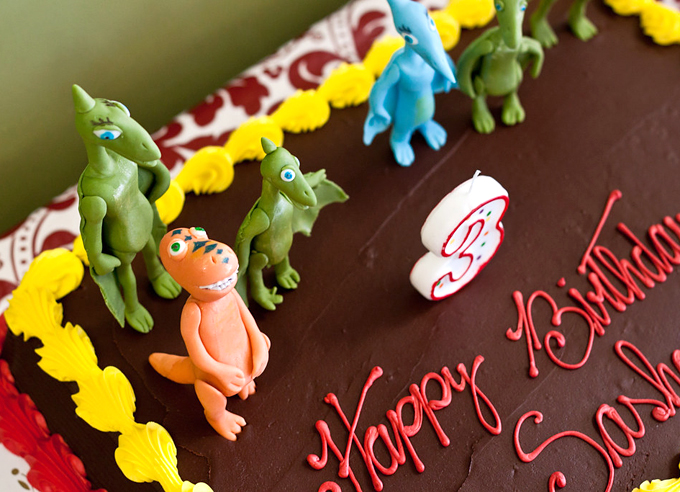
A birthday party is incomplete without a cake. To make your cake special, use dinosaur decorations. Create a dinosaur with icing and create a grass-like appearance. Feel free to put edible dinosaurs and plastic trees on the top of birthday cake.

Dinosaur Themed Activities

Play dinosaur scavenger hunt with your guests. Arrange some plastic dinosaurs and hide them around your house. Children will like to search for them in your home. Prepare different teams to let them find dinosaurs. Moreover, you can put dinosaurs in eggs and hide these eggs.

If you want an outdoor hunt, put dinosaurs in small boxes and bury these boxes in the garden. It will increase fun because children will feel like digging up fossils. Feel free to prepare t-shirts with dinosaurs to give as a return gift to children.

Source: www.fluxmagazine.com/

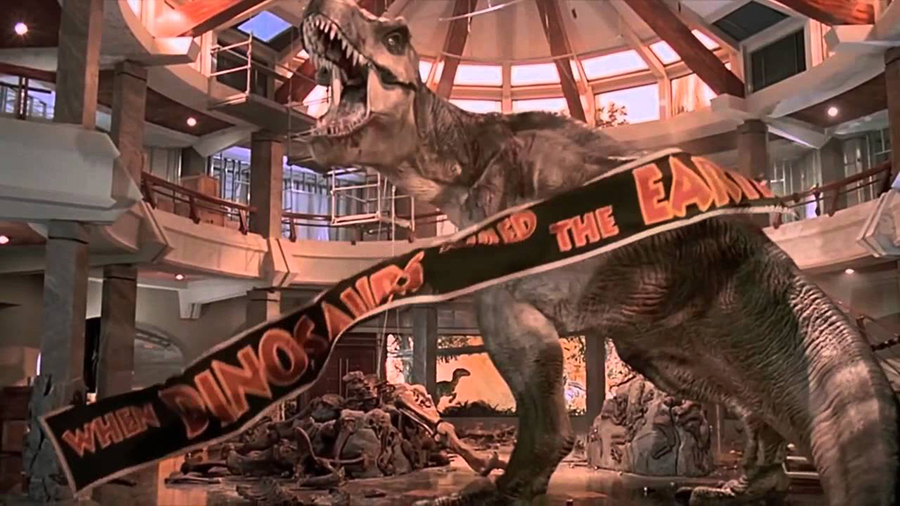
Life Finds A Way: 10 Behind-The-Scenes Facts About Jurassic Park

Saturday, November 9, 2019

When it first hit theaters in 1993, it didn’t take long for Jurassic Park to become the highest grossing movie of all time. Steven Spielberg and his crew pioneered a bunch of new visual effects technologies to bring dinosaurs back to life. Audiences all over the world were thrilled to see prehistoric beasts tearing across the silver screen. Jurassic Park marketed itself as being 65 million years in the making. It actually only took a couple of years to put together, but there are still plenty of interesting stories from the production. Here are 10 Behind-The-Scenes Facts About Jurassic Park.

10 THE TRICERATOPS DUNG WAS COVERED IN HONEY TO ATTRACT FLIES

The giant pile of Triceratops dung looks so convincing, and the actors react to it so believably, that you can practically smell it through the screen. But apparently, it didn’t smell at all on the set. The dung was created with a combination of clay, mud, and straw to give it the color and consistency it needed. The crew then drizzled honey and papayas on it in order to attract a swarm of flies. Having a bunch of flies buzzing around the dung undeniably makes it look a lot more realistic. It was also probably more pleasant for the actors to have odorless dung on the set.

ORIGINALLY, THE FINALE WAS VERY DIFFERENT

In the early drafts of the script for Jurassic Park, the finale looked very different. One of the raptors was going to get pierced by a rib from the T. Rex skeleton, while the other would’ve been hit by the skeleton’s falling jaw. It even remained that way as the film went into shooting. A couple of crew members who felt that the final sequence was underwhelming came to Steven Spielberg with the suggestion to punch it up a little bit and they all got together to brainstorm ideas. After this brainstorming, they came up with the scene we see in the final film.

JEFF GOLDBLUM MADE IAN MALCOLM MORE HEROIC

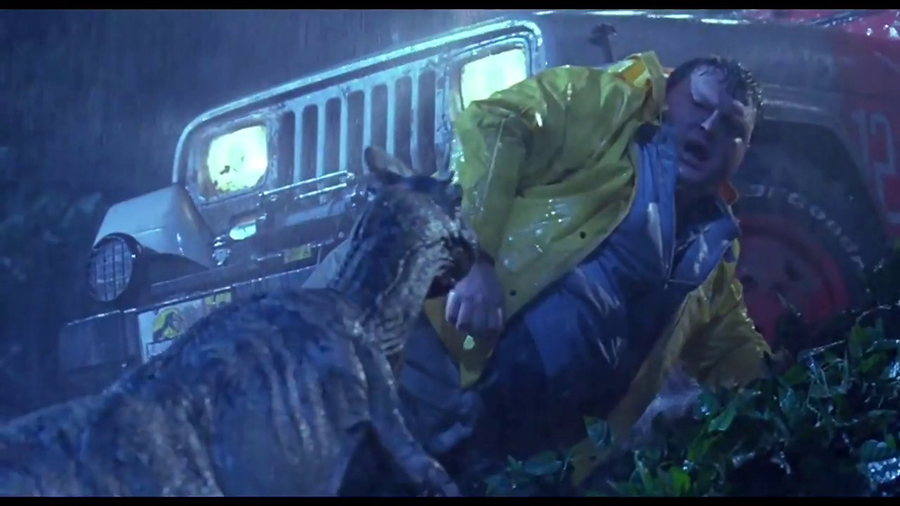
In the novel, Ian Malcolm isn’t a very heroic guy, and in the script for the film, he wasn’t supposed to be either. In the scene where the T. Rex attacks the characters, Malcolm was supposed to just run away like Gennaro (read: like a coward). It was Jeff Goldblum’s idea to make Malcolm more heroic and have him distract the T. Rex and allow Alan Grant to swoop in and rescue the kids. It didn’t detract from Malcolm being a roguish hotshot — sort of the Han Solo of the Jurassic Park universe — but it did cement his place as a screen legend.

SAMUEL L. JACKSON WAS SUPPOSED TO HAVE A REAL DEATH SCENE

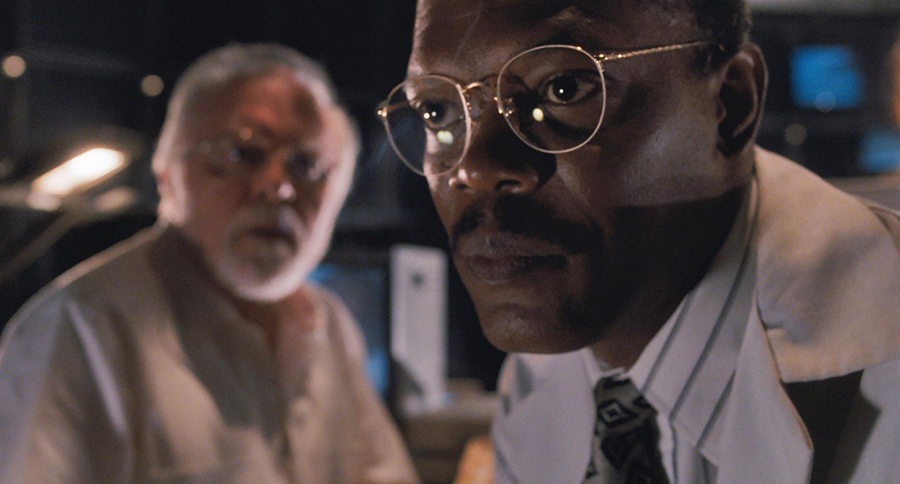
Samuel L. Jackson got his big break in Jurassic Park, playing the role of Arnold. He’s set up in the first act as one of the park’s smartest scientists, and then he’s killed offscreen. This is suggested when Ellie finds his severed arm. Originally, his character was supposed to have a real death scene, and Jackson was excited to do it, because it would’ve been cool to be chased by raptors and torn to shreds. Jackson was ready to fly out to Hawaii and shoot his character’s death when a hurricane destroyed the set and the scene had to be scrapped.

THE ANIMATRONIC T. REX WAS SO DANGEROUS THAT THE CREW NEEDED SAFETY MEETINGS

The animatronic T. Rex used in Jurassic Park was so dangerous that the crew needed to have safety meetings to discuss how to use it properly and avoid any T. Rex-related injuries. The T. Rex weighed a whopping 12,000 lbs — some reports have it between 13,000 and 15,000 lbs — so if anyone got stuck under it or it fell on anyone, it would’ve been quite an ordeal.

The crew set up a system of flashing lights to let anyone who was nearby know that it was about to be turned on. The head of the T. Rex whooshing by felt like a bus driving past.

JAMES CAMERON WANTED TO DIRECT JURASSIC PARK

James Cameron has said that he wanted to turn Michael Crichton’s novel Jurassic Park into a film, but when he called up to inquire about the rights, he was just a few hours too late, as Steven Spielberg had gotten in there first. Cameron would later say that Spielberg was the better choice for the job, as he would’ve made it more violent and adult-oriented — describing it as Aliens with dinosaurs” — and kids deserved a dinosaur movie they could actually see. Funnily enough, Spielberg’s visual effects in Jurassic Park were directly influenced by Cameron’s innovative visual effects in Terminator 2: Judgment Day.

WAYNE KNIGHT WANTED A GORIER DEATH FOR NEDRY

Wayne Knight — best known for playing Newman in Seinfeld — wasn’t bothered that his Jurassic Park character Nedry died. In fact, he felt that he deserved to die. (This would become a recurring theme in the Jurassic Park franchise: only characters who deserve to be killed are killed.) But Knight did want his character to have a gorier death. In the movie, it happens offscreen after he’s terrorized by a little dinosaur that he tried to outsmart. In the book, it was a lot more graphic than that — Nedry even got decapitated. Knight was hoping that would be depicted in the movie.

SOME A-LIST NAMES WERE UP FOR ROLES IN THE FILM

It was recently reported that the trio of Sam Neill, Laura Dern, and Jeff Goldblum will be getting back together for Jurassic World 3. It’s hard to imagine anyone other than those three actors taking the roles, but some A-list names were considered for the movie. Steven Spielberg looked at William Hurt and Harrison Ford for Alan Grant, and Robin Wright and Juliette Binoche for Ellie Sattler.

Spielberg also considered Sean Connery for the role of John Hammond. If James Cameron had made the movie, he wanted to cast Arnold Schwarzenegger as Alan Grant, Bill Paxton as Ian Malcolm, and Charlton Heston as John Hammond, which are interesting choices.

STEVEN SPIELBERG OVERSAW POST-PRODUCTION FROM THE SET OF SCHINDLER’S LIST

Last year, Steven Spielberg decided he had enough time while the visual effects were being applied to Ready Player One to shoot a smaller, less VFX-laden movie, The Post. In the early ‘90s, he did the exact same thing while the visual effects were being applied to Jurassic Park, and took the time to shoot Schindler’s List. He had to oversee the post-production of Jurassic Park from the set of Schindler’s List, although the emotional toll of shooting a movie about the horrors of the Holocaust left Spielberg feeling so depressed that he needed an hour before he could answer trivial questions about digital dinosaurs.

THE DINOSAURS ONLY HAVE 14 MINUTES OF SCREEN TIME

Despite the fact that Jurassic Park is two hours long and its whole premise revolves around dinosaurs, the cloned prehistoric creatures only actually appear during a combined total of 14 minutes of the movie. This is similar to how Jerry only ever actually said the line “Hello, Newman,” 15 times throughout 180 episodes of Seinfeld. Maybe the makers of the Jurassic World movies should take some cues from this and realize that less is more. There doesn’t need to be a dinosaur in every scene. If there isn’t, you can build up the tension and give the dinosaur scenes more impact.

Source: https://screenrant.com/

10 Things From The Jurassic Park Franchise That Haven't Aged Well

Saturday, November 9, 2019

The Jurassic Park franchise has been an unstoppable force since 1993, when Steven Spielberg's Jurassic Park roared onto screens worldwide and made audiences believe the impossible could become a reality. Not only did the maverick filmmaker and his creative team pioneer some of the best visual effects in cinema, but they also created one of the most beloved action-adventure franchises of all time.

The original film was based on the Michael Crichton novel about a theme park of dinosaurs that eventually break loose and wreak havoc on visitors. It inspired a sequel novel as well as a series of films, each expanding the world-building of the last. As incredible as the franchise is, each film's writing both helped and hindered its progress. As a result, it hasn't aged as magnificently as you might think. Read on below for 10 reasons why.

10 JURASSIC PARK 1 & 2: THE TECHNOLOGY

Something that's immediately salient to modern viewers watching Jurassic Park and its sequel, The Lost World, is the outdated technology on display. When compared to the sleek tech featured in the Jurassic World films, it becomes ironic that the characters of the first two films in the franchise are talking on cellphones derisively called "bricks."

Comically large cellphones aside, there's also the computers and their interfaces, which look completely archaic by today's standards. It works on some levels though; the tension is only amplified by the slow loading displays as Lex desperately tries to hack into the park's systems and restore power, before a velociraptor bursts into the computer lab and eats everyone.

JURASSIC PARK: "THEY DO MOVE IN HERDS"

In 1993, the panoramic scene involving Dr. Grant, Dr. Sattler, and Hammond watching herds of brachiosaurus and parasaurolophus was mind-blowing. CGI had never been used so seamlessly to blend into a natural environment, much less bring to life creatures that had been dead hundreds of thousands of years.

While the scene still holds up in terms of giving movie wizardry credit where credit is due, there's still the matter of the poor texturing on the brachiosaurus, which gets even more patchy as we close in on it attacking a tree for its daily lunch of leaves.

JURASSIC PARK: "THEY'RE FLOCKING THIS WAY"

No one can deny that Jurassic Park was a groundbreaking film for visual effects. CGI was still very much in its infancy in 1991 when the film was in pre-production, the use of which would set the tone for blockbusters to come. That being said, while good for its era, some of the CGI just doesn't hold up today.

The "flock of Gallimimus" scene comes to mind, with the dinosaurs looking out of place in the environment around them. The coloration of their skin looks oddly bright and untouched by shadows, and they very much look super-imposed onto a backdrop.

THE LOST WORLD: CORPORATE BAD GUYS VS. GOOD ENVIRONMENTALISTS

Sometimes there's something innately comforting about the black and white, good versus evil aspect present in the '80s and '90s action-adventure films. The Lost World keeps the trope alive and well by pitting environmentalists (like Vince Vaughn's "Earth First character") versus the corporate baddies of InGen.

Of course in real life, people are so rarely broken down into those sorts of binary archetypes, and it was the fact they weren't in the original Jurassic Park that made the characters so complex. There's good and there's bad in The Lost World, and it means you can cheer extra loud when bad guys get eaten, but it doesn't make the film age any better.

THE LOST WORLD: GYMNASTICS KILLED THE DINOSAURS

While you might have thought a giant meteor wiped out the dinosaurs, it was, in fact, a teenager with mad gymnastic skills. And not just any teen, but Ian Malcolm's estranged daughter who's recently been cut from the gymnastics team.

She's given the opportunity to show off her skill against a velociraptor, part of a species that's been shown to be the most cunning predators of the series. The scene where a raptor waits patiently while she goes through her routine on a pole, gaining enough momentum to kick it through a window is painful to watch and ruins the tension.

THE LOST WORLD: SAN DIEGO RAMPAGE

In the grand tradition of King Kong and Godzilla, The Lost World set out to leave the terrifying isolation of the island and bring the danger of dinosaurs to the mainland. A T-Rex descends on San Diego and rampages through the city streets, in both an homage and a mockery of the monster movies that came before it.

While parts of this sequence are undoubtedly epic, there are several that are full of such campy humor that pulls you out of the moment. What should be nothing short of horrifying becomes humorous when a T-Rex drinks from a swimming pool and a Japanese ex-pat screams at it like it's the second coming of Mothra.

JURASSIC PARK 3: SCIENTIFIC FALLACIES

As the final film in the Jurassic Park trilogy, Jurassic Park III tried a combination of things to satisfy fans; it rehashed elements from the other two films and souped-up its dinosaurs. It introduced new dinosaurs like the Spinosaurus, as well as gave viewers their first look at the sort of hybrid dinosaurs they'd see later in Jurassic World.

It's not so much that the dinosaurs look bad, it's the fact that after so many years since the original film, filmmakers had no interest in being accurate with the science behind them. The scientific community bemoaned the fact that filmmakers were still using research from the '80s to depict their dinosaurs, as well as continuing the myth that DNA doesn't have an expiration date.

JURASSIC WORLD: RUNNING IN HEELS

The more one watches Jurassic Park with the intelligent and competent Dr. Sattler (Laura Dern) as its heroine, the more one bemoans the character Bryce Dallas Howard plays in Jurassic World. As the prim operations manager, she has a Romancing the Stone moment and heads into the park with roguish Chris Pratt's raptor tamer in her all-white business suit.

Unlike that adventure yarn, she doesn't hack off the heels of her shoes to bushwhack through the jungle. Instead, she keeps her heels on and improbably survives a series of dangerous events while maneuvering in them. She's still wearing them at the end of the film when she sprints to outrun a rampaging T-Rex.

JURASSIC PARK & JURASSIC WORLD: SCIENCE IS HEARTLESS

Michael Crichton, author of sci-fi thrillers like The Andromeda StrainPrey, Westworld, and of course, Jurassic Park has long explored the belief that scientists are heartless individuals who, if left unchecked, would doom the world with their hubris and monstrous creations.

Both Jurassic Park and its reboot Jurassic World reflect this archetype, exploring the inherent dangers of genetic research to the extent of having souped-up dinosaurs on the loose because scientists lack any sort of basic restraint, common sense, or judgment. It feels not only uninspired but wildly out of touch.

FALLEN KINGDOM: MAD SCIENTIST

Like some maniacal mad scientist out of Frankenstein, the one-dimensional character of Dr. Henry Wu (B.D. Wong) continues to pop up in the Jurassic World films to figuratively twirl his mustache and genetically engineer more dinosaur hybrids.

The character was much more interesting in Michael Crichton's book, where he had much more to do with the process of creating the theme park than was even hinted at in the Jurassic Park film. His inclusion in the later films in the franchise as a contrived villain removes all the moral ambiguity that existed when it was focused on the avuncular John Hammond and his pursuit of legacy at the expense of his grandchildren.

Source: https://screenrant.com/

New Sphenisciform Fossil Further Resolves Bauplan of Extinct Giant Penguins

Saturday, November 9, 2019

CAPTION New Zealand is a key area for understanding the diversity of the extinct penguins and has even revealed the existence of 'giant' penguin species (larger than living penguins). A new study describing a remarkably complete giant penguin skeleton from the Oligocene, Kawhia Harbour in the North Island of New Zealand was presented by Simone Giovanardi, Massey University Albany, Auckland, New Zealand, at this year's annual meeting of the Society of Vertebrate Paleontology.  CREDIT: Simone Giovanardi

A new sphenisciform fossil from the north island of New Zealand further resolves the bauplan of extinct giant penguins.

Penguins are descendants of seabirds that lost the ability to fly more than 60 million years ago in exchange for chasing the abundant food available in the ocean. New Zealand is a key area for understanding the diversity of the extinct penguins and has even revealed the existence of 'giant' penguin species (larger than living penguins). A new study describing a remarkably complete giant penguin skeleton from the Oligocene, Kawhia Harbour in the North Island of New Zealand was presented by Simone Giovanardi, Massey University Albany, Auckland, New Zealand, at this year's annual meeting of the Society of Vertebrate Paleontology held this year in Brisbane, Australia.

These giant penguins differed from their living descendants in the length of their front limbs and elongated beaks, perhaps suggesting differences in ecological roles when compared with living penguins. The preserved hindlimbs of the new North Island fossil are also significantly longer than all previously described specimens.

Giovanardi adds, "The Kawhia giant penguin is mostly complete and largely articulated in life position, which helps a great deal with reconstructing the relatively long and slender body." This specimen suggests a mixture of characteristics of an older body plan found in other Eocene-Oligocene giant penguins and the one found in the more derived giant penguin, Kairuku.

To date, most of the giant penguins found in New Zealand have been discovered in the South Island. This fossil was found in an Oligocene silty mudstone from the North Island of New Zealand and currently represents the most complete pre-Pleistocene vertebrate reported from this region. Giovanardi concludes by stating, "The North Island of New Zealand has its own paleontological tale to tell."

FEDERATION OF AMERICAN SOCIETIES FOR EXPERIMENTAL BIOLOGY

###

About the Society of Vertebrate Paleontology

Founded in 1940 by thirty-four paleontologists, the Society now has more than 2,300 members representing professionals, students, artists, preparators, and others interested in VP. It is organized exclusively for educational and scientific purposes, with the object of advancing the science of vertebrate paleontology. Journal Web site: Society of Vertebrate Paleontology: http://www.vertpaleo.org

Source: www.eurekalert.org/

Daniella Pineda & Justice Smith Set to Return For Jurassic World 3

Friday, November 8, 2019

While the talk of the town is the return of the franchise’s original three stars, the roster for Jurassic World 3 will see the return of two more familiar and lovable faces in the forms of Daniella Pineda’s Zia Rodriguez and Justice Smith’s Franklin Webb, according to Collider.

DeWanda Wise recently joined Mamoudou Athie (Sorry for You Loss), who will also star in a lead role. Returning cast members include Chris Pratt and Bryce Dallas Howard, as well as original Jurassic Park stars Laura Dern, Sam Neill, and Jeff Goldblum.

Steven Spielberg and Colin Trevorrow return to executive produce Universal Pictures and Amblin Entertainment’s Jurassic World 3, with Trevorrow once again directing the next chapter in one of the biggest franchises in the history of cinema. Producers Frank Marshall and Pat Crowley once again partner with Spielberg and Trevorrow in leading the filmmakers for this installment.

Joining the Jurassic team for the first time is Emily Carmichael (Pacific Rim UprisingThe Black Hole), who will craft the Jurassic World 3 screenplay with Trevorrow. They will work off a story by Derek Connolly and Trevorrow, who together co-wrote Jurassic World and Jurassic World: Fallen Kingdom.

Fallen Kingdom was an opening to the realm of blockbuster hits for Smith, who followed up the dinosaur thriller with the lead role in the big-screen adaptation of Detective Pikachu, which received positive reviews from critics and audiences alike and was a smash box office success. Pineda would go on to star in the Netflix thriller series What/If alongside Renée Zellweger, which received mixed reviews from critics.

Jurassic World 3 will debut in theaters on June 11, 2021.

Source: www.comingsoon.net/

NASA Scientist Shows Dinosaurs Roamed Earth on The Other Side of The Milky Way

Saturday, November 9, 2019

When dinosaurs ruled the Earth, the planet was on a completely different side of the galaxy.

A new animation by NASA scientist Jessie Christiansen shows just how long the dinosaurs' reign lasted, and how short the era of humans has been in comparison, by tracing our solar system's movement through the Milky Way.

Our Sun orbits the galaxy's centre, completing its rotation every 250 million years or so. So Christiansen's animation shows that last time our Solar System was at its current point in the galaxy, the Triassic Period was in full swing and dinosaurs were just beginning to emerge.

Many of the most iconic dinosaurs roamed Earth when the planet was in a very different part of the Milky Way.

Christiansen got the idea to illustrate this history when she was leading a stargazing party at California Institute of Technology in Pasadena. Attendees were astonished when she mentioned that our Solar System had been across the galaxy when dinosaurs roamed.

"That was the first time I realised that those time scales – archaeological, fossil record time scales and astronomical time scales – actually kind of match along together," Christiansen told Business Insider. "Then I had this idea that I could map out dinosaur evolution through the galaxy's rotation."

The resulting video puts both timelines in perspective:

Christiansen said it took her about four hours to make the film using timed animations in PowerPoint. She also noted a couple minor corrections to the text in her video: plesiosaurs are not dinosaurs, and we complete a galactic orbit every 250 million years (not 200 million years).

'A spiral through space'

Galactic movement is more complicated than the video shows, though. The other stars and planetary systems in the galaxy are also moving, at different speeds and in different orbits. The inner portions spin faster than the outer regions.

What's more, the galaxy itself is moving through space, slowly approaching the nearby Andromeda galaxy.

"The animation kind of makes it seem like we've come back to the same spot, but in reality the whole galaxy has moved a very long way," Christiansen said.

"It's more like we're doing a spiral through space. As the whole galaxy's moving and we're rotating around the centre, it kind of creates this spiral."

So in the Solar System's rotation around the galactic centre, we're not returning to a fixed point. The neighbourhood is different from the last time we were here.

Earth, however, is not drastically different; it still supports complex life. That's partially thanks to the path of our sun's galactic orbit.

"Our solar system doesn't travel to the centre of the galaxy and then back again. We always stay about this distance away," Christiansen said.

In other words, even as our solar system travels through the Milky Way, it doesn't approach the inhospitable centre, where life probably wouldn't survive.

"There's a lot of stars, it's dynamically unstable, there's a lot of radiation," Christiansen said. "Our Solar System certainly doesn't pass through that."

That's a huge part of why dinosaurs, mammals, or any other form of life can exist on Earth.

This article was originally published by Business Insider.

Source: www.sciencealert.com/

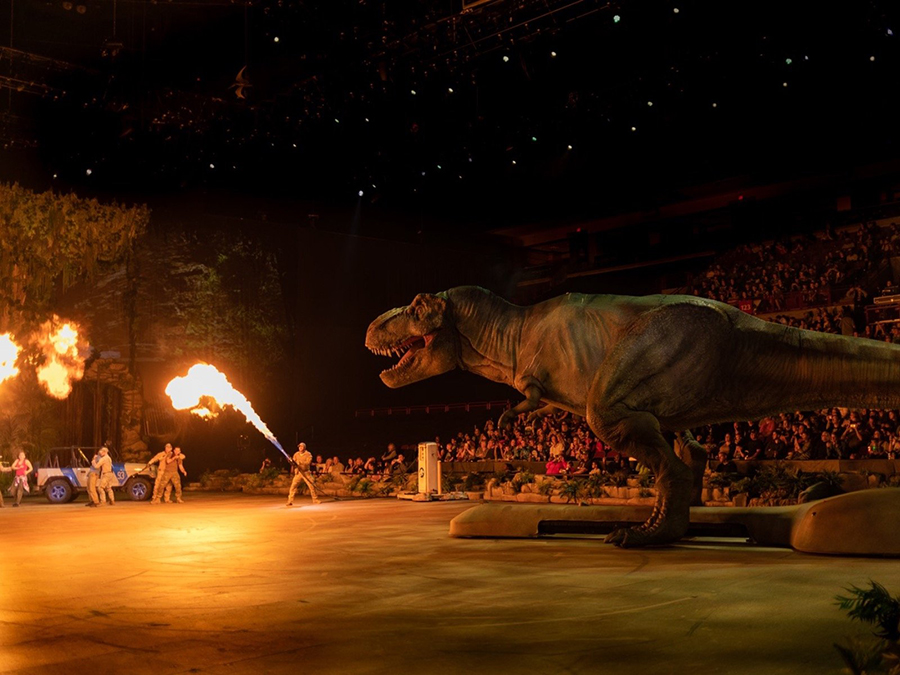
5 Reasons to Check Out "Jurassic World Live Tour"

Friday, November 8, 2019

The T. rex is coming! (PHOTO: Jurassic World Live Tour Facebook)


JURASSIC WORLD COMES TO LIFE FOR THE FIRST TIME IN A TOURING ARENA SHOW!

Your trip to Isla Nublar takes a terrifying turn after the Indominus rex escapes and causes chaos in the park!


Before the dinosaurs bring down the house (one can only hope not literally, but anything's possible with a T. rex), we got a chance to peak behind the scenes and under the skin of these amazing reptiles and learn how they come alive from the people pulling their strings. And in the process, we learned five reasons why this will be a can't miss show.

1. It's not just the greatest hits

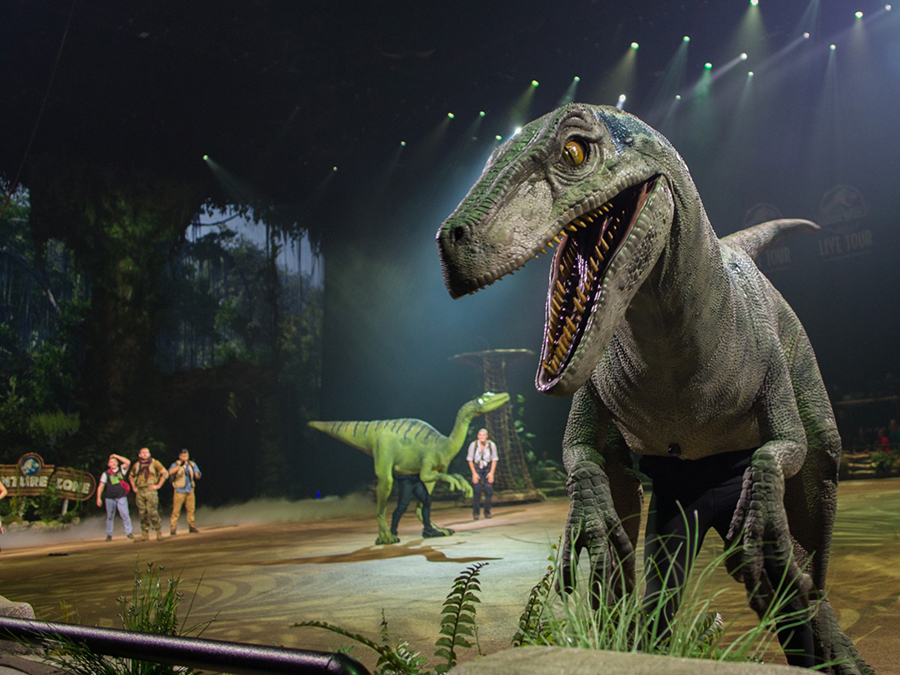
(PHOTO: Jurassic World Live Tour Facebook)

Seeing dinosaurs alone is quite the spectacle – but "Jurassic World Live Tour" goes behind just showing you these scaly wonders. You get a legitimate story, actually involved in the universe of the "Jurassic World" franchise – complete with Amblin and Universal working with and providing the actual creature designs, branding and creature effect from the hit films.

Taking place between the last two movies, "Jurassic World Live Tour" follows a crew of scientists – led by Dr. Kate Walker – heading to the recently decimated Jurassic World theme park (thanks a lot, Indominus rex) to save a new breed of dinosaur from a brutal fate.

"I like the fact that we're taking a movie franchise and taking another story with it," said dinoteer Enrique Escajeda. "The fact that we're adding to the canon, rather than just rehashing something or saying, 'Here are some highlights and we'll toss some stuff at you; see you later, have a good day.' It's actually adding and contributing something – and that doesn't happen a whole lot in the live event arena."

So consider this like "Jurassic World 1.5," not just a random glorified parade of your old prehistoric friends and foes.

2. Bringing dinosaurs to life

Sure, it doesn't require finding a miracle mosquito caught in some amber, groundbreaking crazy DNA science and the daringness to stare a T. rex in the face ... but it still requires a lot of work and a lot of talented people to bring the dinosaurs back to life for "Jurassic World Live Tour."

To start, the tour scoured several cities across the country, auditioning more than 1,000 people to find the right talented crew of creature puppeteers to provide as their dinosaurs' heart beats. It was a process that searched for people skills, athleticism, strength, endurance and more, requiring wannabe dinosaurs to show off their acting skills, martial arts skills – after all, there are a number of action scenes – and more through an obstacle course, workshopping with weights and playing with hand puppets. No, seriously – playing with puppets.

"In the casting forum, we have them emulate how to be a dinosaur – because if you can do emulate a dinosaur with a puppet, then you can probably be a dinosaur in the show," said Kori Kirschner, athletic trainer for "Jurassic World Live Tour." "We watch how they utilize their body, and there's a soundtrack, so they're roaring and sniffing and moving."

In the end, 27 people were selected for the show – but, of course, making the show is just the start of the work. The dinoteers learn how to inhabit a dinosaur, learning how to look like a prehistoric creature and display an animal's thought process, as well as even emotions and character traits, through small gestures and movements – all while also working alongside the dinosaur noises and roars that we all know, recognize and, in the case of the carnivores, fear.

"We have some guidelines to give you a little bit of an idea of what these animals might be like, but the way I always see my raptor as a horse mixed with a chicken, mixed with tiger," said dinoteer Austin Paz. "You're curious. You're a little bit jerky like a chicken would be. You have a long neck and body like a horse – but you're also definitely the top predator, the one in charge, so you scan and see your prey."

"We're constantly listening to the show track, and we have to bring the sounds to life with our animation," added dinoteer Skylar J. Keck. "I love the sounds. I love being able to animate and bring those different sounds and nuanced things to life.

"That's really fun – but also you get to act as a dinosaur. You get to bring this dinosaur to life, and that in itself is just the coolest."

3. No lightweight lizards

In case it wasn't enough of a challenge to get into the character of a prehistoric lizard that hasn't walked the planet in millions upon millions of years, the dinoteers also have the weight of playing a dinosaur on their shoulders – literally. Ask any member of the "Jurassic World Live Tour" team what the biggest challenge is with the show, and you'll get the same answer: handling the prehistoric puppet's pounds, which range between 130-145 pounds.

"They are heavy," Escajeda said. "You have to be this muscular thing that moves really fast – but at the end of the day, you're still a human with over 100 pounds on you, trying to move like you're really strong and fast. There was a lot of conditioning – laps, getting used to being strapped into the feet, because your hip flexors are now using and lifting the legs of the dinosaur, and to do that and try to run was a lot. In the beginning, we thought it was going to be impossible."

"In some of the cities, we've had some people workshop with our weight vests, which are 60 pounds – which is just half of the weight of our lightest dinosaur," Kirschner said. "So not only do they have to emulate the dinosaur, they have to have the strength and endurance to manipulate the dinosaur across a ten-minute period."

In fact, the dinoteers first learn how to puppet without the puppet, instead using a plain dino rig to get used to figuring out the controls and seeing how your reptile's actions and reactions actually look like before closing yourself off inside pounds of scaly plastic.

"It helps take the stress away, so you're not worried about the weight and holding yourself up and instead getting you focused on the puppeteering and articulation," Paz explained. "Then you take that and translate it as you start building the puppet. We start with this, then we go into the dinoteer puppet without any of the foam or skin, then we add the foam and the skin, slowly taking away the visual and adding the weight."

As it turns out, being a dinosaur is a lot of work. No wonder they all called it a day and went extinct all those millions of years ago!

4. A full dish of dinos

"Jurassic World Live Tour" will feature a cast list of dinosaurs marching through Fiserv Forum on par with the actual Jurassic Period. In total, 21 reptiles spread across seven species will rampage through the new arena, stomp through this special story and greet the humans both on the stage and in the crowd. (Well, hopefully just the herbivores will; the carnivores can keep their distance.) That number includes familiar faces, like the stegosaurus, triceratops and everyone's favorite nightmares: the creepy and crafty raptors – with maybe even a Blue sighting? – and the carnivorous king of the dinosaurs, the Tyrannosaurus rex. But there will also be a new ferocious face ...

5. Meet a new meat eater

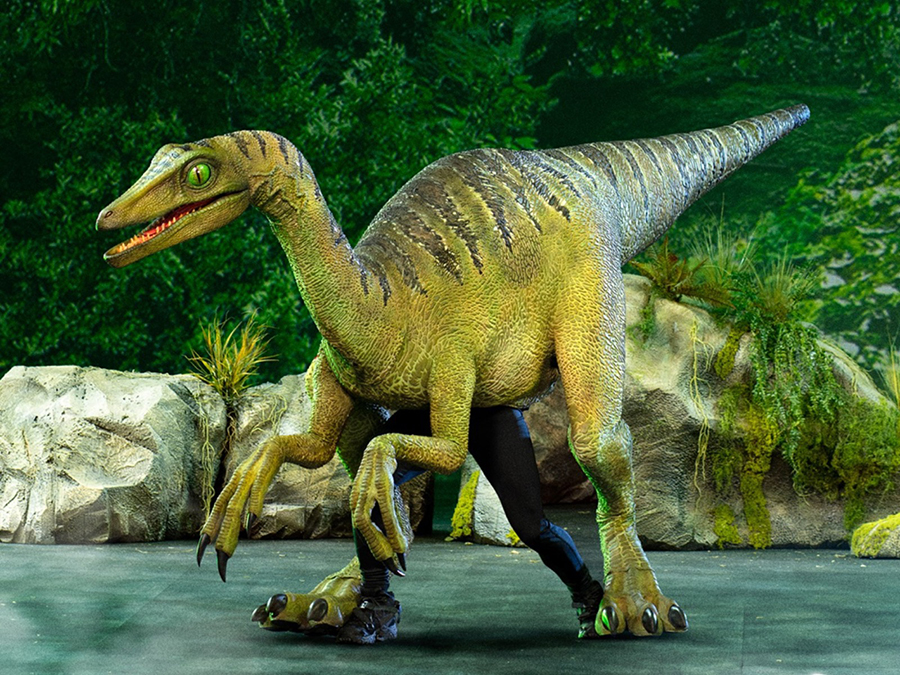
(PHOTO: Jurassic World Live Tour Facebook)

Presenting the newest character in the "Jurassic World" saga: Jeanie the troodon, a species unseen in the series thus far, with an intelligence level also unseen in a dinosaur in any of the past movies. You see, the troodon – a real dinosaur species, not a made-up Hollywood creation – had a large brain for its size, implying that it was smarter than most of its brethren.

"She's able to really sense and emulate emotion more so than the velociraptor," said Keck, who helps play Jeanie the troodon during the show.

And, of course, the troodon is a meat eater. Great; why can't the herbivores ever be the smart ones?

"I get to be the troodon that's in there attacking people, so I feel like I'm really living out my childhood dream, roaring and biting people and throwing them," Escajeda joked. "I'm like, 'Yes, this is exactly what I imagined dinosaurs like and what it would be like to be one.'"

Source: https://onmilwaukee.com/

Pages