Blogs

This Ancient “Giant Spider” Fossil Surprised Paleontologists – Detective Work Revealed a Hoax

Saturday, December 21, 2019

The specimen will be stripped of the scientific name Mongolarachne chaoyangensis and rechristened as a crayfish. Credit: Selden et al.

A ‘Jackalope’ of an Ancient Spider Fossil Deemed a Hoax

Earlier in 2019, a remarkable new fossil specimen was unearthed in the Lower Cretaceous Yixian Formation of China by area fossil hunters — possibly a huge ancient spider species, as yet unknown to science.

The locals sold the fossil to scientists at the Dalian Natural History Museum in Liaoning, China, who published a description (pdf) of the fossil species in Acta Geologica Sinica, the peer-reviewed journal of the Geological Society of China. The Chinese team gave the spider the scientific name Mongolarachne chaoyangensis.

But other scientists in Beijing, upon seeing the paper, had suspicions. The spider fossil was huge and strange looking. Concerned, they contacted a U.S. colleague who specializes in ancient spider fossils: Paul Selden, distinguished professor of invertebrate paleontology in the Department of Geology at the University of Kansas.

Image A shows a mosaic of parts of the specimen as seen under fluorescence microscopy: bright white shows areas of cement used to repair the specimen, bright blue shows the rock matrix, bright yellow marks areas painted with oil-based paint, and dull red is the fossil cuticle. Image B is a map of specimen showing cracks, cemented areas (grey), and painted parts (brown). Credit: Selden et al

“I was obviously very skeptical,” Selden said. “The paper had very few details, so my colleagues in Beijing borrowed the specimen from the people in the Southern University, and I got to look at it. Immediately, I realized there was something wrong with it — it clearly wasn’t a spider. It was missing various parts, had too many segments in its six legs, and huge eyes. I puzzled and puzzled over it until my colleague in Beijing, Chungkun Shih, said, ‘Well, you know, there’s quite a lot of crayfish in this particular locality. Maybe it’s one of those.’ So, I realized what happened was I got a very badly preserved crayfish onto which someone had painted on some legs.”

Selden and his colleagues at KU and in China (including the lead author of the paper originally describing the fossil) recently published an account of their detective work in the peer-reviewed journal Palaeoentomology.

“These things are dug up by local farmers mostly, and they see what money they can get for them,” Selden said. “They obviously picked up this thing and thought, ‘Well, you know, it looks a bit like a spider.’ And so, they thought they’d paint on some legs — but it’s done rather skillfully. So, at first glance, or from a distance, it looks pretty good. It’s not till you get down to the microscope and look in detail that you realize they’re clearly things wrong with it. And, of course, the people who described it are perfectly good paleontologists — they’re just not experts on spiders. So, they were taken in.”
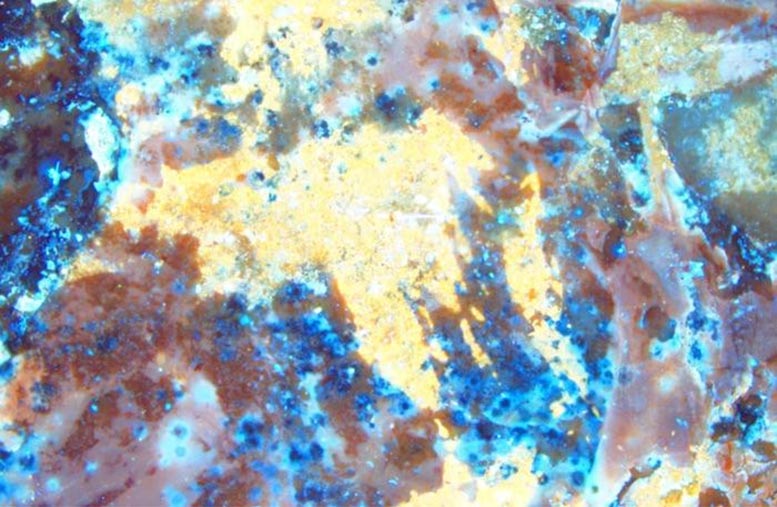
Detail of an area near where the posterior (false) legs meet the body, showing bright yellow fluorescence (= paint) with brush strokes overlying dull red cuticle and blue matrix. Credit: Selden et al

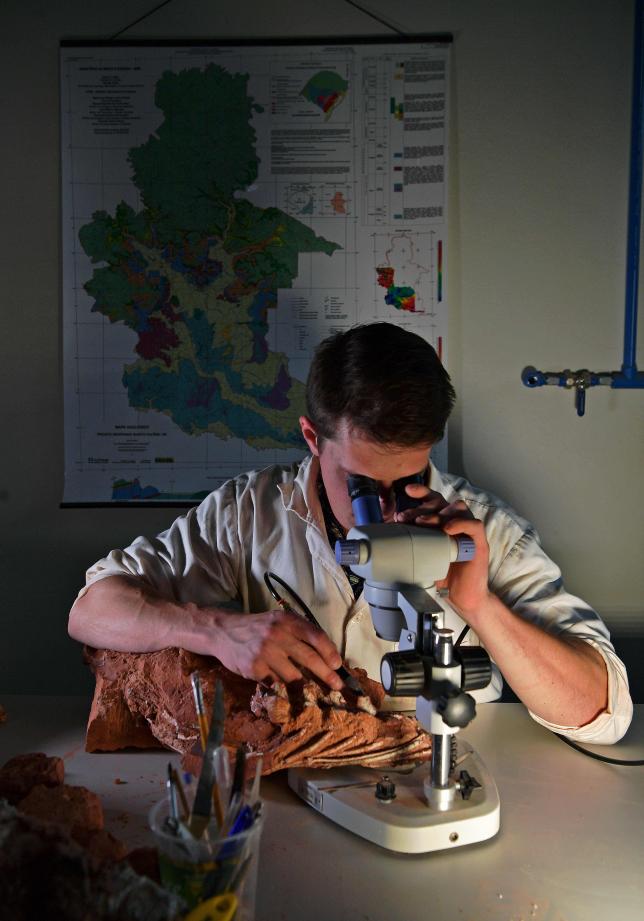
In possession of the original fossil specimen at KU, Selden teamed up with his graduate student Matt Downen and with Alison Olcott, associate professor of geology. The team used fluorescence microscopy to analyze the supposed spider and differentiate what parts of the specimen were fossilized organism, and which parts were potentially doctored.

“Fluorescence microscopy is a nice way of distinguishing what’s painted on from what’s real,” Selden said. “So, we put it under the fluorescence microscope and, of course, being a huge specimen it’s far too big for the microscope. We had to do it in bits. But we were able to show the bits that were painted and distinguish those from the rock and from the actual, real fossil.”

The team’s application of fluorescence microscopy on the fossil specimen showed four distinct responses: regions that appear bright white, bright blue, bright yellow, and ones that are dull red. According to the paper, the bright white areas are probably a mended crack. The bright blue is likely from mineral composition of the host rock. The yellow fluorescence could indicate an aliphatic carbon from oil-based paint used to alter the crayfish fossil. Finally, the red fluorescence probably indicates the remnants of the original crayfish exoskeleton.

“We produced this little paper showing how people could be very good at faking what was clearly a rather poor fossil — it wasn’t going to bring in a lot of money — and turning it into something which somebody bought for quite a lot of money, I imagine, but it clearly was a fake,” the KU researcher said.

Selden said in the world of fossils fakery is commonplace, as impoverished fossil hunters are apt to doctor fossils for monetary gain.

What’s less common, he said, was a fake fossil spider, or a forgery making its way into an academic journal. However, he acknowledged the difficulty of verifying a fossil and admitted he’d been fooled in the past.

“I mean, I’ve seen lots of forgeries, and in fact I’ve even been taken in by fossils in a very dark room in Brazil,” he said. “It looked interesting until you get to in the daylight the next day realize it’s been it’s been enhanced, let’s say, for sale. I have not seen it with Chinese invertebrates before. It’s very common with, you know, really expensive dinosaurs and that sort of stuff. Maybe they get two fossils and join them together, this kind of thing. Normally, there’s not enough to gain from that kind of trouble with an invertebrate.

“But somebody obviously thought it wasn’t such a big deal to stick a few legs onto this, because a giant spider looks very nice. I’m not sure the people who sell them necessarily think they’re trying to dupe scientists. You tend to come across these things framed — they look very pretty. They’re not necessarily going to be bought by scientists, but by tourists.”

Selden’s coauthors on the paper were Olcott and Downen of KU, along with Shih of Capital Normal University in Beijing, and Dong Ren of Capital Normal University and the Smithsonian Institution, and Ciaodong Cheng of Dalian Natural History Museum.

Selden didn’t know the eventual fate of the enhanced spider fossil, which he likened to the famed “jackalope.”

He said he thought it would go back to China where it could be put on display as a cautionary tale. One thing is for certain: it will be stripped of the scientific name Mongolarachne chaoyangensis and rechristened as a crayfish. Because of the fossil’s alterations and state of preservation, Selden said it was hard to pin down its exact species. The team tentatively placed the fossil in Cricoidoscelosus aethus, “because this is marginally the commoner of the two crayfish recorded from the Yixian Formation.”

Reference: “The supposed giant spider Mongolarachne chaoyangensis, from the Cretaceous Yixian Formation of China, is a crayfish” by Paul A. Selden, Alison N. Olcott, Matt R. Downen, Dong Ren, Chungkun Shih, Xiaodong Cheng, Palaeoentomology. DOI: 10.11646/palaeoentomology.2.5.15

Source: https://scitechdaily.com/
A Triassic Park Flourished 250MYA in Brazil

Sunday, December 22, 2019

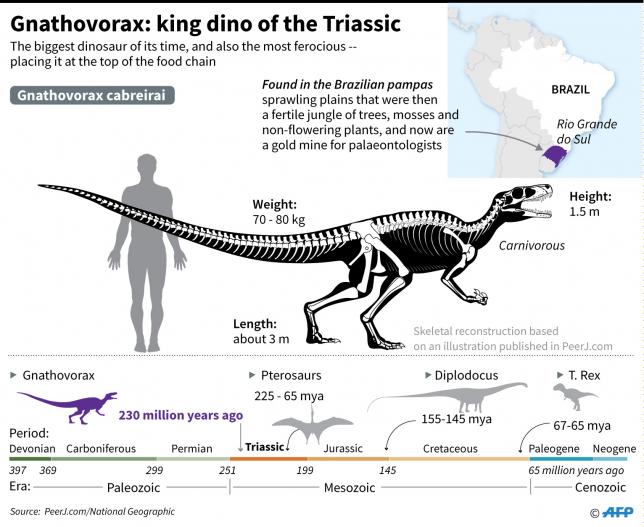
Graphic on Gnathovorax, a carnivorous dinosaur that roamed what is now southern Brazil some 250 million years ago. Photo: AFP

Millions of years before the arrival of the mighty Tyrannosaurus rex, another fearsome dinosaur -- the Gnathovorax -- roamed what is now southern Brazil, ripping apart its prey with sharp teeth.

Measuring nearly 10 feet (three meters) long, it was the biggest dinosaur of its time, and also the most ferocious -- placing it at the top of the food chain, as T.rex once was.

Basically, the Gnathovorax cabreirai was the king of Triassic Park, if you will, as the dominant creature of the pre-Jurassic period that began roughly 250 million years ago.

"In the Triassic ecosystem, it held a place similar to what lions have today," says Rodrigo Temp Muller, a 26-year-old paleontologist at the Federal University of Santa Maria.

And the Gnathovorax's stomping grounds were the Brazilian pampas -- sprawling plains that were then a fertile jungle of trees, mosses and non-flowering plants, and now are a gold mine for paleontologists.

About 100 dig sites filled with fossils are located in Rio Grande do Sul state, on Brazil's border with Argentina and Uruguay -- and are yielding clues to help experts understand that long-ago era.

Paleontologist Rodrigo Temp Muller examines a dinosaur fossil from the Triassic period at CAPPA, a Brazilian research support centre for paleontology in Sao Joao do Polesine, Brazil, on 2 December 2019. Photo: AFP

 'Hooked claws' 
The first Gnathovorax skeleton was found in 2014 at Sao Joao do Polesine, a small town located about 300 kilometers (200 miles) west of the state capital Porto Alegre.

Dating back more than 230 million years, it was one of the oldest and best preserved dinosaur fossils ever found -- the skeleton was nearly complete.

It's one of the oldest meat-eating dinosaurs ever identified.

"The fact that it is in such good condition allowed us to glean a large amount of information about its anatomy," Muller told AFP.

"It was a bipedal dinosaur that walked on its hind legs and had hooked claws to trap its prey," added the researcher, whose study was published last month in PeerJ -- the Journal of Life and Environmental Sciences.

The Gnathovorax was only about 1.5 meters tall, and weighed about 70 to 80 kilos (150-175 pounds), Muller said.

Some of those characteristics were similar to those of T.rex, which appeared more than 150 million years later in North America at the very end of the Cretaceous period.

A fossilised skeleton of a 233 million year old Bagualosaurus Agudoensis dinosaur is seen at CAPPA, a Brazilian research support centre for paleontology in Sao Joao do Polesine, Brazil, on 2 December 2019. Photo: AFP

That dino could grow to more than 12 meters, but it was not a distant cousin to the Gnathovorax, which instead belongs to the Herrerasauridae family of dinosaurs of the Triassic period.

It appears to be more closely linked to other species whose fossils were found in Brazil and Argentina.

During the Triassic period, the continents were not separated as they are now, and dinosaurs were smaller than those that would follow in the Jurassic and Cretaceous periods.

These dinosaurs eventually vanished in a massive flood plain.

"We've discovered numerous fossils across the region and there are surely more. The type of sediment that we have here is ideal for preserving fossils," Muller said.

"The future is promising."

Paleontologist Jose Darival Ferreira digs at an excavation site in Agudo, Brazil, on 3 December 2019. Photo: AFP

Long-necked giant
At the Center for Paleontological Research at the Federal University of Santa Maria in Sao Joao do Polesine, the Gnathovorax skeleton is on display in a glass case.

The skull is particularly well preserved, and observers can easily see the dinosaur's powerful jaw that gives it its name -- Gnathovorax cabreirai means "ravenous jaws."

Once the fossils were extracted from the soil, they were carefully examined with tools that look like a dentist's drill. In some cases, the work can take years.

The Gnathovorax is not the only species studied by the Brazilian research team.

They also found impressive remains of the Macrocollum itaquii, the oldest long-necked dinosaur in the world, which lived about 225 million years ago.

Those fossils were found in 2012, on a vacant lot along a road in Agudo, about 20 kilometers outside Sao Joao do Polesine.

"It was also a biped, like the Gnathovorax, but it was a plant eater. Its teeth were adapted to eating plant matter, which it went to find high up because of its long neck," Muller said.

These treasures are evidence of Brazil's rich paleontological history -- one that partially went up in smoke last year when the National Museum in Rio was devastated by fire.

Numerous valuable collections were destroyed, including an impressive group of dinosaur fossils.

Source: https://en.prothomalo.com/

Original Jurassic Park Cast Likely To Return After Jurassic World 3

Saturday, December 21, 2019

Ever since the Jurassic Park franchise returned in 2015 with Colin Trevorrow’s Jurassic World, one of the main criticisms of the most recent installments was an over-reliance on nostalgia. Obviously, that’s something of a recurring theme in today’s studio blockbusters given the mixed reactions to the latest Star Wars and Terminator movies, but there’s always been a fine line between breathing new life into an established brand and simply rehashing what came before.

Jurassic World may have introduced a fresh batch of characters and featured a fully-functioning park on Isla Nublar, but it still relied heavily on recognizable locations and iconography from the past. Follow-up Fallen Kingdom tried to remedy this by blowing up the whole island during the first act, but it still came off as a little too similar to original sequel The Lost World, this time with a mansion substituted in for the entire city of San Diego.

Long-running franchises seemingly always bring back the original stars at some point, but Fallen Kingdom played with these expectations by having Jeff Goldblum’s Ian Malcolm show up in the movie for a brief cameo. However, the still-untitled Jurassic World 3 is doubling down on the nostalgia craze by bringing back Goldblum, Sam Neill and Laura Dern’s characters from the 1993 classic as featured players, with the original trio set to team up with Chris Pratt and Bryce Dallas Howard for more dinosaur-related adventures.

Not only that, but sources close to We Got This Covered – the same ones who said Bill Murray would be back for Ghostbusters: Afterlife, which we now know to be true – have told us that Universal are planning on making three more Jurassic World movies after this next one, and the studio hopes that Goldblum, Neill and Dern will stick around for at least one of them, with the creative team behind the franchise apparently still working out if the focus for the Jurassic series going forward is the past or the future.

It’s unclear as of yet what role they would play, but at this point, it wouldn’t be surprising to hear that Joseph Mazzello’s Tim will be returning to action in Jurassic World 3 as an adult as well, with the now 36 year-old carving out a solid career for himself after appearing in the likes of The Social Network, G.I. Joe: Retaliation and Bohemian Rhapsody. For now, though, we’ll just have to wait and see who else ends up appearing in the threequel, as well as the further three films that are set to follow.

Original Story on https://wegotthiscovered.com/

You Can Actually Hang Out With Dinosaurs In These Tennessee Mountains For Free

Thursday, December 26, 2019

ima.party.freckle | Instagram ima.party.freckle | Instagram

You can't say you've never dreamed of this.

Most of us 90s babies grew up on The Land Before Time and Jurassic Park and you're lying if you said you never wanted to see a real-life dino. Tennessee is hiding something we pre-historic lovers would go crazy for. Seeing this dinosaur park is just one of the best things to do in Tennessee. 

Backyard Terror's Dinosaur Park is tucked away in the middle of the Tennessee mountains. The models of the dinosaurs are freakishly lifelike and give you a feel of what it would be like if they still roamed the Earth.

Besides just walking through and seeing the creatures, there is also a digging site, a nature trail and much more that you can explore for free. 

There are over 50 pre-historic creatures that habitat the area and there are more that join the pack every year as the attraction gets bigger and bigger.

The tour is self-guided and you're allowed to take as many pictures as your heart desires. 

You have to make sure you stop by the many exhibits Backyard Terror has to offer. There's a velociraptor enclosure but we can't promise that Chris Pratt will be included. 

It is easy to spend hours here, so there is a nice picnic area where you can have a snack or order pizza from their partner, Pizza Plus.


Backyard Terror's Dinosaur Park 

Price: Free

Address: 1065 Walnut Grove Rd., Bluff City, TN

Why You Need To Go: If you love dinosaurs and everything pre-historic, you need to explore this spot in the Tennessee mountains that has over 50 replicas of dinos. 

Source: www.narcity.com/

Canadian High Arctic Islands Were Once Home to Rich Forests

Tuesday, December 31, 2019

Dr. West hunts for fossils using a rock hammer to split apart shale on Ellesmere Island. Image credit: Markus Sudermann.

Lush green forests grew on Ellesmere and Axel Heiberg islands of the Canadian High Arctic 56 million years ago (Paleocene-Eocene boundary), according to a new study published in the journal Palaeontographica Abteilung B.

“It’s very surprising how similar these ancient polar forests were to some of our modern forests,” said Dr. Christopher West, a paleobotanist in the Departnmet of Geological Sciences at the University of Saskatchewan and the corresponding author of the study.

“We identified fossil plants related to many modern temperate trees: birch, alder, elms — even plants belonging to the grape family. Some of the fossils are related to trees now found only in East Asia.”

“The presence of these forests gives us an idea about what could happen over long periods of time if our modern climate continues to warm, and also how forest ecosystems responded to greenhouse climates in the distant past.”

In the study, Dr. West and his colleagues, University of Saskatchewan’s Dr. Jim Basinger and Brandon University’s Dr. David Greenwood, created a comprehensive catalogue of fossil plants from multiple localities on Ellesmere and Axel Heiberg islands.

They identified and described 83 types of plants: 62 ‘dicot’ angiosperms, three monocotyledonous angiosperms, 13 gymnosperms, and five pteridophytes.

“While Earth was considerably warmer during the early Eocene, the continents were mostly situated where they are now, and northern latitudes would have had lengthy periods of darkness,” the researchers said.

“Despite the nearly total lack of light, the forests persisted, likely because of just how warm it was.”

“We won’t see a return to a forested polar region in our lifetimes, but it is important to remember that we as humans have become agents of climate change, and that our warming climate will have potentially dramatic effects on our modern ecosystems,” Dr. West said.

“If we are able to understand how ecosystems long ago responded to global warming, we may be able to better predict how our own modern ecosystems will respond to our own rapidly warming climate.”

“This research will also help climate modelers as they use data from the past to better understand our own climate.”

_____

Christopher K. West et al. 2019. The late Paleocene to early Eocene Arctic megaflora of Ellesmere and Axel Heiberg islands, Nunavut, Canada. Palaeontographica Abteilung B 300 (1-6): 47-163; doi: 10.1127/palb/2019/0066

Source: www.sci-news.com/

New Study Believes Dinosaurs Were Being Poisoned Before Epic Asteroid Strike

Tuesday, December 24, 2019

Credit: Getty Images

Let's face it, dinosaurs enjoyed their rule of the roost on Earth for an epic length of time and were, as Jurassic Park's Dr. Ian Malcolm asserts so vehemently, selected for extinction by nature.

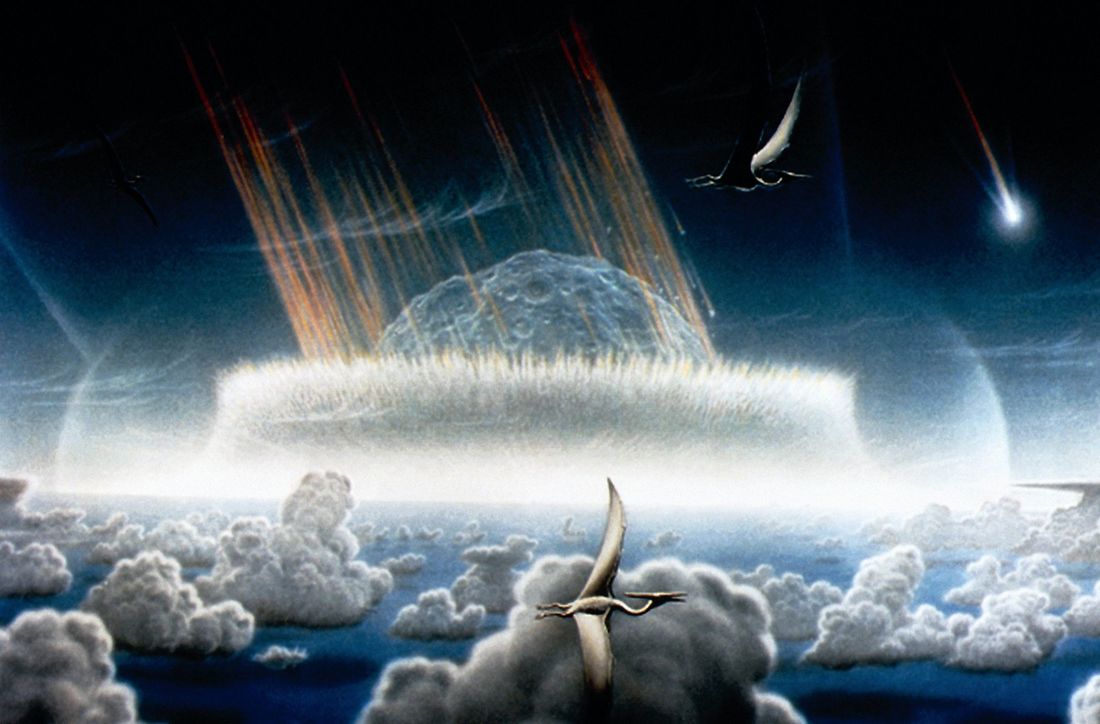
Wherever the debate on the exact cause of their eventual demise leads, it's often apparent to scientists that there were a number of contributing factors that played into their removal from our planet's ecosystem, most notably a ginormous asteroid 66 million years ago that left the Chicxulub Crater in Mexico's Yucatan Peninsula at the end of the Cretaceous Period.

Now, a new University of Michigan-led study presented to the online journal Nature Publications poses that thousands of years before the asteroid plowed into our Big Blue Marble, dinosaur health had been in grave danger due to a sudden increase in mercury levels caused by the mass eruptions of the Deccan Traps in India. 

Investigating fossilized marine mollusk shells collected from across the globe, scientists were surprised to discover “what appears to be a global signal of both abrupt ocean warming and distinctly elevated mercury concentrations” caused by the million-year-long volcanic explosions. This devastating geologic event remains one of the prime factors in the creation of the majority of Western India.

Credit: Getty Images

“For the first time, we can provide insights into the distinct climatic and environmental impacts of Deccan Traps volcanism by analyzing a single material,” researcher Kyle Meyer, lead author of the study, explained in a statement.

“It was incredibly surprising to see that the exact same samples where marine temperatures showed an abrupt warming signal also exhibited the highest mercury concentrations and that these concentrations were of similar magnitude to a site of significant modern industrial mercury contamination.”

The significant levels of mercury, a highly toxic metal, found within these ancient shells was similar to the contaminated freshwater clamshells researchers gathered from Virginia’s South River site in the Shenandoah Valley, which has a restricted fishing ban imposed due to dangerous mercury levels caused by industrial pollution.

Credit: Getty Images

“Mercury anomalies had been documented in sediments but never before in shells,” co-author Sierra Petersen noted. “Having the ability to reconstruct both climate and a volcanism indicator in the exact same materials helps us circumvent lots of problems related to relative dating. So, one of the big firsts in this study is the technical proof of concept.”

While Earth's changing climate due to the Yucatan's asteroid impact no doubt played a predominant role in these giant creatures being wiped off the Earth, it's only a small piece of a complex puzzle paleontologists, geologists, and climatologists are still trying to fit together. 

Theorizing that naturally occurring mercury caused by the incredible Indian eruptions acted as a harmful influence in the dinosaurs' lives, this new study recognizes much more about the timing and scope of the Deccan Traps eruptions to bolster the idea that mercury poisoning was already affecting these giant beasts long before the monster rock fell from the sky. 

Source: www.syfy.com/

Fossil Research Unveils New Turtle Species and Hints at Intercontinental Migrations

Tuesday, December 24, 2019

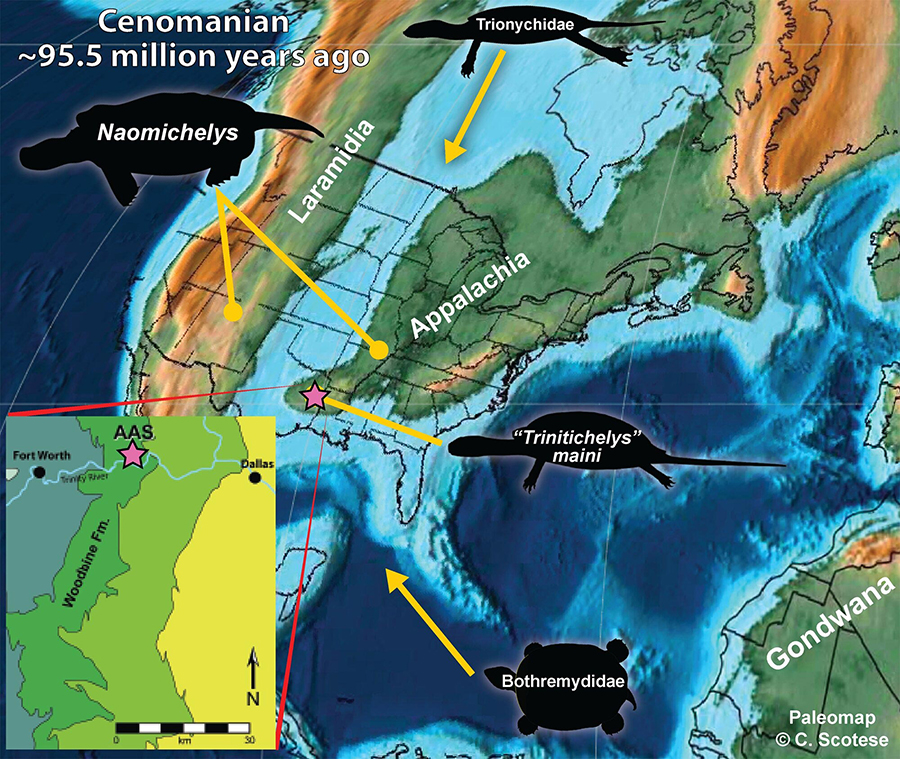
Map of North America during the Cenomanian age (96 million years ago) showing the four turtle families newly discovered at the Arlington Archosaur Site (AAS). The AAS fossil assemblage includes a diverse combination of native North American turtle lineages alongside those that migrated from Asia or the Southern hemisphere. One of these species, "Trinitichelys" maini is a new species to science, described here for the first time.  CREDIT Brent Adrian, M.F.A.

New 96-million-year old turtles from Texas connect North America with Asia and the Southern Hemisphere, suggesting vast intercontinental migrations during this time.

The Arlington Archosaur Site (AAS) of Texas preserves remnants of an ancient Late Cretaceous river delta that once existed in the Dallas-Fort Worth area. Known for discoveries of fossil crocodiles and dinosaurs, a multi-institution research team has described four extinct turtle species, including a new river turtle named after AAS paleontologist Dr. Derek Main and the oldest side-necked turtle in North America. These new turtles include an intriguing combination of native North American forms alongside Asian and Southern Hemisphere immigrants, suggesting extensive intercontinental migration of turtles during this time.

Originally discovered by amateur fossil hunter Art Sahlstein in 2003, the AAS is a prolific fossil locality found in the middle of a suburban subdivision. The AAS preserves remnants of an ancient Late Cretaceous river delta around 96 million years ago in what is today the Dallas-Fort Worth area. It preserves a record of a freshwater wetland that sat near the shore of a large peninsula, including a diverse assemblage of crocodile relatives, dinosaurs, amphibians, mammals, fish, invertebrates, and plants, several of which are also new species awaiting description. "Until this discovery, there were very few turtle fossils from this time period discovered in Appalachia," says Dr. Heather Smith, one of the authors of the paper. The research team describing these discoveries includes Brent Adrian, M.F.A., Heather F. Smith, Ph.D., and Ari Grossman, Ph.D., from Midwestern University in Glendale Arizona, and Christopher Noto, Ph.D., from University of Wisconsin-Parkside.

"The AAS turtle assemblage informs a growing understanding of Appalachian ecosystems in the mid-Cretaceous, most of which were obscured by later erosion along coasts and extensive continental river drainages,'' said Brent Adrian, the lead author of the study, published in the current issue of the online journal Palaeontologia Electronica. One new species - "Trinitichelys" maini - is a baenid turtle, an extinct lineage of aquatic North American turtles that persisted from the Early Cretaceous through the Eocene. These turtles were medium-sized (about the size of a modern snapping turtle), had heavily fused bones and shells, and occupied freshwater river habitats. "Trinitichelys" maini is the oldest member of the group found in the eastern North American subcontinent of Appalachia, which at that time was separated from Laramidia, the western sub-continent of North America.

"T." maini honors the late Dr. Derek Main, the first director of the AAS project, who recognized the scientific potential of the site. "Derek's incredible work with the community led to the creation of one of the most extensive and diverse collections of mid-Cretaceous fossils known in Texas," says Dr. Chris Noto, who took over as director of the AAS in 2013, "He was an inspiration to all those who worked with him, and it is only fitting this new species is named after him."

Alongside T. maini, the study describes three more intriguing new turtles from the AAS. One species represents the oldest side-necked (pleurodire) turtle discovered in North America. Side-necked turtles originated in the Southern Hemisphere, and the AAS marks the first time they are found in North America. Yet another surprise is an early soft-shelled turtle (trionychid), which belongs to a lineage that immigrated from Asia. Adding to this unusual mix is Naomichelys sp., a large semi-aquatic turtle with unusual tubercles (raised bumps) on its shell that is a relict North American species typically found in much older rocks. This combination of turtle species in one location is unique, as it includes Asian, Southern Hemisphere, and native North American forms, and both young and older, relict taxa.

###

Work at the Arlington Archosaur Site is supported in part by the National Geographic Society, who provided a grant to complete field work at the site, and the Perot Museum of Nature and Science in Dallas, who curates the fossils found at the site and organizes the many volunteers who work there. Palaeontologia Electronica is the oldest electronic professional, peer-reviewed journal of paleontology and is sponsored by the Palaeontological Association, the Paleontological Society, and the Society of Vertebrate Paleontology.

Source: www.eurekalert.org/

Paleontologists Uncover Weewarrasaurus pobeni: Fossilized Remains of Baby Ornithopod Dinosaurs in Australia

Tuesday, December 24, 2019

An artist’s depiction of the ornithopod dinosaur Weewarrasaurus pobeni tending its nest. Image credit: University of New England.

Paleontologists have unearthed the 100-million-year-old (Cretaceous period) fossilized bones of perinatal non-iguanodontian ornithopods in the Griman Creek Formation in central-northern New South Wales, Australia. The fossils provide the first evidence of perinatal dinosaurs from Australia and, more broadly, the first insights into the high-latitude breeding preferences of non-iguanodontian ornithopods in Gondwana.

The newly studied fossils belong to a species of small-bodied ornithopod dinosaur very similar to Weewarrasaurus pobeni.

To estimate the individuals’ age, the researchers used growth rings in the dinosaur bones, similar to the rings in a tree trunk.

“Age is usually estimated by counting growth rings, but we couldn’t do this with our two smallest specimens, which had lost their internal detail,” said Justin Kitchener, a PhD student in the School of Environmental and Rural Science at the University of New England.

“To get around this, we compared the size of these bones with the size of growth rings from the Victorian dinosaurs. This comparison confidently places them at an early growth stage, probably prior to, or around the point of hatching.”

Approximately 100 million years ago, when these dinosaurs were being born, Australia was much closer to the South Pole.

“Southeastern Australia would have been between 60°S and 70°S, equivalent to modern day Greenland,” the scientists explained.

“Although the climate at these latitudes was relatively warmer than they are today, like some Antarctic penguins, these dinosaurs would have endured long dark winters and possibly burrowed or hibernated to survive.”

“Because they are so delicate, egg shell and tiny bones rarely survive to become fossils.”

“We have examples of hatchling-sized dinosaurs from close to the North Pole, but this is the first time we’ve seen this kind of thing anywhere in the Southern Hemisphere,” said Dr. Phil Bell, a paleontologist in the School of Environmental and Rural Science at the University of New England.

“It’s the first clue we’ve had about where these animals were breeding and raising their young.”

The findings appear in the journal Scientific Reports.

_____

J.L. Kitchener et al. 2019. High-latitude neonate and perinate ornithopods from the mid-Cretaceous of southeastern Australia. Sci Rep 9, 19600; doi: 10.1038/s41598-019-56069-8

Source: www.sci-news.com/

The 10 Best Jurassic Park Movie Posters, Ranked

Saturday, December 21, 2019

The Jurassic Park franchise has managed to cross over generations and still remains popular today. And these 10 posters are fantastically designed.

The Jurassic Park franchise has managed to cross over generations and is still one of the most popular sci-fi movie series today. Based on the best selling book, the series looks at what would happen if Dinosaurs were brought into the modern world.

Every series needs a great marketing campaign and this franchise certainly has that. All the posters on this list are fantastically designed but we've ranked 10 of them in order to see which of these amazing pieces of art, is the best of them all!

10 - JURASSIC PARK 3

This is perhaps the most simple poster on this list. It takes its design from the original posters of the first movie but hasn't developed that concept any further. We like that the claw marks make the sign to show it is the third film however.

There's no tag line attached which is unusual at this stage of the movie industry, but the classic logo is looking better than ever and certainly does the job of reminding audiences of this magical zoo that they are about to embark into.

9 - JURASSIC PARK 3 VARIATION

This is of course a slight variation on the first, although it has added an interesting idea that says a little more about this film. The movie sees these terrifying creatures attack members of the public, so it seems fitting to have it's ominous shadow on the poster.

Apart from this, the poster doesn't push the boundaries anymore. The simple design is absolutely striking though and it does what it needs to. Guests would definitely be scared of entering the park if they saw this poster for it.

8 - JURASSIC PARK 3D

The return to the Park for a 3D adventure wasn't the most popular idea but it did mean that we got a cracking new poster. This does a lot in such a small space so we definitely want to point out a few key points. The first is of course that famous car that's driving through the gates.

The gate itself is of course the iconic entrance to the park, showing fans that they will be embarking on a new adventure. The logo is boldly on this gate as well as the notification that this is a 3D film. It's a pretty useful and great design!

7 - LOST WORLD

While this poster is quite basic it does something very new. This was only the second film of the franchise and announced a new title for the sequel. It carries on the old logo while giving it a fresh coat of paint.

Not only this, the poster has a fantastic tag line which shows the danger will only continue. The fact that something has survived makes audiences wonder what that could possibly be, therefore making them return to cinemas.

6 - JURASSIC PARK SECOND VARIATION

From the original film, this unused poster teases some of what's in store for cinema goers. Those classic gates and car are on full display once again and it's made clear that this is a Spielberg film. The 65 million years in the waiting line is also a nice touch.

The T-rex on the moon also gives an ominous presence to this film. It's such a big part of the movie that it's nice to see it featured on a full moon, taking us back to the famous scene with the goat and the vibrating water.

5 - JURASSIC PARK VARIATION

Another poster from the original film and once again it makes use of that logo, although in a much less prominent way. It also mentions Steven Spielberg once again, who became even more well known after this fantastic piece of work.

The use of the eye is quite a powerful image however. It invokes various terrifying scenes from the film and showcases the nightmares audience members might be having. It's a great piece of design and memorable on this list.

4 - JURASSIC WORLD VARIATION

This soft reboot poster is a huge departure from what we traditionally see. It features the new logo, which is obviously inspired by the old one and actually prominently features a character from the film, which is rare compared to the rest.

Not only that, the character comes face to face with the main 'villain' of the film; one of the most monstrous creatures ever seen in this franchise. It's a huge juxtaposition between the order inside the park and the craziness of the wildlife outside.

3 - FALLEN KINGDOM

The sequel to the last film invokes the classic tag lines of previous posters, with the life finds a way slogan. The T-rex, one of the most famous dinosaurs in these films, is also a major part of the poster after his return in the last film.

The huge action set piece of the volcano has been teased in the background and elements of the last film, including the ball that guests can ride around in, have also been included. What's more, one of the main characters of the series can actually be seen.

2 - JURASSIC WORLD

This was one of the big reveals for one of the newest films of the franchise, with star Chris Pratt riding his motorcycle as his legion of dinosaurs run alongside him. It's a cool scene from the film and absolutely worth putting on a poster.

The poster reveals that new logo that we previously mentioned and also gives us a hint of what the park would be like; with dense trees populating the background. It's a simple piece of art with no tag lines and no major credits to see.

1 - ORIGINAL JURASSIC PARK

The very original poster for the first film kick started all the rest and is a great piece of design. It's a simple approach but a really effective one. The black background draws focus to that red and yellow logo which really pops on the page .

The tag line, about 65 millions years in the making, has its return here as does Spielberg's name. Although it's far more simple compared to others on this list, the original has to be ranked highest because it really inspired everything that followed; it has certainly aged well.

Source: https://screenrant.com/

Last Population of Homo erectus Survived in Central Java until 108,000 Years Ago

Saturday, December 21, 2019

This is an artist’s reconstruction of Homo erectus. Image credit: Yale University.

An international team of researchers has pinpointed the first comprehensive age for the last known occurrence of the early hominin species Homo erectus.

In the 1930s, a team of geologists and archaeologists from the Netherlands made a stunning discovery at Ngandong on the Solo River in central Java, Indonesia, when they unearthed 12 skulls and two leg bones of Homo erectus.

These fossils are the most advanced form of this hominin species, and represent an important evolutionary change.

Previous attempts to date the Ngandong fossils returned very young (53-27,000 years) as well as much older ages (143-500,000 years). Those studies had issues with the true provenance of the material, a lack of association between the fossils and material being dated, and the leaching of uranium from the fossils, all creating uncertainties.

“After many unconvincing attempts to date the site over the years we knew we needed to try a different approach,” said co-lead author Dr. Kira Westaway, a researcher in the Department of Earth and Environmental Sciences at Macquarie University.

“Previous studies fixated on the evidence itself, so instead we viewed the fossils as a piece of a much larger puzzle, and tried to understand how they fitted into the wider valley and region.”

Dr. Westaway and colleagues applied a regional approach to dating the Ngandong site and interpreted the evidence within the wider landscape of central Java.

The site is in a river deposit that represents a rung on a ladder of floodplain steps called terraces. The team took into account how the Solo River system was created, how the terraces were formed, and how the fossils were deposited.

The scientists applied a barrage of dating techniques to all three contexts: the stalagmites in caves, the river terrace sediments around the Homo erectus fossils, and to the associated mammal teeth found within the bone bed.

The result was 52 new ages, indicating that the river deposit and fossils were laid down between 117,000 and 108,000 years ago.

This age range enables the Ngandong site to be placed into a framework for human evolution in Southeast Asia.

Ngandong Homo erectus existed at around the same time as Homo floresiensis in Indonesia and the recently-discovered Homo luzonensis in the Philippines, both of which have some Homo erectus-like features.

At this age, Homo erectus could potentially have met other human species such as Denisovans.

“The new age estimates from Ngandong indicate that Homo erectus and Denisovans probably overlap in the region, or at least met at some time before 100,000 years ago,” Dr. Westaway said.

“This may mean some of the unique traits that have been recognized in the skulls of very late Homo erectus fossils at places like Ngandong may in fact be a result of a mixture of two archaic populations — Homo erectus and Denisovans.”

“This is the most rigorous dating attempt thus far for the last occurrence of Homo erectus,” said co-author Dr. Gert van den Bergh, from the University of Wollongong.

“Other studies have placed modern humans in China 120,000 years ago, so we are closer and closer to finding an overlap between Homo erectus and modern humans in Southeast Asia.”

The results were published in the journal Nature.

_____

Y. Rizal et al. Last appearance of Homo erectus at Ngandong, Java, 117,000-108,000 years ago. Nature, published online December 18, 2019; doi: 10.1038/s41586-019-1863-2

Source: www.sci-news.com/

Pages