nandi's blog

Coal-Burning Contributed to End-Permian Mass Extinction

Wednesday, June 24, 2020

Elkins-Tanton et al demonstrate that the volume and composition of organic matter interacting with magmas in the Siberian Traps region may explain the global carbon isotope signal and may have significantly driven the end-Permian mass extinction. Image credit: Margaret Weiner / University of Cincinnati Creative Services.

An international team of geologists has found the first direct evidence that volcanic eruptions in the southern part of the Siberian Traps region 252 million years ago burned large volumes of coal and vegetation.

The end-Permian extinction, also known as the Permian-Triassic extinction event and the Great Dying, is the Earth’s most severe mass extinction that peaked about 252.3 million years ago.

The catastrophe killed off nearly 96% of all marine species and 70% of terrestrial vertebrate species on the planet over the course of thousands of years.

Calculations of sea water temperature indicate that at the peak of the extinction, the Earth underwent hot global warming, in which equatorial ocean temperatures exceeded 40 degrees Celsius (104 degrees Fahrenheit).

Among the possible causes of this event, and one of the most long-hypothesized, is that massive burning coal led to catastrophic global warming, which in turn was devastating to life.

To search for evidence to support this hypothesis, Arizona State University’s Professor Lindy Elkins-Tanton and colleagues looked at the Siberian Traps region, where it was known that the magmas and lavas from volcanic events burned a combination of vegetation and coal.

They focused on the volcaniclastic rocks — rocks created by explosive volcanic eruptions — and collected over 500 kg of samples.

“We found towering river cliffs of nothing but volcaniclastics, lining the river for hundreds of miles. It was geologically astounding,” Professor Elkins-Tanton said.

As the samples were analyzed, the authors began seeing strange fragments in the volcaniclastics that seemed like burnt wood, and in some cases, burnt coal.

Further field work turned up even more sites with charcoal, coal, and even some sticky organic-rich blobs in the rocks.

“Our study shows that Siberian Traps magmas intruded into and incorporated coal and organic material,” Professor Elkins-Tanton said.

“That gives us direct evidence that the magmas also combusted large quantities of coal and organic matter during eruption.”

And the changes at the end-Permian extinction bear remarkable parallels to what is happening on Earth today, including burning hydrocarbons and coal, acid rain from sulfur, and even ozone-destroying halocarbons.

“Seeing these similarities gives us extra impetus to take action now, and also to further understand how the Earth responds to changes like these in the longer term,” Professor Elkins-Tanton added.

The findings were published in the journal Geology.

_____

L.T. Elkins-Tanton et al. Field evidence for coal combustion links the 252 Ma Siberian Traps with global carbon disruption. Geology, published online June 12, 2020; doi: 10.1130/G47365.1

Source: www.sci-news.com/

Paleontologists Redescribe Enigmatic Carboniferous-Period Fish

Wednesday, June 24, 2020

Tanyrhinichthys mcallisteri was most likely a bottom-cruising predator similar in general ecomorphology to modern sturgeon. Image credit: Nobu Tamura.

A team of U.S. paleontologists has redescribed the morphology of a long-snouted ray-finned fish called Tanyrhinichthys mcallisteri and created a more complete and accurate reconstruction of the fish as a living animal.

Tanyrhinichthys mcallisteri lived around 300 million years ago (Carboniferous period) in an estuary environment in what is today New Mexico, the United States.

The fish was between 15 and 20 cm long and had sharp, recurved teeth.

It was first described in 1984 by Michigan State University paleontologist Michael Gottfried from a single specimen collected in the Kinney Brick Quarry.

“The specimen looks like someone found a fish and just pulled on the front of its skull,” said Jack Stack, a researcher in the Department of Earth and Environmental Sciences at Michigan State University and the Department of Earth and Environmental Sciences at the University of Pennsylvania.

“Many modern fish species, from the swordfish to the sailfish, have protuberant snouts that extend out in front of them, often aiding in their ability to lunge at prey. But this characteristic is much rarer in ancient fishes.”

In the 2010s, several more specimens of Tanyrhinichthys mcallisteri were found in the same quarry.

In a new study, Stack and colleagues from the University of Pennsylvania, Maryland-National Capital Parks and Planning Commission, and New Mexico Museum of Natural History and Science examined these specimens in detail and studied other species that dated to the same period.

“This sounds really simple, but it’s obviously difficult in execution as fossils are compressed flat when they are preserved,” Stack said.

What the scientists noticed cast doubt on the conception of Tanyrhinichthys mcallisteri as resembling a pike.

While a pike has an elongated snout with its jaws at the end of it, allowing it to rush its prey head-on, Tanyrhinichthys mcallisteri has an elongated snout with its jaws at the bottom.

“The whole form of this fish is similar to other bottom dwellers,” Stack said.

The team also noticed canal-like structures on Tanyrhinichthys mcallisteri’s snout concentrated in the top of its head, suggestive of the locations where sensory organs would attach.

“These would have detected vibrations to allow the fish to consume its prey,” said Dr. Lauren Sallan, a paleobiologist in the Department of Earth and Environmental Sciences and the Department of Biology at the University of Pennsylvania.

The scientists noted that many of the species that dwelled in similar environments possessed longer snouts.

“This also makes sense because it was an estuary environment with large rivers feeding into it, churning up the water, and making it murky,” Dr. Sallan said.

“Rather than using your eyesight, you have to use these other sensory organs to detect prey.”

Despite this, other features of the different ancient fishes’ morphology were so different from Tanyrhinichthys mcallisteri that they do not appear to have shared a lineage with one another, nor do modern sturgeon descend from Tanyrhinichthys mcallisteri.

Instead the long snouts appear to be an example of convergent evolution, or many different lineages all arriving at the same innovation to adapt well to their environment.

“Our work, and paleontology in general, shows that the diversity of life forms that are apparent today has roots that extend back into the past,” Stack said.

The team’s results were published in the Zoological Journal of the Linnean Society.

_____

Jack Stack et alTanyrhinichthys mcallisteri, a long-rostrumed Pennsylvanian ray-finned fish (Actinopterygii) and the simultaneous appearance of novel ecomorphologies in Late Palaeozoic fishes. Zoological Journal of the Linnean Society, published online June 22, 2020; doi: 10.1093/zoolinnean/zlaa044

Source: www.sci-news.com/

Jurassic Park And The T-Rex Scene Which Steven Spielberg Deleted

Tuesday, June 23, 2020

Jurassic Park’ is undoubtedly one of the most beloved movies in film history and a favorite of Steven Spielberg fans. The filmmaker delighted us with this dinosaur story back in 1993 and created what would later become a franchise.

Now, when the new installment of the saga is preparing, ‘Jurassic World 3’, we have discovered anew sequence removed from the original tape that involved the T-Rex and of which we did not know its existence until today.

In the last episode of the ReelBlen podcast, David Koepp, one of the writers of the film, starring revealed a shocking sequence by the Tyrannosaurus rex, children, and a river, claiming that Spielberg rejected it for being too complicated to shoot.

“I think I found out when he was showing me a bunch of storyboards he had made, some of which are exactly how you see them in the movie. There was a sequence on the river with the Rex and the kids. But (Spielberg) said: ‘ Oh, we’re not going to do this. “It was totally cut. There were too many things that were going to be challenging and difficult, and it hadn’t even been technologically discovered in that movie. So the idea of ​​adding water to that made Lord Shark. .. it would be quite difficult for him. “

Apparently, according to the novel, in that sequence, the dinosaur should have chased the children and Grant down the river, but it seems that, according to Koepp, Spielberg preferred not to do it due to the large number of technical problems he had filming ‘Shark’.

Source: https://andoverleader.com/

Carnivorous Dinosaurs as Big as T. rex Lived in Jurassic Australia

Tuesday, June 23, 2020

A reconstruction of a Jurassic dinosaur track-maker from southern Queensland in front of a silhouette of the largest known Tyrannosaurus rex. Image credit: Anthony Romilio.

Paleontologists have analyzed 151- to 165-million-year-old dinosaur footprints from 11 sites in southern Queensland, most of which produced large (length of 30-50 cm) and very large-sized (length greater than 50 cm) theropod dinosaur tracks, including Australia’s largest carnivorous dinosaur footprint (79 cm long).

“I’ve always wondered, where were Australia’s big carnivorous dinosaurs? But I think we’ve found them, right here in Queensland,” said lead author Dr. Anthony Romilio, a paleontologist in the School of Chemistry and Molecular Biosciences at the University of Queensland.

“The specimens of these gigantic dinosaurs were not fossilized bones, which are the sorts of things that are typically housed at museums.”

“Rather, we looked at footprints, which — in Australia — are much more abundant.”

“These tracks were made by dinosaurs walking through the swamp-forests that once occupied much of the landscape of what is now southern Queensland.”

One of the dinosaur footprints from an Oakey mine in Queensland, Australia. Image credit: Anthony Romilio.

Dr. Romilio and colleagues documented a total of 20 fossil dinosaur tracks and five trackways from the Walloon Coal Measures of Oakey and Rosewood districts in southern Queensland.

They identified a total of 11 track-bearing mines sites (one at Oakey, and ten at Rosewood), and four dinosaur track types.

Large and very large tracks were more common than small tracks. Most of the tracks belong to theropods, the same group of dinosaurs that includes AustralovenatorVelociraptor, and their modern-day descendants, birds.

“Most of these footprints are around 50 to 60 cm in length, with some of the really huge tracks measuring nearly 80 cm,” Dr. Romilio said.

“We estimate these tracks were made by large-bodied carnivorous dinosaurs, some of which were up to 3 m high at the hips and probably around 10 m long.”

“To put that into perspective, Tyrannosaurus rex got to about 3.25 m at the hips and attained lengths of 12 to 13 m long, but it didn’t appear until 90 million years after our Queensland giants.”

“The Queensland tracks were probably made by giant carnosaurs — the group that includes Allosaurus.”

“At the time, these were probably some of the largest predatory dinosaurs on the planet.”

The research was published in the journal Historical Biology.

_____

Anthony Romilio et al. Footprints of large theropod dinosaurs in the Middle-UpperJurassic (lower Callovian-lower Tithonian) Walloon Coal Measures of southern Queensland, Australia. Historical Biology, published online June 12, 2020; doi: 10.1080/08912963.2020.1772252

Source: www.sci-news.com/

Why Jurassic Park's CGI Still Looks So Good

Saturday, June 20, 2020

Here's why Jurassic Park's groundbreaking CGI still looks so good and holds up almost 30 years after the blockbuster's original release.

Jurassic Park's CGI remains some of the most influential visual effects of recent decades, and there's some unlikely and fascinating reasons why it still looks so good. Back in 1993, cinematic computer graphics were still in their infancy. Even though computer-generated images had appeared in movies since the 1970s, filmmakers were still grappling with how best to use the technology in the early '90s. But when Steven Spielberg's Jurassic Park arrived, it brought with it a genuinely groundbreaking use of visual effects that set a standard that's still followed today.

Led by Lucasfilm’s Industrial Light and Magic (ILM) division, and supported by Stan Winston's practical effects team, the visual effects in Spielberg's blockbuster hold up almost 30 years after the film's release. That's an incredible achievement considering how far computer-generated effects have developed in the last few decades. Now, CGI is ubiquitous to the point that it's a rarity to see a new movie released without some form of computer-aided enhancements. When Jurassic World 3 debuts in 2021, it's bound to arrive laden with digital dinos and computer-generated environments. But back in 1993, audiences weren't used to seeing the kind of convincing visual effects Jurassic Park introduced — making the film a truly pioneering blockbuster.

Using a mixture of practical effects and computer-generated imagery, Spielberg, Stan Winston, and ILM managed to craft an iconic film that remains impressive even by today's standards. By not leaning too heavily on computer imagery, mixing real-life animatronic puppets with digital effects, and making careful use of lighting, Jurassic Park has more than stood the test of time.

Jurassic Park Doesn't Actually Use A Lot Of CGI

Spielberg and his effects teams succeeded in creating convincing visual effects because they didn't rely on CGI as their go-to tool. In fact, only four to five minutes of the 14-15 total minutes of dinosaur scenes were entirely computer generated. All the other visual effects were created using Stan Wintson's various physical dinosaur models. The legendary technician, responsible for creating practical models for Predator and Terminator, built everything from animatronic puppets, to to a full-size animatronic T-Rex, and even Velociraptor suits that could be worn by stuntmen. CGI was then used to build on top of what the production team had already created on-set. In other words, Jurassic Park's CGI still looks so good today because there isn't much of it in the film, which makes sense considering the limitations of the technology at the time.

But while CGI was undoubtedly limited back in 1993, Jurassic Park actually represents somewhat of a revolution in the use of computer graphics. Surprisingly enough, in the early stages of production there wasn't any major CGI planned for the film. Spielberg initially hired stop-motion expert Phil Tippett – who'll be working on upcoming seasons of The Mandalorian – to create the main dinosaur scenes, even going as far as having him make stop-motion test sequences for the T-Rex truck attack scene and the Velociraptor kitchen scene. The director was planning on using ILM to add motion blur to Tippett's stop-motion sequences to make them appear more real, but after the effects studio said they could actually render the dinosaurs completely digitally, that the plan was changed and the pioneering computer graphics audiences eventually witnessed were born. The result was a first not just for ILM as a studio but for digital cinematic effects in general. It's no wonder the film won the visual effects award at the 1994 Oscars.

But perhaps even more important than the breakthrough graphics was Spielberg's decision to still keep the CGI to a minimum. According to Dennis Murren, visual effects supervisor at ILM, once the director saw how convincing the digital dinosaurs looked, he actually rewrote the ending of the film to include the now-famous full-body shot of the T-Rex letting out a final roar in the Jurassic Park visitor center rotunda. But despite clearly being impressed by the capabilities of ILM, Spielberg still limited the CGI elements and retained the use of Stan Winston's puppets for much of the memorable dinosaur scenes viewers still love today. In fact, there's said to be a total of just 63 visual effects shots in the whole film, a tiny number compared to Jurassic World's more than 2,000 VFX shots. Limiting the shots in this way allowed a still-nascent technology to remain effective and conceal many of its shortcomings, while the puppets made sure the dinosaurs retained a sense of weight and physicality. That, and rendering a single frame of the CGI T-Rex is said to have taken hours, so unless Spielberg wanted to push the release back a year or so he would have had no choice but to keep the digital effects to a minimum.

Other Tricks Jurassic Park Used To Make Dinosaurs Look Real

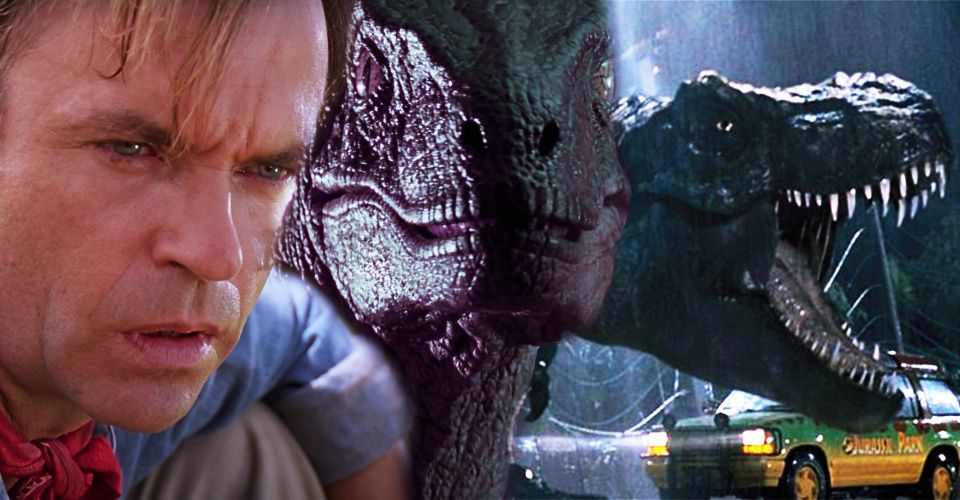
Being constrained by having to choose VFX shots selectively actually helped the production team to keep the dinosaurs feeling real throughout Jurassic Park. Recent sequels have been smothered in digital effects shots – with the CGI dinosaurs actually being one of the main things not to like about Jurassic World.  Spielberg's original was helped by its limited reliance on computer graphics. Still, for the shots that did use digital dinos, ILM had to use various tricks to ensure the CGI beasts remained convincing. Aside from doing hundreds of hours of research that included studying how elephants, crocodiles, and giraffes move, the team also made specific choices about how to frame and light scenes that required CGI. Perhaps the best example is the scene in which the T-Rex is finally revealed as it terrorises Sam Neill's Alan Grant and his group while they cower in the park's Jeeps.

By setting this scene in the rain at night, ILM made it so they didn't have to worry about accurately rendering huge portions of the T-Rex. The parts of the giant dino that were in shadow were merely black areas, while the rain made it so the team could render realistic-looking highlights relatively easily. On top of that, this whole section of the film is mainly lit with one damaged floodlight. This made sure the effects team didn't have to worry about multiple light sources and how the various rays from those sources would scatter and reflect throughout the scene – making it much easier to light the T-Rex convincingly and also keep large parts of the beast in shadow. What's more, ILM – which got its start creating the VFX for the original Star Wars films – had the perfect reference for how the T-Rex should look on-screen, thanks to the giant animatronic puppet Stan Winston created for many of the shots in this scene. By checking the footage where this model of the T-Rex was used, the effects artists could see plainly how to render a realistic digital version of the same dinosaur, with all the light reflections and shadows in the right places and at the right levels.

Contrast this scene with the moment Neill's Alan Grant and Laura Dern's Ellie Sattler witness real-life Brachiosaurus for the first time and the limitations of the technology become more apparent. This bright scene is still remarkable for its impressive CGI, but the sunlit setting certainly makes some blurry dinosaur skin textures more noticeable. For the most part, Jurassic Park kept its broad daylight CGI scenes to a minimum, and the film is all the better for it. In fact, the film's visual effects hold up so well because of smart decisions such as this. In the early-90s CGI was improving increasingly quickly, but it was Spielberg's tasteful use of the technology, relying on it as a backup tool rather than a basis for the entire movie, that made Jurassic Park's visual effects as impressive as they were then, and still are today.

Source: https://screenrant.com/

Jurassic World 3 Script Is Awesome & Exhilarating Says Bryce Dallas Howard

Saturday, June 20, 2020

Bryce Dallas Howard, star of the Jurassic World franchise, reveals the script for Jurassic World 3 is both "awesome" and "exhilarating."

The Jurassic World 3 script is "awesome" and "exhilarating," according to star Bryce Dallas Howard. Like many other productions that were at work in 2020, the third installment of the wildly popular Jurassic World franchise has had more than its share of problems. These issues were due entirely to the COVID-19 pandemic, which has taken a huge toll on health and economic issues worldwide. However, despite the shutdowns that have affected the production of Jurassic World: Dominion, hopes still remain high the sequel will be able to get back on track soon.

It was only a matter of weeks ago that Sam Neill, star of the original Jurassic Park as well as Jurassic World: Dominion, stated he believed filming would resume in London "as soon as we can." Neill appears to have been correct, as recent news has revealed Jurassic World: Dominion will begin filming July 6. The situation in the UK is still challenging at the moment, as it continues to have some of the highest numbers of coronavirus cases in the world. None the less, Universal is reportedly spending $5 million on preventive measures, to ensure that everything goes to plan.

News that Jurassic World: Dominion is returning to work is sure to excite fans, though the production is likely to face many challenges ahead. Still, there is plenty about the upcoming sequel to look forward to. In a recent interview with Collider, Howard spoke about having read the film’s script. In addition to being hopeful about returning to work on Jurassic World: Dominion, Howard called the script “awesome” and “exhilarating.” The Jurassic World star recalled her excitement upon reading the script with her husband, saying:

The script was awesome, it was so exhilarating reading it – my husband got to read it too, Colin [Trevorrow] was like, ‘Yeah, you and Seth can read it,’ and we were like, just the whole time, kinda flipping out. Which is like, that was exhilarating because we are all so excited to come back together.

It’s great to know the film excites Howard to such a degree, and her unabashed joy over reading the script speaks to the new territory the film is said to explore. With the dinosaurs now loose in civilization, there are many possibilities and directions in which Jurassic World: Dominion could go. Past information about dinosaurs living in snowy regions will surely be a visual treat for audiences, treading new ground for the iconic franchise. And of course, no mention of the Jurassic World franchise or the upcoming Dominion would be complete without acknowledging this will be the final film in the Jurassic World trilogy. That being said, Dominion will not mark the end of films in the Jurassic Park universe by any means. Producer Frank Marshall has gone on record saying more of the Jurassic era awaits fans beyond Jurassic World’s trilogy.

With production set to resume on Jurassic World: Dominion, hopefully, the film will be able to make its June 11, 2021 release date. Howard’s excitement over the script is a great sign fans are going to enjoy Jurassic World: Dominion. However, it’s also worth remembering that no actor in any major franchise would publicly say anything disparaging about a film they were set to star in. For now at least, Howard’s exhilaration will likely be matched by many eager Jurassic World fans.

Source: https://screenrant.com/

Halos of Clay Can Preserve Billion-Year-Old Microbes

Saturday, June 20, 2020

The Burgess Shale, in the Canadian Rocky Mountains, contains impressively well preserved fossils that are more than 500 million years old. Finding fossils of earlier life has been challenging.  Image credits: NorthStarPhotos via Shutterstock

Putting together the history of life on Earth has a major stumbling block: Prior to about 540 million years ago, most life was squishy and microbial, which meant it rarely fossilized. This major blind spot makes it difficult for researchers to study ancient life at a key point in Earth’s evolutionary history, and even more difficult to potentially find evidence of ancient microbial life on Mars. But a recent study of kaolinite, an aluminum-rich clay, gives researchers some major hints about where to start looking.

The smallest needle in the biggest haystack

In 1859, Charles Darwin was at a loss. Plenty of fossils of multi-celled and large animals had been found, but there seemed to be no fossils of those animals’ more basic evolutionary ancestors. His theory of evolution, however, contended that life must have existed for eons before then. “To the question why we do not find records of these vast primordial periods, I can give no satisfactory answer,” he wrote in “On the Origin of Species.”

We now know the answer to his question: Fossilization of an organism with no shell or skeleton is incredibly rare. Before about 540 million years ago, when the age known as the Cambrian began and multicellular life rapidly diversified, the only living things on Earth were small --  microbes, bacteria and algae. They lacked the hard components that would have allowed their bodies to be more easily fossilized.

“When we try to reconstruct the study of life billions of years ago, we find only pieces of the puzzle,” said Emmanuelle Javaux, a geobiologist at the University of Liege in Belgium. “It’s important to understand what they really represent.”

A new study by researchers at Yale University in New Haven, Connecticut and the University of Oxford in the U.K. analyzed pre-Cambrian fossils to understand how they were created. The analysis showed “halos” of a specific type of clay, kaolinite, around microbial fossils, suggesting that kaolinite is particularly good at preserving these traces of life.

Researchers had long suspected clay could be an important material for preserving soft-bodied organisms. Ancient medical texts up to 5,000 years old mention that clays tend to aid in healing wounds, and scientists have found that clays with metallic ions -- like kaolinite with aluminum -- can work as antibacterial agents. This antibacterial property of kaolinite is likely what kept the ancient microbial life from being consumed by bacteria, allowing it to be fossilized instead of decaying.

Information about how soft-bodied organisms are fossilized can show how the early fossil record might be biased toward certain time periods or types of environments. “The point of this study was to understand some of the environmental conditions which are conducive to fossilization,” said Ross Anderson, a paleobiologist at Oxford and lead author of the study. “Because if we know that, we've got a much better idea of how to go find them.”

Finding microscopic, billion-year-old traces of life is, as one might expect, akin to “looking for a very tiny needle in a very, very big haystack," said Anderson. Any hints about likely places to find these fossils shrinks the haystack significantly.

A well-known blind spot of paleontology is that it can only know about life that was preserved. If the only fossils from a certain era were found in tropical climates, that doesn’t necessarily mean all life on Earth lived in the tropics at that time; it could mean that the tropics had the best conditions for fossilization. Anderson’s study suggests pre-Cambrian fossils may be biased toward environments that were rich in kaolinite, a discovery that helps put these fossils into context and potentially make them easier for paleontologists to find.

“We paleontologists like recognizable patterns,” said Elena Naimark, a paleontologist at the Russian Academy of Sciences in Moscow, Russia who was not involved in the study. “Patterns mean that we understand things correctly, they mean that we know where we should search for our precious fossils and how and why they are there. This is how we decipher the past.”

An explosive mystery of life

A key mystery for paleontologists to decipher is why the transition between simple microscopic life and complex macroscopic life, the lack of fossil evidence for which flummoxed Darwin, occurred. This event is called the Cambrian explosion: the crucial turning point in Earth’s evolutionary history. And because evidence of life before that transition is so difficult to find, researchers don’t know why it happened.

A popular idea is that pre-Cambrian oxygen levels were low to nonexistent, and a rise in the amount of oxygen in the atmosphere allowed animals to grow bigger and more diverse. There are theories based in developmental genetics as well, suggesting that minor genetic modifications to an animal’s development may have been able to cause very large changes when the animal grew to adulthood. Still more theories look at ecological explanations, such as changes to the food chain or “arms races” between predators and prey.

“If we want an answer to this question, we need an accurate timescale,” Anderson said. “We don’t have a very good one at the moment, because it’s such a spotty fossil record. It’s difficult to know when exactly things happened and in what sequence of events, or if our fossils are biased in some way.”

Finding billion-year-old microbes is particularly relevant to an upcoming Mars rover mission, Perseverance, which will be looking for evidence of ancient life on Mars. The rover can only take so many samples, so having some guidance about where to look raises the chances of a fruitful discovery.

“I think this is our best chance to find some trace of life on Mars,” said Javeaux, who is involved with a similar Mars rover project at the European Space Agency. That rover is set to launch in 2022. “This study will help us to target the best potential locations to find life.”

Source: www.insidescience.org/

Antarcticoolithus bradyi: Paleontologists Find Giant Soft-Shelled Egg of Cretaceous-Period Marine Reptile in Antarctica

Saturday, June 20, 2020

An artist’s rendering of a pair of mosasaurs and their egg. Image credit: Francisco Hueichaleo.

A giant fossilized egg of an extinct marine reptile has been found in the 68-million-year-old nearshore marine deposits in Antarctica.

Named Antarcticoolithus bradyi, the new fossil is the first fossilized egg found in Antarctica.

The specimen exceeds eggs of all known non-avian dinosaurs in volume and differs from them in structure.

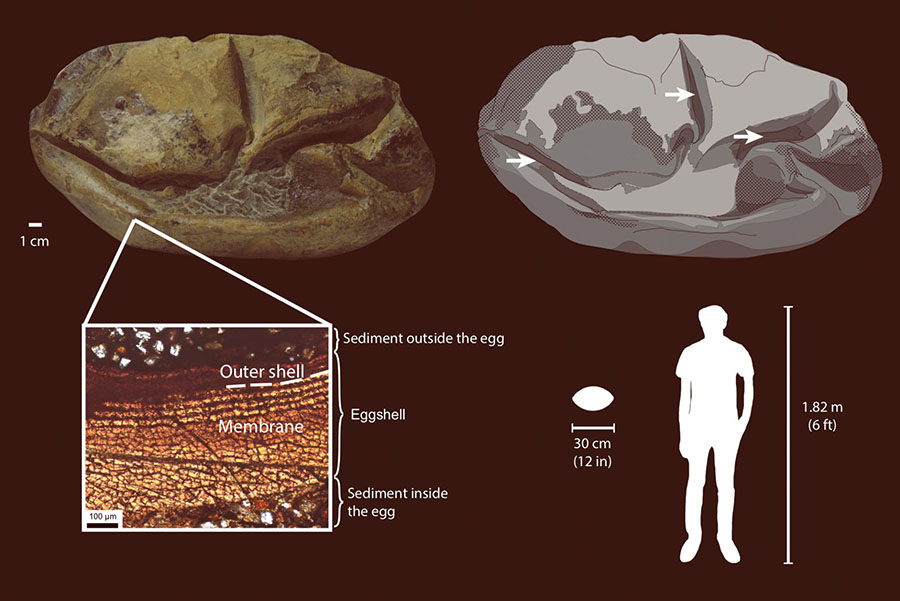
Measuring 29 by 20 cm (11.4 by 7.9 inches) and weighing 6.5 kg, it is the largest soft-shell egg ever discovered and the second-largest egg of any known animal. Although the elephant bird egg is slightly larger, its eggshell is roughly five times thicker.

University of Texas at Austin paleontologist Lucas Legendre and his colleagues from the United States and Chile think that Antarcticoolithus bradyi was laid by a giant marine reptile, such as a mosasaur — a discovery that challenges the prevailing thought that such creatures did not lay eggs.

“The fossil egg is from an animal the size of a large dinosaur, but it is completely unlike a dinosaur egg. It is most similar to the eggs of lizards and snakes, but it is from a truly giant relative of these animals,” Dr. Legendre said.

A diagram showing the Antarcticoolithus bradyi egg, its parts and size relative to an adult human. Image credit: Legendre et al, doi: 10.1038/s41586-020-2377-7.

The researchers found several layers of membrane that confirmed that Antarcticoolithus bradyi was indeed an egg.

“The structure is very similar to transparent, quick-hatching, eggs laid by some snakes and lizards today,” Dr. Legendre said.

However, because the fossil egg is hatched and contains no skeletal material, the scientists had to use other means to zero in on the type of reptile that laid it.

An artist’s interpretation of a baby mosasaur emerging from an egg. Image credit: Francisco Hueichaleo.

They compiled a data set to compare the body size of 259 living reptiles to the size of their eggs.

They found that the reptile that laid the egg would have been 7 m (23 feet) long from the tip of its snout to the end of its body, not counting a tail.

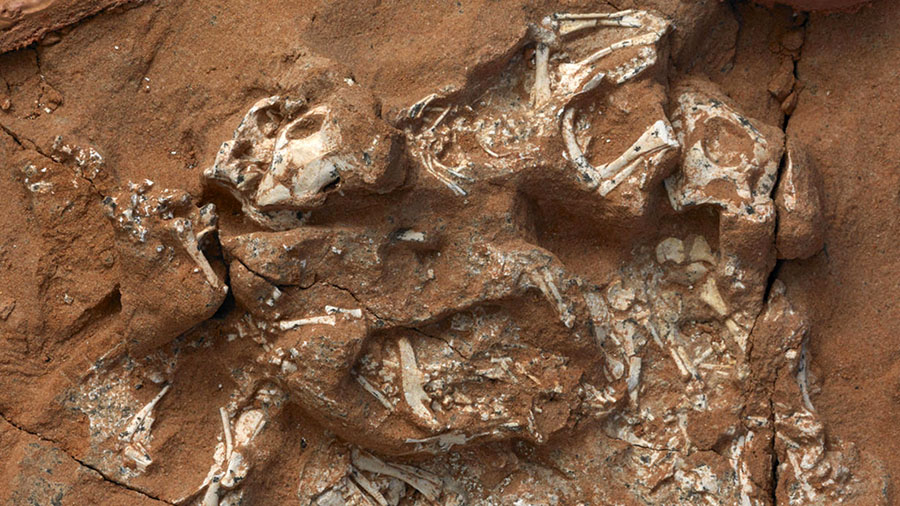
Adding to that evidence, the rock formation where the Antarcticoolithus bradyi egg was discovered also hosts skeletons from baby mosasaurs and plesiosaurs, along with adult specimens.

“Many authors have hypothesized that this was sort of a nursery site with shallow protected water, a cove environment where the young ones would have had a quiet setting to grow up,” Dr. Legendre said.

The study was published in the journal Nature.

_____

L.J. Legendre et al. A giant soft-shelled egg from the Late Cretaceous of Antarctica. Nature, published online June 17, 2020; doi: 10.1038/s41586-020-2377-7

Source: www.sci-news.com/

Eggs of Earliest Dinosaurs Had Soft, Leathery Shells

Friday, June 19, 2020

The exceptionally preserved Protoceratops specimen includes six embryos that preserve nearly complete skeletons. Image credit: M. Ellison / American Museum of Natural History.

A team of paleontologists from the United States, Canada and Argentina has analyzed the fossilized eggs of two different non-avian dinosaurs, Protoceratops and Mussaurus, and found that the eggs resembled those of turtles in their microstructure, composition, and mechanical properties. They’ve also found that hard-shelled eggs evolved at least three times independently in the dinosaur family tree.

For many years there was scant fossil evidence of dinosaur eggs, and all known examples were characterized by thick, calcified shells — leading paleontologists to speculate that all dinosaur eggs were hard-shelled, like those of modern crocodiles and birds.

“The assumption has always been that the ancestral dinosaur egg was hard-shelled,” said study first author Dr. Mark Norell, chair and Macaulay Curator in the Division of Paleontology at the American Museum of Natural History.

“Over the last 20 years, we’ve found dinosaur eggs around the world. But for the most part, they only represent three groups: (i) theropod dinosaurs, which include modern birds; (ii) advanced hadrosaurs like the duck-bill dinosaurs; (iii) and advanced sauropods, the long-necked dinosaurs.”

Dr. Norell and colleagues studied embryo-containing fossil eggs belonging to two species of dinosaur:

(i) Protoceratops, a sheep-sized plant-eating dinosaur that lived in what is now Mongolia between about 75 and 71 million years ago;

(ii) Mussaurus, a long-necked, plant-eating dinosaur that grew to 6 m (20 feet) in length and lived between 227 and 208.5 million years ago in what is now Argentina.

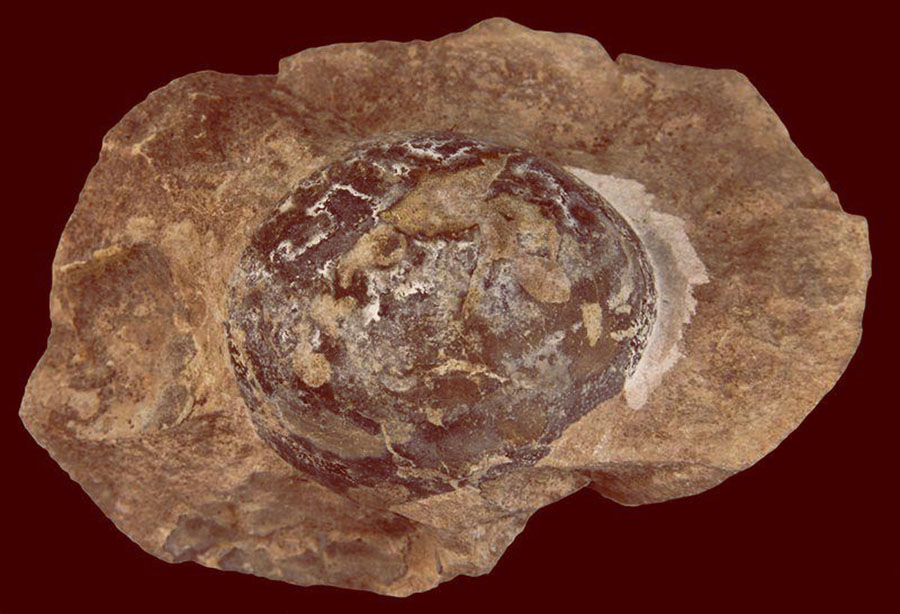
The fossilized egg of Mussaurus. Image credit: Diego Pol.

The researchers focused on the mineral and chemical compositions of the fossils, including a dark-colored halo surrounding the fossilized embryos.

“We looked for any residue of a protein eggshell membrane,” said study co-author Jasmina Wiemann, a graduate student in the Department of Geology & Geophysics at Yale University.

“We essentially ‘fingerprinted’ a large number of modern and fossil samples to build a dataset of the overall molecular picture of the eggshell through time.”

The scientists found that the early dinosaur eggs had a chemical residue that was non-mineralized — meaning they were more like today’s leathery turtle eggs, protecting their embryos with a soft outer covering.

“These dinosaurs buried their eggs in clutches, like modern animals that lay soft eggs, such as many lizards, snakes, and turtles,” Wiemann said.

“This kept the eggs moist and protected. It works very well.”

The discovery also shows that the three main branches of dinosaurs — Ornithischia, Sauropodomorpha, and Theropoda — each started with soft eggshells.

Hard, calcified eggshells evolved independently for each branch.

“By taking a step back and looking at the molecular data, we found that in this case (their eggshells) early dinosaurs were more reptilian than bird-like in their reproductive behavior,” said Matteo Fabbri, a graduate student in the Department of Geology & Geophysics at Yale University.

The results appear in the journal Nature.

_____

M.A. Norell et al. The first dinosaur egg was soft. Nature, published online June 17, 2020; doi: 10.1038/s41586-020-2412-8

Source: www.sci-news.com/

Scientists Discover Cockroach Fossils From The Dinosaur Age

Thursday, June 18, 2020

Two new species of cave dwelling cockroaches have been discovered from a cave in Myanmar. They have been dated to be 99 million years old making them the oldest cave animals known to date.

How can you forget the timeless 1993 classic film “Jurassic Park”? Spoiler alert! In the movie, paleontologist Alan Grant recreates dinosaurs from DNA found in the blood of a mosquito preserved in amber. While that may seem like fiction, animal fossils have been found in amber since the time of the ancient Greeks. Even though cloning hasn’t been performed from amber fossils, they provide a window into the past and the history of life on Earth. 

Recently, a team of scientists have discovered a unique insect fossil from an amber sample. In the Hukawng Valley of Myanmar, just south of India, a huge sample was extracted from the mines there. The amber from this valley is specifically called burmite, and is world-renowned for preserving all sorts of life. The researcher dissected and used microscopes to make images of the massive burmite sample and discovered two new species of cockroaches. The two new species identified were Crenocticola svadba and Mulleriblattina bowagi (Gesundheit! Am I right?). 

Here is a younger cockroach, “only” 40-50 million years old and about 4.5 mm long. Source: Anders L. Damgaard / CC BY-SA

Besides their fun and wacky names, these cockroaches are exceptional because they are the oldest cave dwelling animal ever recorded. The scientist predicted the age of the cockroaches to be at least 99 million years old. Their age was determined using a mineral called zircon that is formed in volcanic fragments from the cave. Zircon is found combined with uranium, lead, and other heavy elements. The elements found within the zircon exist in different isotope states which were measured to reliably determine the age of the rocks. 

These two cockroaches are part of a unique population of organisms called troglobites. Troglobites are animals that are native and thrive in underground habitats like caves. These animals are adapted to these environments through gradual gaining and losing of traits to survive in dark  caves with little nutrition. These cave-dwelling creatures are known to have smaller eyes and wings, lack pigment, and increased length and size of sensory organs and antennae. The two new species discovered possessed some or all of these traits and also seemed to have smaller leg spines. These cockroaches face less predators in caves and therefore have decreased defense mechanisms like leg spines. Since there are such limited resources in caves, these cockroaches may have fed off dinosaur droppings or guano.    

Prior to the discovery of C. syadba and M. bowagi, the oldest known cave-adapted animals lived 66 million years ago during the Cretaceous period. That makes these cockroaches now the oldest known troglobites. The end of the Cretaceous period marks the extinction of the dinosaurs and much of life on earth. The newly discovered C. syadba and M. bowagi are part of Nocticolidae family of cave cockroaches, which lived at least 120 million years ago and are still present today. This suggests that these cave dwellers could have been some of the few animals to survive the mass extinction 66 million years ago that infamously killed three quarters of plant and animal life on Earth (including the T. rex and other land-dwelling dinosaurs.)

Caves experience flooding and rock collapses, resulting in the destruction of habitats and fossil records. The unstable nature of caves over the long term leaves these scientists uncertain they will find a more recent fossil of these species. This may be why no fossil evidence has been found of these species prior to the mass extinction event, suggesting that these bugs roamed before, during, and after the T. rex. Nonetheless, cockroaches have always been considered “indestructible” and it seems that at least the Nocticolidae family has persisted through the ages.Questions still remain if C. syadba and M. bowagi are still alive today and if there is any evidence of older animal cave fossils. Paleontologists are certain that organisms inhabited caves prior to these cockroaches, but only time will tell until new fossil evidence is discovered. One thing is for certain though, to paraphrase Dr. Ian Malcom (Jeff Goldblum) from Jurassic Park, “life… finds a way.”

Study Information

Original studyNocticolid cockroaches are the only known dinosaur age cave survivors.

Study published on: February 11, 2020

Study author(s): Hemen Sendi, Peter Vršanský, Lenka Podstrelená, Jan Hinkelman, Tatiana Kúdelová, Matúš Kúdela, Ľubomír Vidlička, Xiaoyin Ren, Donald L.J. Quicke

The study was done at: Earth Science Institute, Slovak Academy of Sciences, State Key Laboratory of Palaeobiology and Stratigraphy, Center for Excellence in Life and Paleoenvironment, Nanjing Institute of Geology and Palaeontology, Chinese Academy of Sciences, Russian Academy of Sciences, University of Zagreb, Chulalongkorn University

Featured image creditTiia Monto / CC BY-SA

Source: https://sciworthy.com/

Pages