Blogs

130 Million-Year-Old Dinosaur Footprint Found After Storm Shifts Sands on UK Beach

Monday, February 17, 2020

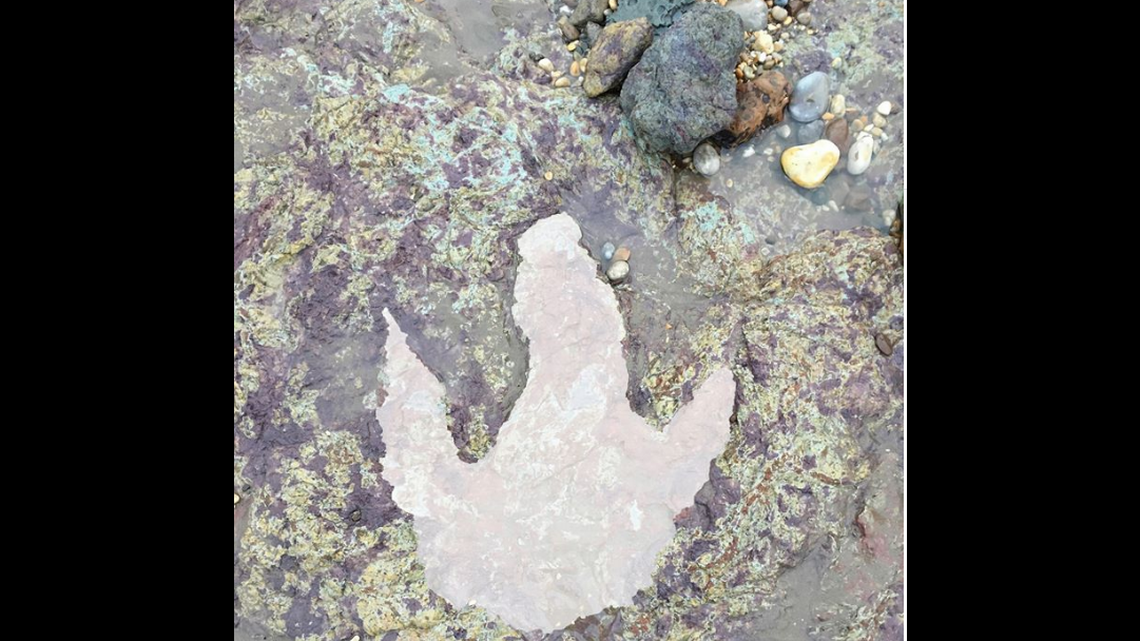
It is believed the track is from a Neovenator or a Baryonyx, giant lizards that walked on two legs, had small front arms and ranged in size from 24 to 32 feet. WIGHT COAST FOSSILS PHOTO

A monstrous three-toed footprint found last week on a British beach is the prehistoric track of a huge carnivorous reptile that died millions of years ago, according to fossil experts.

The print is just under 20 inches long and was discovered on the Isle of Wight after a storm whipped the rocky shore with winds and waves, the Wight Coast Fossils said in a Feb 13 Facebook post.

“All this weather is revealing traces of vanished worlds along our coastline!” the group posted.

“Shifting sands at Sandown Bay revealed this beautiful 130 million-year-old dinosaur track yesterday, preserved in the brightly coloured floodplain clays,” the post said.

Photos shared by the fossil-hunting group show the giant print had a brownish discoloration, making it stand out from the rest of the stone. The group also shared photos of a plaster cast being made to preserve the print.

Wight Coast Fossils says it’s not completely sure what creature made the track, but it could have been either a Neovenator or a Baryonyx, two giant lizards that walked on two legs, had small forearms (like the tyrannosaurs) and ranged in size from 24 to 32 feet, according to the Natural History Museum in London.

A single fossilized claw of a Baryonyx found in the early 1980s measured more than 12 inches in length, the museum reports.

“The mottled clays the footprint is preserved in ... (are) representing an area of boggy over bank marshland that seasonally dried and flooded,” the fossil group posted.

“Our track maker was ... leaving these huge tracks in the boggy soil. Behind the animal lay a range of low forested hills, while ahead lay a flat floodplain landscape dotted with floodplain forests, river channels, and herds of herbivorous dinosaurs,” the group wrote.

Dinosaur footprints have been found before in the island’s Wessex rock formation, “but do not hold up to the forces of erosion for long,” the group wrote.

The easily weathered stone is made up of a series of “alternating beds of clay and sand” that has been dated back 140 million years,” according to Pteros.com.

“Sadly they will typically disappear in a couple of days or weeks, as the tide wears down the soft clays ... an awesome but fleeting glimpse of a time long gone, lying in plain sight,” the fossil group wrote.

Source: www.miamiherald.com/

Tralkasaurus cuyi: New Carnivorous Dinosaur Unearthed in Argentina

Tuesday, February 18, 2020

An artist’s impression of Tralkasaurus cuyi. Image credit: Sebastian Rozadilla.

A new genus and species of medium-sized abelisaurid dinosaur being named Tralkasaurus cuyi has been discovered by Dr. Mauricio Cerroni from the Argentine Museum of Natural Sciences and CONICET and his colleagues.

Tralkasaurus cuyi lived approximately 90 million years ago in what is now Patagonia, Argentina.

It belongs to Abelisauridae, a group of ceratosaurian theropod dinosaurs that thrived during the Cretaceous period on the supercontinent Gondwana.

The incomplete fossilized skeleton of Tralkasaurus cuyi, including a jaw and vertebra, were discovered at the Violante Farm fossil site in Río Negro province, northern Patagonia.

“The materials found are diagnostic to describe this new species: the maxillary bone, that is part of the snout, was found from the skull and it still preserves some teeth,” said Dr. Cerroni, the lead author of a paper published in the Journal of South American Earth Sciences.

“As for the rest of the skeleton, cervical ribs were found, which come out from the neck and are very long, so it is thought that they are tendons that have fossilized; in addition, part of the hip and tail spine were found.”

Tralkasaurus cuyi was about 4 m (13 feet) long, smaller than previously known species of abelisaurid dinosaurs.

“The size of Tralkasaurus cuyi contrasts with that of typical abelisaurids such as Abelisaurus and Carnotaurus (between 7 and 11 m, or 23-36 feet long), indicating that it would occupy a different ecological niche,” the paleontologists said.

“Although its size is very small compared to Tyrannosaurus or Carnotaurus, the newly-discovered dinosaur shares with them the characteristics of being a biped animal, short-necked and muscular, with four claws in each of its hind legs, while its arms were also very short in relation to its body and the bones of its limbs were light and hollow,” Dr. Cerroni said.

“The snout of this new species has a lot of ornamentation, that is, an outer surface marked by roughness (a characteristic of the snout of these carnivores), which makes us assume that, in instead of having horns like Carnotaurus, it could have had small or poorly developed corneal structures,” said team member Dr. Federico Agnolin, a researcher at the Argentine Museum of Natural Sciences, CONICET, and the Universidad Maimonides.

Tralkasaurus cuyi likely preyed upon small animals which would likely include small herbivorous dinosaurs known as iguanadontians, turtles and lizards.

_____

M.A. Cerroni et al. 2020. A new abelisaurid from the Huincul Formation (Cenomanian-Turonian; Upper Cretaceous) of Río Negro province, Argentina. Journal of South American Earth Sciences 98: 102445; doi: 10.1016/j.jsames.2019.102445

Source:

Jurassic World 3: Every Returning Character In The Sequel

Sunday, February 16, 2020

Jurassic World 3 has announced many characters returning from across the franchise, including Jurassic Park, and each could play a pivotal role.

When Jurassic World 3 hits screens next year, it will mark the return of characters from across the Jurassic Park timeline. Not only will the film bring back characters introduced in both Jurassic World and Jurassic World: Fallen Kingdom, it will also feature the three beloved leads of Steven Spielberg’s original 1993 classic. The return of Alan Grant, Ellie Sattler, and Ian Malcolm — who did appear briefly in Fallen Kingdom — is expected to be more than fan-service cameos, and their inclusion alongside Jurassic World characters could give clues about the film’s plot.

In 2015, the dinosaur destruction franchise made a giant comeback with Jurassic World, in which the lessons of the original Jurassic Park were never learned, and a theme park based on John Hammond’s work is a popular tourist destination. Due to some genetic manipulation, of course, a dinosaur escapes and wreaks havoc. Jurassic World was a meta commentary on the first Jurassic Park — it wondered how something as iconic as dinosaurs could compete with the distraction of personal technology. At the same time, it introduced new characters that it hoped would stack up to the originals. While Bryce Dallas Howard’s Claire Dearing and Chris Pratt’s Owen Grady were likeable enough, they didn’t have the same impact as the original's cast. The film managed just fine, though, topping a billion-dollar gross worldwide.

Now, the World trilogy is ending, and its final chapter is likely to be a celebration of the entire franchise. That means familiar faces old and new will be back to grapple with the repercussions of Fallen Kingdom, in which a host of dinosaurs were freed into the American wilderness. The following are the characters returning for Jurassic World 3 and how they will factor into the story.

Claire Dearing (Bryce Dallas Howard)

After her lack of oversight in Jurassic World led to the destruction of the park and loss of several lives, Claire moved her sights to conservation in Fallen Kingdom. As leader of the Dinosaur Protection Group, she returned to Isla Nublar in order to turn the dinosaur tracking systems back on and assist in relocating the animals to a new sanctuary. When she learned that the Jurrassic World dinosaurs were going to be auctioned as biological weapons instead, Claire had to decide between rescuing the animals or letting them die. Ultimately, she allowed another character, Maisie Lockwood, to release them into the wild.

Claire is a character with conviction, so it’s likely that she will still be advocating for dinosaur rights in Jurassic World 3. Now that they’re in the wild, the dinosaurs are likely to be threatened by military forces, which means the stakes are higher for Claire than ever. This is especially true now that she has her own makeshift family.

Owen Grady (Chris Pratt)

Pratt’s dinosaur trainer has an especially strong connection to Blue, the last remaining velociraptor in the series. Their relationship evolved from uneasy allies to companions in Fallen Kingdom, and it’s unlikely that Owen will let Blue be harmed without a fight. While Claire is worried about the lives of every escaped dinosaur, Owen will likely be focused on Blue. The boy-and-his-dog element of the new trilogy will be especially powerful in its finale, and it could provide the driving force behind Owen’s character arc.

Alan Grant (Sam Neill)

One of the most exciting announcements to come from the Jurassic World 3 team is the return of Neill’s Dr. Alan Grant. Alan was the protagonist of the original Spielberg film, but he hasn’t been in any of the dinosaur flicks since 2001’s Jurassic Park III. Because Jurassic World ignored the first trilogy’s sequel films, it’s unknown if his adventures in the third Jurassic Park are still canon. With monsters on the loose, though, his expertise in paleontology and experience with living dinosaurs will likely drag him back into the fray.

By the end of Jurassic Park, Alan learned the dangers of Hammond’s experiment, which means he won’t be too thrilled to have the animals on mainland America. This could establish a dynamic in which the characters from Jurassic Park are at odds with the Jurassic World crew; in Fallen Kingdom, Ian Malcolm petitions the government to allow the dinosaurs to die. If he can convince his old friend Alan to let nature take its course, he might return as a foil for Claire and Owen.

Ellie Sattler (Laura Dern)

Laura Dern is hot off an Oscar win for her role in Marriage Story, but that isn’t stopping her from a long-awaited return to the blockbuster franchise. Ellie, Laura Dern’s paleobotanist, was Alan’s partner in Jurassic Park, but Dern made her more than a love interest; she’s intelligent and funny, but she’s also a fighter. Ellie had a cameo in Jurassic Park III in which she was married and had a child. If that version of events holds up in Jurassic World 3, it will probably take some convincing for Ellie to join in the fight.

If there is a rivalry between the old characters and the new, Ellie is a wild card, whose sympathies could fall in either direction. While her role in the film’s plot is unpredictable because of that, it would be great to see Dern thrown into a few action scenes on par with her raptor chase in Jurassic Park.

Ian Malcolm (Jeff Goldblum)

Goldblum’s cameo in Fallen Kingdom was highly publicized, but it added up to very little screen time. Malcolm is the franchise’s original skeptic, and he had some of the most iconic lines of Jurassic Park. Assuming this movie ignores the Malcolm-centric The Lost World: Jurassic Park, the mathematician should leave the hearing rooms this time around and get back into the field. Malcolm has already made his opinions on the dinosaurs’ safety known, so he’s a natural antagonist to Claire and Owen. How much action he’ll see in the film is anyone’s guess, but he’ll likely play a vital role in recruiting his old friends, Alan and Ellie, back into business.

Henry Wu (BD Wong)

Returning alongside the trio of heroes from the original Jurassic Park is BD Wong’s Dr. Henry Wu. Of all the characters in the franchise, Wu has had the strangest arc. He was an approachable, well-meaning scientist in the 1993 film, but he evolved into the Jurassic World trilogy’s central villain. Wu has become obsessed with genetically manufacturing his own dino species despite the cost in money and lives. It’s a strange direction for a once-grounded character, and Wu will probably have to deal with the combined persuasive forces of Alan, Ellie, and Ian at some point in the film. Almost certainly, Wu won’t make it out alive.

Lowery Cruthers (Jake Johnson)

Johnson’s Lowery performed two main functions in Jurassic World: he was the goofy comic relief and the chorus that provided the film’s meta connection to Spielberg’s classic. Lowery is obsessed with the tragedy of the original Jurassic Park, but he’s also a fanboy who has landed his dream gig. Lowery never left the control room in that film; Johnson’s a well-known actor now, though, which suggests his role will be expanded. Lowery will probably get up close and personal with his beloved dinosaurs this time around, likely as part of Team Claire and Owen.

Barry Sembene (Omar Sy)

In Jurassic World, Barry was Owen’s cautious partner in the dinosaur training business. While Owen had the stronger connection to the animals, Barry acted as Owen’s mature conscience. His expertise, nearly as strong as Owen’s, suggests a more direct role this time around. Barry will probably be back at Owen’s side as they track Blue and the other dinosaurs, although it would be an interesting wrinkle if he was hired by the opposition to find the animals first.

Franklin Webb (Justice Smith)

Franklin was the warm heart of Fallen Kingdom. His character is a slightly older take on the kid-in-danger trope of the Jurassic films; he spent most of his screen time screaming, running, and begging to go home. Of all the previous franchise characters, Franklin will take the most convincing to interact with Jurassic World's dinosaurs again. It wouldn’t be surprising, then, if he was sidelined in a control room or the back of a van somewhere as a tech support character. Franklin all but disappeared in the second half of Fallen Kingdom, and the overstuffed cast in Jurassic World 3 doesn’t guarantee room for a bigger role this time around.

Zia Rodriguez (Daniella Pineda)

Zia is the closest thing the Jurassic World series has to an Ellie Sattler. She’s bright, tenacious, and quick on her feet. Zia was part of a duo with Franklin in Fallen Kingdom, which didn’t know what to do with either of them. Like Franklin, Zia was given a few moments to shine, but was absent for big chunks of the film’s second half. Zia has more backbone than Franklin, though, and an active role right alongside Claire would serve her best.

If Jurassic World 3 does as well as the first film in the series, there will certainly be another trilogy. Zia and Franklin have the potential to be great protagonists for that series if they’re used correctly in this one.

Maisie Lockwood (Isabella Sermon)

One of the most controversial creative choices in Fallen Kingdom centered around Sermon’s Maisie Lockwood. The granddaughter of John Hammond’s one-time partner, Maisie finds kinship with and sympathy for the mutated dinosaurs after learning that she’s a clone of the woman she thought was her mother. While cloning isn’t necessarily a bad fit for the Jurassic franchise, the revelation felt like a sharp left turn for fans — and an unnecessary diversion in a film that was already overstuffed with ideas.

Maisie’s role in Jurassic World 3 will say a lot about the future of the franchise. If her identity as a clone is pivotal to the plot, it’s likely that future films will stray into the larger world of science-fiction. However, she was essentially adopted by Claire and Owen at the end of Fallen Kingdom, which could mean she’ll be the child in danger this time around. Bringing back Jurassic Park’s Alan, Ellie, and Ian suggests a return to the straightforward action of the original, but Maisie does have a strange connection to the dinosaurs, and that will likely be exploited.

The Cast Overall

Currently, Jurassic World 3 has the potential to be several different movies. While it might continue in the blockbuster sci-fi action vein of its direct predecessors, director Colin Trevorrow is making a deliberate choice in bringing back so many characters from the original film. Hopefully that means a return to what made Jurassic Park an instant classic: a monster horror story with loveable characters and a simple plot. Trevorrow referenced the ’93 movie many times in World, and it wouldn’t be surprising to see him return to that sandbox again.

However, Trevorrow also helped develop Fallen Kingdom, which was muddled by its unfocused mix of genres and big ideas. If he can keep his focus as a storyteller, he can deliver a worthy follow-up to the Spielberg original with just as many scares and just as much heart. Clearly, he has the right cast for it.

Source: https://screenrant.com/

Mystery Surrounding Dinosaur Footprints on a Cave Ceiling in Central Queensland Solved

Saturday, February 15, 2020

The mystery surrounding dinosaur footprints on a cave ceiling in Central Queensland has been solved, in article published in Historical Biology, after more than a half a century.

University of Queensland palaeontologist Dr Anthony Romilio discovered pieces to a decades-old puzzle in an unusual place – a cupboard under the stairs of a suburban Sydney home.

“The town of Mount Morgan near Rockhampton has hundreds of fossil footprints and has the highest dinosaur track diversity for the entire eastern half of Australia,” Dr Romilio said.

“Earlier examinations of the ceiling footprints suggested some very curious dinosaur behaviour; that a carnivorous theropod walked on all four legs.

“You don’t assume T. rex used its arms to walk, and we didn’t expect one of its earlier predatory relatives of 200 million years ago did either.”

Researchers wanted to determine if this dinosaur did move using its feet and arms, but found accessing research material was difficult.

“For a decade the Mount Morgan track site has been closed, and the published 1950s photographs don’t show all the five tracks,” Dr Romilio said.

However Dr Romilio had a chance meeting with local dentist Dr Roslyn Dick, whose father found many dinosaur fossils over the years.

“I’m sure Anthony didn’t believe me until I mentioned my father’s name – Ross Staines,” Ms Dick said.

“Our father was a geologist and reported on the Mount Morgan caves containing the dinosaur tracks in 1954.

“Besides his published account, he had high-resolution photographs and detailed notebooks, and my sisters and I had kept it all.

“We even have his dinosaur footprint plaster cast stored under my sister’s Harry Potter cupboard in Sydney.”

Dr Romilio said the wealth and condition of ‘dinosaur information’ archived by Ms Dick and her sisters Heather Skinner and Janice Millar was amazing.

“I’ve digitised the analogue photos and made a virtual 3D model of the dinosaur footprint, and left the material back to the family’s care,” he said.

“In combination with our current understanding of dinosaurs, it told a pretty clear-cut story.”

The team firstly concluded that all five tracks were foot impressions – that none were dinosaur handprints.

Also the splayed toes and moderately long middle digit of the footprints resembled two-legged herbivorous dinosaur tracks, differing from prints made by theropods.

“Rather than one dinosaur walking on four legs, it seems as though we got two dinosaurs for the price of one – both plant-eaters that walked bipedally along the shore of an ancient lake,” Dr Romilio said.

“The tracks lining the cave-ceiling were not made by dinosaurs hanging up-side-down, instead the dinosaurs walked on the lake sediment and these imprints were covered in sand.

“In the Mount Morgan caves, the softer lake sediment eroded away and left the harder sandstone in-fills.”

Source: https://newsroom.taylorandfrancisgroup.com/

9,990-Year-Old Skull May Rewrite Ancient American History

Friday, February 7, 2020

Cavities in the skull of the Tulum cave remains reveals the population may have eaten a markedly different diet to other ancient Americans. Eugenio Acevez

The woman the bones belonged to was markedly different to other ancient Americans.

AT NEARLY 4,300 MILES LONG, the Tulum submerged cave system is the longest underwater cave system ever found. It is also arguably the most important when it comes to human history. Nine ancient human skeletons have been found in this underwater labyrinth. And in a study published on Wednesday, scientists announced the discovery of one more.

The newly-found skeleton, dubbed ‘Chan Hol 3,' belonged to a 30-year-old woman who died some 9,990 years ago. Thirty-percent of her skeleton was found preserved in the cave system, at the bottom of 8 meters of fresh water.

The discovery is described in a paper published in the journal PLOS ONE.

Chan Hol 3 was first found in September 2016, during a systematic survey of the caves. To get to her, cave explorers first had to swim past the sites of past ancient-skeleton discoveries, including the 10,000-year-old skeletal remains of a child, and the 13,000-year-old skeletal remains of a young man.

After that discovery, lead investigator and geoscientist Wolfgang Stinnesbeck told Inverse “it looks as if the oldest osteological remains of humans in the Americas are all reported from the Tulum system of submerged caves.”

It is through analysis of these remains that scientists can get a richer, and more accurate, sense of what life was like for the first humans in the Americas. And Chan Hol 3 is helping to shed light on where we have gotten the narrative wrong.

SUBMERGED HISTORY

The Tulum caves have not always been underwater. During the Last Glacial Maximum, which happened around 25,000 to 19,000 years ago, sea level was more than 100 meters lower than today. At that time, parts of the Tulum cave system were likely completely dry — making them accessible to animals and humans.

A team from Liverpool John Moores University examines the newly found skeleton.Jerónimo Avilés Olguín

When deglaciation began, sea levels rose abruptly, submerging the caves. Today, the cave system contains a freshwater layer over seawater. The cave where this skeleton was found likely became water-filled during a period of rising sea levels 8,000 years ago — the result of global warming.

After she was discovered, Chan Hol 3 was treated with distilled water for eight months, slowly dried out, and then photographed. A uranium-thorium dating technique determined its age — a minimum of 9,900-years-old.

The team compared Chan Hol 3's skull to the skulls of 452 individuals' remains, found across North, Central, and South America — including the skulls also found in the Tulum caves. In doing so, they realized that the skulls found in the caves are more round-headed than other contemporary skulls found in Central and North America. Another telling difference between the Tulum skulls and other ancient Americans' remains is the fact that Chan Hol 3, like other Tulum skulls, has teeth with cavities, indicating a diet high in sugar. The other skulls' teeth are mostly cavity-free — suggesting they ate a markedly different diet.

Taken together, the skulls suggest that two morphologically different groups of ancient American peoples lived in this part of the world at the same time — complicating the story of early human settlement of the Americas.

The Tulum skeletons suggest that either more than one group of people reached the American continent during the same time period, or that people have lived long enough on the Yucatan Peninsula for different groups to develop distinct skull morphology.

The latter hypothesis would mean that human settlement of the Americas happened far earlier than previously thought.

It’s generally believed that humans have lived on the Yucatan Peninsula since the Late Pleistocene — between 126,000 to 11,700 years ago. But exactly when humans came to occupy the Peninsula is hotly debated. The “kelp highway” hypothesis supports the idea that the migration happened between 20,000 to 15,000 years ago, while the discovery of a Patagonian human settlement suggests people had made it to South America by at least 18,500 years ago.

Only time — and more discoveries — can reveal our true human history. And the Tulum cave system may provide many more twists in the plot: Just 932 miles of the 4,399 mile-long system has been explored, after all.

________________________________________________________________________________________________________________________

Abstract: Human presence on the Yucatan Peninsula reaches back to the Late Pleistocene. Osteological evidence comes from submerged caves and sinkholes (cenotes) near Tulum in the Mexican state of Quintana Roo. Here we report on a new skeleton discovered by us in the Chan Hol underwater cave, dating to a minimum age of 9.9±0.1 ky BP based on 230Th/Udating of flowstone overlying and encrusting human phalanges. This is the third Paleoindian human skeleton with mesocephalic cranial characteristics documented by us in the cave, of which a male individual named Chan Hol 2 described recently is one of the oldest human skeletons found on the American continent. The new discovery emphasizes the importance of the Chan Hol cave and other systems in the Tulum area for understanding the early peopling of the Americas. The new individual, here named Chan Hol 3, is a woman of about 30 years of age with three cranial traumas. There is also evidence for a possible trepanomal bacterial disease that caused severe alteration of the posterior parietal and occipital bones of the cranium. This is the first time that the presence of such disease is reported in a Paleoindian skeleton in the Americas. All ten early skeletons found so far in the submerged caves from the Yucatan Peninsula have mesocephalic cranial morphology, different to the dolichocephalic morphology for Paleoindians from Central Mexico with equivalent dates. This supports the presence of two morphologically different Paleoindian populations for Mexico, coexisting in different geographical areas during the Late Pleistocene-Early Holocene.

Source: www.inverse.com/

The Top 6 Places in the World to go Dinosaur Hunting

Sunday, February 16, 2020

NY Post photo composite

Move over Rex, there’s a new Tyrannosaurus in town.

A new species of the apex predator was unearthed accidentally in Canada this week, not by an Indiana Jones-style explorer, but by a farmer.

Dubbed the “Reaper of Death,” the dino bones, consisting of a long snout and large steak-knife-like teeth was from the late Cretaceous Period, were found by the farmer who “stumbled across the fossils in 2010 while hiking near Hays, a hamlet in southern Alberta,” according to the BBC.

While this may sound extraordinary, there are several well-known areas in the world where finding dinosaur bones are as common as stepping in a pile of dog poo in New York City. Not kidding!

Here are six spots where people are still digging up dinos

Wyoming Dinosaur Center. Alamy

United States
“Scientists still routinely pull complete skeletons from digs in the Western United States, from Texas to Montana,” according to Smithsonian Magazine. The hot spots to find dinosaur remains as well as going on a dig are: the Two Medicine Dinosaur Center in Bynum, Montana;  Wyoming Dinosaur Center in Thermopolis, Wyoming. You can also trek to the Dakotas and join paleontologist Walter W. Stein and his PaleoAdventures, for a dig in the Hell Creek Formation in South Dakota’s Black Hills or contact the North Dakota Geological Survey for digs across that state where you can find bones from Tyrannosaurus, Edmontosaurus, Triceratops, Brachychampsa, Dromaeosaurus and Didelphodon.


Canada
Channel your inner farmer and check out Canada’s Dinosaur Provincial Park in Alberta which has the greatest variety of species in one spot.


Mongolia
The Gobi Desert is littered with dino bones. Considered the “Largest fossil reservoir in the world,” according to the BBC, near Bayanzag’s Flaming Cliffs is such a large deposit of ancient beings it is almost impossible to tell what is bone or stone. When I visited several years ago, guides suggested licking the sun-bleached bits. If your tongue sticks to the “rock,” it’s bone.


Russia
In August of 2017, a veritable necropolis of woolly mammoths, woolly rhinos and predatory dinosaurs was found “by accident” by Russian scientists. “The remains are about 130 million years old,” according to The Siberian Times.The site is located at Bolshoy Ilek near the Chulym River in central Russia. Other large bone-filled sites in Siberia are near Mamontovoye and Berelekh.


China
China has more than its share of prehistoric animal bones. The most prolific sites, according to Top China Travel, are: Western Liaoning district, called “The park of the Cretaceous period”; Nanyang City in southwest Henan Province is known as “ninth wonder of the world” due to the discovery of large amounts of intact dinosaur eggs in the 1920s; Zigong has so many bones it is called “the cemetery of dinosaurs” and “former residence of dinosaurs.” Lufeng in Yunan Province is also teeming with finds while Inner Mongolia (aka “Dinosaur Town”) is the only place where scientists have found “dinosaur fossils belong to two geological ages at the same fault.”


Argentina
Paleontologists discovered the remains of two new species of herbivorous dinosaurs Late last year in Argentina’s southern El Calafate area, which is renowned for its ancient bones. The bones are over 70 million years old and were mindboggingly huge: one was over 82 feet long, and the other was 13 feet.

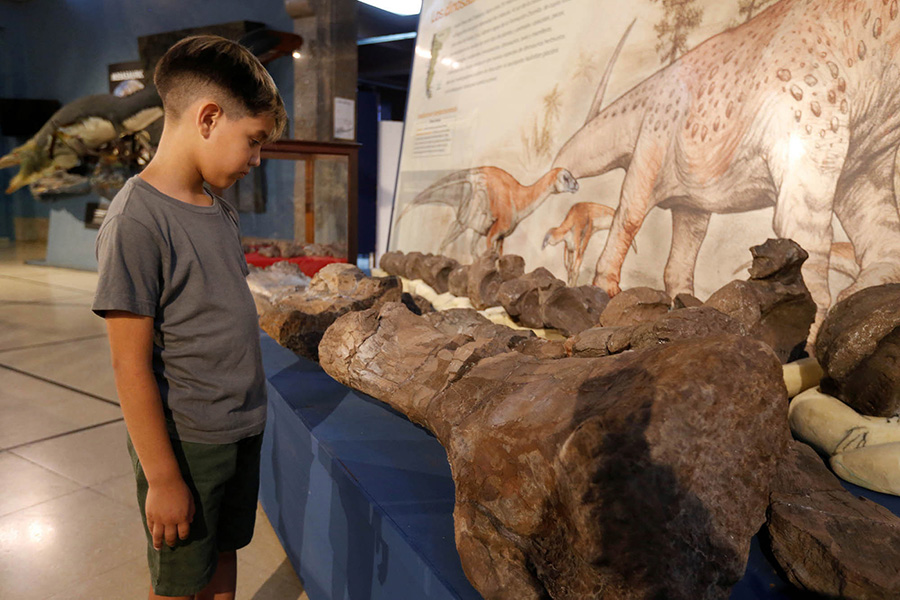
A young visitor at the Museo Argentino de Ciencias Naturales. REUTERS

Source: https://nypost.com/

Fossil Eggshells Suggest All Dinosaurs May Have Been Warm-Blooded

Saturday, February 15, 2020

Photo: Contributed Photo

New analysis reveals body temps in same range as modern birds.

Were all dinosaurs warm-blooded? Were any of them warm-blooded? The question of endothermy has long been, ahem, a hot topic in paleontology. No doubt a new study, using a recently developed method, will fire up the debate.

Unlike cold-blooded ectotherms, endotherms have the ability to regulate their body temperature internally. They generate, conserve and shed heat in response to their environment, making them generally more adaptable to different climates and ecological niches.

Most animals, including reptiles, are ectotherms. Mammals, birds and a handful of fish are either endotherms or evolved some degree of endothermy. Because warm-blooded birds evolved from dinosaurs, and dinosaurs evolved from cold-blooded reptiles, researchers have long sought clues to just where in the reptile-to-bird story things heated up.

From Analog To Isotope

Over the years, researchers have come up with a number of theories about warm-blooded dinosaurs, but they've been based almost entirely on looking at living animals and extrapolating. Comparing the bone structure of some dinosaurs with that of modern birds, for example, suggested that at least some of the extinct animals may have evolved endothermic abilities.

These kinds of comparisons can be problematic, however, because they're based on the assumption that dinosaurs lived, breathed and grew the same way modern animals do.

More recently, researchers have been looking for dinosaur endothermy with a method called carbonate clumped isotope paleothermometry. Paleothermometry itself is nothing new; it's been around for decades as a way to model ancient ocean temperatures, climates and other environmental patterns using proxies.

For example: The density of the cells that form a tree's annual growth ring varies based on the ambient temperature and humidity of the tree's environment. Researchers have used these subtle changes to reconstruct ancient climate patterns.

Carbonate clumped isotope paleothermometry zeroes in on, yes, carbonates. Living things are one of the many sources of these chemical compounds, and tooth enamel and eggshells in particular are full of them. The exact composition and structure of the carbonate varies based on the temperature at the time it formed. By analyzing this variation, researchers are able to determine what the body temperature of the animal was.

Avoiding Ambient Noise

The paleothermometry method was previously used to estimate body temperature for species in two of the major groups of dinosaurs: sauropods (the often-enormous, four-legged, long-necked plant-eaters) and theropods (the bipedal, generally carnivorous dinosaurs, including the lineage that eventually gave rise to birds).

These previous studies suggested that the animals had body temperatures of about 32-38 degrees Celsius (about 90-100 degrees Fahrenheit), which put them in the range of modern endotherms.

There were some questions about the dinosaur specimens used, however, because they were collected from sites that, back in the Mesozoic, would have been in the low to mid-latitudes. Seasonal temperatures in these locations may have reached 100 degrees or more, potentially skewing the paleothermometry data.

For example, a separate study using the method sampled eggshells from cold-blooded animals — bearded lizards and tortoises — living at the Los Angeles Zoo. The samples fell into the range of living endotherms because of the warm environment.

To avoid this problem, most of the samples in the new study came from dinosaur eggshells found in Alberta, Canada, which would have had cooler ambient temperatures. Therefore any higher paleothermometry readings would be a strong indicator of endothermy.

One of the species sampled, Maiasaura peeblesorum, is the first ornithischian dinosaur to be tested using this method. Ornithischians were the first major lineage of dinosaurs to split off onto their own branch, making them, of all dinosaurs, the most distant relatives of modern birds.

Including an ornithischian in the study is significant because of their evolutionary distance to birds, but also because it means all three major groups of dinosaurs have now been analyzed using this method of paleothermometry.

Another species in the study, the theropod Troodon formosus, is more closely related to the lineage that evolved into birds. The third sample came from eggshells collected in Romania and tentatively assigned to a sauropod, Magyarosaurus.

Global Warming...With A Twist

The researchers also tested eggshells from modern birds including emus, chickens, hummingbirds, sparrows and wrens. They included previously-collected body temperature information about alligators, mollusks and other ectotherms in their analysis.

The study's results: All of the dinosaur material tested fell within the range of modern endotherms. The Maiasaurus sample in particular, say the authors, tested within the range of modern birds at about 44 degrees Celsius (about 111 degrees Fahrenheit). Finding evidence of warm-bloodedness in all major groups of dinosaur suggests that endothermy was an ancestral trait that evolved earlier in the archosaur lineage.

But wait, there's a twist: The research uncovered something interesting about Troodon. One sample tested at about 38 degrees Celsius (100 degrees Fahreneheit). However, the other two samples, from two different sites, had significantly cooler body temps of around 27-28 degrees Celsius (80-82 degrees Fahrenheit). The lower Troodon temps matched those of fossil mollusks from the same deposits — because mollusks are ectotherms and cannot self-regulate their heat, the temperature in which their shells formed is considered a proxy for the environment's ambient temperature.

The researchers' analysis suggests that the cooler Troodon samples may be evidence of heterothermy in the dinosaurs.

Heterothermic animals have evolved the ability to essentially switch off their endothermy and become more ectothermic to conserve energy. Heterothermy typically turns up in smaller birds and mammals that have periods of high activity and extreme energy expenditure. To recoup their losses, so to speak, they may drop their body temperatures and become inactive during short daily periods of torpor, or longer stretches of hibernation.

The too-cool Troodons may, say the authors, be a hint that at least some dinosaurs were heterothermic.

The research appears in Science Advances.

Source: www.discovermagazine.com/

How Did Dinosaur Parents Know When Their Kids Had a Fever?

Saturday, February 15, 2020

From the time that dinosaur fossils were first discovered, these creatures have fascinated scientists and laypeople alike. In the academic world, their remains provide important clues into the prehistoric world; in popular culture, dinosaurs have inspired blockbuster hits, such as Jurassic Park and King Kong.

Now, a research team headed by Professor Hagit Affek at the Hebrew University of Jerusalem's Institute of Earth Sciences has unlocked a mystery that has stymied researchers for decades: How did dinosaurs regulate their body temperatures? Were they warm-blooded or cold-blooded?

Affek's study, published in Science Advances, relies on a novel method to measure historical temperatures. Called clumped isotope geochemistry, this method analyzes chemical bonds among heavy isotopes in calcium carbonate minerals—the main ingredient in egg shells. This allows scientists to calculate both the temperature at which the minerals formed and the body temperature of the mother that laid the egg.

Affek and her team applied this method to fossilized eggs from three distinct dinosaur species along the evolutionary path from reptile to bird and found that their body temperature ranged from 35-40 degrees Celsius. However, this bit of information still did not answer the question as to whether dinosaurs were endothermic or exothermic, meaning, did they generate their own body heat or get warm from the sun and their environment?

"The global climate during the dinosaur era was significantly warmer than it is today. For this reason, measuring only the body temperatures of dinosaurs who lived near the equator wouldn't tell us whether they were endo- or exothermic because their body temperature may simply have been a cold-blooded response to the hot climates they lived in," shared Affek.

Hadrosaur eggshells. Credit: Darla Zelenitsky

To address this issue, her team focused on dinosaurs that lived in high latitudes like Alberta, Canada—far enough north to ensure that their warm body temperatures were the result of an internal, metabolic warming process rather than merely reflecting the climate around them.

To verify their hypothesis, Affek and her team needed to determine the environmental temperature in Alberta back when dinosaurs lived. They accomplished this by applying their isotope method to mollusk shells that lived in Alberta alongside the dinosaurs. Since mollusks are cold-blooded creatures, they reflect the ambient climate of the time. The mollusks' body temperature measured 26°C and showed that the dinosaurs living in Alberta were endothermic; otherwise, they could not have maintained a body temperature of 35-40°C.

As dinosaurs evolved, they moved from lizard-like (cold-blooded) characteristics to avian (warm-blooded) ones. "We believe that this transformation happened very early on in dinosaurs' evolution since the Mayasaura eggs—a lizard-like dinosaur species that we tested—were already able to self-regulate their body temperature, just like their warm-blooded, bird-like cousins, the Torrdons," explained Affek.

The fact that both of these species, located at opposite ends of the dinosaur evolutionary tree, had body temperatures higher than those of their environment means that both had the ability to warm themselves.

Either way, Mother of Dragons, if your baby is showing a fever of 41 degrees, it's time to call the doctor.

More information: R.R. Dawson el al., "Eggshell geochemistry reveals ancestral metabolic thermal regulation in Dinosauria," Science Advances (2020). DOI: 10.1126/sciadv.aax9361 , https://advances.sciencemag.org/content/6/7/eaax9361

Journal information: Science Advances

Provided by Hebrew University of Jerusalem Source: https://phys.org/

Jurassic Park: 10 Things That Made The Original Great (That The Sequels Have Missed)

Friday, February 14, 2020

The original Jurassic Park is loved by many but the sequels always seem to be missing "something" that made the first film so great.

Steven Spielberg’s Jurassic Park wasted no time becoming the highest-grossing film of all time in 1993. It’s a triumph of science fiction, suspenseful filmmaking, and storytelling in general that captivated audiences around the world with the perfect mix of spectacle and substance. It has since been followed by two sequels, a reboot, and a sequel to the reboot, with a sequel to the sequel to the reboot on the way.

But none of the follow-ups have come close to recapturing the magic of the original. There are many reasons for this, so here are 10 Things That Made The Original Jurassic Park Great (That The Sequels Have Missed).

10 - Well-Rounded Characters

While viewers of the Jurassic World movies know Owen Grady as “Chris Pratt” and Claire Dearing as “the one who ran in high heels,” viewers of Jurassic Park know exactly who Alan Grant is, and exactly who Ellie Sattler is. Alan starts off the movie hating kids and ends up caring for two of them, while Ellie holds onto fiercely feminist values in the face of sexists like John Hammond in a male-dominated field.

The role of Ian Malcolm went on to define Jeff Goldblum’s on-screen persona. The original Jurassic Park movie took the time to develop its characters, which very few blockbusters bother to do these days.

9 - Strong Themes

Jurassic Park deals with some lofty ideas, like chaos theory and capitalism, through its dino-infested action. The message behind pretty much every Jurassic sequel can be summed up as: nature good, military bad. Jurassic Park is a complex cautionary tale about the dangers of playing God.

The characters and their viewpoints are drawn from those themes: for example, when Ian Malcolm tells John Hammond, “Your scientists were so preoccupied with whether or not they could, they didn’t stop to think if they should.”

8 - Favoring Practical Effects Over CGI

The team working on the original Jurassic Park pioneered early CGI technologies to create some of the VFX shots, and a lot of that CGI still holds up surprisingly well today. But if there was a special-effects shot that Spielberg could do practically, he did it practically.

CGI was just a last resort if a shot couldn’t be achieved using practical effects. CGI is the go-to in today’s Jurassic sequels, with basically no practical effects, but the practical stuff in Jurassic Park – designed by the great Stan Winston – is timeless.

7 - Careful Framing

Martin Scorsese famously said that filmmaking is all a matter of what is in the frame and what isn’t in the frame. In Jurassic Park, a lot is left to the viewer’s imagination. Steven Spielberg pioneered this technique as a money-saving tactic when he was making Jaws and it ended up making the movie an effective thrill-ride.

In Jurassic Park, he applies it deliberately in scenes like the dinosaur feeding where we see shrubbery shaking with sound effects of a live goat being ripped to shreds. The sequels don’t leave anything to our imagination, lazily showing the dinosaurs at every turn for some cheap spectacle.

6 - No Plot Holes

The Jurassic sequels are filled with plot holes, from characters making stupid decisions (e.g. using gymnastics to kill a raptor in The Lost World) to plot developments that just plain don’t make sense (e.g. are we seriously supposed to believe that there’s been an active volcano on this island the entire time and no one thought that was a concern until it erupted?).

In Jurassic Park, there aren’t any plot holes. Michael Crichton and David Koepp’s script is airtight: the characters’ motivations make sense, each plot point leads smoothly into the next, and there aren’t any gaps in the story’s logic.

5 - Suspenseful Filmmaking Techniques

If Alfred Hitchcock saw the T. rex attack or the raptors-in-the-kitchen sequence from Jurassic Park, he would’ve been proud. Steven Spielberg didn’t just put a dinosaur in each frame and expect that alone to make it interesting.

He played around with lighting, editing, camera angles, and tense music to actually build suspense throughout each set piece.

4 - Taking The Humans’ Perspective

There’s a shot in Jurassic World: Fallen Kingdom of a T. rex standing over Chris Pratt, roaring. The whole marketing campaign was built around this moment. But it has no impact, because it’s a wide shot, taken from 20 feet in the air. We’re not looking at the T. rex from Chris Pratt’s perspective; we’re looking at Chris Pratt from the T. rex’s perspective. And none of us are T. rexes – we’re all people, like Chris Pratt – so we have no emotional response to this.

In the first movie, however, Steven Spielberg always kept the camera at the humans’ perspective. If a dinosaur breaks through a car window, the camera is in the car. It’s much more effective than the bland coverage seen in today’s blockbusters.

3 - John Williams’ Score

A huge part of what made Jurassic Park such a breathtaking moviegoing experience was the sweeping score composed by John Williams.

Williams composed the score for The Lost World, but he avoided his themes from the first one and went for a completely different style that didn’t work at all, and every subsequent movie was scored by someone else. Williams’ score for the original Jurassic Park is one of the greatest ever composed.

2 - It’s A Modern Retelling Of Frankenstein

The Jurassic sequels have been about everything from a T. rex wandering through the streets of San Diego to the reunion of a divorced couple to a little girl finding out she’s a clone and dooming the world due to some weird kinship she feels with the dinosaurs. The filmmakers have lost sight of what made Jurassic Park work as a quintessential science fiction story: it was a modernized retelling of Frankenstein.

This isn’t to say that every Jurassic movie should copy the plot from the first one, but they should be following the essential, groundbreaking philosophical debates that Mary Shelley opened with her gothic classic. (And no, that doesn’t mean turning them into haunted house movies, a la the second half of Jurassic World: Fallen Kingdom.)

1 - An Earned Finale

All throughout Jurassic Park, the characters are separately terrorized by a T. rex and a couple of velociraptors. In the climactic set-piece, the T. rex and the raptors take care of each other. The message is that, in the end, nature will work itself out. This thrilling finale feels earned, because of the way the story built up to it.

The Jurassic sequels have climaxes that either come out of nowhere, like the Godzilla-inspired ending of The Lost World, or rip off the originals to lesser effect, like Jurassic World’s similar battle that just throws every dinosaur at the screen to see what sticks.

Source: https://screenrant.com/

Stunning New Dinosaur 50ps Launched by Royal Mint

Friday, February 14, 2020

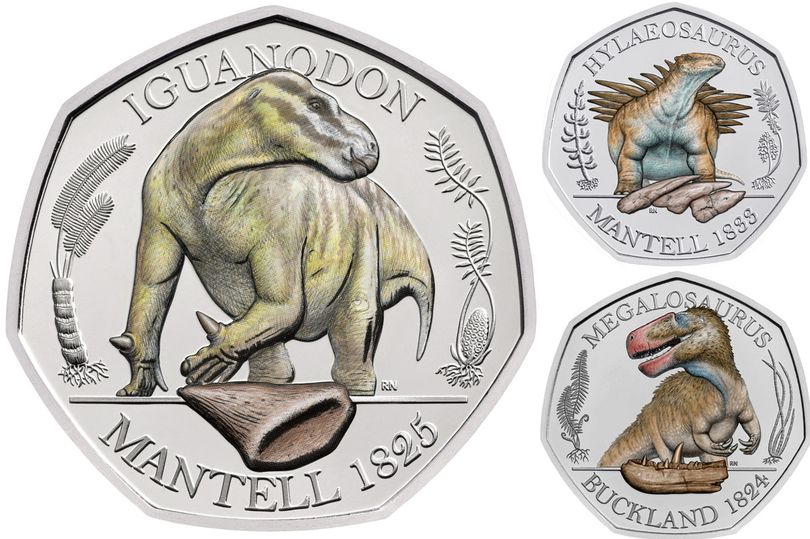
The coins will range from £10 to up to £945 for limited-run, gold-proof editions (Image: Royal Mint)

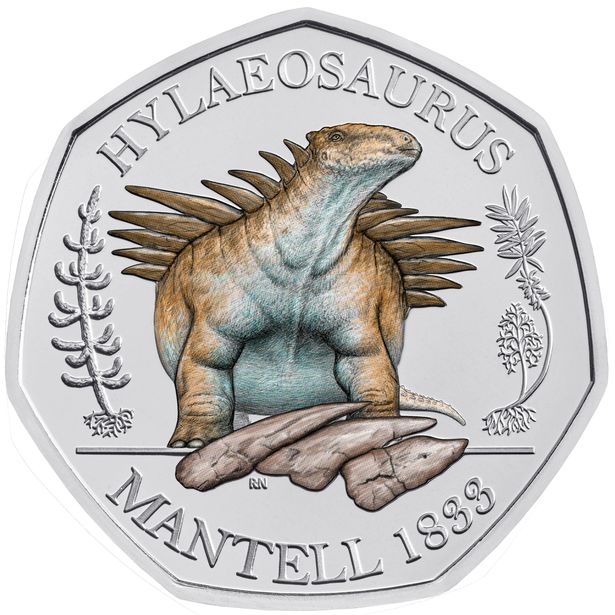
The coins feature three different dinosaurs, including the Megalosaurus, the Iguanodon and the Hylaeosaurus - but you'll have to pay £10 to get your hands on one.

A range of commemorative 50p coins will be emblazoned with dinosaurs to mark Britain's contribution to discovering the prehistoric creatures - and they go on sale today.

The coins will feature three different dinosaurs, the fossils of which led British anatomist Sir Richard Owen to coin the term "Dinosauria" in a paper in 1842, the Royal Mint and Natural History Museum said.


The renowned Victorian scientist applied the name, meaning "fearfully great lizards", after realising the fossils of Megalosaurus, Iguanodon and Hylaeosaurus shared common characteristics.

But they're unlikely to end up in your small change - as the coins are launching on the Royal Mint website only.

The Megalosaurus coin can be bought online from Thursday, while the other two coins are launching in March and April.

The prices start at £10 for the brilliant uncirculated coin, which will be available in an unlimited quantity (Image: The Royal Mint)

The Megalosaurus coin can be bought from Thursday, the Iguanodon from March 16 and the Hylaeosaurus from April 6 (Image: The Royal Mint)

Clare Matterson, executive director of engagement at the Natural History Museum said: "The story of the discovery of dinosaurs is fascinating and particularly relevant for the Natural History Museum since Sir Richard Owen, who coined the term dinosaur, was also our founder.

"The Dinosauria collection brings this story to life for modern day dinosaur enthusiasts everywhere."
The illustrations by paleoartist Robert Nicholls are scientifically accurate representations of the prehistoric beasts.

The Royal Mint is releasing 50,000 coloured versions of the coin at £20 each, which will feature augmented reality technology for the first time ever (Image: The Royal Mint)

The Megalosaurus coin can be bought from Thursday, the Iguanodon from March 16 and the Hylaeosaurus from April 6.

The Royal Mint is releasing 50,000 coloured versions of the coin at £20 each, which will feature augmented reality technology for the first time ever.

Or if you don't mind spending even more you can get a silver proof coin for £60, a silver proof coloured version for £65 and a gold coin for a whopping £945.

Rachel Hooper of Changechecker said: "We expect these coins to be very popular with collectors, especially considering this is the first time ever dinosaurs have featured on a UK coin.

"Looking back at the popularity of previous 50p series such as the 2012 Olympic 50ps and the Beatrix Potter coins from 2016, 2017 and 2018, we would expect demand for these new coins to be high as collectors look to add all three to their collection."

If the coins rise in value similar to the Beatrix Potter designs, they could be worth several hundred of pounds down the line.

Source: www.mirror.co.uk/

Pages