Blogs

99-Million-Year-Old Bee Found Encased in Burmese Amber
Friday, February 14, 2020

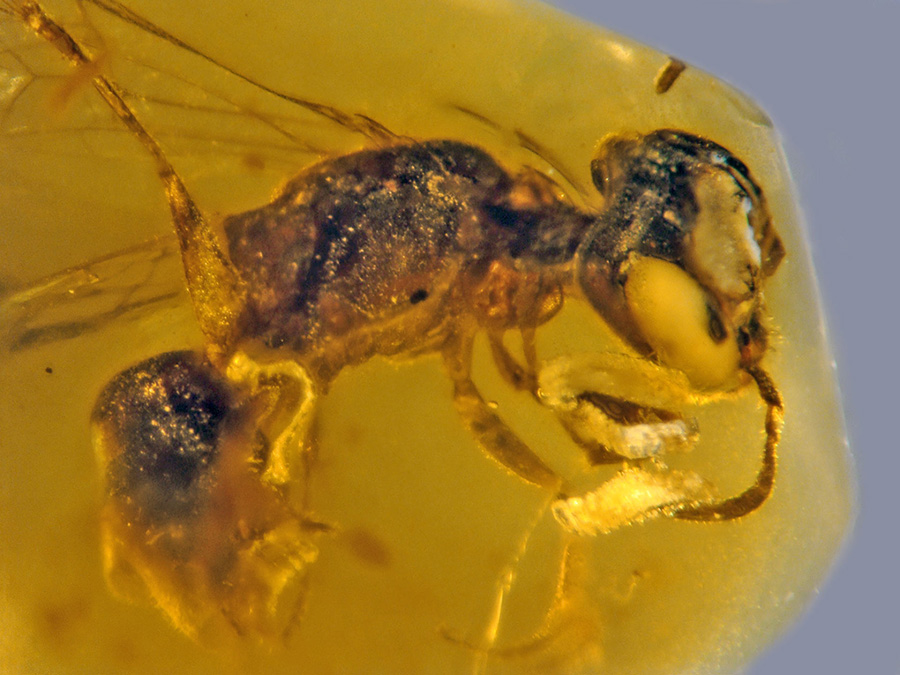
Discoscapa apicula; the bee is carrying four beetle triungulins. Image credit: George Poinar Jr. / College of Science, Oregon State University.

In a paper published online in the journal Palaeodiversity, Oregon State University’s Professor George Poinar Jr. described a new family, genus and species of pollen-collecting bee found in a piece of 99-million-year-old amber (mid-Cretaceous period) excavated from a mine in Myanmar.

Bees are an important component in the evolutionary history and diversification of flowering plants (angiosperms).

The great majority of bees depend on pollen, nectar, oils, waxes, scents and resins from flowering plants for adult and larval nutrition, sexual attractants and nest construction.

Bees evolved from apoid wasps, which are carnivores. Not much is known, however, about the changes wasps underwent as they made that dietary transition.

The newly-described primitive bee is so unique that Professor Poinar decided to establish a new genus and family (Discoscapidae) for it.

Named Discoscapa apicula, the ancient insect is a small, black, mostly hairless, pollen-collecting bee.

It shares traits with modern bees — including plumose hairs, a rounded pronotal lobe, and a pair of spurs on the hind tibia — and also those of apoid wasps, such as very low-placed antennal sockets and certain wing-vein features.

“Something unique about the new family that’s not found on any extant or extinct lineage of apoid wasps or bees is a bifurcated scape,” Professor Poinar said.

“The fossil record of bees is pretty vast, but most are from the last 65 million years and look a lot like modern bees.”

“Fossils like the one in this study can tell us about the changes certain wasp lineages underwent as they became palynivores — pollen eaters.”
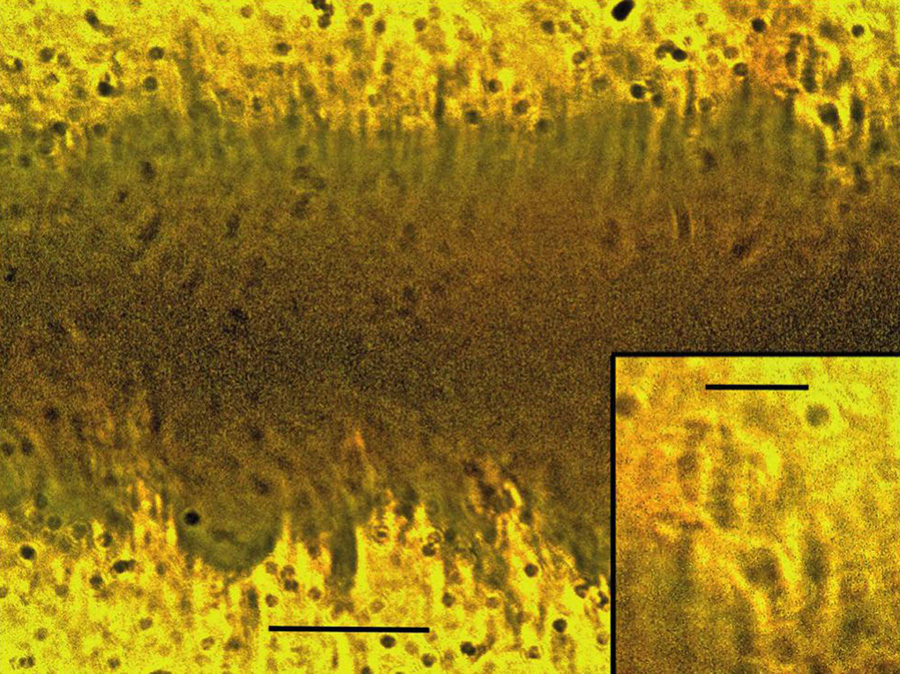
Pollen catching hairs with surrounding pollen grains on the hind leg femur of Discoscapa apicula in Burmese amber. The insert shows branches on hairs. Scale bars – 213 µm and 50 µm (insert). Image credit: Poinar Jr, doi: 10.18476/pale.v13.a1.

The single female specimen of Discoscapa apicula is positioned at the edge of a small piece of amber.

The specimen, which was obtained from a mine first excavated in 2001, in the Hukawng Valley, southwest of Maingkhwan in Kachin State in Myanmar, contains beetle parasites.

Pollen grains on its legs show that the bee had recently visited one or more flowers.

“Additional evidence that the fossil bee had visited flowers are the 21 beetle triungulins — larvae — in the same piece of amber that were hitching a ride back to the bee’s nest to dine on bee larvae and their provisions, food left by the female,” Professor Poinar said.

“It is certainly possible that the large number of triungulins caused the bee to accidentally fly into the resin.”

_____

George Poinar Jr. 2020. Discoscapidae fam. nov. (Hymenoptera: Apoidea), a new family of stem lineage bees with associated beetle triungulins in mid-Cretaceous Burmese amber. Palaeodiversity 12 (1): 1-9; doi: 10.18476/pale.v13.a1

Source: www.sci-news.com/

Neoepiblema acreensis: Giant Extinct Ancient Rodent Had a Tiny Brain

Thursday, February 13, 2020

Virtual brain endocast inside of the translucent skull of Neoepiblema acreensis (UFAC 4515) from the Upper Miocene of Brazil (a) and extant caviomorphs: (b) Hydrochoerus hydrochaeris (OUVV 10698); (c) Dinomys branickii (MCN-D 074); (d) Lagostomus maximus (CAPPA/UFSM-AC); (e) Coendou spinosus (MCN 355) (f) Chinchilla lanigera (OUVC 9529); (g) an artistic reconstruction of N. acreensis (by Márcio L. Castro). Credit: Biology Letters (2020). DOI: 10.1098/rsbl.2019.0914

A team of researchers with Universidade Federal de Santa Maria, Universidade Federal do Acre and the Paleontological Institute and Museum has discovered the ancient remains of a giant, extinct, tiny-brained rodent that once lived in South America. In their paper published in the journal Biology Letters, the group describes the skeletal remains they found and how the rodent likely appeared when alive.

While working in the State of Acre in what is now Brazil, the researchers uncovered an almost complete skull and a fragment of another skull from a previously unknown creature. That creature turned out to be the largest rodent ever known to have lived in South America. The researchers named the find Neoepiblema acreensis.

The nearly complete skull was in very good condition—it was so well preserved that the researchers were able to make out impressions made by the olfactory bulbs, which are parts of the brain involved in processing odors. They were also able to see where the frontal and temporal lobes had been. By looking at the size of the skull, the researchers were able to calculate the likely overall size of the rodent. They estimate the creature was approximately 1.5 meters in length and weighed approximately 80 kilograms—making it approximately the size of a full-grown human being. It also had very large incisors.

Further study of the skulls showed them both to be approximately 10 million years old. They also found that the creatures were extinct relatives of the modern pacaranas and chinchilla and that they lived in the western part of Brazilian Amazonia. Back then, before the area was a rainforest, it was a swamp, and South America was still cut off from both North America and Antarctica. The researchers also note that due to its large size, it was likely not the target of very many predators, though it would have made a nice meal for the giant crocodiles that lived in the area during the same time period. They also surmise that it was probably not very smart—its brain was small compared to the rest of its body, weighing in at just 113 grams.


More information: José D. Ferreira et al. Small within the largest: brain size and anatomy of the extinct Neoepiblema acreensis , a giant rodent from the Neotropics, Biology Letters (2020). DOI: 10.1098/rsbl.2019.0914

Journal information: Biology Letters 

Source: https://phys.org/

Jurassic World 3 May Bring Back [SPOILERS] For A Cameo

Saturday, February 15, 2020

Jurassic World: Fallen Kingdom didn’t exactly go down as well as its predecessor with fans of critics, but it still made a ton of money at the box office, enough for Universal to move forward with yet another sequel. After all, no movie that makes roughly $1.3 billion will ever be allowed to just sit on the shelf, with no follow-up being developed. Clearly, this series still has legs and sure enough, Jurassic World 3 is now gearing up to get in front of cameras.

Set to be with us in 2021, we don’t know a whole lot about it just yet, but Chris Pratt and Bryce Dallas Howard are set to return for more dinosaur hi-jinx, and they’ll be joined by some of the original Jurassic Park cast, with Sam Neill, Laura Dern and Jeff Goldblum all on board. But the fun doesn’t end there, as sources close to We Got This Covered – the same ones who told us Bill Murray would return for Ghostbusters: Afterlife, and that Transformers is being rebooted, both of which we now know to be true – say that the film may be bringing back another familiar face for a cameo.

The actor in question is Jake Johnson, who played Lowery in Jurassic World but opted not to return for the sequel, Fallen Kingdom. It’s unclear how he’ll factor into this next effort, but we’re told that it would just be a cameo and the studio hasn’t been able to lock him down just yet. Though they are trying to and hope to have him involved.

Obviously, it’d be great to see more of Lowery, even if it’s only via a cameo, and we’re certainly keeping our fingers crossed that he’ll return. But even if they ultimately fail to get him on board, it sounds like the studio is cooking up something pretty special with Jurassic World 3 and we can’t wait for it to roar into theaters on June 11th, 2021.

Source: https://wegotthiscovered.com/

Rare Disease Found in Kids, Discovered in Dinosaur Fossil

Friday, February 14, 2020

Photograph of the larger hadrosaur vertebra in lateral view (left) and caudal view (right). The space that contained the overgrowth opens to the caudal surface of the vertebra. Credit: Assaf Ehrenreich, Sackler Faculty of Medicine, Tel Aviv University

The fossilized tail of a young dinosaur that lived on a prairie in southern Alberta, Canada, is home to the remains of a 60-million-year-old tumor.

Researchers at Tel Aviv University, led by Dr. Hila May of the Department of Anatomy and Anthropology at TAU's Sackler Faculty of Medicine and Dan David Center for Human Evolution and Biohistory Research, have identified this benign tumor as part of the pathology of LCH (Langerhans cell histiocytosis), a rare and sometimes painful disease that still afflicts humans, particularly children under the age of 10.

A study on the TAU discovery was published on February 10 in Scientific Reports. Prof. Bruce Rothschild of Indiana University, Prof. Frank Rühli of the University of Zurich and Mr. Darren Tanke of the Royal Museum of Paleontology also contributed to the research.

"Prof. Rothschild and Tanke spotted an unusual finding in the vertebrae of a tail of a young dinosaur of the grass-eating herbivore species, common in the world 66-80 million years ago," Dr. May explains. "There were large cavities in two of the vertebrae segments, which were unearthed at the Dinosaur Provincial Park in southern Alberta, Canada."

It was the specific shape of the cavities that attracted the attention of researchers.

"They were extremely similar to the cavities produced by tumors associated with the rare disease LCH that still exists today in humans," adds Dr. May. "Most of the LCH-related tumors, which can be very painful, suddenly appear in the bones of children aged 2-10 years. Thankfully, these tumors disappear without intervention in many cases."

The dinosaur tail vertebrae were sent for on-site advanced micro-CT scanning to the Shmunis Family Anthropology Institute at TAU's Dan David Center for Human Evolution and Biohistory Research, Sackler Faculty of Medicine, which is located at the Steinhardt Museum of Natural History.

"The micro-CT produces very high-resolution imaging, up to a few microns," Dr. May says. "We scanned the dinosaur vertebrae and created a computerized 3-D reconstruction of the tumor and the blood vessels that fed it. The micro and macro analyses confirmed that it was, in fact, LCH. This is the first time this disease has been identified in a dinosaur."

According to Dr. May, the surprising findings indicate that the disease is not unique to humans, and that it has survived for more than 60 million years.

"These kinds of studies, which are now possible thanks to innovative technology, make an important and interesting contribution to evolutionary medicine, a relatively new field of research that investigates the development and behavior of diseases over time," notes Prof. Israel Hershkovitz of TAU's Department of Anatomy and Anthropology and Dan David Center for Human Evolution and Biohistory Research. "We are trying to understand why certain diseases survive evolution with an eye to deciphering what causes them in order to develop new and effective ways of treating them."


More information: Bruce M. Rothschild et al, Suggested Case of Langerhans Cell Histiocytosis in a Cretaceous dinosaur, Scientific Reports (2020). DOI: 10.1038/s41598-020-59192-z

Provided by Tel Aviv University


 Source: https://phys.org/

Meet Thanatotheristes degrootorum: T. Rex's Older Cousin "The Reaper of Death"

Tuesday, February 11, 2020

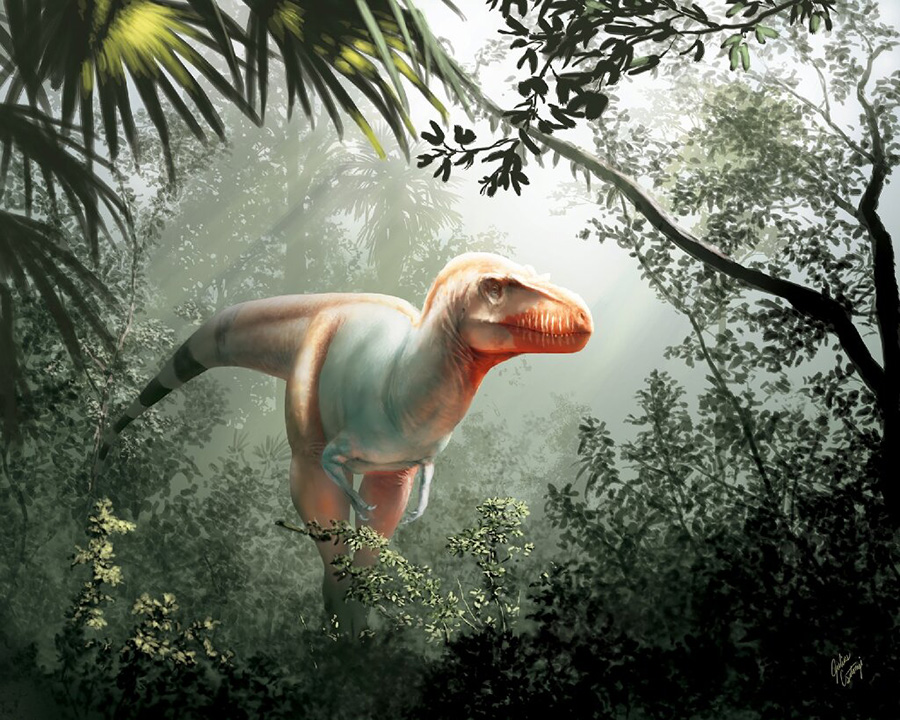
Thanatotheristes degrootorum. Image credit: Julius Scotonyi, Royal Tyrrell Museum.

A new species of tyrannosaurine dinosaur that lived about 79.5 million years ago (Cretaceous period) has been identified from fossils found in Alberta, Canada.

“We are thrilled to announce the first new species of tyrannosaur to be discovered in Canada in 50 years,” said Dr. François Therrien, curator of dinosaur paleoecology at the Royal Tyrrell Museum.

“The last tyrannosaur described from Canada was Daspletosaurus in 1970.”

The newly-identified species was approximately 8 m long (26.2 feet) and likely preyed on large plant-eating dinosaurs, such as the horned Xenoceratops and the dome-headed Colepiochephale.

Dubbed Thanatotheristes degrootorum, the ancient creature is the oldest tyrannosaur known from Canada and northern North America.

Researchers said Thanatotheristes degrootorum was around eight metres long and hunted around 80 million years ago

“This is the oldest occurrence of a large tyrannosaur in Canada, found in an older window of time than where previous tyrannosaurs have been found,” said Dr. Darla Zelenitsky, a dinosaur researcher at the University of Calgary.

“With this new species, we now know that tyrannosaurs were present in Alberta prior to 77 million years ago, the age of the next-oldest tyrannosaur,” Dr. Therrien added.

“We can tell from the skull how Thanatotheristes degrootorum is related to the other, better-known tyrannosaurs from Alberta.”

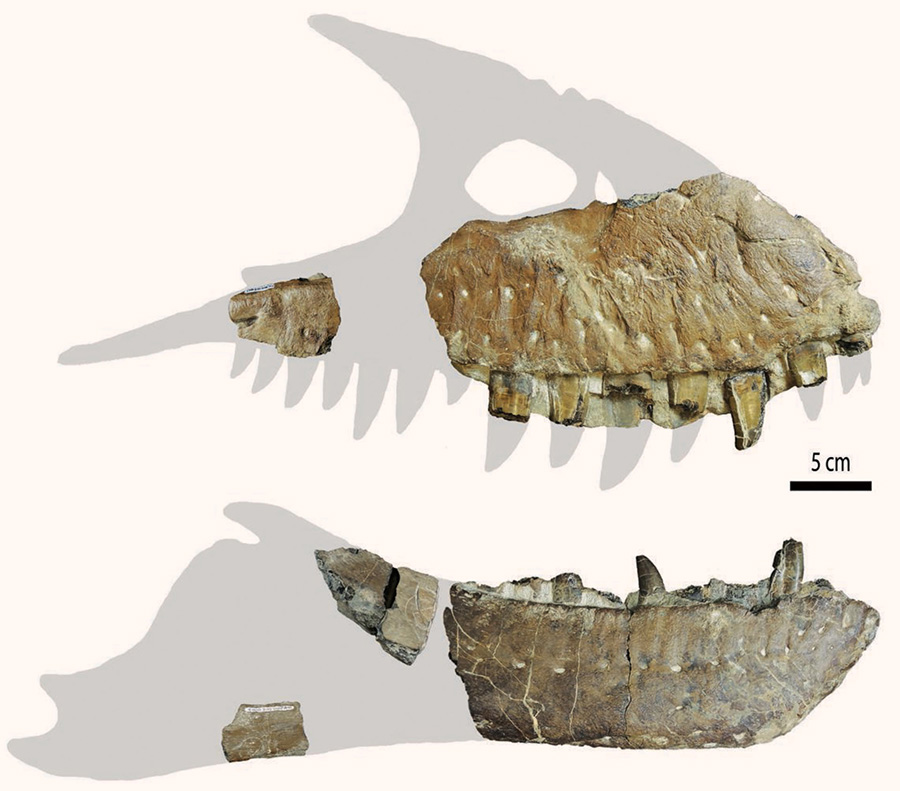
The jaw bones of Thanatotheristes degrootorum. Image credit: Jared Voris.

A partial skull and the upper and lower jaw bones of the new tyrannosaur were found by farmers and paleontology enthusiasts John and Sandra De Groot in 2010 near the town of Hays.

“The jawbone was an absolutely stunning find. We knew it was special because you could clearly see the fossilized teeth,” John De Groot said.

“John always said that one day he would find a dinosaur skull. Finding the jaw was exciting. Hearing that it is a new species, and seeing it given our family name, was beyond belief,” added Sandra De Groot.

The paleontologists found features of Thanatotheristes degrootorum’s skull that had not been seen before in other tyrannosaurs.

The fossil has several physical features, including ridges along the upper jaw, which clearly distinguishes it as being from a new species.

The diagnostic evidence showed that Thanatotheristes degrootorum is a close relative of two other well-known tyrannosaur species, Daspletosaurus torosus and Daspletosaurus horneri. All three species form a newly named group of dinosaurs called Daspletosaurini.

“This group had longer, deeper snouts and more teeth in the upper jaws than tyrannosaurs found in the southern U.S., which had shorter, bulldog-like faces,” said Jared Voris, a Ph.D. student at the University of Calgary.

“This discovery is significant because it fills in a gap in our understanding of tyrannosaur evolution,” Dr. Therrien said.

Thanatotheristes degrootorum provides scientists with insights into the tyrannosaur family tree, and shows that tyrannosaurs from the Cretaceous of Alberta were more diverse than previously known.”

The discovery is reported in a paper in the journal Cretaceous Research.

_____

Jared T. Voris et al. A new tyrannosaurine (Theropoda:Tyrannosauridae) from the Campanian Foremost Formation of Alberta, Canada, provides insight into the evolution and biogeography of tyrannosaurids. Cretaceous Research, published online January 23, 2020; doi: 10.1016/j.cretres.2020.104388

Source: www.sci-news.com/

Researchers Discover Unusually Large Bird Wing in Dinosaur-Era Amber

Tuesday, February 11, 2020

[Photo by Xing Lida]

An international team of researchers announced that they have discovered an amber containing parts of an "unusually large" ancient bird wing dating back around 99 million years.

The bird wing found in Hukawng Valley in northern Myanmar, an area rich in amber fossil discoveries, is expected to help enrich the understanding of the size of ancient birds, according to Xing Lida, a paleontologist from the China University of Geosciences.

The amber, 5.3 cm long and weighing 79.4 grams, contains a fragmentary right wing with length measures less than a centimeter. It is thought to belong to enantiornithines, a group of extinct birds commonly found in the Cretaceous Period, Xing said.

Some feathers have also been preserved, with the longest at 37 mm. "It likely belonged to an individual that was about 10 cm long from its snout to vent," said Xing. "It could be a large enantiornithine or a new species of enantiornithines."

The results of the research were published in Cretaceous Research.

Source: www.chinadaily.com.cn/

Finding the Elephant’s Long-Lost Relatives in Kutch: Deinotherium indicum

Sunday, February 9, 2020

Large mammal: An artist’s impression of Deinotherium showing flatter skulls than elephants.   | Photo Credit: Wikimedia commons

This find is the region’s first occurrence of the mammal and expands the species’ distribution range.

It was a pleasant January winter morning last year and Ningthoujam Premjit Singh along with his team was out on their excavation work at Kutch. When he stumbled upon a premolar tooth of about 6 cm width and 7 cm length, little did he know that what he held belonged to an extinct ancient elephant called Deinotherium indicum.

First occurrence
Interestingly, this turned out to be the region’s first occurrence of the mammal which weighed between eight and 10 tons in weight. Dr. Singh adds that this new find also expands the distribution range of this species, hitherto only known from two or three localities (Tapar of Gujarat, Haritalyangar in Himachal Pradesh, and Piram Island off the coast of Gujarat). It also increases our understanding of the variations in dental morphology of the South Asian Deinotheres species. Dr. Singh is a postdoctoral fellow at the Department of Geology at Panjab University and the first author of the paper recently published in the Journal of Paleontology.

Biostratigraphy
Using a technique called biostratigraphy, it was noted that D. indicum lived roughly between 11 and 7 seven million years ago in India. In biostratigraphy, the presence of certain species from a known time period can be used to estimate the age of a deposit containing the same species in a different locality. “Remains of D. indicum have been found in well-dated Siwalik deposits from Haritalyangar of Himachal Pradesh. Based on the similarity in species, we inferred a similar date for the Kutch’s D. indicum,” Advait M. Jukar from the Department of Paleobiology, National Museum of Natural History, Smithsonian Institution explains in an email to The Hindu. He is the co-first author and corresponding author of the paper.

He adds that definite dates can only be procured when paleomagnetic and radiometric studies are performed on the rocks that these fossils came from.

When asked how morphologically different this species is from today's elephants, he explained that though they had similar large bodies with column-like limbs, their heads were very different. “They had flatter skulls, and a set of downwards pointing, curved tusks only on the lower jaw. Analyses of their skulls have shown that they probably also had a short, slightly bulbous trunk. If you looked inside their mouths, all of their teeth would have erupted and were used in chewing at the same time. Modern elephants have only one tooth in use on each side of their jaw,” explains Dr. Jukar.

Distant relative
This species was a fairly distant relative of today’s elephants, both evolutionarily and in time. The deinotheriidae, the family that includes D. indicum, was first found in the fossil record approximately 28 million years old in Africa, but the family that includes modern elephants doesn’t appear until about eight million years ago.

The team plans to continue their studies in the Tapar beds of Kutch as it may be hiding many more fossils. “The plan now is to keep describing different species until we have a solid understanding of the diversity of vertebrates from western India. We hope to create a dataset of species occurrences through time in western India and compare the trends in diversity seen there with those seen in the well-studied fossil record from the Siwaliks,” adds Dr. Jukar.

Source: www.thehindu.com/

All The Places Where ‘Jurassic World’ Was Filmed

Sunday, February 9, 2020

Jurassic World: Gyrosphere (Behind the Scenes)

When Steven Spielberg released the first ‘Jurassic Park’ film way back in 1993, even he must have dared not predict the impact the film would have on the average moviegoer’s psyche. ‘Jurassic Park’ was not just a film; it was an experience. Right from the epic opening musical score by legendary Hollywood composer John Williams, to the ridiculously lifelike animatronics based special effects, the film remains a marvel of cinema to this day. This is part of the reason why the gap of nearly fourteen years between the third and the fourth movie in the franchise is a bit of a surprise. What is not a surprise, however, is the enormous hype and success garnered by the 2015 release of ‘Jurassic World’.

Despite featuring an entirely new cast boasting the likes of Chris Pratt, Bryce Dallas Howard, Vincent D’Onofrio and Jake Johnson, ‘Jurassic World’ is actually a direct sequel to the original ‘Jurassic Park’ trilogy, taking place over two decades after the events of the original ‘Jurassic Park’.

The story line borrows heavily from its predecessors, with the source of carnage and mayhem this time around being a vicious new hybrid dinosaur named Indominus Rex which escapes its enclosure in the Jurassic World luxury resort. Now, it is up to ex military badass and dinosaur training expert Owen Grady (played by Chris Pratt) to save as many people as he can with the assistance of Claire Dearing (played by Bryce Dallas Howard), the Jurassic World operations manager with whom he shares a romantic past.

If you were wondering where was ‘Jurassic World’ filmed, read on to find out everything we know.

Jurassic World Filming Locations

Like the original ‘Jurassic Park’, ‘Jurassic World’ is set in the fictional Central American island of Isla Nublar, which is now home to the Jurassic World theme park. In ‘Jurassic Park’, the scenes depicting Isla Nublar were filmed in multiple locations across Hawaii, and this is the case with ‘Jurassic World’ as well. Most of the exterior shots depicting the lush overgrowth of Isla Nublar were filmed on location in various parts of Hawaii including Oahu, Kauai, and Honolulu.

Some of the exterior scenes, as well as most of the interior scenes in ‘Jurassic World’, were shot on set in a studio in New Orleans, as well as in a number of other locations across Louisiana. Principal photography for the film began in April of 2014, concluding roughly four months later in August.

Kauai, Hawaii

Principal filming for ‘Jurassic World’ took place across two major islands in Hawaii including “the Garden Isle” of Kauai. This is in keeping with franchise traditions, as the first ‘Jurassic Park’ was also filmed on this island. Most of the outdoor filming took place at the Jurassic Kahili Ranch in Kilauea, Kauai. The ranch is a massively diverse natural property covering 2,800 acres and a number of breathtaking waterfalls, lush forests, mountains, ponds, and more.

The famous Kualoa Ranch also makes a brief appearance in the movie as the Dinosaur Island, as do the enchanting Manawaiopuna Falls, Hanapepe Valley. Both are prominent locations where filming for the original ‘Jurassic Park’ was also done.

Other locations in Kauai where ‘Jurassic World’ was filmed include the Na Pali Coast State Park, Olokele Valley, and the Blue Hole.

Oahu, Hawaii

Once again, ‘Jurassic World’ also revisits “The Gathering Place” island of Oahu, in Hawaii. The scene in the movie where the two boys jump off the top of a waterfall was filmed on location in Oahu, at the massive 150 foot tall Manoa Falls.

Limited filming also took place in Hawaii’s capital city of Honolulu in locations that include the Honolulu Zoo and the Hawaii Convention Center. 

New Orleans, Louisiana

While the bulk of the exterior filming took place in Hawaii, filming also continued on set in the culinary city of New Orleans. Production was based out of the Big Easy Studios in Gentilly Road, New Orleans, which is also the site for the filming of Tom Cruise’s ‘Jack Reacher: Never Go Back’.

The abandoned Six Flags New Orleans park parking lot and NASA’s Michoud Assembly Facility in New Orleans together were used to depict the Jurassic World theme park, which massive set constructions on both locations.

Source: www.thecinemaholic.com/

The Return To Jurassic Park is where Jurassic World: Evolution Truly Finds its Way

Saturday, February 8, 2020

(Image credit: Frontier)

Going back to the island with Jurassic World Evolution: Return To Jurassic Park.

Playing I like to think of myself as someone who is pretty much immune to nostalgia. I live in the now, because that's where all the best games are. But there's something about hearing that soaring John Williams theme that immediately transports me back to doodling stegosauri in the margins of my homework. So seeing that Jurassic World Evolution, the dinosaur zoo management game based on the more recent, more rubbish movies, was getting DLC that took you back to Isla Nublar? Yup, pretty much irresistible.

The Return To Jurassic Park campaign is meant for people already familiar with the game, I suspect. Mainly because a warning message pops up telling me exactly that. Naturally, I ignore it. What could possibly go wrong? Before I find out the answer to that question, I'm introduced to the premise of the campaign. Return describes itself as a 'what if' story. Namely, 'What if we'd managed to get Jeff Goldblum, Sam Neill and Laura Dern back for a sequel?'

(Image credit: Frontier)

And it is unmistakably them – no one does halting, stresses-never-quite-falling-where-you- expect-them line delivery like Goldblum. Honestly, though, I'm more impressed by everything else. It's the Jurassic Park font! The Jeeps! Those huge gates! And, oh, the dinosaurs! Frontier has done an excellent job of extracting their DNA from amber and bringing them to virtual life. But, to paraphrase Goldblum: that's how it always starts, the oohs and ahhs. And then... 

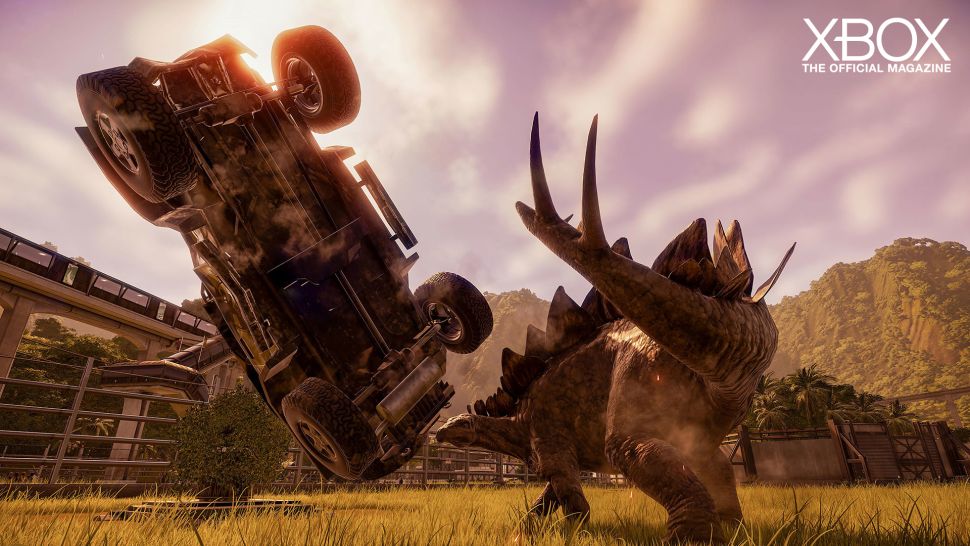
Literally 30 seconds into the game, I spot a velociraptor doing laps of the park. While the main cast calmly discuss chaos theory, the staff on the ground find themselves in rather more clear and present danger. And lo, as the man himself prophesied, there is running and screaming. Time to mobilise my rangers. It turns out I can steer the Jeep myself, which goes surprisingly well. I quickly track the raptor down, and go to ready the tranq rifle... except I don't do that. I hit the wrong button, and rename the Jeep instead. The game doesn't pause while I'm doing this, and the raptor gets away. Clever girl. Or, more accurately, stupid me.

(Image credit: Frontier)

I give in, read a few tooltips, and learn that I don't have to do this stuff manually. I can just cue up the task and let my (far more competent) staff handle it. Which is how I am taken by surprise by a Jeep bursting out of the nearby lake and starting to fire off tranq darts. It's not just the dinos who've been spliced with amphibian DNA, it seems. The raptor runs headlong at her attacker, ready for an aquatic showdown... at which point, she passes out and sinks to the bottom of the lake. Can dinosaurs drown? A menu tab informs me she has a 100 per cent comfort rating. So that's something, at least. 

This is just one of the dozens of misadventures I encounter over a couple of hours playing Return To Jurassic Park. There are storms, there are escapes, there's a triceratops who comes down with the common cold. I even manage to get in a few wins here and there, like scooping our tranquilised friend up from the lake bed and airlifting her back to dino-jail. And let's be honest, I reckon that alone is enough to make me a better administrator than John Hammond ever was. At least in my park you can enjoy a nice cup of water without getting it spilled all over the place.

Source: www.gamesradar.com/

Scientists ‘Resurrect’ Mutated Genes of Wrangel Island Mammoths

Saturday, February 8, 2020

Woolly mammoths (Mammuthus primigenius) were among the most abundant cold adapted species during the Pleistocene. Their once large populations went extinct in two waves, an end-Pleistocene extinction of continental populations followed by the mid-Holocene extinction of relict populations on St. Paul Island, a small island in the middle of the Bering Sea, 5,600 years ago, and on Wrangel Island, a remote Arctic refuge off the coast of Siberia, 4,000 years ago. To learn about the plight of these giant creatures and the forces that contributed to their extinction, a team of researchers has ‘resurrected’ Wrangel Island mammoths’ mutated genes. The goal was to study whether the genes functioned normally. They did not.

“The key innovation of our paper is that we actually resurrect Wrangel Island mammoth genes to test whether their mutations actually were damaging (most mutations don’t actually do anything),” said Dr. Vincent Lynch, an evolutionary biologist at the University at Buffalo.

“Beyond suggesting that the last mammoths were probably an unhealthy population, it’s a cautionary tale for living species threatened with extinction: if their populations stay small, they too may accumulate deleterious mutations that can contribute to their extinction.”

To conduct the study, Dr. Lynch and his colleagues first compared DNA of a Wrangel Island mammoth to that of three Asian elephants and two more ancient mammoths that lived when mammoth populations were much larger.

The scientists identified a number of genetic mutations unique to the Wrangel Island mammoth.

Then, they synthesized the altered genes, inserted that DNA into cells in Petri dishes, and tested whether proteins expressed by the genes interacted normally with other genes or molecules.

The researchers did this for genes that are thought or known to be involved in a range of important functions, including neurological development, male fertility, insulin signaling and sense of smell.

“In the case of detecting odors, for example, we know how the genes responsible for our ability to detect scents work,” Dr. Lynch said.

“So we can resurrect the mammoth version, make cells in culture produce the mammoth gene, and then test whether the protein functions normally in cells.”

“If it doesn’t — and it didn’t — we can infer that it probably means that Wrangel Island mammoths were unable to smell the flowers that they ate.”

This study builds on prior work by other scientists, such as a 2017 paper in which authors identified potentially detrimental genetic mutations in the Wrangel Island mammoth, estimated to be a part of a population containing only a few hundred members of the species.

“The results are very complementary,” Dr. Lynch said.

“The 2017 study predicts that Wrangel Island mammoths were accumulating damaging mutations.”

“We found something similar and tested those predictions by resurrecting mutated genes in the lab.”

“The take-home message is that the last mammoths may have been pretty sick and unable to smell flowers, so that’s just sad.”

The results were published in the journal Genome Biology and Evolution.

_____

Erin Fry et al. Functional architecture of deleterious genetic variants in the genome of a Wrangel Island mammoth. Genome Biology and Evolution, published online February 7, 2020; doi: 10.1093/gbe/evz279

Source: www.sci-news.com/

Pages