Blogs

5 Best Dinosaur Games 2020

Tuesday, February 4, 2020

Yes, you read that correctly. Today, we’re going to be taking a look at all the best dinosaur games out there. Now, while you think there wouldn’t be many, this list does include some must-play games for you to check out. 

We’ve rounded up some of the best dinosaur games from a number of different genres and platforms. If you’re looking for something new to play and love dinosaurs… you really have no excuse for not checking these titles out!

1. ARK: Survival Evolved

Release Date: August 27, 2017

Genre: Action-adventure survival video game

Developer: Studio Wildcard

Publisher: Studio Wildcard

If you are a fan of survival games then it’s definitely worth giving ARK: Survival Evolved a look. Once you spawn into the world, you’ll have to start from scratch in an environment filled to the brim with dangerous dinosaurs. 


This game has quite an interesting progression curve as well. The further you progress will see you learn how to tame these dangerous beasts and in some cases, create mounts to ride them!

If you’ve ever wanted to live in your own little dinosaur paradise then this is a great way to pass the time. You can enjoy the experience with a group of friends if you need a bit of friendly company in this hostile environment.

2. Jurassic World Evolution

Release Date: 12 June 2018

Genre: Business simulation

Developer: Frontier Developments

Publisher: Frontier Developments

While we were very tempted to fill this slot with Zoo Tycoon: Dinosaur Digs, this is only an expansion pack for an existing non-dinosaur game. We went for a more recent dinosaur business simulator instead in the form of Jurassic World Evolution


This game tasks the player with the challenge of doing something the Jurassic Park movies couldn’t – creating a dinosaur theme park that doesn’t fall to pieces on the first day! You have full control over how to build your park, the direction your research will take and even the ability to mess with the dinosaur DNA to make your exhibits even more terrifying!

If you’re a fan of park building games then this is an interesting spin on the existing formula. 

3. Lego Jurassic World

Release Date: 12 June 2015

Genre: Action-adventure

Developer: TT Fusion

Publisher: Warner Bros. Interactive Entertainment

There seems to be a Lego game for almost everything these days, we’ve had Lego Star Wars, Lego Lord of the Rings, Lego Marvel but more importantly for this list, we have Lego Jurassic World


For anybody that has played a Lego game in the past, they’ll feel right at home here. This title follows the story of the original Jurassic Park trilogy along with the first Jurassic World movie (and yes, you’ll be able to interact with a Lego Jeff Goldblum in this game don’t worry!).

These games are great when played with friends. Lego games have some of the most enjoyable co-op available. You’ll be able to play as some of your favorite characters in the Jurassic Park universe alongside a huge number of Lego dinosaurs as well.

4. Turok: Dinosaur Hunter

Release Date: March 4, 1997

Genre: First-person shooter

Developer: Iguana Entertainment

Publisher: Acclaim Entertainment

Originally a title for the Nintendo 64, Turok: Dinosaur Hunter has recently made its way to the Nintendo Switch with a pretty faithful port of the original. Players will have to explore a world filled with traps, puzzles, deadly weapons and, of course, dinosaurs. 

With mechanics similar to the Quake-style of games, the action in Turok is often frantic and fast-paced. If you don’t move fast, you’ll soon find yourself overrun by the horde of dinosaur enemies that are aiming to destroy you. This is fast-paced action at its best and a great first-person shooter to sink your teeth into.

5. Yoshi’s Crafted World

Release Date: March 29, 2019

Genre: Platform, side-scrolling

Developer: Good-Feel

Publisher: Nintendo

While this may be a bit of a stretch, everybody’s favorite dinosaur is Yoshi, right? It’s only fair that he gets a spot on the list. While we could have gone for Yoshi’s more famous outing in Super Mario World 2: Yoshi’s Island, Yoshi’s Crafted World is a lot more accessible to find these days.

Yoshi’s Crafted World has a beautiful cardboard aesthetic that makes each environment you play in look both stunning and unique. There are lots of activities to do in the world, you can pass your time exploring, gathering collectibles and completing the stages of the main quest.

Final Word

Well there you have it, we’ve managed to come up with what we think is a quite diverse dinosaur-related list. If you are a fan of dinosaurs and video games in general then some of these will be great additions to your game library. 

Have we missed a title that would fall on your best dinosaur games list? If so, be sure to let us know in the comments section below. We love hearing your thoughts, especially when it comes to niche gaming areas.

Source: www.wepc.com/

Sharks in Kentucky? What Explorers Found in Mammoth Cave is Blowing Researchers' Minds

Thursday, January 30, 2020

During a trip to Mammoth Cave National Park in November, paleontologist John-Paul Hodnett was stunned.

Preserved in the walls of the cave were parts of a large, fossilized shark head — from a shark that lived about 330 million years ago. 

The discovery began when Mammoth Cave specialists Rick Olson and Rick Toomey came across the fossils as they explored and mapped the cave system. They sent photos to Vincent Santucci, the senior paleontologist for the National Park Service in Washington, D.C., for help identifying the fossils. 

Santucci then sent Hodnett, a paleontologist and program coordinator at Dinosaur Park in Maryland, to help with what became the "Mammoth Cave National Park Fossil Shark Research Project."

Some of the shark fossils in the photos were identifiable, but Hodnett said what got him really excited was something else.

"One set of photos showed a number of shark teeth associated with large sections of fossilized cartilage, suggesting there might be a shark skeleton preserved in the cave," he said. 

Researchers discovered fossilized remains of a 330-million-year-old shark in Mammoth Cave. (Photo: Provided by Matt Cecil)

Fossils of shark skeletons are rare because cartilage does not typically survive fossilization. Shark teeth, however, are made of bone and enamel and preserve well. Since sharks replace their teeth throughout their lives, shark teeth are one of the most common fossils on the planet, Hodnett said.

"I wasn't exactly sure what I was going to see in the cave during my trip in November," Hodnett said. "When we got to our target specimen my mind was blown."

The fossils weren't parts to a full skeleton, but parts of a head that belonged to a shark, about the size of a Great White Shark, which ranges in length from 11 feet to 21 feet.

Based on what was exposed in the cave wall, Hodnett said the find includes a lower jaw, skull cartilage and several teeth. Hodnett determined the shark belonged to a species called "Saivodus striatus" from the Late Mississippian period, about 330 to 340 million years ago. 

Hodnett said the time period is not well-represented in North America but is well-known in Europe.

"Most significantly, the majority of the shark fossils we discovered come from a layer of rock that extends from Missouri to Virginia but never documented the presence of sharks, until now," he said. "It's like finding a missing puzzle piece to a very big picture."

Thanks to the slow erosion of the limestone in the cave, the shark teeth are mostly intact and extremely detailed.

The back of the lower jaw of the Saivodus shark starts by the hand, and the front edge of the jaw sticks out at the opposite end. (Photo: Provided by John-Paul Hodnett)

More than 100 individual specimens have been discovered during the project. Hodnett said teeth and dorsal fins of other shark species are also exposed in the cave ceiling and walls. 

"We've just scratched the surface," Hodnett said. "But already it's showing that Mammoth Cave has a rich fossil shark record."

Because the National Park Service has experienced fossil theft and vandalism in the past, it does not release information about the specific location of fossils found in its parks.

"We want the public to benefit from the scientific information, but at the same time we have a duty to protect these non-renewable resources," Santucci said.

Hodnett said the team is working on presenting a preliminary account of the project in October at the Society of Vertebrate Paleontology meeting in Cincinnati.

Source: www.courier-journal.com/

When Did Dinosaurs Evolve in North America, When the Fossil Record Is Not Even Definite?

Tuesday, January 28, 2020

Collage: Jose-Luis Olivares/MIT (original background photograph courtesy of Malka Machlus from Lamont-Doherty Earth Observatory of Columbia University)

Dinosaurs are accepted to be dominant in the Jurassic and Cretaceous periods, ruled the earth for 135 million years. Many fossils were found that point to many habitats with them existing there. But, one conundrum makes it mysterious, that is when did the first dinosaur exist in the geological period. There is all this information but no definite answers, when did dinosaurs come to be in North America?

Based on fossils found in Argentina, a good estimate when they came to be in the Late Triassic (230 million years ago MYA). It was when Pangaea the supercontinent existed, another school of thought is that fossils North America were until 212 (million years ago MYA) and later in South America. Other ideas are a vast desert that prevented migration across the continent.

Scientists at MIT are no satisfied and have arguments about the subject. Here are some of the ideas that do not connect, based on current ideas of their actual beginning.

 a. Some problems like non-dinosaur relatives were living with proto-dinosaurs. It gets more unclear when more advance dinosaurs are living at the same time 12 million years too.

 b. There is a 16-million-year gap with no living vertebrate fossils found. It might have been pieces of rocks from that period which eroded from then on?

 c. This gap is weird because it should have fossils in there and theories point to South America. From there, they just spread all over the globe, but it seems implausible.

To date, early saurian evolution is best seen in Argentina, with very distinct layers as the dinosaur species evolved and with fossils as evidence. Late Triassic, after the Jurassic, is where proto-dinosaurs began turning to what became "dinosaurs". After this period, the dinosaurs were evolved and became the creatures that ruled the earth. At this point, fossil records were stratified and clear, some overlapping evolutionary processes but still regular.

When the fossil records in North America, it is not clear at all. Triassic fossils are plentiful in the layers of rock, it is the Chinle Formation specifically. This is of particular interest because of these places like Arizona, New Mexico, Utah, Colorado, and the Petrified Forest National Park where most fossils are found. These areas have been dated, the first discoveries are in Mexico, which is as old as 212 million years ago.

One way to confirm the age of the formations where fossils are found, especially the Chinle Formation and taking sample sediments from it. Crushing the rocks to find zircon, which has uranium-containing minerals that form before volcanic activity. This method will measure, the zircon based on uranium, to lead isotopes and see how old the zircon is. Another reason this is done is the spot where it originated in the bedrock. Another wrinkle to add is the Blue Mesa locality of the Petrified Forest National Park which has a lot of late Triassic rocks. One of the oldest strata that are found to have dinosaur fossils.

Analyzing the zircons will map the ages of sedimentary rock, that delineate the Chinle Formation. Based on the dating method, Arizona fossil is older than those in New Mexico by 223 million years ago (MYA). Both evolved, and proto-dinosaur were extant at the same time.

 A gap presented by the Chinle Formation is the problem and cannot reconcile the 16-million-year gap when dinosaurs evolved in North America. From co-habiting in a simultaneous time frame that needs more information, the solution is yet to be thought of.

Source: www.sciencetimes.com/

FUNKO Launches Funkoverse: Jurassic Park Strategy Game After London Toy Fair Debut

Tuesday, January 28, 2020

Funko is expanding the Funkoverse universe with the launch of new Jurassic Park board games.

Following the successful release of Funko’s new product offering, the line of Funkoverse board games, the leader in collectible merch has released new additions to the world of Funkoverse.

Funko has unveiled the new Funko Pop! Funkoverse: Jurassic Park Strategy Game, along with a standalone Funko Pop! Funkoverse: Jurassic Park Expandalone that are both slated for release on March 4.

The Funkoverse: Jurassic Park Strategy Game will retail at $39.99, while the Funkoverse: Jurassic Park Expandalone is priced at $24.99.

Customers can now pre-order them at major retail outlets like Amazon.com following their debut at the London Toy Fair this 2020.

The Funko Pop! Funkoverse: Jurassic Park Strategy Game lets players battle against friends as they control characters from the blockbuster film franchise Jurassic Park. The board comes with two playable maps that users can play as a standalone game or as an addition to other Funkoverse games. This set includes 4 Characters: Doctor Grant, Ellie Satler, John Ray Arnold, and Velociraptor. There are also 4 Character Bases, 4 Character Cards, 2 Basic Characters, 2 Basic Character Cards, 2 Double-Sided Scenario Cards, 2 Item Cards, 2 Status Cards, 2 Cooldown Tracks, 1 Double-Sided Map, 12 Game Tokens, 15 Game Markers, 6 Dice, 21 Points, 1 First Player Marker and Instructions.

Meanwhile, the Funko Pop! Funkoverse: Jurassic Park Expandalone comes with Dr. Ian Malcolm and T-Rex, along with 2 Characters, 2 Character Bases, 2 Character Cards, 2 Basic Characters, 2 Basic Character Cards, 2 Double-Sided Scenario Cards, 1 Item Card, 3 Status Cards, 2 Cooldown Tracks, 1 Double-Sided Map, 6 Game Tokens, 13 Game Markers, 6 Dice, 11 Points, 1 First Player Marker and Instructions.

The Jurassic Park Expandalone Funkoverse board games is pretty much the smaller version of the Jurassic Park Strategy Game.

They are the perfect gifts for any Jurassic Park fan.

Pre-order them now on Amazon.com before other Jurassic Park fans find out about them.

Follow Paleontology World on Facebook, Instagram and Pinterest.

Source: www.i4u.com/

Top 10 Jurassic Park Gifts Fans Actually Want

Tuesday, January 28, 2020

Summary List

Jurassic Parklater known as Jurassic World is a timeless series of action and adventure that started with a book by the same name. Michael Crichton wrote a scientific thriller that eventually leads to Steven Spielberg himself directing the 1993 classic. With 5 movies and a multitude of other media from games to books, Jurassic Park isn't slowing down. With the originals holding up due to their acting and impressive use of CGI and puppets/animatronics, this series has cemented itself as perfect couch movies for any age.

With that in mind, we thought it would be fun to showcase the cool collectibles and merch that Jurassic Park has amassed over the years!

1. Jurassic World Super Colossal Velociraptor Blue

Jurassic World's iconic Velociraptor, Blue, returns. 

But don't worry, he's on our side! At over 18 inches high and 3 1/2 feet long, this Jurassic World Super Colossal Velociraptor looms over the other dinosaurs.

With super-realistic skin and his iconic blue stripe, this velociraptor tears down the other dinosaurs with biting and scratching motions. With a multitude of articulations, swing and fight with deadly accuracy. Open up his jaw to eat up to 20 mini action figure dinosaurs whole, showing who the true apex predator is.

2. LEGO Jurassic World Blue’s Helicopter Pursuit 75928 Building Kit

With a multitude of adventures to be had, follow the cast of Jurassic World as they take on a world full of dinosaurs.

Owen and Wheatley pursue Blue, trying to track him down. With the help of a pilot, get the higher ground and try to keep Blue, the Velociraptor, safe but returned home!

With rotating helicopter blades and a stud capture gun, take to the skies! With almost 400 pieces and 5 minifigs (including Blue), mark your own dinosaur adventure!

3. Jurassic Park Vintage Logo Snapback Hat With Pre-Curved Bill

Represent the coolest dinosaur franchise around with this Jurassic Park Vintage Logo Snapback Hat with Pre-curved Bill.

This officially licensed product is perfect for fans of comfort and style, with the iconic Jurassic Park logo and a slightly weathered look to the hat. Block out the sun and the impending doom of a dinosaur takeover with this wool snapback. One size fits most, so be comfy no matter what - make sure to hand wash this T-rex emblazoned apparel.

4. Megaraptor Dinosaur Life Size Extra Large Claw Fossil Replica

Be a true Paleontologist with this Megaraptor Dinosaur Life Size Extra Large Claw Fossil Replica. This fossil replica was made by Grant Field Specimens and is of the Megaraptor family, aka megaraptor namunhuaquii. These large creatures were found in the Late Cretaceous period, long before humans.

This claw is an actual cast of a real Megaraptor claw, found in Patagonia Argentina at the Rio Nequen Formation. Wow your friends with this super-realistic cast, with exquisite detail in every corner.

5. Jurassic Park Mug 25th Anniversary Raptor Egg Molded Ceramic Coffee Cup

Although very valuable, there's no use in taking Raptor eggs from the Parks. These smart creatures will track you down in no time!

Instead, let's stick with a cool Raptor Egg Molded Ceramic Coffee Cup. With a 10 oz capacity, drink your favorite beverage with the joy of knowing this mug is cooler than your friends' mugs.

Marking the 25 anniversary of the series, this mug also has the iconic logo and font cast across it.

6. Jurassic Park: A Novel

What better way to commemorate the series than with the origin? Jurassic Park is a novel by Michael Crichton.

Follow paleontologist Alan Grant and paleobotanist Ellie Sattler as they travel to a mysterious island off of the coast of Costa Rica. What follows is a wild ride of dino-DNA and humans dabbling in something far bigger than them.

Fans old and new will enjoy the written form of this stellar series, with a few twists not seen in the movie to keep the experience fresh.

7. Ellusionist Jurassic Park Playing Card Deck

Ellusionist is known for their intricate yet subtle playing cards. With a smoothness perfect for regular play and magicians alike, this B9 card stock is elegant and durable.

Ellusionist made sure to work with Universal Studios to create a gorgeous design for the cards, featuring the Park itself as the major theme. With an archaic feel, these cards won our hearts with the dinosaur bone print and rustic colors that perfectly matched the movie series.

8. Jurassic Park Looksee Gift Box

Not sure what to get your dino-loving friend? Or perhaps you're looking for something unique for yourself. You've come to the right place! This Jurassic Park Loksee Gift Box features 5 Official Jurassic Park-themed items for fans of all ages.

First up is the tin itself! This square tin is 7.75 inches and bears the ever-loved Jurassic Park logo. Also included is infamous barbasol can, now in tin form to store your valuables! Also included is a unique Japanese Jurassic Park mini-mug, along with a cool Park-themed ticket magnet. There are so many cool gifts in one package, with even a dino fossil coaster to boot!

9. Jurassic Park 25th Anniversary Collection 4K Blu-Ray

Celebrate 25 Years of Dino adventures with this Jurassic Park 25th Anniversary Collection in 4K Blu-ray.

Start from the beginning with Jurassic Park, where we first meet the DNA of Dinos being brought back to life at Jurassic Park itself. From the tiniest of dinos to the gigantic T-Rex, plight through this fun thriller in all of its 4K glory.

Pick up the following three adventures over the next 25 years, including The Lost World, Jurassic Park 3, and Jurassic World.

10. Jurassic Park Classic Logo T Rex Kids Youth Pullover Hoodie & Stickers

Survive the colds of winter in style with this Jurassic Park Classic Logo T Rex Youth Pullover Hoodie. Featuring one of the most memorable logos to date, wear it knowing you can watch these cool movies without having to ever face dinos in real life!

With a comfy blend of Cotton and Polyester, your teen/kid will be the coolest kid around.

Also included are two stickers including the Jurassic Park logo alongside a threatening T-Rex, about to chomp your hands off!

We hope you like the items we recommend! PW has affiliate partnerships, so we receive a share of the revenue from your purchase. This won’t affect the price you pay and helps us offer the best product recommendations.

Source: https://screenrant.com/

Colin Trevorrow has a Name in Mind for Jurassic World 3, but it isn't Extinction

Tuesday, January 28, 2020

Colin Trevorrow might be getting a lot of buzz right now for his version of Star Wars: Episode IX that we'll never get to see, but the writer/director is, in fact, working on closing out a trilogy of his own in the Jurassic World franchise. The final movie of the second Jurassic Park trilogy is currently in production and while there's a lot likely still to be determined, it seems the movie that we're calling Jurassic World 3 for simplicity's sake does have an official title. Colin Trevorrow isn't telling us what it is, but he is telling us what it isn't.

A thread on Twitter recently started to spitball ideas on what Jurassic World 3 might be called and director Colin Trevorrow has been lurking in the thread to see what fans are coming up with, and while he's not giving away the title that he's come up with, he has but some fans at ease by confirming the movie won't be called Jurassic World: Extinction.

It's certainly true that Extinction feels like a title that is so obvious that it should be avoided. It's quite possible that, by the end of Jurassic World 3, all the dinosaurs will be gone once again, and will therefore return to being "extinct." Of course, the title could also tease the possibility that it will, in fact, be the human race that will be extinct by the time the movie is over, giving the title a sort of double meaning. It feels exactly like the move that Hollywood would make, which makes it much less interesting.

Colin Trevorrow confirms to us all that the movie isn't called that. However, he also confirms to another fan that the movie does have a title. Whether he's had it from the beginning or only recently locked it in, there is a title for the film.

Jurassic World 3 is still over a year away, set to release in June of 2021, which means promotion for the movie isn't likely to really get rolling until late this year. It's possible we could get a title reveal with a poster or something similar before the first trailer release, but if we don't see a trailer until this fall it's possible we won't know what the mysterious title is until then.

Of course, even once we know the title, it doesn't mean we'll know too much about the movie. Jurassic World: Fallen Kingdom didn't exactly explain its plot with its title, so we shouldn't expect that to happen here. Having said that, we do know what Jurassic World 3 will be about ultimately, as it will see dinosaurs roaming freely in the human world, and show how humanity is dealing with the new threat.

What do you think Jurassic World 3 will be called? Let us know in the comments.

Source: www.cinemablend.com/

A Squid Fossil Offers a Rare Record of Pterosaur Feeding Behavior

Tuesday, January 28, 2020

A Rhamphorhynchus pterosaur tries and fails to snatch a Plesioteuthis squid from the surface of the ocean in this artist's impression.  CHRISTIAN KLUG

A tooth embedded in a squid fossil tells a story of a battle at sea with the flying reptile.

A fossil of a squid with a pterosaur tooth embedded in it offers extraordinary evidence of a 150-million-year-old battle at sea. While many pterosaur fossils containing fish scales and bones in their stomachs have revealed that some of these flying reptiles included fish in their diet, the new find from Germany is the first proof that pterosaurs also hunted squid.  

The fossil was excavated in 2012 in the Solnhofen Limestone, near Eichstätt in Bavaria, where many Jurassic Period fossils of pterosaurs, small dinosaurs and the earliest known bird, Archaeopteryx, have been found. The region’s environment at the time was something like the Bahamas today, with low-lying islands dotting shallow tropical seas.

The embedded tooth fits the right size and shape for the pterosaur Rhamphorhynchus, paleontologists report online January 27 in Scientific Reports. They argue that the tooth was left by a pterosaur that swooped to the ocean surface to snap up the 30-centimeter-long squid from the extinct Plesioteuthis genus, but was unsuccessful, possibly because the squid was too large or too far down in the water column for the predator to manage.

“The Plesioteuthis squid wrestled it off and escaped, breaking at least one tooth off the pterosaur, which became lodged in [the squid’s] mantle,” says Jordan Bestwick, a paleontologist at the University of Leicester in England. “This fossil is important in helping us understand the dietary range of Rhamphorhynchus, and tells us about its hunting behavior.”

This well-preserved fossil of a 30-centimeter-long Plesioteuthis squid has the tooth of a pterosaur embedded in its mantle. RENÉ HOFFMAN

The fossil itself is unique, according to pterosaur researcher Taíssa Rodrigues at the Federal University of Espírito Santo in Vitorio, Brazil, who was not involved in the study. “It is very rare to find predator-prey interactions that include pterosaurs,” she says. “In the few cases we do have, pterosaurs were the prey of large fish. So it is great to see this the other way around.”

Paleontologist Michael Habib of the University of Southern California in Los Angeles says he suspects the squid was far too large for the pterosaur to haul out of the water. “The pterosaur was lucky that the tooth broke off,” says Habib, who was not involved with the study. “A squid of that size could probably have pulled it under.”

CITATIONS

R. Hoffman et al. Pterosaurs ate soft-bodied cephalopods (Coleoidea)Scientific Reports. Published online January 27, 2020. doi: 10.1038/s41598-020-57731-2 . 

Source: www.sciencenews.org/

New Species of Allosaurus Discovered in Utah

Saturday, January 25, 2020

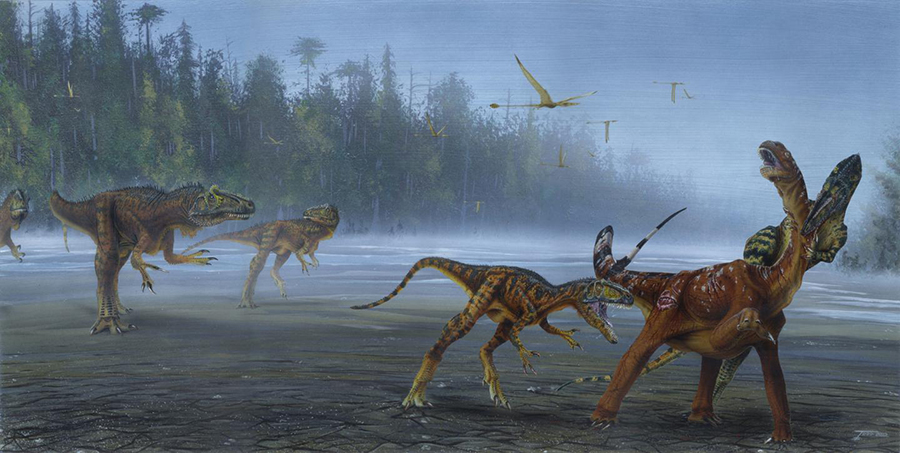
Allosaurus jimmadseni attack juvenile sauropod.  CREDIT: Todd Marshall

A remarkable new species of meat-eating dinosaur has been unveiled at the Natural History Museum of Utah. Paleontologists unearthed the first specimen in early 1990s in Dinosaur National Monument in northeastern Utah. The huge carnivore inhabited the flood plains of western North America during the Late Jurassic Period, between 157-152 million years ago, making it the geologically oldest species of Allosaurus, predating the more well-known state fossil of Utah, Allosaurus fragilis. The newly named dinosaur Allosaurus jimmadseni, was announced today in the open-access scientific journal PeerJ.

The species belongs to the allosauroids, a group of small to large-bodied, two-legged carnivorous dinosaurs that lived during the Jurassic and Cretaceous periods. Allosaurus jimmadseni, possesses several unique features, among them a short narrow skull with low facial crests extending from the horns in front of the eyes forward to the nose and a relatively narrow back of the skull with a flat surface to the bottom of the skull under the eyes. The skull was weaker with less of an overlapping field of vision than its younger cousin Allosaurus fragilisAllosaurus jimmadseni evolved at least 5 million years earlier than fragilis, and was the most common and the top predator in its ecosystem. It had relatively long legs and tail, and long arms with three sharp claws. The name Allosaurus translates as "different reptile," and the second part, jimmadseni, honors Utah State Paleontologist James H. Madsen Jr.

Following an initial description by Othniel C. Marsh in 1877, Allosaurus quickly became the best known--indeed the quintessential--Jurassic theropod. The taxonomic composition of the genus has long been a debate over the past 130 years. Paleontologists argue that there are anywhere between one and 12 species of Allosaurus in the Morrison Formation of North America. This study recognizes only two species--A. fragilis and A. jimmadseni.

"Previously, paleontologists thought there was only one species of Allosaurus in Jurassic North America, but this study shows there were two species--the newly described Allosaurus jimmadseni evolved at least 5 million years earlier than its younger cousin, Allosaurus fragilis," said co-lead author Mark Loewen, research associate at the Natural History Museum of Utah, and associate professor in the Department of Geology and Geophysics at the University of Utah led the study. "The skull of Allosaurus jimmadseni is more lightly built than its later relative Allosaurus fragilis, suggesting a different feeding behavior between the two."

"Recognizing a new species of dinosaur in rocks that have been intensely investigated for over 150 years is an outstanding experience of discovery. Allosaurus jimmadseni is a great example of just how much more we have to learn about the world of dinosaurs. Many more exciting fossils await discovery in the Jurassic rocks of the American West," said Daniel Chure, retired paleontologist at Dinosaur National Monument and co-lead author of the study.

George Engelmann of the University of Nebraska, Omaha initially discovered the initial skeleton of the new species within Dinosaur National Monument in 1990. In 1996, several years after the headless skeleton was collected, the radioactive skull belonging to the skeleton using a radiation detector by Ramal Jones of the University of Utah. Both skeleton and skull were excavated by teams from Dinosaur National Monument.

"Big Al," another specimen belonging to the new species, was discovered in Wyoming on United States Bureau of Land Management (BLM) land in 1991 and is housed in the collections of the Museum of The Rockies in Bozeman, Montana. Previously thought to belong to Allosaurus fragilis, "Big Al" was featured in the BBC's 2001 "Walking with Dinosaurs: Ballad of Big Al" video. Over the last 30 years, crews from various museums have collected and prepared materials of this new species. Other specimens include "Big Al Two" at the Saurier Museum Aathal in Switzerland and Allosaurus material from the Dry Mesa Quarry of Colorado at Brigham Young University.

"This exciting new study illustrates the importance of continued paleontological investigations on public lands in the West. Discovery of this new taxon of dinosaur will provide important information about the life and times of Jurassic dinosaurs and represents another unique component of America's Heritage," said Brent Breithaupt, BLM regional paleontologist.

Early Morrison Formation dinosaurs were replaced by some of the most iconic dinosaurs of the Late Jurassic

Allosaurus jimmadseni lived on the semi-arid Morrison Formation floodplains of the interior of western North America. The older rocks of the Morrison Formation preserve a fauna of dinosaurs distinct from the iconic younger Morrison Formation faunas that include Allosaurus fragilis, Diplodocus and Stegosaurus. Paleontologists have recently determined that specimens of this new species of dinosaur lived in several places throughout the western interior of North America (Utah, Colorado and Wyoming).

Study summary

Dinosaurs were the dominant members of terrestrial ecosystems during the Mesozoic. However, the pattern of evolution and turnover of ecosystems during the middle Mesozoic remains poorly understood. The authors report the discovery of the earliest member of the group of large-bodied allosauroids in the Morrison Formation ecosystem that was replaced by Allosaurus fragilis and illustrate changes acquired in the genus over time. The study includes an in-depth description of every bone of the skull and comparisons with the cranial materials of other carnivorous dinosaurs. Finally, the study recognizes just two species of Allosaurus in North America with Allosaurus fragilis replacing its earlier relative Allosaurus jimmadseni.

Fact sheet: Major points of the paper

  • A remarkable new species of meat-eating dinosaur, Allosaurus jimmadseni, is described based on two spectacularly complete skeletons. The first specimen was unearthed in Dinosaur National Monument, in northeastern Utah.
  • Allosaurus jimmadseni is distinguished by a number of unique features, including low crests running from above the eyes to the snout and a relatively narrow back of the skull with a flat surface to the bottom of the upper skull under the eyes. The skull was weaker with less of an overlapping field of vision than its younger cousin Allosaurus fragilis.
  • At 155 million years old, Allosaurus jimmadseni is the geologically-oldest species of Allosaurus predating the more well-known State Fossil of Utah Allosaurus fragilis.
  • Allosaurus jimmadseni was the most common and the top predator in its ecosystem. It had relatively long legs and tail, and long arms with three sharp claws.

Study design

  • Comparison of the bones with all other known allosauroid dinosaurs indicate that the species possessed unique features of the upper jaw and cheeks (maxilla and jugal) and a decorative crest stretching from just in front of the eyes to the nose.
  • Many of the comparisons were made with the thousands of bones of Allosaurus fragilis collected from the famous Cleveland-Lloyd Dinosaur Quarry administered by the Bureau of Land Management that are housed in the collections of the Natural History Museum of Utah.
  • On the basis of these features, the scientific team named it a new genus and species of dinosaur, Allosaurus jimmadseni (translating to "Jim Madsen's different reptile").
  • Allosaurus jimmadseni is particularly notable for its slender, narrow skull with short sharp nasal crests compared to its close relative and successor Allosaurus fragilis.
  • The study was funded in part by the University of Utah, the National Park Service and the National Science Foundation.

New dinosaur name: Allosaurus jimmadseni

  • The first part of the name, Allosaurus, (a·luh·SAW·ruhs) can be translated from Greek as the "other", "strange" or "different" and "lizard" or "reptile" literally to "different reptile". The second part of the name jimmadseni (gym-MAD-sehn-eye) honors the late Utah State Paleontologist James Madsen Jr. who excavated and studied tens of thousands of Allosaurus bones from the famous Cleveland-Lloyd Dinosaur Quarry in central Utah and contributed greatly to the knowledge of Allosaurus.

Size

  • Allosaurus jimmadseni was approximately 26 to 29 feet (8-9 meters) long.
  • Allosaurus jimmadseni weighed around 4000 lbs. (1.8 metric tonnes).

Relationships

  • Allosaurus jimmadseni belongs to a group of carnivorous dinosaurs called "allosauroids," the same group as the famous Allosaurus fragilis.
  • Other dinosaurs found in rocks containing Allosaurus jimmadseni include the carnivorous theropods Torvosaurus and Ceratosaurus; the long-necked sauropods Haplocanthosaurus and Supersaurus; and the plate-backed stegosaur Hesperosaurus.
  • Allosaurus jimmadseni is closely related to the State Fossil of Utah, Allosaurus fragilis.

Anatomy

  • Allosaurus jimmadseni was a two-legged carnivore, with long forelimbs and sharp, recurved claws that were likely used for grasping prey.
  • Like other allosauroid dinosaurs, Allosaurus jimmadseni had a large head full of 80 sharp teeth. It was also the most common carnivore in its ecosystem.

Age and geography

  • Allosaurus jimmadseni lived during the Kimmeridgian stage of the Late Jurassic period, which spanned from approximately 157 million to 152 million years ago.
  • Allosaurus jimmadseni lived in a semi-arid inland basin filled with floodplains, braided stream systems, lakes, and seasonal mudflats along the western interior of North America.
  • Allosaurus jimmadseni represents the earliest species of Allosaurus in the world.

Discovery

  • Allosaurus jimmadseni can be found in a geologic unit known as the Salt Wash Member of the Morrison Formation and its equivalents exposed in Colorado, Wyoming, and Utah.
  • The first specimen of Allosaurus jimmadseni was discovered in the National Park Service administered by Dinosaur National Monument in Uintah County, near Vernal, Utah.
  • Allosaurus jimmadseni was first discovered by George Engelmann of the University of Nebraska, Omaha on July 15, 1990 during a contracted paleontological inventory of the Morrison Formation of Dinosaur National Monument.
  • Another specimen of Allosaurus jimmadseni known as "Big Al," was found on land administered by the U.S. Department of the Interior's Bureau of Land Management in Wyoming.
  • Further specimens of Allosaurus jimmadseni have been subsequently recognized in the collections of various museums.
  • Allosaurus jimmadseni specimens are permanently housed in the collections of Dinosaur National Monument, Utah; the Museum of the Rockies, Bozeman, Montana; the Saurier Museum of Aathal, Switzerland; the South Dakota School of Mines, Rapid City, South Dakota; Brigham Young University's Museum of Paleontology, Provo, Utah; and the United States National Museum (Smithsonian) Washington D.C.
  • These discoveries are the result of a continuing collaboration between the Natural History Museum of Utah, the National Park Service, and the Bureau of Land Management.

Excavation

  • The first skeleton of Allosaurus jimmadseni was excavated during the summers of 1990 to 1994 by staff of the National Park Service's Dinosaur National Monument. The skeleton block was so heavy it required the use of explosives to remove surrounding rock and a helicopter to fly out the 2700 kg block. The head of the skeleton was missing
  • The first bones of Allosaurus jimmadseni discovered included toes and some tail vertebrae. Later excavation revealed most of an articulated skeleton missing the head and part of the tail.
  • The radioactive skull of the first specimen of Allosaurus jimmadseni, which had previously eluded discovery, was found in 1996 by Ramal Jones of the University of Utah using a radiation detector.

Preparation

  • It required seven years to fully prepare all of the bones of Allosaurus jimmadseni.
  • Much of the preparation was done by then Dinosaur National Monument employees Scott Madsen and Ann Elder, with some assistance from Dinosaur National Monument volunteers and students at Brigham Young University.

Other

  • The Natural History Museum of Utah houses the world's largest collection of Allosaurus fossils, which are frequently studied by researchers from around the world.
  • More than 270 National Park Service (NPS) areas preserve fossils even though only 16 of those were established wholly or in part for their fossils. Fossils in NPS areas can be found in the rocks or sediments of a park, in museum collections, and in cultural contexts (building stones, artifacts, historical legends, and documents).
  • The United States Bureau of Land Management manages more land--247 million acres--than any other federal agency, and manages paleontological resources using scientific principles and expertise.

Source: www.eurekalert.org/

715-Million-Year-Old Fungi Microfossils Found

Saturday, January 25, 2020

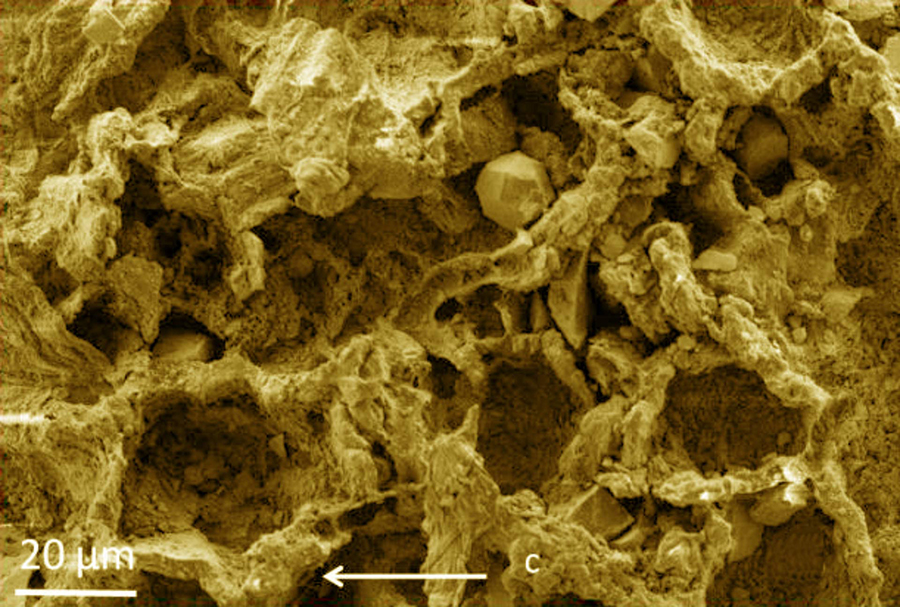
High-resolution SEM micrograph of the mycelium-like structures from the Mbuji-Mayi Supergroup, Democratic Republic of Congo. Image credit: Bonneville et al, doi: 10.1126/sciadv.aax7599.

An international team of researchers has found the microscopic fungal filaments and mycelium-like structures in 715-million-year-old (Neoproterozoic Era) dolomitic shale from the Democratic Republic of Congo.

“These ancient rocks formed in a lagoon or coastal lake environment,” said Professor Steeve Bonneville, a scientist at the Université Libre de Bruxelles, Belgium.

“The presence of fungi in this transitional area between water and land leads us to believe that these microscopic mushrooms were important partners of the first plants that colonized the Earth’s surface around 500 million years ago.”

Using multiple molecular analysis techniques, such as synchrotron radiation spectroscopy, μ-Raman confocal microscopy, fluorescence microscopy, and electron microscopy, Professor Bonneville and colleagues demonstrated the presence of chitin — a very tough compound found in the cell walls of fungi — in the Neoproterozoic fungal microfossils.

The researchers also demonstrated that the organisms were eukaryotes, i.e. their cells had a nucleus.

High-resolution SEM micrograph of the mycelial networks from the Mbuji-Mayi Supergroup, Democratic Republic of Congo. Image credit: Bonneville et al, doi: 10.1126/sciadv.aax7599.

“We document dark, nontranslucide, cylindrical filaments typically between 3.5 and 11.5 μm in width, extending over several hundreds of micrometers in length,” they said.

“These filaments sometimes evolve into dense interconnected networks of 500 μm in diameter.”

“In these mycelium-like structures, filaments have multiple-order, high-angle branching and, possibly, anastomosing filaments, common features of fungal networks yet rare for prokaryotes.”

The filaments for living and fossil fungi range from 2 to over 20 μm in width.

The size of the Neoproterozoic fossil filaments observed by the team fits well with fungal dimensions.

“This is a major discovery, and one that prompts us to reconsider our timeline of the evolution of organisms on Earth,” Professor Bonneville said.

“The next step will be to look further back in time, in even more ancient rocks, for evidence of those microorganisms that are truly at the origins of the animal kingdom.”

The findings were published in a paper in the journal Science Advances.

_____

S. Bonneville et al. 2020. Molecular identification of fungi microfossils in a Neoproterozoic shale rock. Science Advances 6 (4): eaax7599; doi: 10.1126/sciadv.aax7599

Source: www.sci-news.com/

3,000-Year-Old Teeth Solve Pacific Banana Mystery

Friday, January 24, 2020

The findings were made from 3,000-year-old skeletons at Teouma, the oldest archaeological cemetery in Remote Oceania, a region that includes Vanuatu and all of the Pacific Islands east and South, including Hawaii, Rapa Nui and Aotearoa. Credit: University of Otago

Humans began transporting and growing banana in Vanuatu 3000 years ago, a University of Otago scientist has discovered.

The discovery is the earliest evidence of humans taking and cultivating banana into what was the last area of the planet to be colonised.

In an article published this week in Nature Human Behaviour, Dr. Monica Tromp, Senior Laboratory Analyst at the University of Otago's Southern Pacific Archaeological Research (SPAR), found microscopic particles of banana and other plants trapped in calcified dental plaque of the first settlers of Vanuatu.

The finds came from 3000-year-old skeletons at the Teouma site on Vanuatu's Efate Island.

Dr. Tromp used microscopy to look for 'microparticles' in the plaque, also known as dental calculus, scraped from the teeth of the skeletons. That allowed her to discover some of the plants people were eating and using to make materials like fabric and rope in the area when it was first colonised.

Teouma is the oldest archaeological cemetery in Remote Oceania, a region that includes Vanuatu and all of the Pacific islands east and south, including Hawaii, Rapa Nui and Aotearoa. The Teouma cemetery is unique because it is uncommon to find such well-preserved archaeological burials in the Pacific. Bone generally does not preserve in hot and humid climates and the same is true for things made of plant materials and also food.

The first inhabitants of Vanuatu were people associated with the Lapita cultural complex who originated in Island South East Asia and sailed into the Pacific on canoes, reaching the previously uninhabited islands of Vanuatu around 3000 years ago.

There has been debate about how the earliest Lapita people survived when they first arrived to settle Vanuatu and other previously untouched islands in the Pacific. It is thought Lapita people brought domesticated plants and animals with them on canoes—a transported landscape. But direct evidence for these plants had not been found at Teouma until Dr. Tromp's study.

"One of the big advantages of studying calcified plaque or dental calculus is that you can find out a lot about otherwise invisible parts of people's lives," Dr. Tromp says. Plaque calcifies very quickly and can trap just about anything you put inside of your mouth—much like the infamous Jurassic Park mosquito in amber—but they are incredibly small things that you can only see with a microscope."

The study began as part of Dr. Tromp's Ph.D. research in the Department of Anatomy and involved collaboration with the Vanuatu Cultural Centre, Vanuatu National Herbarium and the community of Eratap village—the traditional landowners of the Teouma site.

Dr. Tromp spent hundreds of hours in front of a microscope finding and identifying microparticles extracted from thirty-two of the Teouma individuals. The positive identification of banana (Musa sp.) is direct proof it was brought with the earliest Lapita populations to Vanuatu.

Palm species (Arecaceae) and non-diagnostic tree and shrub microparticles were also identified, indicating these plants were also important to the lives of this early population, possibly for use as food or food wrapping, fabric and rope making, or for medicinal purposes, Dr. Tromp says.

"The wide, and often unexpected range of things you can find in calcified plaque makes what I do both incredibly exciting and frustrating at the same time."

The article was co-authored by Elizabeth Matisoo-Smith, Rebecca Kinaston and Hallie Buckley of the University of Otago, and Stuart Bedford and Matthew Spriggs of the Australian National University.


More information: Monica Tromp et al. Exploitation and utilization of tropical rainforests indicated in dental calculus of ancient Oceanic Lapita culture colonists, Nature Human Behaviour (2020). DOI: 10.1038/s41562-019-0808-y

Provided by University of Otago Source: https://phys.org/

Pages