Blogs

Lekaneleo roskellya: 'Extraordinary' Discovery: Fossil of New Type of Lion Found in Australia

Sunday, March 1, 2020

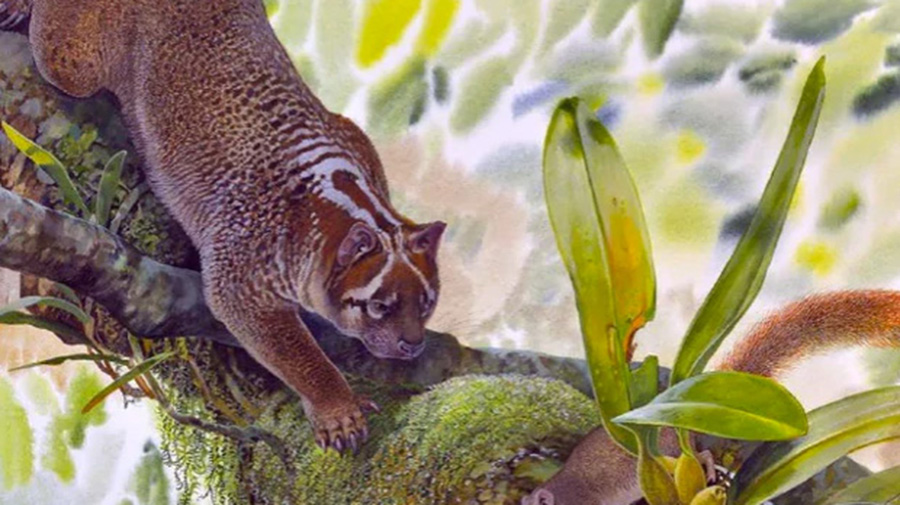
An artist's impression of marsupial lion now known as Lekaneleo roskellya. Photo / news.co.au

A new type of lion that roamed the country tens of millions of years ago has been discovered in northwest Queensland, Australia.

A fossil found in the Riversleigh World Heritage area near the border with the Northern Territory was originally thought to be part of a different genus of marsupial lions, but recent discoveries about variations in its teeth have shown it was actually a separate genus.

A new paper published by University of New South Wales (UNSW) researchers in the Journal of Vertebrate Paleontology said the lion was about the size of a house cat and roamed ancient Australia during the Oligocene-Miocene (about 23 to 34 million years ago).

The woman who discovered the fossil in 1997, Anna Gillespie, also co-authored the latest study that re-examined the fossil.

She originally gave the marsupial lion its scientific name Priscileo roskellyae, a reference to former federal minister Ros Kelly, who provided "significant support" to projects in the Riversleigh Heritage Area.

But it will now be reclassified as Lekaneleo roskellyae, after the team noted differences in its teeth from other members of the Priscileo genus.

A different marsupial lion found in Riversleigh was named Microleo attenboroughi after naturalist Sir David Attenborough.

Co-author Professor Michael Archer told ABC News the lion had teeth "capable of slicing straight through bones".

"They had an extraordinary, elongated, bolt-cutting type of premolar," he said.

"This was the most extraordinary adaptation or evolution that a carnivorous mammal has ever developed anywhere in the world."

He said the teeth were the reason the lion was now being recognised as a distinct genus.

"We've only just recognised [it's] highly different than any of the other previous ones we've seen — that's why it's been described now as a new genus of marsupial lion."

Long extinct, the new genus will go down alongside other relics of Australia's historical fauna.

Animals like the thylacine (commonly known as the Tasmanian tiger) and megafauna like the Diprotodon (the largest marsupial ever discovered) once called Australia home, along with other biologically diverse native animals.

Extinction fears are mounting for other Australian marsupials such as the platypus and koala, particularly since recent bushfires killed many koalas and decimated the habitat of those that remain.

Professor Archer said there were lessons to be learned from the latest discovery and the previous extinctions.

"It makes us understand that the total effect that has happened in Australia is a steady loss of the complexities that was normal in the forests in Australia."

Source: www.nzherald.co.nz/

Lizard Forefoot Found Preserved in Dominican Amber

Saturday, February 29, 2020

Light microscopic image of the piece of 15-20-million-year old Dominican amber; the specimen contains a fairy wasp and the left forelimb of an anole lizard; several flow structures can be recognized in the resin. Image credit: Barthel et al, doi: 10.1371/journal.pone.0228843.

The left forelimb of an anole lizard (genus Anolis) has been found perfectly preserved in a piece of Miocene-Epoch amber from the Dominican Republic.

“Vertebrate inclusions in amber are very rare, the majority are insect fossils,” said Jonas Barthel, a doctoral student in the Institute for Geosciences at the University of Bonn.

Barthel and colleagues found the left forelimb of the Anolis lizard in a 2-cm piece of 15-20-million-year old Dominican amber.

“The claws and toes are very clearly visible in the honey-brown amber mass, almost as if the tree resin had only recently dripped onto them — yet the tiny foot is about 15 to 20 million years old,” they said.

The researchers examined the specimen by micro-Raman spectroscopy, electron microprobe, and time-of-flight secondary ion mass spectroscopy.

The analyses revealed that the forefoot is broken in two places and that one of the fractures is surrounded by a slight swelling.

“We propose the following model for our observations,” the scientists said.

“While climbing the tree, the lizard got into contact with a flow of resin and could not escape its sticky trap.”

“After some time, it attracted the attention of a predator that ripped off the lizard, leaving solely the fore limb in the resin. Later on, the resin hardened and became deposited within the surrounding soil which represents the starting point of its diagenesis.”

“The presence of ‘Schlauben’ (a succession of flows), the splintered humerus, the edema, the peeled off parts of the skin, and lastly the numerous air bubbles strongly support this model.”

The Raman spectroscopy revealed that mineral hydroxyapatite in the bone had been transformed into fluoroapatite by the penetration of fluorine.

“This is surprising, because we assumed that the surrounding amber largely protects the fossil from environmental influences,” Barthel said.

“However, the small crack may have encouraged chemical transformation by allowing mineral-rich solutions to find their way in.”

The Raman spectroscopy also showed that collagen — the bone’s elastic component — had largely degraded. Despite the seemingly very good state of preservation, there was actually very little left of the original tissue structure.

“We have to expect that at least in amber from the Dominican Republic, macromolecules are no longer detectable,” said Professor Jes Rust, also from the Institute for Geosciences at the University of Bonn.

“It was not possible to detect more complex molecules such as proteins, but the final analyses are still pending.”

“The degradation processes in this amber deposit are therefore very advanced, and there is very little left of the original substance.”

The findings were published in the journal PLoS ONE.

_____

H.J. Barthel et al. 2020. Fluoridation of a lizard bone embedded in Dominican amber suggests open-system behavior. PLoS ONE 15 (2): e0228843; doi: 10.1371/journal.pone.0228843

Source: www.sci-news.com/

Facivermis yunnanicus: Paleontologists Solve Mystery of Cambrian Worm-Like Creature

Saturday, February 29, 2020

Facivermis yunnanicus. Image credit: Franz Anthony.

An enigmatic worm-like animal called Facivermis yunnanicus lost lower limbs for tube-dwelling lifestyle, according to new research published in the journal Current Biology.

Facivermis yunnanicus lived some 518 million years ago in the Cambrian period.

It had a long body and five pairs of spiny arms near its head, leading to suggestions it might be a missing link between legless cycloneuralian worms and a group of fossil animals called lobopodians, which had paired limbs all along their bodies.

But the new study reveals the creature was itself a lobopodian that lived a tube-dwelling lifestyle anchored on the sea floor, and so evolved to lose its lower limbs.

“A key piece of evidence was a fossil in which the lower portion of Facivermis yunnanicus was surrounded by a tube,” said Dr. Richard Howard, a researcher at Yunnan University, the University of Exeter, and the Natural History Museum, London.

“We don’t know the nature of the tube itself, but it shows the lower portion of the worm was anchored inside by a swollen rear end.”

“Living like this, its lower limbs would not have been useful, and over time the species ceased to have them.”

“Most of its relatives had three to nine sets of lower legs for walking, but our findings suggest Facivermis yunnanicus remained in place and used its upper limbs to filter food from the water.”

“This is the earliest known example of secondary loss — seen today in cases such as the loss of legs in snakes.”

The Cambrian period is seen as the dawn of animal life, and the scientists were fascinated to find a species evolving to be more primitive even at this early stage of evolution.

“We generally view organisms evolving from simple to more complex body plans, but occasionally we see the opposite occurring,” said Dr. Xiaoya Ma, a researcher at Yunnan University and the University of Exeter.

“What excited us in this study is that even at this early stage of animal evolution, secondary-loss modifications — and in this case, reverting ‘back’ to lose some of its legs — had already occurred.”

“We’ve known about this species for about 30 years, but it’s only now that we’ve got a confident grasp of where it fits in the evolutionary tree.”

“Studies like this help us understand the shape of the tree of life and figure out where the adaptations and body parts we now see have come from.”

“For several years we and others have been finding lobopodians from the Cambrian period with pairs of appendages along the length of the body — long, grasping ones in the front, and shorter, clawed ones in the back,” said Dr. Greg Edgecombe, from the Natural History Museum.

“But Facivermis yunnanicus takes this to the extreme, by completely reducing the posterior batch.”

_____

Richard J. Howard et al. A Tube-Dwelling Early Cambrian Lobopodian. Current Biology, published online February 27, 2020; doi: 10.1016/j.cub.2020.01.075

Source: www.sci-news.com/

Paleontologists Discover Why The Oceans Are So Diverse

Saturday, February 29, 2020

An ecologically diverse marine coral reef community teeming with fishes and corals at Miloliʻi, Hawaii. (Photo courtesy of John H.R. Burns)

A new study in the journal Science has given insight into why the world's oceans are full of more species than ever before -- a question that has long been a focus of paleontological research.

The most diverse kinds of animals in the modern oceans, such as fish, mollusks, and crustaceans, diversified slowly and steadily for long periods of time, and were buffered against extinction.

Andrew Bush, an author on the paper and associate professor of Geosciences and Ecology & Evolutionary Biology in the College of Liberal Arts and Sciences, says that knowing how biodiversity evolved over Earth's history can help humans think about future issues with environmental disruptions, like climate change.

"Paleontology can help us identify traits that helped species survive and thrive in the past, including during mass extinctions," Bush says. "Hopefully, research like this can help us plan for the effects of environmental disruption in the coming decades."

The study examined approximately 20,000 genera (groups of related species) of fossil marine animals across the past 500 million years, and approximately 30,000 genera of living marine animals.

The findings clearly show that the species in the most diverse animal groups also tend to be more mobile and more varied in how they feed and live, notes lead study author Matthew Knope, assistant professor of biology at the University of Hawai`i at Hilo.

"Being a member of an ecologically flexible group makes you resistant to extinction, particularly during mass extinctions," he says. "The oceans we see today are filled with a dizzying array of species in groups like fishes, arthropods, and mollusks, not because they had higher origination rates than groups that are less common, but because they had lower extinction rates over very long intervals of time."

The "slow and steady" development of lineages through time has been a key factor in dictating which lineages have achieved the highest diversity.

Michal Kowalewski, professor of invertebrate paleontology at the University of Florida, who was not involved with the study, said the study highlights "the value of paleontological data for assessing core questions of biology."

"Perhaps the fable of the tortoise and the hare is apt in explaining marine animal diversification: some groups jumped out to an early diversity lead only to be surpassed by other groups that were more ecologically diverse and less evolutionarily volatile, with steady diversification rates and strong resistance to mass extinctions," adds Knope.

Co-authors also include Luke O. Frishkoff, University of Texas at Arlington, Noel A. Heim, Tufts University, and Jonathan L. Payne, Stanford University. Read the study online at Science.


Story Source:

Materials provided by University of ConnecticutNote: Content may be edited for style and length.


Journal Reference:

  1. Matthew L. Knope, Andrew M. Bush, Luke O. Frishkoff, Noel A. Heim, Jonathan L. Payne. Ecologically diverse clades dominate the oceans via extinction resistanceScience, 2020; 367 (6481): 1035 DOI: 10.1126/science.aax6398

Source: www.sciencedaily.com/

Jurassic World 3: 10 Things "Dominion" Needs To Be A Success

Thursday, February 27, 2020

Jurassic World 3: 10 Things "Dominion" Needs To Be A Success

Jurassic World is rounding out the dinosaur trilogy with Dominion. Here's what we think it does and doesn't need in order to be a box office success.

Director Colin Trevorrow has confirmed that the third and final installment of the Jurassic World trilogy is now in full swing. Sub-titled "Dominion," the film will unite the new trilogy cast with original Jurassic Park stars Sam Neil, Jeff Goldblum and Laura Dern for one final (possibly?) dino outing.

While the original Jurassic World film was praised as a fun return-to-form for the franchise, the second film, Fallen Kingdom, was met with slightly less favor from critics and audiences. In order for this final installment to work, here are some things Trevorrow needs to keep in mind.

10 - IT'S NOT ALWAYS ABOUT THE DINOS

If the original Jurassic Park taught us anything, it's that the dinosaurs don't always need to be the main focus. Jurassic World has done an admirable job of sticking to that by introducing solid character arcs for Owen and Claire, but Fallen Kingdom moved too far away from it.

Since the original Jurassic Park gang will amalgamate with the new cast, it's a great time to explore not just how the older characters have developed since their ordeal, but how they interact with those who have continued to persue John Hammond's original vision. Sometimes, the road to the next big action sequence is paved with introspection.

9 - FOCUS ON THE ADVENTURE

While the prospect of dinosaurs escaping into the heartland of America is an interesting prospect, it could quickly fly off the rails if spectacle takes precedence over the story. The focus of previous Jurassic Park/World films has largely been set on adventure, and this was lost somewhat in Fallen Kingdom as the franchise focused more on corporatism.

If this is truly to be the final outing for the franchise, it needs to recapture the magic of the original film somehow. The movie would be served better by concentrating less on evil company henchmen, and more on coming up with a tangible solution for the dinosaur problem.

8 - NO MORE GENETICS

Jurassic World has made genetic tampering a focus of the first two films, but it's time to dial that back for the sake of the story. The first film touched on this when Claire's character remarked that kids look at a Stegosaurus "like an elephant at the city zoo."

This could end up being a self-fulfilling prophecy. The first two films said enough about this issue that it can safely be sidelined in favor of focusing on the dinosaurs we all know and love. Audiences don't need a genetically engineered antagonist. They need a sense of wonder, excitement and awe.

7 - BLUE ISN'T NECESSARY

While audiences loved Blue, she doesn't necessarily need to be involved in the third film. Owen's relationship with the Velociraptor runs deep, but it's going to get harder and harder to sell audiences on the notion that they always find their way back to each other.

If Fallen Kingdom was any indicator, Blue is free. Maybe she should stay that way, rather than being roped in as a convenient plot device. After all, there are a lot of other dinosaurs out there to focus on.

6 - MORE T-REX SCENES

Few would argue that the beloved Tyrannosaurus Rex is a main staple of Jurassic Park/World films, and no director on the face of the planet will ever be able to change that. While subsequent films in the franchise have put some mean dinos in the spotlight (most notably the Spinosaurus), the T-Rex is the one audiences always want to see more of.

As a plot character, the T-Rex is perfect. Its dodgy vision gives writers options when it comes to interactions with key characters, while its menace and terror factor never seems to go away. While other dinos like the Indominus Rex have a lot of fancy genetic features to play with, the T-Rex is a straight-up, natural-born killing machine that can turn the story upside down with just one scene.

5 - MORE IAN MALCOLM

Everyone loves Ian Malcolm, thanks largely to Jeff Goldblum's own quirky personality and how it plays out in the character. It's obvious that many of his scenes in the original Jurassic Park were ad-libbed (which director Steven Spielberg is fond of), which led to some hilariously natural and entertaining dialogue.

Malcolm should take more of a central role in the film, without strangling the rest of the characters out of the picture. His lack of chemistry with Alan Grant could work in the film's favor to create some wonderfully silly and memorable moments, especially after so many years of knowing one another.

4 - MORE ELLIE SATTLER

Ellie came into her role largely in the second act of Jurassic Park, while staying relatively low key through the first. As such, we didn't get quite as good a look at her character as we'd have liked. Whether she's still married to someone other than Alan Grant is anyone's guess, but Sattler's character should be featured beyond just her past relationships.

As a paleobotanist, there's not much Ellie can offer in terms of dinosaur advice, but she can act as a lens through which audiences can explore how Earth's modern flora might affect them. In order for this to work, Ellie's going to need more screen time in order to demonstrate her skill set.

3 - NO ODD PLOT TWISTS

On paper, Fallen Kingdom's plot seems like a workable story, but it was executed with far less grace than the script might have originally suggested. As such, the film went from big-budget summer adventure flick to spine-tingling horror film within the space of a single act. It was jarring, to say the least.

It didn't completely derail the film, but it definitely took the franchise out of its fishbowl, and put it into the wrong kind of tank. The third film doesn't need any crazy plot twists in order to work its magic. That's what the dinosaurs are there for.

2 - UTILIZE THE ENVIRONMENT

America is a big country with a lot to see, and this third film had better take advantage of it! Let's get back to some good old-fashioned 1980s and 1990s adventure set pieces, with a strong focus on the beautiful environments we have here at home.

There are plenty of forests, lakes, rivers, countrysides, and mountains to take advantage of, and peppering the dinos into these beloved locales will really help sell the sense of scale and adventure of the film. This is one area where director Colin Trevorrow should go big.

1 - NO MORE CLIFFHANGERS

At this point, the franchise has nowhere to go. Everything that needed to be said has been said, and it's going to be rather difficult to top dinosaurs running amok in our backyards. The last five films have pulled out all the stops to give us a memorable ride, but it's time for that ride to end.

Sequel-itis is real, and it can have a detrimental impact on the legacy of a good franchise. Let's wrap up the story for all time, then encase this property in amber so that we can remember it fondly as something that didn't continue to deteriorate into redundancy.

Source: https://screenrant.com/

110-Million-Year-Old Fossilized Plant Gum Found

Thursday, February 27, 2020

Orange-colored gum ducts (arrows) in the brown leaf tissue of Welwitschiophyllum brasiliense from the Crato Formation, Brazil. Image credit: Roberts et al, doi: 10.1038/s41598-020-60211-2.

Paleontologists in Brazil have found thin bands of fossil gum — the first occurrence in the fossil record — inside 110-million-year-old (Cretaceous period) fossilized leaves of the extinct plant Welwitschiophyllum brasiliense. The discovery of fossilized plant gum is unusual because of its solubility in water.

A wide variety of plants produce fluid exudates e.g. resins and gums, with each group differing in chemical definitions.

Due to similarity in physical appearance distinguishing exudates based on chemistry is vital, for example gums and resins are visually similar resulting in these terms being used interchangeably.

However, their chemical definitions are very different; resins are composed of lipid-soluble terpenoids, while gums are complex, highly branched (non-starch) water-soluble polysaccharides.

Differences between gum and resin can also be seen in the functional roles within the plant.

The main roles of resins are to respond to wounding, as a defense against pathogens and to dissuade herbivory by insects and other organisms.

Gum is involved in food storage, structural support, and also for wound sealing, but there is no common role across species.

Further confusion arises as some plants, e.g. Boswellia and Commiphora species, even produce exudates with a mixture of polysaccharide and resin components (the gum resins myrrh and frankincense, respectively).

Until now only fossilized plant resin (ambers) and latex filaments have been reported preserved in the fossil record.

While the fossilization of fluid exudates might seem unlikely, the fossilization of resin is relatively common, and extends back some 320 million years to the Carboniferous period, but chemically confirmed gums have never been reported.

“Our discovery overturns the basic assumption that plant gums cannot be preserved in the fossil record,” said lead author Dr. Emily Roberts, a researcher in the School of the Environment, Geography and Geosciences at the University of Portsmouth and the Department of Palaeontology at the University of Vienna.

“It has opened our eyes to the fact that other plant chemicals may also be preserved — we can no longer just make assumptions. When we first tested the gum I was astonished that we were confirming something that was thought to be impossible — it just goes to show that fossil plants can surprise us.”

Fossilized leaves of Welwitschiophyllum brasiliense from the Crato Formation, Brazil. Scale bar – 3 mm. Image credit: Roberts et al, doi: 10.1038/s41598-020-60211-2.

Using Fourier-transform infrared spectroscopy (FTIR) and attenuated total reflectance (ATR) spectroscopy, Dr. Roberts and colleagues analyzed the amber-colored substance inside Welwitschiophyllum brasiliense leaves from Crato Formation, Brazil.

The chemical spectrum of this substance clearly differed from those of ambers and resins, but resembled spectra of plant gum.

Welwitschiophyllum brasiliense is considered a relative of Welwitschia mirabilis, one of the oldest and most enigmatic plants in existence.

Today, Welwitschia mirabilis can be found only in the Namib Desert in Namibia and Southern Angola and has chemically confirmed gum in both the cone and in abaxial ducts within leaves.

“Our findings confirm that the Welwitschia mirabilis plant found in Africa today produces a gum similar to a plant growing 110 million years ago in Brazil,” said co-author Professor David Martill, also from the School of the Environmental Geography and Geosciences at the University of Portsmouth.

Welwitschia mirabilis is one of life’s survivors, thriving in one of the harshest environments on earth for over 120 million years.”

“This discovery is extremely exciting, especially when put into the context of these two continents of Africa and South America, being one during the Cretaceous period.”

The results were published in the journal Scientific Reports.

_____

E.A. Roberts et al. Cretaceous gnetalean yields first preserved plant gum. Sci Rep 10, 3401; doi: 10.1038/s41598-020-60211-2

Source: www.sci-news.com/

OFFICIAL: Next 'Jurassic World' Movie Is Called 'Dominion'

Wednesday, February 26, 2020

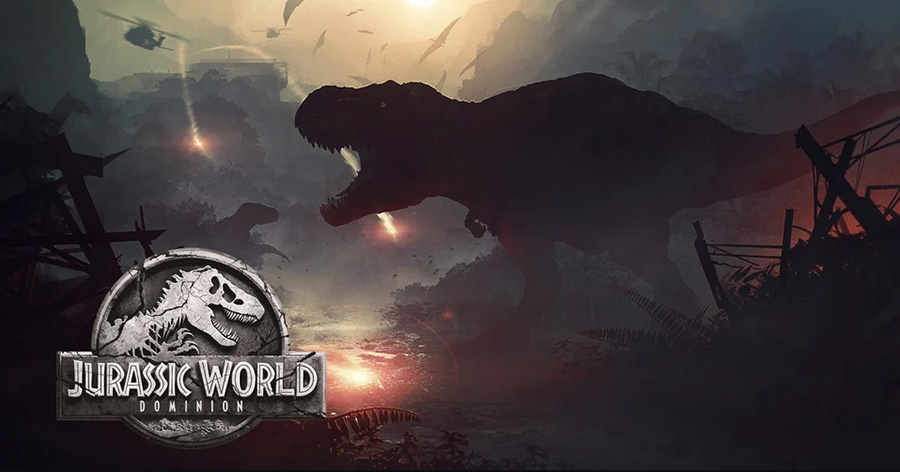
Next 'Jurassic World' Movie Is Called 'Dominion'

Filmmaker Colin Trevorrow revealed the news as filming began.

The final moments of 2018's Jurassic World: Fallen Kingdom suggested that the dinosaurs would be inheriting the Earth. Now, the newly revealed title for the third Jurassic World movie suggests that is the case.

Filmmaker Colin Trevorrow tweeted a photo from the first day of filming, with the revelation that the third installment is called Jurassic World: Dominion. Star Chris Pratt followed that up with a dictionary definition of the word, writing, "1. sovereignty or control. 'man's attempt to establish dominion over nature.'"

Pratt and Bryce Dallas Howard return to star in Dominion, which will also include original Jurassic Park actors Jeff Goldblum as chaos theorist Dr. Ian Malcom, Laura Dern returning as paleobotanist Dr. Ellie Sattler and Neill as paleontologist Dr. Alan Grant. Also on the call sheet are Jake Johnson, Omar Sy, Mamoudou Athie and DeWanda Wise.

Emily Carmichael penned the script with Trevorrow, who directed the 2015 reboot of the franchise and was co-writer of Fallen Kingdom. Trevorrow and writing partner Derek Connolly developed the story. Trevorrow is executive producing with Steven Spielberg, the filmmaker behind the original movies in the 1990s. Frank Marshall and Pat Crowley are returning as producers.

Universal and Amblin Entertainment have set a June 11, 2021, release date for Jurassic World 3.

Source: www.hollywoodreporter.com/

'Exquisite' Dinosaur-Age Cockroaches Discovered Preserved in Amber

Thursday, February 27, 2020

Crenocticola svadba is a newly named species with quite a back story.   LENKA PODSTRELENÁ, SENDI ET AL. GONDWANA RES 2020 (COPYRIGHT ELSEVIER 2020

Researchers identify two new species from a mine in Myanmar.

Cockroaches are the first and only creatures to be discovered living in caves before the dinosaurs were wiped out 66 million years ago.

Two new species of the critter have been identified preserved in amber from around 99 million years ago in the mid-Cretaceous period when dinosaurs roamed the Earth.

All other cave-dwelling animals originate from the current Cenozoic Era, beginning 66 million years ago when three quarters of plant and animal species, including the dinosaurs, went extinct after a huge asteroid smashed into Earth.

"It is a small miracle," says lead investigator Peter Vršanský at the Slovak Academy of Sciences in Bratislava, Slovakia. "But one can expect that in 110 tons of amber you will find something peculiar."

The specimens were originally discovered in amber deposits from a mine located in Hukawng Valley, Myanmar, which were provided to the researchers for analyses.

"It was clear from the first look that these were fantastic, but a lot of time is needed to determine exactly what you see," explains Vršanský. "It is a time abyss. You must imagine that these are in dino caves, with pterosaurs in the air, and nearly no flowers. It is another world."

Being from one of the world's most important fossil sites, the amber’s age was already known. Crystals in the mine’s volcanic rocks had been dated to 98.8 million years ago - give or take half a million years - which means that trees oozed resin and trapped the unsuspecting cockroaches in amber around a similar time.

The researchers analysed the specimens using microscope photography to determine the appearance and anatomical features of the ancient amber-locked arthropods. The team reports its findings in the journal Gondwana Research.

"It's a new genus and new species, the full determination and description took several months," explains Vršanský. "Definitely they are the earliest known unequivocal cave-dwellers."

The two species were named Mulleriblattina bowangi and Crenocticola svadba and placed in the Nocticolidae family, which comprises other species thriving today. Their cave-dwelling life was evident based on lost colouration, reduced wings and eyes, elongated antennae for sensing, and reduced leg spines for passive defence.

But if they were cave-dwellers, how did they become trapped in tree resin?

Mulleriblattina bowangi  PETER VRŠANSKÝ, SENDI ET AL. GONDWANA RES 2020 (COPYRIGHT ELSEVIER 2020)

"Most probably the source tree was growing directly at the cave entrance," says Vršanský. "Alternatively, the resin was produced from roots which grew down inside."

Other cave animals undoubtedly existed in the Mesozoic "dinosaur" era spanning 253 to 66 million years ago. But caves likely collapsed or didn't allow fossil preservation over such vast timescales. Plus some fossilised animals may lack vital clues that betray cave-dwelling tendencies.

Nevertheless, all cave animals living today have a late-Cenozoic origin, meaning that all other Mesozoic-origin cave-dwellers went extinct. It’s a mystery that Vršanský can't explain, especially as cave environments should protect organisms from extreme environmental fluctuations that often caused extinctions out in the open.

While it's not certain if the new cockroach species survived the mass extinction event that killed the dinosaurs, Vršanský says it's plausible because cave environments remained in the Myanmar region afterwards. Indeed, the species may have never died out.

"It cannot be fully excluded that they still survive today. Not all species in this group are known and not all living Australian nocticolid species are described," explains Vršanský. "The question is if survivors will be still the same species, which is doubtful, or if they transferred into other taxon. But this lineage survives today."


Source: https://cosmosmagazine.com/

Proterocladus antiquus: Paleontologists Find One-Billion-Year-Old Green Seaweed Fossils

Wednesday, February 26, 2020

Proterocladus antiquus. Image credit: Virginia Tech.

Paleontologists have discovered the microscopic fossilized remains of green seaweed near Dalian in the Liaoning province of northern China. The microfossils are approximately one billion years old. They represent a previously unknown species of green seaweed, named Proterocladus antiquus, and are barely visible to the naked eyed at 2 mm in length, or roughly the size of a typical flea.

“These new fossils suggest that green seaweeds were important players in the ocean long before their land-plant descendants moved and took control of dry land,” said senior author Professor Shuhai Xiao, a researcher in the Department of Geosciences and Global Change Center at Virginia Tech.

“The entire biosphere is largely dependent on plants and algae for food and oxygen, yet land plants did not evolve until about 450 million years ago.”

“Our study shows that green seaweeds evolved no later than one billion years ago, pushing back the record of green seaweeds by about 200 million years. What kind of seaweeds supplied food to the marine ecosystem.”

The current hypothesis is that land plants — the trees, grasses, food crops, bushes, even kudzu — evolved from green seaweeds, which were aquatic plants. Through geological time they moved out of the water and became adapted to and prospered on dry land, their new natural environment.

“These fossils are related to the ancestors of all the modern land plants we see today,” Professor Xiao said.

“However, the caveat that not all geobiologists are on the same page — that debate on the origins of green plants remains.”

“Not everyone agrees with us; some scientists think that green plants started in rivers and lakes, and then conquered the ocean and land later.”

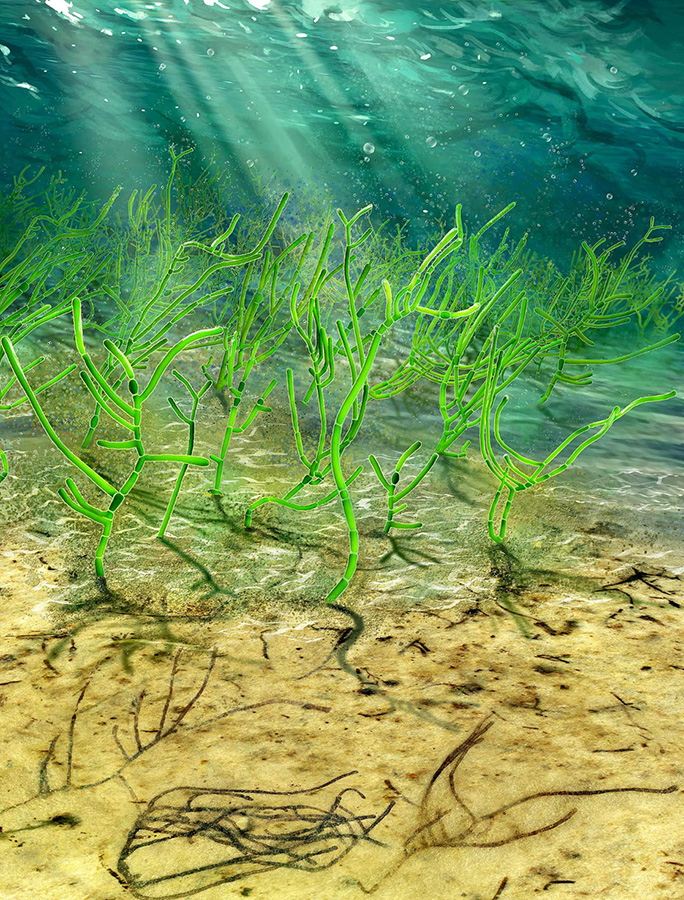
In the background of this digital recreation, ancient green seaweed Proterocladus antiquus is seen living in the ocean one billion years ago. In the foreground is the same seaweed in the process of being fossilized far later. Image credit: Dinghua Yang.

There are three main types of seaweed: brown (Phaeophyceae), green (Chlorophyta), and red (Rhodophyta), and thousands of species of each kind.

Fossils of red seaweed, which are now common on ocean floors, have been dated as far back as 1.047 billion years old.

“There are some modern green seaweeds that look very similar to the fossils that we found,” Professor Xiao said.

“A group of modern green seaweeds, known as siphonocladaleans, are particularly similar in shape and size to the fossils we found.”

Photosynthetic plants are, of course, vital to the ecological balance of the planet because they produce organic carbon and oxygen through photosynthesis, and they provide food and the basis of shelter for untold numbers of mammals, fish, and more.

“Yet, going back 2 billion years, Earth had no green plants at all in oceans,” Professor Xiao said.

Proterocladus antiquus seaweeds display multiple branches, upright growths, and specialized cells known as akinetes that are very common in this type of fossil,” said lead author Dr. Qing Tang, a postdoctoral researcher in the Department of Geosciences and Global Change Center at Virginia Tech.

“Taken together, these features strongly suggest that the fossil is a green seaweed with complex multicellularity that is circa one billion years old. These likely represent the earliest fossil of green seaweeds. In short, our study tells us that the ubiquitous green plants we see today can be traced back to at least one billion years.”

The discovery is described in a paper in the journal Nature Ecology & Evolution.

_____

Q. Tang et al. A one-billion-year-old multicellular chlorophyte. Nat Ecol Evol, published online February 24, 2020; doi: 10.1038/s41559-020-1122-9

Source: www.sci-news.com/

Maculaferrum blaisi: New Species of Ancient Hairy Cicada Identified

Tuesday, February 25, 2020

The fossilized forewing of Maculaferrum blaisi; total forewing length estimated at 20-23 mm, maximal forewing width at 7.5 mm. Image credit: Demers-Potvin et al, doi: 10.4202/app.00669.2019.

A new genus and species of hairy cicada that lived around 100 million years ago (Cretaceous period) has been identified from a fossilized wing found in Canada.

The newly-discovered species belongs to Tettigarctidae, a family of hairy cicadas that includes only two extant species: Tettigarcta crinita and Tettigarcta tomentosa.

The single fossilized forewing of the prehistoric incest was collected from the Redmond no. 1 mine near Schefferville — the so-called Redmond Formation — in Labrador, Canada.

Dubbed Maculaferrum blaisi, the species is the first hemipteran insect (true bug) to be discovered at the Redmond Formation.

“A single wing was sufficient to identify the family to which the insect belonged,” said Alexandre Demers-Potvin, a Master’s student at McGill University.

“We were easily able to demonstrate that the insect belonged to the Tettigarctidae family thanks to the pattern of the veins we observed on its wing.”

“This gives us a better understanding of the site’s insect biodiversity during the Cretaceous period, a time before the dinosaurs were wiped out,” he said.

“The finding also illustrates that rare species can be found at the Redmond mine and that it deserves the attention from the paleontological community.”

The discovery of Maculaferrum blaisi confirms the presence of the once-widespread family Tettigarctidae in North America and contributes to filling a Late Cretaceous gap in the fossil record of hairy cicadas.

“The find is exciting because it represents the oldest, diverse insect locality in Canada,” said Professor Hans Larsson, Director of the Redpath Museum at McGill University.

“It’s also from an exciting time during an evolutionary explosion of flowering plants and pollinating insects, that evolved into the terrestrial ecosystems of today.”

The team’s paper was published in the journal Acta Palaeontologica Polonica.

_____

Alexandre V. Demers-Potvin et al. First North American occurrence of hairy cicadas discovered in the Cenomanian (Late Cretaceous) of Labrador, Canada. Acta Palaeontologica Polonica, published online February 20, 2020; doi: 10.4202/app.00669.2019

Source: www.sci-news.com/

Pages