Blogs

Discover China: A Small County's Bond With Dinosaurs

Sunday, November 3, 2019

Heilongjiang Provincial Museum. Courtesy of Trip.com

From building walls and green belts to roadside dustbins, dinosaur images can be found virtually everywhere in Jiayin, a small county in northeast China.

The county with a population of around 80,000 in Heilongjiang Province, is dubbed the "hometown of dinosaurs" as China's first dinosaur fossil was discovered there in 1902. Dinosaurs have become its symbol, attracting dino fans from around the globe.

In the Shenzhou Dinosaur Museum in Jiayin, some tourists are gazing at giant herbivorous dinosaurs, while others are riding stationary bikes that can control the speed of computer-animated dinosaurs on a screen.

"The small county deserves its reputation. I felt like I was in a world of dinosaurs," said tourist Wu Jinqiang from the city of Mudanjiang.

Cleaning, reinforcing and adding protective coatings are among the daily jobs of Shen Fengbin, a fossil restoration researcher of the museum.

Covering an area of more than 4,600 square meters, the museum displays over 800 pieces of dinosaur fossils, attracting more than 70,000 tourists each year.

"I was quite confused and frustrated when I started working in the museum in 2005 because I didn't have a professional background on dinosaurs," Shen said.

Over the years, he voluntarily participated in fossil excavations, collected a large number of reports on dinosaur fossils and read many books. In 2016, he successfully found a well-preserved dinosaur skeleton.

"That day was full of excitement and I will never forget it as long as I live," Shen said.

Since 1990, Heilongjiang Province has organized several massive archaeological excavations in Jiayin. So far, the skeletons found in the county have been assembled into 10 dinosaurs.

Jiayin's bond with dinosaurs can be traced back to the early 1900s. Local fishermen often found large chunks of fossilized bones on the river banks during flood season.

However, the objects' true identity remained a mystery until giant duck-billed dinosaur skeletons were excavated in a local mountain in 1902.

In 1977, a team of geologists found a number of fossils in an unknown mountain. They collected dozens of boxes of skeletons and sent them to Beijing. Archaeologists confirmed that the fossils belonged to duck-billed dinosaurs.

A joint excavation was launched in the mountain in 1978 and 1979, discovering more than 1,400 pieces of dinosaur fossils. Since then, the spot has been known as "Dinosaur Mountain."

Today the mountain has been transformed into a popular tourist destination -- Jiayin Dinosaur National Geopark. Hundreds of dinosaur skeletons are believed to be buried underground.

In the geopark, a brachiosaurus takes a walk on the grassland, a tyrannosaurus gives a terrifying howl, and dinosaur eggs are scattered everywhere on the ground... vivid sculptures transport tourists back to the age of the dinosaurs.

"Orlov, a former Soviet Union paleontologist," Jiang Zengyu, a pupil from the provincial capital Harbin, read the introduction on the sign in front of a sculpture in the park.

"My son is a dino lover. I heard there was a dinosaur park in Jiayin, so I took him to learn something," his mother said.

In August, an international forum on fossil protection was held in Jiayin, attracting over 180 paleontologists.

The paleontologists from more than 10 countries including Russia, Japan and France exchanged views on fossil protection, tourism featuring geological cultures, the study of the Cretaceous-Paleogene boundary and other issues.

"Jiayin is regarded as a key dinosaur fossil site of the Cretaceous Period in Northeast Asia, contributing a great deal to geological research of China and the world," said Liu Fujun, Party chief of the county.

In Jiayin, Shen has realized his dino dream. "I hope more tourists will come to Jiayin and relish the unique charm of this world of paleontology," he said.

Source: www.xinhuanet.com/

Rhinoceroses Lived in Yukon Territory 8-9 Million Years Ago

Saturday, November 2, 2019

An artist’s imagining of an ancient rhinoceros splashing through a stream next to turtles and fish in the Yukon. Image credit: Julius Csotonyi.

The fossil tooth fragments from extinct rhinoceroses that lived 8-9 million years ago have been found in Canada’s Yukon Territory.

The fossils were originally discovered by schoolteacher Joan Hodgins and her students in 1973.

“In the Yukon, we have truckloads of fossils from ice age mammals like woolly mammoths, ancient horses and ferocious lions,” said Dr. Grant Zazula, a paleontologist with Yukon Government.

“But this is the first time we have any evidence for ancient mammals, like rhinos, that pre-date the Ice Age.”

During the Tertiary period, a span of time that began after the dinosaurs went extinct and ended about 2.6 million years ago, a land bridge called Beringia connected what are today Siberia and Alaska.

Paleontologists believe that animals of all sorts, including mammoths and rhinos, poured over that bridge.

The geology and environment of the Yukon, which sat at the center of that mass migration route, isn’t conducive to preserving fossils from land animals.

“We know that a land bridge must have been in operation throughout much of the last 66 million years,” said Dr. Jaelyn Eberle, a curator of fossil vertebrates at the University of Colorado Boulder’s Museum of Natural History.

“The catch is finding fossils in the right place at the right time.”

Series of fossils recovered from the Yukon: pieces of shells from two different species of turtle (left), a fossil from a relative of a modern pike fish (middle) and two fragments of ancient rhino teeth (right). Image credit: Grant Zazula / Jaelyn Eberle.

The team used a scanning electron microscope to analyze the structure of enamel in the fossil tooth fragments.

“Mammal teeth aren’t all built alike,” Dr. Eberle explained.

“The crystals that make up enamel can grow following different patterns in different types of animals, a bit like a dental fingerprint.”

“The Yukon tooth enamel carried the tell-tale signs of coming from a rhinoceros relative.”

The method isn’t detailed enough to determine the precise species of rhino.

“But, if this animal was anything like its contemporaries to the south, it may have been about the same size or smaller than today’s black rhinos and browsed on leaves for sustenance,” Dr. Eberle said.

“It also probably didn’t have a horn on its snout.”

The paleontologists also looked at a collection of fossils found alongside the rhino’s tooth chips.

They belonged to two species of turtle, an ancient deer relative and a pike fish.

The discovery of the turtles, in particular, indicated that the Yukon had a warmer and wetter climate than it does today.

Hodgins, now-retired, is excited to see what became of the fossils she and her students discovered 46 years ago: “It’s just so wonderful to learn what has developed with them from long ago.”

The team’s paper was published in the journal American Museum Novitates.

_____

Jaelyn Eberle et al. 2019. The First Tertiary Fossils of Mammals, Turtles, and Fish from Canada’s Yukon. American Museum Novitates 3943: 1-28; doi: 10.1206/3943.1

Source: www.sci-news.com/

Jeff Goldblum reveals Jurassic World 3 will film next summer

Saturday, November 2, 2019

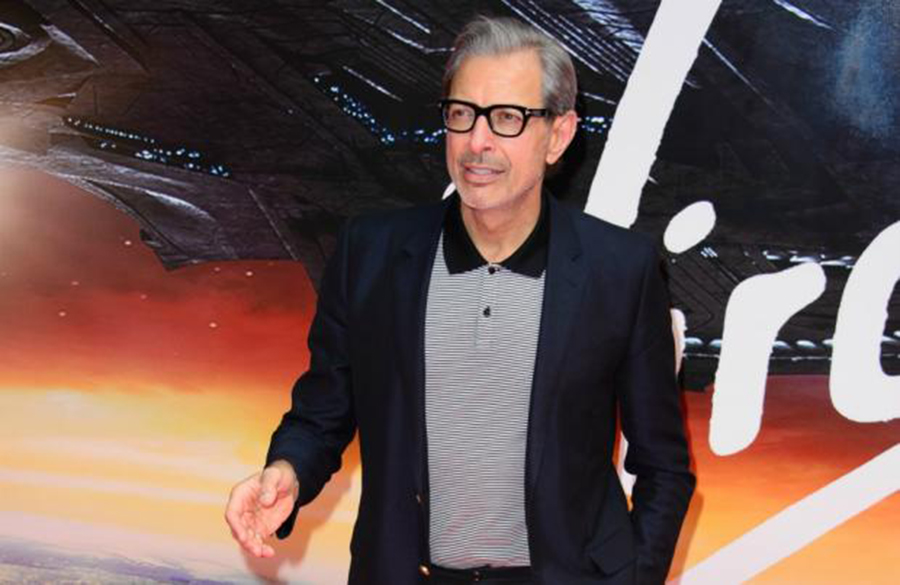
Jeff Goldblum

Jeff Goldblum has confirmed 'Jurassic World 3' will start filming in the UK next summer.


The 67-year-old actor is set to return to the dinosaur franchise as Dr. Ian Malcolm for the fourth time and he "can't wait" to get started on the movie, which will also star Chris Pratt, Bryce Dallas Howard, and original 'Jurassic Park' stars Sam O'Neill and Laura Dern.

Chatting about scary movies with Virgin Radio host Chris Evans, Jeff let slip: "Well, I guess those dinosaur movies are kind of scary. And we're gonna do another one of those around these parts come this summer.

"[I'll] be here shooting with Laura Dern and Sam O'Neill and Chris Pratt and Bryce Dallas Howard.

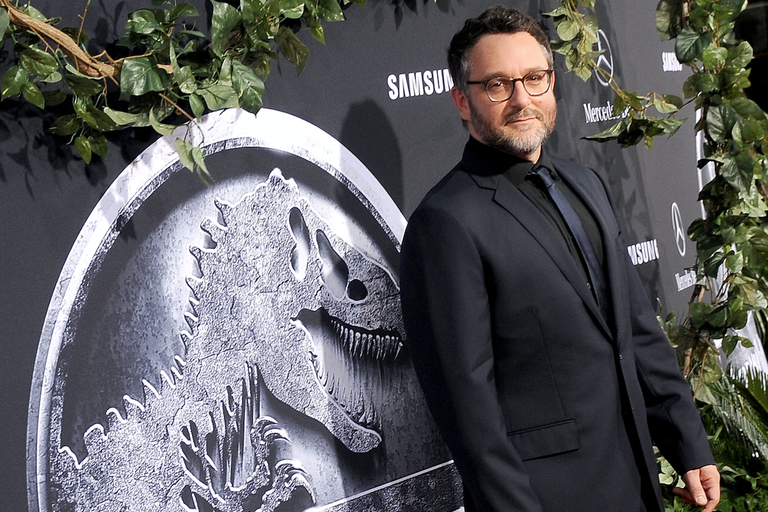
"Colin Trevorrow as the great director is going to be writing and directing it. And I can't wait."

Director Colon Trevorrow recently revealed the movie will bring back Sam and Laura – who played Dr. Alan Grant and Dr. Ellie Sattler – to join Jeff back in the series in an "organic way".

The 43-year-old filmmaker always wanted to include them in the new trilogy, which he considers to be a continuation of the original 'Jurassic Park' franchise, but there needed to be a logical reason to get them back.

He said: "We'd have had to come up with a reason why Ellie, Malcolm and Grant all went to the theme park on the exact same day it broke down – again. The next film allows the legacy characters to be part of the story in an organic way.

"(Co-writer) Emily Carmichael and I call it 'Jurassic Park VI' because it is."

Colin also revealed that the filmmakers had to consider how the characters have changed since their last appearance in 2001's 'Jurassic Park III'.

He said: "You start asking the most basic questions: who are those people now? What do they make of the new world they're living in, and how do they feel about being part of its history?

"Ultimately it will be in collaboration with the actors. They know and love these characters. We'll do it together."

'Jurassic World 3' is set for release in 2021.

Source: www.list.co.uk/

‘Jurassic World 3’ is Really ‘Jurassic Park 6,’ Colin Trevorrow Says

Friday, November 1, 2019

When Colin Trevorrow brought dinosaurs back from extinction (again) with 2015’s Jurassic World, it marked a new chapter for the science fiction monster franchise, paying homage to Steven Spielberg’s 1993 classic while bringing the series into a new era with new leads played by Chris Pratt and Bryce Dallas Howard.

But last month, we learned that the original Jurassic Park trio, Laura Dern, Sam Neill, and Jeff Goldblum, will be returning to run with the reptiles once again. And there’s a reason that the three of them will be united onscreen for the first time in 26 years, Trevorrow recently revealed.

In an interview with Empire Magazine, Trevorrow spoke about bringing back the iconic Jurassic Park characters of Dr. Ellie Sattler, Dr. Alan Grant, and Dr. Ian Malcolm, played by Dern, Neill, and Goldblum, respectively. It’s more than a piece of stunt casting, Trevorrow said, explaining that the upcoming Jurassic World 3 acts more like a sequel to the overall franchise, calling the project “Jurassic Park VI”:

“We’d have had to come up with a reason why Ellie, Malcolm and Grant all went to the theme park on the exact same day it broke down – again. The next film allows the legacy characters to be a part of the story in an organic way. Emily Carmichael and I call it ‘Jurassic Park VI’, because it is. You start asking the most basic questions: who are these people now? What do they make of the new world they’re living in, and how do they feel about being part of its history? Ultimately it will be in collaboration with the actors. They know and love these characters. We’ll do it together.”

While Jurassic World and 2018’s Jurassic World: Fallen Kingdom have largely remained separate from the first three Jurassic Park movies — apart from premise, a few shared characters and a very brief Goldblum cameo. But Trevorrow says that will soon change with Jurassic World 3, which will combine both series into an overall saga. We don’t know in what way Dr. Ellie Satler and Alan Grant will be involved in the story, but it’s likely their dinosaur expertise could be used to corral the dinosaurs unleashed upon the world after an auction goes terribly wrong at the end of Jurassic World: Fallen Kingdom.

Directed by Colin Trevorrow from a script he co-wrote with Emily Carmichael, Jurassic World 3 stars Chris Pratt, Bryce Dallas Howard, Sam Neil, Laura Dern, Jeff Goldblum, and Mamoudou Athie.

Jurassic World 3 is slated to open theaters on June 11, 2021

Source: www.slashfilm.com/

New Dinosaur Footprints Found in Alaska

Friday, November 1, 2019

An artistic rendering of Aniakchak National Monument in the Late Cretaceous epoch. Image credit: Karen Carr / Fiorillo et al, doi: 10.1371/journal.pone.0223471.

Footprints of duck-billed dinosaurs, armored dinosaurs and a tyrannosaur discovered in Aniakchak National Monument, southwestern Alaska, shed new light on the Cretaceous period, according to new research.

Dinosaur fossils are well-known from Alaska, mostly from Denali National Park and the North Slope, but there are very few records of dinosaurs from the Alaskan Peninsula in the southwest part of the state.

In this new study, a team of paleontologists led by Dr. Anthony Fiorillo from the Perot Museum of Nature and Science found and analyzed dinosaur trackways in Aniakchak National Monument, located approximately 416 miles (670 km) southwest of the city of Anchorage, Alaska.

The trackways were preserved in Chignik Formation, a series of coastal sediment deposits dating back to the Late Cretaceous epoch, around 66 million years ago.

Dr. Fiorillo and colleagues identified over 75 new track sites including dozens of dinosaur footprints.

“Most of the combined record of tracks can be attributed to hadrosaurs, the plant-eating duck-billed dinosaurs. Tracks range in size from those made by full-grown adults to juveniles,” they said.

“Other tracks can be attributed to armored dinosaurs, meat-eating dinosaurs, and two kinds of fossil birds.”

“The track size of the predatory dinosaur suggests a body approximately 20-23 feet (6-7 m) long, about the estimated size of the North Slope tyrannosaurid Nanuqsaurus.”

Representative hadrosaur tracks from Aniakchak National Monument. Scale bars in A through C – 10 cm, in E and F – 5 cm. Image credit: Fiorillo et al, doi: 10.1371/journal.pone.0223471.

Previous research on dinosaur remains from northern Alaska found that hadrosaurs were most abundant in coastal habitats. The trackways documented in this study reveal that the same trend was true in southern Alaska.

“Understanding habitat preferences in these animals will contribute to understanding of how ecosystems changed through time as environmental conditions shifted and dinosaurs migrated across northern corridors between continents,” the researchers said.

“Our study shows us something about habitat preferences for some dinosaurs and also that duck-billed dinosaurs were incredibly abundant,” Dr. Fiorillo said.

Hadrosaurs were as commonplace as cows, though given we are working in Alaska, perhaps it is better to consider them the caribou of the Cretaceous.”

The study was published online in the journal PLoS ONE.

_____

A.R. Fiorillo et al. 2019. Dinosaur ichnology and sedimentology of the Chignik Formation (Upper Cretaceous), Aniakchak National Monument, southwestern Alaska; Further insights on habitat preferences of high-latitude hadrosaurs. PLoS ONE 14 (10): e0223471; doi: 10.1371/journal.pone.0223471

Source: www.sci-news.com/

Alaskan Dinosaur Footprints Reveal an Ancient Ecosystem

Friday, November 1, 2019

© iStock/gremlin

The vast number of dinosaur footprints in Alaska reveal that high latitude hadrosaurs preferred tidally influenced habitats, according to the Perot Museum of Nature and Science, Texas.

Dinosaur fossils are common in Alaska, with some of the most famous areas of fossil excavation being Denali National Park and the North Slope. There are very few records of dinosaurs from the Alaskan Peninsula in the southwest part of the state. Anthony Fiorillo and his colleagues from the Perot Museum of Nature and Science in Texas, documented the abundant dinosaur trackways from Aniakchak National Monument, around 670km southwest of Anchorage.

Preserved in the Chignik Formation, the trackways were preserved in a series of coastal sediment deposits dating back to the late Cretaceous Period, around 66m years ago. Survey work from 2001 to 2002 and 2016 to 2018, identified two footprints of armoured dinosaurs, one being from a large predatory tyrannosaur and a few footprints attributable to two types of birds. 93% of the tracks belonged to hadrosaurs, a highly successful herbivore which is typically the most common dinosaurs a high latitude fossil ecosystem.

The researchers explained: “While there are now numerous records of dinosaurs from Cretaceous rocks around the state of Alaska, very few fossil records of terrestrial vertebrates are known from the Mesozoic rocks of the southwestern part of the state. Here we report the new discovery of extensive occurrences of dinosaur tracks from Aniakchak National Monument of the Alaska Peninsula.”

Previous research conducted in northern Alaska has found that hadrosaurs were more abundant in coastal habitats. The trackway documented revealed that the same trend was apparent in southern Alaska. The authors of the study suggest that understanding habitat preferences of dinosaurs will contribute to the understanding of how ecosystems change through time as environmental conditions shifted and dinosaurs migrated across northern corridors between continents.

Fiorillo adds, “Our study shows us something about habitat preferences for some dinosaurs and also that duck-billed dinosaurs were incredibly abundant. Duck-billed dinosaurs were as commonplace as cows, though given we are working in Alaska, perhaps it is better to consider them the caribou of the Cretaceous.”

Source: www.scitecheuropa.eu/

Scientists Unearth Huge Claw From 110-Million-Year-Old Carnivorous Dinosaur

Thursday, October 31, 2019

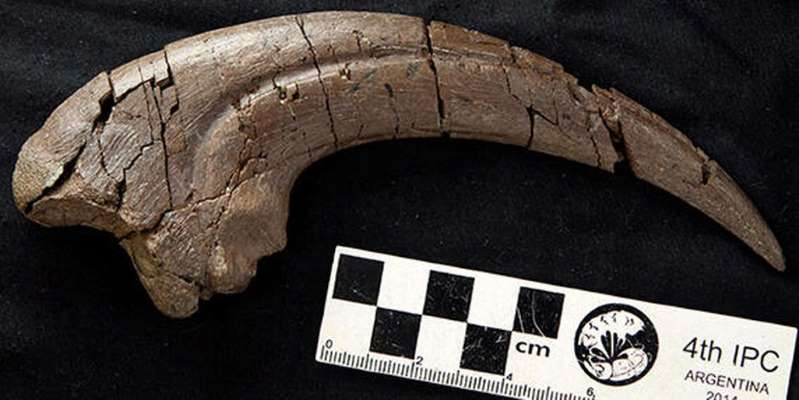
Claw-ght red-handed.  Stephen Poropat/Museums Victoria

An 8-inch sickle-shaped claw from the Cretaceous period hints at a new species of megaraptorid.

A handful of bones, including an 8-inch (20-centimeter) claw found in the 107 million-year-old Eumeralla Formation in Australia, point to the discovery of a new species of carnivorous dinosaur. The rare find has intrigued paleontologists because the bones look almost identical to a previously-discovered species that lived around 10 million years later and thousands of miles further north.

The discovery, published in the Journal of Vertebrate Paleontology, includes two teeth, two claws, an ankle bone and a neck bone belonging to a group of theropod dinosaurs -- those that include beasts like the T. rex -- known as the megaraptorids. The find adds to the hundreds of fossils unearthed at Eric the Red West (ERTW), a site south-west of Melbourne, Australia, but it's particularly exciting because of the resemblance to a species known as Australovenator wintonensis.

"All of these bones, other than the vertebra, can be compared with Australovenator wintonensis and all appear to be very similar," says Stephen Poropat, a paleontologist at Swinburne University and first author on the study.

The striking resemblance presents a conundrum for the researchers because Australovenator wintonensis was discovered in Queensland, a region thousands of miles to the north of ERTW. Those bones were dated to 95 million years ago, which means there's a 10 million-year gap between the two fossil finds.

"It is possible that we've found bones of subadult Australovenator individuals," says Poropat, "but it is more likely that we're dealing with a different species.

"To have a dinosaur species lasting for more than 10 million years would be extraordinary, but not impossible."

Perhaps the most impressive find is the striking 8-inch claw. Poropat explains the unique shape -- one that you're probably familiar with if you've ever seen Jurassic Park -- is mostly identical to megaraptorid claws found in other regions, including Megaraptor, a theropod discovered in Argentina with an almost 13-inch claw.

With only fragments of the fossil currently available, it hasn't received an official name or identifier just yet. However, Eric the Red West has turned up some stellar fossils in the past and Poropat hopes that more theropod bones will be found in the future. Another expedition to the site will occur in November.

"The deposits are all representative of deep, fairly fast-flowing rivers, so we don't expect to find a whole skeleton of a land-living animal, but we might get lucky," he says.

Source: www.cnet.com/

Gaseous Mercury Emissions from Volcanoes Contributed to End-Triassic Mass Extinction

Thursday, October 31, 2019

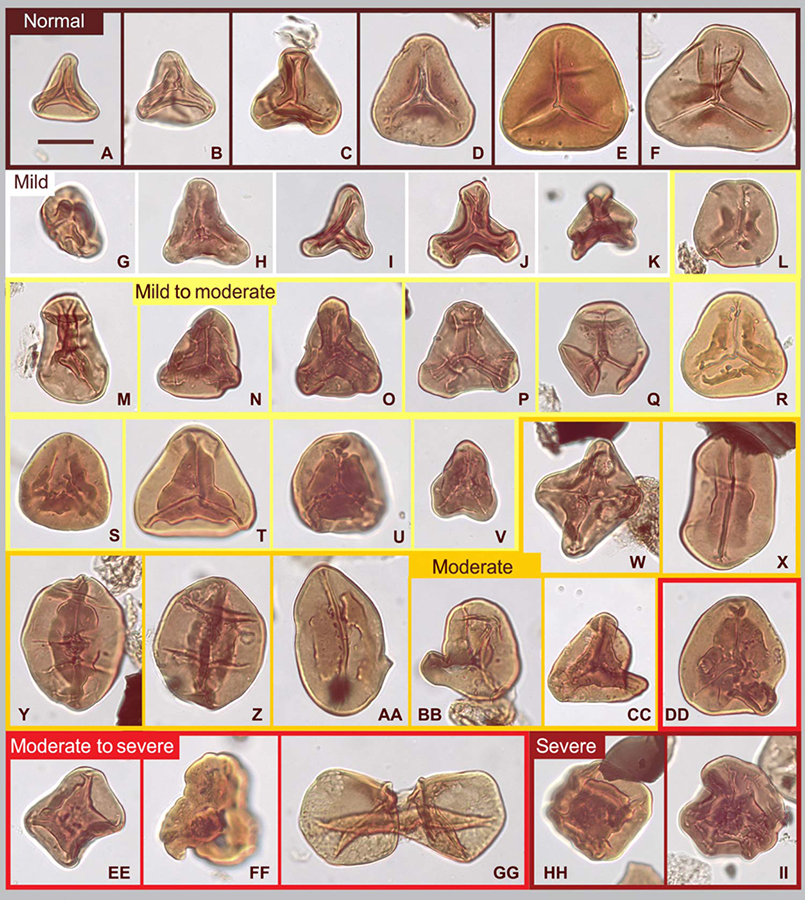
Normal and mutated fern spores from the end-Triassic mass extinction. Scale bar – 20 μm. Image credit: Sofie Lindström, Geological Survey of Denmark and Greenland.

The end-Triassic mass extinction occurred 201.51 million years ago and resulted in the demise of some 76% of all marine and land species. Up until now, most scientists believed that the catastrophe was caused by the release of volcanic carbon dioxide with global warming as a consequence. According to new research, the increased concentrations of mercury — the most genotoxic element on Earth — contributed to the end-Triassic crisis.

“Prior to industrialism, volcanic activity was the major release mechanism of large amounts of mercury from the Earth’s crust,” said Aarhus University researcher Hamed Sanei, co-author of the study.

“That makes it possible to use mercury in sediments to trace major volcanic activity in the Earth’s past and in extent tie the extinctions of fossil organisms to large igneous province (LIP) volcanism.”

“Previous studies found elevated mercury concentrations in Triassic-Jurassic boundary sediments over a very large area stretching from Argentina to Greenland and from Nevada to Austria and that made us curious about the impact on the end-Triassic event.”

“We decided to examine whether mercury could have played a role.”

The scientists analyzed fossil fern spores from core samples dating to the end-Triassic mass extinction and found a link between the increased mercury levels and mutations in the spores.

This rise in mutations happened during a period of increased volcanic activity in a LIP called the Central Atlantic Magmatic Province leading to rising mercury levels.

“By looking at fern spores in sediments from the mass extinction, it was evident that these ferns were negatively affected by the mercury levels,” said lead author Dr. Sofie Lindström, from the Geological Survey of Denmark and Greenland.

“Since mercury is accumulated in the food chain, it seems likely that other species have suffered as well.”

“These results suggest that the end-Triassic mass extinction was not just caused by greenhouse gases from volcanoes causing global climate change, but that they also emitted toxins such as mercury wreaking havoc.”

The findings were published in the journal Science Advances.

_____

Sofie Lindström et al. 2019. Volcanic mercury and mutagenesis in land plants during the end-Triassic mass extinction. Science Advances 5 (10): eaaw4018; doi: 10.1126/sciadv.aaw4018

Source: www.sci-news.com/

Jurassic World 3 Director On Why He Brought Back The Original Jurassic Park Stars

Wednesday, October 30, 2019

GREGG DEGUIRE/WIREIMAGEGETTY IMAGES

"The challenge is to make sure they don't feel like parodies of themselves."

While we know that Jurassic World 3 will bring back original franchise stars Sam Neill, Jeff Goldblum and Laura Dern, the reason behind it has remained a mystery.

However, director Colin Trevorrow has dished a bit more on why we'll see Doctors Alan Grant, Ian Malcolm and Ellie Sattler again, promising their return will be "organic".

"We'd brought back Dr Henry Wu first because he was the man behind the science and the only one who made sense," he told Empire.

UNIVERSAL

"Otherwise, we'd have had to come up with a reason why Ellie, Malcolm and Grant all went to the theme park on the exact same day it broke down – again.

"But the next film allows the legacy characters to be a part of the story in an organic way. [Jurassic World 3 screenwriter] Emily Carmichael and I call it Jurassic Park IV, because it is."

He further explained: "The challenge is to make sure they don't feel like caricatures or parodies of themselves. They're so iconic, you can easily fall into that trap. You start by asking the most basic questions: who are these people now?

"What do they make of the new world they're living in, and how do they feel about being part of its history? Ultimately it will be in collaboration with the actors. They know and love these characters. We'll do it together."

Star Chris Pratt recently reacted to the news that the three would appear, tweeting: "It's finally happening. Get ready for what is absolutely without a doubt going to be the biggest, baddest and best, movie of the franchise. #WeSparedNoExpense".

Jurassic World 3 has a release date of June 11, 2021.

Source: www.digitalspy.com/

Using Realistic Dinosaurs to Design Your Dream Stone-Age Garden

Wednesday, October 30, 2019

Image source: dailtbeast.com

There is no denying the fact that a beautifully-designed garden can add so much to your home’s interior décor. Not only it beautifies the exterior of your home but also lets in positive energy inside. With the emergence of primitive plants and realistic dinosaur models, the trend of creating a personalized dinosaur theme garden is on the rise.

Yes, colorful flowers and rockery enhance the look of your home, but a fully customized stone-age garden can literally amaze your guests and visitors. The best bit? You don’t have to break your bank to achieve your desired theme-based garden. In fact, with little investment and creativity, you can design your dream garden in no time. How? Let’s explore.

Using Realistic Dinosaurs to Design Your Dream Stone-Age Garden

According to OnlyDinosaurs, Animatronic dinosaurs are a great way to upgrade any home’s exterior décor. Whether you’re renovating your existing garden or constructing one from scratch, you should consider incorporating a realistic dinosaur theme to make your décor stand out of the crowd.

Primitive Plants

IMAGE SOURCE: WILDERNORTH.COM

Ideally, you should look for primitive plants to achieve your desired prehistoric look. These plants include Mosses, Ferns, Gingko trees and Cycads. Asparagus, Gunnera, and Junipers can also be added for an ultimate stone-age look.

Creating a prehistoric garden is very similar to building a conventional garden, but you’ll find the final results surprisingly different and unique.

Rockery

The rockery is yet another exciting element that can help you achieve a real-life dinosaur garden for your home. Try to build rockery all around your garden except for the entrance of course. Also try to pick colors that are darker, redder in tone. Once you’ve successfully constructed a garden and rockery for your place, now is the time to look for other elements that can add a more realistic feel to your outer place.

Realistic Dinosaur Models

IMAGE SOURCE: AMAZON.COM

Obviously, a stone-age dinosaur garden is incomplete without some ferocious, wild dinosaurs. Today, there are many online vendors that offer life-like realistic dinosaur models that are astounding to be used as your ultimate prehistoric garden accessory. These models can move, turn heads and roar to give real-time prehistoric experience. Try to invest in a few realistic models of your choice including baby dinosaurs, T-Rex, cerapoda or any other type to match with your rockery and overall garden theme.

As there are many vendors out there, you have to be extremely careful in picking the right one so that you can get the best of the best options within your budget. Get in touch with your vendor and share your requirements. You can either pick anything from their catalog or can also order personalized dinos on request.

Other Accessories

Apart from these basic things, you can also purchase a smoke machine to fit beneath your fire-spitting Robosaurus to make it look even more real and functional. Also, make sure to install lighting that perfectly matches up with your overall theme. A well-lit pergola or gazebo can also add a unique touch to your garden. Also, you can cover some space to make it fit for all seasons.

Benefits of Constructing a Realistic Dinosaur Garden for Your Home

Uniqueness

IMAGE SOURCE: TOWNNEWS.COM

Unlike other conventional garden themes, dinosaur garden is unique and trendy. It gives you an opportunity to experiment with hundreds of ideas to build a full-fledge prehistoric garden of your choice.

Economical

Custom dinosaur gardens need not be too fancy or extravagant. Not only they’re super easy and doable for your home but you can also build one if you own a school. Just make sure you pick the right types of plants and the best dinosaur models to give your place an authentic feel.

Makes a Great Party Venue

A dinosaur theme garden inside your home or school can be used as an ultimate party venue. Especially, you can arrange a great Halloween bash or an outstanding theme birthday party without spending any extra money.  Just ask your guests to dress in a customized dinosaur walking costumes to make the entire event look more picture-perfect.

Manageable

Dissimilar to other complex interior designs that require continuous maintenance and care and hefty monthly budget, looking after your custom dinosaur theme garden is a no-brainer. The realistic dinosaur figurines are too easy to install and you don’t have to invest in much time to keep them in good shape.

Final Words

A personalized dinosaur theme garden can elevate the interiors of any home architecture. They add an element of uniqueness and panache to your overall home décor. Kids and adults love them alike. Just be certain to do the proper research beforehand to unearth more unique ways to transform your plain and boring outer space into something really inspiring and electrifying.

What other things you think can be added to your dinosaur garden to make it look more realistic and lifelike. Please drop your feedback below as we would love to hear back!

Source: https://foreignpolicyi.org/

Pages