
Blogs

Miocene-Period Great Ape Unearthed in Germany: Danuvius guggenmosi
Friday, November 8, 2019

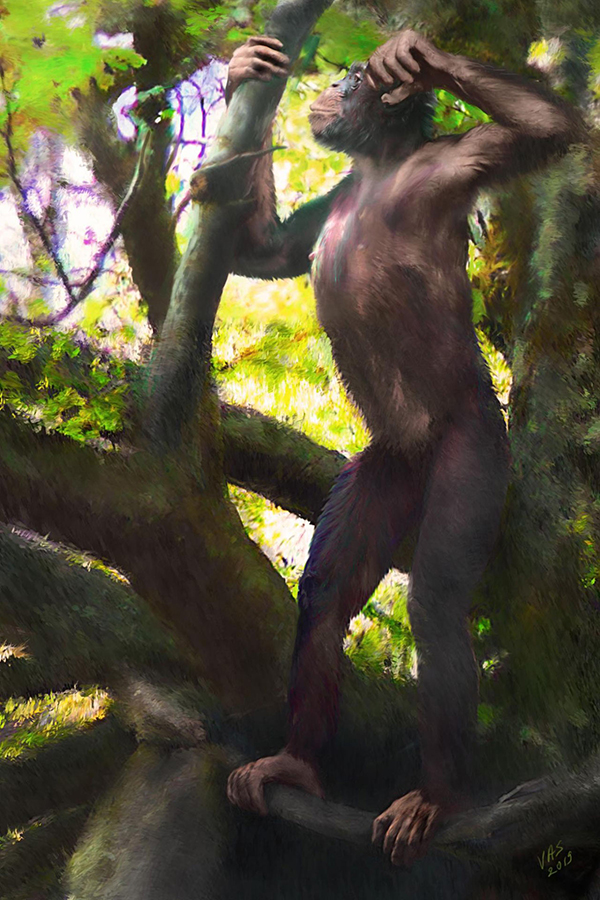
Danuvius guggenmosi, a great ape that lived some 12 million years ago (Miocene period) in what is now Germany. Image credit: Velizar Simeonovski.

A previously unknown species of great ape that was well adapted to both walking upright as well as using all four limbs while climbing has been identified from fossils found in southern Germany.

Named Danuvius guggenmosi, the ancient great ape lived during the Miocene Epoch, 11.62 million years ago.

The primate was about 3.3 feet (1 m) in height. Females weighed about 18 kg, less than any great ape alive today, males had a mass of about 31 kg, also at the low extreme of modern great ape body size.

The fossilized remains from at least four individuals of Danuvius guggenmosi (a male, two females and a juvenile) were unearthed in the Hammerschmiede clay pit in the Allgäu region of Bavaria between 2015 and 2018.

The most complete skeleton belonged to a male and had body proportions similar to modern-day bonobos.

Thanks to completely preserved limb bones, vertebra, finger and toe bones, Professor Madelaine Böhme from the Senckenberg Center for Human Evolution and Palaeoenvironment at the University of Tübingen and colleagues were able to reconstruct the way Danuvius guggenmosi moved about in its environment.

“For the first time, we were able to investigate several functionally important joints, including the elbow, hip, knee and ankle, in a single fossil skeleton of this age,” Professor Böhme said.

“It was astonishing for us to realize how similar certain bones are to humans, as opposed to great apes.”
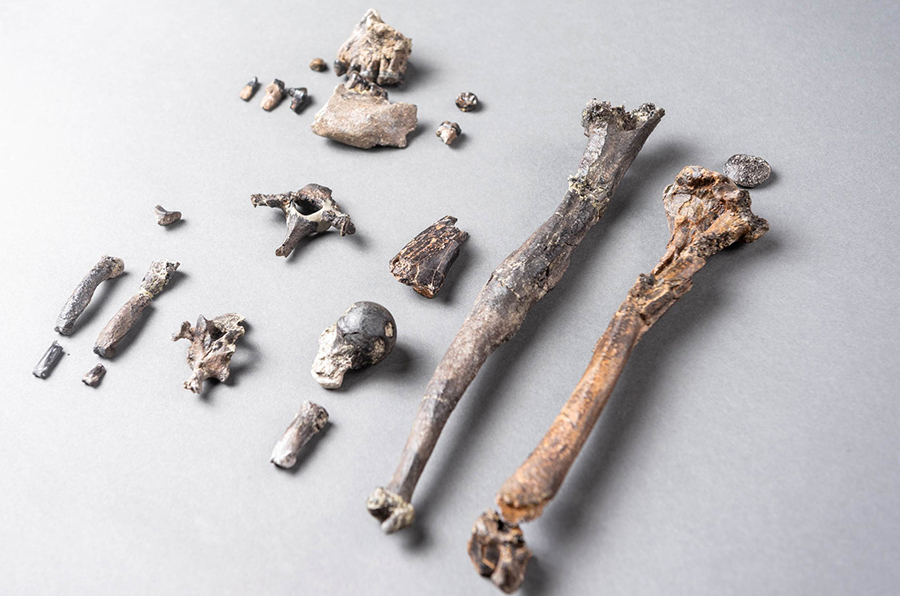
The bones from the skeleton of a male Danuvius guggenmosi. Image credit: Christoph Jäckle.

The team’s findings indicate that Danuvius guggenmosi could walk on two legs and could also climb like an ape.

The spine, with its S-shaped curve, held the body upright when standing on two legs. The animal’s build, posture, and the ways in which it moved are unique among primates.

Danuvius guggenmosi combines the hindlimb-dominated bipedality of humans with the forelimb-dominated climbing typical of living apes,” said Professor David Begun, a researcher at the University of Toronto.

“These results suggest that human bipedality evolved in arboreal context over 12 million years ago.”

“In contrast to later hominins, Danuvius guggenmosi had a powerful, opposable big toe, which enabled it to grasp large and small branches securely,” said Professor Nikolai Spassov, from the Bulgarian Academy of Science.

“The ribcage was broad and flat, and the lower back was elongated; this helped to position the center of gravity over extended hips, knees and flat feet, as in bipeds.”

The results are supported by a recent study of the hip-bone from the 10 million-year-old ape Rudapithecus hungaricus found in Hungary.

“That fossil also indicates that the European ancestors of African apes and humans differed from living gorillas and chimpanzees,” Professor Begun said.

The study was published in the journal Nature.

_____

M. Böhme et al. A new Miocene ape and locomotion in the ancestor of great apes and humans. Nature, published online November 6, 2019; doi: 10.1038/s41586-019-1731-0

Source: www.sci-news.com/

Check Out Jurassic World and Other Classic Steelbooks

Thursday, November 7, 2019

In the world of movie collection, steelbooks are an exceptional buy. You get a great movie and limited edition art on a metal casing. Perfect for any movie enthusiast, these cases are instant classics and a clever way to tell someone you care about their passions.

Best Buy is known for its expansive selection of limited edition steelbooks. Today's highlight is the Jurassic World 5-Movie Collection. The 1993 worldwide phenomenon Jurassic Park earned audiences' attention as Steven Spielberg directed a dinosaur thriller with a heart. What would happen if we remade dinosaur DNA and rebirthed an entire era of extinct terrors for our amusement? Well, it goes about as well as you could expect. And it's absolutely mesmerizing to watch, even 26 years later! Jurassic Park spawned 4 sequels over the years, included two recent films with Guardians of the Galaxy star Chris Pratt. Each of the five movies comes packed with behind-the-scenes extras and goodies for all to enjoy.

This steelbook also has a great front-and-back artwork that pays homage to the overrun parks of the franchise.

And that's just the start of the steelbook content that Best Buy has to offer for us today!

Next up is the classic Jumanji and its sequel Jumanji: Welcome to the Jungle (technically the third in the franchise, after Zathura: a Space Adventure). With an outstanding cast featuring the Rock, Karen Gillan, Kevin Hart, and Jack Black, this modern take on the classic Jumanji felt fresh and fun. This steelbook of the original Jumanji with the 2017 Jumanji: Welcome to the Jungle comes as both 4k Ultra HD and Blu-ray. And for fans of the fast-paced racer series, Fast and the Furious, comes the original 2001 hit. Vin Diesel and the late Paul Walker star in this crime drama with a penchant for fast cars and crazy stunts. With a unique comic-book cover, this steelbook has a life of its own. Also on sale is the war tale of Dunkirk, directed by The Dark Knight's Christopher Nolan. This historical thriller showcases World War II's battle for Dunkirk, France. With an eye for detail and character-driven stories, Christopher Noal fails to disappoint. Today's Daily Deals ends off with the recent family-friendly comedy, Hotel Transylvania 3: Summer Vacation. The crew of Hotel Transylvania is off on vacation with their ragtag group of vampires, ghouls, and goblins!

As always, these prices are not guaranteed to last past midnight tonight EST. So instead of checking in to a sketchy dinosaur park with lofty goals, check out these Best Buy steelbooks! Don't forget to stop by tomorrow for more deals on merch tailored for you.

We hope you like the items we recommend! We have affiliate partnerships, so we receive a share of the revenue from your purchase. This won’t affect the price you pay.

Source: https://screenrant.com/

Exceptional Fossils May Need a Breath of Air to Form

Thursday, November 7, 2019

Fossilization process. Author: Xabier Murelaga - Elhuyar Fundazioa

Some of the world's most exquisite fossil beds were formed millions of years ago during time periods when the Earth's oceans were largely without oxygen.

That association has led paleontologists to believe that the world's best-preserved fossil collections come from choked oceans. But research led by The University of Texas at Austin has found that while low oxygen environments set the stage, it takes a breath of air to catalyze the fossilization process.

"The traditional thinking about these exceptionally preserved fossil sites is wrong," said lead author Drew Muscente. "It is not the absence of oxygen that allows them to be preserved and fossilized. It is the presence of oxygen under the right circumstances."

The research was published in the journal PALAIOS on November 5, 2019.

Muscente conducted the research during a postdoctoral research fellowship at the UT Jackson School of Geosciences. He is currently an assistant professor at Cornell College in Mount Vernon, Iowa. The research co-authors are Jackson School Assistant Professor Rowan Martindale, Jackson School undergraduate students Brooke Bogan and Abby Creighton and University of Missouri Associate Professor James Schiffbauer.

The best-preserved fossil deposits are called "Konservat-lagerstätten." They are rare and scientifically valuable because they preserve soft tissues along with hard ones -- which in turn, preserves a greater variety of life from ancient ecosystems.

"When you look at lagerstätten, what's so interesting about them is everybody is there," said Bogan. "You get a more complete picture of the animal and the environment, and those living in it."

The research examined the fossilization history of an exceptional fossil site located at Ya Ha Tinda Ranch in Canada's Banff National Park. The site, which Martindale described in a 2017 paper, is known for its cache of delicate marine specimens from the Early Jurassic -- such as lobsters and vampire squids with their ink sacks still intact -- preserved in slabs of black shale.

During the time of fossilization, about 183 million years ago, high global temperatures sapped oxygen from the oceans. To determine if the fossils did indeed form in an oxygen-deprived environment, the team analyzed minerals in the fossils. Since different minerals form under different chemical conditions, the research could determine if oxygen was present or not.

"The cool thing about this work is that we can now understand the modes of formation of these different minerals as this organism fossilizes," Martindale said. "A particular pathway can tell you about the oxygen conditions."

The analysis involved using a scanning electron microscope to detect the mineral makeup.

"You pick points of interest that you think might tell you something about the composition," said Creighton, who analyzed a number of specimens. "From there you can correlate to the specific minerals."

The workup revealed that the vast majority of the fossils are made of apatite -- a phosphate-based mineral that needs oxygen to form. However, the research also found that the climatic conditions of a low-oxygen environment helped set the stage for fossilization once oxygen became available.

That's because periods of low ocean oxygen are linked to high global temperatures that raise sea levels and erode rock, which is a rich source of phosphate to help form fossils. If the low oxygen environment persisted, this sediment would simply release its phosphate into the ocean. But with oxygen around, the phosphate stays in the sediment where it could start the fossilization process.

Muscente said that the apatite fossils of Ya Ha Tinda point to this mechanism.

The research team does not know the source of the oxygen. But Muscente wasn't surprised to find evidence for it because the organisms that were fossilized would have needed to breathe oxygen when they were alive.

The researchers plan to continue their work by analyzing specimens from exceptional fossil sites in Germany and the United Kingdom that were preserved around the same time as the Ya Ha Tinda specimens and compare their fossilization histories.


Story Source:

Materials provided by University of Texas at AustinNote: Content may be edited for style and length.


Journal Reference:

  1. A.D. MUSCENTE, ROWAN C. MARTINDALE, JAMES D. SCHIFFBAUER, ABBY L. CREIGHTON, BROOKE A. BOGAN. TAPHONOMY OF THE LOWER JURASSIC KONSERVAT-LAGERSTÄTTE AT YA HA TINDA (ALBERTA, CANADA) AND ITS SIGNIFICANCE FOR EXCEPTIONAL FOSSIL PRESERVATION DURING OCEANIC ANOXIC EVENTSPALAIOS, 2019; 34 (11): 515 DOI: 10.2110/palo.2019.050

Source: www.sciencedaily.com/

Paleontologists Find Two New Snake Species in Greece

Friday, November 8, 2019

Fossil herpetofauna Maramena. Photo: Paleontoliga Elektronica

Fossilised remains of two new species of snakes found for the first time were discovered near the city of Serres in northern Greece.

Greek researcher George Georgalis from the University of Toronto named the 5.5- to 6-million-year-old snakes: Periergophis micros and Paraxenophis spanios.

“These two new snakes have new names because they belong to a totally new species and are completely different from any other species,” Dr Georgalis told the Athens Macedonia News Agency. “The strange thing is that such vertebral anatomy has not been observed anywhere else and there is nothing, either in modern or in extinct serpent species, that even comes close to the morphology of these new species.”

He explained that the serpents “are so unique that we find it difficult to include them in any known family and we immediately understand that they belong to a new species.”

The Greek paleontologist has published a scientific paper in Paleontoliga Elektronica on the discovery, in collaboration with other scientists from German, Swiss and Czech Republic Universities.

Source: https://neoskosmos.com/

New Type of Fossilization Discovered

Wednesday, November 6, 2019

Rasmussen & Muhling show that the infiltration of liquid hydrocarbons was responsible for the formation of these filamentous microfossils from the Red Dog Zn-Pb-Ag massive sulfide deposit in the western Brooks Range, northern Alaska, the United States. Image credit: Rasmussen & Muhling, doi: 10.1130/G46346.1.

A previously unrecognized mode of fossilization of ancient microbes may explain how some of Earth’s oldest microfossils formed, according to new research.

Microfossils provide information about the antiquity of life on Earth and the nature of the early biosphere, however some mystery still surrounds how they were preserved.

It generally thought that many of the oldest microfossils formed when silica grew on their cell walls encasing the microorganism.

When the microorganism died, their cells rapidly decayed, leaving behind only traces of carbon in a hollow cavity that molded the shape of the organism.

Professor Birger Rasmussen from the University of Western Australia and the China University of Geosciences and University of Western Australia’s Dr. Janet Muhling worked on the 340-million-year-old Red Dog zinc-lead deposit in northern Alaska, the United States.

They found the carbon filling of semi-hollow microfossils was not derived from the original organism but from migrated oil.

“We found that oil infiltration of silica-entombed bacteria was responsible for producing the structures, which resembled many of the oldest microfossils preserved in the rock record,” Professor Rasmussen said.

“Using high-resolution electron microscopes, we found microfossils located around oil-carrying fractures were black and filled by a thin film of carbon.”

“In contrast, microfossils between the fractures contained little or no internal carbon and were virtually invisible.”

The formation of carbon-rich microfossils around fractures suggested oil moving through the cracks in the rock had seeped into the semi-hollow molds left after the bacteria died.

“What we have found is a new process of fossilization,” Professor Rasmussen said.

“We are now looking at rock samples from other localities to examine what role oil might have played in the preservation of microfossils on the early Earth.”

“The results may have implications for how we assess whether ancient microstructures are signs of life on early Earth and how we might detect biosignatures on Mars and other rocky planets.”

The study was published in the journal Geology.

_____

Birger Rasmussen & Janet R. Muhling. Organic-rich microfossils produced by oil infiltration of hollow silicified bacteria: Evidence from the ca. 340 Ma Red Dog Zn-Pb deposit, Alaska. Geology, published online September 25, 2019; doi: 10.1130/G46346.1

Source: www.sci-news.com/

Laura Dern In The Dark About Jurassic World Role

Tuesday, November 5, 2019

Laura Dern knows very little about her role in 'Jurassic World 3' other than her alter ego, Dr. Ellie Sattler, will be "heroic"

The actress is set to reprise her 'Jurassic Park' role of Dr. Ellie Sattler in the upcoming blockbuster and while she's promised her alter ego will be "heroic", she's insisted no one has given her any other details about the latest installment in the dinosaur saga.

Asked about her comeback, she told 'Entertainment Tonight': "I'm still waiting to hear [more]!

"I mean, she's just going to be heroic! That's all I know. But I know nothing else."

Laura's co-star, Jeff Goldblum, recently confirmed the movie will start shooting in London next summer.

Chatting about scary movies last week, he let slip: "Well, I guess those dinosaur movies are kind of scary. And we're gonna do another one of those around these parts come this summer.

"[I'll] be here shooting with Laura Dern and Sam Neill and Chris Pratt and Bryce Dallas Howard.

"Colin Trevorrow as the great director is going to be writing and directing it. And I can't wait."

Trevorrow recently revealed the movie will bring back Sam – who played Dr. Alan Grant and Laura to join Jeff back in the series in an "organic way".

He said: "We'd have had to come up with a reason why Ellie, Malcolm and Grant all went to the theme park on the exact same day it broke down – again. The next film allows the legacy characters to be part of the story in an organic way.

"(Co-writer) Emily Carmichael and I call it 'Jurassic Park VI' because it is."

The director also revealed that the filmmakers had to consider how the characters have changed since their last appearance in 2001's 'Jurassic Park III'.

He said: "You start asking the most basic questions: who are those people now? What do they make of the new world they're living in, and how do they feel about being part of its history?

"Ultimately it will be in collaboration with the actors. They know and love these characters. We'll do it together."

'Jurassic World 3' is set for release in 2021.

Source: www.list.co.uk/

Meat-Eating Dinosaurs Adopted Highly Specialized Diets

Tuesday, November 5, 2019

Diagram shows the diversity of skull shapes in the meat-eating dinosaurs, and the fact that they form three distinct groups, the small carnivores, large carnivores, and the mixed plant and generalist feeders (herbivores and omnivores).  CREDIT: Joep Schaeffer

The fossil record is filled with meat-eating dinosaurs. Some paleontologists have suggested there are too many theropod dinosaurs, given what scientists know about food chains.

New research, however, suggests meat-eating dinosaurs developed highly specialized diets, allowing theropods to avoid competition for resources.

Of course, scientists can't go back and watch theropods hunt and feed. For the new study, published in the journal Paleontology, researchers had to infer details about dino diets by analyzing the shapes and sizes of jaws and teeth.

"I measured everything I could from the jaws and teeth of 83 theropod dinosaurs, including the giants, but also small ones the size of a turkey," lead study author Joep Schaeffer, a graduate student at the University of Bristol in Britain, said in a news release.

For each fossil, scientists recorded dozens of measurements related to the specimen's jaws and teeth. The researchers used a model to help them compare the measurements from each species.

"We could simply treat all the separate measurements as part of the mix, or we could measure so-called landmarks, where we make an outline of the jaw and tooth shape by marking dots round the edge," said Bristol professor Mike Benton. "So, in the end, Joep ran his analyses using each possible measurement method, and we compared the results."

Though there were a variety of ways to analyze the measurements, the model showed each statistical method yielded similar results. The data revealed stark differences between the predatory anatomy of each species.

The data showed tyrannosaurs were especially unique, and in a class of predator all their own. Scientists determined that maniraptoriform theropods, the group of dinosaurs most closely related to birds, featured the greatest variation in jaw shapes.

The findings suggest maniraptoriform theropods and other meat-eating dinosaurs adapted their jaws to target niche prey.

"Tyrannosaurs were good at subduing large prey with their massive jaws. So, they all had the same kinds of jaws and teeth. But the maniraptoriforms were experimenting with a wide range of smaller prey, maybe from small dinosaurs to early mammals and lizards -- even some large, juicy insects," Schaeffer said. "This meant they had evolved a much wider array of kinds of jaws and teeth, and while many probably continued to hunt prey on the ground, others might have become specialized to hunting in the trees and pursuing fast-moving prey."

Source: www.upi.com/

The Next Best Thing To A Real Dinosaur

Monday, November 4, 2019

Ever since Jurassic Park was released in cinemas, people have been in love with dinosaurs. Whether it is the deadly Tyrannosaurus rex or the cunning Velociraptor, many people wish they could see one of these beasts in person.

It may not be possible to meet a real dinosaur, but that’s never stopped anyone from dreaming. With animatronic technology, it is possible to create a realistic dinosaur costume that will amaze anyone.

It starts with the design

To make an animatronic dinosaur that can pass for real, you need to design it meticulously. Companies that deal in animatronics, use an entire department to draft a design for the dinosaur that is intricately detailed.

Art designers spend weeks drawing up plans and getting the look right so that each part of the dinosaur can fool the human eye, while still balancing out the rest of the costume.

The costume must be functional, and that is what makes it so difficult. To create a realistic dinosaur is already impressive, but it also has to move realistically. Each part must move like a real dinosaur, or at least how we think a dinosaur would have moved if it were still alive.

Framework

The dinosaur begins its life as a metal frame. It must be molded from steel tubing to create the structure that the rest of the dinosaur will be built upon.

All of the animatronic devices will be attached to this frame and each of the limbs and head as well. The whole construction must be able to move and function before the rest of the costume is added.

Shape

To give the dinosaur shape, foam is added to the metal frame. The foam comes in blocks and each block must be attached and then carve to fit the shape of the dinosaur. Excess foam is cut away as the whole costume takes on the shape of a dinosaur.

This stage requires a lot of careful handling. The shape of the dinosaur is drawn onto the foam and cut away with Stanley knives or electrical tools like a jigsaw.

It takes quite a bit of artistic ability to perfectly sculpt the shape of a realistic dinosaur.

Skin texture

The next step is to add detail to the foam material. Artists use soldering irons to burn shapes into the foam. The add scales and muscles to the dinosaur to create the skin texture.

For some details, they may use a hand-held electric iron.

The end result is a scaly, bumpy dinosaur skin that looks like authentic lizard skin, or perhaps something you would see on a dragon.

Skin

Once the dinosaur has the right texture, the next step is to add skin. The creators use silk stockings for this. They will cut up the stockings into bandages and stretch them over the foam material. This gives the dinosaur a smooth, living-skin look.

Silicon is used to hold the silk stocking material in place and it also adds to the effect. The end result is a rough, reptilian skin that looks like something a real dinosaur would have.

3D printing

There is an alternative to creating the skin. Many people lake artistic ability, or they just may have a bigger budget to work with and prefer some help. In this case, the skin can be printed using 3D printing technology.

With 3D printers, designers can create incredibly detailed skin. This can be very realistic and can even be patterned on real-life lizard skin.

Designers can create the ideal texture and pattern on a computer and play around with it until they get it the way they want. Once they have a skin that they like, they can print it out, ready to be attached to the dinosaur costume.

The printed skin is then attached to the foam on the metal frame. This gives you the best result and looks the most realistic. It is quite expensive though. Depending on the company, they may opt to have people make the skin and texture with soldering irons and stockings, just to make it look more creative.

Painting

Once the skin is in place, the next step is to paint the dinosaur. This can easily ruin the effect if it isn’t done well, so a skilled artist should handle the painting.

The paint job should be done in several layers with different colors to match the different gradations you might find on living skin. Just like with a lizard, the belly should be a light color and the back should be a dark color. There should be various shades in between.

It is quite a process with several coats being needed. The paint usually takes a week or more to dry. A final assessment is needed to make sure everything is as it should be.

If the paint isn’t exactly right, then more coats may be needed. It is also important the various shades of color look realistic and balance each other.

Final details

Once the paint has dried and given the OK, the next step is to add the eyes, teeth, and claws. Any final detailing is done at this time as well, such as adding dark streaks to the claws to make them look real.

The claws and teeth may be filed down until they fit right and have the correct look. Anything that still needs to be glued or touched up with paint is finished off and when it’s finished and checked, you have a completed animatronic dinosaur costume.

The wait is worth it. These costumes look incredible, you’ll think you are staring at a real T-rex. On a typical costume, the eyes blink, the head moves realistically, the tail moves, it even roars. If the operator is skilled, it can be easy to think you are seeing a living animal, especially when it comes towards you.

If you have never seen a realistic, animatronic dinosaur costume, then you owe it to yourself to see one soon. Check them out today.

Source: https://ventsmagazine.com/

Researchers Find Ancient Bird in Dinosaur-Era Amber

Sunday, November 3, 2019

An international team of researchers have discovered an amber containing an ancient bird dating back around 100 million years.

The specimen found in Hukawng Valley in northern Myanmar, an area rich in amber fossil discoveries, will help enrich understanding of the diversity of ancient birds and the evolution of feathers. The result of the research was published in Scientific Reports.

The specimen is currently stored at the Yingliang Stone Nature History Museum in Quanzhou, Fujian Province. No bones are preserved in the new specimen but the outline of the bird foot is recorded in a detailed skin surface, which is surrounded by feathers.

Unlike previous discoveries in the same area, the bird's toes are very stout, and the outer toe appears strongly thickened relative to the inner two digits. The strong toes are similar to current raptors, which may indicate that the specimen is a small aerial insectivorous bird, according to Xing Lida, a paleontologist from the China University of Geosciences.

This type of foot has not been found in local fossil records, indicating the diversity of birds in the dinosaur era.

Source: www.xinhuanet.com/

How To Organize a Dinosaur Theme Birthday Party For Your Kid?

Monday, November 4, 2019

Dinosaur Party Ideas

If your preschooler loves dinosaurs, you don’t need to think too hard about his or her next birthday party theme. You can make this gigantic animal a part of your party planning and surprise your kid and the gang easily. Here are some ideas that you can implement to achieve this goal.

Decorations

Right from the invitation cards to the venue, everything should embody your party idea. For example, invites can have dinosaur shapes, cuts, and colors. Create multiple prehistoric footprints and put them on the walkway to the main hall or room where the event will take place. The table where all the food and drinks you keep can feature small dinosaur toys or little puppets strategically. Also, you can hang some pictures of these extinct animals from one corner to another with a wee bit of details so that it becomes engaging.

Costumes

You can hire one or two people to wear and stand like a dinosaur to elevate the theme. Kids will love this idea, which you will also notice when they keep going back to them to see what it feels like touching such fierce animal. However, the cost can be a determining factor, though. The dinosaur costume can be wild and made to the specifications of your liking.  If you are a DIY person and have lots of time, you may try to create one. Or, you can place an order for it too.

There are some good choices on amazon.com, where you can find different types of dinosaur costumes. Some dresses have visible legs or hidden legs. So, it is up to you to decide what you want.

If this works out, you can rest assured that it will be the highlight of the whole theme and a super hit thing for your kid and his or her friends.

Foods and drinks

You can easily replicate the theme in refreshments also. Get dinosaur-shaped frozen foods, which can cook in the oven in no time. Get cookie-cutters that have dinosaur designs so that you can give sandwiches such a shape or make baked cookies in that mold. Since lava and swamps were common things in the dinosaur era, you can select green and red colors in drinks to represent them.

In essence, there are plenty of fun things that you can organize around a dinosaur theme. Just get creative and resourceful. Then, everything will fall into the right place automatically. And, yes, don’t forget to plan some dinosaur activities too. Kids need to do something fun to avoid boredom. For example, in one section of the room or hall where people in dinosaur costume stand, you can divert kids there so that they can ask them to do different things.  Besides, you can have drawing activities where kids need to make anything related to the beast or the beast itself. So, think through and plan. It’s got a full scope.

Source: https://ventsmagazine.com/

Pages