Blogs

What Dinosaur Poop Tells Us About Ancient Life

Saturday, October 5, 2019

The proliferation of flowering plants made herbivorous dinosaur dropping more nutritious, which provided a backdrop fot the dung beetle's evolution, a new study suggests. DE AGOSTINI PICTURE LIBRARY/DE AGOSTINI/GETTY IMAGES

Karen Chin didn't plan on becoming an expert on dinosaur droppings. She studied the fossilized dinosaur poop, called coprolites, as a graduate student, but she figured she'd branch out afterwards to pursue any one of her many interests. Plus, she adds with a laugh, "I didn't want to become known as the dung person."

Yet the more she learned about coprolites, the more she became captivated by the field's unique potential to shed light on past ecosystems. By analyzing a dinosaur's last meal, she realized, researchers could reconstruct food webs connecting ancient organisms.

"What I like about studying coprolites is that you wouldn't be able to get this kind of information just by looking at a dinosaur skull and teeth," Chin says.
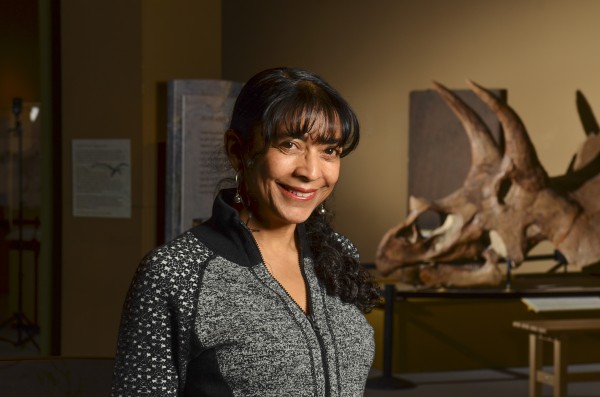
Karen Chin is an American paleontologist and taphonomist who is considered one of the world's leading experts in coprolites. Image courtesy of Karen Chin.

How to Find a 75-Million-Year-Old Turd

Now an associate professor at the University of Colorado Boulder, Chin has published more than two dozen papers detailing fossilized dinosaur poop, making her a leading figure in the field of "paleoscatalogy." It's a small research area because, compared to dinosaur bone fossils, coprolites are relatively rare.

For feces to become fossils, she explains, they need to be buried soon after they're expelled, and in moist environments conducive to bacterial growth, such as lakeshores.

Luckily, she's gotten really good at spotting the stuff, which isn't easy. While droppings from medium-sized animals tend to keep their sausage-like shape, that isn't usually the case for larger animals, she says. Because their poop has further to fall (up to 7-8 feet, for some dinosaurs!), it can break into pieces and end up as an unrecognizable pile.
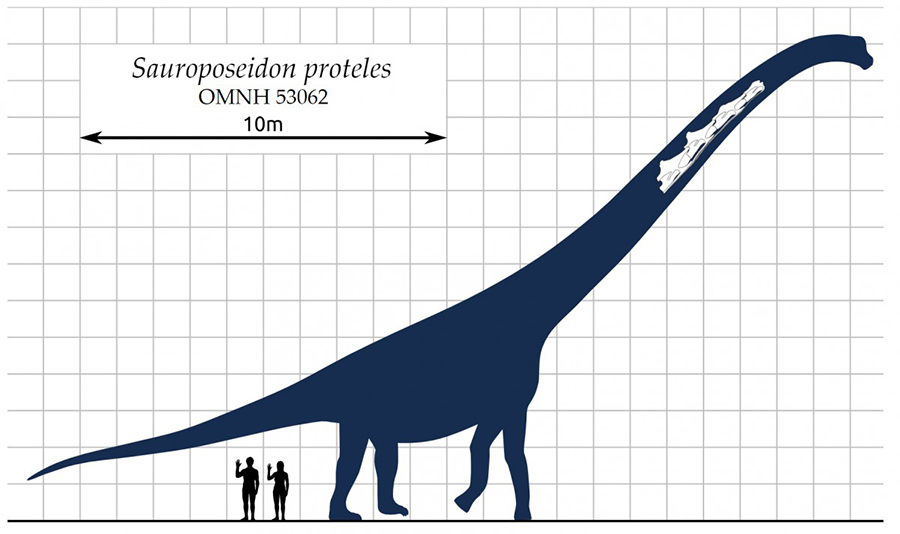
Scale diagram of Sauroposeidon, giant sauropod dinosaur genus from the Early Cretaceous. Image courtesy Wikimedia Commons.

To identify these coprolites, scientists like Chin look at several criteria in addition to shape.

First, researchers scan suspected scat for the presence of chopped up bits of plant matter, shell, and bone. They also analyze the sample's chemical makeup for high concentrations of calcium and phosphorus, which is a giveaway for digested bone and tissue. Plant matter contains lower levels of these tell-tale elements, however, making fossilized poop from herbivorous dinosaurs even harder to find.

Finally, paleoscatalogists look for evidence that the suspected excrement was snacked on by poop-loving organisms, like dung beetles. In fact, burrows made by ancient beetles played a key role in confirming the identity of the first coprolites that Chin studied in 1996.

At a conference with her collaborator, the entomologist Bruce D. Gill, she remembers "geeking out" over photos of the coprolite burrows — and a giant dung ball from Africa. Gill brought the ball along to show that dung beetles must have dug those particular fossilized burrows.

Coprolite found in Utah by Karen Chin. Image courtesy of Karen Chin.

"It was pretty funny and pretty exciting, because it not only helped make the case that these were coprolites," she says, "but it also showed an interaction that we did not (previously) have evidence for."

The pair's finding suggested that dinosaurs and dung beetles co-existed 75-76 million years ago. Prior to this, the oldest evidence for dung beetles dated back to 66 million years ago — around the time most dinosaurs went extinct. She says their work can be useful to modern dung beetle scientists who are trying to establish beetles' evolutionary lineages and how their feeding tendencies have changed.

What Fossilized Dinosaur Poop Tells Us About Ancient Life

Over the years, new and surprising discoveries have kept her engaged in the work, Chin says. In 2003, for example, she and colleagues found a coprolite from Alberta that contained chunks of extraordinarily well-preserved muscle tissue. "I didn't expect that we would see fossilized meat, essentially," she says.

In another pair of papers, in 2007 and 2017, Chin's lab discovered that large herbivorous dinosaurs fed on rotted wood, as well as the crustaceans living inside, which challenged the accepted notion that these large creatures strictly ate plant matter, due to the design of their teeth and jaws.

Chin hypothesizes that the dinosaurs may have dined on the crustacean-infested wood while they were reproducing. She compares it to a similar phenomenon in birds, which switch from seeds to insects when they're reproducing to get the protein for egg yolks and shells.

Dinosaurs may have dined on the crustacean-infested wood while they were reproducing.

Other researchers are also moving the field forward, including scientists at Uppsala University. In 2017, Martin Qvarnström and colleagues developed a new technique involving X-ray imaging to analyze dinosaur dung. This method offers a non-destructive alternative to Chin's technique, which relies on shaving off thin sample slices and examining them under a microscope.

Another group, led by geologist Vivi Vajda at the Swedish Museum of Natural History, published a 2016 study analyzing the pollen grains strewn inside coprolite samples found in Spain. By identifying the pollen in the coprolites, researchers can gain insights about the dinosaurs' diet and the surrounding vegetation at the time. Her team found well-preserved grains from ferns, which Vajda calls the "crocodiles of plants" because they haven't changed much since the time of the dinosaurs.

Chin says there's still so much to learn from coprolites. She's most interested in questions about the dinosaurs' diets, ancient geochemical cycles, and identifying exactly what kind of dinosaur a dropping came from, beyond just whether it was a herbivore or carnivore.

Answering these questions will be difficult, she adds, but "there are still exciting new discoveries happening all the time."

Source: www.freethink.com

Ferrodraco lentoni: New Cretaceous Pterosaur Discovered in Australia

Saturday, October 5, 2019

Life restoration of Ferrodraco lentoni. Image credit: Travis R. Tischler.

The 96 million-year-old fossilized bones discovered in Queensland, Australia, have been identified as a new genus and species of ornithocheirid pterosaur, Ferrodraco lentoni.

Pterosaurs were highly successful reptiles — not dinosaurs, as they’re commonly mislabeled.

These creatures thrived from about 220 million years ago to 65 million years ago, when they were wiped out by the asteroid that also doomed the nonavian dinosaurs.

Some pterosaurs were the largest flying animals of all time, with wingspans exceeding 30 feet (9 m) and standing heights comparable to modern giraffes.

Ferrodraco lentoni (Lenton’s iron dragon, after the late Mayor of Winton, Graham Lenton) had a wingspan of around 13 feet (4 m).

The flying reptile lived approximately 96 million years ago, during the Cretaceous Period.

Its fossilized remains were found near the northeastern margins of the Winton Formation in Queensland by paleontologist Bob Elliott in April 2017.

The specimen is the first pterosaur reported from the Winton Formation, and is also the most complete pterosaur ever found in Australia.

“The skeleton of Ferrodraco lentoni is exceptionally well preserved and comprises five partial vertebrae, eight limb bones, a large portion of the jaw, skull and crest, and 40 isolated and partial teeth,” said Adele Pentland, a PhD candidate at the Swinburne University of Technology and the Australian Age of Dinosaurs Museum.

“This is the most complete pterosaur that has ever been found in Australia and we have somewhere between 10 to 11% of the skeleton.”

Ferrodraco lentoni was likely a top aerial predator in its ecosystem.

“At this time the Winton region was on the southern shores of an inland sea and was globally positioned about where Victoria’s southern coastline is today,” Pentland said.

The study is published in the journal Scientific Reports.

_____

Adele H. Pentland et al. 2019. Ferrodraco lentoni gen. et sp. nov., a new ornithocheirid pterosaur from the Winton Formation (Cenomanian–lower Turonian) of Queensland, Australia. Scientific Reports 9, article number: 13454; doi: 10.1038/s41598-019-49789-4

Source: www.sci-news.com

Ever Wonder What Dinosaur Meat Tasted Like? Try Eating This Bird

Saturday, October 5, 2019

Researchers have found exceptionally preserved organic matter inside samples of rock from the 3.5-billion-year-old Dresser Formation in the Pilbara region of Western Australia.

Humans never walked the Earth alongside dinosaurs -- but if we had, undoubtedly we would have tried to barbeque a Velociraptor. Or perhaps oven roast some T. rex.

Of course we have no way of knowing if dinosaurs would have been a delicacy or a disgusting dish to be served to unwelcome dinner guests. But scientists do know that modern-day birds are descendants of dinosaurs -- evolving over millions of years to lose their teeth and grow beaks.

In one study, scientists at Yale and Harvard were actually able to alter chicken embryos to grow the snouts of velociraptors rather than beaks.

"Until very late in development, the body of a bird looks not like a bird body but more like a dinosaur body," said Bhart-Anjan Bhullar, assistant professor of Vertebrate Paleontology and Zoology at Yale, and the lead author on the study. "It turns out that although that explains the shortness of the face, it didn't explain the overgrown beak."

His research revealed that birds have a unique set of genes in the middle of their faces that tell their bodies to grow outward, eventually forming a beak. His team of scientists removed that bird-specific zone from chickens' faces to replicate the molecular activity of their early ancestors. Then they let those embryos grow, which resulted in a chicken-raptor hybrid skull.

"When I affected the earlier genes, the later genes diverted back to a more reptile-like gene," Bhart-Anjan Bhullar explained. "What we had done was an experimental rolling back of evolution to resurrect this form that hadn't really been seen on Earth for millions of years."

Tastes like chicken?

That prompted us to wonder: If it's possible to create a dino-chicken in a lab, would dinosaurs have tasted like chicken? Well, not exactly.

Dinosaurs were strong, formidable animals, Bhullar explains. Based on the velociraptor claw specimens that scientists have preserved, Bhullar speculates they would taste more like birds of prey, such as hawks or eagles.

"I wouldn't be surprised if they acted more like the raptors today -- if they were precise and swift and really scary," Bhullar told CNN. "Actually, all of the movies I've seen, like 'Jurassic Park,' have been underestimating the size of their talons. They are about twice the size and exactly shaped like eagle talons."

So what would a hawk taste like? (We don't suggest you track down a bird of prey for dinner, by the way.) Exotic meat enthusiasts say it would be similar to turkey, but more gamey because hawks are carnivores.

Of course, the taste of any meat is affected by the animal's muscle composition and what it eats. A swift-moving raptor needs fast-twitch muscle fibers, which are associated with white meat. But not all dinosaurs were similar to raptors -- some were herbivores, some were land-dwelling and some looked far less frightening.

Since dinosaurs are reptiles, Bhullar suggests that other primitive dinos might taste similar to crocodiles, which share a common ancestor with dinosaurs.

As far as the flavor of crocodile, Paul Cook, the owner of exotic meat company Osgrow, told CNN it looks and tastes like a pork chop.

"It's got that golden brown color on the outside. And you'd need a proper knife and fork to eat it," Cook said. "People think it will taste like fish because it's been in water. It's more like pork, but you sort of know it's been in water. It's definitely not chicken."

But the meat of dinosaurs' more simple evolutionary descendants -- chickens and other small birds like pigeons and ground dwelling fowl -- shouldn't be discounted.

"The things that survived [the great extinction] were the things that could survive on almost anything," Bhullar explained. "So the birds that survived were these diminutive little drab creatures -- probably not that bright. Similar to a chicken."

In fact, a 2007 study in the journal Science revealed that some protein sequences from a T. rex fossil closely resembled the protein sequences found in a chicken.

So depending on the dinosaur, maybe it would make for a delicious BBQ after all. And Cook is sure the meat would fly off the shelves.

"If anyone could produce dinosaur meat, I'm sure I could sell that," Cook said. "People will buy it just to try it."

Source: https://edition.cnn.com

Organic Matter Found in 3.5-Billion-Year-Old Stromatolites

Friday, October 4, 2019

Baumgartner et al provide exceptional evidence for the biogenicity of some of Earth’s oldest stromatolites through preservation of organic matter, including microbial remains, by sulfidization. Image credit: Paul Harrison.

Researchers have found exceptionally preserved organic matter inside samples of rock from the 3.5-billion-year-old Dresser Formation in the Pilbara region of Western Australia.

The Dresser Formation stromatolites have been thought to be of biogenic origin ever since they were discovered in the 1980s.

However, despite strong textural evidence, that theory was unproven for nearly four decades, because scientists hadn’t been able to show the definitive presence of preserved organic matter remains.

“This is an exciting discovery — for the first time, we’re able to show the world that these stromatolites are definitive evidence for the earliest life on Earth,” said Dr. Raphael Baumgartner, a researcher at the Australian Centre for Astrobiology at the University of New South Wales and the lead author of a paper published in the journal Geology.

“The discovery is the closest we have come to a ‘smoking gun’ to prove the existence of such ancient life,” said University of New South Wales Professor Martin Van Kranendonk, co-author of the study.

“This represents a major advance in our knowledge of these rocks, in the science of early life investigations generally, and — more specifically — in the search for life on Mars. We now have a new target and new methodology to search for ancient life traces.”

“These new pieces of critical evidence we have uncovered represent a truly exciting step forward, enabling us to prove the existence of ancient life on our planet,” said co-author Dr. Marco Fiorentini, from the University of Western Australia.

Stromatolites in the Dresser Formation are usually sourced from the rock surface, and are therefore highly weathered.

In the new study, the authors worked with samples that were taken from further down into the rock, below the weathering profile, where the stromatolites are exceptionally well preserved.

They analyzed the rocks using micro-analytical tools and techniques, including high-powered electron microscopy, spectroscopy and isotope analysis.

They found that the stromatolites are essentially composed of pyrite that contains organic matter.

“The organic matter that we found preserved within pyrite of the stromatolites is exciting — we’re looking at exceptionally preserved coherent filaments and strands that are typically remains of microbial biofilms,” Dr. Baumgartner said.

“The results obtained from the ongoing study at the Dresser Formation can be used as a blueprint to inform further research focusing on the analysis of Martian rocks, to ultimately search for clues of early life in the wider Solar System,” Dr. Fiorentini said.

_____

Raphael J. Baumgartner et al. Nano-porous pyrite and organic matter in 3.5-billion-year-old stromatolites record primordial life. Geology, published online September 25, 2019; doi: 10.1130/G46365.1

Source: www.sci-news.com

The Real Jurassic Park Was A Vast Desert

Thursday, October 3, 2019

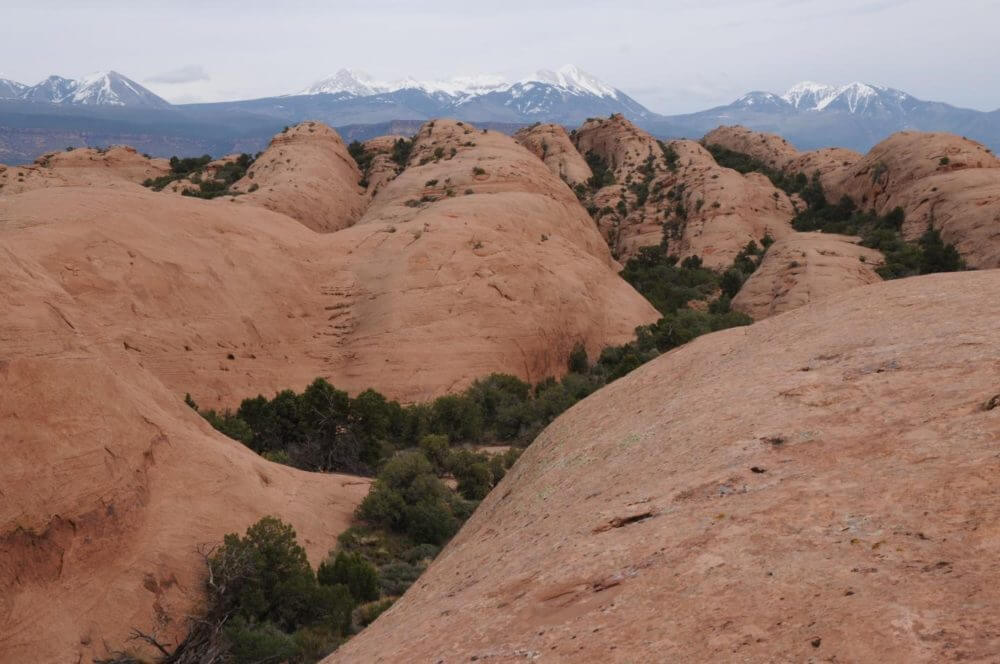
Navajo Sandstone from the Moab area taken by study co-author Stephen T. Hasiotis. Credit: Stephen T. Hasiotis

An ancient desert covered in sand dunes as far as the eye could see, where dinosaurs and small mammals once roamed, may have been the real Jurassic Park. Today, the Navajo Sandstone, as it’s called, is known for the beautiful red and tan sandstones that grace many of the U.S. Southwest’s national parks and monuments–for example, Arches, Canyonlands, Capitol Reef and Zion.

In the early Jurassic, the grains that formed these sandstones were deposited in the largest known sand sea in Earth’s history. The deposits show a record of desertification–the process by which fertile grasslands turn into deserts.

How did this landscape lose its water bodies, vegetation and animals? How long did desertification take to happen?

A new NSF-funded study published in the journal Geology reveals answers from rock layers that represent lake deposits. The lakes once occupied interdune areas, which served as watering holes for dinosaurs and small, extinct relatives of mammals.

The deposits’ 200-million-year ages show that parts of the Navajo desert in eastern Utah are much older than previously thought and, along with dates obtained from Arizona deposits, show that the sand sea was younger to the south. The lake and its springs tell a tale of a vast desert that, at times, had a wetter climate and more active hydrologic cycle than had been assumed.

The research demonstrates that the desertification process is complex, and that ages of sedimentary rock layers help answer important questions on how desertification takes place in continental interiors.

The research was funded by NSF’s Division of Earth Sciences.

Source: https://scienceblog.com

Paleontologists Discover First Skeletal Remains of Ancient Shark in Morocco

Friday, October 4, 2019

Photo Credit: PAULO OLIVERIA, ALAMY STOCK PHOTO

Experts have found the first skeletal remains of a Phoebodus, an ancient shark in Morocco’s Anti-Atlas Mountains.

International experts were amazed to find the first skeletal remains of a Phoebodus, an ancient shark in the Anti-Atlas Mountains in Morocco.

Phys.org announced the discovery on October 2, announcing that expert researchers working in the field were stunned to find the remains of several prehistoric creatures. The experts found skulls and a complete skeleton from a Phoeboous, an ancient shark that lived 350 million years ago.

Researchers believe that the discovery is “unprecedented.”

Researchers often find shark teeth, including those of the Phoeboduss, which are “the most common fossils discovered on the planet,” Fox News reported.

The researchers say the latest discovery is unprecedented as the body of the Phoebodus is “primarily made of cartilage, a complete skeleton has never been found, until recently.”

The researchers found the shark fossil in a mountainous region which used to be a shallow sea basin, according to Phys.org.

“Testing of the material in which the shark remains were fossilized revealed that the specimens were approximately 370 million years old,” the statement added.

When researchers studied the discovery, they found that the shark had a “long, think body” and a “flat skull and a long jaw.”

This is not the first time experts have made important discoveries in Morocco. In August, paleontologists from the UK, in collaboration with researchers from Morocco, discovered a species of stegosaurian dinosaur.

The species estimated to be 168 million years old.

The landmark discovery, according to researchers, could possibly lead to further revelations.

Source: www.moroccoworldnews.com

Kaprosuchus saharicus: The Galloping, Dinosaur-Eating Crocodile

Friday, October 13, 2017

Kaprosuchus by Vialir on DevianArt

Kaprosuchus is a  genus of mahajangasuchid crocodyliform. It is known from a single nearly complete skull collected from the Upper Cretaceous Echkar Formation of Niger. The name means "boar crocodile" from the Greek κάπρος, kapros ("boar") and σοῦχος, souchos ("crocodile") in reference to its unusually large caniniform teeth which resemble those of a boar. It has been nicknamed "BoarCroc" by Paul Sereno and Hans Larsson, who first described the genus in a monograph published in ZooKeys in 2009 along with other Saharan crocodyliformes such as Anatosuchus and Laganosuchus. The type species is K. saharicus.

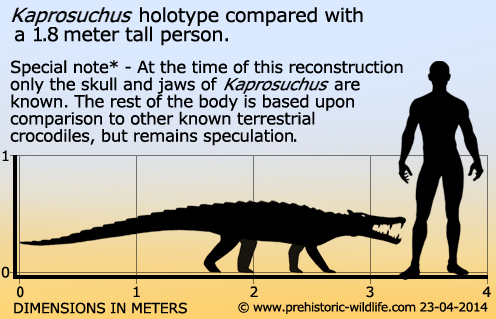
Size of Kaprosuchus by prehistoric-wildlife.com

Kaprosuchus is known from a nearly complete skull 507 mm in length in which the lower jaw measured 603 mm long. The original description estimated the entire animal to be 6 metres (19.7 ft) in length. It possesses three sets of tusk-like caniniform teeth that project above and below the skull, one of which in the lower jaw fits into notches in upper jaw. This type of dentition is not seen in any other known crocodyliform. Another unique characteristic of Kaprosuchus is the presence of large, rugose horns formed from the squamosal and parietal bones that project posteriorly from the skull. Smaller projections are also seen in the closely related Mahajangasuchus.

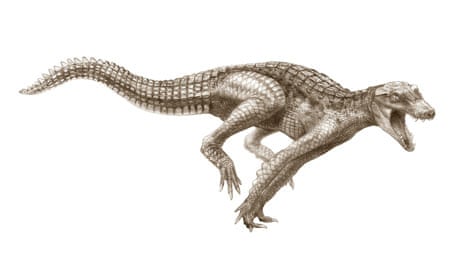
 Artist's conception of Caprosuchus, which had a soft, dog-like nose and was an agile galloper. By Todd Marshall/National Geographic

The snout of Kaprosuchus shows generalized proportions and the naris is positioned dorsally. In Kaprosuchus many teeth are hypertrophied and labiolingually (laterally) compressed, unlike those of crocodyliforms with similarly shallow snouts, which are usually subconical and of moderate length. Another difference between the skull of Kaprosuchus and those of crocodyliforms that also possess dorsoventrally compressed snouts is the great depth of the posterior portion of the skull.

In Kaprosuchus, the orbits (i.e., eye sockets) open laterally and are angled slightly forward rather than upward. The orbits turned forward suggest that there was somewhat stereoscopic vision, i.e., an overlap in the visual field of the animal.

The surfaces of the premaxillae are rugose with the edges elevated above the body of the bone, suggesting that a keratinous shield would have been supported by the rugosities at the tip of the snout. Along the interpremaxillary suture, the area where the two premaxillae meet, the surface is smooth, giving the paired rugosity of the premaxillae the resemblance of a moustache in anterior view.

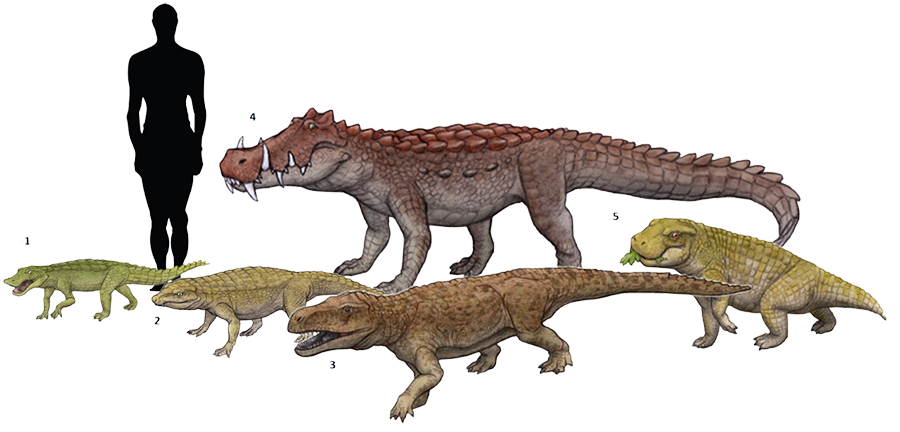
1. Anatosuchus minor (“duck crocodile”) 2003 (Crocodylomorpha/Metasuchia/Notosuchia) 2. Notosuchus terrestris (“southern crocodile”) 1896 (Crocodylomorpha/Metasuchia/Notosuchia/Notosuchidae) 3. Postosuchus krikpatricki (“Crocodile from Post”) 1985 (Archosauromorpha/Rauisuchia/Rauisuchidae) 4. Kaprosuchus saharicus (“boar crocodile”) 2009 (Crocodylomorpha/Mahajangasuchidae) 5. Simosuchus clarki (“pug-nosed crocodile”) 2000 (Crocodylomorpha/Metasuchia/Notosuchia/Ziphosuchia) by Nobu Tamura

Kaprosuchus is a member of the family Mahajangasuchidae along with closely related Mahajangasuchus insignis from the Upper Cretaceous of Madagascar. Although it differs greatly from any other known crocodyliform, Kaprosuchus shares several characteristics with Mahajangasuchus. These include the obliteration of all but the posterior portion of the internasal suture; a laterally facing rugose external articular fossa; the positioning of the jaw joint below the posterior maxillary teeth; a deep, anterodorsally oriented mandibular symphysis; a vertically descending ectopterygoid that is slightly inset from the lateral margin of the jugal; a flared choanal septum forming an articular foot for the palatine; and the hornlike dorsal projection of the external rim of the squamosal (although this is much more developed in Kaprosuchus than Mahajangasuchus).

Skull of K. saharicus, scale bar equals 10 cm

Kaprosuchus is thought to have been a primarily if not exclusively terrestrial predator. Evidence for this behavior includes the positioning of the orbits laterally and somewhat anteriorly, which suggests an overlap in vision. This is unlike many other neosuchians, including extant crocodilians, in which the orbits are positioned dorsally as an adaptation to aquatic predation where the head can be held underwater while the eyes remain above the surface.

Additional support for terrestrial predation can be found in the teeth and jaws. The enlarged caniniforms are sharp-edged and relatively straight, unlike the fluted, subconical, recurved teeth of aquatic crocodyliforms. Because the retroarticular process of the lower jaw is long, it is likely that the jaws were able to open relatively quickly with a large gape to allow for the opposing caniniforms to clear one another. The fused nasal bones are thought to have provided reinforcement for the jaws against compression associated with a powerful bite. The telescoped, dorsally positioned external nares are seen as protection against impact if the animal rammed prey with its robust snout. The keratinous shield thought to have covered the tip of the snout would have provided further protection.

Source: https://en.wikipedia.org / www.natgeo.com

Jurassic Park Kids Want to Return for Jurassic World 3

Tuesday, October 1, 2019

The impressive list of returning franchise characters for Jurassic World 3 may soon expand even more, as the two child actors from Jurassic Park are reportedly interested in appearing. According to a new report, Ariana Richards and Joe Mazzello are said to be open to reprising the roles of siblings Lex and Tim Murphy for a cameo appearance or more, should they be asked to do so. Of course, even if the report is accurate, it's going to take some interest from Universal and director Colin Trevorrow to include them in the story, as neither former child star has yet been asked to be a part of the project.

If Richards and Mazzello happen to be cast for Jurassic World 3, they would be joining three of their co-stars from the original movie. It was just recently revealed three main characters from the first Jurassic Park were being brought back for the upcoming sequel, as Laura Dern, Sam Neill, and Jeff Goldblum have all been officially announced. Obviously, they'll be reprising the roles of Ellie Sattler, Dr. Alan Grant, and Ian Malcolm in Jurassic World 3, and the characters will reportedly have major roles in the story. While Goldblum had an appearance in Fallen Kingdom, the reunion will mark the first time Dern and Neill have been seen in the series since Jurassic Park 3. Of course, they'll be joining Chris Pratt and Bryce Dallas Howard, back in their roles as Owen and Claire.

In the original Jurassic Park, Lex and Tim are introduced as the grandchildren of park founder John Hammond. Dr. Grant (Neill) reluctantly takes the children under his wing to keep them safe after the dinosaurs escape their enclosures. One of the more touching moments sees the three of them petting a Brachiosaurus from high atop a tree. Perhaps the more memorable scene involving the Murphy siblings comes after they reach the park's visitor center where they believe it's safe, only to be hunted in the kitchen by hungry Velociraptors. Fortunately, both children manage to survive and escape the island, with Richards and Mazzello later appearing briefly in the sequel The Lost World with Goldblum.

It wouldn't be strange to see Richards and Mazzello return, as this could happen with any character from the previous installments. After playing minor character Dr. Henry Wu in the original movie from 1993, BD Wong has since reprised the role in both Jurassic World and Fallen Kingdom. Adding, the trio of Dern, Neill, and Goldblum only further makes it clear those involved with the franchise are very open to seeing characters return. While the Lex and Tim Murphy haven't been seen since the second installment of the franchise, they were such a memorable part of the original, and checking back in with them would be awesome for fans.

In any case, Jurassic World 3 isn't set to premiere in theaters until June 11, 2021. Richards and Mazzello may not be attached to the project at this time, but anything can happen between now and then. This report comes to us from CinemaBlend.

Source: https://movieweb.com

10 Famous Places Where Dinosaur Bones Have Been Uncovered; Open to Visitors

Monday, September 30, 2019

Dinosaur bones can be seen in several museums around the world where we can learn about the prehistoric creatures that used to roam the Earth. These bones were uncovered all across the world by those who have a passion for uncovering the secrets these bones hold about the past.  What you probably didn't know was that you have the ability to visit the places where these bones were discovered.

These locations are all across the world according to PBDB Navigator and are open to visitors for their enjoyment. Maybe if you visit you will be lucky enough to stumble across the next big find and further expand our knowledge on this topic. Keep reading to learn about ten places where dinosaur bones have been uncovered!

10 - MOAB, UTAH

There have been several dinosaur bones and sets of tracks uncovered in Moab, Utah. The place to visit is the Mill Canyon Tracksite and Mill Canyon Bone Trail. You can still see a huge bone encased in rock along the path, as well as tracks from eight different dinosaurs.

They also have their own dinosaur museum so guests can also see clean and preserved bones on display to complete their dinosaur adventure. This place is known for uncovering dinosaurs from the Triassic, Jurassic, and Cretaceous periods, with one of the most notable being the Camarasaurus.

9 - ANTOFAGASTA, CHILE

There were two discoveries made here and both came from the Kimmeridgian period, which is part of the Late Jurassic period. It was a type of Therapod and was uncovered from the Río San Salvador back in 2001.

You can see if you can find some more bones in the hot climate, or go on some other adventures. These include things like stargazing, surfing, or even betting away the rest of your funds in a casino. There are so many places to look and so much land that still has yet to be uncovered by a paleontologist like yourself.

8 - LAVINI DI MARCO, ITALY

This was a huge dig site in Italy that uncovered several dinosaur bones that contributed to an expansion of our knowledge on these prehistoric creatures. They have found dinosaur bones, but have also uncovered tracks and other invertebrate species.

The species found are mostly from the Early Jurassic period and have discovered evidence of therapods and sauropods. You can travel around this area and make your own discoveries, as well as see some of the tracks left behind by these ancient beasts.

7 - LIKHOELE MOUNTAIN, LESOTHO

Dinosaur bones were found in the Mafeteng District in Lesotho on the Likhoele Mountain. They were identified as part of the ornithischian species and many sets of finds have been found in this region.

Your travels through the mountain range could uncover even greater prehistoric discoveries in this area in Africa.  If you do happen to come up empty despite hours of searching, there is still the view to look forward to at the end of the day.

6 - YUNNAN, CHINA

There is something here called Dinosaur Valley where there have been loads of dinosaur bones that have been discovered. It is a museum that also showcases dinosaur bones in the quarry section.

It is also said that there are numbers of undiscovered bones in the surrounding area, so you have the chance to look for some of your own. It is a once in a lifetime experience and gives guests the chance to immerse themselves into prehistoric times as they encounter more history than they could have ever imagined.

5 - ANDHRA PRADESH, INDIA

There have been numerous dinosaur bones found in this part of India and they have uncovered evidence of the Dandakosaurus and Jaklapallisaurus. They actually excavated the full fossil of a Rhynchosaur which managed to stay hidden for 200 million years.

They learned so much about the creatures death to its predicted size, which is why the Yamanpalli bonebed is the best place for you to visit. You might surprise yourself and help uncover the world's next greatest dinosaur find if you decide to take a trip to this part of the world.

4 - KENT, ENGLAND

There was an Acanthopholis discovered here back in 1865 and it was one of the earliest dinosaur discoveries ever reported. There have been even more uncovered since that fateful day and you could be on the list for the next great discovery.

A walk through the area and a close inspection of your surroundings might give you more than you bargained for. There is also a dinosaur zoo in the area for when you grow tired of not finding any evidence for yourself. You are guaranteed to have a great time and enjoy all that England has to offer a dinosaur enthusiast.

3 - ROCKY HILL, CONNECTICUT

There is a Dinosaur State Park located in Rocky Hill, Connecticut where you can go to live out your paleontologist dreams. This area is covered in dinosaur tracks and there are plenty of nature trails for you to explore.

If you are one of the lucky ones you might be able to find your own set of bones or a new set of trails that were left by these prehistoric beasts. They also have several activities that change throughout the year so you and your family can have a blast learning about the past.

2 - FORDING COAL MINE, CANADA

These might not be bones, but Raptor tracks are pretty cool and mean that there are probably some bones nearby. They found 140 million years old tracks in the mines and it only goes to show that there is so much more to be uncovered.

You have to wonder what else is there to discover in this area as we dig deeper into the Earth. This means it is up to you to find the next big thing in paleontology and this is a great place to start.

1 - ULYANOVSK, RUSSIA

There was a huge dinosaur discovered back in 1982 on the bank of the Volga River. It was said to weigh a total of 17 tons and it was dubbed the Volgatitan. There have not been very many discoveries in Russia, but we know from this dinosaur's location that there are more to be found. It might be worth the trip to take a second look around the area and see if any more dinosaurs are hiding from the world who wish to be found.

Source: www.thetravel.com

Tiny Plankton Slow to Recover After Dinosaur-Killing Asteroid Collision

Tuesday, October 1, 2019

Microscopic nanoplankton fossils. Credit: Samantha Gibbs/Paul Bown

A team of scientists have revealed that after the devastation caused by a mass extinction event on Earth 66 million years ago, the plankton at the base of the ocean ecosystem were disrupted for nearly two million years. It then took a further eight million years for global species numbers to fully recover.

The team, from the University of Southampton and the universities of Bristol, UCL, Frankfurt and California, found that while the plankton in the oceans showed the first signs of ecological recovery almost immediately, these early communities of microscopic organisms were highly unstable and cell sizes unusually small.

The Cretaceous/Paleogene mass extinction occurred when an asteroid impact caused global environmental devastation. It is well known for killing off the dinosaurs, but also laid waste to much smaller creatures, such as ocean plankton—removing crucial food sources from the base of the marine ecosystem which were critical for the recovery of large species.

In a study published in the journal Nature, the team shows major instability persisted for two million years following the extinction event, but after this, the gradual appearance of new species and larger cells helped re-establish an ecosystem which was resilient to the sudden change in climate. Also, the delivery of carbon to the sea floor returned to pre-extinction levels, restoring a critical ocean function that controls atmospheric carbon dioxide levels.

By conducting this research, the scientists have charted the aftermath of near annihilation through the creation of a 13-million-year record of fossil plankton dynamics and in-turn provided a remarkable glimpse into how the marine ecosystem "reboots."

Lead author Sarah Alvarez (University of Bristol, UCL and now Gibraltar) explains: "We looked at the best fossil record of ocean plankton we could find—calcareous nanofossils (they are still around today) and collected 13 million years of information from a sample every 13 thousand years. We measured abundance, diversity and cell size from over 700,000 fossils, probably the largest fossil dataset ever produced from one site."

As much today as in the past, the marine ecosystem is dependent on plankton at its base and this study highlights the risks posed by diversity loss which may result in highly unstable communities, loss of important ecosystem functions and the long timescales of recovery.

Palaeobiologist and co-lead author, Dr. Samantha Gibbs of the University of Southampton comments: "Losing species today runs the risk of eliminating key creatures in ecosystems. What we've demonstrated from this fossil record is that function is achieved if you have the right players fulfilling key roles.

"Today, by reducing biodiversity, we are running the risk of losing our critical ecosystem players, many of whose importance we don't yet fully appreciate."

More information: Sarah A. Alvarez et al. Diversity decoupled from ecosystem function and resilience during mass extinction recovery, Nature (2019). DOI: 10.1038/s41586-019-1590-8

Journal information: Nature

Source: https://phys.org

Pages