Blogs

Sahara Was Earth’s Most Dangerous Place 100 Million Years Ago

Tuesday, April 28, 2020

The giant predatory dinosaur Carcharodontosaurus eyes a group of Elosuchus — crocodile-like hunters — near a carcass. Image credit: Davide Bonadonna.

A large number of ferocious predators, including predatory dinosaurs, pterosaurs and crocodile-like creatures, made Sahara the most dangerous place on Earth, according to an analysis of fossils from the Cretaceous-period sediments in eastern Morocco.

About 100 million years ago, the so-called Kem Kem beds were home to a vast river system, filled with many different species of aquatic and terrestrial animals.

Fossils from this formation include three of the largest predatory dinosaurs ever known, including Carcharodontosaurus and Deltadromeus, as well as several pterosaurs and crocodile-like hunters.

“This was arguably the most dangerous place in the history of planet Earth, a place where a human time-traveler would not last very long,” said Dr. Nizar Ibrahim, a researcher at the University of Detroit Mercy and the University of Portsmouth.

“Many of the predators were relying on an abundant supply of fish,” added Professor David Martill, a scientist at the University of Portsmouth.

“This place was filled with absolutely enormous fish, including giant coelacanths and lungfish. The coelacanth, for example, is probably four or even five times large than today’s coelacanth.”

“There is an enormous freshwater saw shark called Onchopristis with the most fearsome of rostral teeth, they are like barbed daggers, but beautifully shiny.”

The paleontologists produced the first detailed and fully illustrated account of the Kem Kem beds.

The researchers now define this sedimentary package as the Kem Kem Group, which consists of two distinct formations, the Gara Sbaa Formation and the Douira Formation.

“This is the most comprehensive piece of work on fossil vertebrates from the Sahara in almost a century, since the famous German paleontologist Ernst Freiherr Stromer von Reichenbach published his last major work in 1936,” Professor Martill said.

The research is described in a paper in the journal ZooKeys.

_____

N. Ibrahim et al. 2020. Geology and paleontology of the Upper Cretaceous Kem Kem Group of eastern Morocco. ZooKeys 928: 1-216; doi: 10.3897/zookeys.928.47517

Source: www.sci-news.com/

Fossil Fuelled: The Forgotten Dinosaur Discovery Which Transformed Science

Saturday, April 25, 2020

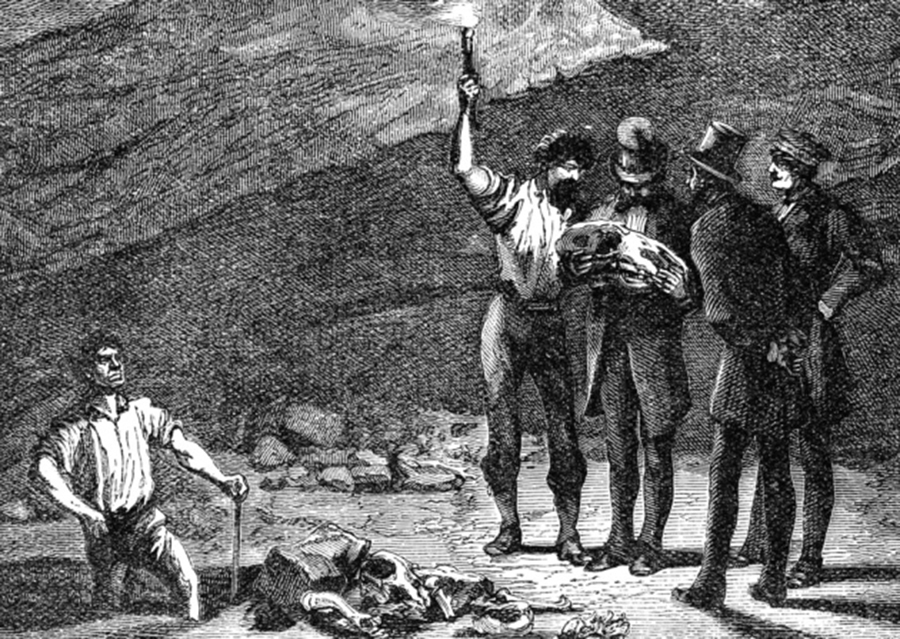
Iguanadon (herbivorous dinosaur) fossils discovered by Jules Creteur in a coal mine, Bernissart, Belgium 1878. captured in a wood engraving. Photo: Universal History Archive/Getty Images

RICHARD LUCK looks back on a little-known chapter from history, when a chance discovery in a Belgian backwater produced one of science’s greatest ever finds.

“I think I’ve struck gold!” So bellowed miner Jules Creteur upon discovering something sparkling 322 metres below the surface on a Belgian coal field.

As is so often the case, what glisters was in fact iron pyrite, which looks pretty but is far from priceless. In this instance, the ‘fool’s gold’ formed part of a fossilised tree stump. Irritated, Creteur removed the ancient relic and resumed digging. Which is when he really struck gold.

What emerged from that mine in Bernissart, on the French border, close to the town of Mons, was among the most important discoveries of any age.

By the time the palaeontologists were done with the site, 30 near-complete dinosaur skeletons had been excavated. And what this epic find from 1878 revealed would hugely advance our understanding of the beasts that dominated this planet for 165 million years.
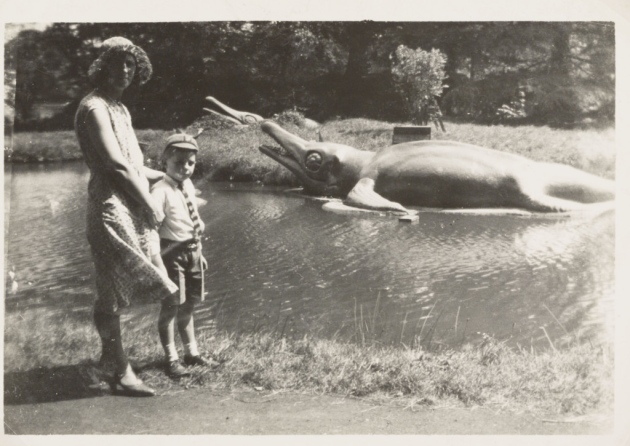
The world's first prehistoric sculptures, built in 1854, were designed by Benjamin Waterhouse Hawkins under the guidance of Professor Richard Owen, who invented the word dinosaur. Picture: SSPL/Getty Images

Long though they might have ruled the world, dinosaurs have only been known to science for two centuries. Before then, remains of ‘terrible lizards’ were written off as belonging to extinct races of dragons (especially true of China), giants (pretty much anyplace the Bible held sway) or animal species that had been wiped out by the Biblical flood (see giants).

Though the term dinosaur (Greek for ‘terrible lizard’) was coined by the biologist and palaeontologist Sir Richard Owen in 1842, the first remains were unearthed some 20 years earlier. It is these identifications – by Gideon Mantell and William Buckland – that the Royal Mint has this year chosen to celebrate with a trio of commemorative 50 pence pieces.

Of the three species depicted – Megalosaurus, Hylaosaurus and Iguanodon – it’s the last of these that’s of particular interest. Translating as ‘Iguana tooth’, Iguanodon came to mankind’s attention when Mary Ann Mantell, Gideon’s wife, chanced upon some fossilised teeth while her husband, a Sussex GP, was visiting a patient near Lewes.

Recognising that the remains belonged to a long extinct creature, Gideon Mantell’s determination to correctly identify the teeth led to Iguanodon becoming the first celebrity of the dinosaur world.

Indeed, after further Iguanodon remains were unearthed near Maidstone, Kent, interest in dinosaurs swelled to such an extent that, when the Crystal Palace was relocated from Hyde Park to South London in the 1850s, the sculptor Benjamin Waterhouse Hawkins was commissioned to create 33 prehistoric animal statues to take up place in the parkland beneath the great glass structure.

Naturally, pride of place went to a pair of Iguanodons which Waterhouse Hawkins constructed under the watchful eye of Sir Richard Owen. Owen was convinced that the species of old resembled modern-day animals.

As such, ‘his’ Iguanodons looked rather like Haitian Rhinoceros Iguanas, complete with nose horns. Quite how wrong Sir Richard had got things only became apparent some 30 years later when a band of Belgian miners made the discovery of a lifetime.

Mention dinosaur discoveries and the Gobi Desert and the Montana Badlands are more likely to come to mind than the Low Countries. Yet it was in Bernissart, a town in the Walloon-speaking region of Belgium, that Jean Creteur and his colleagues struck it lucky. Not that they were quick to recognise the importance of their haul. Quite the opposite, the miners drilled through an entire Iguanodon skeleton before noticing that they were no longer dealing with coal.

As Creteur said at the time: “What we had in front of us was something too black to be stone and yet too hard to be wood. The pieces that we pulled out looked like broken ends of pit props.” It was only after the material had reached the surface that Creteur and his crew realised that they were dealing with the fossilised remains of a vast prehistoric beast.

In pursuit of further clarification, the mine’s directors sought to bring Belgium’s finest palaeontologist minds to Bernissart, a feat complicated by the discovery having been made at the beginning of April. Once the academics arrived, it wasn’t long before a potential practical joke was recognised as the scientific find of the century.

So began a three-year project to remove fossil material from the Bernissart mine. Louis De Pauw, the head preparer of the Musée royal d’histoire naturelle de Belgique, was charged with extracting the bones from the pit, a feat he accomplished by exposing each skeleton in turn, recording its location within the shaft and then applying plaster to the fossil to preserve it while it was taken from the mine in metre-squared blocks.

Come the end of 1879, 14 complete Iguanodon skeletons had been retrieved from Bernissart, together with the remains of crocodiles, turtles and a variety of fish and plant species. Had that been the end of it, De Pauw’s place in palaeontology’s pantheon would be assured.

Members of the 'Young Explorers', a group organised by the British Wildlife Society, sketching a skeleton of the Iguanodon dinosaur at the Natural History Museum in London. Picture: Harry Todd/Fox Photos/Getty Images

By the time the three years were up, though, some 30 Iguanodon had been brought to the surface. Were it not for dwindling funds and the mine manager’s desire to resume normal service, this era of discovery might have lasted decades.

Now, however, it was down to Louis Dollo, a French-born assistant naturalist at the Royal Belgian Institute of Natural Sciences, to bring the bones back to life.

Given free use of an abandoned church, Dollo sort to mount the dinosaurs in lifelike poses. So complete were the specimens De Pauw excavated, it was now clear to everyone that the Iguanodon of the Cretaceous Period didn’t look an awful lot like the Crystal Palace behemoths.

For one thing, the spike that British scientists had placed on the beasts’ snouts had now been more properly identified as a thumb – Iguanodon presumably used it in close combat with predators.

Dollo also came to the conclusion that, given how short Iguanodons’ forelimbs were – at least in comparison to its back legs – the dinosaur probably adopted a bipedal stance not unlike that of a kangaroo. It was a notion reinforced by discoveries in America where scientists were convinced that species such as Hadrosaurus – another herbivorous animal, not entirely dissimilar to Iguanodon – walked on two legs rather than four.

It was, therefore, a bipedal Iguanodon that greeted visitors to Brussels’ Nassau Palace in 1883. The sensation of its time, the skeleton would acquire new company with each passing year. Come 1908, a herd of 11 Iguanodon took pride of place in what is now the Royal Belgian Institute of Natural Sciences. And besides these mounted specimens lay the remains of a further 19 animals, still encased in the rock and in the positions in which they had been discovered.

The guest of honour at the exhibit’s unveiling was none other than Leopold II. “I shall tell you what I think,” the monarch murmured to Louis Dollo, “and if it is something foolish, you will forget it. I think that the Iguanodons were some sort of giraffe.” Ever the gentlemen, Louis Dollo wholeheartedly agreed with the king.

Though they’d been dead for the better part of 65 million years, the Iguanodons weren’t allowed to rest on their fossilised laurels. During the First World War, Germany – having occupied Wallonia – dispatched eminent scientist Otto Jaeckel to Bernissart to see what else he could find.

Fortunately, the occupation didn’t last long enough for the invaders to pack up the Bernissart herd and send it back to Berlin as a gift for the kaiser. Instead, peace was declared, Jaeckel and his fellow Germans were sent packing and Dollo and De Pauw got back to being the Ross Gellers of their day.

Alas, the pair were denied their dream of returning to Bernissart when first funding issues and then flooding meant that whatever still lay in the shaft would forever be beyond mankind’s reach.

There were still fresh chapters to be written about what the pair had found there, however. For example, further examination of the skeletons revealed that two distinct species of Iguanodon had been unearthed – Iguanodon bernissartensis, the casts of which were dispatched to museums the world over, and Iguandon mantelli, named in honour of the man who identified those fossil teeth all those years ago in Lewes.

There was also the question of how so many specimens came to be found in the same place. Since the Bernissart haul included bones from the predatory Megalosaurus, some theorised that the Iguanodon had been chased over a cliff to their deaths. But what with the abundance of aquatic fossils found alongside the dinosaurs, in all probability the skeletons were found together as they had been washed down a river, the clay at the bottom of which was particularly receptive to the process of fossilisation.

Dinosaurs sculptures in Crystal Palace Park. Picture: Moment Editorial/Getty Images

Later still, the Brussels skeletons contributed to a sizeable volte face of the kind that occasionally occurs in scientific fields.

Upon examining the fossils afresh in 1980, the British palaeontologist David Norman was struck by the amount of soft tissue that coated the skeletons. The vast number of tendons surrounding the spine and tail were of particular interest since they indicated that, rather than the kangaroo-like pose Dollo advocated, Iguanodon probably held its tail horizontally. Add this to the hoof-like toes on the creatures’ forelimbs and Norman could but conclude that Iguanodon spent a good portion of its life on four legs, just as his countrymen posited a century earlier.

Fortunately, since it has so many Iguanodon skeletons at its disposal, the Institut royal des Sciences naturelles de Belgique has been able to remount specimens in accordance with Norman’s discoveries, while retaining some – admittedly very impressive – three-metre high bipedal exhibits.

Providing the focal point of the biggest single-room dinosaur exhibit on the planet, the Bernissart Iguanodon herd ought to considered one of Europe’s most celebrated museum collections. That it isn’t is almost as sad as the fact that the Crystal Palace Iguanodons have been placed on a Historic England ‘at risk’ register, this in spite of them enjoying Grade II Listed status.

What with the fragile nature of the Brussels skeletons – they have to be exhibited as a specific temperature to guard against decomposition – Europe could lose two ground-breaking dinosaur landmarks in very short order. Dinosaurs ruled our world for more than 150 million years. How tragic it would be if their remains and their memory proved unable to last out the 21st century.

With special thanks to Dr Ellinor Michel. For more on the Crystal Palace dinosaurs and their preservation visit cpdinosaurs.org

Source: www.theneweuropean.co.uk/

Researchers Offer Glimpse Into Dinosaur Ecosystems

Saturday, April 25, 2020

About 75 million years ago, southern Alberta was a lush and warm coastal floodplain rich in plant and animal life, similar to Louisiana’s environment today. Credit: Luke Dickey // Special to Western News

By casting an eye into the daily lives of dinosaurs millions of years in the past, Western researchers may be helping humanity get a glimpse of its future.

Seventy-five-million years ago, North America was divided into western and eastern landmasses by a shallow inland sea. The west was home to an extremely rich diversity of dinosaurs; it has been a mystery as to how so many big animals co-existed in such a small area.

Researchers have proposed that diversity was maintained by dividing up the landscape and food sources. For example, horned dinosaurs (ceratopsians) may have stuck to coastal areas, while duck-billed dinosaurs (hadrosaurs) preferred more inland habitats.

This idea remained untested, however, as researchers cannot directly observe dinosaur behavior and ecosystems.

To solve this conundrum, a team including Western researchers has now compared the compositions of stable isotopes in fossil teeth from these dinosaurs.

Stable isotopes are naturally occurring varieties of chemical elements (like carbon or oxygen) that do not change into other elements over time. When animals consume food and water, the stable isotopes of the elements that make up those resources are passed to the animal's tissues, including tooth enamel.

The stable carbon and oxygen isotope compositions of these herbivorous dinosaurs were measured using various methods. The primary approach was laser gas chromatography isotope ratio mass spectrometry conducted at Western's Laboratory for Stable Isotope Science (LSIS) by Anthropology professor Fred Longstaffe, Western research scientist Li Huang and project lead Thomas Cullen of the Field Museum.

"This approach allowed us to analyze very small samples and, because of that, extend the science of isotope ecology back into the time of the dinosaurs," said Longstaffe, Canada Research Chair in Stable Isotope Science. "Normally, my isotope ecology work is focused on Ice Age animals and the reasons for their disappearance or survival. To attempt to reach back much deeper to the time when the dinosaurs lived was both challenging and exciting."

The study, "Large-scale stable isotope characterization of a Late Cretaceous dinosaur-dominated ecosystem," was recently published in the journal Geology.

The researchers compared results for numerous individuals of each dinosaur species to those of other animals in this ancient ecosystem. While multiple ecological patterns are evident in the results, and differences found in some species, the stable carbon and oxygen isotope ranges for large herbivorous dinosaurs were found to strongly overlap, providing direct evidence against the habitat use hypothesis.

"Measuring the ratios of the different isotopes of elements such as carbon or oxygen in tissues like tooth enamel gives us a unique window into the diet and habitat of an animal who has been extinct for millions of years," Cullen said.

"Dinosaurs lived in a weird world: broad-leafed and flowering plants were much less common; it was warm enough in high latitudes to support crocodilians; carbon dioxide in the atmosphere was higher than it is today; and there was little to no ice at the poles.

"It's not like anything we, as humans, have any direct experience with—but it may be the direction we are headed. It's critical that we understand how ecosystems and environments function under those sorts of conditions so we can better prepare ourselves for the future."

The new study is one of the largest ever conducted on a dinosaur ancient ecosystem, involving more than 350 isotopic measurements from 17 different species whose fossils had all accumulated in a single ancient wetland deposit. Even more uniquely, the authors combined this information with measurements from 16 living species that the team previously sampled from a modern coastal wetland in Louisiana.

About 75 million years ago, southern Alberta was a lush and warm coastal floodplain rich in plant and animal life, similar to Louisiana's environment today.


More information: T.M. Cullen et al. Large-scale stable isotope characterization of a Late Cretaceous dinosaur-dominated ecosystem, Geology (2020). DOI: 10.1130/G47399.1

Journal information: Geology 

Provided by University of Western Ontario 

Source: https://phys.org/

After The Dinosaurs Went Extinct, Some Birds Shrank In Body Size And Kept Big Brains

Friday, April 24, 2020

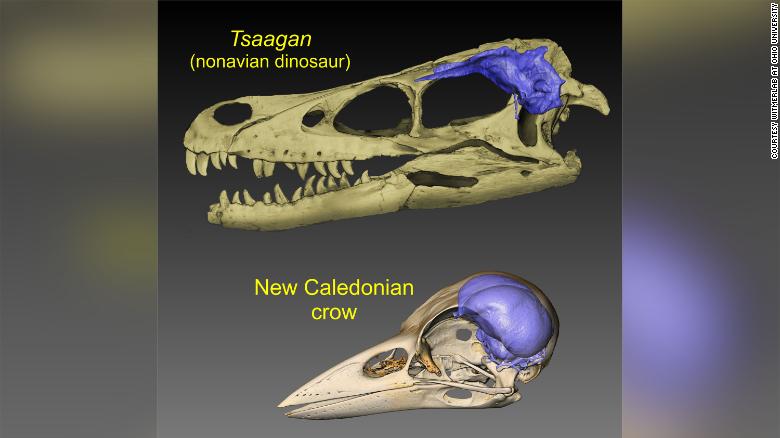
Thes visuals show brain endocasts (blue) from the skulls of a dinosaur and a modern bird.

Being called a "bird brain" may be closer to a compliment than an insult.

That's because new research suggests that some birds evolved over time to have smaller bodies and maintain large brains.

Researchers studied the endocasts of skulls belonging to hundreds of dinosaurs and extinct birds.

They used CT scans of the animals' ancient skulls to create endocasts, which act like an imprint of the brain in the skull, reflecting brain sizes (since brains don't fossilize). Then, they compared the brain sizes with brain measurements of modern birds in a large data set.

The brain measurements were analyzed along with body size to compare the scale of brain size to body size.

Together, the evolutionary biologists and paleontologists were able to show the timeline for bird brain evolution. The study published in the journal Current Biology.

Before the mass extinction event that killed off the dinosaurs 66 million years ago, the researchers discovered that birds and large dinosaurs had brains that were very similar in size.

But some birds went through what the researchers refer to as a "scaling" event after the dinosaurs went extinct.

Crows have large brains and exhibit behaviors similar to humans.

Birds were some of the first animals to recover and repopulate the empty landscape after the dinosaurs disappeared. They diversified and evolved in this setting, and some of the birds that started out larger in size experienced what's called "a scaling down." Their bodies shrank in size, but they kept the big brains of their larger ancestors.

"Our paper emphasizes that the mass extinction really altered the course of avian brain evolution," said Daniel Ksepka, lead study author and curator of science at the Bruce Museum, in an email to CNN.

"There were profound changes in brain-body scaling in the immediate aftermath of the extinction, and these may have played an important role in modern birds surviving and going on to radiate into the 10,000+ species we have today."

The changes appeared to occur very rapidly after the asteroid impact that caused the dinosaur extinction, Ksepka said. They found at least seven brain-body scaling events in birds right after the mass extinction.

Before the mass extinction event, the similarities between dinosaur and bird brains were almost indistinguishable.

"There is no clear line between the brains of advanced dinosaurs and primitive birds," said Amy Balanoff, study co-author and assistant research professor in Johns Hopkins University's Department of Psychological and Brain Sciences, in a statement.

"Birds like emus and pigeons have the same brain sizes you would expect for a theropod dinosaur of the same body size, and in fact some species like moa have smaller-than-expected brains."

The mass extinction event likely acted as a trigger for these changes. These birds had to evolve to survive.

"In the aftermath of the asteroid impact, it would have been intensely challenging to survive," Ksepka said. "Larger-brained animals tend to have more flexibility in adapting to changing environments.

"Likewise, smaller-bodied animals seem to have had a better chance of surviving in the immediate aftermath since they need less food. So, the altered landscape may have triggered the rapid evolution of new brain-body scaling patterns by favoring both larger brains and smaller bodies."

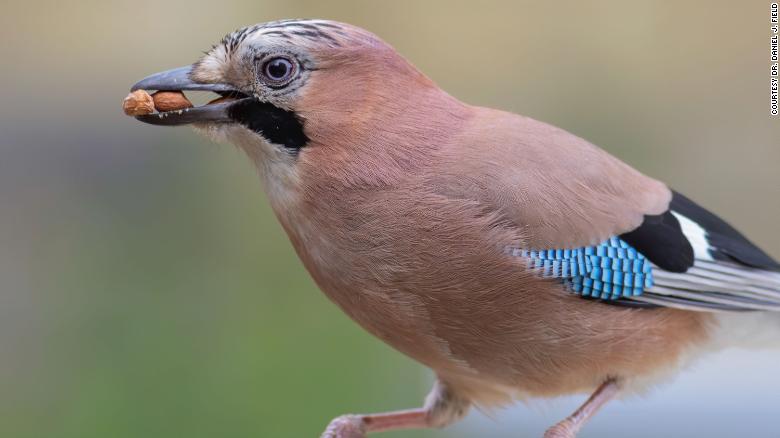
This Eurasian Jay is a member of the large-brain bird family called corvids.

The largest evolutionary brain leap is evident in modern birds like parrots and corvids, the group that includes crows, ravens and other related birds. And their brains are quite large when compared with their body size, although crows and parrots are relatively large birds. Crows are "particularly turbo-charged" when it comes to brain capacity, Ksepka said.

It can explain why they're able to recognize and remember human faces, use tools and even speak, like parrots do. In fact, crows and ravens seem to parallel our own evolutionary history as well as some behaviors we associate with being human, Ksepka said.

"Like our hominin [ancient human ancestor] lineage, these birds evolved to have both larger brains and larger bodies," Ksepka said. "Brain size expanded faster than body size, leading to big, smart birds. Just like we ended up being big, (sometimes) smart primates."

"Crows are really off the charts - they outpaced all other birds," said Adam Smith, study co-author and curator of the Bob Campbell Geology Museum at Clemson University, in a statement. "Our results suggest that calling someone 'bird-brained' is actually quite a compliment!"

Source: https://edition.cnn.com/

The Greatness of Jurassic Park Comes From Its Many Bad Ideas

Wednesday, April 22, 2020

Maybe waving a flare at a T-Rex isn’t such a great idea? Photo: All Images (Universal Pictures)

Bad ideas are the fuel that makes good stories go. If characters in movies, books, television, etc. made good choices all the time, we wouldn’t enjoy sharing in their trials and tribulations half as much. While thinking about that idea, the first thing that jumped into my mind was a film built off the back of one very bad idea—Steven Spielberg’s Jurassic Park.

Jurassic Park is a movie that, let’s be very clear, is absolutely incredible, but incredible because it’s built on so many characters making horrible decisions. What are we talking about? First and foremost, the idea of making dinosaurs, period, is the biggest and worst idea in the entire movie. The entire film proves that fact, scene after scene, line after line. Let’s take a look at some of our favorite Bad Ideas from Jurassic Park.


- A lesson for the youth of the world? Never, ever, question Dr. Alan Grant about the prowess of Velociraptors. He will make you feel terrible.

- Initially, Dr. Grant and Dr. Sattler have the good first instinct to not go with John Hammond to his park. Soon after though, they take what amounts to a bribe to do so. Accepting bribes is rarely a good thing, and here it changes their lives for the worse.

Simply going to the island is a bad idea for everyone: Grant, Sattler, Malcolm, etc.

For Dennis Nedry, the magic words should be “Bad Ideas.”

- Dennis Nedry is the king of bad ideas, as you’ll see later in this list. But his first is betraying his employer. What are you doing, Dennis?

- To be fair, Nedry is betraying his employer, John Hammond, because he believes Hammond underpays him. I thought you were “sparing no expense,” John! If you’re going to spend anywhere, it should be on employees who keep your big idea running. What a bad idea.

- During the first third of Jurassic Park, you continually hear calls for people to get to the boats. To me, this is the result of two bad ideas. One, lots of employees are straggling. Two, why isn’t there housing on this remote island?

Jurassic Park was a once-in-a-generation movie: a blockbuster that made tons of money, changed…

- It never plays out as such, but it always struck me as bad when Hammond takes the pieces of shell off the baby raptor. Let that creature do it herself!

- When a robot arm corrects you, you know you made a bad decision. So Dr. Grant, put down that dinosaur egg.

- Technically, the idea of denying the dinosaurs the X chromosome to control population sounds like a good idea, but defying nature so forcefully, as we know, ends up being a very bad idea.

The beginning of the end for these four.

- The scientists of Jurassic Park can make any dinosaur they want. So why, oh why, do they breed velociraptors, who are clearly way too smart and violent for a zoo? They weren’t even popular until they were in this movie, so it’s not like there were “fans” out there. Awful idea.

- In the words of Dr. Sattler, assuming control of an extinct eco-system is not a good idea.

- Inviting your young grandchildren to an unproven island filled with giant, killer dinosaurs was probably not the best idea, John.

- Everyone is leaving the island to go to the boat, right? So then why is the automated tour still happening? Maybe delay it until the full workforce is up and running?

- Talk about bad decisions—if Dr. Grant and Dr. Sattler had not jumped out of a moving car to see the sick triceratops, everyone would have made it back to the visitor center safe and sound.

- Though the triceratops doesn’t have any traces of it in her droppings, doesn’t it sound like a bad idea to grow toxic plants like West Indian lilac?

Stick! Stick, stupid!

- It’s Dennis Nedry time! He’s got so many bad ideas we needed to make a list within our list of them.

  • Rushing his scheme because of the weather
  • Shutting down the security systems
  • Shutting down the electric fences (but good idea not shutting down the raptor fences, which is also proof just how bad the first idea is)
  • Leaves his fingerprints everywhere in the embryo room
  • Drives too fast in the rain
  • Doesn’t know the way to the ship well enough, so that he can still get there in the pouring rain
  • Shuts down the phones
  • Password protects everything (a good idea for him, a bad idea for everyone else)
  • Goes into the woods after crashing his car
  • Antagonizes deadly dinosaur, resulting in his demise

- Skeevy lawyer Donald Gennaro leaving Lex and Tim in the car when the T-Rex comes. He learned pretty quickly what a bad idea that was.

- Lex should not have taken out a large flashlight after the T-Rex got loose. She all but signaled where the fresh meat was.

- After being nice and quiet, Tim slams the door to the car, giving the T-Rex the final signal to where they are.

Grant is good at this. Malcolm, not so much.

- Alan Grant, a dinosaur expert, using a flare to distract the T-Rex? Good idea. Ian Malcolm, Chaotician, doing the same, then running with it? Very, very bad idea.

- When Grant comes to rescue Tim in the tree, he tells him not to look down. What’s the first thing Tim does? Looks down.

- Though it’s teased by Nedry earlier in the film, John Hammond later realizes that his over-dependence on automation in Jurassic Park was a bad idea.

- Hammond then makes it seem like he’s going to reopen the park! Bad idea, John!

Today is the 25th anniversary of Jurassic Park. I was 11 years old when it came out. Here’s what I…

- Much like denying dinosaurs the X-chromosome seemed like a good idea, so too did filling in the sequence gaps with amphibian DNA. However, because amphibians can sometimes change sex, it ends up being a bad idea as the dinosaurs begin to breed.

- Maybe the only way to get around Nedry’s programming was to shut down the entire system...but, nevertheless, that too was a bad idea.

- Muldoon and Arnold briefly talk about the lycine contingency, which is a fail-safe to stop the dinosaurs in the park. Not doing that immediately was a terrible idea.

Great idea shutting down the system, you guys.

- Though you see it in the film’s first scene, as well as the cow feeding scene, it’s not until the end of the film that you realize the raptor cage is basically right next door to the visitor center. Talk about dumb. Maybe they should have put it on the far side of the park.

- We can’t be sure if it would’ve changed anything, but it’s probably safe to assume Mr. Arnold going to the maintenance shed alone wasn’t the best idea.

- Apparently the best way for Grant and the kids to get back to the visitor’s center was to climb over the electric fence. Even so, the mere idea of it does not seem very smart.

- Early on, the film makes a point of explaining how well Muldoon knows raptors. But, unfortunately for him, he makes the mistake of focusing on the one raptor while the other sneaks up on him. Not-so-clever, man.


Of course, there are LOTS of good ideas in the movie too: Grant protecting the kids, the scientists questioning Hammond, the eventual idea to not endorse the park, etc.—but what’s the fun in that? The bad ideas in the movie give it conflict, and that’s what makes it one of the best blockbusters ever.

Source: https://io9.gizmodo.com/

Jurassic World Aftermath Could Be The Next Jurassic Park Game

Wednesday, April 22, 2020

Jurassic World Aftermath

The trademark application was filed last week.

It looks like a new game called Jurassic World Aftermath is in the works, and it may have ties to a previously canceled project.

As spotted by franchise fansite Jurassic Outpost, Universal Studios filed a new US trademark application for Jurassic World Aftermath on April 14. The application covers video games and a broad swath of game-related mediums for both consoles and mobile devices, as well as "downloadable virtual reality game software". These applications are always meant to be as broad as possible while still being enforceable, so don't read too much into the specifics for now.

The name "Jurassic World Aftermath" suggests that the game will take place following the events of the 2015 film, and perhaps after Jurassic World: Fallen Kingdom as well. That's all we can gather from the trademark application itself. However, Jurassic Outpost theorizes that Aftermath may be the return of Jurassic World Survivor, a game that was never officially announced before it was seemingly canceled in 2015.

The project has resurfaced a few times since then, with rumors about Survivor surviving as a survival MMO. There's no proof that Jurassic World Aftermath and Jurassic World Survivor are related. Between the first Jurassic World 3 image making its way to social media and this trademark application being made public, it looks like Universal Studios may be getting ready to go all Mesozoic on us again.

With Jurassic World Evolution having proven that a decent Jurassic Park game can be made in the 21st century, hopefully we won't have to wait too long to find out more about Jurassic World Aftermath.

Source: www.gamesradar.com/

Dinosaurs Dominated The Earth Thanks To A Hip Modification

Tuesday, April 21, 2020

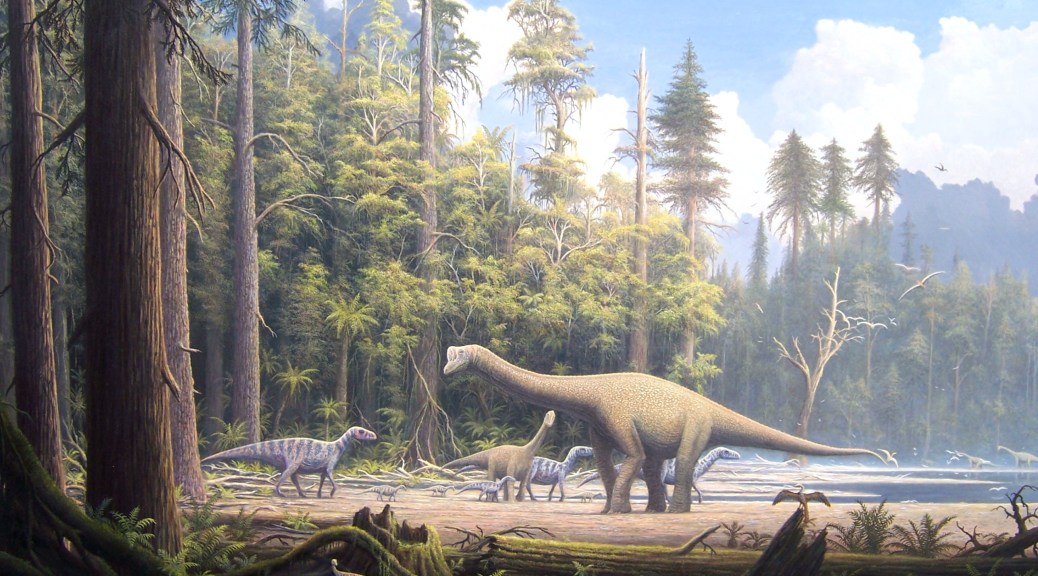
Europasaurus holgeri scene by PaleoGuy

A study published by the magazine Scientific Reports in which they are analyzed virtual reconstructions of sauropod dinosaurs points out that part of the evolutionary success that led them to be the largest animals that have ever stepped on Earth may have been due to a hip modification. This study, the result of the development of virtual paleontology, has been led by researchers from UNED, together with the Universidade de Lisboa and the Museo Paleontológico de Elche.

The sauropods they are one of the most popular groups of dinosaurs. They were the largest animals to have walked the earth, and the conditions that enabled them to achieve enormous evolutionary success during the Mesozoic are a recurring theme in paleontological research.

The hip of sauropod dinosaurs

A study of Evolutionary Biology Group of the UNED (GBE), lead by Daniel Vidal, researcher at UNED, together with the paleontologist at UNED, Francisco OrtegaPedro Mocho from the Universidade de Lisboa; José Luis Sanz of the Royal Academy of Sciences; and Ainara Aberasturi, director of the Elche Paleontological Museum; Published in Scientific Reports magazine, it reveals a character that could have been a key innovation in the evolution of the group.

Sauropod dinosaurs were gigantic animals, quadrupeds, with a long tail and a small skull at the end of an also long neck. The description of new species of sauropods has revealed an enormous versatility in their feeding capacities that allowed them to exploit from the vegetation at ground level to the leaves located several meters high in the treetops. The study of these capacities is not easy from the skeletons preserved as fossils. However, the enormous development that the virtual paleontology It has allowed a new approach through the analysis of virtual models of these animals.

Study with a preserved dinosaur in Elche

In this study the skeleton, about 13 meters long, of the sauropod is used as a base Spinophorosaurus nigerensis. This dinosaur is temporarily deposited in the Paleontological Museum of Elche for study and was excavated in 2007 in Niger, in the context of the PALDES (Paleontology and Development) project. This specimen from the Middle Jurassic (about 170 million years ago) is one of the most complete and best preserved primitive sauropods known. Using advanced digitizing techniques, They were obtained three-dimensional models very high resolution of each of the more than 200 bones of the skeleton. From these models a virtual recreation of the animal, applying a series of methodological principles that minimize any preconceived notion.

Surprisingly, the virtually reconstructed animal is very different than expected. Instead of having a horizontal spine, the torso and neck are much higher than in previous reconstructions due to the morphology of the sacral vertebrae. These vertebrae, instead of having a rectangular arrangement, have a wedge of up to 20 degrees that elevates the vertebrae of the tail and those of the back and neck. In Spinophorosaurus this wedging is accompanied by long arms and a flexible neck that would allow it to feed on vegetation more than 7 meters high, positioning the neck as current giraffes do.

A key innovation in its evolutionary development

When comparing the sacrum of Spinophorosaurus with that of other sauropods, it was observed that most presented also minted sacred. Only those more primitive sauropods had rectangular profile sacs. This indicates that the wedging of the sacrum appeared early in the evolutionary history of these animals, and could represent a key innovation in their evolutionary success that had been largely unnoticed until now..

The first sauropods with rectangular sacros would have had the capacity to feed on medium-sized vegetation. However, the sauropods with a wedged sacrum acquired the ability to take advantage of the higher vegetation, a capacity that would be inherited by all their descendants. In the evolutionary history of sauropods until their extinction 66 million years ago, the sacrum never lost its wedging, so those species that evolved towards a smaller-sized feeding had to modulate the position of their head through changes in length. relative of his arms.

Source: www.explica.co/

Jurassic World 3 Set Photo Teases Dinosaurs In Snow

Tuesday, April 21, 2020

Director Colin Trevorrow posts a behind the scenes photo from the Jurassic World: Dominion set, teasing the possibility of dinosaurs in the snow.

Director Colin Trevorrow has posted a behind the scenes photo from the Jurassic World: Dominion set, teasing the possibility of dinosaurs in the snow. Like every other ongoing movie production in Hollywood, the Jurassic World sequel is currently on-hold due to the coronavirus pandemic and, because of this, may struggle to make its tentative release date. It won't be for lack of trying, though, as Trevorrow has confirmed he's working on the film from home during the shutdown.

The conclusion to the Jurassic World trilogy, Dominion sees Trevorrow return to the director's chair after J.A. Bayona replaced him at the helm on 2018's Jurassic World: Fallen Kingdom (which Trevorrow still co-wrote and produced). In addition to tying up plot threads from the previous two movies, Dominion aims to further bridge the gap between these films and the Jurassic Park trilogy by bringing back Sam Neill, Jeff Goldblum, and Laura Dern in their roles as Alan Grant, Ian Malcolm, and Ellie Sattler. This will actually be Goldblum's second go-round with the Jurassic World trilogy at that, following his brief appearance at the beginning and end of Fallen Kingdom.

Among the many other characters returning for Jurassic World: Dominion are Maisie Lockwood (Isabella Sermon), the granddaughter of the late Sir Benjamin Lockwood - though she's really a clone of his daughter - who was rescued and essentially adopted by series leads Owen (Chris Pratt) and Claire (Bryce Dallas Howard) towards the end of Fallen Kingdom. Trevorrow recently teased her return in the film by tweeting a BTS photo from the Dominion set, showing him shooting a scene with Sermon.

More intriguingly (since it was a given Sermon would return), this photo suggests Dominion will be the first Jurassic movie to feature dinosaurs in the snow. Since Fallen Kingdom ended with the surviving dinosaurs from Isla Nublar being set free in the world, it stands to reason this new film will show the creatures living in all sorts of different environments, this snowy landscape included. The second Jurassic World movie offered an exciting taste of just that in both its final minutes and credits scene, showing dinosaurs popping up everywhere from a zoo to the beach and even Las Vegas. in Jurassic World canon, carnivorous dinosaurs are warm-blooded and herbivores are cold-blooded, so wintery conditions alone might not be enough to protect people from becoming a dino-snack in Dominion.

After Jurassic World kept its action contained to Isla Nublar and nearly half of Fallen Kingdom took place in Lockwood Manor, the hope is Dominion will take advance of its open-world premise to deliver a experience unlike anything in the Jurassic franchise so far. Last year's short film Battle at Big Rock, which Trevorrow directed, provided a sneak peek at what life is like for humans post-Fallen Kingdom, and the results bode well for the trilogy finale. At the very least, here's hoping we get to see Blue the Velociraptor make a snowman with Owen, Claire, and Maisie. (Okay, probably not, but no harm in dreaming, right?)

Source: https://screenrant.com/

Family Creates Dinosaur Sculptures During Coronavirus Social Distancing

Saturday, April 18, 2020

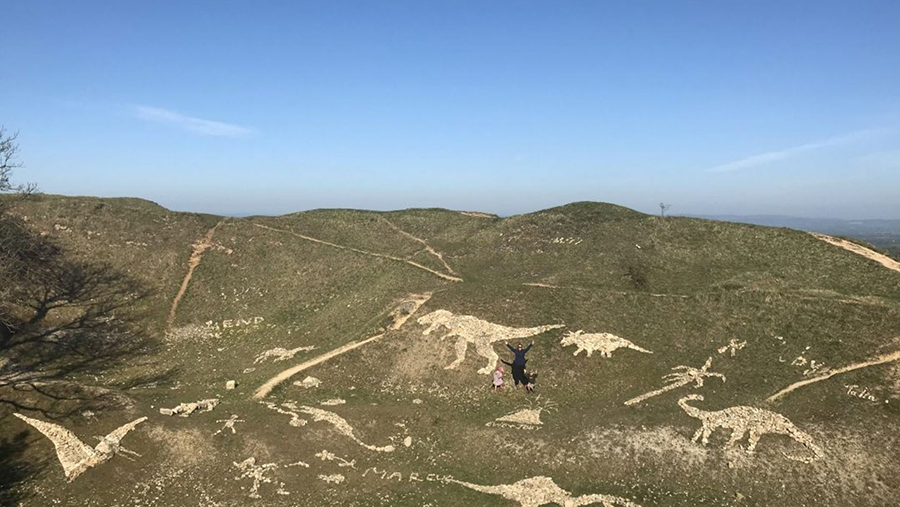
The Booker family have been spending their time in isolation creating amazing dinosaur designs - using loose rocks in a disused quarry near Stroud, Gloucestershire. (Credit: SWNS)

It's an art show 65-million-years in the making.

The coronavirus pandemic has resulted in social distancing measures in nearly every part of the world, causing people to look for new and unusual forms of enjoyment. One family has taken their time in isolation to new heights, creating dinosaurs made out of rocks from an abandoned quarry, British news agency SWNS reports.

The Booker family — James, Emily and their two children, Thomas and Olivia — have created several rock portraits, including a Tyrannosaurus rex, Triceratops and a Velociraptor, near an old quarry in Stroud, Gloucestershire, England. The Bookers initially created the designs as a way of saying thank you to the health workers who aided with Thomas' epilepsy.

"It's something to give back for all the care and generosity Thomas had," 42-year-old James said. "The nurses that he had in hospital were fantastic - they bent over backwards to make sure he was never bored."

The idea was born when James took the children to the quarry.

(L-R) Olivia, James, Emily, and Thomas Booker. (Credit: SWNS)

"We went to the quarry and just started building structures out of rocks," James added. "I was with the kids and did an outline of Thomas. He wanted to be holding some sticks, or a bow and arrow. I said: 'What about a Velociraptor chasing you?'. So I spent a couple of trips up doing that and refining it."

James said the other dinosaurs came as Emily, 35, dealt with the children.

"She was using that time constructively and creatively with Thomas and Olivia, doing bug hunting, fossil collecting and nature discussions," he explained. "But after a while she got bored of me going back and forth so she said: 'Why don't you do something epic?'"

 The impressive gallery was produced using random pieces of stone and is meant as a thank you to health workers who helped the family deal with Thomas' epilepsy. A T. rex, a Triceratops and a Velociraptor are among the designs laid out by the Bookers at the spot near Stroud, Glos. (Credit: SWNS)

The largest structure, which is Thomas' favorite, is the T. rex, which measures approximately 20 feet long.

Even amid social distancing, James said it's become a conversation starter with other people, some of whom have filled in the outlines.

"I thought: 'If it's making people stop and giving them happiness, what's next?' It's been a conversation starter with random people - even with social distancing," he continued. "I don't know anyone who doesn't like dinosaurs."

Dinosaurs were wiped out 65 million years ago by an asteroid that hit Earth in what is now the Yucatan Peninsula in Mexico, along with nearly 75 percent of all species on the planet.

The asteroid may have also acidified Earth's oceans after its impact, according to a study published in October 2019. Another study published in September 2019 compared the impact of the asteroid to the power of 10 billion atomic bombs.

Source: www.foxnews.com/

15 Things You Never Knew About The Jurassic Park Films

Sunday, April 19, 2020

After all these years, Jurassic Park is still one of the scariest adventures in movie history.

The human fascination for dinosaurs is practically universal. As science fiction writer Seth Dickinson explains, these creatures are “the first sense we get that Earth is really, really old, that there were all these things that happened in deep history that we’ll never fully understand.” On the other hand, for author Genevieve Valentine, dinosaurs interest us because they are creatures who ended up meeting a tragic end. Valentine told Wired, “If a dinosaur exists there’s the inherent tragedy of knowing that either we are somewhere we shouldn’t be or it is somewhere it shouldn’t be.”

Well, regardless of why you are curious about dinosaurs, no one can deny that the ‘Jurassic Park’ film franchise has been a big box office hit from the beginning. And here are some behind-the-scenes secrets that you may want to know about:

15 - Dr. Alan Grant Was Based On A Real Paleontologist Who Consulted On The Film

While speaking with The Huffington Post, Dr. Horner revealed, “My job was really just to sit next to Steven [Spielberg] and answer questions for him.” It also just so happens that he is also working on a hybrid dinosaur, just like in the film. He confirmed, “We’ve got an actual project on the way to do this sort of thing.”

14 - In Part, Laura Dern Agreed To Do The Film Because Nicolas Cage Convinced Her

Dern recalled, “I said to him, ‘Nic, they want to put me on the phone with Steven Spielberg, but they want to talk to me about a dinosaur movie…’ And he was like, ‘You are doing a dinosaur movie! No one can ever say no to a dinosaur movie!’ She later added, “So he was such an influence on me.”

13 - Jim Carrey Auditioned For Jeff Goldblum’s Role

Casting director Janet Hirshenson explained, “I read the book and I thought of Jeff Goldblum right away. There were several other people we taped for the part, though. Jim Carrey had come in and he was terrific, too, but I think pretty quickly we all loved the idea of Jeff.”

12 - Sam Neill Landed The Role Of Dr. Alan Grant Without Having Read The Book

Neill revealed, “So I went to Canada and two days later, I had the part. And three or four weeks after that we started shooting in Hawaii. So it all happened real quick. I hadn’t read the book, knew nothing about it, hadn’t heard anything about it, and in a matter of weeks I’m working with Spielberg.”

11 - Ariana Richards Landed The Role Of Lex After Her Screams Woke Up Steven Spielberg’s Wife And Sent Her Running

Richards recalled, “I was called into a casting office, and they just wanted me to scream. I heard later on that Steven had watched a few girls on tape that day, and I was the only one who ended up waking his sleeping wife off the couch.” She also ran through the hallway to check on her kids.

10 - The Raptor Sounds Were Developed Using A Combination Of Different Animals, Including A Walrus And A Male Dolphin

Sound designer Gary Rydstrom explained, “The raptor is probably made up of bits and pieces of 20 or 30 ­different animals, to make a vocabulary.” He later added, “But the main attack scream is a combination of a ­walrus, for the low ­frequency, and then the higher-frequency range was a boy dolphin pining for a female.”

9 - In The Famous Kitchen Scene, The Raptors Were Supposed To Wave Forked Tongues Until Dr. Horner Objected

Dr. Horner recalled, “They were going to have raptors coming in there waving their forked tongues around. We know they didn’t have forked tongues, so I took that out. Instead, they snort and fog up the window.” He also pointed out, “We’ve taken them from being very reptilian to being warm-blooded.”

8 - While Most Dinos Were Animatronic, The Raptors Were Real People

Dr. Horner revealed, “The raptors, rather than being animatronic, are people.” He further explained, “They’re actors that are moving around, and then they lay the actual image of the Velociraptors over the top of these people, so there actually are people for the actors to act against.” We’re pretty sure these people studied closely how raptors moved too.

7 - While Shooting Scenes With Dinosaurs, Actors Were Actually Looking At A Simple Paper With A Marked X

Dern recalled, “‘There’s a piece of paper up there in the tree and it has an X on it. Just stare at that. That’s a brachiosaurus.’ And we were all like, ‘Okay… is there still going to be an X when they see the movie, or are you going to put something else in?’”

6 - The Movie’s Last Day Of Filming In Hawaii Was Disrupted By A Hurricane

Spielberg recalled, “I turned on the TV. There was an animation of the Hawaiian island chain. The island we were on, Kauai, was outlined in red and there was a big arrow pointing to it, and then there was the icon of a cyclonic hurricane moving directly towards us. It was like a movie.”

5 - Feathers Were Purposely Left Off The Dinosaurs To Make Them Look Scarier

Dr. Horner explained the decision to go with this inaccuracy saying, “We didn’t make them colorful like they are, and we didn’t make them feathery because they’re scarier when they’re not.” He also remarked, “Just keep in mind that it’s a fictional film and not a documentary. So it is what it is.”

4 - A Hydraulic-Powered T. Rex Would Malfunction In The Rain, Scaring Everyone On Set

Producer Kathleen Kennedy recalled, “The T. Rex went into the heebie-jeebies sometimes. Scared the crap out of us. We’d be, like, eating lunch, and all of a sudden, a T. Rex would come alive. At first, we didn’t know what was happening, and then we realized it was the rain. You’d hear people start screaming.”

3 - While Making Jurassic World: Fallen Kingdom, J.A. Bayona Would Scare The Actors By Playing Dinosaur Roars

Chris Pratt told Slash Film, “J.A. uses that a lot and he uses it for jump scares. He has this whole playlist that’s always wired in, including a T-Rex roaring. He added, “He loves to manipulate us in that way, which is really helpful as an actor. He’ll scare us out of nowhere or do something unexpected.”

2 - The Dinosaur Supervisor Insisted That Animators On The Film Take Six Weeks Of Mime Classes

The classes helped them understand how a dinosaur moves. Tippett explained, “It’s very helpful physically. When you act it out, you internalize it. You can feel it a different way.” Spielberg also remarked, “Phil gave all the dinosaurs personalities and real characteristics based on his experience with the animal kingdom and the natural world.”

1 - There Were A Lot Of Directors Interested Originally, But Spielberg Won Thanks To His Friendship With Michael Crichton (The Original Author)

The film is based on a book written by Michael Crichton and Entertainment Weekly reported, “According to Spielberg, other interested directors may have included ­Richard Donner (Lethal Weapon) and James Cameron (Avatar). Universal won the bidding war, thanks in large part to Spielberg’s relationship with Crichton.” Sadly, Crichton passed away in 2008 due to cancer.

Source: www.thethings.com/

Pages